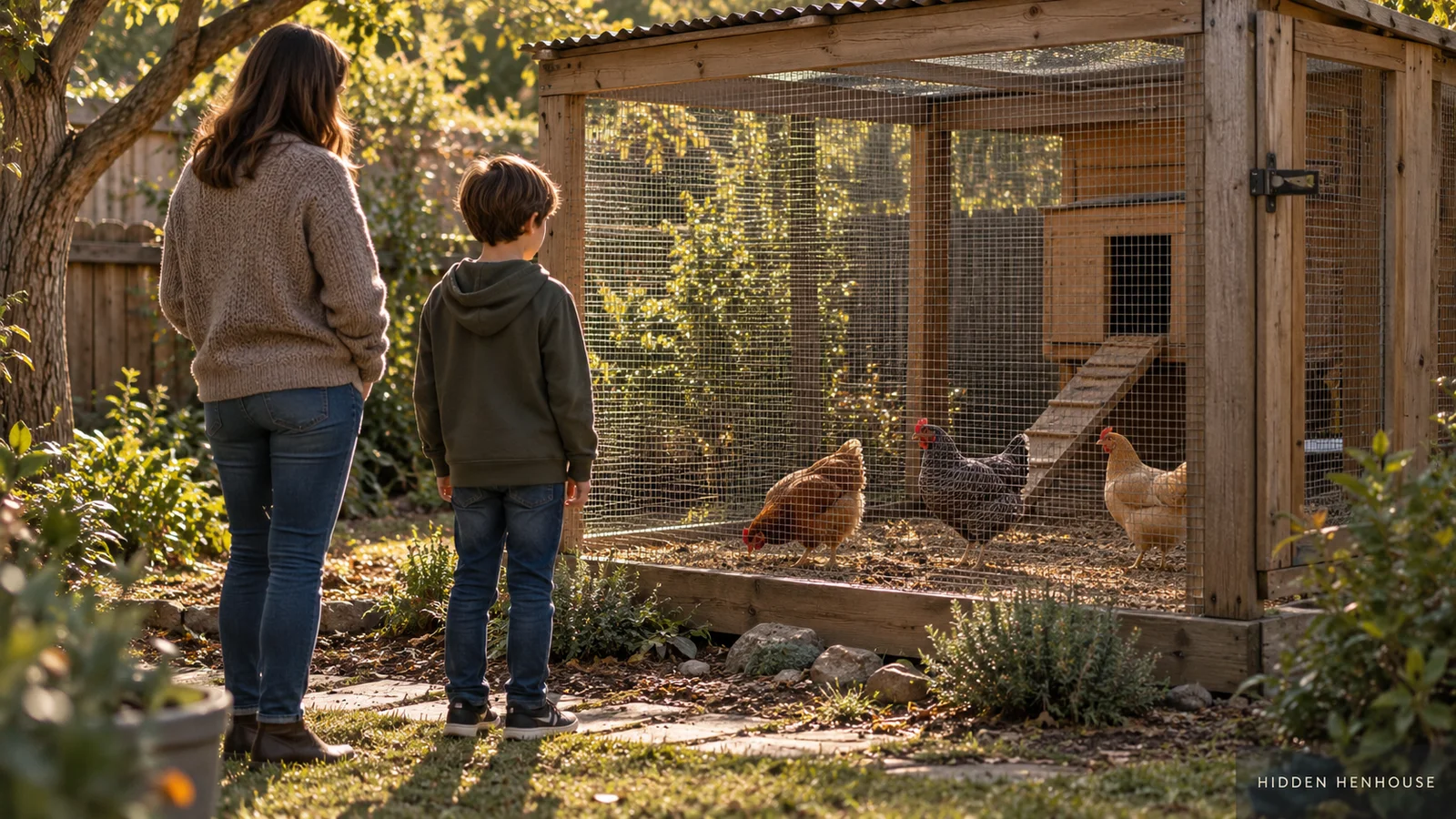

Backyard chickens for kids can turn an ordinary chore into a useful conversation about animals, food and keeping a promise. They also bring germs, pecks, messy equipment and work that continues when a child loses interest. A family flock needs an adult owner, even when children are enthusiastic helpers.
Start with the safety boundary: children younger than five should not handle poultry or spend time in the areas where poultry live and roam. Older children can participate with supervision, suitable tasks and careful handwashing. A friendly hen does not remove those precautions.
GUIDED ARTICLE EXPERIENCE
Raising Chickens With Kids: Responsibility, Learning & Safety
Read along as the narration moves through the article.
Private device narration · No hosted audio or tracking
CONTINUE GUIDED TOUR
Continue where you left off.
GUIDED TOUR COMPLETE
You have reached the end of this study.
Study record saved on this device.
GUIDED TOUR
Raising Chickens With Kids: Responsibility, Learning & Safety
Narrator: Paranoid Prophet Recommended Voice Native device narration
Prepare to follow the article as it is narrated.
VOICE & TOUR OPTIONS
Voice & Listening
NARRATOR
Finding a narrator…
Checking the best narrator available on this device.
Restores the best curated narrator available on this device.
Narrator choices are curated for clear, long-form listening on this device.
Screen-awake support will be checked when narration starts.
CHOOSE A NARRATOR
Curated for this device
Choose a verified narrator for this browser, or use System Narrator. Automatic mode uses the best reliable route exposed by this device; your chosen narrator is preserved even if this device needs a temporary fallback.
Preparing the guided article experience…
RESUME GUIDED TOUR?
Continue where you left off.
GUIDED TOUR COMPLETE
You have reached the end of this study.
Updated October 5, 2026. Reviewed against CDC backyard-poultry guidance, including its September 24, 2026 update. Household task suggestions below are our editorial recommendations, not official chore-age rules.
Article Guide8 sections
Safety comes before the family project
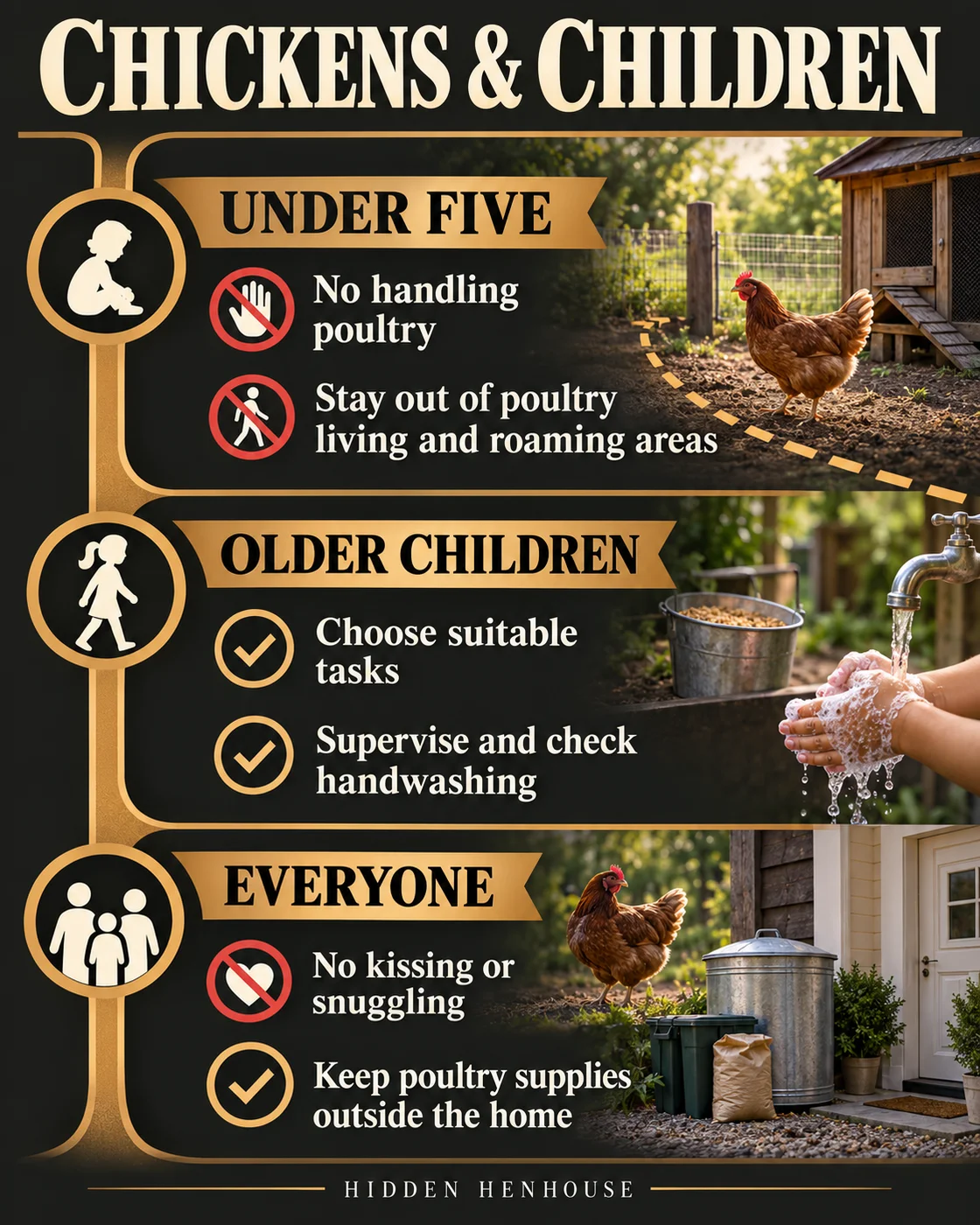
The CDC’s current backyard-poultry guidance includes both direct contact and the environment: under-fives should neither handle birds nor spend time where they live and roam. Chicks and ducklings count too. If chickens free-range across the whole yard, that yard cannot also serve as an under-five poultry-free play space.
For a younger child, plan learning away from the birds and their equipment: look at pictures, draw a hen, or watch from a separate clean area outside the flock’s living and roaming space. An adult can record the egg count and let the child chart the numbers indoors. Do not turn egg collection, carrying the feeder or tossing scraps into a preschool activity.
CDC explains that healthy-looking poultry can carry harmful germs. Clean feathers, a tidy coop and a calm temperament are not proof that contact is safe. Adults 65 and older and people with weakened immune systems also face greater risk; individual health concerns belong with a healthcare professional.
- Supervise older children: stay close enough to stop unsafe behavior and check handwashing afterward.
- Wash with soap and running water after poultry contact: include eggs, feeders, waterers and the birds’ environment. Use sanitizer when soap and water are unavailable, then return to proper washing when possible.
- No kissing or snuggling birds: keep them away from faces, and keep food and drinks out of poultry areas.
- Keep birds and their equipment outside the home: clean poultry supplies outdoors and keep dedicated coop footwear outside.
These precautions reduce risk; they do not make a flock germ-free. Eggs also need safe handling. Adults should discard cracked eggs, refrigerate collected eggs and cook them thoroughly. CDC recommends firm yolks and whites and 160°F for egg dishes. Keep the detailed egg-handling guidance available rather than relying on a child’s memory.
Choose chores by ability and supervision
A fifth birthday is not automatic permission to carry a heavy waterer, catch a bird or clean a coop. Extension’s agricultural child-safety guidance emphasizes matching work to the child and the hazards, with instruction and supervision. General farm-task advice does not override the poultry-specific under-five restriction.
Our practical recommendation: begin with a short task that an adult can demonstrate, watch and finish. Ask whether the child can follow directions, keep hands away from the mouth, recognize when to stop, and complete handwashing without cutting corners. If any answer is no, choose observation or recordkeeping instead.
Observation and records
From an appropriate poultry-free place, a child can note which birds are active, sketch feather patterns or write down the egg numbers an adult supplies. Keep notebooks and pencils clean; they should not become coop equipment that later travels to the kitchen table.
Supervised routine work for capable older children
Possible tasks include checking the flock with an adult, measuring an adult-approved portion of complete feed, or collecting eggs together. The adult checks the result: water must actually be available, feed must be correct, and a gate must actually latch. A chore chart records participation; it does not replace inspection.
Use a clear stopping rule. A bird that struggles, a spilled container, an open gate or an unfamiliar problem means “call the adult,” not “figure it out alone.” Do not require picking up hens as proof that a child cares about them. Calm observation is worthwhile animal care.
Work we would keep with adults
For an ordinary family setup, our conservative recommendation is that adults handle manure-heavy cleaning, disinfectants, sharp or powered tools, sick or injured birds, pest treatment and veterinary decisions. These jobs bring different hazards from counting eggs. Older teens may learn more with appropriate training, but this guide does not certify readiness for hazardous work.
What children can learn—and what chickens cannot promise
The Wisconsin Extension 4-H poultry project includes bird identification, feeding, feed-label reading, egg formation and flock management. That gives families a credible starting point for learning. It does not show that buying chickens guarantees empathy, better attention, stronger character or happier relationships.
Try one question at a time rather than turning every visit into a lesson. “Why was today’s egg count different?” can lead to a simple chart. “What does the feed label say?” can introduce the difference between an animal’s nutritional needs and a treat. Sketching the same hen on different days encourages careful looking without needing to touch her.
Budgeting is another useful exercise. An older child can divide a feed receipt by the number of pounds purchased, then compare the result with another bag size. An adult should explain what the calculation leaves out: storage, waste, travel and whether the feeds are actually comparable. Our cost-of-raising-chickens guide provides reusable formulas rather than promises of cheap eggs.
Responsibility develops through what the family actually does. Show the child that feeding still happens in bad weather and that someone covers the flock during a trip. If enthusiasm fades, the hens still need care. An adult taking over promptly teaches more than leaving an animal short of water to make a point.
Pick the flock for your household, not a “kid-safe” label
Breed descriptions can help narrow choices, but temperament is a tendency, not a guarantee. Individual birds differ, and even an unaggressive hen can peck or scratch. No breed makes toddler handling acceptable. Avoid buying a bird because a seller describes it as a perfect pet for small children.
Use our beginner breed guide to compare priorities such as size, climate fit and egg production. Then consider the individual birds, your enclosure and the adult’s experience. A family that mainly wants eggs and observation does not need to add the management demands of a rooster.
Before choosing a flock, settle the adult questions: local permission, predator protection, space, veterinary access, budget, holiday cover and a separate poultry-free area where needed. The starting-flock guide helps match numbers to the yard and household. Adding birds rarely makes a care plan simpler.
Children should not invent diets from whatever is available. Adults choose the appropriate complete feed and control extras. See what not to feed chickens for poultry feeding safety; that guide concerns the birds’ diet and does not replace CDC’s human-health advice.
Build a routine that survives a busy week
Keep the plan small enough to use. One supervised visit, one observation and one reliable hygiene routine beat a complicated chart nobody checks. Decide who has final responsibility each morning and evening, and name the backup adult before a trip or an illness interrupts the routine.
Shared chores may give a family time to talk, but they can also cause arguments. Leave room for a child who enjoys watching and dislikes handling, or who wants to help only occasionally. Children do not owe a flock constant enthusiasm; the adults who bought the animals owe it consistent care.
For a Christian household, Proverbs 12:10 offers a fitting reflection on caring for animals. Stewardship here is practical: meet their needs, respect their limits and protect people as well. The verse supports that moral reflection, not a medical claim about poultry safety.
Questions families ask
Can a toddler collect eggs without touching the chickens?
Do not use that workaround. That restriction covers the area, so avoiding direct bird contact is not enough. Adults can collect and handle the eggs, then provide numbers for a clean indoor counting activity.
Can an older child hold a hen?
Sometimes, with an adult assessing the child and bird and supervising closely. Handling is optional, not a learning requirement. Keep the bird away from the face, stop if either becomes distressed, and follow the hygiene routine. A calm breed description is not a safety clearance.
Is a clean coop enough to prevent illness?
No. Cleanliness matters, but healthy-looking birds can still carry germs. Keep the age boundary and hygiene precautions even when the enclosure looks immaculate.
Should we buy chickens to teach responsibility?
Only if an adult genuinely wants and can maintain the flock. Children can practice responsibility through suitable participation, but chickens are a long-term animal-care commitment rather than a guaranteed parenting tool.
Sources and review notes
- CDC: Salmonella and backyard poultry, reviewed September 24, 2026—current age and hygiene boundaries.
- CDC: Backyard Poultry, July 18, 2025—human-health risks, eggs and poultry care.
- Extension FReSH: age-appropriate agricultural tasks—general task-selection framework, not permission to disregard CDC poultry restrictions.
- University of Wisconsin Extension: 4-H poultry project—educational activities, not proof of developmental guarantees.
No material disagreement was found in the reviewed sources about the current poultry safety boundary. Older or broader farm-task advice should be read in its own context. This article contains household recommendations; it does not claim firsthand child-development results or replace individualized medical advice.
A useful family project starts with adult responsibility
Give children a chance to notice, ask questions and help where they can do so appropriately. Keep younger children outside poultry areas, make supervision real, and cover the chores when interest wanes. The hens do not need a perfect family lesson. They need dependable care, every day.