
GUIDED ARTICLE EXPERIENCE
Genesis Creation and Time: What Scripture and Science Can—and Cannot—Say
Read along as the narration moves through the article.
Private device narration · No hosted audio or tracking
CONTINUE GUIDED TOUR
Continue where you left off.
GUIDED TOUR COMPLETE
You have reached the end of this study.
Study record saved on this device.
GUIDED TOUR
Genesis Creation and Time: What Scripture and Science Can—and Cannot—Say
Narrator: Paranoid Prophet Recommended Voice Native device narration
Prepare to follow the article as it is narrated.
VOICE & TOUR OPTIONS
Voice & Listening
NARRATOR
Finding a narrator…
Checking the best narrator available on this device.
Restores the best curated narrator available on this device.
Narrator choices are curated for clear, long-form listening on this device.
Screen-awake support will be checked when narration starts.
CHOOSE A NARRATOR
Curated for this device
Choose a verified narrator for this browser, or use System Narrator. Automatic mode uses the best reliable route exposed by this device; your chosen narrator is preserved even if this device needs a temporary fallback.
Preparing the guided article experience…
RESUME GUIDED TOUR?
Continue where you left off.
GUIDED TOUR COMPLETE
You have reached the end of this study.
Genesis opens with one of the most consequential claims ever made: “In the beginning, God created the heavens and the earth.” Genesis 1:1 does not begin with matter explaining itself, time producing itself, or the universe emerging as its own ultimate cause. It begins with God.
That claim still confronts modern readers. We live in an age of telescopes, particle physics, cosmic background radiation, relativity, and enormous questions about the universe’s beginning and history. Science can investigate the physical world in breathtaking detail. It can measure light, gravity, expansion, radiation, motion, and time. But it cannot answer every question Genesis raises.
Genesis asks who created, why creation is ordered, what human beings are for, why the world is good yet broken, and to whom all things belong. Those are not small questions. They shape how we understand matter, life, work, worship, human dignity, death, and hope.
This article explores Genesis creation and time without forcing Scripture into a modern science textbook or turning modern scientific models into proof texts for Genesis. Christians can receive real scientific discoveries with gratitude. They can also admit that Genesis 1 contains interpretive questions faithful believers have debated for centuries.
The goal is not to make the Bible sound less miraculous so that it feels more acceptable to modern assumptions. Nor is it to make science say more than the evidence allows. The goal is to read both truthfully: Scripture as God’s authoritative revelation, and creation as the work of the God Scripture reveals.
For the wider biblical foundation of God’s identity, character, and self-revelation, see Who Is God? The Biblical Answer Revealed in Jesus Christ.
Article Guide9 sections
Genesis Creation and Time: The Short Answer
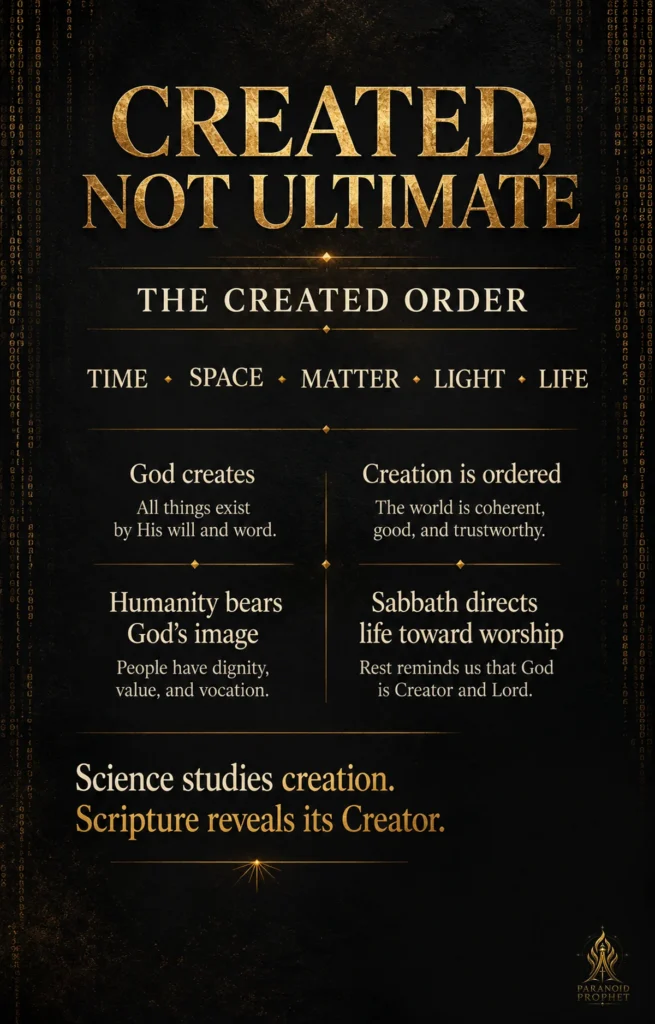
Genesis teaches that the one true God created heaven and earth, brought order to what He made, declared His work good, gave humanity a unique calling, and set apart the seventh day as holy.
That means time, space, matter, light, land, sea, stars, living creatures, and human life are not ultimate realities. They belong to the created order. They depend on God rather than existing independently beside Him.
Genesis reveals the Creator of time and creation. Science can investigate the physical universe God made, but it cannot prove Genesis, settle every question about its days, or turn a proposed reconciliation model into required Christian doctrine.
This distinction matters. Christians do not need to fear scientific investigation, because all truth belongs to God. But neither should they treat a modern cosmological model, a theory about time dilation, or a proposed explanation for distant starlight as though it carries the authority of Scripture.
Genesis 1 is not silent about reality. It tells us that creation is not eternal, accidental, divine, ownerless, or meaningless. It tells us that the world is ordered by God’s word, that human beings bear His image, and that worship and rest belong within the pattern of a rightly ordered life.
At the same time, Genesis does not answer every modern question in the vocabulary of physics, astronomy, geology, or biology. It does not use the categories of cosmic inflation, general relativity, microwave background radiation, or atomic clocks. That does not make Genesis less true. It means readers must be careful not to demand from the text what it was not written to provide.
Some Christians read the days of Genesis 1 as six ordinary days. Others understand the days as analogical, literary, or extended periods. Those differences matter, and this article will address them directly. But Christians should not lose the truths Genesis makes plain while debating the questions it leaves open.
How This Article Weighs Scripture and Science
Scripture is the final authority for what Christians confess about God, creation, humanity, sin, redemption, and hope. Scientific investigation can help us understand the physical world God made. Biblical scholarship can clarify language, literary structure, historical context, and major interpretive arguments. Apologetic models can suggest possible ways Christians have tried to relate Scripture and scientific claims.
Those are not identical levels of authority.
This article will distinguish between what Genesis clearly teaches, what modern science can observe and model, what Christians debate in interpretation, and what remains a proposed reconciliation rather than an established conclusion. That discipline is not a weakness. It protects readers from having their faith attached to claims Scripture itself does not require them to defend.
What Genesis Clearly Teaches About Creation
God Is the Creator, Not Part of Creation
Genesis begins by placing God before and above everything that follows. Heaven and earth do not give birth to God. Light does not create Him. Time does not contain Him. The waters do not rival Him. He speaks, and creation responds.
This sharply separates biblical faith from the idea that the universe is divine, self-existing, or morally ultimate. The sun, moon, stars, sea, land, animals, and human beings are good gifts, but none of them is God.
That truth should produce humility. We do not own the universe simply because we can study it. We do not define reality simply because we can describe part of its physical behavior. Creation belongs to the One who made it.
Isaiah 40 later returns to this same vision of God’s unmatched greatness. The nations are not large enough to rival Him. The stars are not beyond His rule. The Creator does not grow weary, and His wisdom cannot be measured by creaturely standards.
Creation Is Ordered, Good, and Purposeful
Genesis 1 does not portray creation as chaotic matter barely held together by blind forces. God brings light and darkness, waters and sky, land and seas, vegetation and fruitfulness, creatures suited to their realms, and humanity placed within a world prepared for life.
The repeated pattern is deliberate: God speaks, what He commands comes to be, God sees that it is good, and creation moves toward greater fullness and order.
This does not mean Genesis gives a laboratory sequence for reconstructing every physical process in the history of the cosmos. It does mean that Scripture presents the world as intelligible because it is ordered by God. The universe is not meaningless noise. It has structure because it comes from the wisdom and will of its Creator.
That conviction gives scientific exploration a proper place. Christians can study creation because creation is not irrational. Yet the study of creation should lead beyond pride. The more we learn about the scale, complexity, and beauty of the world, the less reasonable it becomes to treat the Creator as a small idea inside it.
Humanity Bears God’s Image and Receives a Calling
Genesis reaches a distinct climax when God creates humanity in His image: “male and female he created them.” Genesis 1:26–28 gives human beings a dignity that no scientific measurement can create or remove.
To bear God’s image is not a license for exploitation. Humanity receives delegated authority under God, not autonomy from Him. We are called to exercise stewardship in a world that belongs to its Creator.
This is why Genesis matters far beyond debates about origins. It tells us why human life has worth before usefulness, strength, intelligence, wealth, or social status. It tells us why the natural world is not disposable. And it tells us why human power must remain accountable to God.
The Creation Week Moves Toward Sabbath
Genesis 1 does not end with the creation of humanity. It moves into Genesis 2:1–3, where God rests from His work, blesses the seventh day, and makes it holy.
God’s rest does not mean that He was exhausted. Scripture elsewhere makes clear that the Creator does not grow tired as creatures do. His rest marks the completion, goodness, and royal ordering of His work.
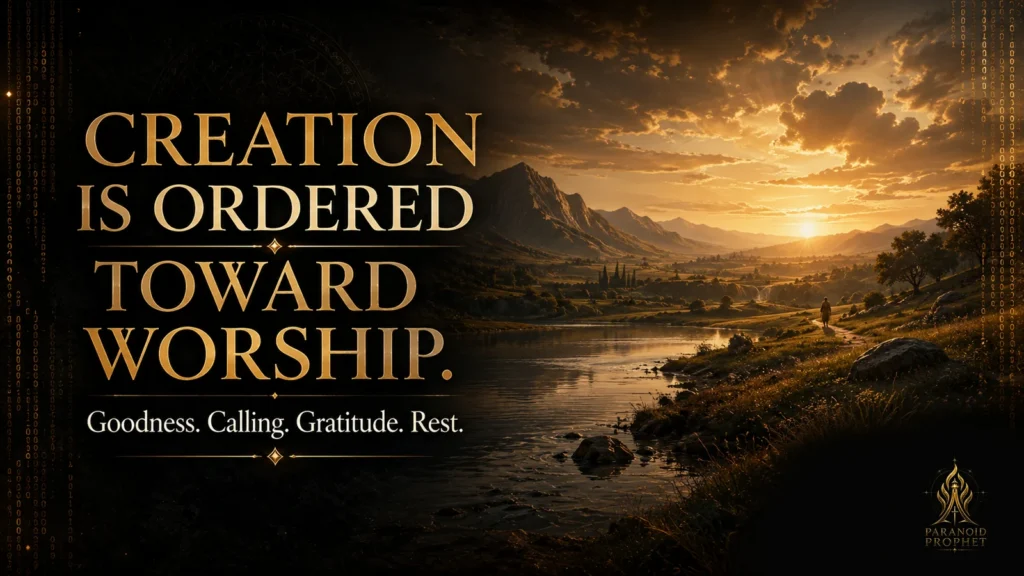
The seventh day matters because it shows that the goal of creation is not endless production. Creation is ordered toward communion, worship, gratitude, and rest before God. Exodus 20:8–11 later grounds Israel’s Sabbath rhythm in God’s work and rest in creation.
Every serious interpretation of Genesis 1 must take that pattern seriously. Whether readers conclude that the creation days are ordinary calendar days, analogical days, a literary framework, or something else, the text itself directs attention toward the Creator’s completed work and the holiness of Sabbath.
That brings us to the question readers often ask first: are the days of Genesis 1 meant to be ordinary twenty-four-hour days? The answer requires more than a slogan, a single Hebrew word, or an appeal to modern science.
Do the Days of Genesis 1 Mean 24-Hour Days?
This is one of the first questions readers bring to Genesis 1. Are the six days ordinary twenty-four-hour days? Do they represent longer periods? Are they arranged as a literary framework? Or are they God’s workdays, analogous to human workdays without being measured by a modern clock?
Faithful Christians have given different answers. The disagreement is real, and it affects how readers relate Genesis 1 to questions of chronology, cosmic history, and the age of the earth. But the debate should not be reduced to a simple choice between people who “take Genesis literally” and people who do not.
Every major Christian reading must reckon with the same features of the text: the repeated days, the language of evening and morning, the pattern of God’s speech and evaluation, the movement toward Sabbath, and the connection Exodus later draws between God’s work and Israel’s rest.
The question is not whether Genesis 1 is meaningful or authoritative. The question is what kind of temporal and literary claim its seven-day structure is making.
What Yom Can and Cannot Decide
The Hebrew word commonly translated “day” is yom. Like the English word day, it can carry more than one meaning depending on context.
Sometimes it refers to the daylight portion of a day, in contrast to night. Sometimes it refers to an ordinary day. In other settings, it can refer more broadly to a time, occasion, or period.
That range is important, but it does not settle Genesis 1 by itself.
A word does not determine its meaning apart from the sentence, structure, and context in which it appears. English speakers know this instinctively. “I had a hard day,” “back in my day,” and “the day after tomorrow” all use the same word differently. The surrounding language tells us how the word is functioning.
The same care is needed in Genesis. Christians should not argue that yom always means a literal twenty-four-hour day in every Hebrew context. Neither should they argue that its broader uses elsewhere automatically prove that the days of Genesis 1 are long ages or merely symbolic periods.
The word’s semantic range opens an interpretive question. It does not answer that question without further work.
Why Genesis 2:4 Does Not Settle Genesis 1
Genesis 2:4 is often introduced into this debate because it refers to “the day” when the Lord God made the earth and the heavens. Genesis 2:4 uses the Hebrew expression beyom, commonly translated “in the day that” or “when.” In that verse, the word looks back broadly over God’s creative work.
This shows that yom can be used in an idiomatic expression that refers to more than one ordinary day. That observation is worth making.
But Genesis 2:4 does not automatically tell readers how to interpret every day in Genesis 1.
The grammatical setting is different. Genesis 2:4 uses beyom as a broad temporal expression. Genesis 1 repeatedly presents a numbered sequence: first day, second day, third day, and so on. It also includes the repeated refrain that there was evening and there was morning.
That means Genesis 2:4 cannot function as a quick answer to the creation-days question. It prevents readers from making overly rigid claims about the Hebrew word yom, but it does not erase the contextual features that lead many Christians to understand Genesis 1 as describing ordinary days.
A careful reader should therefore avoid two shortcuts. The first says, “Yom can mean more than twenty-four hours, so Genesis 1 must describe long ages.” The second says, “Yom often means an ordinary day, so no other reading is worth considering.” Neither approach does justice to the whole passage.
Why Many Christians Read the Days as Ordinary Days
Many Christians conclude that Genesis 1 most naturally describes six ordinary days followed by an ordinary seventh day of rest. Their case does not rest on the Hebrew word yom in isolation.
They point first to the numbered sequence of days. Genesis 1 does not simply speak in broad, undefined periods. It moves deliberately from the first day through the sixth day, followed by the seventh-day Sabbath.
They also point to the repeated evening-and-morning formula. The refrain appears at the close of each of the first six days and gives the chapter a regular day-and-night rhythm. Genesis 1:3–5 begins by distinguishing light from darkness and naming them day and night, which many readers see as setting the ordinary temporal pattern for the chapter.
Perhaps most significantly, they point to the Sabbath command. Exodus 20:8–11 grounds Israel’s six days of labor and one day of rest in God’s six days of work and seventh-day rest in creation. For ordinary-day readers, that connection is not decorative. It strongly suggests that the creation week gives a real temporal pattern for human life.
This reading should never be dismissed as simplistic, anti-intellectual, or automatically hostile to science. It is a serious attempt to let the narrative sequence, repeated language, and Sabbath pattern carry their natural weight.
At the same time, ordinary-day readers differ among themselves about how Genesis relates to questions of geology, astronomy, biological history, death before the fall, distant starlight, and scientific dating. A commitment to ordinary days does not make every later scientific or apologetic conclusion automatic.
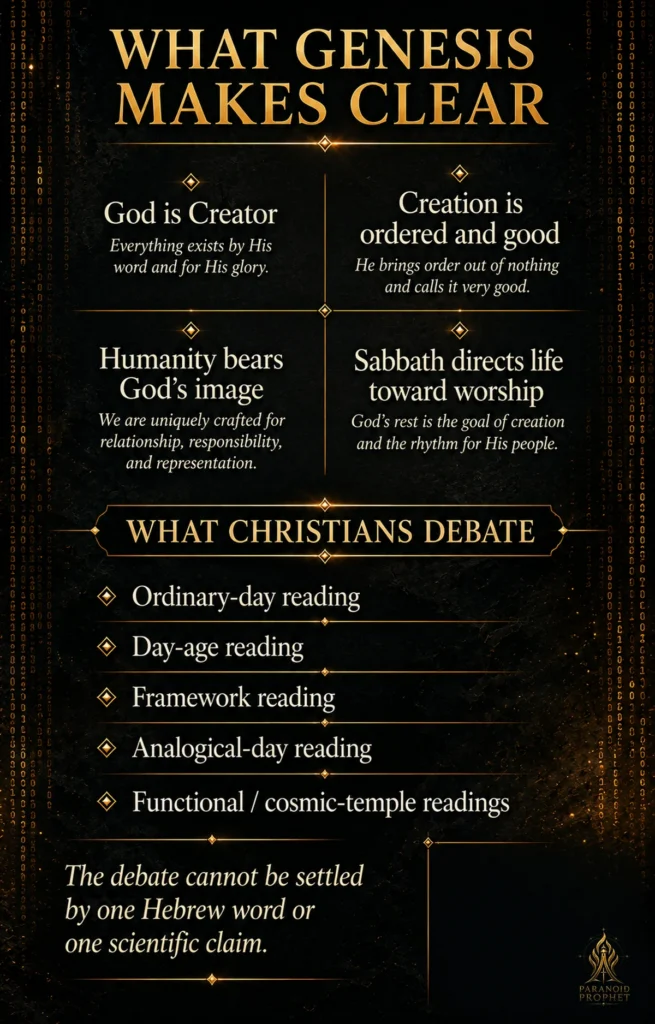
Major Christian Readings of the Creation Days
The ordinary-day reading is not the only view held by Christians committed to Scripture. The following approaches should be understood as serious interpretive families, not as labels for dismissing one another.
The ordinary-day or calendar-day reading understands the six creation days as ordinary days, followed by the seventh-day Sabbath. Its strongest arguments are the numbered days, evening-and-morning refrain, day-and-night language, and the Sabbath pattern of Exodus 20. Readers who hold this view usually believe Genesis 1 intends to communicate a real chronological sequence of God’s creative work.
The day-age reading understands the days as extended periods rather than ordinary twenty-four-hour days. Advocates often appeal to the broader semantic range of yom and seek to read Genesis alongside the immense timescales commonly proposed in modern scientific accounts of earth and cosmic history. Critics respond that the numbered days, evening-and-morning formula, and Exodus Sabbath pattern create substantial challenges for this view.
The framework reading emphasizes the literary architecture of Genesis 1. Many framework readers observe a pattern between days one through three and days four through six: light and luminaries; sky and sea with birds and fish; land and vegetation with animals and humanity. They argue that the chapter presents God’s creation in a carefully ordered theological structure rather than functioning primarily as a modern chronology. Critics answer that literary artistry and historical sequence are not mutually exclusive.
The analogical-day reading understands the creation days as God’s workdays, analogous to human workdays but not necessarily identical to twenty-four-hour periods. This approach takes the Sabbath pattern seriously while arguing that God’s work and rest should not be measured by creaturely clocks in a simple one-to-one way. Critics ask whether the day-and-night language of Genesis 1 still points more naturally toward ordinary days.
Functional and cosmic-temple readings place special emphasis on Genesis 1 as an account of God ordering creation for purpose, rule, worship, and human vocation. These readings often stress that the chapter is answering questions about who rules creation, what creation is for, and how humanity should live before God. Their advocates do not necessarily deny material creation or historical reality, but they argue that modern material chronology is not Genesis 1’s central concern.
These views are not interchangeable. They make different claims about the text, chronology, Sabbath, and the relationship between Genesis and scientific models. Christians should be honest about those differences rather than pretending every interpretation says the same thing.
Yet the debate should not cause readers to miss the truths shared across these approaches. God is the Creator. Creation is ordered and good. Humanity is accountable to God. The world is not self-made or self-owned. Sabbath directs creation toward worshipful rest. And Genesis 1 gives Christians a theological vision of reality that no scientific measurement can replace.
This hub will not attempt to settle every argument about the creation days. A dedicated article can examine the textual case for ordinary days, the strongest alternatives, and the points at which those views genuinely diverge.
For this article, the next question is different: even where science can describe the physical history of the universe, what can it actually prove about Genesis—and where must Christians refuse to force a modern cosmological model into the biblical text?
What Science Can Explore—and What It Cannot Prove About Genesis
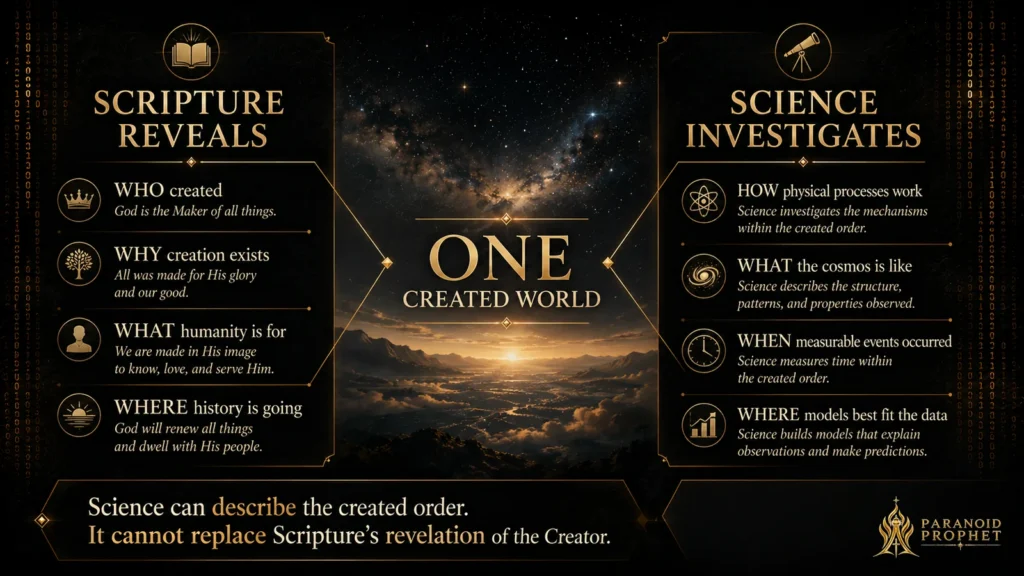
Genesis tells readers that the world depends on God. Science investigates the physical world that exists because God created it.
Those statements belong together, but they are not identical. Genesis speaks about the Creator, the goodness and order of creation, humanity’s calling, and the world’s relation to God. Science studies measurable features of the created order: matter, radiation, gravity, motion, stars, galaxies, biological systems, and the physical history of the universe.
Christians should not fear either truth. The physical world is not hostile to Scripture because it belongs to the God who speaks in Scripture. Yet Christians should also resist the temptation to make a scientific model carry theological weight it was never designed to bear.
Modern cosmology can describe aspects of the universe’s physical history. It can trace expansion, study ancient radiation, measure the motion of galaxies, and test how gravity and light behave. It cannot tell us by measurement alone why anything exists, why creation is good, why human beings bear dignity, or what the Creator intends for His world.
Those are not gaps that science has failed to fill. They are questions of a different kind.
Genesis is not less true because it does not use the vocabulary of astronomy or physics. Modern cosmology is not automatically hostile to Scripture because it uses mathematical models and observational data. The challenge is to let both speak within their proper boundaries rather than forcing either one to become something it is not.
The Big Bang and Genesis 1
The phrase Big Bang is often used loosely. In modern cosmology, it refers to the early history of an expanding universe that was once far hotter and denser than it is today. Scientists study evidence related to expansion, early particle formation, radiation, the development of galaxies, and the large-scale structure of the cosmos.
NASA’s overview of the universe describes a physical history that includes a proposed period of cosmic inflation, an early hot and expanding state, later cooling, the formation of atoms, and the eventual development of stars and galaxies. It also acknowledges that important questions remain unresolved, including what preceded inflation or what powered it. NASA’s cosmology overview is a useful reminder that modern science can describe extraordinary features of the universe without claiming to have answered why the universe exists at all.
Christians may rightly find that picture awe-inspiring. A universe with a real physical history, enormous scale, order, and measurable development does not make the Creator unnecessary. It can deepen the sense of wonder that Genesis already creates.
But Genesis 1 should not be turned into a technical description of the Big Bang.
When Genesis says, “Let there be light,” it reveals God’s sovereign command over creation. Genesis 1:3–5 does not provide a modern astrophysical account of early radiation, cosmic expansion, or particle physics. The passage is not incomplete because it does not use those categories. It is answering a different question: Who brings light, order, and life into the world? The answer is God.
There may be points of theological resonance between Genesis and the scientific discovery that the universe has a history rather than standing as an unexplained eternal reality. Yet resonance is not proof. Christians should not say that the Big Bang proves Genesis, that Genesis predicted modern cosmology, or that a scientific theory has finally decoded the days of creation.
The wiser claim is simpler and stronger: modern cosmology studies the physical universe with real sophistication, while Genesis reveals that the universe is not self-made, self-explaining, or independent from God.
The CMB and the Limits of Cosmic Comparison
The cosmic microwave background, usually shortened to CMB, is another major feature of modern cosmology. It is radiation observed throughout the universe and studied as evidence of its early physical conditions.
In the standard cosmological account, the CMB is associated with a period roughly 380,000 years after the hot early phase of the universe, when matter had cooled enough for light to travel freely across space. The European Space Agency describes it as a window into the early universe and one of the most important sources of evidence used to study its large-scale development. ESA’s Planck overview helps explain why the CMB matters so much to modern cosmologists.
The CMB is real observational evidence. Christians do not need to minimize it, avoid it, or pretend that the physical history of the universe is unimportant.
But the CMB should not be identified directly with the light of Genesis 1:3.
Genesis presents God creating light before the later ordering of luminaries in the creation account. The CMB belongs within a modern scientific reconstruction of the universe’s early physical history. The two discussions may both involve light, but they do not therefore refer to the same event or operate at the same level of explanation.
That distinction protects both Scripture and science from being used carelessly. Genesis 1:3 should not be reduced to a poetic label for relic radiation. The CMB should not be transformed into an apologetic shortcut for proving a particular reading of the creation days.
Christians can say more than, “Science and Scripture have nothing to do with each other.” Both concern the real world God made. Yet they do not answer every question in the same way. Scientific observations may sharpen our sense of the universe’s scale, age, complexity, and physical history. Genesis tells us that this immense universe is still creation: dependent, ordered, purposeful, and accountable to its Maker.
Why the Limits Matter
When Christians force Genesis to match every current scientific model, they risk attaching biblical confidence to conclusions that may later be revised, refined, or replaced. When they dismiss scientific inquiry merely because it raises difficult questions, they risk treating the created order as a threat rather than a witness to God’s wisdom and power.
A better path is intellectual humility under God.
Scientific models should be tested by evidence. Biblical interpretations should be tested by the text, its language, its literary structure, its place in the canon, and the whole counsel of Scripture. Neither task is helped by exaggeration.
This is why Paranoid Prophet distinguishes Scripture, historical and scientific observation, scholarly interpretation, and apologetic synthesis. Scripture is the authority for Christian confession. Science can help readers understand the physical world. Interpretation requires care. Reconciliation models remain proposals unless the evidence truly supports them. For the site’s wider standards on evidence, sources, and correction, read Sources & Verification.
The universe may be more physically complex than human intuition first assumes. That does not make Genesis scientifically solved. It does, however, prepare readers for an important fact modern physics has made increasingly clear: measured time is not as simple or uniform as it feels in ordinary life.
Relativity Makes Time More Mysterious, Not Genesis Automatically Solved
For most of human history, time has felt simple. A day passes. A clock moves forward. Morning becomes evening. One hour appears to be the same length everywhere for everyone.
Modern physics has shown that physical time is more complex than ordinary experience suggests.
Einstein’s theories of relativity describe a universe in which the rate measured by clocks is affected by motion and gravity. A clock moving at very high speed does not register elapsed time in precisely the same way as a clock at rest relative to it. A clock in a stronger gravitational field also runs at a different rate than one farther from that gravitational field.
These are not merely philosophical ideas or science-fiction thought experiments. Precise clocks, satellites, and navigation systems require scientists and engineers to account for relativistic effects. The timing used by GPS depends on corrections for both motion-related and gravity-related differences in clock rates. The National Institute of Standards and Technology explains that modern atomic-clock experiments have confirmed relativistic effects even across comparatively small differences in elevation.
That is a remarkable discovery. Time belongs to the created order. It is not a detached, self-explaining container in which God and the universe simply happen to exist. The physical world includes relationships among matter, energy, gravity, motion, space, and measured time that are more intricate than common intuition first assumes.
Christians should be able to receive that discovery with wonder. The universe God made is not less glorious because it is more complex than our first impressions. The Creator is not threatened by the strange depth of His creation.
What Time Dilation Really Establishes
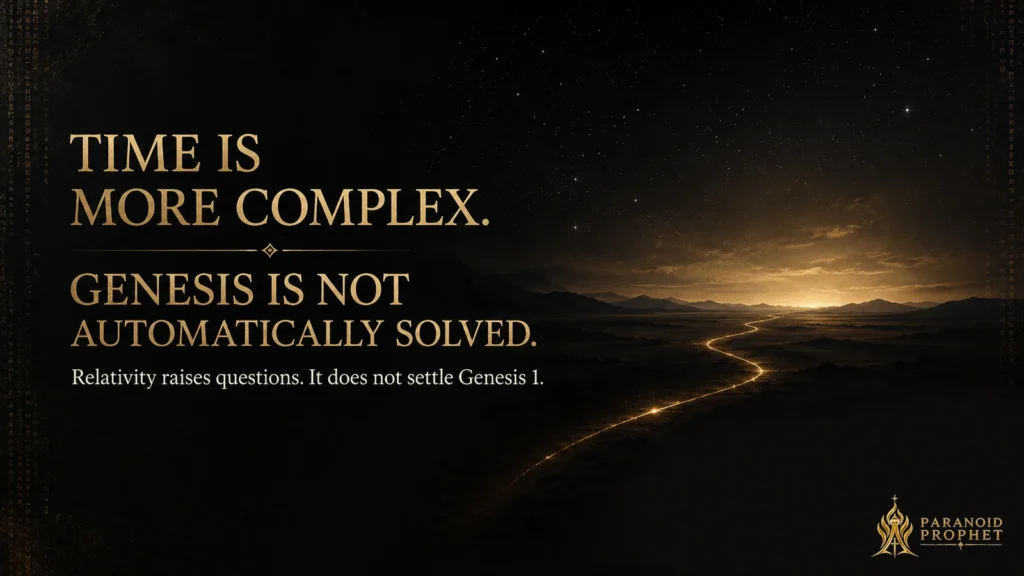
Relativity establishes something significant: physical clocks do not measure elapsed time identically under every condition.
That statement should be neither minimized nor exaggerated.
It means that motion and gravity matter to measured time. It means that the universe cannot be understood merely by imagining one universal clock ticking at exactly the same rate in every physical setting. It means that words such as “before,” “after,” “simultaneous,” and “how much time passed” can require more care when applied to extreme motion, gravity, or cosmic scale.
But relativity does not tell Christians how long the days of Genesis 1 were.
It does not determine whether Genesis intends ordinary calendar days, analogical days, a literary framework, extended periods, or another reading. It does not establish that billions of years passed elsewhere while six ordinary days passed on Earth. It does not turn Psalm 90:4 into a scientific equation. And it does not provide a mathematical key for translating biblical chronology into modern cosmological timescales.
Those limits matter because Christians can be tempted to use a real scientific discovery as though it settles a theological debate the discovery was never designed to answer.
Psalm 90:1–4 teaches that God is eternal and that a thousand years are like yesterday when they are past. Second Peter 3:8–9 reminds impatient readers that the Lord’s apparent delay is not slowness but patience. Both passages rightly humble human assumptions about time before the eternal God.
Neither passage, however, was written to explain gravitational time dilation, satellite clocks, or the duration of the days in Genesis 1. Their point is theological and pastoral: God is not bound by human impatience, human limits, or creaturely perspective.
That does not make them less profound. It keeps us from making them say something they were never given to say.
Why Young-Earth Relativistic Models Remain Proposals
Some young-earth creationist cosmologies appeal to relativistic time dilation in an effort to address distant starlight, cosmological redshift, and the apparent age of the universe while maintaining ordinary-length creation days on Earth.
These models are not imaginary. They are genuine apologetic proposals that attempt to bring biblical chronology and modern observations into a single framework. Their advocates often argue that different physical conditions during creation could have involved dramatically different rates of measured time in different parts of the cosmos.
That possibility is precisely why this subject deserves more than ridicule. Relativity has shown that measured time is not a simplistic universal constant. Christians should not dismiss every attempt to think carefully about the relationship between Genesis, cosmic history, and physical time.
Yet intellectual honesty requires a second statement: these models remain debated proposals, not established scientific proof and not required Christian doctrine.
Relativity alone does not produce a young-earth cosmology. A model must make specific claims about cosmic geometry, gravitational conditions, expansion, observational consequences, and the relationship between Earth-based clocks and distant events. Those claims can be assessed, challenged, revised, or rejected. Christians are not obligated to treat one reconciliation model as though the authority of Genesis rises or falls with it.
This article therefore will not claim that time dilation solves Genesis chronology. It will not ask readers to choose between faith in Scripture and confidence in every scientific detail of a particular cosmological model.
A later specialist article can examine these proposals directly: what they attempt to explain, how their advocates reason, what objections they face, and what Christians can responsibly conclude. Here, the central point is more modest and more secure: relativity has made time stranger than simplistic materialism or common intuition often assumes, but it has not made the interpretation of Genesis automatic.
How Christians Can Receive Science Without Forcing a Reconciliation
Christians do not honor Scripture by pretending difficult questions do not exist. Neither do they honor science by treating every present model as though it has erased the need for theological explanation.
The better path is disciplined confidence.
Receive Genesis as God’s authoritative revelation about the Creator, creation, humanity, goodness, Sabbath, sin, and hope. Receive honest scientific investigation as a legitimate effort to understand the physical world God made. Test interpretations of Scripture by the text itself. Test scientific claims by evidence, reasoning, and their explanatory strength. And treat attempts to harmonize disputed questions with appropriate humility.
That posture is not indecision. It is faithfulness.
Christians can say confidently that God created. They can say confidently that the universe is ordered, contingent, and meaningful. They can say confidently that human beings bear God’s image and remain accountable to Him. They can say confidently that time, matter, light, and space are creaturely realities rather than rival gods.
They can also admit where Scripture does not give a modern scientific mechanism, where scientific models remain incomplete, where faithful interpreters disagree, and where a proposed reconciliation is interesting without being established.
This humility protects the church from unnecessary collapse when a popular argument fails. More importantly, it directs readers back to the God who does not need weak arguments.
The question is not whether Christians must choose between the Bible and serious attention to the created world. The question is whether they will allow Scripture to speak with authority, allow creation to be studied honestly, and refuse to force either one into a false harmony.
That approach does not make every question easy. It does place the questions in their proper order: first the Creator, then His creation, then our careful and limited attempts to understand both.
Frequently Asked Questions About Genesis Creation and Time
Does Genesis teach a young earth?
Genesis does not use the modern phrase “young earth.” Christians who read the creation days as ordinary days often understand Genesis, its genealogies, and the wider biblical storyline as pointing toward a relatively recent creation. Other Christians read the days and genealogies differently and do not believe Genesis specifies a modern scientific age for the earth or universe.
The debate matters, but Christians should not pretend that every question about chronology is equally clear. Genesis unquestionably teaches that God created, creation is ordered and good, humanity bears God’s image, and the world belongs to its Maker.
Are the days of Genesis 1 ordinary twenty-four-hour days?
Many Christians believe they are. The numbered days, evening-and-morning refrain, day-and-night language, and Sabbath pattern of Exodus 20:8–11 are substantial reasons for that reading.
Other Christians understand the days as analogical, literary, or extended periods. The article has explained why these views exist and why the debate cannot be settled by one Hebrew word or one scientific claim. A future specialist article will examine the strongest arguments for each major view in greater depth.
Does Genesis 2:4 prove that the creation days were long ages?
No. Genesis 2:4 shows that yom can function broadly in an idiomatic expression such as “in the day that” or “when.” That observation is important, but it does not automatically determine the meaning of the numbered days and evening-and-morning pattern in Genesis 1.
Does the Big Bang prove Genesis?
No. Modern cosmology describes a physical history of expansion, cooling, radiation, matter, stars, and galaxies. Genesis reveals that the universe is created by God, ordered by His wisdom, and dependent on His will.
Christians may see points of resonance between a universe with a physical history and the biblical confession that creation depends on God. But resonance is not proof. The Big Bang does not establish the meaning of Genesis 1, and Genesis 1 does not function as a technical Big Bang description.
Is the cosmic microwave background the light of Genesis 1:3?
Christians should not identify them directly. The cosmic microwave background belongs within a modern scientific reconstruction of the early universe. Genesis 1:3–5 reveals God bringing light and order by His command.
Both discussions involve light, but they answer different questions and operate in different categories. The CMB should not be turned into an apologetic shortcut, and Genesis should not be reduced to a label for a later scientific observation.
Does relativity explain the days of Genesis?
No. Relativity establishes that physical clocks do not measure elapsed time identically under every condition. Motion and gravity affect measured clock rates. That is a real and tested feature of the physical world.
But relativity does not tell readers whether the days of Genesis 1 are ordinary calendar days, analogical days, a literary framework, or extended periods. It does not turn Psalm 90 into a physics equation, and it does not settle Genesis chronology by itself.
Does Psalm 90:4 mean one day with God equals one thousand years?
No. Psalm 90:1–4 teaches that the eternal God is not limited by human frailty or creaturely experience of time. Second Peter 3:8–9 uses the same truth to answer those who mistake God’s patience for delay.
Neither passage gives Christians a conversion formula for the days of Genesis. Their purpose is theological and pastoral: God is faithful, eternal, patient, and not constrained by human impatience.
Can Christians accept modern science without compromising Scripture?
Christians can receive genuine scientific discovery with gratitude because the world being studied belongs to God. They do not need to fear evidence, observation, mathematics, or careful testing.
At the same time, Christians are not required to treat every interpretation, extrapolation, or philosophical conclusion attached to science as unquestionable truth. Scripture remains the final authority for Christian faith. Scientific claims should be examined honestly, and biblical interpretation should be governed by the text rather than by pressure to make Genesis sound modern.
What can Christians say confidently when faithful believers disagree about creation?
Christians can confess that God created heaven and earth; creation is ordered, good, and dependent on Him; humanity bears God’s image; sin has brought real disorder into the world; and God will finally renew creation through Jesus Christ.
They can also disagree seriously about Genesis 1’s days without treating every disagreement as a denial of biblical authority. The right response is not indifference or compromise. It is conviction joined to humility, careful interpretation, and worship of the Creator.
Sources and Further Reading
Source discipline: Scripture is the final authority for Christian doctrine. Scientific sources help explain what modern observation and modeling can establish about the physical universe. Biblical scholarship helps readers understand language, literary structure, and competing interpretations. Apologetic reconciliation models may be worth examining, but they should not be treated as established proof or required Christian doctrine. For the site’s wider standards on research, evidence, and correction, read Sources & Verification.
Primary Scripture
- Genesis 1:1–2:3; Genesis 2:4; Genesis 1:26–28
- Exodus 20:8–11; Exodus 31:12–17; Job 38:1–18
- Psalm 90:1–4; Isaiah 40:12–28; Isaiah 55:8–9
- John 1:1–5; Colossians 1:15–20; Hebrews 1:1–4
- Romans 8:18–25; Revelation 21:1–5
Scientific Background
- NASA, “Cosmic History”
- European Space Agency, “Planck and the Cosmic Microwave Background”
- National Institute of Standards and Technology, “Putting Einstein to the Test”
Biblical and Interpretive Further Reading
- Gordon J. Wenham, Genesis 1–15.
- C. John Collins, Genesis 1–4: A Linguistic, Literary, and Theological Commentary.
- John Lennox, Seven Days That Divide the World.
- David G. Hagopian, ed., The Genesis Debate: Three Views on the Days of Creation.
- John H. Walton, The Lost World of Genesis One. This is one influential functional and cosmic-temple proposal, not the only faithful reading of Genesis 1.
The Creator Revealed Through Jesus Christ
Genesis begins with God creating heaven and earth. The New Testament carries that confession forward by revealing that all things were created through and for the Son. Colossians 1:15–20 presents Christ as the image of the invisible God, the One through whom all things were created, the One before all things, and the One in whom all things hold together.
This does not turn Genesis 1 into a hidden physics manual about Jesus. It gives creation its full canonical horizon. The Creator is not an impersonal force behind the universe. The God who made all things has made Himself known in His Son.
The One through whom creation came to be entered the world He made. He took flesh. He walked under the sun and stars He created. He bore the curse of sin and death. He rose bodily from the grave. And He will not abandon creation to decay.
Romans 8:18–25 describes creation groaning under the weight of corruption while awaiting liberation. Revelation 21:1–5 promises not escape from God’s creation, but its renewal under His reign.
That is where Genesis creation and time finally lead. The universe is not self-made, ownerless, or meaningless. It belongs to Christ. The One through whom all things were made is the One who entered creation, bore its curse, defeated death, and will make all things new.
For the wider biblical and historical case for Christ’s identity, see Is Jesus the Son of God? Evidence from History, Prophecy, Resurrection, and Scripture.
CONTINUE THE INVESTIGATION
Return to the foundation
Who Is God? Biblical Attributes Explained
Move from a focused creation-and-time discussion to the broader biblical question of God’s character and attributes.