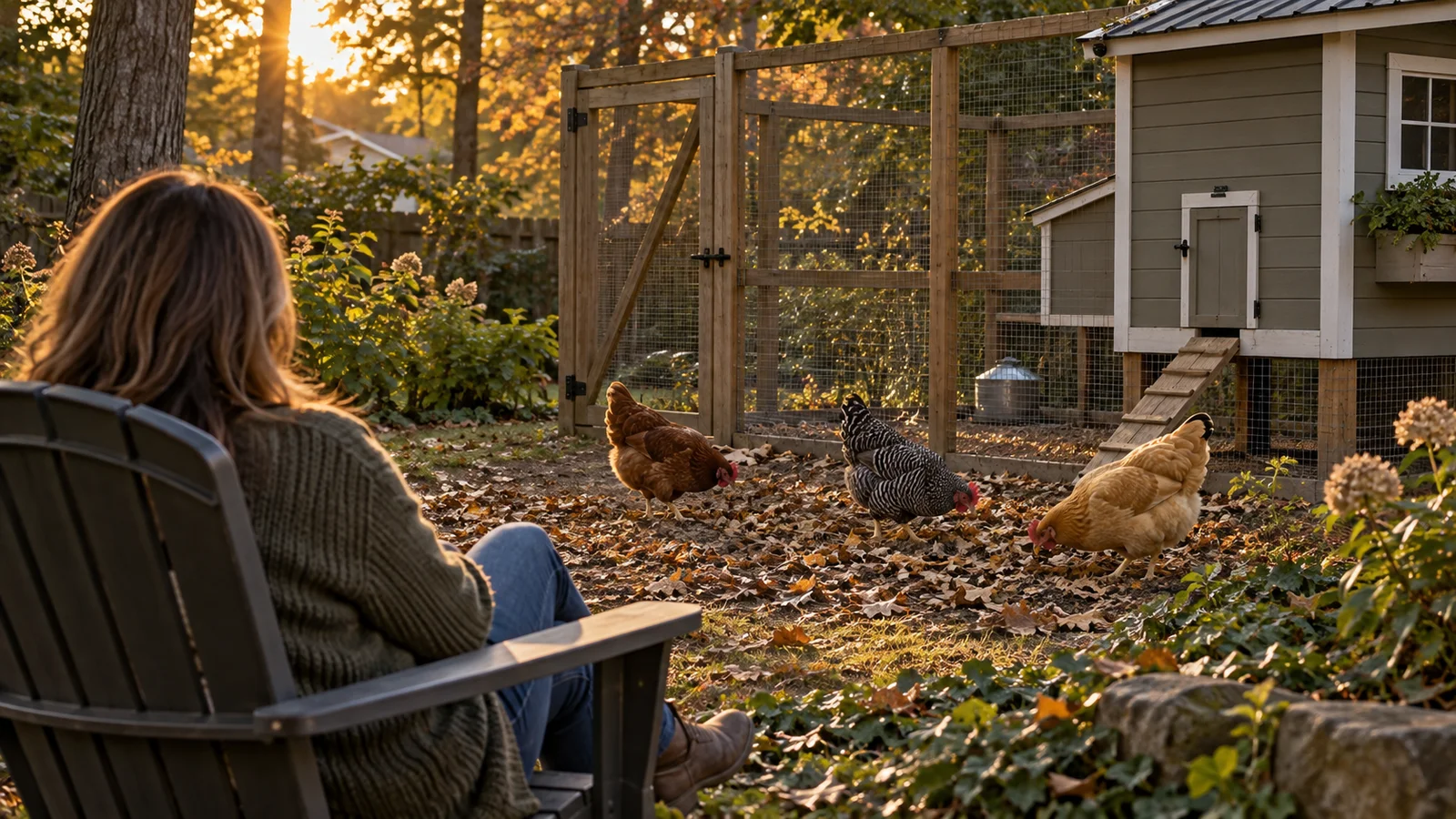

A quiet backyard routine can feel grounding. Feeding hens, collecting eggs and watching a flock scratch through leaves can be enjoyable, absorbing and a reason to step outside.
It is also different from saying chickens treat anxiety, reduce cortisol or function as therapy. The research does not justify those chicken-specific clinical claims.
Updated October 6, 2026. Sources checked for this remaster.
GUIDED ARTICLE EXPERIENCE
Backyard Chickens and Mental Well-Being: Routine, Enjoyment & What the Evidence Can Say
Read along as the narration moves through the article.
Private device narration · No hosted audio or tracking
CONTINUE GUIDED TOUR
Continue where you left off.
GUIDED TOUR COMPLETE
You have reached the end of this study.
Study record saved on this device.
GUIDED TOUR
Backyard Chickens and Mental Well-Being: Routine, Enjoyment & What the Evidence Can Say
Narrator: Paranoid Prophet Recommended Voice Native device narration
Prepare to follow the article as it is narrated.
VOICE & TOUR OPTIONS
Voice & Listening
NARRATOR
Finding a narrator…
Checking the best narrator available on this device.
Restores the best curated narrator available on this device.
Narrator choices are curated for clear, long-form listening on this device.
Screen-awake support will be checked when narration starts.
CHOOSE A NARRATOR
Curated for this device
Choose a verified narrator for this browser, or use System Narrator. Automatic mode uses the best reliable route exposed by this device; your chosen narrator is preserved even if this device needs a temporary fallback.
Preparing the guided article experience…
RESUME GUIDED TOUR?
Continue where you left off.
GUIDED TOUR COMPLETE
You have reached the end of this study.
Article Guide11 sections
The honest answer
Backyard chickens may contribute to a life that feels more connected, structured or enjoyable for some keepers.
Possible reasons include:
- a consistent daily routine
- time outdoors
- attention directed away from screens
- caring for living animals
- enjoyable observation and humor
- sharing eggs or flock experiences with other people
Those are plausible and can be personally meaningful. They belong among the possible lifestyle benefits of backyard chickens, rather than guaranteed outcomes.
But the strongest research on human-animal interaction is largely about pets in general, dogs, horses or structured animal-assisted programs. The results are mixed, and they do not let us claim that ordinary chicken keeping is a treatment for a mental-health condition.
Routine can be meaningful without being medicine
Chickens need water, feed, egg collection and observation every day.
For some people, that structure feels useful. A task with an obvious purpose can break up an unstructured day and create a reason to go outside.
But routine can also become burden.
Birds still need care when:
- the weather is bad
- you are tired
- laying slows
- a predator attacks
- a hen becomes sick
- you want to travel
Before getting birds, ask whether daily care, an emergency budget and a reliable backup keeper fit your life. Watching an existing flock may offer enjoyment without adding dependents. For family involvement, use age-appropriate responsibilities and poultry-hygiene boundaries.
What human-animal research actually says
Research on pets and human mental health is not uniformly positive.
A systematic review of pet ownership and quality of life found positive, mixed, neutral and negative findings across the included studies. A 2024 pandemic review found stronger pet relationships associated with lower depression in some findings, while higher attachment was also associated with anxiety. It could not determine the direction of causation. A 2025 review of pet attachment likewise found positive, negative, mixed and null findings. Attachment studies measure a different question from ownership itself, and neither establishes a chicken-specific treatment effect.
Structured human-animal interaction research can show benefits in some contexts, but does not isolate whether the animal accounts for the effect. A farm-animal-assisted therapy review described promising results within supported programs, while noting scarce research. Neither transfers those outcomes to an ordinary backyard flock.
That distinction is essential: clinical programs and ordinary ownership answer different questions.
What about cortisol and oxytocin?
Claims that a few minutes with hens lower cortisol or trigger oxytocin need direct evidence from that setting.
An older review of human-animal interactions discusses measured stress variables and a proposed oxytocin mechanism, drawing largely on other animals and structured settings. A proposed mechanism is not a demonstrated effect of watching backyard hens.
That does not prove the same physiological effect from watching hens in a backyard.
So this page does not use hormone claims to sell chicken keeping.
Outdoor time may matter separately from the chickens
There is a broader research literature on nature and green-space exposure.
A 2024 systematic review/meta-analysis found associations between some forms of garden/green-space access and better mental-health outcomes during the pandemic. The authors also rated the overall evidence quality very low and noted substantial risk of bias.
That makes it reasonable to say:
Spending time outside may be part of why a backyard routine feels good for some people.
It does not make chickens the active ingredient.
Companionship can be real even when the evidence is messy
Individual chickens have recognizable behaviors and preferences. Some keepers become attached to particular birds.
You do not need a clinical trial to describe that attachment as personally meaningful.
The line to avoid is turning a personal relationship into a universal medical result.
Examples of reasonable personal descriptions, not reports about our own flock:
- “I enjoy sitting outside with the flock.”
- “The routine gives me something concrete to do.”
- “Losing a favorite hen can hurt.”
Unreasonable scientific language without direct evidence:
- “chickens regulate your nervous system”
- “chickens treat depression”
- “clucking releases oxytocin”
Chicken keeping can also add stress
A balanced mental-well-being article has to include the hard side.
Chicken keeping can bring:
- worry during disease outbreaks
- predator losses
- difficult end-of-life decisions
- financial expense
- travel limitations
- conflict with neighbors or ordinances
- frustration with mud, manure or damaged landscaping
A person already overwhelmed by daily obligations may not experience another dependent animal as calming.
That does not make the hobby bad. It means the effect is individual.
Chickens are not a replacement for mental-health care
If someone is dealing with persistent anxiety, depression, trauma, suicidal thoughts or another significant mental-health problem, chicken keeping should not be presented as treatment.
Enjoying animals and outdoor routines can coexist with professional care. If symptoms persist or interfere with daily life, use NIMH guidance for finding mental-health help.
The birds do not need to be therapists to have value.
FAQ
Can chickens reduce stress?
Some keepers find flock routines relaxing, but strong chicken-specific clinical evidence is lacking. General human-animal and nature research should not be converted into a chicken-specific treatment claim.
Are chickens therapy animals?
Ordinary backyard chickens are not the same thing as a structured animal-assisted intervention delivered in a clinical program.
Do chickens lower cortisol?
This article does not make that claim. Hormonal findings from other human-animal contexts cannot simply be assigned to chickens.
Can chickens help with loneliness?
A keeper may experience companionship or social connection through animals and other chicken keepers, but individual experience varies and causality is not established.
Which breed is best for mental health?
There is no evidence-based mental-health breed ranking. Choose birds based on husbandry fit, temperament tendencies and your actual flock goals.
Faith, peace and responsibility
Christian peace is not produced by owning the right animal.
Creation can still invite gratitude and attention. The Christian stewardship framework centers responsible care rather than a promised emotional result. Caring faithfully for creatures can be a meaningful part of ordinary life. But Scripture should not be used to turn an enjoyable hobby into a mental-health promise.
Sometimes the gift is simpler: a responsibility in front of you, an animal depending on your care, and a few minutes outside paying attention.
Sources and evidence limits
- Barr et al. 2024 systematic review
- Pet Ownership and Quality of Life systematic review
- Crossman 2017 review
- Nature exposure systematic review/meta-analysis
- Farm-animal-assisted therapy review
The 2025 pet-attachment review updates the evidence picture without resolving causality. None of the reviews linked here establishes that backyard hens treat a mental-health disorder.