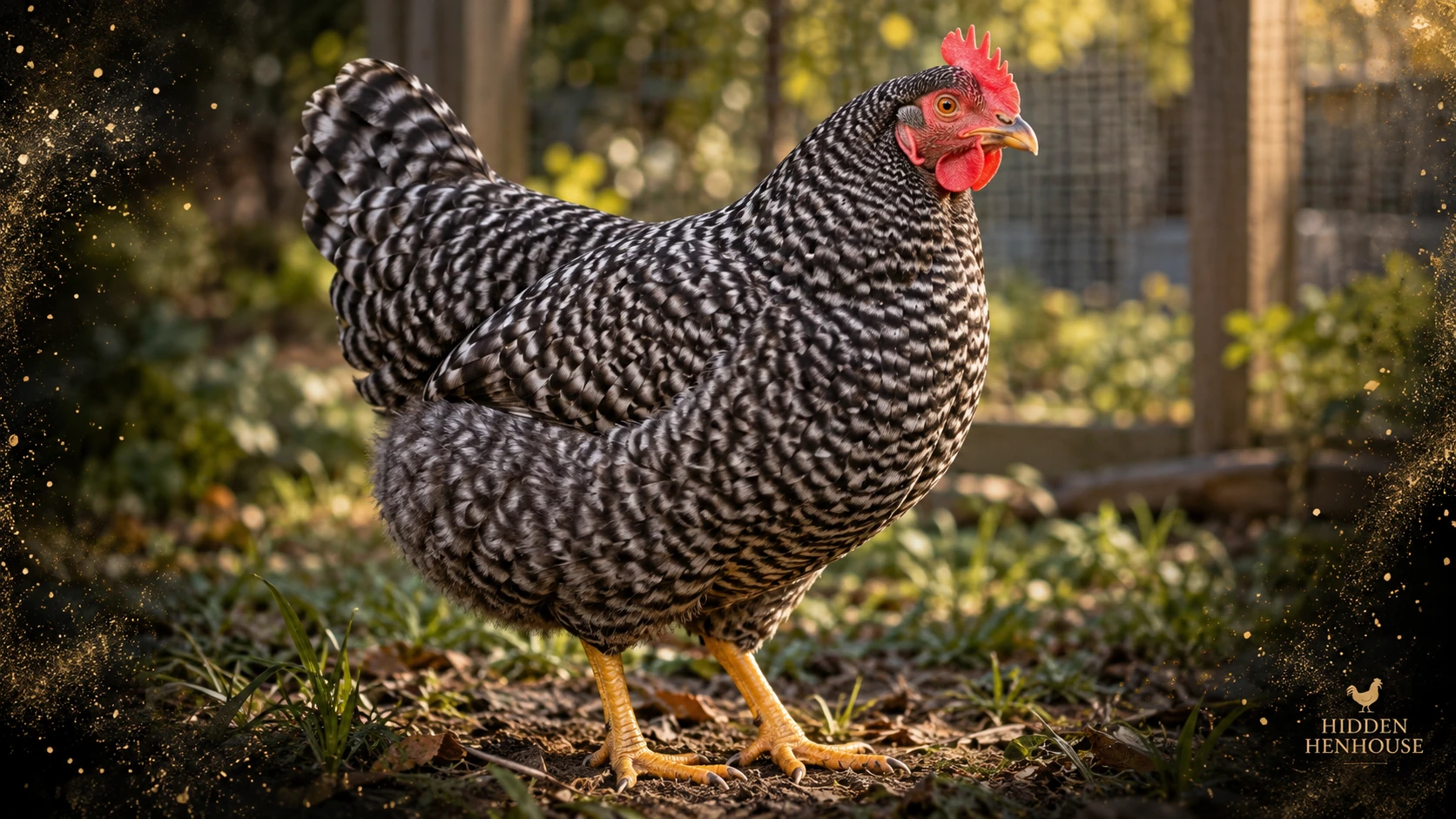

The Barred Plymouth Rock is one of the classic American backyard chickens for good reason. It is a large dual-purpose bird, lays brown eggs, and is widely described as calm and manageable. It also has well-supported cold-hardiness, although proper winter housing still matters.
But a useful breed guide needs two qualifications up front. Barred is a variety of the Plymouth Rock breed, not a separate breed. And breed reputation is not a personality guarantee. A Plymouth Rock may be a very good family-flock fit, but individual birds, strain, handling and flock dynamics still matter.
Updated October 6, 2026. Breed and husbandry sources checked for this remaster.
GUIDED ARTICLE EXPERIENCE
Barred Plymouth Rock Chicken: Temperament, Eggs & Backyard Fit
Read along as the narration moves through the article.
Private device narration · No hosted audio or tracking
CONTINUE GUIDED TOUR
Continue where you left off.
GUIDED TOUR COMPLETE
You have reached the end of this study.
Study record saved on this device.
GUIDED TOUR
Barred Plymouth Rock Chicken: Temperament, Eggs & Backyard Fit
Narrator: Paranoid Prophet Recommended Voice Native device narration
Prepare to follow the article as it is narrated.
VOICE & TOUR OPTIONS
Voice & Listening
NARRATOR
Finding a narrator…
Checking the best narrator available on this device.
Restores the best curated narrator available on this device.
Narrator choices are curated for clear, long-form listening on this device.
Screen-awake support will be checked when narration starts.
CHOOSE A NARRATOR
Curated for this device
Choose a verified narrator for this browser, or use System Narrator. Automatic mode uses the best reliable route exposed by this device; your chosen narrator is preserved even if this device needs a temporary fallback.
Preparing the guided article experience…
RESUME GUIDED TOUR?
Continue where you left off.
GUIDED TOUR COMPLETE
You have reached the end of this study.
Article Guide15 sections
Quick facts about the Barred Plymouth Rock
| Trait | Practical answer |
|---|---|
| Identity | Plymouth Rock breed, Barred variety |
| Origin | United States, 19th century |
| APA class | American |
| Purpose | Dual-purpose: eggs and meat |
| Comb | Single |
| Egg color | Brown |
| Egg size | Large |
| Egg production | Livestock Conservancy describes about 200 eggs per year; individual output varies |
| Adult size | About 7.5 lb hens and 9.5 lb males in the Conservancy breed profile |
| Temperament | Calm and docile tendency |
| Broodiness | Can be broody; traditionally regarded as good sitters and mothers |
| Climate note | Strong cold-hardiness reputation; summer heat still requires normal heat-stress management |
| Best fit | Keepers who want a calm, substantial brown-egg bird rather than maximum egg output |
Weight-source context: Wisconsin Extension gives the same sex-specific standard weights as the Conservancy: 7.5 lb hens and 9.5 lb males. Mississippi State’s general breed guide instead lists adults at 4–7 lb without explaining the difference. We use the sex-specific standard figures here; ask your supplier about the actual line’s mature size.
Barred Rock or Plymouth Rock: what is the correct name?
The breed is Plymouth Rock. Barred is one recognized color pattern within that breed.
That distinction matters because online breed guides often turn a variety name into a separate breed. The American Poultry Association recognizes multiple large-fowl Plymouth Rock varieties, including Barred, White, Buff, Silver Penciled, Partridge, Columbian and Blue.
For a backyard keeper shopping specifically for the familiar black-and-light barred bird, “Barred Rock” is normal shorthand. Just understand that the bird belongs to the Plymouth Rock breed.
The Barred variety is also the original Plymouth Rock type. The Livestock Conservancy traces the breed’s American development to the 1800s and notes its importance as a traditional farm chicken.
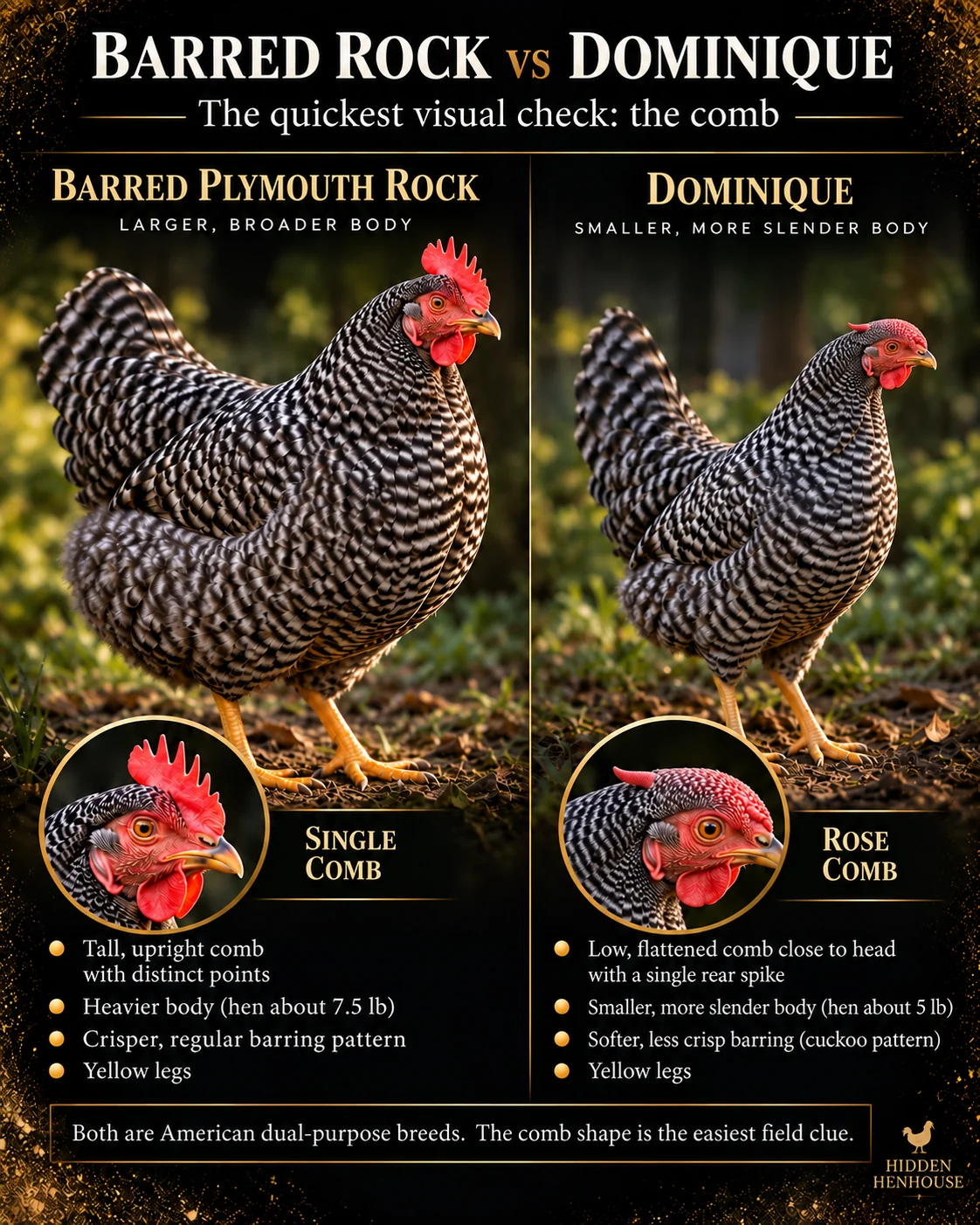
Barred Rock vs. Dominique: the easiest way to tell them apart
Barred Plymouth Rocks are commonly confused with Dominiques because both are American birds with barred plumage and yellow legs.
The easiest identification point is the comb:
- Barred Plymouth Rock: upright single comb
- Dominique: low rose comb with a rear spike
The breeds also differ in body type and barring. Plymouth Rocks are heavier, deeper-bodied birds, while Dominiques are smaller and more refined. Good Barred Plymouth Rocks should show crisp, regular barring rather than the softer cuckoo-style appearance associated with Dominiques.
If you are buying barred chicks or adult birds and breed identity matters to you, confirm the comb type and ask the seller whether the stock is actually Plymouth Rock rather than relying on black-and-white feathering alone.
Why people choose Barred Plymouth Rocks
The appeal is balance.
A Barred Plymouth Rock is not usually chosen because it wins a single category. Instead, the breed combines several traits many backyard keepers want:
- useful brown-egg production
- enough body size to remain a genuine dual-purpose breed
- a calm temperament tendency
- documented cold hardiness
- a long American farm-breed history
- broodiness that can be useful if natural hatching is part of the plan
That makes it a different proposition from a light, highly active egg specialist such as a Leghorn.
If you are still deciding among several breeds, compare the Barred Rock with the broader Best Chicken Breeds for Beginners guide rather than choosing from one trait alone.
Temperament: calm is a tendency, not a promise
The Livestock Conservancy describes Plymouth Rocks as calm and docile, and University of Wisconsin Extension also describes them as generally docile and easy to tame.
That supports their reputation as approachable backyard birds. It does not mean every hen will enjoy handling or every rooster will be gentle.
For a family flock, the useful question is not “Is this breed safe for kids?” No chicken breed can honestly carry that guarantee.
A better question is whether the breed’s normal activity level and temperament tendency fit a supervised household. On that standard, Plymouth Rocks are a reasonable breed to consider.
Children still need the hygiene and supervision practices described in the site’s Backyard Chickens for Kids guidance.
How many eggs do Barred Plymouth Rocks lay?
The Livestock Conservancy’s current Plymouth Rock profile describes production at around 200 large brown eggs per year.
Treat that as a breed-profile planning figure, not a contract.
Annual egg output changes with:
- strain and breeder selection
- age
- season and daylight
- nutrition
- molt
- health
- stress
- overall management
That is why this guide does not preserve the old promise of 200 to 280 eggs from every hen.
If maximum egg numbers are the main goal, other birds may fit better. If you want a dual-purpose bird with respectable brown-egg production and a calmer farm-breed profile, the Plymouth Rock makes more sense.
Are Plymouth Rocks good in cold weather?
Cold hardiness is one of the breed’s better-supported advantages.
The Livestock Conservancy identifies cold hardiness as a Plymouth Rock characteristic, and University of Minnesota Extension specifically lists Plymouth Rocks among heavier breeds that overwinter well.
That still does not make them “winter-proof.”
A dry, ventilated coop, unfrozen water, complete feed, moisture control and observation for cold stress still matter. Their single comb and wattles can also be injured by frostbite under cold, damp conditions.
For winter management, use the site’s Winterizing a Chicken Coop and Run guide rather than adding breed-specific heating rules here.
What about hot summers?
Do not choose a Plymouth Rock because someone labels it heat-proof.
Large-bodied birds can still experience heat stress. In hot weather, every flock needs shade, ventilation, fresh cool water and monitoring.
The practical takeaway is simple: the breed has a documented cold-weather strength, but summer management still matters.
Do Barred Plymouth Rocks go broody?
They can.
The Livestock Conservancy and University of Wisconsin both describe broodiness or mothering behavior as part of the breed’s traditional profile.
That can be an advantage if you want a hen to hatch eggs naturally. It can also interrupt laying and become a management issue if you do not want chicks.
Broodiness is still an individual and line-variable behavior. Do not buy a Plymouth Rock expecting a guaranteed incubator.
For signs and humane management, use the site’s Broody Hen Behavior guide.
Mixed flock and neighborhood fit
The Livestock Conservancy describes Plymouth Rocks as easy to keep in a flock and generally able to get along with other breeds. Their temperament tendency is relatively calm.
But flock compatibility is never solved by breed labels alone. Resource competition, crowding, introductions and individual personalities matter more once birds are actually living together.
Because they are substantial birds, plan housing around the Chicken Space Requirements guide instead of assuming a one-size-fits-all breed number.
Main drawbacks to know before buying
A good breed profile should make it easy to say no.
The Barred Plymouth Rock may be a poor fit if:
- you want the highest possible egg output from the smallest bird
- you do not want any chance of broodiness
- your setup is consistently hot with weak shade or airflow
- you would rather keep a smaller, more active egg-specialist bird
- you expect a guaranteed lap chicken because the breed is described as docile
The breed’s large body is part of its dual-purpose value, but your housing and handling setup still needs to fit a substantial bird.
Who should choose a Barred Plymouth Rock?
Consider this variety if your priorities are:
- calm temperament tendency
- brown eggs without chasing maximum-output genetics
- a traditional dual-purpose body type
- good cold-weather suitability
- a breed with a long American farm history
- possible natural broodiness
Choose something else if your first priority is ultra-high egg output, very low broodiness, or a small active bird.
What to ask the breeder or hatchery
Ask more than “Is it a Barred Rock?”
Useful questions include:
- Is this standard-bred Plymouth Rock stock, production-oriented stock, or a hatchery utility line?
- What are the parent birds like temperamentally?
- What does this line typically do for egg production in your conditions?
- Does broodiness show up often in this line?
- What adult size should I expect?
- What traits has the breeder actually selected for?
Those answers tell you more about the birds you are buying than a generic internet breed scorecard.
Barred Plymouth Rock FAQ
Is a Barred Rock the same as a Plymouth Rock?
A Barred Rock is the Barred variety of the Plymouth Rock breed. “Barred Rock” is common shorthand, but Plymouth Rock is the breed.
Are Barred Rocks good for beginners?
They can be. Their calm tendency, dual-purpose usefulness and cold hardiness make them a reasonable beginner option when those traits match the keeper’s goals.
Are Barred Rocks good with children?
The breed has a calm reputation, but no breed is child-safe by default. Children still need supervision and poultry hygiene.
What color eggs do they lay?
Plymouth Rocks lay brown eggs. The Livestock Conservancy lists the breed’s eggs as large.
How many eggs should I expect?
The Livestock Conservancy describes around 200 large brown eggs per year for the breed. Treat that as a source-specific planning figure, because real output varies by line, age and management.
Do they go broody?
They can, and traditional Plymouth Rocks have a reputation as sitters and mothers. The tendency still varies by individual and line.
A stewardship-first way to choose a breed
There is no virtue in buying the bird with the longest list of superlatives.
Good stewardship starts with choosing animals whose real needs and tendencies fit the home you can provide. For many backyard flocks, the Barred Plymouth Rock earns consideration because it is balanced rather than extreme.
Authoritative sources
- The Livestock Conservancy, Plymouth Rock Chicken
- The Livestock Conservancy, Dominique Chicken (comparison context)
- American Poultry Association, Accepted Breeds & Varieties
- University of Wisconsin Extension, Chicken Breeds & Varieties
- University of Minnesota Extension, Caring for Chickens in Cold Weather
- Mississippi State University Extension, Choosing the Right Breed for Your Backyard Flock