
For most first-time backyard chicken keepers, 3 to 6 hens is a sensible starting range. There is no perfect number, though. Your available space, local rules, egg use, budget, and how much pressure you are willing to put on the backyard matter more than hitting a magic number.
If I were starting over, I would start smaller than we did.
We began with 16 chickens and two ducks in a normal neighborhood backyard. In hindsight, that was an aggressive opening move. A couple of years later, we are down to about 12 chickens, and we still produce enough eggs that we regularly give some away.
By about the end of our first year, the flock had essentially stripped the backyard of grass. The upside is that I do not spend much time mowing back there anymore. The downside is that there is not much left to mow.
That is why my advice to a first-time keeper is simple: start with enough chickens to have a healthy little flock, but do not choose your number based only on how many eggs you imagine collecting. Think about the whole system the birds will live in.
GUIDED ARTICLE EXPERIENCE
How Many Chickens Should You Start With?
Read along as the narration moves through the article.
Private device narration · No hosted audio or tracking
CONTINUE GUIDED TOUR
Continue where you left off.
GUIDED TOUR COMPLETE
You have reached the end of this study.
Study record saved on this device.
GUIDED TOUR
How Many Chickens Should You Start With?
Narrator: Paranoid Prophet Recommended Voice Native device narration
Prepare to follow the article as it is narrated.
VOICE & TOUR OPTIONS
Voice & Listening
NARRATOR
Finding a narrator…
Checking the best narrator available on this device.
Restores the best curated narrator available on this device.
Narrator choices are curated for clear, long-form listening on this device.
Screen-awake support will be checked when narration starts.
CHOOSE A NARRATOR
Curated for this device
Choose a verified narrator for this browser, or use System Narrator. Automatic mode uses the best reliable route exposed by this device; your chosen narrator is preserved even if this device needs a temporary fallback.
Preparing the guided article experience…
RESUME GUIDED TOUR?
Continue where you left off.
GUIDED TOUR COMPLETE
You have reached the end of this study.
Article Guide17 sections
Quick Answer: How Many Chickens Should a Beginner Start With?
For a typical backyard flock, this is how I would think about the starting numbers:
| Starting flock | My take |
|---|---|
| 1 chicken | Not a good plan. Chickens are social animals that normally live and behave as part of a flock. |
| 2 chickens | Possible, but fragile. If one bird dies or needs to be separated, the other is suddenly alone. |
| 3 chickens | A practical minimum for many backyard keepers. |
| 4 to 6 chickens | My preferred beginner range for many households with adequate space. |
| 7 to 10 chickens | Manageable with the right setup, but feed, manure, space, eggs, and yard pressure increase quickly. |
| 10+ chickens | Not unreasonable, but I would not recommend starting here unless you have deliberately built for it. |
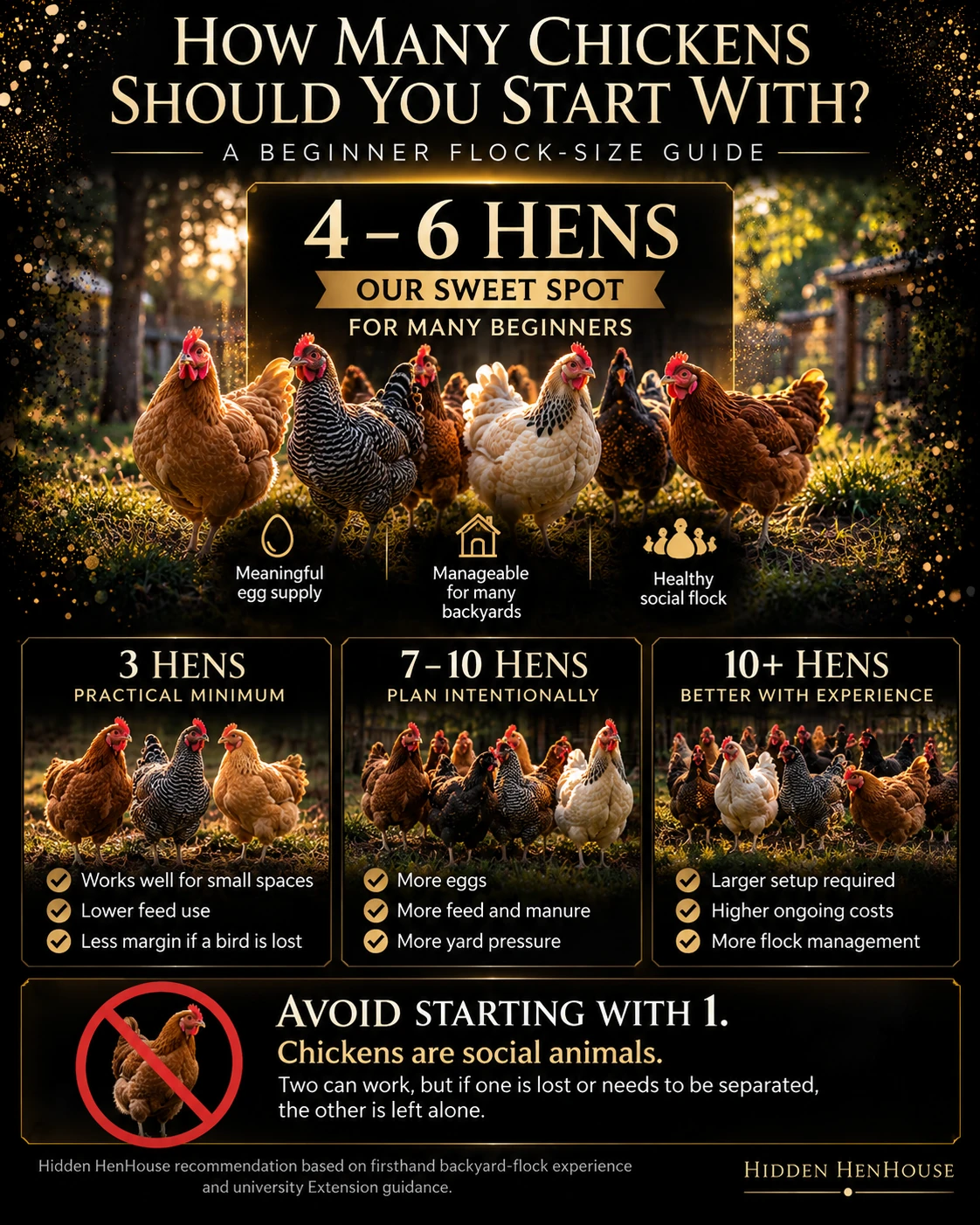
Alabama Cooperative Extension describes chickens as highly social animals that form recognizable groups, hierarchies, and social relationships. That does not mean science has established some magical rule that exactly three chickens are required. I treat three as a practical floor, while four to six gives a new keeper a little more resilience without immediately jumping into double digits.
We Started With 16 Chickens and Two Ducks. I Wouldn’t Recommend That.
Our experience is one reason I am more conservative now.
Sixteen chickens and two ducks did not sound outrageous when we started, and technically, we made it work. But there is a difference between asking, “Can I physically keep this many birds?” and asking, “Is this the best number for someone learning how to keep birds?”
More birds mean more feed, water, manure, bedding, eggs, scratching, flock dynamics, cleaning, space pressure, and more things that can go wrong at the same time.
Our current flock of around 12 chickens still produces plenty of eggs for us, including enough to give eggs to other people. If you are starting because you want fresh eggs for the family, you may need far fewer hens than you think.
Don’t Choose Your Flock Size From Egg Math Alone
A productive laying hen can produce a lot of eggs, but backyard flocks are not spreadsheets.
UF/IFAS Extension estimates roughly 200 to 240 eggs per hen per year for a small backyard flock, while also emphasizing that production varies with breed, age, condition, and day length. Molting and shorter days can reduce laying, and production generally declines as hens age.
So I would not calculate the smallest possible flock from peak spring production and assume the egg basket will look identical all year.
A Better Way to Plan
Look at how many eggs your household actually uses now. Then ask whether you would still be satisfied when production slows during molt, shorter days, age-related decline, or other normal changes.
If yes, stay conservative. If not, give yourself a little more production margin.
And remember that once you have chickens, you may start using more eggs simply because they are there. We certainly ended up with enough that sharing eggs became normal.
If egg production is a major reason you want chickens, your breed choice matters too. Our guide to the best chicken breeds for beginners can help you compare temperament, climate fit, and laying potential.
Hidden Henhouse Reality Check: Space Is More Than Coop Square Footage
Chicken-space advice is usually reduced to a simple formula.
University of Maryland Extension publishes minimum space requirements of 1.5 square feet indoors and 8 square feet of outdoor run per laying hen, with more room listed for larger chickens.
| Bird type | Minimum indoor space | Minimum outdoor run |
|---|---|---|
| Laying hen | 1.5 square feet per bird | 8 square feet per bird |
| Large chicken | 2 square feet per bird | 10 square feet per bird |
Those numbers are useful minimum housing guidelines. They are not a promise that your yard will stay beautiful if you meet them.
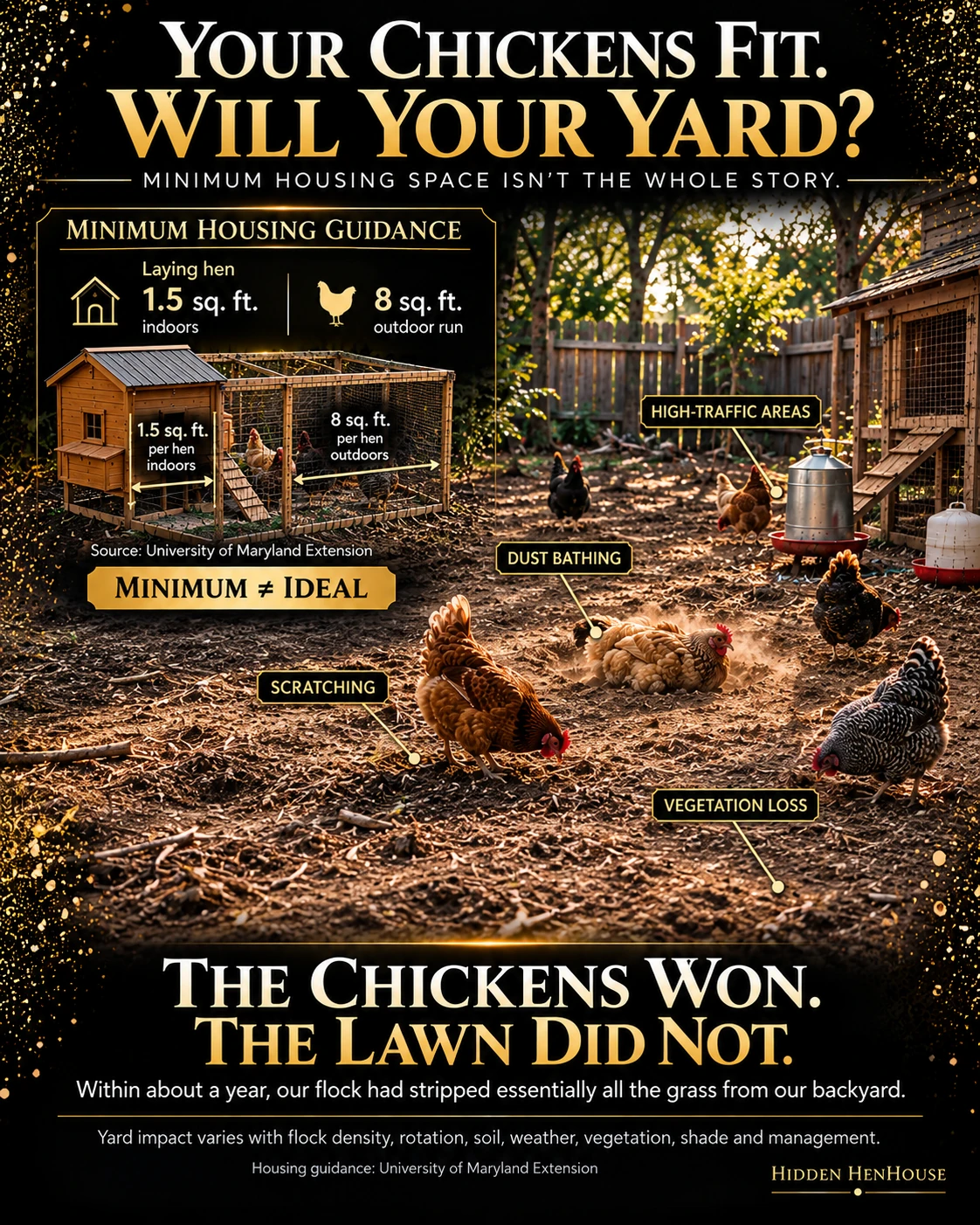
Chickens scratch, dig, dust bathe, eat vegetation, revisit favorite areas, and congregate around shade, feeders, waterers, doors, and structures.
That first year turned our backyard into a pretty convincing case study in what sustained chicken pressure can do to grass. We now have roughly 12 chickens, but the lawn had already lost that battle.
The chickens won. The lawn did not.
That does not mean chickens inevitably destroy every yard. Flock density, rotation, soil, rainfall, grass type, shade, and available range all matter. But if keeping a green neighborhood lawn is important to you, flock size should be part of that calculation from day one.
This is one reason I would rather see a beginner start with four well-managed chickens than buy ten simply because a coop manufacturer says ten will fit.
For the deeper space question, see our guide to how much room chickens really need. If your flock has already turned the yard into a dust bowl, we also have a guide to growing grass with backyard chickens.
How Much Feed Will Your Chickens Actually Eat?
Feed is another reason flock size matters.
Mississippi State University Extension says an average laying hen consumes about one-quarter to one-third pound of feed per day, depending on weather, bird size, and productivity.
That adds up quickly.
Approximate Layer-Feed Use
| Hens | Feed per day | Feed per 30 days |
|---|---|---|
| 3 | 0.75 to 1 pound | 22.5 to 30 pounds |
| 4 | 1 to 1.33 pounds | 30 to 40 pounds |
| 6 | 1.5 to 2 pounds | 45 to 60 pounds |
| 10 | 2.5 to 3.33 pounds | 75 to 100 pounds |
| 12 | 3 to 4 pounds | 90 to 120 pounds |
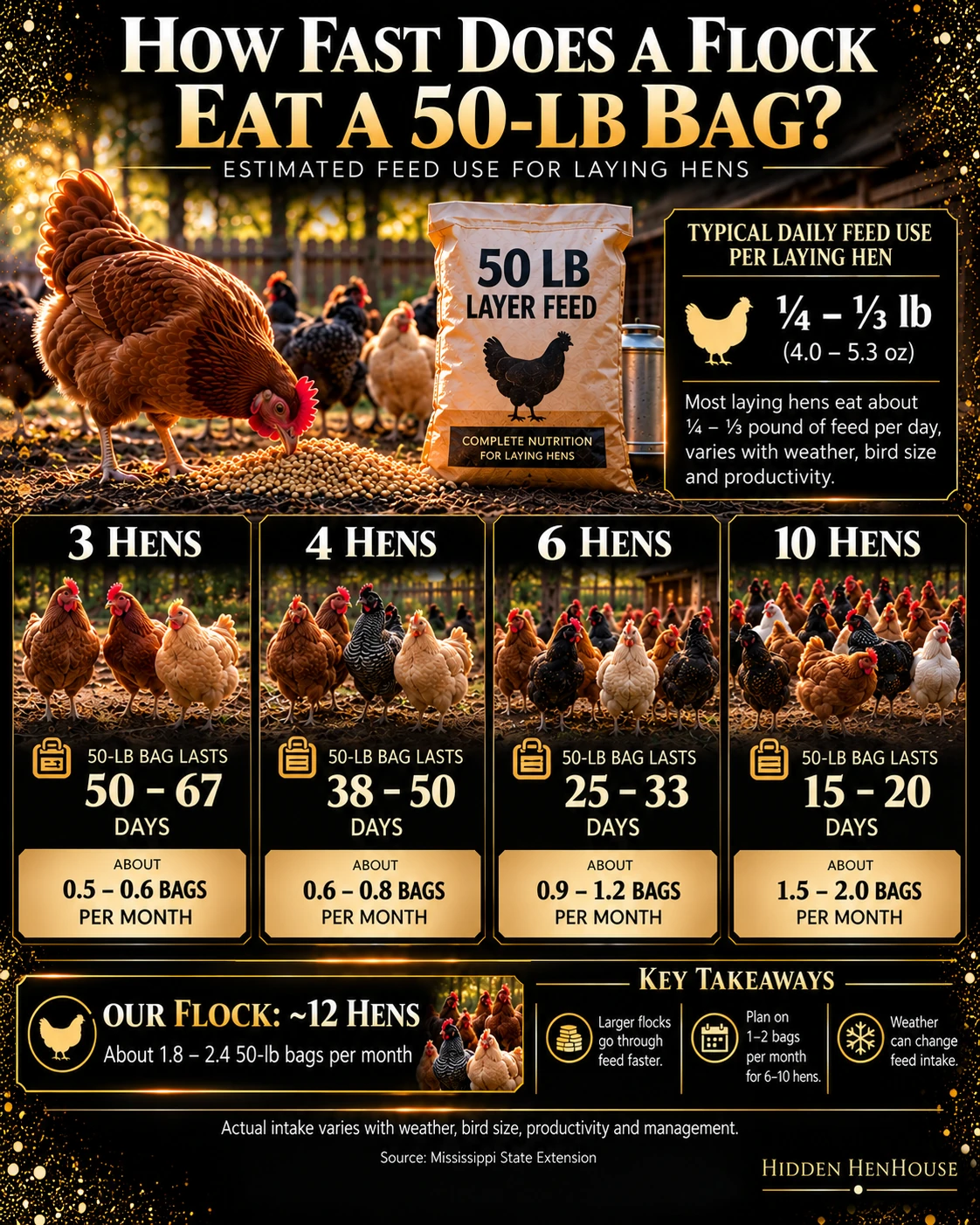
These are planning estimates, not guarantees.
They are also more useful than saying chicken feed costs some fixed dollar amount per bird every month, because feed prices change.
Instead, use this:
Expected monthly feed × the price you actually pay per pound = a better estimate of your feed cost.
For example, if your layer feed costs $20 for a 50-pound bag, that is $0.40 per pound. A six-hen flock using roughly 45 to 60 pounds per month would consume approximately $18 to $24 worth of feed, before waste, treats, bedding, supplements, or other expenses.
For the bigger financial picture, see our guide to the real cost of raising backyard chickens.
Bigger Flocks Don’t Just Cost More. They Change the Work.
I would not promise anyone that chickens require exactly “10 minutes a day.”
Some days are easy. Other days you discover dirty water, wet bedding, a broken latch, a damaged feeder, a bird acting strangely, an egg mess, a bully, or a predator problem.
University of Maryland Extension emphasizes that a home flock requires daily care, including weekends, vacations, and holidays.
That is the important part.
You do not need to stand beside your chickens all day, but somebody needs to be responsible for them every day.
Six birds do not necessarily take twice as long as three, but increasing flock size magnifies the consequences of an inadequate setup.
Chickens Need Other Chickens
One chicken should not be your plan.
Chickens form social groups, establish a pecking order, communicate with flock mates, and learn from one another. Alabama Cooperative Extension’s overview of chicken behavior describes these social hierarchies and group behaviors in detail.
That is why I like three as a practical minimum, even though it is not a magical biological threshold.
Two chickens can live together, but there is an obvious weakness in starting with two: if one dies, becomes ill, or needs to be separated, you suddenly have a solitary chicken.
Starting with three gives you some margin. Starting with four to six gives you more margin without creating a huge beginner flock.
You Don’t Need a Rooster for Eggs
Hens lay eggs without a rooster.
You need a rooster if you want fertile eggs that could develop into chicks. You do not need one to get breakfast.
That distinction matters in neighborhoods because rooster rules and noise restrictions may be different from rules for hens.
Check Your Local Rules Before Buying Anything
This comes before chicks, not after you already have six of them under a heat lamp.
Rules for backyard poultry vary by location and may regulate whether poultry is allowed, flock size, roosters, coop placement, setbacks, sanitation, permits, or lot size. Property rules, leases, or HOA restrictions may add another layer.
University of Maryland Extension recommends checking applicable zoning and environmental rules before planning a flock and also emphasizes the importance of considering neighbors.
A legal flock can still become a neighborhood headache if it smells, attracts pests, constantly escapes, or creates unnecessary noise.
Responsible chicken keeping includes being a decent neighbor.
Plan for the Adult Flock, Not the Cute Chicks
Include hens who may remain after peak production. The aging-hen care guide helps plan space, accessible resources and ongoing responsibilities without assuming every older bird should be replaced.
Six chicks fit practically anywhere. Six adult hens do not.
Before buying chicks or pullets, plan for the birds at full size. Think through:
- coop size
- outdoor space
- ventilation
- predator protection
- feeder capacity
- water capacity
- roosting space
- manure management
- shade
- drainage
- feed storage
This sounds obvious. It becomes much more obvious once the birds are already growing.
What If You Want More Chickens Later?
You probably will.
Chicken math is real enough that I understand how people end up with larger flocks. But expanding later is perfectly reasonable.
I would rather begin with a manageable flock and build experience than deliberately oversize the first flock because you might eventually want more.
There is one major catch: new birds should not simply be dropped into the existing flock.
Quarantine New Birds for 30 Days
USDA APHIS recommends quarantining new additions for 30 days and observing them for signs of illness and external parasites before exposing the established flock.
This is an important correction to the older version of this article, which recommended only two weeks.
After quarantine, introductions should still be gradual because the existing flock already has a social hierarchy.
Planning for future expansion therefore means thinking about where you could quarantine and temporarily house a second group of birds, not merely whether there is room for more hens in the main coop.
So How Many Chickens Would I Start With Today?
If I were completely new and raising hens in a neighborhood backyard again, I would probably start with 4 to 6 hens.
Not because six is sacred. Not because four is scientifically perfect. It is simply a useful balance.
That range gives you a real social flock, some buffer if a bird is lost or separated, a meaningful egg supply, manageable feed consumption, and enough time to learn chicken behavior before you build a much larger flock.
I would start with 3 if:
- local rules severely limit flock size
- space is tight
- egg demand is low
- I am uncertain whether chicken keeping will fit my lifestyle
I would start with 4 to 6 if:
- I have adequate coop and outdoor space
- we regularly use eggs
- I have planned for daily care
- I am comfortable with feed and setup costs
- local rules permit it
I would start with more than 6 only if:
- I have deliberately built adequate space for the adult flock
- I understand the additional feed and manure
- I have a real plan for the eggs
- I understand what that many birds can do to a yard
- I am comfortable learning chicken keeping at that scale
Could a beginner successfully start with 10 chickens? Absolutely. We started considerably bigger than that.
That does not mean I think it is the wisest way to learn.
Stewardship Comes Before Flock Size
One thing our faith changes about how I look at this question is that “How many chickens can I fit?” is not really the best question.
The better question is:
How many animals can I care for well?
Proverbs 12:10 says, “The righteous care for the needs of their animals.”
That principle does not tell us whether a coop should hold four hens or six. Poultry husbandry and the realities of your property answer that. But it does give us the right posture.
Do not buy more animals simply because they are cute, inexpensive, or available. Make sure you can provide what they need.
We started big, learned as we went, and now have a flock that still gives us more eggs than we need. If I were beginning again, I would start smaller, learn the birds, learn the property, and expand intentionally.
That is slower. I also think it is wiser.
Frequently Asked Questions
Is three chickens enough?
For many backyard keepers, yes. Three gives you a small social flock and can still produce a meaningful number of eggs. I prefer four to six for many beginners because it provides more margin if a bird dies or needs to be separated.
Is six chickens too many for a beginner?
Not necessarily. Six hens can be an excellent starter flock if you have adequate housing, outdoor space, feed budget, time for daily care, and local permission.
How many chickens do I need for a dozen eggs a week?
There is no fixed answer. Breed, age, daylight, molt, season, nutrition, and health all affect production. A few productive hens may easily exceed a dozen eggs during strong laying periods, while the same flock may produce considerably less at another time of year. Plan for variation rather than perfect weekly production.
Do chickens need a rooster to lay eggs?
No. Hens lay eggs without a rooster. A rooster is necessary only if you want fertilized eggs.
Can I add more chickens later?
Yes, but do not put newly purchased birds directly into your established flock. USDA APHIS recommends quarantining new additions for 30 days first, followed by a gradual introduction.
The Bottom Line
For most beginners, 3 to 6 hens is a useful starting range, and I would personally lean toward 4 to 6 when the space and local rules support it.
But do not choose your flock because somebody on the internet told you six is perfect.
Look at your space, egg use, feed budget, local rules, daily routine, yard, and future expansion plans. Then choose the smallest flock that comfortably accomplishes what you are trying to do.
You can always learn and expand later.
It is considerably harder to give your backyard its grass back.
Continue Caring for Your Flock
- Chicken Space Requirements: How much coop and outdoor room does your flock really need?
- Best Chicken Breeds for Beginners: Compare beginner-friendly breeds before choosing your first birds.
- Cost of Raising Backyard Chickens: See what feed, housing, bedding, and other expenses really add up to.
- How to Grow Grass With Backyard Chickens: If your chickens have already declared war on the lawn, start here.
Sources & Poultry Guidance
Key husbandry claims in this guide are based on university Extension and USDA guidance, alongside our firsthand backyard-flock experience.
- Alabama Cooperative Extension System — Common Backyard Chicken Behaviors
- University of Maryland Extension — Raising Your Home Chicken Flock
- University of Maryland Extension — Housing Requirements
- Mississippi State University Extension — Feeds and Nutrition
- UF/IFAS Extension — Raising Backyard Chickens for Eggs
- USDA APHIS — Virulent Newcastle Disease: Prevention Guidance