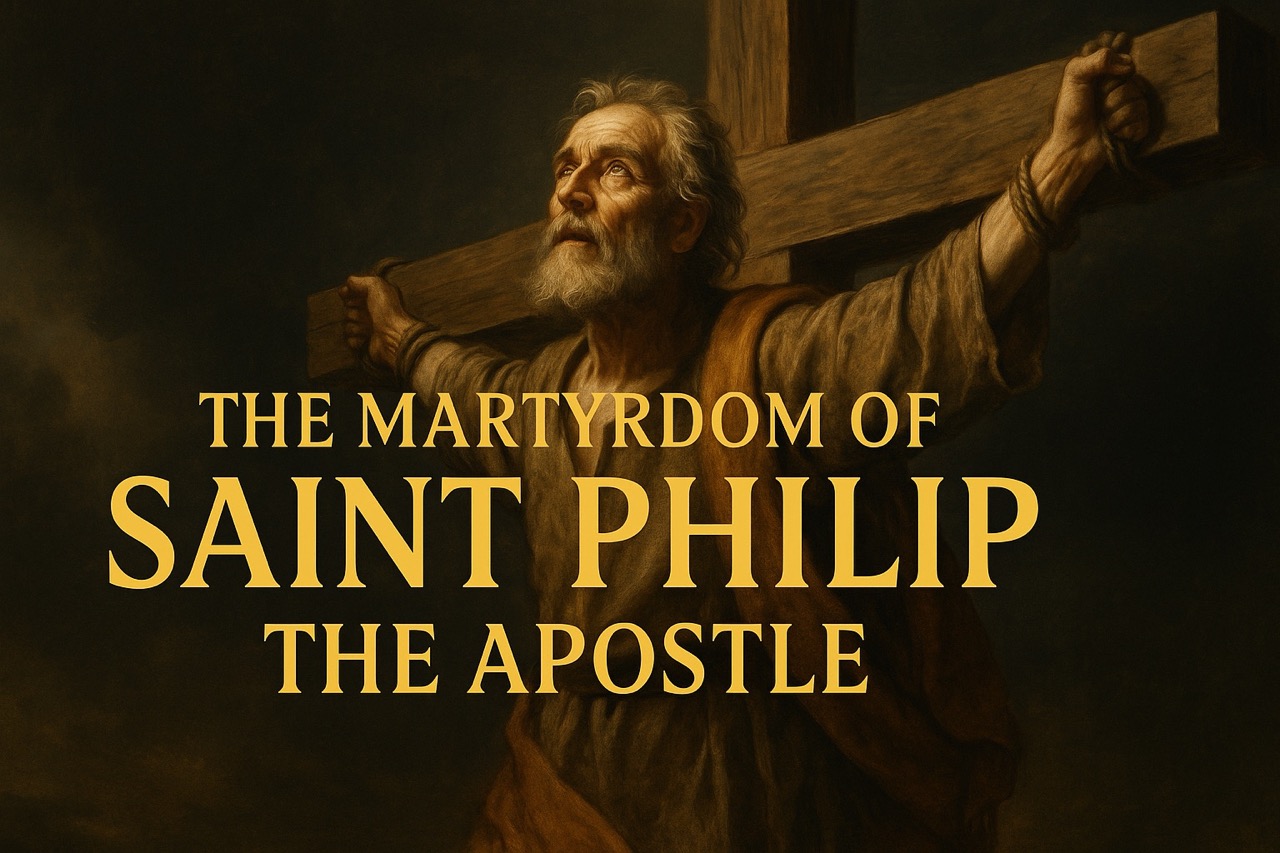

The Martyrdom of Saint Philip the Apostle serves as a poignant reminder that profound faith often manifests in quiet dedication. Though not as prominently featured in the Gospels as some of his peers, Philip’s unwavering commitment led him to a martyr’s death, steadfastly proclaiming the resurrection of Christ.
👣 Who Was Saint Philip?
Philip hailed from Bethsaida and was among the first to follow Jesus, as noted in John 1:43. His immediate response to Jesus’ call exemplifies his readiness to embrace the truth. He promptly shared this revelation with Nathanael, stating:
“We have found the one Moses wrote about in the Law… Jesus of Nazareth.”
— John 1:45
Throughout the Gospels, Philip’s interactions highlight his inquisitive nature and sincere devotion:
- John 6:5–7: Jesus tests Philip’s faith during the feeding of the 5,000.
- John 12:21–22: Philip facilitates the meeting between Jesus and seeking Greeks.
- John 14:8–9: His request to see the Father prompts Jesus to reveal His divine nature.
These instances portray Philip as a disciple eager to understand and share the truth.
📖 Scriptural References to Philip
Philip’s presence in key moments underscores his role in Jesus’ ministry:
- John 1:43–46: His calling and evangelism to Nathanael.
- John 6:5–7: Demonstrating faith amidst logistical challenges.
- John 12:21–22: Bridging cultural gaps to bring others to Christ.
- John 14:8–9: Seeking deeper understanding of Jesus’ relationship with the Father.
- Acts 1:13: Listed among the faithful after Jesus’ ascension.
⚔️ The Martyrdom of Saint Philip
After Jesus’ ascension, Philip preached in regions including Phrygia. His journey led him to Hierapolis (modern-day Pamukkale, Turkey), where he confronted pagan practices. His teachings attracted many converts, including the proconsul’s wife, which incited the authorities’ wrath.
Tradition holds that Philip was crucified in Hierapolis, possibly upside down, as some accounts suggest. Notably, the Acts of Philip, an apocryphal text, describes his crucifixion alongside Bartholomew. While Bartholomew was released, Philip chose to remain on the cross, ultimately leading to his death.
Archaeological discoveries in 2011 by Francesco D’Andria unearthed a first-century tomb in Hierapolis, believed to be Philip’s final resting place. This finding aligns with historical accounts of his martyrdom in the city.
🚪 Could Philip Have Escaped?
Philip had opportunities to avoid persecution. He could have returned to Judea or ceased his public preaching. However, his conviction in the truth of the resurrection compelled him to continue his mission, even in the face of death.
👁️ Significance of Philip’s Martyrdom
Philip’s martyrdom underscores the authenticity of the apostles’ testimonies. His willingness to die for his faith serves as compelling evidence of the resurrection’s reality. Unlike fabricated tales, such unwavering commitment suggests a profound truth experienced firsthand.
📖 Lessons from Philip’s Life
Philip’s story teaches that impactful faith doesn’t always seek the spotlight. His consistent dedication, even without widespread recognition, exemplifies true discipleship. In a world that often values prominence, Philip’s life reminds us of the power of steadfast, humble service.
📚 Internal Related Reading
- The Martyrdom of Saint Thomas the Apostle
From doubt to death, Thomas wrestled. Philip endured. - The Martyrdom of Saint James the Greater
James died first. Philip died faithfully. - The Endurance of Saint John the Beloved
John survived. Philip died. Both obeyed. - Peter’s Martyrdom: From Denial to Glory
Philip wasn’t as loud as Peter — but his loyalty ran just as deep. - Martyrdom of Jesus’ Disciples
One truth, twelve lives — and a church that wouldn’t die.
🌐 External Related Reading
- Eusebius – Church History (Book III)
Earliest mention of Philip’s ministry and martyrdom - Philip’s Tomb in Hierapolis – BiblePlaces
Archaeological site believed to mark Philip’s burial location - Philip the Apostle – Britannica
Historical overview of Philip’s life and legacy
🙋♂️ Frequently Asked Questions About the Martyrdom of Saint Philip the Apostle
📖 Life and Identity
❓ Who was Saint Philip the Apostle in the Bible?
Saint Philip the Apostle was one of the original Twelve disciples personally called by Jesus in John 1:43. He came from Bethsaida, the same town as Peter and Andrew, and is known for his thoughtful, sincere faith and early evangelism.
❓ Is Saint Philip the same person as Philip the Evangelist?
No. While their names are the same, they are distinct individuals. Philip the Apostle was one of the Twelve, while Philip the Evangelist was one of the Seven deacons appointed in Acts 6 and appears again in Acts 8 and Acts 21.
❓ What was Philip’s personality like according to scripture?
Philip is portrayed as curious, honest, and consistent. He asked deep questions (John 14:8) and brought others to Jesus (John 1:45, John 12:21). While not as outspoken as Peter or John, he was quietly faithful to the end.
✝️ Martyrdom and Death
❓ How did Saint Philip the Apostle die?
According to early Christian tradition, Philip was crucified in Hierapolis (modern-day Turkey) for preaching the Gospel. Some sources, such as the Acts of Philip, describe his crucifixion as being upside down — though this detail is debated by scholars.
❓ Where was Saint Philip crucified?
He was crucified in Hierapolis, Phrygia, an ancient Greco-Roman city located in what is now Pamukkale, Turkey. This area was known for its pagan worship and opposition to Christianity.
❓ Is there archaeological evidence for his death?
Yes. In 2011, archaeologists uncovered a first-century tomb believed to be the burial site of Saint Philip in Hierapolis. The tomb was found near the remains of a martyrium (a church honoring a martyr), supporting longstanding Christian tradition.
❓ Did Philip die alone, or were others with him?
Some ancient accounts suggest that Philip and Bartholomew were crucified together, though Bartholomew was later released. One tradition also states that one of Philip’s daughters was martyred during the same time.
❓ Was Saint Philip tortured before death?
While details vary, many traditions imply that Philip was tortured prior to crucifixion. His prolonged suffering reportedly became a public testimony, and some sources say he continued preaching from the cross.
🌍 Legacy and Theology
❓ Why is the martyrdom of Saint Philip the Apostle important?
Philip’s martyrdom is significant because it confirms the apostles’ unwavering belief in the resurrection of Jesus. He didn’t die for an abstract doctrine — he died because he knew Jesus was alive, and refused to deny it.
❓ What does the death of Saint Philip prove about early Christianity?
His death adds to the overwhelming evidence that the early apostles were not inventing a myth. They were willing to suffer and die because they had seen the risen Christ. This kind of martyrdom gives credibility to the Gospel message.
❓ What can modern Christians learn from Saint Philip?
Philip teaches that faithfulness doesn’t require fame. He lived quietly, followed Jesus consistently, and stood firm when it mattered most. His story is a reminder that obedience without applause is still sacred — and often more enduring than public success.
❓ What makes Saint Philip different from other apostles?
Unlike Peter, John, or Paul, Philip didn’t write scripture or lead the early church. But his legacy shows that even ordinary disciples, without fame or miracles, can bear powerful witness through endurance and sacrifice.