
GUIDED ARTICLE EXPERIENCE
Martyrdom of Jesus’s Disciples | How They Died for the Truth
Read along as the narration moves through the article.
Private device narration · No hosted audio or tracking
CONTINUE GUIDED TOUR
Continue where you left off.
GUIDED TOUR COMPLETE
You have reached the end of this study.
Study record saved on this device.
GUIDED TOUR
Martyrdom of Jesus’s Disciples | How They Died for the Truth
Narrator: Paranoid Prophet Recommended Voice Native device narration
Prepare to follow the article as it is narrated.
VOICE & TOUR OPTIONS
Voice & Listening
NARRATOR
Finding a narrator…
Checking the best narrator available on this device.
Restores the best curated narrator available on this device.
Narrator choices are curated for clear, long-form listening on this device.
Screen-awake support will be checked when narration starts.
CHOOSE A NARRATOR
Curated for this device
Choose a verified narrator for this browser, or use System Narrator. Automatic mode uses the best reliable route exposed by this device; your chosen narrator is preserved even if this device needs a temporary fallback.
Preparing the guided article experience…
RESUME GUIDED TOUR?
Continue where you left off.
GUIDED TOUR COMPLETE
You have reached the end of this study.
The martyrdom of Jesus’ disciples matters because it puts real cost around the earliest resurrection proclamation. The first Christians were not defending a private feeling, a vague inspiration, or a religious slogan. They proclaimed that Jesus had been crucified, raised from the dead, seen by witnesses, exalted by God, and made Lord.
Their suffering is not the whole resurrection case, but it is an important piece of the evidence puzzle. When the evidence is ranked honestly, the costly witness of the earliest Christians supports sincerity, weakens deliberate fraud theories, and shows that the resurrection proclamation came with consequences from the beginning.
A strong Christian case does not need to pretend every apostolic death tradition is equally certain. Some accounts are rooted in Scripture. Some are supported by early historical testimony. Some are strong traditions with debated details. Others are later, regional, conflicting, or difficult to verify. This article separates those categories so the argument becomes stronger, not weaker.
The question is not whether every traditional story about every apostle can be proven with the same level of confidence. It cannot. The better question is whether the earliest Christian witnesses appear to have invented the resurrection proclamation for comfort, power, or social advantage. The evidence points in the opposite direction. The resurrection message was public, costly, and tied to real people who suffered for proclaiming Jesus as the risen Lord.
The martyrdom argument is not that death automatically proves truth. It is that the earliest resurrection witnesses carried a public claim about Jesus into real danger.
For the broader case that Jesus is the Son of God, see the main Jesus Evidence hub: Is Jesus the Son of God? Evidence from History, Prophecy, Resurrection, and Scripture. This article serves one narrower purpose: to examine what we can and cannot know about the deaths of Jesus’ disciples and why their costly witness still matters.
Article Guide16 sections
Short Answer: Did Jesus’ Disciples Die for Their Resurrection Witness?
Some did. Some are very strongly remembered as suffering and dying as witnesses to Christ. Others are remembered in later tradition, but the details are harder to verify. The most careful answer is not, “Every apostle definitely died as a martyr in the way later stories describe.” The stronger answer is this: Scripture and early Christian history show that the resurrection proclamation was early, public, costly, and tied to named witnesses.
Scripture directly records the death of Stephen and the execution of James the son of Zebedee. Stephen was not one of the Twelve, but Acts presents him as an early Christian witness killed after publicly testifying before the council. James the son of Zebedee was one of Jesus’ apostles, and Acts says Herod killed him with the sword.
James the brother of Jesus is another major witness, though he was not one of the Twelve. Paul names him as someone to whom the risen Christ appeared, and Josephus later reports his execution in Jerusalem. Peter and Paul are not given death scenes in Acts, but early Christian memory strongly connects both men with suffering and death in Rome. John belongs in a different category: he is remembered as enduring exile and long witness, not as a clear martyrdom example.
Other apostolic death traditions should be handled more carefully. Andrew, Thomas, Philip, Bartholomew, Matthew, James son of Alphaeus, Jude / Thaddaeus, Simon the Zealot, and Matthias all have later traditions attached to their deaths, but those traditions vary in age, detail, and historical strength. Some may preserve real memory. Some are difficult to confirm. None should be treated as equal to Scripture.
So the short answer is this: the strongest evidence does not prove every later martyrdom detail, but it does show a serious pattern. The earliest Christian witnesses did not gain safety by proclaiming Jesus’ resurrection. They gained opposition, danger, exile, imprisonment, and in some cases death. Their witness points back to the crucified and risen Christ they refused to deny.
Scripture First, History Second, Tradition Carefully
This article follows a simple order: Scripture first, historical evidence second, scholarly context third, and apologetic synthesis last. Scripture is the final authority for who Jesus is. History and tradition can help us examine public claims about Jesus’ existence, crucifixion, early resurrection proclamation, and apostolic witness, but Scripture defines Jesus as Lord, Messiah, Son of God, Lamb of God, Savior, risen King, and coming Judge.
What Scripture Clearly Records
The New Testament clearly records that Jesus’ followers proclaimed His resurrection, suffered for His name, and carried that message into real danger. Acts records Stephen’s death after his public witness before the council (Acts 7). Acts also records that Herod killed James the brother of John with the sword (Acts 12:1–2).
Paul preserves an early summary of the resurrection proclamation in 1 Corinthians 15:3–8. He says Christ died for our sins according to the Scriptures, was buried, was raised on the third day according to the Scriptures, and appeared to Cephas, the Twelve, more than five hundred, James, all the apostles, and finally to Paul himself.
Paul also tells us he met Cephas and James the Lord’s brother in Jerusalem (Galatians 1:18–19). He describes his own sufferings in detail: beatings, imprisonments, dangers, hunger, sleepless nights, and constant pressure for the churches (2 Corinthians 11:23–28). Revelation places John on Patmos “on account of the word of God and the testimony of Jesus” (Revelation 1:9).
These texts do not give a complete death record for every apostle. They do something more important: they anchor the earliest Christian witness in resurrection proclamation, named people, public danger, and costly allegiance to Jesus Christ.
What Early History Can Support
Early historical sources can support some claims with real weight. Josephus gives an important non-Christian reference to the execution of James, identifying him as the brother of Jesus who was called Christ. That does not prove every later Christian detail about James’s death, but it does anchor James as a real Jerusalem figure connected to Jesus and executed in the first century.
Early Christian memory also matters, especially when it is close to the first generations of the church. First Clement, written from Rome near the end of the first century, remembers Peter and Paul as examples of faithful endurance under suffering. Later writers such as Tertullian, Origen, and Eusebius add more detail about Peter and Paul in Rome. Those later details should be weighed carefully, but they reinforce a broad early memory: the leading apostolic witnesses did not proclaim Christ from a place of safety.
Historical method can also help us avoid weak claims. It can show where a source is early or late, where traditions agree or conflict, and where later expansions should not be treated as first-tier evidence. A careful historical method does not replace faith. It protects the article from exaggeration and lets the strongest evidence do the heavy lifting.
What Later Tradition Can and Cannot Do
Later tradition should not be ignored, but it should not be treated as equal to Scripture. Traditions about Andrew, Thomas, Philip, Bartholomew, Matthew, James son of Alphaeus, Jude / Thaddaeus, Simon the Zealot, and Matthias may preserve real memory of missionary witness and suffering. They also contain disputed locations, varied methods of death, and details that are difficult to verify.
That does not make these traditions worthless. It means they must be used in the right lane. Later traditions can show how Christians remembered apostolic witness across regions and generations. They can fill out the wider memory of costly mission. But they cannot carry the same authority as Acts, Paul’s letters, Josephus, or the earliest Christian testimony.
The goal is not to flatten all sources into one pile. The goal is to let each source say what it can honestly say. Scripture gives the foundation. Early history gives important public anchors. Later tradition can be meaningful when carefully labeled. The whole case becomes stronger when weak evidence is not inflated and strong evidence is not buried.
With those rules in place, the next question is not whether martyrdom proves everything by itself. It does not. The better question is what martyrdom can actually support, what it cannot prove, and why the costly witness of the first Christians still matters for the resurrection case.
What Martyrdom Can and Cannot Prove
A careful Christian argument does not weaken martyrdom by defining its limits. It strengthens the case by showing exactly what this evidence can and cannot support.
Martyrdom by itself does not automatically prove a belief true. People can die sincerely for false beliefs, inherited traditions, political causes, religious movements, and ideas they never personally witnessed. That objection is real, and a serious article should not dodge it.
But the apostolic witness raises a narrower question. We are not mainly asking whether later believers were sincere. We are asking whether the earliest resurrection witnesses knowingly invented the proclamation that Jesus had risen and then carried that claim into danger, opposition, imprisonment, exile, and death.
That is where martyrdom becomes historically important. It is not a shortcut around the resurrection evidence. It is a supporting beam inside the larger case. The earliest Christians were not proclaiming that Jesus merely inspired them, lived on in their hearts, or left behind a moral legacy. They proclaimed that God had raised the crucified Jesus from the dead.
What This Evidence Can Support
Used carefully, martyrdom evidence can support the sincerity of the early witnesses. It shows that the resurrection proclamation was not a harmless private opinion. It brought real public pressure. The message could lead to rejection, interrogation, imprisonment, exile, and sometimes execution.
This matters because deliberate fraud theories require more than the claim that the disciples were mistaken. They require the earliest witnesses to know the resurrection was false while still publicly proclaiming it under conditions that made their lives harder, not easier.
The evidence can also support continuity between resurrection proclamation and suffering. In Acts, the church’s witness to Jesus brings public opposition. In Paul’s letters, resurrection proclamation is not separated from danger and affliction. In early Christian memory, leading witnesses such as Peter and Paul are remembered as men who endured suffering for Christ.
That does not prove every later death tradition. It does show that suffering was not a strange add-on to Christian memory. From the beginning, public witness to Jesus could carry a price.
What This Evidence Cannot Prove by Itself
Martyrdom cannot prove the resurrection by itself. It cannot prove every apostle died violently. It cannot prove that every later account of every apostle’s death is accurate. It cannot turn a late regional tradition into a first-century source. It cannot make all church memories equal in historical strength.
It also cannot prove that sincere suffering always means a belief is true. Sincerity matters, but sincerity is not the same thing as truth. A person can suffer honestly and still be wrong. That is why the resurrection case must be larger than martyrdom alone.
The strongest Christian case does not say, “The apostles died, therefore Christianity is proven.” It says something more careful: Jesus was crucified, the resurrection proclamation appeared very early, named witnesses were attached to that proclamation, and several of the strongest sources connect that witness to suffering and death.
That is a cumulative argument. Martyrdom belongs inside it, but it should not be forced to carry the whole weight of Christian faith. Scripture gives the full meaning of the resurrection. Historical evidence can show that the earliest proclamation was not a late legend or a safe invention.
Why Sincerity Is Not the Same as Truth
The objection is simple: people die for false beliefs. That is true. Many sincere people have suffered for things that were mistaken, distorted, or untrue. A responsible martyrdom argument must admit that from the start.
But not every kind of false belief is the same. There is a difference between dying for a tradition received from someone else and dying for a public claim you helped originate. Later believers may die for inherited beliefs they trust. The earliest witnesses are closer to the events being proclaimed.
That distinction does not force belief in the resurrection. It does narrow the question. If the earliest resurrection witnesses were lying, then they were not merely mistaken believers. They were proclaiming something they knew was false while accepting danger for it.
That is why the first-generation witness matters. The apostles and early witnesses did not simply inherit a centuries-old tradition. They proclaimed that Jesus had been crucified, buried, raised, and seen. They preached this message while the movement was young, exposed, and vulnerable.
Why Deliberate Fraud Theories Struggle
Martyrdom does not answer every skeptical theory. It does not, by itself, refute grief visions, mistaken interpretation, legendary development, or every alternative explanation. But it does put real pressure on one theory in particular: deliberate fraud.
If the earliest witnesses knowingly fabricated the resurrection, then their proclamation created a strange bargain. They did not gain immediate safety. They did not gain cultural approval. They did not gain an easy path into power. They proclaimed a crucified Messiah in a world where crucifixion meant shame, defeat, and public humiliation.
Their message called people to repent, confess Jesus as Lord, and join a movement that could bring social rejection and official pressure. That does not look like the easiest way to invent influence. It looks more like men and women convinced that God had acted in history by raising Jesus from the dead.
This is why the martyrdom argument should be stated with precision. It does not prove that every witness died in the exact way later tradition describes. It does make deliberate fabrication harder to believe. People may die for false beliefs. But knowingly dying for a claim one invented is a different kind of problem.
Why Martyrdom Belongs Inside the Larger Resurrection Case
The resurrection case should never rest on martyrdom alone. It begins with Jesus Himself: His life, His crucifixion, His burial, the early proclamation that He was raised, the named witnesses in the earliest Christian sources, and the rapid emergence of a movement centered on the risen Christ.
Paul’s summary in 1 Corinthians 15 matters because it shows that resurrection proclamation was already central before later church legends could grow around every apostle. Galatians matters because Paul personally knew Cephas and James the Lord’s brother. Acts matters because it shows public proclamation bringing immediate opposition. Josephus matters because he gives an external anchor for James. First Clement matters because early Roman Christian memory remembers Peter and Paul as suffering witnesses.
Martyrdom belongs inside that larger pattern. It is not the foundation of the gospel. Jesus Christ is. But the suffering of the early witnesses helps show that the resurrection proclamation was not cheap, vague, safe, or detached from real people.
The best argument is not that every tradition is equally strong. The best argument is that the strongest sources reveal a pattern of public risk around the earliest witness to the risen Christ. Later traditions may fill out the wider memory, but they must be ranked carefully.
That is why the evidence must be ranked. A death recorded in Acts does not carry the same kind of weight as a late regional tradition. Josephus is not the same kind of source as a medieval expansion. First Clement is not the same thing as a later apocryphal act. The case becomes stronger when each source is allowed to carry the weight it can honestly bear.
How This Article Ranks the Evidence
The deaths and sufferings of Jesus’ disciples are not all supported by the same kind of evidence. Some accounts are recorded directly in Scripture. Some are supported by early historical testimony or strong early Christian memory. Some are meaningful but depend more heavily on later tradition. Others are late, conflicting, or uncertain.
Ranking the evidence is not a retreat. It is what keeps the case from collapsing into exaggeration. A death recorded in Acts should not be treated the same way as a late regional tradition. Josephus should not be weighed the same way as a much later expansion. First Clement should not be confused with later apocryphal acts. Strong sources should lead. Later traditions should be used carefully. Uncertain details should be named honestly.
This is not a scoreboard of spiritual importance. It is a source-strength map. Stephen and James the son of Zebedee are not more valuable to Christ than quieter apostles whose deaths are harder to trace. The value of a witness is not measured by how many later stories survived about his death. The apostles matter because Christ chose them, sent them, and built the early witness through them.
This article uses five basic evidence lanes so readers can see which claims carry the most weight and which details require more caution.
Direct Biblical Death Accounts
This is the clearest category because the deaths are recorded in the New Testament itself. These accounts do not need later tradition to establish that public witness to Jesus became dangerous. Stephen’s death is narrated in Acts 7, though he was not one of the Twelve. James the son of Zebedee is the clearest apostolic martyrdom case because Acts 12 says Herod killed him with the sword.
Strong Early Historical or Traditional Anchors
This category includes figures whose deaths are not narrated in Acts but are supported by early historical evidence or strong early Christian memory. James the brother of Jesus is anchored by Paul and Josephus, with fuller later Christian tradition. Peter and Paul are remembered very early as suffering witnesses connected to Rome, though some details of their deaths come from later sources.
Endurance, Exile, and Costly Witness
John belongs in a different category. Revelation places him on Patmos because of the word of God and the testimony of Jesus, but he is not a clear martyrdom example. John matters because he keeps the argument honest. Not every apostle must be forced into a violent death tradition for the larger pattern of costly witness to remain serious.
Meaningful but Tradition-Dependent Accounts
Some apostolic death traditions may preserve real church memory, but they depend more heavily on later sources. Andrew, Thomas, Philip, Bartholomew, and Matthew are often remembered as missionary witnesses whose service to Christ brought suffering or death. Their traditions matter, but they should not be used with the same confidence as Acts, Josephus, Paul’s letters, or the earliest Christian testimony.
Late, Conflicting, or Quiet-Apostle Traditions
This category is not a trash pile. James son of Alphaeus, Jude / Thaddaeus, Simon the Zealot, and Matthias still matter because Jesus chose them or the early church recognized them. What is weaker is not their witness, but our surviving evidence about their deaths. Their biblical identities should be honored without forcing certainty onto later traditions that cannot bear it.
This evidence-ranking method allows the article to remain both faithful and persuasive. The point is not to win by exaggeration. The point is to ask what the evidence actually supports, where it is strongest, where it is weaker, and how the public witness of the earliest Christians points back to the risen Christ they proclaimed.
Quick Evidence Map of the Disciples and Early Witnesses
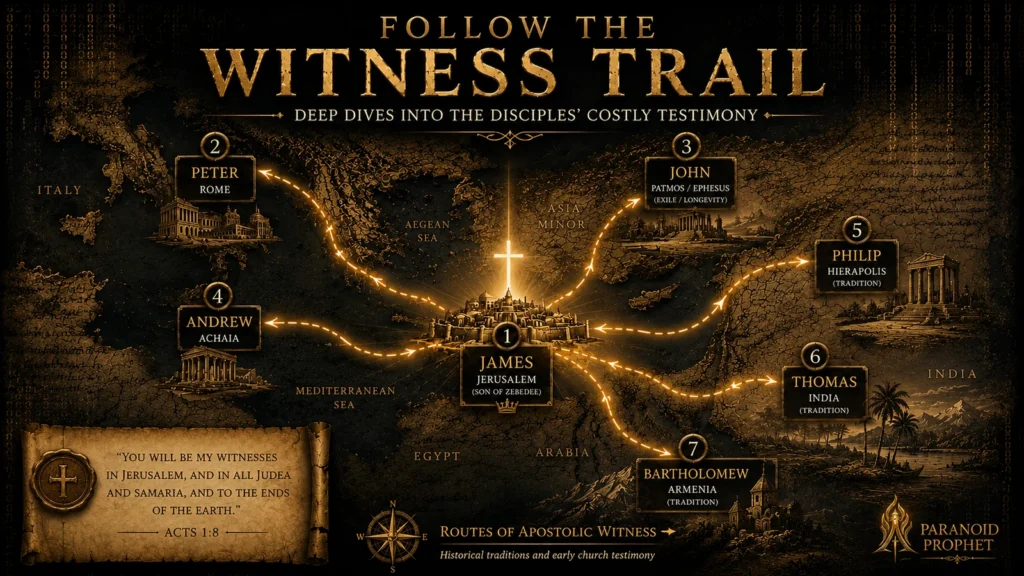
Before walking through the individual accounts, it helps to see the witness trail at a glance. The strongest anchors carry the center of the historical argument. The later traditions still matter, but they should serve as supporting church memory rather than the foundation of the case.
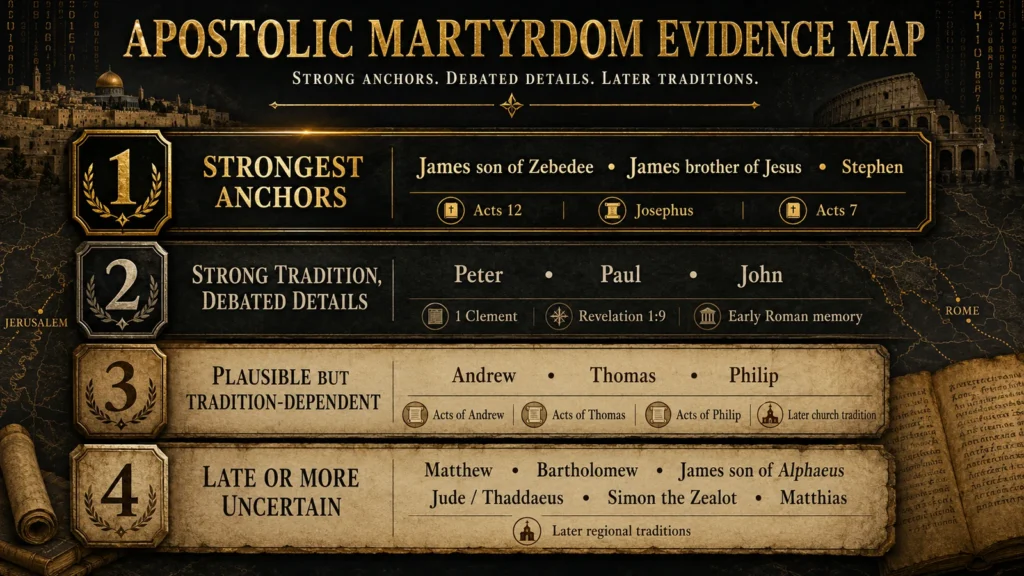
Read this map from strongest to weakest source support, not from greatest to least importance in the kingdom of God. The graphic details of a later martyrdom story may be memorable, but the question is source strength. Scripture, early historical testimony, and early Christian memory carry more weight than later regional traditions with conflicting details.
Each entry below gives the source strength, why the witness matters, and the caution that keeps the claim honest.
Direct Biblical Death Accounts
This is the strongest documentary category. The deaths are not reconstructed from later church memory; they are recorded in Acts as part of the early church’s public witness to Jesus.
Stephen
Source strength: Direct biblical death account. Acts 7 records Stephen’s testimony before the council, his vision of Jesus standing at the right hand of God, and his death by stoning.
Why he matters: Stephen was not one of the Twelve, but his death shows the witness to the risen and exalted Christ bringing lethal pressure very early in the church’s public life.
Use carefully: Stephen should be counted as an early Christian martyr, not as one of the Twelve apostles. Read the full article on how Stephen died.
James the Son of Zebedee
Source strength: Direct biblical apostolic death account. Acts 12:1–2 says Herod killed James the brother of John with the sword.
Why he matters: James was one of Jesus’ apostles and part of the inner circle often named with Peter and John. His execution shows that persecution reached the apostolic circle early after the resurrection proclamation began.
Do not overstate: Acts gives the death, but not a long final speech or detailed martyrdom biography. Read the full article on the martyrdom of James the son of Zebedee.
Strong Early Historical and Traditional Anchors
These accounts are not all the same kind of evidence, but they stand close enough to the early church’s memory to carry real weight. They should still be distinguished from later expansions and regional legends.
James the Brother of Jesus
Source strength: Strong historical anchor. Paul names James as a resurrection appearance recipient in 1 Corinthians 15:7 and says he met “James the Lord’s brother” in Jerusalem (Galatians 1:18–19). Josephus later reports James’s execution in Jerusalem.
Why he matters: James connects Jesus’ own family, the Jerusalem church, Paul’s first-generation contacts, the resurrection appearance tradition, and a non-Christian historical source.
Important distinction: James the brother of Jesus was not one of the Twelve, and Josephus should be separated from later dramatic Christian expansions. Read the full article on how James the brother of Jesus died.
Peter
Source strength: Strong early tradition, debated details. Peter is remembered very early as a suffering witness, especially in 1 Clement, with later testimony from Tertullian, Origen as preserved by Eusebius, and other Roman traditions.
Why he matters: Peter was one of Jesus’ closest apostles, a named resurrection witness in 1 Corinthians 15:5, and a leading preacher in the early church.
Source caution: Peter’s broad Roman martyrdom tradition is stronger than the later detail that he was crucified upside down. Read the full article on Peter’s martyrdom.
Paul
Source strength: Strong early tradition, debated details. Paul’s own letters describe repeated suffering, and 1 Clement remembers him as a suffering witness. Later Roman tradition remembers him as martyred in Rome, often by beheading.
Why he matters: Paul was a former persecutor of the church, the final named resurrection witness in 1 Corinthians 15:8, and a first-generation link to Cephas and James.
Keep the claim precise: Paul’s suffering is clear from his letters, and his Roman martyrdom memory is strong. The beheading detail belongs to later tradition. Read the full article on how Paul died.
Endurance and Exile
This category prevents a common overstatement. John is not useful because he proves that every apostle died violently. He is useful because even the major exception was remembered as suffering for the testimony of Jesus.
John
Source strength: Endurance and exile, not martyrdom. Revelation 1:9 places John on Patmos because of the word of God and the testimony of Jesus, while early church tradition often remembers him as living into old age.
Why he matters: John was one of Jesus’ closest apostles. His witness does not fit the simple “all apostles were martyred” claim, but Patmos still shows that testimony to Jesus could bring exile and suffering.
Keep the category clear: John should not be counted as a clear martyrdom example. He strengthens the article by keeping the argument honest. Read the full article on John’s endurance and exile.
Meaningful but Tradition-Dependent Accounts
These traditions may preserve real memory of apostolic mission and suffering, but they rely more heavily on later sources. They are useful as part of the wider witness trail, not as the center of the historical case.
Andrew
Source strength: Meaningful but tradition-dependent. Andrew is traditionally remembered as crucified, often associated with Achaia or Patras, with later Acts of Andrew material shaping parts of the memory.
Why he matters: Andrew was Peter’s brother, one of the Twelve, and one of the first disciples connected to Jesus in the Gospel tradition. His later death tradition places him inside the wider memory of apostolic mission and suffering.
Handle with restraint: The X-shaped cross is a famous later detail, but it should not carry the center of the argument. Read the full article on Andrew’s martyrdom tradition.
Thomas
Source strength: Meaningful but tradition-dependent. Thomas is traditionally connected with mission to India and death by spear or lance, especially through Acts of Thomas and later Syriac and Indian Christian memory.
Why he matters: Thomas was one of the Twelve and is remembered in John’s Gospel for confessing the risen Jesus as “My Lord and my God” (John 20:28). His tradition points eastward, showing how Christian memory carried apostolic witness beyond the Roman heartland.
Best caution: The Thomas-in-India tradition is significant, but the exact details of his mission and death remain debated. Read the full article on Thomas’s martyrdom tradition.
Philip
Source strength: Meaningful but tradition-dependent. Philip is traditionally associated with ministry and death in Hierapolis, with early church memory preserved through later writers and later Acts of Philip material.
Why he matters: Philip was one of the Twelve and appears in the Gospels as a disciple who brings others toward Jesus. His tradition belongs to the wider memory of apostolic mission in Asia Minor.
Important caution: Philip the apostle and Philip the evangelist can be confused in later tradition, so this account requires care. Read the full article on Philip’s martyrdom tradition.
Bartholomew
Source strength: Meaningful but tradition-dependent, with weaker graphic details. Bartholomew is traditionally remembered as flayed, beheaded, or otherwise killed in a mission field, but these reports come from later church tradition.
Why he matters: Bartholomew is named among the Twelve, even though Scripture gives little direct biographical detail about him. Later memory places him among apostolic witnesses whose mission carried danger.
Do not overstate: The flaying tradition is vivid, but vivid does not automatically mean historically strongest. Read the full article on Bartholomew’s martyrdom tradition.
Matthew
Source strength: Meaningful but tradition-dependent, with uncertain death details. Matthew is traditionally remembered as a missionary witness and often as a martyr, but the location and method vary.
Why he matters: Matthew was a tax collector called by Jesus and named among the Twelve. His biblical significance is clearer than the later traditions about his death.
The limit: Matthew’s death should not be used as a first-tier martyrdom proof because the traditions are varied and late. Read the full article on how Matthew died.
Late, Conflicting, or Quiet-Apostle Traditions
This final group needs the most restraint, but not dismissal. The New Testament gives their apostolic identity, not a detailed death record. Later traditions may preserve church memory, but the evidence is too mixed to make these figures carry the center of the martyrdom argument.
James Son of Alphaeus
Source strength: Late, conflicting, or uncertain. James son of Alphaeus is named among the Twelve, but Scripture gives very little detail about his life and ministry. Later traditions describe him as stoned, beaten, or otherwise killed.
Why he matters: His importance does not depend on reconstructing his death. He matters because Jesus chose him as one of the Twelve, even if the surviving record is quiet.
Use carefully: He is often confused with other men named James, especially James the brother of Jesus or James the Less. Read the full article on how James son of Alphaeus died.
Jude / Thaddaeus
Source strength: Late, conflicting, or uncertain. Jude / Thaddaeus was one of the Twelve and is remembered in later tradition as a missionary witness, sometimes linked with Simon the Zealot.
Why he matters: Jude / Thaddaeus should not be confused with Judas Iscariot. His biblical identity is part of the apostolic witness, even when later death traditions are difficult to untangle.
Source caution: Do not assume every Jude, Thaddaeus, Addai, or Judas tradition refers clearly to the same man or proves one specific death method. Read the full article on how Jude / Thaddaeus died.
Simon the Zealot
Source strength: Late and conflicting tradition. Simon the Zealot was one of the Twelve, but Scripture gives little detail beyond his apostolic name. Later traditions place his ministry and death in different regions.
Why he matters: Simon’s title reminds readers that zeal must be brought under Christ’s authority. His death tradition is uncertain, but his place among the Twelve is not.
Keep the claim modest: Do not claim one certain mission field, death method, or political biography beyond what the sources can support. Read the full article on how Simon the Zealot died.
Matthias
Source strength: Acts gives strong evidence for Matthias’s selection, but not for his death. Acts 1:15–26 presents him as chosen to join the apostolic circle as a witness to Jesus’ resurrection.
Why he matters: Matthias’s clearest role is resurrection witness. The center of his story is not how he died, but why he was chosen after Judas: to stand with the apostles as a witness that Jesus had risen.
Do not overclaim: Later traditions say Matthias was stoned, beheaded, or died naturally. Scripture records his appointment, not his death. Read the full article on how Matthias died.
This map does not dismiss later tradition. It puts each tradition in its proper lane. The strongest anchors do the heavy lifting. The later accounts fill out the wider memory of apostolic mission and public witness. With that method in place, the article can now begin where the evidence is strongest: the deaths and sufferings most clearly anchored in Scripture, early historical testimony, and early Christian memory.
Direct Biblical Death Accounts
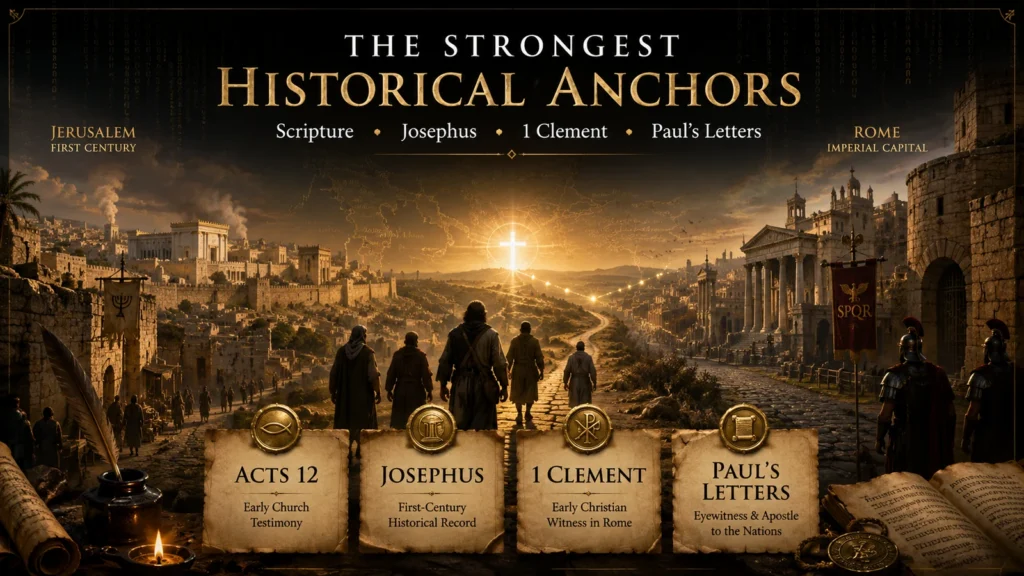
The strongest martyrdom evidence begins where the source trail is clearest: Scripture itself. These accounts do not depend on later church memory to establish that witness to Jesus could become dangerous. Acts directly records the deaths of Stephen and James the son of Zebedee, and those two accounts give the article its firmest biblical starting point.
Stephen was not one of the Twelve, so he should not be used to inflate the apostolic death count. James the son of Zebedee was one of the Twelve, so his execution stands as the clearest New Testament example of an apostle killed in the early life of the church. Together, they show that the resurrection proclamation was not treated as harmless religious speech. It brought public opposition, and sometimes death.
Stephen: The First Christian Martyr
Stephen belongs near the front of this discussion because Acts gives a direct account of his death. He was not one of the Twelve apostles, but he was one of the earliest public witnesses to Jesus after the resurrection, and his death shows how quickly Christian proclamation could become dangerous.
Acts presents Stephen as a man “full of grace and power” who bore witness before the council. His speech traces Israel’s story, exposes resistance to God’s messengers, and climaxes with his vision of “the Son of Man standing at the right hand of God” (Acts 7). The council responds with rage, drags him out, and stones him.
Stephen’s death matters because he does not die for a vague spiritual feeling. He dies after confessing the exalted Christ. His final witness places Jesus at the right hand of God, and his death shows that the early church’s message was not merely private devotion. It was public testimony to the risen and enthroned Lord.
Stephen also introduces another major figure into the story: Saul, who later becomes Paul. Acts says the witnesses laid their garments at Saul’s feet, and that Saul approved of Stephen’s execution. That detail matters because one of the earliest persecutors of the church later becomes one of the greatest proclaimers of the risen Christ.
Stephen should be handled carefully. He is not one of the Twelve, and his death does not answer every question about apostolic martyrdom. But he is a direct biblical example of early Christian witness under lethal pressure, and his testimony points straight to Jesus: risen, exalted, and standing at the right hand of God.
James the Son of Zebedee: The First Apostle Killed
James the son of Zebedee is the clearest apostolic martyrdom case in the New Testament. Acts does not give a long final speech or a dramatic death scene. It gives something shorter and stronger: “Herod the king laid violent hands on some who belonged to the church. He killed James the brother of John with the sword” (Acts 12:1–2).
This James was not a distant later figure. He was one of the Twelve and part of Jesus’ inner circle, often named with Peter and John in the Gospel narratives. He saw Jesus’ ministry from close range. He belonged to the apostolic company that proclaimed Christ after the resurrection. When Acts records his execution, it shows persecution reaching the apostolic circle itself.
That is why James carries such weight in the martyrdom discussion. His death is not built on a late regional tradition. It is reported in Acts. The account is brief, but its brevity should not be mistaken for weakness. Sometimes the strongest evidence is not the most dramatic; it is the most direct.
Still, careful wording matters. Acts tells us James was killed by Herod with the sword. It does not tell us every detail of his trial, his final words, or the full circumstances of his execution. A faithful article should not invent what Scripture does not give.
The secure point is enough: one of Jesus’ apostles was executed in the early life of the church. That does not prove every later martyrdom tradition about every apostle, but it does establish a major biblical anchor. The resurrection witness was not protected from danger. It reached the apostolic circle early, and James the son of Zebedee was the first apostle whose death Scripture records.
Strong Early Historical and Traditional Anchors
The next group is different. James the brother of Jesus, Peter, and Paul do not all belong to the same category as James the son of Zebedee. Their deaths are not narrated in Acts in the same direct way. Yet the evidence connected to them is strong enough to carry serious historical weight.
James the brother of Jesus is anchored by Paul’s letters and Josephus, with later Christian tradition adding fuller detail. Peter and Paul are remembered very early as suffering witnesses connected to Rome, though some famous details about their deaths appear later. These are not weak legends floating loose from history. They are strong anchors that must still be handled with source discipline.
James the Brother of Jesus: Jerusalem Leader and Resurrection Witness
James the brother of Jesus was not one of the Twelve, but he belongs near the top of this discussion because he connects several powerful strands of evidence: Jesus’ family, the Jerusalem church, Paul’s first-generation contacts, resurrection appearance tradition, and a non-Christian historical source.
Paul names James among those to whom the risen Christ appeared: “Then he appeared to James, then to all the apostles” (1 Corinthians 15:7). Paul also says that when he went to Jerusalem, he met Cephas and “James the Lord’s brother” (Galatians 1:18–19). That places James inside the earliest resurrection-witness network, not merely in later church memory.
Josephus later reports the execution of James and identifies him as “the brother of Jesus who was called Christ.” That brief notice is valuable because Josephus was not writing as a Christian apologist. It gives an external anchor: James was a real figure, publicly connected to Jesus, known in Jerusalem, and executed.
Later Christian sources, especially Hegesippus as preserved by Eusebius, give a fuller and more dramatic account of James’s death. Those traditions may preserve meaningful memory, but they should not be treated as identical in weight to Josephus. Josephus anchors the execution. Later Christian tradition expands the story.
James matters because he shows that the resurrection proclamation reached even into Jesus’ own family and became centered in the Jerusalem church. His death does not stand alone as the whole case for Christianity, but it gives the martyrdom argument serious historical weight when used carefully.
Peter: Leading Apostle, Strong Roman Martyrdom Tradition
Peter was one of Jesus’ closest apostles, a leading figure in the early church, and a named resurrection witness. Paul’s received resurrection tradition says Christ appeared to Cephas, then to the Twelve (1 Corinthians 15:5). That makes Peter important before we ever reach later martyrdom tradition.
The earliest major source for Peter’s suffering tradition is 1 Clement, commonly dated near the end of the first century. Writing from Rome, Clement points to Peter as an example of faithful endurance under suffering. He does not give a modern biography of Peter’s final hours, but his testimony is early, Roman, and important.
Later Christian writers add more detail. Tertullian, Eusebius, and traditions Eusebius preserves from Origen connect Peter’s final witness with Rome and crucifixion. Taken together, these sources give real weight to the broad tradition that Peter was martyred in Rome.
The famous detail that Peter was crucified upside down should be handled carefully. It is meaningful and deeply rooted in Christian memory, but it is later than the broad Roman martyrdom tradition. The safer claim is that Peter was strongly remembered as a suffering apostolic witness who died in Rome; the exact manner and later details belong in a more cautious category.
Peter matters because he stands close to Jesus, close to the resurrection proclamation, and close to the early church’s public witness. His martyrdom tradition does not need to be inflated to be useful. Used honestly, it places one of the central apostolic witnesses inside the pattern of proclamation, pressure, and costly allegiance to Christ.
Paul: Former Persecutor, Suffering Witness, Roman Martyrdom Memory
Paul is one of the strongest figures in the wider resurrection-witness discussion because his own letters give us early, first-person evidence for his conversion, proclamation, and suffering. Paul was not a sympathetic insider from the beginning. He was a persecutor of the church who became a preacher of the risen Christ.
Paul names himself as a resurrection appearance recipient in 1 Corinthians 15:8. In Galatians, he says he met Cephas and James the Lord’s brother in Jerusalem. That means Paul was not inventing a detached religion generations later. He stood in contact with the first-generation witness network.
Paul’s own letters also show that suffering was not a late legend added to his story. He describes imprisonments, beatings, danger from enemies, danger from travel, hunger, sleepless nights, and constant pressure for the churches (2 Corinthians 11:23–28). Before later tradition tells us how Paul died, Paul tells us what kind of life his witness produced.
Early Christian memory, especially 1 Clement, remembers Paul as a suffering witness. Later Roman tradition remembers him as martyred in Rome, often by beheading. That detail is plausible within later tradition, especially because Paul was remembered as a Roman citizen, but it should still be separated from the stronger evidence of his repeated suffering and broad Roman martyrdom memory.
Paul matters because he makes deliberate fraud theories harder to sustain. The former persecutor became a public witness to the risen Jesus, suffered repeatedly for that proclamation, and was remembered by the early church as giving his final witness in Rome. His life does not prove the resurrection by itself, but it gives serious weight to the claim that the earliest resurrection proclamation was not a convenient invention.
John: The Important Exception Who Still Endured
John deserves his own category because he protects the article from overstatement. He is traditionally remembered not as a martyr in the same sense as Peter, Paul, or James, but as an apostolic witness who suffered exile and lived into old age.
That makes John inconvenient for sloppy versions of the martyrdom argument, but valuable for a careful one. The claim should not be, “Every apostle definitely died violently.” The evidence does not support that. John keeps the argument honest by showing that costly witness can include endurance, exile, and long faithfulness, not only execution.
John Was Not a Clear Martyrdom Example
Later Christian tradition often remembers John as living into old age, especially in connection with Ephesus. We do not need to reconstruct every detail of that later memory for John to make the point. He should not be forced into a martyrdom category where he does not belong.
A strong Christian case does not need to make John die violently in order to defend the resurrection witness. Honest exceptions do not weaken the argument. They clarify it. If John endured rather than being executed, then the real pattern is not “all apostles died the same way.” The real pattern is that apostolic witness to Jesus carried real consequences.
Patmos Still Shows Costly Witness
Revelation places John on Patmos “on account of the word of God and the testimony of Jesus” (Revelation 1:9). That is not a death account, but it is a suffering account. John is separated, exiled, and marked by his testimony to Jesus.
Patmos matters because it shows that faithful witness did not always end in execution, but it was not cost-free. John’s category is different from James, Peter, or Paul, but it still belongs inside the larger pattern of public allegiance to Christ under pressure.
Why John Keeps the Argument Honest
John is not useful because he proves martyrdom. He is useful because he keeps the argument honest. Some witnesses died violently. Some suffered exile. Some traditions are stronger than others. The Christian case is not strengthened by pretending otherwise.
The better claim is more careful and more durable: the resurrection proclamation was public, dangerous, and costly. John does not break that pattern. He refines it. He reminds us that the goal is not to collect dramatic deaths, but to follow the witness trail back to Jesus Christ.
These strongest anchors carry the center of the martyrdom argument. The later apostolic traditions still matter, but they must be handled in a different lane. They belong to the wider memory of missionary witness, not the foundation of the case.
Meaningful but Tradition-Dependent Apostolic Accounts
The next group of apostles belongs in the wider witness trail, but not in the same evidence lane as Acts 12, Josephus, Paul’s letters, or 1 Clement. Their traditions may preserve real church memory, yet the sources are later, more regional, and often harder to verify.
That does not make these accounts worthless. It means they should be used honestly. The goal is not to erase Andrew, Thomas, Philip, Bartholomew, or Matthew from the martyrdom discussion. The goal is to honor their witness without asking later traditions to carry more historical weight than they can bear.
Andrew: Brother of Peter and the Crucifixion Tradition
Andrew was Peter’s brother, one of the Twelve, and one of the first disciples connected to Jesus in the Gospel tradition. Before any later death story is considered, Andrew already matters because he belonged to the apostolic company gathered around Christ.
Later Christian tradition remembers Andrew as a missionary witness who was crucified, often in Achaia or Patras. The famous X-shaped cross is one of the best-known details attached to him, but it belongs to later tradition and should not be treated as the strongest part of the evidence.
The center of Andrew’s story is not the shape of the cross. The center is the Lord he followed, the risen Christ the apostles proclaimed, and the witness the church remembered him carrying into the nations. Andrew’s tradition is meaningful, but it should serve as supporting church memory, not as a first-tier proof. Read the full article on Andrew’s martyrdom tradition.
Thomas: From Resurrection Confession to Eastern Mission Tradition
Thomas belongs in this discussion before any later India tradition is mentioned because Scripture gives him one of the clearest confessions of the risen Christ. When Thomas sees the risen Jesus, he answers, “My Lord and my God” (John 20:28).
Later tradition connects Thomas with mission to India and often remembers him as killed by spear or lance. That tradition is ancient and important in Syriac and Indian Christian memory, but the exact route, setting, and death details remain debated. Acts of Thomas and later regional memory should be read as tradition, not as Scripture.
The center of Thomas’s witness is not the spear. The center is the risen Christ Thomas confessed as Lord and God. His death tradition may be debated, but his biblical confession stands with power inside the resurrection witness of the New Testament. Read the full article on Thomas’s martyrdom tradition.
Philip: Hierapolis Tradition and the Need for Care
Philip was one of the Twelve and appears in the Gospels as a disciple who brings others toward Jesus. Scripture gives him a real apostolic identity, even though it does not give a death account.
Later Christian tradition connects Philip with ministry and death in Hierapolis. That tradition is meaningful, but it requires careful handling because Philip the apostle can be confused with Philip the evangelist in Acts. Later Acts of Philip material also contains legendary features that should not be treated as equal to early biblical testimony.
Philip reminds us that apostolic death traditions are not only about whether a martyrdom story is famous. They are also about whether the right person is being identified and whether the source can carry the claim being made. His witness matters, but the details must be handled with care. Read the full article on Philip’s martyrdom tradition.
Bartholomew: Famous Martyrdom Tradition, Weaker Details
Bartholomew is named among the Twelve, but Scripture gives little direct biographical detail about him. That silence does not make him unimportant. It simply means the later traditions about his mission and death must be weighed with extra care.
Christian tradition remembers Bartholomew as a missionary witness who was killed, sometimes by flaying, sometimes by beheading, and sometimes through other forms of execution depending on the tradition. The flaying account is famous and visually striking, but vivid does not automatically mean historically strongest.
Bartholomew is one of the clearest examples of why this article ranks evidence. A famous tradition may still be meaningful church memory, but it should not be treated like a direct biblical death account. His place among the Twelve is secure; the exact details of his death are less secure. Read the full article on Bartholomew’s martyrdom tradition.
Matthew: Tax Collector Turned Witness, Uncertain Death Tradition
Matthew was a tax collector called by Jesus and named among the Twelve. His transformation is biblically clear: Jesus called a man associated with tax collection into discipleship and made him part of the apostolic witness.
Matthew’s later death traditions vary. Some remember him as a missionary and martyr, but the location, method, and details are not consistent enough to use his death as a first-tier martyrdom proof. His witness is more secure than the later reports about how he died.
That does not reduce Matthew’s importance. It keeps the claim honest. Matthew matters because Christ called him out of the tax booth, transformed him by grace, and placed him among the Twelve. The later traditions may preserve memory of missionary suffering, but they should not carry the center of the resurrection argument. Read the full article on how Matthew died.
Late, Conflicting, or Quiet-Apostle Traditions
The final group requires the most restraint, but it should not be dismissed. James son of Alphaeus, Jude / Thaddaeus, Simon the Zealot, and Matthias are not less important because their death traditions are harder to trace. The weakness is in our surviving death evidence, not in Christ’s choice of these men.
Scripture gives their names and apostolic identity, but not detailed biographies or death accounts. Later traditions may preserve real church memory, yet they are often late, confused, or conflicting. These witnesses belong in the article, but they should not be forced to carry the foundation of the martyrdom case.
James Son of Alphaeus: A Quiet Apostle with Confused Later Traditions
James son of Alphaeus was one of the Twelve, but Scripture gives very little detail about his life and ministry. That quietness should not be mistaken for spiritual insignificance. Jesus chose him, and that alone gives him a real place in the apostolic witness.
Later traditions describe his death in different ways, including stoning, beating, or other forms of execution. The problem is not only that the traditions are later. It is also that several men named James appear in the New Testament and early Christian memory, which makes confusion easy.
James son of Alphaeus should be honored without blending him into James the brother of Jesus or James the son of Zebedee. His death tradition may be uncertain, but his place among the Twelve is not. Read the full article on how James son of Alphaeus died.
Jude / Thaddaeus: Not Judas Iscariot, Later Mission Traditions
Jude / Thaddaeus was one of the Twelve and should not be confused with Judas Iscariot. His very name requires care because the New Testament and later Christian tradition use several related names and titles that can be difficult to untangle.
Later traditions remember Jude / Thaddaeus as a missionary witness, sometimes pairing him with Simon the Zealot. Some accounts connect him with martyrdom, but the details vary and should not be treated as certain. It is especially important not to assume that every Jude, Thaddaeus, Judas, or Addai tradition refers to the same person.
The safest claim is that Jude / Thaddaeus belonged to the apostolic witness and was later remembered in missionary traditions. His death details require restraint, but his identity as a disciple of Christ should not be overshadowed by confusion over names. Read the full article on how Jude / Thaddaeus died.
Simon the Zealot: Zeal Under Christ, Conflicting Death Traditions
Simon the Zealot was one of the Twelve, but Scripture gives little detail beyond his apostolic name. His title is striking, but it should not become a license for building a full political biography that the New Testament does not provide.
Later traditions place Simon’s ministry and death in different regions, sometimes pairing him with Jude / Thaddaeus and sometimes giving different death methods. Those traditions may preserve a broad memory of missionary witness, but they do not give enough stable evidence to claim one certain location or manner of death.
Simon matters because Jesus gathered even a man called “the Zealot” into His apostolic company. Whatever his earlier associations may have been, his zeal was brought under the authority of Christ. The death tradition is uncertain; the Lord who claimed him is not. Read the full article on how Simon the Zealot died.
Matthias: Chosen as Resurrection Witness, Death Uncertain
Matthias is one of the clearest examples of why death traditions must not become the center of the article. Scripture does not record how Matthias died. Scripture records why he was chosen.
In Acts 1, the apostolic vacancy left by Judas is filled by someone who had accompanied the disciples during Jesus’ ministry and could become “a witness to his resurrection” (Acts 1:15–26). That is Matthias’s secure biblical center. His role is resurrection witness before it is ever a question about martyrdom.
Later traditions say Matthias was stoned, beheaded, or died naturally. Those traditions cannot all be treated as equally certain. But Matthias does not need a proven death method to matter. His witness is clearer than his death, and his appointment reminds readers that the resurrection stood at the center of apostolic identity. Read the full article on how Matthias died.
These quieter and tradition-dependent accounts do not weaken the cluster. They show why source discipline matters. Before this article draws the larger argument together, one more caution is needed: several apostolic names are easy to confuse, and confusion can make weak claims sound stronger than they are.
Identity Cautions: Do Not Confuse the Witnesses
Before drawing the larger argument together, the names need to be handled carefully. Several apostolic figures are easy to confuse, and confusion can make weak claims sound stronger than they are. A careful article should not borrow evidence from one witness and quietly attach it to another.
This is especially important in apostolic martyrdom traditions because later sources often preserve names, titles, regional memories, and death traditions that overlap. The goal is not to dismiss church memory. The goal is to keep each witness in his proper lane.
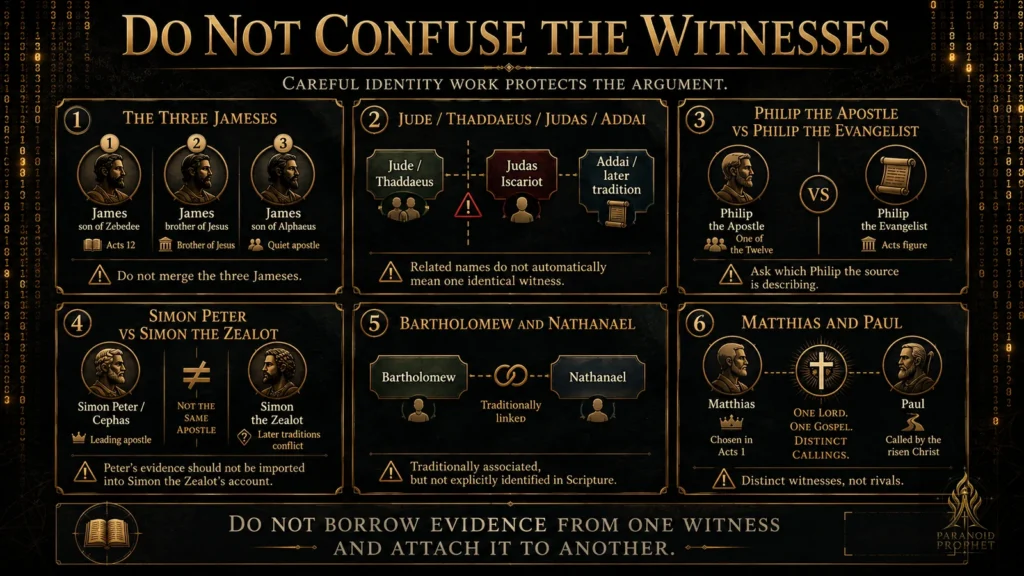
The Three Jameses
The New Testament gives us more than one important man named James. James the son of Zebedee was one of the Twelve and the brother of John. He is the apostle whose death is directly recorded in Acts 12:1–2.
James son of Alphaeus was also one of the Twelve, but Scripture gives very little detail about his life and death. James the brother of Jesus was not one of the Twelve, but Paul names him as a resurrection appearance recipient, and Josephus gives an important historical anchor for his execution in Jerusalem.
These three should not be merged. James the son of Zebedee gives us the clearest apostolic death account in Acts. James the brother of Jesus gives us a strong Jerusalem and Josephus anchor. James son of Alphaeus belongs in a quieter and more uncertain tradition lane.
Jude, Thaddaeus, Judas, and the Letter of Jude
Jude / Thaddaeus was one of the Twelve and should not be confused with Judas Iscariot. The names Jude and Judas are related in English translation, which can create confusion for modern readers. Later traditions also use names and titles such as Thaddaeus, Judas, and Addai in ways that are not always easy to untangle.
The New Testament letter of Jude identifies its author as “a servant of Jesus Christ and brother of James” (Jude 1:1). That figure is often associated with Jesus’ family, but this should not be flattened carelessly into every tradition about Jude / Thaddaeus the apostle.
The safe approach is simple: honor Jude / Thaddaeus as one of the Twelve, clearly distinguish him from Judas Iscariot, and avoid claiming that every Jude, Judas, Thaddaeus, or Addai tradition certainly refers to the same person.
Philip the Apostle and Philip the Evangelist
Philip the apostle was one of the Twelve. Philip the evangelist appears in Acts as a separate early Christian witness, associated with the spread of the gospel in Samaria and with the Ethiopian eunuch (Acts 8).
This distinction matters because later traditions about Philip can blur identities. When claims are made about Philip’s ministry, daughters, location, or death, the first question should be: which Philip is being discussed?
That does not make Philip’s tradition useless. It means the Hierapolis tradition and later Acts of Philip material should be read with identity discipline. The apostle’s witness matters, but the article should not strengthen his death tradition by accidentally importing evidence from another Philip.
Simon Peter and Simon the Zealot
Simon Peter and Simon the Zealot are different apostles. Simon Peter, also called Cephas, was one of Jesus’ closest apostles, a leading preacher in the early church, and a named resurrection witness in 1 Corinthians 15:5.
Simon the Zealot was also one of the Twelve, but Scripture gives little detail about him beyond his apostolic name. His later death traditions are far less certain than Peter’s Roman martyrdom memory.
Peter’s evidence should not be imported into Simon the Zealot’s account. Peter belongs among the stronger early traditional anchors. Simon the Zealot belongs among the later, conflicting, or quieter apostolic traditions.
Bartholomew and Nathanael
Bartholomew is named among the Twelve in the apostolic lists. Nathanael appears in John’s Gospel as a man brought to Jesus by Philip, and Jesus speaks of him as “an Israelite indeed, in whom there is no deceit” (John 1:45–51).
Many Christians have associated Bartholomew with Nathanael because Bartholomew appears in the Synoptic apostolic lists while Nathanael appears in John in close connection with Philip. That association may be reasonable, but Scripture does not explicitly say, “Bartholomew is Nathanael.”
So the careful wording is traditional or possible, not certain. Bartholomew’s place among the Twelve is clear. The identification with Nathanael should be handled as a common tradition, not a settled biblical statement.
Matthias and Paul
Matthias and Paul should not be set against each other as if one cancels the other. Matthias was chosen in Acts 1:15–26 to fill the vacancy left by Judas and to become a witness to Jesus’ resurrection. That selection is part of Scripture.
Paul was later called by the risen Christ and became an apostolic witness to the Gentiles. He names himself among those to whom the risen Christ appeared in 1 Corinthians 15:8, and his letters give early evidence for his proclamation and suffering.
Scripture gives both men dignity without requiring us to pit them against each other. Matthias’s death is uncertain, but his selection as a resurrection witness is clear. Paul’s calling is also clear, but that does not erase Matthias from the apostolic witness.
Why Their Witness Still Matters
After all the cautions, what remains? Not a simplistic claim that every apostle certainly died the same way. Not a demand that every later tradition be treated as equally strong. What remains is a public, early, named witness to the crucified and risen Jesus — a witness that often brought danger.
The point is not to make every tradition certain. The point is to let the strongest evidence speak clearly and the weaker evidence speak modestly. When that happens, the witness trail still matters. It shows that the earliest Christians did not treat the resurrection as a safe slogan. They proclaimed it in public, attached it to real people, and carried it into a world that could punish them for it.
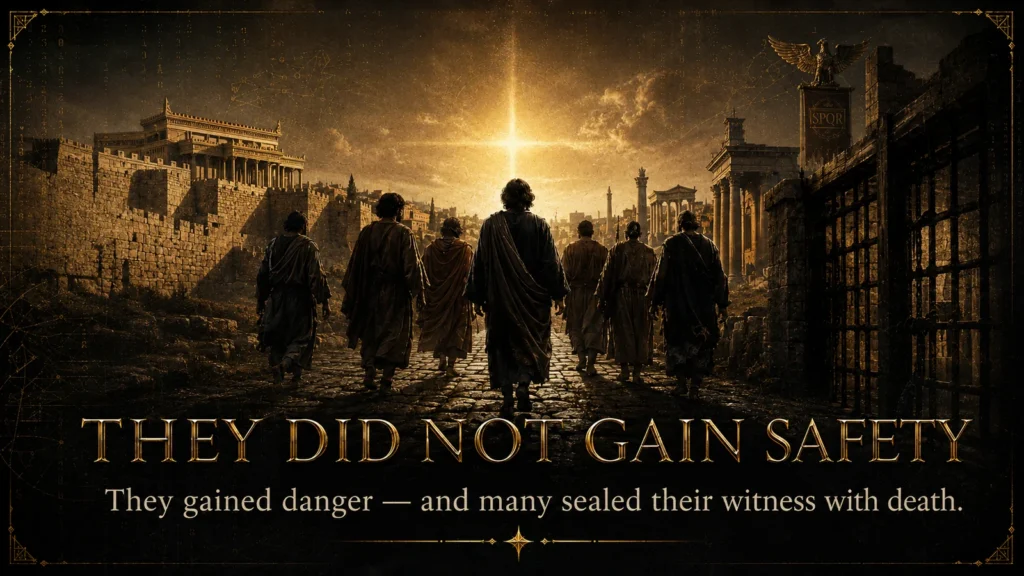
They Were Not Defending a Private Feeling
The earliest Christian witnesses were not merely saying that Jesus inspired them. They were not only preserving the memory of a beloved teacher. They proclaimed that Jesus died for sins, was buried, was raised on the third day, and appeared to witnesses (1 Corinthians 15:3–8).
That claim was public. Peter preached the resurrection in Jerusalem. Paul carried the message across the Gentile world. James the brother of Jesus became a leader in the Jerusalem church. The apostolic witness was not hidden in private mystical language. It was announced as an event God had accomplished in history.
This is why suffering matters in the argument. It does not make the resurrection true by itself. But it shows that the resurrection proclamation was not detached from real people, real danger, and real consequences.
They Proclaimed a Crucified and Risen Lord
The apostles did not proclaim a vague spiritual victory. They preached a crucified Messiah. In the Roman world, crucifixion was shameful, public, and brutal. It was not the kind of ending someone would normally invent to make a movement look powerful.
Yet the earliest Christian message did not hide the cross. It proclaimed that the crucified Jesus had been raised and exalted. Peter preached that God made the crucified Jesus both Lord and Christ (Acts 2:36). Paul preached Christ crucified and risen. John saw himself on Patmos because of the word of God and the testimony of Jesus.
The apostles are not the heroes of the gospel. Christ is. Their witness matters because it points away from themselves and toward Him: the Lamb of God, the risen Lord, and the King who reigns at the right hand of God.
Their Suffering Pressures Deliberate Invention Theories
Martyrdom does not answer every skeptical theory. It does not prove the resurrection by itself. It does not prove every death tradition in later church history. And yes, people can die sincerely for beliefs that are false.
But the first-generation witness creates a more specific problem for deliberate invention theories. The earliest witnesses were not merely dying for a tradition handed to them centuries later. They were close to the origin of the claim. They proclaimed that Jesus had been crucified, raised, and seen.
If that proclamation was a deliberate invention, then the earliest witnesses knowingly carried a false claim into danger, social loss, imprisonment, exile, and in some cases death. That does not force belief in the resurrection, but it makes the deliberate-invention explanation harder to sustain.
Their Deaths Are Not the Foundation — Christ Is
The deaths of Jesus’ disciples are not the foundation of Christian faith. Jesus Christ is. Their suffering can support sincerity, public consequence, and the seriousness of the early proclamation, but the gospel rests on Jesus Himself: His sinless life, His atoning death, His burial, His resurrection, His exaltation, and His promised return.
History can help show that the resurrection proclamation was early, public, and costly. Scripture tells us what the resurrection means. Jesus is not merely remembered by devoted followers. He is the risen Son of God, the Lord before whom every knee will bow, and the Savior who conquered death.
That is why the martyrdom argument should stay in its proper place. It is not the whole case. It is not the gospel. It is one witness trail among many, and every honest trail must lead back to Christ.
Common Objections About Apostolic Martyrdom
A careful article should answer objections directly. Some criticisms expose weak versions of the martyrdom argument, and those weak versions should be corrected. But the strongest form of the argument remains serious: the earliest resurrection proclamation was public, dangerous, and tied to named witnesses.
Did All the Apostles Die as Martyrs?
No. That claim is too broad. James the son of Zebedee is directly killed in Acts. Peter and Paul have strong early martyrdom traditions connected to Rome. John is remembered as enduring exile and long life. Several other apostolic death traditions depend on later sources and should be handled with caution.
The stronger claim is not that every apostle certainly died violently. The stronger claim is that the resurrection witness brought real danger, and several of the strongest sources connect that witness to suffering and death.
Does Martyrdom Prove Christianity Is True?
Not by itself. Martyrdom can support sincerity and public consequence, but it cannot carry the entire resurrection case. A person can suffer sincerely and still be wrong.
Christian faith finally rests not on the courage of the witnesses, but on the truth of the One they witnessed to.
The Christian case is cumulative. It includes Jesus’ crucifixion, the early resurrection proclamation, named witnesses, Paul’s received tradition, Paul’s contact with Cephas and James, the transformation of persecutors and skeptics, and the rise of a movement centered on the risen Christ. Martyrdom belongs inside that larger case, not above it.
Can People Die for False Beliefs?
Yes. That objection is valid. Many people have died sincerely for beliefs that Christians would say are false. Sincerity alone does not prove truth.
The important distinction is between later believers dying for inherited beliefs and first-generation witnesses suffering for a public claim close to its origin. That distinction does not force belief, but it pressures the idea that the resurrection proclamation began as deliberate fraud.
Isn’t This Just Church Legend?
Some later traditions contain legendary development. That is why this article ranks the evidence instead of treating every account as equal. Andrew, Thomas, Philip, Bartholomew, Matthew, James son of Alphaeus, Jude / Thaddaeus, Simon the Zealot, and Matthias all require caution when discussing death details.
But not everything is late legend. Acts records the deaths of Stephen and James the son of Zebedee. Paul’s letters preserve early resurrection proclamation and suffering testimony. Josephus gives an external anchor for James the brother of Jesus. Revelation places John on Patmos. First Clement gives early Roman memory of Peter and Paul as suffering witnesses.
Weren’t Many Death Traditions Written Too Late?
Yes, many death traditions are late compared with the New Testament. That is why they should not be used as first-tier evidence. Late does not always mean false, but it does mean lower confidence.
A responsible article can still mention later traditions when they are labeled correctly. They may preserve regional church memory, but they should not be treated with the same confidence as Acts, Paul’s letters, Josephus, Revelation, or the earliest Christian testimony.
Why Do the Traditions Disagree?
Different regions preserved different memories. Some names were easy to confuse. Later apocryphal acts expanded stories. Over time, dramatic details could grow around real apostolic figures.
Disagreement does not erase the strongest anchors, but it does warn us not to overstate the weaker details. The solution is not to ignore tradition or accept everything uncritically. The solution is to rank the evidence honestly.
Does John Disprove the Martyrdom Argument?
No. John disproves sloppy versions of the argument. He does not disprove the careful version. If someone claims every apostle certainly died violently, John is a problem for that claim.
But John still shows costly witness. Revelation places him on Patmos because of the word of God and the testimony of Jesus. His endurance reminds readers that faithful witness can include exile, pressure, and long obedience, not only execution.
Why Include Uncertain Traditions at All?
Because readers ask about all the apostles, and church memory matters when it is labeled correctly. Ignoring uncertain traditions can make the article feel incomplete. Pretending they are certain can make the article unreliable.
The better path is honest inclusion. Strong evidence should carry the center. Weaker traditions should be named carefully. Uncertainty should be admitted openly. That kind of source discipline does not weaken the Christian case. It makes the case more trustworthy.
The witness trail now needs two final pieces: a clean path into the full deep-dive articles and a focused source list for readers who want to test the claims. The case is strongest when the reader can follow the evidence, check the cautions, and see that every honest line leads back to the risen Christ.
Read the Full Witness Trail
This hub gives the map. The full articles give the evidence trail. Each deep dive looks more closely at the biblical texts, ancient sources, later traditions, identity cautions, and apologetic limits connected to that witness.
Read the strongest sources first, then move outward into the more tradition-dependent accounts. That order keeps the case honest and helps the reader see why the resurrection witness matters without treating every tradition as equally certain.
Direct Biblical Death Accounts
- How Did Stephen Die? — the first Christian martyr, directly recorded in Acts 7.
- The Martyrdom of James the Son of Zebedee — the clearest apostolic death account in Acts 12.
Strong Early Historical or Traditional Anchors
- How Did James the Brother of Jesus Die? — Jerusalem leader, resurrection appearance recipient, and Josephus anchor.
- Peter’s Martyrdom — leading apostle, named resurrection witness, and strong Roman martyrdom tradition.
- How Did Paul Die? — former persecutor, resurrection witness, suffering apostle, and Roman martyrdom memory.
Endurance and Exile
- John’s Endurance and Exile — the important exception who shows that faithful witness can mean exile and long endurance, not only execution.
Tradition-Dependent Apostolic Memories
- Andrew’s Martyrdom Tradition — brother of Peter and remembered missionary witness, with later crucifixion tradition.
- Thomas’s Martyrdom Tradition — resurrection confession in John 20:28 and later eastern mission tradition.
- Philip’s Martyrdom Tradition — apostolic witness connected to Hierapolis traditions, with identity cautions.
- Bartholomew’s Martyrdom Tradition — famous but source-dependent traditions requiring restraint.
- How Did Matthew Die? — tax collector turned witness, with later and varied death traditions.
Late, Conflicting, or Quiet-Apostle Traditions
- How Did James Son of Alphaeus Die? — a quiet apostle whose later traditions are easily confused with other James figures.
- How Did Jude / Thaddaeus Die? — one of the Twelve, not Judas Iscariot, with later mission traditions.
- How Did Simon the Zealot Die? — apostolic identity is clear, but later death traditions conflict.
- How Did Matthias Die? — chosen as a resurrection witness in Acts 1, though his death tradition remains uncertain.
Main Jesus Evidence Hub
For the larger case that includes history, prophecy, crucifixion, resurrection, deity, holiness, and the identity of Christ, return to the main hub: Is Jesus the Son of God? Evidence from History, Prophecy, Resurrection, and Scripture.
Sources and Further Reading
The sources below are not all equal in authority or historical weight. Scripture is the foundation. Early historical sources and early Christian testimony help anchor public claims. Later traditions can be useful, but they must be labeled carefully and weighed with restraint.
Scripture and New Testament Anchors
- Acts 7 — Stephen’s public witness and death.
- Acts 12:1–2 — James the son of Zebedee killed by Herod.
- Acts 1:15–26 — Matthias chosen as a witness to the resurrection.
- 1 Corinthians 15:3–8 — early resurrection proclamation and named witnesses.
- Galatians 1:18–19 — Paul’s contact with Cephas and James the Lord’s brother.
- 2 Corinthians 11:23–28 — Paul’s suffering testimony.
- Revelation 1:9 — John on Patmos because of the word of God and testimony of Jesus.
- John 20:28 — Thomas’s confession of the risen Jesus: “My Lord and my God.”
Ancient Historical Anchors
- Josephus, Antiquities of the Jews 20.200 — important non-Christian reference to James, identified as the brother of Jesus who was called Christ.
- Tacitus, Annals 15.44 — Roman reference to Christus, Pontius Pilate, and early Christians in Rome. This is background for Jesus’ crucifixion and the historical setting of early Christianity, not a direct source for apostolic deaths.
Early Christian Memory
- 1 Clement 5 — early Roman Christian memory of Peter and Paul as suffering witnesses.
- Eusebius, Ecclesiastical History, Book 2, Chapter 23 — preserves later Christian traditions about James the brother of Jesus, including material associated with Hegesippus.
- Eusebius, Ecclesiastical History — also preserves earlier traditions and reports connected to Peter and Paul. Use Eusebius carefully because he often stands as a later collector of earlier material.
- Tertullian — a later source often discussed in connection with Peter and Paul’s Roman martyrdom traditions. Useful, but not equal in weight to Scripture, Paul’s own letters, or the earliest anchors.
Later Tradition-Dependent Sources
Later sources such as the Acts of Andrew, Acts of Thomas, Acts of Philip, and regional traditions about Bartholomew, Matthew, Jude / Thaddaeus, Simon the Zealot, and Matthias should not be treated as equal to Scripture or early historical testimony. They can still help explain how later Christians remembered apostolic mission, suffering, and martyrdom.
These sources are useful only when handled in the right lane. They may preserve echoes of real memory, but they often include legendary expansion, theological storytelling, regional claims, and conflicting details. A strong article lets them speak modestly instead of forcing them to carry the center of the case.
Modern Scholarship and Source Discipline
Modern scholarship can help readers weigh dates, genres, source layers, and historical claims. It should not replace Scripture, and it should not be used to make weak evidence sound stronger than it is. The most useful scholarship for this topic is careful about the difference between direct biblical testimony, early historical anchors, early Christian memory, and later tradition.
- Sean McDowell, The Fate of the Apostles — focused study on apostolic martyrdom traditions and levels of historical probability.
- N. T. Wright, The Resurrection of the Son of God — major work on resurrection belief in its Jewish and early Christian setting.
- Michael Licona, The Resurrection of Jesus — historical argument for the resurrection using historiographical method.
- Richard Bauckham, Jesus and the Eyewitnesses — important work on eyewitness testimony and Gospel memory.
- Craig Keener, Acts: An Exegetical Commentary — detailed historical and exegetical work on Acts and the early church.
- Bart D. Ehrman, works on the historical Jesus and early Christianity — useful as a critical scholarly perspective, especially where skeptical scholars still affirm Jesus’ existence and crucifixion.
Conclusion: Costly Witness to the Risen Christ
The martyrdom of Jesus’ disciples should not be exaggerated. The New Testament does not record a death scene for every apostle. Later traditions are not all equal. Some are strong. Some are meaningful but dependent on later sources. Some are late, conflicting, or difficult to verify. A faithful Christian case does not need to pretend otherwise.
But after the cautions are made, something serious remains. Jesus’ earliest followers proclaimed His resurrection in public. They named witnesses. They preached a crucified and risen Lord. They carried that message into opposition, exile, imprisonment, social loss, and in some cases death. The resurrection proclamation was not a comfortable slogan. It was a public claim about what God had done in history.
Martyrdom does not prove the resurrection by itself. It does not settle every historical question. It does not make every later tradition certain. But it does support the sincerity and seriousness of the early witness. It makes deliberate invention harder to believe. It shows that the first Christian proclamation was not detached from real people who suffered for the name of Jesus.
Still, the apostles are not the center of the gospel. Their courage matters because it points beyond them. Their suffering matters because it testifies to the One they refused to deny. Their deaths are not the foundation of Christian faith. Jesus Christ is.
Their blood is not the foundation of the gospel; Jesus Christ is. He is the crucified Savior, the risen Lord, the Son of God, the Lamb who was slain, the King who reigns, and the Judge who will come again. The witness trail ends where Christian faith begins and remains: not in the death of the disciples, but in the crucified and risen Lord Jesus Christ.