
GUIDED ARTICLE EXPERIENCE
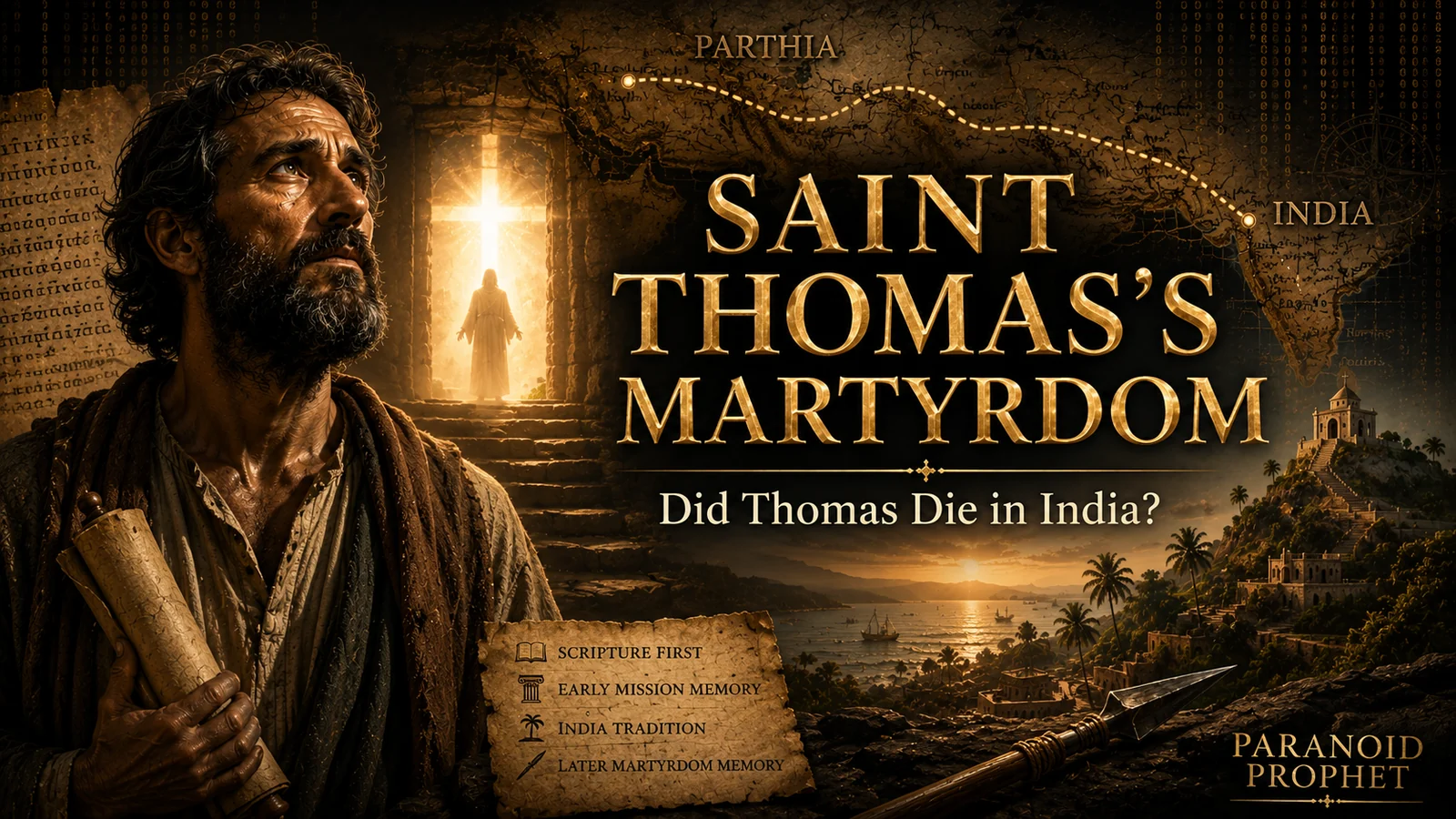
Saint Thomas’s Martyrdom: Did Thomas Die in India?
Read along as the narration moves through the article.
Private device narration · No hosted audio or tracking
CONTINUE GUIDED TOUR
Continue where you left off.
GUIDED TOUR COMPLETE
You have reached the end of this study.
Study record saved on this device.
GUIDED TOUR
Saint Thomas’s Martyrdom: Did Thomas Die in India?
Narrator: Paranoid Prophet Recommended Voice Native device narration
Prepare to follow the article as it is narrated.
VOICE & TOUR OPTIONS
Voice & Listening
NARRATOR
Finding a narrator…
Checking the best narrator available on this device.
Restores the best curated narrator available on this device.
Narrator choices are curated for clear, long-form listening on this device.
Screen-awake support will be checked when narration starts.
CHOOSE A NARRATOR
Curated for this device
Choose a verified narrator for this browser, or use System Narrator. Automatic mode uses the best reliable route exposed by this device; your chosen narrator is preserved even if this device needs a temporary fallback.
Preparing the guided article experience…
RESUME GUIDED TOUR?
Continue where you left off.
GUIDED TOUR COMPLETE
You have reached the end of this study.
Saint Thomas’s martyrdom is one of the most famous apostolic death traditions, but Thomas’s story does not begin with a spear in India. It begins with a disciple who met the risen Christ and confessed, “My Lord and my God.”
That matters because Thomas is often reduced to one word: doubt. He is remembered as “Doubting Thomas,” the man who would not believe unless he saw the wounds of Jesus for himself. But Scripture does not leave Thomas there. In John’s Gospel, doubt is not the end of his story. Confession is.
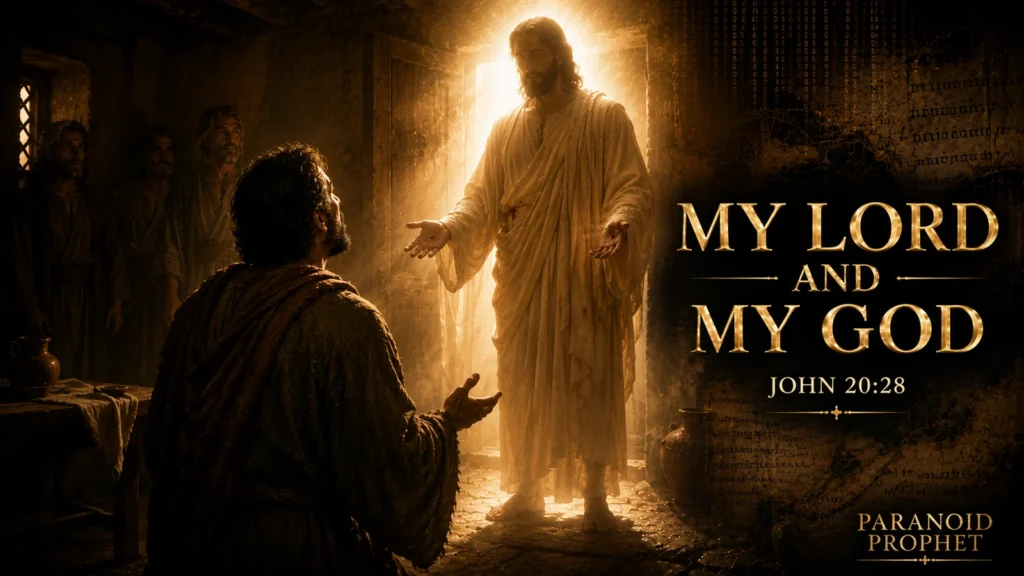
Thomas asked for evidence. Jesus met him with mercy and correction. The risen Christ showed him the wounds of crucifixion and called him out of unbelief. Thomas responded with one of the clearest confessions of Jesus’s divine identity in the New Testament: “My Lord and my God” (John 20:24–29).
Later Christian tradition remembers that same apostle carrying the gospel eastward, especially in traditions connected with India, and suffering for Christ. Those memories are important. They deserve serious attention. But they must be handled in the right order.
Scripture records Thomas’s apostolic identity, his honest questions, his encounter with the risen Jesus, and his confession of Christ as Lord and God. Scripture also places Thomas among the apostles after the ascension (Acts 1:12–14). But the New Testament does not record Thomas’s death.
That means the India account, the Mylapore memory, St. Thomas Mount, and the spear or lance associated with Thomas’s martyrdom belong to Christian tradition rather than direct biblical report. Caution is not cynicism. It is part of a stronger Christian case. A faithful article does not need to make every claim sound equally certain.
This article argues something more careful and more credible: Thomas’s biblical witness is strong, his confession of the risen Jesus is the theological center of his story, and his later martyrdom tradition belongs inside the larger disciple witness and martyrdom trail when handled honestly.
The center of Thomas’s story is not the spear. The center is the risen Christ Thomas confessed.
Article Guide9 sections
Saint Thomas’s Martyrdom: Evidence at a Glance
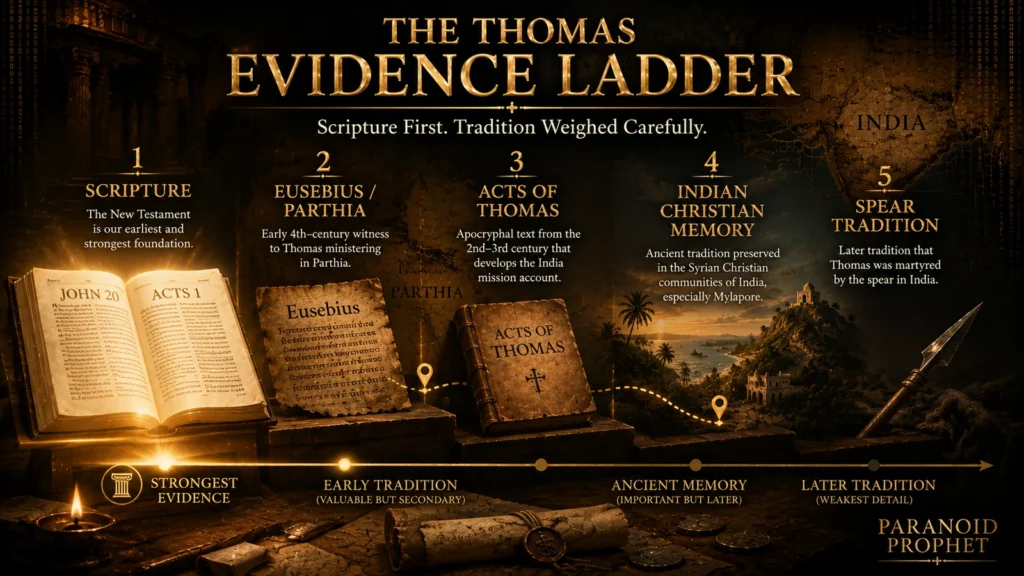
A serious article on Thomas should keep the evidence in order. Scripture gives us Thomas the apostle, the honest questioner, and the witness who confessed Jesus as Lord and God. Early Christian tradition connects Thomas with mission eastward. Later and apocryphal traditions connect him with India, Mylapore, St. Thomas Mount, and martyrdom by spear or lance.
| Person | Thomas the Apostle |
| Also Known As | Didymus, “the Twin” |
| Relationship to Jesus | One of the Twelve |
| Key Biblical Identity | An honest, questioning disciple who encountered the risen Christ and confessed Him as “My Lord and my God.” |
| Major Scripture Texts | John 11:16; John 14:5–6; John 20:24–29; Acts 1:13 |
| Resurrection Connection | Thomas demanded evidence, encountered the risen Christ, and confessed Jesus as Lord and God. |
| Death in Scripture | The New Testament does not record Thomas’s death. |
| Early Missionary Tradition | Eusebius preserves a tradition associating Thomas with Parthia. |
| India Tradition | The Acts of Thomas and later Indian Christian memory connect Thomas with mission in India. |
| Martyrdom Tradition | Later tradition often remembers Thomas as martyred by spear or lance near Mylapore or St. Thomas Mount. |
| Evidence Strength | Strong for the biblical Thomas; more cautious for exact mission and death details. |
| Best Apologetic Use | Thomas supports the sincerity, cost, and continuity of apostolic witness, not a standalone proof of the resurrection. |
This evidence map keeps Thomas in the right lane. He should not be reduced to a doubter, a travel legend, a spear tradition, or a slogan about martyrdom. Scripture first shows him as a real disciple who faced danger with Jesus, asked honest questions, met the risen Christ, and confessed Him as Lord and God.
The later traditions matter because they are attached to that kind of witness. But the order matters. John 20 is Scripture. The Acts of Thomas is not. Thomas’s confession is stronger than the later details of his death. His martyrdom tradition should be studied, but it should not be made to carry more weight than it can bear.
What This Article Is Arguing
This article argues that Thomas matters because of who he followed, what he saw, what he confessed, and how the church remembered his witness.
Thomas was not a distant Christian defending a story centuries removed from Jesus. He belonged to the first generation of disciples. He walked with Christ before the cross. He wrestled honestly with confusion. He was absent when Jesus first appeared to the gathered disciples after the resurrection, and he refused to accept the report without evidence.
Jesus did not answer Thomas by praising unbelief. He confronted it. But He also met Thomas with mercy. He showed him the wounds of crucifixion and called him to believe. Thomas’s answer was not cautious admiration. It was worship: “My Lord and my God.”
That confession is the center of Thomas’s witness. Before the article asks how Thomas died, it must ask whom Thomas confessed. The answer is not merely “a teacher,” “a prophet,” or “a martyr.” Thomas confessed the risen Jesus as Lord and God.
Christian tradition later remembers Thomas as a missionary who carried the gospel eastward and suffered for Christ. The details require careful handling. Scripture does not tell us that Thomas died in India. It does not narrate Mylapore, St. Thomas Mount, the spear, or his final words. Those details come through tradition, including apocryphal and later Christian sources.
Still, historical caution does not make the tradition meaningless. The Thomas tradition is worth studying because it connects a named apostle, a powerful resurrection confession, eastern missionary memory, and a long Christian tradition of costly witness. The point is not to pretend every detail is equally certain. The point is to weigh the evidence honestly and ask what Thomas’s witness contributes to the larger case for Christ.
Thomas’s martyrdom tradition does not prove the resurrection by itself, and it should not be used that way. The stronger argument is cumulative. Thomas was a real apostle who demanded evidence, encountered the risen Christ, confessed Him as Lord and God, remained among the apostolic company, and was later remembered as carrying that confession at great cost.
That is not the story of a man defined by doubt. It is the story of a witness whose doubt was answered by the risen Christ.
Who Was Thomas to Jesus?
Before Thomas is remembered as a martyr, he must first be seen as a disciple.
Scripture does not introduce Thomas through India, Mylapore, St. Thomas Mount, or the spear tradition. It introduces him as one of the Twelve: a real man who followed Jesus, misunderstood Him at times, asked direct questions, and was eventually brought face-to-face with the risen Christ.
That matters because Thomas is often flattened into a single nickname: “Doubting Thomas.” The nickname is not completely unfair, but it is incomplete. Thomas did doubt. He did demand evidence. He did refuse to accept the resurrection report from the other disciples without seeing the wounds of Jesus for himself.
But that is not the whole biblical Thomas.
John’s Gospel shows a fuller picture. Thomas could be blunt, loyal, confused, courageous, and deeply honest. He was not the loudest apostle. He was not the most publicly prominent. But when John names him, the scenes are not throwaway details. They prepare the reader for one of the strongest confessions of Christ in the New Testament.
Thomas the Twin
John identifies Thomas as “the Twin,” using the name Didymus (John 11:16; John 20:24). Scripture does not tell us who his twin was, and a careful article should not build speculation where the Bible is silent.
The important point is simpler: Thomas was a named apostle in the circle of Jesus. He was not a later symbol invented to make a moral point about doubt. He belonged to the first generation of disciples who walked with Christ before the cross.
That gives his later witness weight. The man remembered in Christian tradition as carrying the gospel eastward is first known from Scripture as one of Jesus’s own disciples. His story begins not with a legend, but with a name among the Twelve.
“Let Us Also Go, That We May Die with Him”
One of the most overlooked Thomas scenes comes before the resurrection, before the famous demand to see the wounds, and before his confession of Jesus as Lord and God.
In John 11, Jesus prepares to go back toward Judea after the death of Lazarus. The disciples know the danger. They remember that the Jewish leaders had recently sought to stone Jesus. Going back toward that region does not look safe.
Thomas speaks into that tension: “Let us also go, that we may die with him” (John 11:16).
That line is not shallow unbelief. It sounds like grim loyalty. Thomas may not understand everything Jesus is doing. He may not see the glory about to be revealed at Lazarus’s tomb. He may even speak with a heavy realism that expects the worst.
But he is not detached. If Jesus is going toward danger, Thomas is willing to go with Him.
This is why reducing Thomas to “the doubter” is too thin. The same man who later struggles to believe the resurrection report is also the man who, earlier in the Gospel, is willing to walk toward danger with Jesus. Thomas’s faith is not simple, polished, or easy. But it is real enough to follow Christ into risk.
“Lord, We Do Not Know Where You Are Going”
Thomas appears again in the upper room, where Jesus speaks to His disciples about His Father’s house and the way He is going. Jesus tells them, “You know the way to where I am going.” Thomas answers with the kind of honesty that makes him so human: “Lord, we do not know where you are going. How can we know the way?” (John 14:1–6).
Thomas asks what others may have wondered but did not say. He does not pretend to understand. He does not hide behind religious language. He brings his confusion into the open.
Jesus’s answer becomes one of the clearest statements of His identity and exclusive saving role in all of Scripture: “I am the way, and the truth, and the life. No one comes to the Father except through me” (John 14:6).
That moment matters for Thomas’s portrait. His question is not the center; Christ’s answer is. But Thomas’s honesty becomes the occasion for Jesus to reveal Himself more clearly. The disciple who did not know the way was standing before the One who is the way.
That pattern prepares us for John 20. Thomas does not need vague religion. He needs Christ Himself. His questions are real, but Jesus’s answers are greater.
Thomas and the Wounds of the Risen Christ
The scene that defines Thomas in public memory comes after the resurrection.
Thomas was not with the other disciples when Jesus first appeared to them. When they told him, “We have seen the Lord,” Thomas did not accept the report easily. He demanded to see the marks of the nails and the wound in Jesus’s side before he would believe (John 20:24–25).
That demand was serious. Thomas was not asking for a vague spiritual feeling. He wanted the crucified Jesus. He wanted continuity between the One who died and the One the disciples claimed was alive.
This moment does not merely explain why Thomas is remembered for doubt. It prepares the reader for why Thomas matters as a witness. The man who demanded evidence would soon stand before the risen Christ and answer with one of the clearest confessions in the New Testament.
Before later tradition remembers Thomas carrying the gospel eastward, Scripture shows the decisive movement of his life: he follows Jesus toward danger, asks honest questions, demands evidence, and is brought from doubt to confession.
Thomas Among the Apostles After the Ascension
Thomas does not disappear after John 20.
The book of Acts lists him among the apostles gathered in Jerusalem after the ascension of Jesus. Acts names “Peter and John and James and Andrew, Philip and Thomas, Bartholomew and Matthew, James the son of Alphaeus and Simon the Zealot and Judas the son of James” (Acts 1:12–14).
Acts does not tell us how Thomas died. It does not narrate his mission to Parthia, India, Mylapore, or St. Thomas Mount. Those questions belong to later tradition and must be weighed carefully.
But Acts does show something important: Thomas remains among the apostolic company after the resurrection and ascension. He is not presented as a man who had a dramatic moment in John 20 and then vanished from the witness community. He belongs among the first-generation apostles before the public mission of the church moves outward.
This is modest evidence, but it matters. Thomas’s later tradition is not attached to an anonymous figure. It is attached to one of the Twelve, a disciple who walked with Jesus, encountered the risen Christ, confessed Him as Lord and God, and remained among the apostolic witnesses after the ascension.
The strongest part of Thomas’s story is not the later spear tradition. It is the biblical witness that comes before it. Thomas asked for wounds. Jesus stood before him as the crucified and risen Lord. Thomas did not merely confess that Jesus had survived. He confessed Him as Lord and God.
That is the center of Thomas’s witness. Before Christian tradition remembers where he went or how he died, Scripture shows us whom he worshiped.
What Do We Actually Know About Thomas’s Death?
By this point, the strongest part of Thomas’s witness is already clear from Scripture.
Thomas was one of the Twelve. He followed Jesus before the cross. He asked honest questions. He encountered the risen Christ. He confessed Jesus as “My Lord and my God.” He remained among the apostles after the ascension.
But when we ask how Thomas died, the evidence changes categories.
The New Testament does not record Thomas’s death. It does not narrate his final mission field, his final sermon, his final words, or the circumstances of his martyrdom. That does not make the later accounts worthless. It means they must be handled as Christian tradition rather than direct biblical report.
This is where a serious article has to slow down. The Thomas-and-India memory is important, especially for the history of Christianity in the East and in India. But John 20 and Acts 1 do not carry the same kind of evidence as the Acts of Thomas, later martyrdom accounts, or local Christian memory connected with Mylapore and St. Thomas Mount.
Scripture Does Not Record Thomas’s Death
Scripture tells us the most important things about Thomas’s witness. It tells us he belonged to the apostolic company. It tells us he demanded evidence after the resurrection report. It tells us Jesus showed him His wounds and called him to believe. It tells us Thomas confessed the risen Jesus as Lord and God.
But Scripture does not tell us how Thomas died.
The New Testament does not say Thomas died in India. It does not mention Mylapore. It does not mention St. Thomas Mount. It does not say he was killed by a spear or lance. Those details come through later Christian memory.
That boundary matters. The silence of Scripture does not prove Thomas died peacefully. It also does not disprove the later martyrdom account. It simply means those claims should not be treated as if they were recorded in the canonical Gospels or the book of Acts.
A faithful article can honor tradition without confusing categories. Scripture is final authority for Thomas’s apostolic witness and confession of Christ. Later sources may help us understand how the church remembered Thomas’s mission and death, but they do not stand on the same level as Scripture.
Eusebius and the Parthia Tradition
One of the earliest important references to Thomas’s missionary field comes from Eusebius of Caesarea. In Church History 3.1, Eusebius preserves a tradition about where different apostles were believed to have gone. In that account, Parthia is associated with Thomas.
This matters because it shows that early Christian memory connected Thomas with mission eastward. Parthia was east of the Roman world, associated with regions beyond the familiar setting of the Gospels and Acts. That means the eastern Thomas memory is not merely a late medieval invention. There is early evidence that Thomas was remembered in connection with the East.
But this evidence should not be stretched beyond what it says.
Eusebius does not give a detailed biography of Thomas’s later life. He does not narrate Thomas preaching in South India. He does not mention Mylapore, St. Thomas Mount, or a spear. He gives us an early eastern mission association, not a full martyrdom account.
So Eusebius is useful, but limited. He helps establish that Thomas was remembered as an apostle whose witness moved eastward. He does not settle every later India claim. Parthia and the later India stream should be related carefully, not collapsed into one undebated conclusion.
The Acts of Thomas and the India Tradition
The major source behind much of the Thomas-and-India tradition is the Acts of Thomas. This is not the New Testament book of Acts. It is an apocryphal Christian text associated with stories about Thomas’s mission, preaching, miracles, and death.
The Acts of Thomas is important because it shows how strongly Thomas became connected with India in Christian memory. It presents Thomas as sent eastward and places him in a missionary narrative far beyond Judea. It also contributes to the later stream that remembers Thomas as suffering and dying as a witness to Christ.
But importance is not the same as Scripture-level certainty.
The Acts of Thomas is a theologically shaped narrative. It contains dramatic scenes, speeches, miracles, symbolic episodes, and devotional material. It may preserve older material, but it should not be read as if every detail were straightforward historical reporting from Thomas’s own hand.
That does not make the text useless. It makes it a source that must be used carefully. It is valuable for studying how Thomas was remembered by early Christians and how his name became associated with mission to India. It is not a simple shortcut for proving every detail of his journey or death.
One example shows the need for caution. The Acts of Thomas connects Thomas with a ruler often identified with names like Gundaphar or Gondophares, an Indo-Parthian royal figure known from historical evidence. That gives the account a point of historical texture. But historical texture is not the same as proof that every scene in the narrative happened exactly as written.
The Acts of Thomas should be neither swallowed whole nor dismissed out of hand. It belongs in the evidence ladder. It helps explain why Thomas is so strongly associated with India, but it does not carry the same authority as John’s Gospel.
Indian Christian Memory and the Thomas Tradition
The Thomas tradition also matters because it is not merely a story preserved on a page. It is deeply connected with the memory of Christian communities in India, especially the St. Thomas Christian tradition.
For many Indian Christians, Thomas is not a distant name in an apocryphal text. He is remembered as the apostolic witness connected with the arrival and deep roots of Christianity in India. That memory has shaped worship, identity, church history, and local tradition for centuries.
That should be treated with respect. A Western reader should not casually wave away the Thomas tradition as if it were meaningless simply because it is not narrated in the New Testament. Christian memory matters. Local tradition matters. The endurance of the St. Thomas Christian tradition deserves serious attention.
At the same time, respect does not require overclaiming. Indian Christian memory is historically significant, but it does not make every detail equally certain. The tradition that Thomas preached in India, the memory that he died near Mylapore or St. Thomas Mount, and the account that he was killed by spear or lance should be weighed carefully.
The best approach is not cynicism or exaggeration. It is ordered evidence.
| Source | What It Gives | What It Does Not Give |
| New Testament | Thomas as one of the Twelve, resurrection witness, confessor of Jesus as Lord and God, and member of the apostolic company after the ascension. | A record of Thomas’s death, India mission, Mylapore, St. Thomas Mount, or spear martyrdom. |
| Eusebius | Early Christian memory associating Thomas with Parthia and eastern mission. | A detailed India mission account or martyrdom-by-spear narrative. |
| Acts of Thomas | A developed apocryphal account connecting Thomas with India, missionary activity, and martyrdom memory. | Canonical authority or certainty for every travel, miracle, speech, and death detail. |
| Indian Christian Memory | Enduring Christian tradition connecting Thomas with India, especially in the memory of St. Thomas Christians and places such as Mylapore and St. Thomas Mount. | Direct New Testament evidence or proof of every exact first-century detail. |
This evidence order helps protect the article from two opposite mistakes.
The first mistake is exaggeration: saying Thomas definitely died in India by spear as if the New Testament recorded it. The second mistake is dismissal: treating the Thomas tradition as worthless because it comes through later Christian memory.
A better approach is more careful and more credible. Scripture gives us Thomas the apostolic witness. Eusebius gives us early eastern mission memory. The Acts of Thomas gives us an important apocryphal India account. Indian Christian memory preserves a long and meaningful tradition of Thomas’s mission and death.
Now the article can ask the famous question more directly: did Thomas die by a spear in India?
Did Thomas Die by a Spear in India?
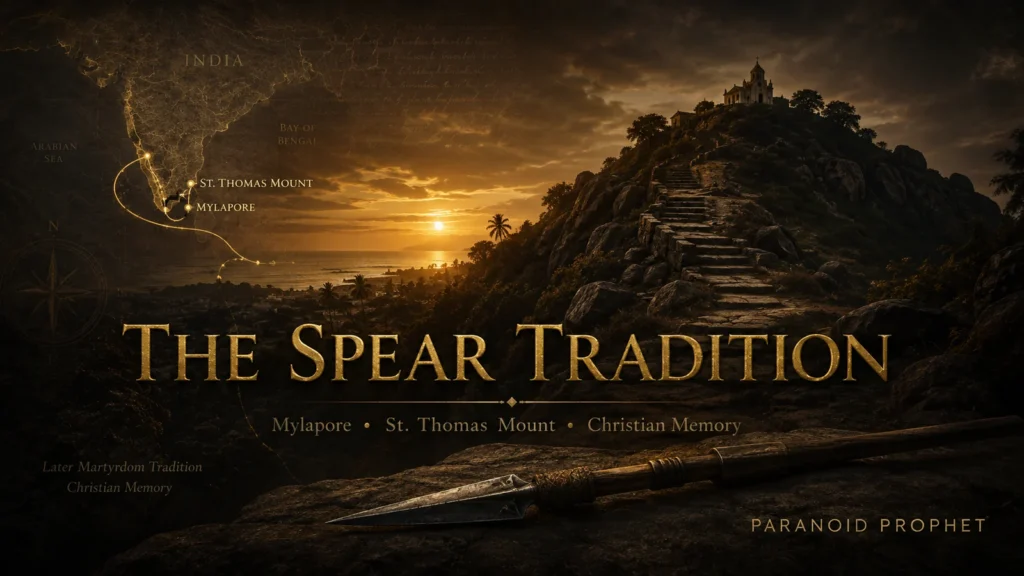
According to later Christian tradition, Thomas was martyred in India, often remembered as being killed by spear or lance near Mylapore or St. Thomas Mount.
That is the traditional answer to the question, “How did Saint Thomas die?” But it needs to be stated carefully. The New Testament does not record Thomas’s death. It does not say he died in India. It does not describe a spear, a final sermon, a final prayer, or the exact location of his martyrdom.
So the best answer is not, “The Bible says Thomas was speared in India.” It does not. The better answer is this: Christian tradition remembers Thomas as a missionary witness to India and as a martyr, often by spear or lance. That memory is significant, but the exact details belong to later tradition rather than direct biblical report.
This distinction does not weaken Thomas’s witness. It keeps the article honest. The strongest evidence for Thomas is still Scripture: the apostle who encountered the risen Christ and confessed Him as “My Lord and my God.” The spear tradition matters only because it is attached to that witness.
The Traditional Account
The traditional account remembers Thomas as carrying the gospel eastward and bearing witness to Christ in India. In that memory, Thomas is not presented as a man who outgrew his confession or quietly abandoned the risen Lord. He is remembered as a missionary apostle whose witness became costly.
Later accounts often describe opposition to Thomas’s preaching and connect his death with a spear or lance. The basic shape of the tradition is clear: Thomas preached Christ, faced hostility, and died as a witness rather than deny the Lord he had confessed.
But the details vary, and that matters. Some accounts emphasize royal opposition. Some focus on local resistance. Some preserve dramatic speeches, miracles, or final scenes. Those details may have devotional and historical interest, but a serious article should not build its strongest argument on the exact wording of Thomas’s final speech or the precise mechanics of his death.
The better approach is to identify the core tradition without pretending we can recover every detail with certainty. Thomas was remembered as a missionary to the East, especially connected with India. He was remembered as suffering for Christ. He was remembered, in later tradition, as dying by spear or lance.
That tradition deserves attention. It is not the same kind of evidence as John 20.
Mylapore, St. Thomas Mount, and the Spear Tradition
Mylapore and St. Thomas Mount are among the most famous locations connected with Thomas’s death. In later Christian memory, these places became associated with his final witness, martyrdom, and enduring presence in the history of Indian Christianity.
These locations matter because they show how deeply Thomas’s memory became rooted in Indian Christian tradition. Thomas is not remembered there as a vague symbol. He is remembered as an apostolic witness tied to the story of Christianity’s ancient roots in India.
That deserves respect. The Thomas tradition is not merely an abstract legend sitting in a dusty text. It is tied to communities, worship, identity, pilgrimage, and local memory. For many Christians in India, Thomas represents the apostolic beginning of their Christian heritage.
At the same time, place-memory does not settle every first-century detail. A site can preserve an important tradition without proving every part of the later narrative. Mylapore and St. Thomas Mount should be treated as historically significant Christian memory, not as a replacement for New Testament evidence.
That is the balance this article needs. The Mylapore and St. Thomas Mount traditions should not be mocked or waved away. They also should not be presented as if the New Testament itself narrated Thomas’s final moments there.
The spear or lance belongs in that same category. It is the most famous death detail connected with Thomas. It is significant, widely remembered, and visually powerful. But it should be described as later martyrdom tradition, not as a biblical fact.
How Strong Is the Evidence?
The evidence for Thomas should be weighed in layers. Some claims are very strong because they come directly from Scripture. Other claims are worth taking seriously but less certain because they come through early tradition, apocryphal literature, and later Christian memory.
| Claim | Evidence Strength | Why It Matters |
| Thomas was one of the Twelve | Strong | The New Testament identifies Thomas as one of Jesus’s apostles. |
| Thomas encountered the risen Christ | Strong | John 20 presents Thomas before the risen Jesus and the wounds of crucifixion. |
| Thomas confessed Jesus as “My Lord and my God” | Strong | This is one of the clearest confessions of Jesus’s divine identity in the New Testament. |
| Thomas remained among the apostles after the ascension | Strong | Acts 1 places Thomas inside the apostolic company after Jesus’s resurrection and ascension. |
| Thomas was remembered with eastern mission | Moderate | Eusebius preserves an early tradition associating Thomas with Parthia. |
| Thomas was associated with India | Important but debated | The Acts of Thomas and Indian Christian memory strongly connect Thomas with India, but not with Scripture-level certainty. |
| Thomas died near Mylapore or St. Thomas Mount | Later tradition | These places are deeply connected with Thomas in Indian Christian memory, but the New Testament does not record the location of his death. |
| Thomas died by spear or lance | Later martyrdom detail | This is the famous traditional account, but it should be stated as tradition rather than direct biblical report. |
| Exact final words, final scene, or number of wounds | Weakest | These details belong to later devotional or hagiographical development and should not carry the argument. |
This table does not erase the Thomas tradition. It gives it a proper place. The biblical Thomas stands on the strongest ground. The eastern mission memory has early support. The India tradition is important and deeply rooted. The spear detail is famous, but later.
That distinction is what keeps the argument serious.
What We Should and Should Not Claim
A strong article on Thomas should be clear about what can be said confidently, what should be said carefully, and what should be avoided.
We can say confidently that Thomas was one of the Twelve, that he encountered the risen Christ, that he confessed Jesus as “My Lord and my God,” and that he remained among the apostles after the ascension.
We can also say that Christian tradition connects Thomas with eastern mission, especially through the Parthia tradition preserved by Eusebius and the India tradition developed in the Acts of Thomas and Indian Christian memory.
We should say more carefully that Thomas preached in India, died near Mylapore or St. Thomas Mount, and was killed by spear or lance. Those claims are not empty, but they are not recorded in Scripture.
We should avoid saying as bare fact that Thomas definitely died in India by spear, that St. Thomas Mount proves the exact death scene, that every part of the Acts of Thomas is historically secure, or that Thomas’s martyrdom by itself proves the resurrection.
The stronger claim is the more honest one: Thomas was remembered by the church not as a man who abandoned Christ, but as a witness who carried the name of Jesus at great cost. The exact details of the final scene are harder to recover. The remembered direction of his life is clear: he belonged to Christ.
That is where Thomas’s spear tradition should sit. It should not be made stronger than the sources allow, but it should not be treated as meaningless either. It belongs inside a larger pattern of apostolic witness, missionary memory, and costly confession.
The strongest evidence is not the spear. The strongest evidence is the confession that came before it.
Thomas’s story does not ask the reader to build faith on a later death scene alone. It points back to the risen Christ who stood before Thomas with the wounds of crucifixion and received his worship. Once the tradition is weighed honestly, we can ask what it contributes to the larger case for Christ.
What Thomas’s Witness Shows About the Case for Christ
Thomas’s martyrdom tradition matters most when it is placed in the right argument.
It is not the foundation of Christian faith. Christ is. The resurrection does not stand or fall on whether every later detail about Thomas in India can be recovered with certainty. The spear tradition does not carry the whole case. It was never meant to.
But Thomas still belongs inside the larger case for Christ. Scripture gives us a first-generation disciple who demanded evidence, encountered the risen Jesus, confessed Him as Lord and God, and remained among the apostolic company after the ascension. Later Christian memory then remembers that same apostle carrying the name of Christ eastward under pressure.
That does not prove everything by itself. But it does matter.
Thomas Was Not a Casual Believer
Thomas is apologetically important because he is not presented as a man who believed easily.
When the other disciples told him, “We have seen the Lord,” Thomas did not immediately accept their report. He wanted the wounds. He wanted the marks of crucifixion. He wanted continuity between the Jesus who died and the Jesus the disciples claimed was alive.
That does not make Thomas a modern skeptic. He was not running a laboratory experiment. He was a first-century Jewish disciple trying to process a claim that would have sounded staggering even to men who had walked with Jesus: the crucified Lord was alive.
Still, the movement in Thomas’s story is powerful. The man who said, “Unless I see,” becomes the man who says, “My Lord and my God.” His witness matters because John does not present him as gullible, detached, or easily swept along by the group. Thomas wanted evidence, and when the risen Christ stood before him, his answer was worship.
That is the heart of Thomas’s apologetic value. His greatest importance is not that later tradition remembers him as a martyr. His greatest importance is that the disciple who demanded evidence confessed the risen Jesus as Lord and God.
Thomas Strengthens the Disciple Witness Trail
Thomas also belongs inside the larger disciple witness and martyrdom trail, but his lane must stay distinct.
The apostolic witness trail is cumulative, not flat. James gives the clearest apostolic death report in Scripture. Peter is remembered by early Christians as the restored disciple who suffered in Rome. John gives us endurance, exile, and testimony because of the word of God and the witness of Jesus. Andrew gives us the quiet disciple who repeatedly brought others to Christ and was later remembered as faithful unto death.
Thomas adds something different: the apostle who demanded evidence, encountered the risen Christ, confessed Him as “My Lord and my God,” and was later remembered as carrying that confession eastward.
Not every apostolic death tradition has the same evidence strength. James in Acts is not the same category as Thomas in later Christian memory. John’s exile in Revelation is not the same kind of evidence as the spear tradition near Mylapore or St. Thomas Mount. A serious article should not flatten those differences.
But when the categories are kept clear, the broader pattern is still difficult to dismiss cheaply. The earliest Christian witness was not built around vague admiration for a dead teacher. It centered on the claim that Jesus was crucified, raised, exalted, worshiped, and worthy of faithful obedience under pressure.
Thomas does not carry the whole case by himself. But he belongs inside it.
For the wider trail, see the martyrdom of Jesus’s disciples, along with Peter’s martyrdom and Saint Andrew’s martyrdom. Thomas’s article adds a distinct witness: demanded evidence, resurrection encounter, divine confession, and later remembered mission to the East.
What Thomas’s Martyrdom Does and Does Not Prove
A strong Christian argument does not need to pretend Thomas’s martyrdom proves more than it can prove.
Thomas’s death tradition does not prove every detail of the Acts of Thomas. It does not prove the exact route of his mission. It does not prove the exact scene at Mylapore or St. Thomas Mount. It does not prove the precise weapon, the number of wounds, his final words, or every later devotional detail attached to his memory.
It also does not prove the resurrection by itself. People can suffer for things they sincerely believe, and sincerity alone does not make every claim true. A serious article should admit that plainly.
But that does not make Thomas’s martyrdom tradition irrelevant.
It supports the sincerity and cost of Thomas’s remembered witness. It shows that the church did not remember him as a man who outgrew his confession, abandoned Christ, or quietly returned to ordinary life after the resurrection claim. It remembers him as a missionary witness whose allegiance to Jesus became costly.
That is the better apologetic argument. Not “Thomas died, therefore Christianity is proven.” The better argument is cumulative: Thomas’s biblical confession and later remembered faithfulness belong inside a wider pattern of apostolic witness to the risen Christ.
When that pattern is joined to the stronger resurrection evidence — Jesus’s crucifixion, the early resurrection proclamation, the testimony preserved in the New Testament, and the transformation of the first Christian movement — Thomas becomes one meaningful strand in a larger cord.
The spear tradition matters only after John 20 has done its work.
Thomas Points Beyond Himself to Jesus
Thomas’s doubt, courage, journey, and death tradition all matter only because they point beyond themselves.
The center is Jesus Christ: crucified, risen, wounded, worshiped, and confessed as Lord and God.
Thomas’s story presses the reader back to the same question Thomas faced in the locked room: who is this wounded and risen Jesus?
If Jesus were merely a teacher, Thomas’s confession would be too much. If Jesus were merely a martyr, Thomas’s worship would be misplaced. If Jesus were only a religious symbol, the wounds would not matter the way John says they matter. But Thomas stands before the risen Christ and answers with personal allegiance and worship: “My Lord and my God.”
That is why the later account of Thomas’s death should be handled carefully but not ignored. The church remembered Thomas not as a man who suffered for vague spirituality, but as a witness to the Christ he had confessed.
Thomas’s story does not ask the reader to stop at Thomas. It points beyond him to Jesus. The question is not finally whether every later detail of Thomas’s death can be reconstructed. The deeper question is whether the Christ Thomas confessed is worthy of the worship he gave Him.
Scripture answers by showing the risen Jesus receiving that confession. Christian tradition answers by remembering Thomas as a witness who carried that confession at cost. The case for Christ does not rest on Thomas alone, but Thomas stands inside the witness trail as the man who demanded evidence and ended in worship.
Frequently Asked Questions About Saint Thomas’s Martyrdom
Was Saint Thomas martyred?
Christian tradition remembers Saint Thomas as a martyr. The New Testament does not record his death, so the claim should be treated as Christian tradition rather than direct biblical report.
How did Saint Thomas die?
According to later tradition, Saint Thomas was killed by spear or lance. This tradition is often connected with India, especially places such as Mylapore or St. Thomas Mount. Scripture does not describe the manner of Thomas’s death.
Did Saint Thomas die in India?
Thomas is strongly associated with India in Christian tradition, especially through the Acts of Thomas and Indian Christian memory. The New Testament does not say Thomas died in India, so the claim should be stated carefully: later tradition remembers Thomas as dying there.
Is Thomas’s martyrdom recorded in the Bible?
No. The Bible records Thomas as one of the Twelve, shows his encounter with the risen Christ, records his confession of Jesus as “My Lord and my God,” and places him among the apostles after the ascension. It does not tell us how Thomas died.
Did Thomas touch Jesus after the resurrection?
John records Jesus inviting Thomas to see and touch His wounds, but the text does not explicitly say Thomas actually touched Him. John places the emphasis on Thomas’s confession: “My Lord and my God” (John 20:24–29).
What did Thomas mean by “My Lord and my God”?
Thomas’s words are a worshipful confession of the risen Jesus’s divine identity. He does not merely say Jesus is alive. Standing before the risen Christ, Thomas confesses Him personally as Lord and God.
What is the Acts of Thomas?
The Acts of Thomas is an apocryphal Christian text connected with traditions about Thomas’s mission, preaching, miracles, and martyrdom. It is important for studying how Thomas became associated with India, but it is not part of the New Testament.
Is the Acts of Thomas Scripture?
No. The Acts of Thomas is not Scripture and should not be treated like the canonical Gospels or the biblical book of Acts. It can be useful for studying Christian tradition, but Scripture remains the final authority for Thomas’s apostolic witness and confession of Christ.
Who are the St. Thomas Christians?
The St. Thomas Christians are ancient Christian communities in India whose identity and memory are deeply connected with Thomas the Apostle. Their tradition deserves respect, but it should still be distinguished from direct New Testament evidence.
How strong is the evidence for Thomas’s martyrdom?
The evidence is strongest for the biblical Thomas: one of the Twelve, a witness of the risen Christ, and the apostle who confessed Jesus as “My Lord and my God.” The evidence for Thomas’s mission eastward is meaningful but more cautious. The details about India, Mylapore, St. Thomas Mount, and the spear belong to later tradition.
What does Thomas’s martyrdom prove?
Thomas’s martyrdom tradition does not prove the resurrection by itself. Its best use is more careful: it supports the sincerity, cost, and continuity of apostolic witness when placed beside the stronger biblical evidence for Thomas’s encounter with the risen Christ.
Why does Thomas matter for the case for Christ?
Thomas matters because he was not presented as a casual believer. He demanded evidence, encountered the risen Jesus, confessed Him as Lord and God, remained among the apostles, and was later remembered as carrying that confession at great cost. His story points beyond Thomas to the risen Christ.
Sources and Further Reading
This article uses Scripture as the final authority for Thomas’s identity, confession, and apostolic witness. Early Christian and later sources are used as historical and traditional context, not as equal to Scripture.
Biblical Passages
- John 11:16 — Thomas says, “Let us also go, that we may die with him.”
- John 14:5–6 — Thomas asks how the disciples can know the way, and Jesus answers, “I am the way, and the truth, and the life.”
- John 20:24–29 — Thomas encounters the risen Christ and confesses, “My Lord and my God.”
- John 20:30–31 — John explains that these signs were written so readers may believe Jesus is the Christ, the Son of God.
- Acts 1:12–14 — Thomas is listed among the apostles after the ascension.
Early Christian and Traditional Sources
- Eusebius, Church History 3.1 — preserves an early tradition associating Thomas with Parthia.
- Acts of Thomas — an apocryphal text connected with Thomas’s India mission and martyrdom tradition.
- NASSCAL e-Clavis: Acts of Thomas — scholarly overview of the apocryphal Thomas tradition.
- Encyclopaedia Britannica: Thomas Christians — background on the historic Christian communities in India associated with Thomas tradition.
Source Discipline
The strongest claims in this article come from Scripture: Thomas was one of the Twelve, encountered the risen Christ, confessed Jesus as Lord and God, and remained among the apostles after the ascension.
The claims about Parthia, India, Mylapore, St. Thomas Mount, and martyrdom by spear or lance are treated as Christian tradition. They are important for church history and apologetic context, but they should not be presented as if they were recorded in the New Testament.
Conclusion: Thomas Confessed the Living Christ
Thomas was more than “Doubting Thomas.”
He was a real disciple: loyal enough to walk toward danger with Jesus, honest enough to ask hard questions, shaken enough to demand evidence, and humbled enough to worship when the risen Christ stood before him.
His strongest witness is not the spear tradition. It is not Mylapore. It is not St. Thomas Mount. It is not even the memory of his mission to India, important as that tradition is.
His strongest witness is the confession that came before all of that: “My Lord and my God.”
That confession stands at the center of Thomas’s story. The man who refused to believe without seeing the wounds was met by the crucified and risen Lord. Jesus did not leave him in unbelief. He confronted him, showed him mercy, and called him to faith.
Thomas answered with worship.
Later Christian tradition remembers Thomas carrying that confession eastward and suffering for Christ. Those details should be handled carefully. Scripture does not record his death. The India tradition, the spear, and the remembered sites of his martyrdom belong to later Christian memory.
But careful handling does not empty the story of meaning. The church did not remember Thomas as a man who abandoned Christ, outgrew his confession, or quietly walked away from the resurrection claim. It remembered him as a witness who carried the name of Jesus at cost.
That is why Thomas belongs in the disciple witness trail. He does not prove the resurrection by himself. He does not carry the whole case for Christ. But he stands inside the larger pattern: named apostles, public witness, costly proclamation, and enduring confession centered on the crucified and risen Lord.
Thomas’s story does not finally point to doubt, India, or the spear. It points to the wounded and risen Christ, standing alive and worthy of the words Thomas gave Him:
“My Lord and my God.”
CONTINUE THE INVESTIGATION
Evidence standard continuation
Did the Apostles Die for the Resurrection? What We Can Honestly Say
Return from this individual witness tradition to the comparative source review that separates strong evidence, plausible tradition, and uncertainty.