
Article Guide11 sections
Which Peter Are We Talking About?
GUIDED ARTICLE EXPERIENCE
Peter’s Martyrdom: Was Peter Crucified Upside Down?
Read along as the narration moves through the article.
Private device narration · No hosted audio or tracking
CONTINUE GUIDED TOUR
Continue where you left off.
GUIDED TOUR COMPLETE
You have reached the end of this study.
Study record saved on this device.
GUIDED TOUR
Peter’s Martyrdom: Was Peter Crucified Upside Down?
Narrator: Paranoid Prophet Recommended Voice Native device narration
Prepare to follow the article as it is narrated.
VOICE & TOUR OPTIONS
Voice & Listening
NARRATOR
Finding a narrator…
Checking the best narrator available on this device.
Restores the best curated narrator available on this device.
Narrator choices are curated for clear, long-form listening on this device.
Screen-awake support will be checked when narration starts.
CHOOSE A NARRATOR
Curated for this device
Choose a verified narrator for this browser, or use System Narrator. Automatic mode uses the best reliable route exposed by this device; your chosen narrator is preserved even if this device needs a temporary fallback.
Preparing the guided article experience…
RESUME GUIDED TOUR?
Continue where you left off.
GUIDED TOUR COMPLETE
You have reached the end of this study.
Peter’s martyrdom matters because Peter was not a distant believer defending a secondhand tradition. He was one of Jesus’ closest disciples, a named witness in the earliest resurrection proclamation, and a man remembered by the early church as suffering unto death for the Christ he once denied.
The Peter in this article is Simon Peter, also called Simon, Peter, and Cephas. He was a fisherman from Galilee when Jesus called him to leave his nets and follow Him. The Gospels present him as one of the Twelve, part of the inner circle with James and John, and one of the most visible witnesses in Jesus’ earthly ministry.
That matters for the resurrection question. Peter did not stand at a safe distance from the events Christianity is built on. He followed Jesus, confessed Jesus as the Christ, failed grievously by denying Him, was restored by the risen Lord, and then became one of the central public preachers that God had raised Jesus from the dead.
So when Christians talk about Peter’s martyrdom, we should not begin with medieval artwork, legends about Rome, or the famous upside-down cross. Those details matter, and this article will handle them carefully. But the foundation is stronger than the most famous image. Peter belongs to the first generation of witnesses who proclaimed the crucified and risen Jesus.
This article belongs under the larger question of the martyrdom of Jesus’ disciples. Peter needs his own careful treatment because his tradition is both powerful and layered. The broad claim that Peter suffered and died as a witness to Christ is strong. Some later details, including the exact manner of death and the upside-down crucifixion tradition, require more careful ranking.
Peter’s Martyrdom: The Evidence at a Glance
A serious Christian article should keep the evidence in order. Scripture gives us Peter’s calling, confession, denial, restoration, resurrection witness, public preaching, imprisonment, and suffering. Scripture also records Jesus speaking of the kind of death by which Peter would glorify God. Acts, however, does not narrate Peter’s final martyrdom.
That does not weaken the case. It tells us how to build it. Peter’s martyrdom is not hanging on one late legend. It rests first on the New Testament portrait of Peter as a first-generation witness to the risen Jesus, then on early Christian tradition that remembers his witness ending in suffering and death.
| Evidence Category | What We Can Say |
|---|---|
| Person | Simon Peter. |
| Also Known As | Simon, Peter, and Cephas. |
| Relationship to Jesus | One of the Twelve and part of Jesus’ inner circle with James and John. |
| Resurrection Connection | Named as Cephas in the early resurrection proclamation preserved in 1 Corinthians 15:3–8. |
| Biblical Death Report | Peter’s final death is not narrated in Acts. |
| Biblical Death Foreshadowing | John 21:18–19 says Jesus spoke of the kind of death by which Peter would glorify God. |
| Earliest External Martyrdom Witness | 1 Clement remembers Peter as a suffering witness who endured many labors and bore testimony. |
| Later Tradition | Tertullian, Origen as preserved by Eusebius, and later Christian sources connect Peter with crucifixion in Rome. |
| Evidence Strength | Strong early tradition with debated details. |
| Best Apologetic Use | Peter’s death supports the sincerity, public cost, and first-generation seriousness of the apostolic resurrection witness. |
This evidence map keeps the article honest without making it timid. Peter’s death should not be dismissed as empty legend, but the strongest point is not the famous image of Peter hanging upside down. The stronger point is that Peter belonged to the first generation of witnesses, publicly proclaimed the resurrection, suffered for that proclamation, and was remembered by the early church as dying because he belonged to Christ.
What This Article Is Arguing
This article argues that Peter’s martyrdom strengthens the historical and apologetic case for the seriousness of the resurrection proclamation. Peter was not defending a vague religious feeling or a tradition centuries removed from the events. He was a leading apostolic witness. He is named as Cephas in the early resurrection proclamation of 1 Corinthians 15. He appears in Acts as a public preacher of the crucified and risen Jesus. He suffers imprisonment and threats because he refuses to stop bearing witness to Christ.
Martyrdom does not magically make a claim true. People can die sincerely for false beliefs. But Peter is not merely an example of generic religious sincerity. He stands close to the events at the center of Christianity. If the early Christian tradition is right that Peter suffered unto death, then his death belongs to the same public witness that had already marked his life: God raised Jesus from the dead.
That is what makes Peter’s martyrdom compelling. The man who once denied Jesus in fear became a public witness of the risen Christ. The man restored beside the sea later preached in Jerusalem that God had made the crucified Jesus both Lord and Christ. And the early church remembered him not as a distant admirer, but as a faithful witness whose final suffering was tied to the Lord he proclaimed.
So the question is not merely, “Was Peter crucified upside down?” That question matters, and this article will answer it carefully. But the deeper question is stronger: why did the early church remember Peter, the restored denier and named resurrection witness, as a man who suffered and died for the risen Lord?
That answer begins not in Rome, but beside the waters of Galilee and in the streets of Jerusalem. Before Peter became a martyr, he was a disciple. Before he was remembered for his death, he was known for his confession, his failure, his restoration, and his bold proclamation that God had raised Jesus from the dead.
Who Was Peter to Jesus?
Before Peter is remembered as a martyr, he must first be seen as a disciple. His death matters because his life was bound to Jesus from the beginning of the Gospel story. Peter was not a distant admirer of Christian ideas. He walked with Jesus, listened to Jesus, failed Him, was restored by Him, and later proclaimed Him publicly as the risen Lord.
The Gospels do not present Peter as polished or naturally fearless. They present him as bold, impulsive, sincere, weak, and deeply human. That honesty strengthens the whole story. Peter’s importance does not come from flawless courage. It comes from the mercy of Christ, who took a man who failed in public and made him a public witness.
Peter also stood close to moments not every disciple saw. He was present at the transfiguration, where Jesus’ glory was revealed, and at Gethsemane, where Jesus entered the agony before the cross. Peter’s witness was not casual proximity. He stood near the glory, sorrow, authority, and suffering of Jesus.
That is the right place to begin. Peter’s martyrdom is not mainly a story about human bravery. It is a story about the risen Jesus restoring a broken disciple and sending him back into the world as a shepherd, preacher, and witness.
Called from the Nets
Peter’s story begins with the authority of Jesus. Simon Peter was a fisherman when Christ called him to follow. Matthew records Jesus walking by the Sea of Galilee, seeing Simon and Andrew casting a net, and saying, “Follow me, and I will make you fishers of men” (Matthew 4:18–20).
That call is simple, but not small. Peter does not begin as a religious scholar, a political revolutionary, or a polished public speaker. He begins as a working man summoned by Christ. Jesus calls, and Peter follows.
Luke’s account adds another layer. After the miraculous catch of fish, Peter falls down before Jesus and says, “Depart from me, for I am a sinful man, O Lord” (Luke 5:1–11). From early in the story, Peter senses that Jesus is not merely another teacher. In the presence of Christ, Peter sees authority, holiness, and his own unworthiness.
That moment prepares us for the rest of Peter’s life. He will follow Jesus closely, but not perfectly. He will speak boldly, but not always wisely. He will promise loyalty, but later collapse under fear. Yet the call of Jesus proves stronger than Peter’s weakness. The same Lord who called Peter from the nets would later restore him after his denial.
The Confession of Christ
One of Peter’s clearest moments comes at Caesarea Philippi. Jesus asks His disciples, “Who do people say that the Son of Man is?” After they report the opinions of others, Jesus presses the question closer: “But who do you say that I am?” Peter answers, “You are the Christ, the Son of the living God” (Matthew 16:13–20).
For this article, the central point is Peter’s confession: Jesus is the Christ, the Son of the living God. Peter’s later suffering is not suffering for a vague moral teacher. It is suffering connected to the claim that Jesus is the Messiah, the Son of God, the one revealed by the Father.
This confession gives shape to Peter’s whole story. Before he is remembered as dying for Christ, he first confesses who Christ is. Before he becomes a public preacher of the resurrection, he recognizes that Jesus is not merely one prophet among many. Jesus is the promised Christ.
Peter did not understand everything yet. He would still resist the way of the cross and be rebuked by Jesus. But even with imperfect understanding, his confession stands as one of the great moments of apostolic recognition: Jesus is the Christ.
Failure, Denial, and Restoration
Peter’s story would be much thinner if it moved straight from confession to courage. Scripture gives us something more honest. Peter was not only the disciple who confessed Jesus. He was also the disciple who denied Him.
Before the crucifixion, Jesus warned Peter that his confidence would fail. In Luke’s Gospel, Peter says, “Lord, I am ready to go with you both to prison and to death.” Jesus answers that before the rooster crows, Peter will deny Him three times (Luke 22:31–34).
That warning matters because Peter’s later witness should not be romanticized as natural fearlessness. Peter once believed he was ready for prison and death, but when the pressure came, he broke. As Jesus was being tried, Peter denied knowing Him three times. When the rooster crowed, Peter remembered the word of the Lord and went out and wept bitterly (Luke 22:54–62).
The New Testament does not hide Peter’s failure. It does not polish him into a flawless hero. It shows his collapse plainly. Peter had confessed Jesus with his mouth, but under fear he denied Him with that same mouth.
That makes the later tradition of Peter’s death more sobering. The man who once trembled before a servant girl would later be remembered as standing firm before powers far greater than that.
Then came mercy.
After the resurrection, Jesus did not discard Peter. In John 21, the risen Christ meets Peter beside the sea and asks him three times, “Do you love me?” Three times Peter had denied Him. Three times Jesus draws out Peter’s love and commands him to feed His sheep (John 21:15–19).
This restoration is central to Peter’s martyrdom story. His later courage was not the courage of a man who had never failed. It was the courage of a man who had been forgiven, restored, and recommissioned by the risen Lord.
John 21 also points forward to Peter’s death. After restoring Peter, Jesus speaks of a time when Peter would stretch out his hands and be led where he did not want to go. John explains that Jesus said this to show by what kind of death Peter would glorify God. That does not give every later detail about Rome or crucifixion, but it does give a biblical foundation for seeing Peter’s future death as a death that would glorify God.
So before we ask how Peter died, we need to see what kind of man Christ made him. Peter was called from the nets, brought to confession, broken by fear, restored by grace, and sent back into service. His martyrdom matters because it belongs to this larger story: the risen Jesus did not merely forgive Peter. He made Peter a witness.

Peter as a Witness of the Risen Jesus
Peter’s restoration did not remain private. The risen Jesus did not merely forgive Peter beside the sea and leave him there. He restored him, recommissioned him, and placed him back into service as a shepherd, preacher, and witness.
That is why Peter’s martyrdom matters for the resurrection case. Peter was not remembered as dying for a vague religious mood, a moral slogan, or a general attachment to Christian identity. His witness had a specific message: Jesus was crucified, God raised Him from the dead, and the risen Christ now reigns as Lord.
Before we ever reach later traditions about Rome, the New Testament already gives us three major evidence lanes. Peter is named in one of the earliest resurrection summaries we possess. Acts presents him publicly preaching the resurrection in Jerusalem. Acts also shows him threatened, imprisoned, and beaten because he refused to stop speaking in the name of Jesus.
That makes Peter’s later martyrdom tradition more than an isolated death story. If the early church remembered Peter as dying for Christ, that final witness was tied to the same proclamation that had already marked his public life: God raised Jesus from the dead.
Cephas in the Earliest Resurrection Proclamation
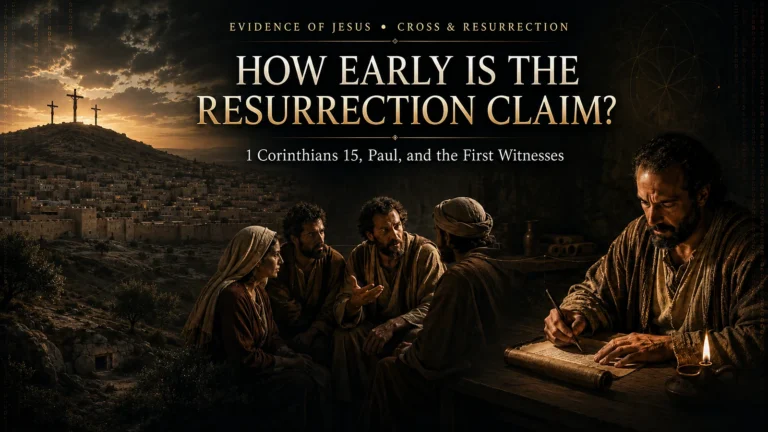
One of the most important texts for Peter’s witness is not a martyrdom story at all. It is Paul’s summary of the gospel in 1 Corinthians 15:3–8, one of the earliest written summaries of the resurrection proclamation we possess.
Paul says that Christ died for our sins in accordance with the Scriptures, that He was buried, that He was raised on the third day in accordance with the Scriptures, and that He appeared to Cephas, then to the Twelve. Cephas is the Aramaic form of Peter’s name. That detail pulls us close to the earliest Jewish-Christian setting of the resurrection message.
Paul also says he “received” this tradition and “delivered” it to the Corinthians. He is not presenting the resurrection as a private invention or a late theological symbol. He is passing along a proclamation already known in the early church: Christ died, Christ was buried, Christ was raised, and Christ appeared.
This is why Peter is significant for resurrection evidence. Before Christians handed down traditions about Peter’s death, they already knew Peter as Cephas, one to whom the risen Christ appeared. His name stands near the earliest core of Christian proclamation: death, burial, resurrection, and appearances.
A careful argument should not force Paul’s words to answer every later question. Paul does not describe the appearance to Cephas in detail. He does not tell us the location, the length of the encounter, or every physical feature of what Peter experienced. But he does place Peter directly inside the received resurrection tradition. For a historical discussion, that is not a small point.
Peter’s martyrdom does not stand alone as a legend about a brave man. It stands downstream from a much earlier claim: Peter belonged to the first generation that proclaimed Jesus had been raised from the dead. His later death, preserved in early Christian memory, is connected to resurrection witness already embedded in the earliest Christian message.
Peter’s Preaching in Acts
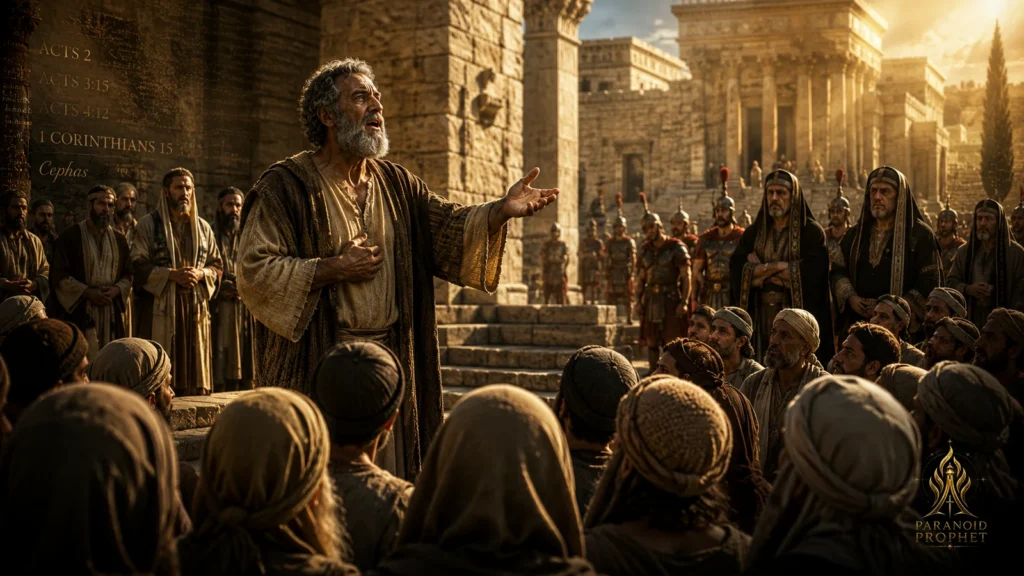
Acts is not earlier than Paul’s letters, but it remains the major biblical narrative of the church’s public preaching after the resurrection. It presents Peter’s ministry not as vague spirituality, but as open proclamation that God had raised Jesus from the dead.
At Pentecost, Peter stands in Jerusalem and preaches that Jesus was “delivered up according to the definite plan and foreknowledge of God,” crucified by lawless men, and raised by God because death could not hold Him (Acts 2:22–36). The sermon ends with a direct claim: God has made the crucified Jesus both Lord and Christ.
That is the center of Peter’s preaching. Jesus was not merely honored after death. He was raised, vindicated, and enthroned by God. Peter’s message is not simply, “Remember our teacher.” It is, “God raised Him up.”
In Acts 3, Peter again places the resurrection at the center. Speaking after the healing of the lame man, he says that the people denied the Holy and Righteous One and killed the Author of life, “whom God raised from the dead.” Then Peter adds, “To this we are witnesses” (Acts 3:13–16).
That phrase carries weight: “we are witnesses.” Peter is not presented merely as a teacher of Christian morals. He is presented as a witness making a public claim about what God has done in Jesus.
In Acts 4, Peter stands before the rulers and elders and again identifies Jesus as the one whom they crucified and whom God raised from the dead. Then he declares that salvation is found in no one else, because there is no other name under heaven given among men by which we must be saved (Acts 4:8–12).
This is why Peter’s later martyrdom, if the tradition is historically sound, carries real apologetic weight. Peter’s testimony was public, repeated, and centered on the risen Christ. He was not defending a religious brand. He was proclaiming that the crucified Jesus had been raised and exalted by God.
Peter’s Suffering Before His Final Martyrdom
Before later Christian sources speak of Peter’s final death, Acts already presents Peter suffering for the name of Jesus. His conflict with authorities was not invented only in later martyrdom tradition. The New Testament itself portrays Peter as a man threatened and punished because he refused to stop preaching Christ.
In Acts 4, Peter and John are ordered not to speak or teach at all in the name of Jesus. Their answer is direct: “Whether it is right in the sight of God to listen to you rather than to God, you must judge.” They cannot stop speaking about what they have seen and heard (Acts 4:18–21).
In Acts 5, the apostles are arrested again. Peter and the apostles answer, “We must obey God rather than men.” Then they preach again that the God of their fathers raised Jesus, whom the authorities killed by hanging Him on a tree, and that they are witnesses of these things (Acts 5:17–42).
The response is not mild. They are beaten and charged not to speak in the name of Jesus. Yet they leave rejoicing that they were counted worthy to suffer dishonor for the name. That scene does not narrate Peter’s final death, but it does show the pattern: resurrection proclamation, opposition, suffering, and continued witness.
Acts 12 adds another important piece. Herod kills James the brother of John with the sword and then imprisons Peter. Peter is delivered from prison, so Acts does not give us his martyrdom. But the chapter makes clear that Peter’s life was already in danger in the apostolic period (Acts 12:1–17).
By the time Acts leaves Peter’s story, he is not untouched. He has preached the resurrection publicly, been commanded to stop, refused to stop, suffered for the name of Jesus, and escaped a deadly imprisonment. To ask how Peter’s witness ended, we now move beyond Acts to the early Christian sources that remembered his final martyrdom.

Was Peter Crucified Upside Down?
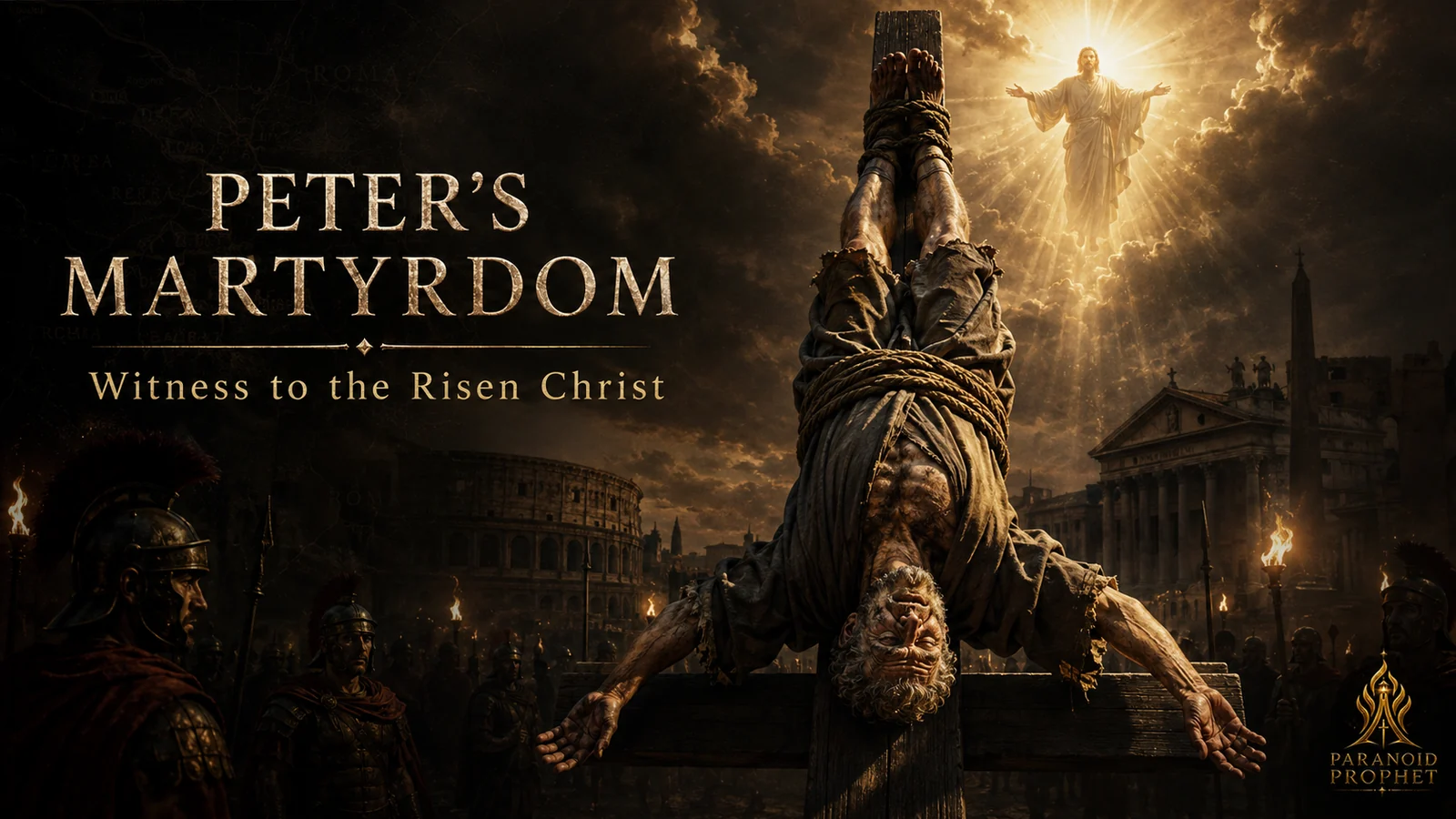
The upside-down crucifixion of Peter is one of the most famous traditions in Christian history. It is also one of the most profound. If the tradition is true, then Peter’s final act of witness was not only death for Christ, but a death remembered by the church as marked by humility before Christ.
The broad tradition that Peter died as a martyr is the strongest layer of evidence. The tradition that he was crucified in Rome is also serious and deeply rooted in early Christian memory. The upside-down detail is more specific and comes through later sources, but it should not be dismissed as if it were a modern legend or a medieval invention.
The key source often cited is Eusebius, who preserves a tradition from Origen that Peter came to Rome and was crucified head-downward. This is one of the most important witnesses behind the famous account (Eusebius, Church History 3.1).
That source is later than Peter’s lifetime, so it should not be treated as Scripture or as an eyewitness transcript. But it is still significant. Origen was not inventing a random detail out of nowhere. He was preserving a tradition already circulating in Christian memory: Peter died in Rome, and he was crucified head-downward.
It is also worth noticing that we do not have an early competing tradition that gives a different manner of Peter’s death and overturns this account. Tertullian connects Peter with crucifixion but does not mention the upside-down detail. That silence means we should rank the detail carefully, but silence is not disproof. The later head-downward tradition fits within the broader and older memory that Peter died by crucifixion as a witness to Christ.
The apocryphal Acts of Peter also contains the head-downward crucifixion tradition. In that account, Peter asks to be crucified with his head downward. This source must be used cautiously. The Acts of Peter is not part of the New Testament, and its style is dramatic, theological, and legendary in places. It can help us trace the spread and meaning of the tradition, but it should not be treated as a transcript of Peter’s execution (Acts of Peter).
Still, the tradition should be taken seriously. We have a strong early Christian memory of Peter’s martyrdom, a serious later tradition connecting him with crucifixion in Rome, and a persistent account that his crucifixion was head-downward. The upside-down detail is not as early as the basic martyrdom claim, but it is old, meaningful, and historically plausible.
The meaning of the tradition is powerful. Later Christians understood Peter’s inverted crucifixion as an act of humility. The traditional explanation is that Peter did not consider himself worthy to die in the same manner as his Lord. We should not present the exact wording as a recoverable transcript, but the theological memory is striking: the man who once denied Jesus was remembered as dying in a posture of humility before Him.
This also helps clarify the symbol known as the Cross of Saint Peter, or the Petrine Cross. In its historic Christian setting, the inverted cross was associated with Peter’s humility before Christ. It was not originally a symbol of rebellion against Jesus. Modern misuse of the symbol should not erase its older Christian meaning. Christians do not need to surrender an ancient Christian symbol simply because later culture has twisted it.
So was Peter crucified upside down? The strongest careful answer is this: Peter was very likely martyred, he was probably crucified in Rome, and the head-downward tradition is a serious and ancient Christian memory of how that death occurred. It is not the foundation of the case for Peter’s martyrdom, but it is a meaningful and plausible detail within that larger tradition.
If Peter did die this way, the symbolism is hard to miss. The disciple who once fell in fear was lifted by grace. The man who denied Jesus before a servant girl was remembered as confessing Him before Rome. And the apostle who had been restored by the risen Christ was remembered as going to his death in a posture that said, even at the end, Christ alone is worthy.
What Peter’s Martyrdom Can and Cannot Prove
Peter’s martyrdom matters for Christian apologetics because Peter was not a distant believer dying for an inherited tradition. He was a first-generation disciple of Jesus, named as Cephas in the early resurrection proclamation preserved in 1 Corinthians 15:3–8, restored by the risen Christ in John 21, and presented in Acts as a public preacher of the crucified and risen Jesus.
That makes Peter different from someone dying centuries later for a tradition received at a distance. Peter’s witness stands close to the events at the heart of Christianity. He was not merely defending an institution, a philosophy, or a religious identity. He was bearing witness to Jesus Christ: crucified, risen, exalted, and reigning as Lord.
Martyrdom by itself does not magically make a claim true. People can die sincerely for beliefs that are false. But Peter’s case is stronger than generic martyrdom. The question is not whether suffering can turn a false belief into truth. It cannot. The better question is this: does Peter’s suffering fit better with sincere apostolic conviction or with the idea that the earliest witnesses knowingly invented the resurrection?
Peter’s martyrdom strongly supports his sincerity. It supports the public cost attached to early resurrection preaching. It weakens the claim that the resurrection was a safe invention created for comfort, status, or power. The proclamation of the risen Christ was not a harmless religious slogan. It brought threats, imprisonment, beatings, and, according to early Christian memory, death.
That does not mean we need to pretend Peter’s death proves every later detail attached to his story. It does not recover his exact final words, reconstruct his trial, or prove that every apostle died in the same way. The stronger argument is more focused: Peter was a first-generation witness who publicly proclaimed the resurrection, suffered for that proclamation, and was remembered by the early church as faithful to Christ unto death.
The case is cumulative. Peter’s martyrdom is one beam in a larger structure. The larger case includes Jesus’ crucifixion, the early resurrection proclamation, Paul’s received tradition in 1 Corinthians 15, the appearances named there, Paul’s transformation, James’s later leadership, the rise of resurrection preaching in Jerusalem, and the willingness of early witnesses to suffer for the name of Jesus.
Peter’s death does not carry that whole case alone. But it belongs inside it. When one of Jesus’ closest disciples publicly proclaims the resurrection, suffers for that proclamation, and is remembered by early Christians as dying because he belonged to Christ, that is not a small piece of evidence. It is a serious witness to the conviction that Jesus had truly risen.
Why Peter Still Matters for the Resurrection Case
Peter matters because he stands at the intersection of several major evidence lanes.
He knew Jesus during His earthly ministry. He confessed Jesus as the Christ, the Son of the living God. He failed under pressure and denied Him. He was restored by the risen Jesus. He was named as Cephas in the early resurrection tradition. He preached openly that God raised Jesus from the dead. He suffered for that message before later sources remember his final martyrdom.
That does not make Peter flawless. It makes him real. Scripture does not hide his weakness, and that honesty strengthens the portrait. Peter was not naturally unbreakable. He broke. Then Christ restored him and made him a witness.
This is why shallow explanations are not enough. If someone wants to dismiss the resurrection as a late legend, Peter stands too close to the beginning. If someone wants to reduce Christianity to vague moral inspiration, Peter’s preaching stands in the way. If someone wants to say the apostles knowingly invented the resurrection, Peter’s public suffering and martyrdom tradition make that explanation harder to sustain.
The man who once denied Jesus before a servant girl later preached the risen Christ before crowds and rulers. The man who wept bitterly was restored and sent. The man who had once collapsed under fear became one of the central witnesses that God had raised Jesus from the dead.
That transformation does not look like a man protecting a lie. It looks like a man convinced that the Lord he abandoned had risen, forgiven him, and sent him.
Peter does not carry the whole resurrection argument by himself. But remove Peter from the story, and the earliest Christian witness becomes harder to explain. He was too close to Jesus, too central to the proclamation, and too costly a witness to ignore.
The point is not that Peter was a flawless hero or that every later story about him carries the same historical weight. The point is stronger than that: Christ restored Peter, Peter proclaimed the risen Christ, and the early church remembered Peter as faithful to that witness unto death.
Conclusion: Peter Died as a Witness to the Risen Christ
The strongest case for Peter’s martyrdom keeps the evidence in order. Scripture gives us Peter’s calling, confession, failure, restoration, resurrection preaching, suffering, and Jesus’ prophecy of his death. Early Christian sources then preserve the tradition that Peter’s witness ended in martyrdom.
That makes Peter’s death more than an isolated story about a brave apostle. Peter stands close to the center of the Christian claim. He knew Jesus. He denied Jesus. He was restored by the risen Jesus. He preached publicly that God had raised Jesus from the dead. And the early church remembered him as one who carried that witness to the end.
Peter’s courage did not save the world. Christ is the foundation of the faith, not Peter. Jesus’ death and resurrection are the gospel. But Peter’s martyrdom matters because it points beyond Peter to the Lord who restored him, sent him, sustained him, and was glorified even in his death.
A careful Christian case does not need invented details. We do not need a reconstructed courtroom scene, a recoverable final speech, or absolute certainty about every later tradition. The real case is already serious enough: Peter was a first-generation witness to Jesus Christ, he proclaimed the crucified and risen Lord when it cost him, and early Christian sources remembered him as a suffering apostolic witness whose death was connected with Rome, Nero, and crucifixion.
If Peter was crucified head-downward, as ancient Christian tradition remembers, the symbolism is profound. The man who once fell in fear was lifted by grace. The man who denied Jesus before a servant girl was remembered as confessing Him before Rome. The apostle restored beside the sea was remembered as going to his death in a posture of humility before the Lord he loved.
That is why Peter’s martyrdom still matters. It does not stand alone as the whole resurrection case, but it stands inside the earliest Christian witness like a burning marker of conviction. Peter’s life after Easter is hard to separate from the claim he preached: God raised Jesus from the dead.
The same Lord Peter denied restored him. The same Christ Peter preached sustained him. And the same risen Jesus for whom Peter suffered is the Lord before whom every witness, every skeptic, every ruler, and every soul must finally stand.
Sources and Further Reading
This article uses Scripture as the foundation, early Christian sources as historical witness, and modern study only where it helps evaluate the strength of apostolic martyrdom traditions. Scripture defines Peter’s identity and witness. Early Christian sources preserve the tradition of how that witness ended.
Scripture
- Matthew 4:18–20 — Jesus calls Peter from his nets.
- Luke 5:1–11 — Peter recognizes his sinfulness before Jesus.
- Matthew 16:13–20 — Peter confesses Jesus as the Christ, the Son of the living God.
- Luke 22:31–34 — Jesus warns Peter that he will deny Him.
- Luke 22:54–62 — Peter denies Jesus three times.
- John 21:15–19 — Jesus restores Peter and speaks of his future death.
- 1 Corinthians 15:3–8 — Cephas is named in the early resurrection proclamation.
- Acts 2:22–36 — Peter preaches the crucified and risen Jesus at Pentecost.
- Acts 3:13–16 — Peter says the apostles are witnesses that God raised Jesus.
- Acts 5:17–42 — Peter and the apostles suffer for preaching Christ.
- Acts 12:1–17 — James is killed and Peter is imprisoned, though Peter is delivered.
Early Christian Sources
- 1 Clement 5 — early Roman witness remembering Peter as a suffering apostolic example who endured many labors and bore testimony.
- Tertullian, Scorpiace 15 — later early source connecting Peter with Rome, Nero, John 21, and crucifixion.
- Eusebius, Church History 2.25 — preserves the tradition that Peter and Paul suffered martyrdom in Rome under Nero.
- Eusebius, Church History 3.1 — preserves Origen’s tradition that Peter was crucified head-downward.
- Acts of Peter — apocryphal source preserving the upside-down crucifixion tradition, used cautiously as tradition history rather than Scripture or transcript.
Modern Study
- Sean McDowell, The Fate of the Apostles — modern study evaluating the martyrdom traditions of Jesus’ closest followers and their significance for apostolic testimony.
Related Articles
- Martyrdom of Jesus’ Disciples: What History Really Shows
- Saint James’ Martyrdom: The First Apostle Killed for Christ
- The Historical Reality of Jesus
CONTINUE THE INVESTIGATION
Evidence standard continuation
Did the Apostles Die for the Resurrection? What We Can Honestly Say
Return from this individual witness tradition to the comparative source review that separates strong evidence, plausible tradition, and uncertainty.