
GUIDED ARTICLE EXPERIENCE
Lucifer vs. the Watchers: Are Satan and the Watchers the Same?
Read along as the narration moves through the article.
Private device narration · No hosted audio or tracking
CONTINUE GUIDED TOUR
Continue where you left off.
GUIDED TOUR COMPLETE
You have reached the end of this study.
Study record saved on this device.
GUIDED TOUR
Lucifer vs. the Watchers: Are Satan and the Watchers the Same?
Narrator: Paranoid Prophet Recommended Voice Native device narration
Prepare to follow the article as it is narrated.
VOICE & TOUR OPTIONS
Voice & Listening
NARRATOR
Finding a narrator…
Checking the best narrator available on this device.
Restores the best curated narrator available on this device.
Narrator choices are curated for clear, long-form listening on this device.
Screen-awake support will be checked when narration starts.
CHOOSE A NARRATOR
Curated for this device
Choose a verified narrator for this browser, or use System Narrator. Automatic mode uses the best reliable route exposed by this device; your chosen narrator is preserved even if this device needs a temporary fallback.
Preparing the guided article experience…
RESUME GUIDED TOUR?
Continue where you left off.
GUIDED TOUR COMPLETE
You have reached the end of this study.
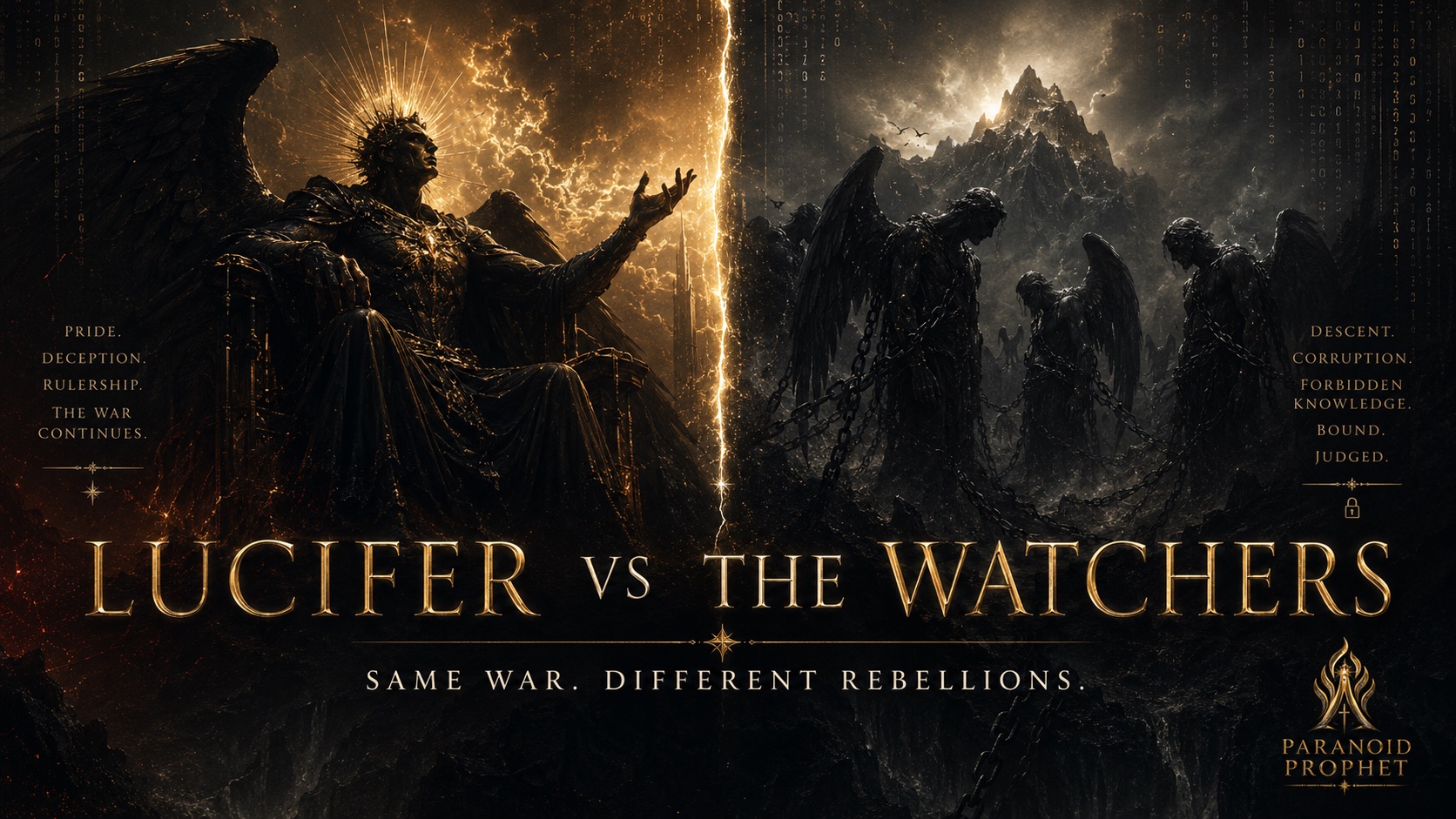
Are Lucifer or Satan and the Watchers the same? No. They may belong to the same wider rebellion against God, but Scripture and ancient Jewish tradition do not present them as the same being, group, role, transgression, or judgment category.
The phrase Lucifer vs the Watchers can sound like a contest between named peers. The sources give a more careful comparison: a traditional name applied to one canonical adversary on one side, and an ancient interpretive name for a group associated with Genesis 6 on the other.
“Lucifer,” as Christians commonly use the term, usually refers to Satan: the adversary, accuser, tempter, deceiver, and counterfeit ruler revealed across Scripture. Yet the name requires care. It entered Christian vocabulary through the Latin rendering of Isaiah 14:12 and the King James tradition. Isaiah directly gives a taunt against the king of Babylon; it does not introduce Lucifer as Satan’s undisputed pre-fall personal name or narrate his complete origin.
“Watcher” also requires source discipline. Daniel 4 uses the word for a holy heavenly figure. Genesis 6 calls its controversial actors “sons of God,” not Watchers. The specific story of rebel Watchers descending, taking wives, producing giants, teaching forbidden arts, and receiving special judgment comes primarily from First Enoch and related ancient interpretation. Jude and Second Peter provide strong biblical points of contact, but neither letter imports every Enochic detail.
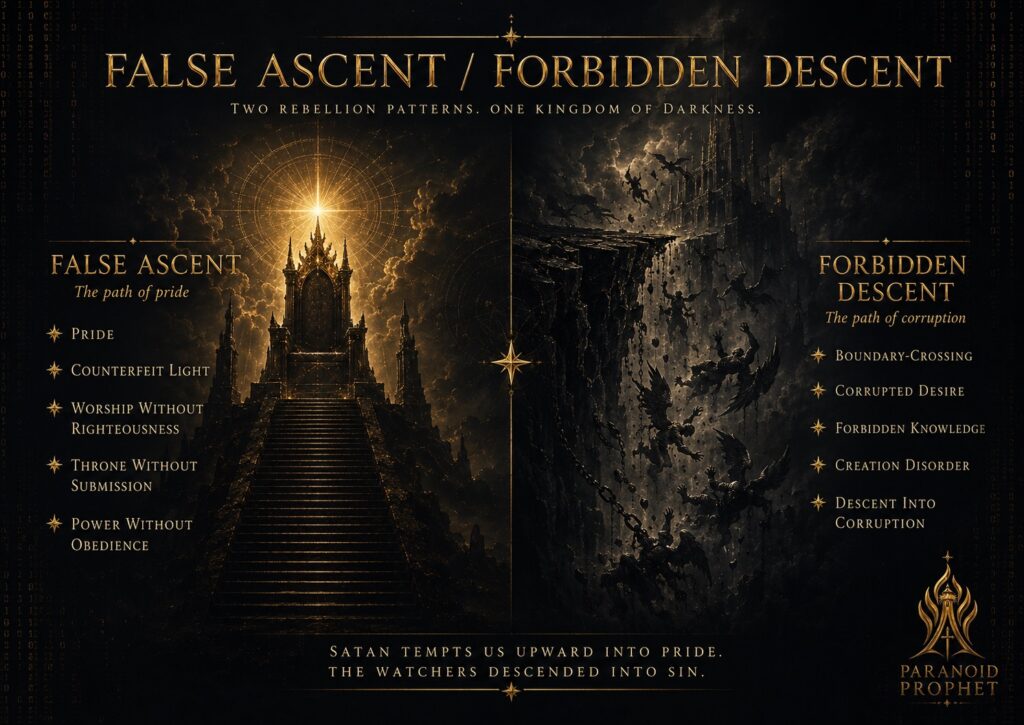
The difference can be remembered through two images. Satan’s rebellion is often associated with false ascent: pride, counterfeit glory, deceptive light, accusation, and rule opposed to God. The Watcher tradition is associated with forbidden descent: heavenly beings abandoning an appointed boundary, corrupting mediation, entering forbidden unions, and transmitting power detached from obedience.
That contrast is useful, but it is an interpretive framework, not an explicit biblical formula or a complete biography of either rebellion. Satan also descends, moves, tempts, and accuses. The Watchers also display pride and deception. Direction helps illuminate their characteristic patterns; it does not prove that the rebellions are unrelated or reveal a hidden chain of command.
This article therefore has one narrow job: compare the canonical profile of Satan with the Enochic Watcher tradition, identify what can and cannot be said about their relationship, and explain why the distinction matters. The wider taxonomy belongs in The Unseen Rebellion Map. Here the sources remain in order: Scripture defines, ancient context may clarify, and modern theory stays downstream. Both patterns finally meet the same limit, because every rebel power remains created, judged, and beneath Jesus Christ.
That order allows firm conclusions without artificial certainty. Scripture clearly reveals Satan’s characteristic work and the judgment of angels who sinned. The Satanic application of Isaiah 14, the Genesis 6 connection in Jude and Peter, and the detailed Watcher narrative each involve additional interpretive steps. Naming those steps does not empty the comparison of meaning. It shows readers which claims are direct, which are strong inferences, and which belong to ancient reception.
Article Guide10 sections
Are Lucifer and the Watchers the Same?
Lucifer is a traditional Christian label normally applied to one personal adversary, Satan. The rebel Watchers are a group of heavenly beings in the Enochic interpretation of Genesis 6. Scripture never calls Satan a Watcher, Genesis 6 never names Satan, and First Enoch does not simply reveal Satan as the leader who organized the Watchers’ descent.
The categories do overlap. Both concern creaturely rebellion against divine order. Both involve corruption, deception, judgment, and harm to humanity. They may be understood as participants in one wider kingdom of darkness. But common allegiance cannot by itself establish a common identity, a shared origin event, or one fully revealed hierarchy. Related does not mean identical.
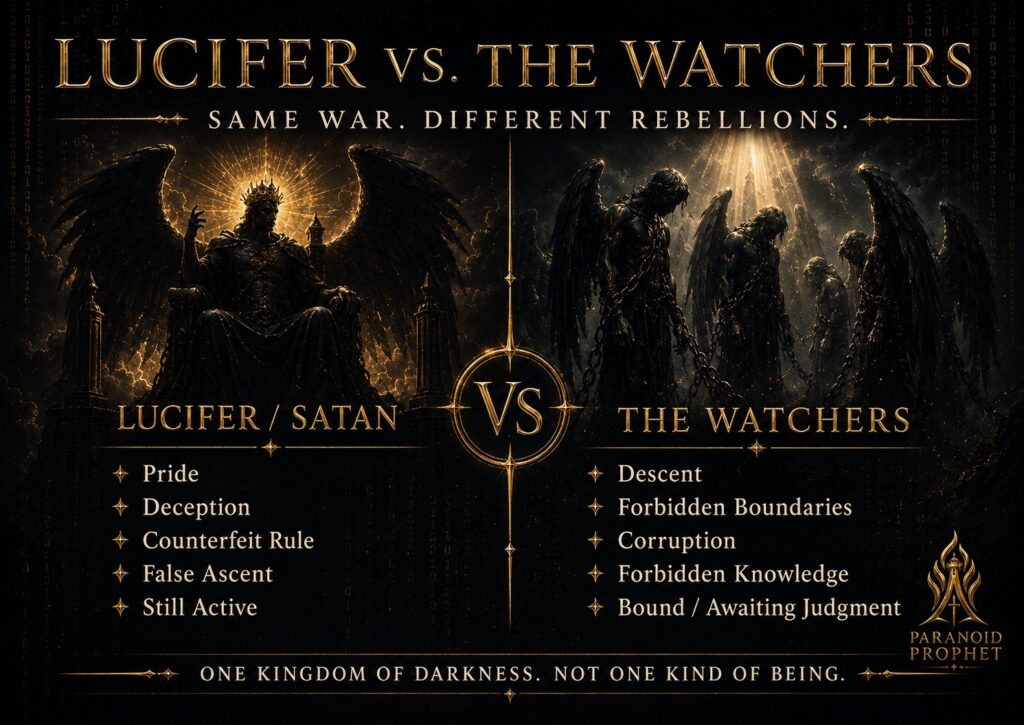
The distinction is clearest when source and scale stay visible. Satan’s profile stretches across the canonical story, from the serpent identified through later Scripture to the accuser, tempter, ruler-like opponent, defeated enemy, and finally judged devil. The Watcher rebellion is concentrated around Genesis 6, its ancient reception, and the New Testament warnings about angels who sinned and are restrained.
False ascent and forbidden descent are useful patterns, not complete biographies. They summarize characteristic movements without pretending Scripture has given a documentary timeline of Satan’s first sin or an exhaustive organizational chart for the Genesis 6 rebels.
Who Is Lucifer, or Satan, in Scripture?
A responsible comparison begins with Satan’s clearer biblical profile. Isaiah 14 and Ezekiel 28 matter because Christian tradition has long read their proud rulers as reflecting a deeper spiritual pattern. They should remain supporting texts. Job, Zechariah, the Gospels, Paul, and Revelation identify the adversary’s activity more directly.
What “Lucifer” Means
Isaiah 14:4-15 is introduced as a taunt against the king of Babylon. At verse 12, the Hebrew expression is commonly rendered “shining one,” “day star,” or “morning star,” followed by “son of dawn.” The Latin tradition used lucifer, meaning light-bearer or morning star, and the King James Version preserved “Lucifer” in English.
Over time, many Christians used Lucifer as a proper name for Satan before his fall. That usage is established in Christian tradition, but it should not be confused with a direct naming formula in the Hebrew text. Morning-star imagery is not inherently satanic; Scripture can use related language positively, including for Christ in Revelation 22:16. Context, not the image alone, determines the referent.
This article can therefore speak of “Lucifer” because that is the term readers are asking about, while treating Satan as the stronger canonical category. The distinction honors the history of Christian interpretation without making one translation choice carry more weight than the passage and the wider canon permit.
Isaiah 14 and False Ascent
The Babylonian ruler in Isaiah 14 imagines ascent, an elevated throne, and likeness to the Most High. The language exposes imperial pride through cosmic poetry. The one who expects the heights is brought to the depths; the ruler who shook kingdoms becomes an object of astonishment. In its first setting, the taunt announces that human tyranny cannot climb beyond God’s judgment.
Christian readers have often recognized more than an isolated royal vice in this pattern. Babylon’s pride resembles the wider Satanic impulse toward counterfeit rule, self-exaltation, and glory without obedience. That layered reading can be theologically meaningful so long as the earthly ruler remains visible and the analogy does not become a secret chronology.
The passage supplies this article’s false-ascent image through a layered Christian reading; it does not independently supply Satan’s entire biography. The clearest claims about Satan should come from passages that actually name or directly identify him.
Ezekiel 28 and Corrupted Glory
Ezekiel 28 directly confronts the ruler and then laments the king of Tyre. The first oracle condemns a human ruler who claims divine status despite being mortal. The lament then uses elevated images of Eden, beauty, wisdom, precious stones, cherubic presence, violence, pride, profanation, and expulsion.
That movement has led many Christians to perceive a spiritual reality behind or reflected through Tyre’s king. The reading is possible as a theological pattern: entrusted glory becomes corrupt, wisdom is ruined, and exalted status ends under divine judgment. Yet the imagery is textually and interpretively complex. Some readings apply the cherubic language to the king; others understand the king in relation to a guardian cherub.
Ezekiel 28 should therefore support rather than control the Satan profile. It does not provide a simple sequence of Satan’s creation, office, first sin, expulsion, and later activity. Its secure emphasis is the downfall of creaturely splendor corrupted by pride and violence, first spoken against Tyre.
Satan as Adversary, Accuser, and Tempter
In Job 1-2 and Zechariah 3, the adversarial and accusatory profile comes into focus. In Job, “the satan” challenges the integrity of Job’s worship but cannot act beyond limits God sets. In Zechariah, Satan stands to accuse Joshua the high priest, while the Lord rebukes the accusation and restores the accused. Satan is dangerous, but never sovereign.
Matthew 4 identifies him as the tempter who distorts Scripture, presses Jesus toward self-serving proof, offers kingdom without the path of obedient suffering, and seeks worship. The temptation is not merely to do obviously evil things. It is to grasp a real vocation through a false means and to accept rule detached from loyalty to God.
These texts provide a firmer Satanic pattern than a reconstructed prehistory: he questions faithful worship, prosecutes the righteous, distorts God’s word, and offers counterfeit paths to authority. His recurring aim is to divide trust from obedience and glory from the character of God.
Satan as Deceiver and Counterfeit Light
Genesis 3 presents the serpent who reframes God’s command as deprivation, promises wisdom through disobedience, and denies judgment. Genesis itself calls him the serpent; Revelation 12 and 20 provide the canonical identification of the ancient serpent with the devil and Satan. The connection rests on the wider biblical witness, not on importing a later name into Genesis without explanation.
Jesus calls the devil a murderer and the father of lies in John 8:44. Paul warns in 2 Corinthians 11 that Satan can disguise himself as an angel of light. Deception may therefore arrive through what appears elevated, liberating, beautiful, wise, or spiritually authoritative. Counterfeit light is dangerous precisely because it does not announce itself as darkness.
Satan’s deception does not make every error a direct manifestation of Satan or every unusual light a spiritual event. It gives Christians a theological test: apparent illumination must be judged by its truth about God, Christ, holiness, worship, and the gospel rather than by spectacle or promised access.
Satan’s Activity, Defeat, and Judgment
The New Testament can call Satan the ruler of this world and the prince of the power of the air, yet those descriptions never make him an equal opposite to God. In John 12:31, Jesus announces judgment on the ruler of this world as the cross approaches. Hebrews 2 connects Christ’s death with breaking the devil’s enslaving use of death. Colossians 2 announces the disarming of hostile rulers and authorities through the cross.
Luke 10:18 and Revelation 12 both use fall or expulsion imagery, but neither should be flattened into a straightforward documentary account of Satan’s first rebellion before humanity. In Luke, Jesus responds to the disciples’ successful mission. Revelation presents symbolic conflict tied to the Messiah, accusation, witness, and the devil’s shortened time. Each text contributes to Satan’s defeat without supplying a speculative primordial timeline.
Revelation 20 gives the final horizon: the deceiver is judged and cannot escape the sentence of God. Satan remains active for a limited time, but his activity occurs within creaturely limits and beneath a verdict secured by Christ. His canonical profile is now clear enough for comparison: adversary, accuser, tempter, liar, murderer, deceiver, counterfeit light, ruler-like opponent, defeated enemy, and object of final judgment.
Who Are the Watchers?
The Watcher side of the comparison requires a different source sequence. Genesis supplies the compressed event. Daniel proves that “watcher” is biblical terminology, though not inherently a rebel label. Jude and Second Peter describe sinning angels under restraint. First Enoch provides the developed rebel-Watcher story that joins those elements in ancient interpretation.
Genesis 6 and the Sons of God
Genesis 6:1-4 describes the sons of God taking daughters of humanity, the appearance of the Nephilim, and renowned figures of old. The heavenly-being interpretation of the sons of God fits the phrase’s use in Job, the ancient reception of the passage, and the angelic-rebellion language later found in Jude and Second Peter.
The episode belongs inside Genesis 6’s larger escalation. Human multiplication is followed by forbidden taking, the Nephilim, pervasive wickedness, corrupt flesh, violence, judgment, and Noah’s favor before God. The heavenly transgression matters, but it does not remove human responsibility or consume the chapter’s concern with violence and corruption.
Genesis 6 Explained develops that whole-chapter movement. Sons of God and Daughters of Men owns the full interpretation debate. Here it is enough to identify the event that later Watcher tradition expands.
“Watcher” in Daniel and First Enoch
In Daniel 4, Nebuchadnezzar sees a “watcher, a holy one” descend with a decree concerning the royal tree. The figure serves the judgment of the Most High. The passage establishes that watcher language can describe a faithful heavenly messenger. The word itself does not mean fallen angel.
Genesis 6, by contrast, never uses the term. First Enoch’s Book of the Watchers identifies the sons of God with a company of Watchers who descend, bind themselves by oath, take wives, father giants, transmit forbidden teachings, and are bound for judgment. That framework became highly influential in Second Temple Jewish interpretation.
This yields a precise formulation: Watchers are biblical as a general heavenly term in Daniel, while rebel Watchers tied to Genesis 6 are primarily an Enochic interpretive label. The Watchers Explained develops their history and identity; The Book of Enoch Explained sets the authority boundary between Scripture and ancient context.
Jude, Second Peter, and Angels Who Sinned
Jude 6 and 2 Peter 2:4 provide the strongest New Testament points of contact. Jude describes angels who did not keep their own position but abandoned their proper dwelling and are kept under restraint for judgment. Peter places angels who sinned near the Flood in a sequence of examples showing that God judges rebellion and rescues the righteous.
Jude also preserves a prophecy attributed to Enoch, demonstrating familiarity with Enochic tradition. That use makes the ancient context significant. It does not require the conclusion that Jude canonizes every episode, name, number, or cosmological detail in the larger Enochic collection. An inspired author can use a recognized tradition for his own warning without granting equal authority to the entire source.
The Genesis 6 connection is strong because of the abandoned boundary, angelic sin, sexual-transgression context, Noah-era placement, restraint, and future judgment. It remains an interpretation rather than a sentence Jude or Peter states verbatim. The letters control the Christian conclusion: angelic rebellion is real, divine restraint is effective, and privilege does not shield any creature from judgment.
Forbidden Descent and Corrupted Mediation
First Enoch develops the rebellion as a group descent into the human sphere. The Watchers cross an appointed boundary, enter forbidden unions, generate violent offspring, and transmit practices that intensify bloodshed, exploitation, enchantment, and corrupt attempts to master hidden things. Semjaza appears prominently in the oath and group leadership; Azazel receives a major role in teaching and corruption.
The issue is not that created knowledge, craft, observation, or technology is evil by nature. Scripture celebrates skill and wisdom received under God. The Watcher warning concerns mediation detached from righteousness: power offered through rebellion, knowledge separated from obedience, and access that bypasses creaturely limits and covenant faithfulness.
The Watchers represent forbidden descent, corrupted mediation, boundary crossing, and knowledge detached from obedience. That summary belongs here; the complete ancient teaching catalog belongs in What Did the Watchers Teach?.
Watchers, Nephilim, and Giant Aftermath
The Watchers and the Nephilim are not the same category. Under the Enochic reading of Genesis 6, the Watchers are heavenly rebels and the giants are their embodied offspring or earthly result. Later biblical giant-associated peoples, including Anakim, Rephaim, Og, and warriors from Gath, raise a continuity question that Genesis does not fully explain.
Who Were the Nephilim? owns the identity question. Did the Nephilim Survive the Flood? examines bodily continuity after the Flood. Those questions must also remain separate from First Enoch’s theory that spirits proceeding from dead giants became active evil spirits.
Jude and Peter emphasize restrained angels, while the Gospels portray active demons and unclean spirits. Ancient tradition offers a way to relate those conditions without making the beings identical. Where Are Demons and Fallen Angels Now? compares the status and origin views in their proper lane.
Was Satan the Leader of the Watchers?
Scripture does not identify Satan as the leader of the Genesis 6 angels. Genesis 6 does not name him. Jude and Second Peter do not name him as their commander. First Enoch gives Semjaza a leading role in the group’s oath and gives Azazel an especially prominent role in corruption and judgment; it does not simply identify either figure as Satan.
Satan and the Watchers may share allegiance within a wider rebellion. Scripture speaks of the devil and his angels, and the New Testament portrays a coordinated kingdom of darkness. That broad relationship does not reveal whether Satan ordered the Hermon descent, whether every Watcher belonged to one mapped command structure, or whether Semjaza or Azazel should be decoded as another name for Satan.
The disciplined answer is neither denial nor invention: a shared kingdom is plausible, but the detailed leadership relationship is unrevealed. Confidence should stop where the sources stop.
False Ascent and Forbidden Descent
The central comparison can now be made without forcing the sources. False ascent names the pride, counterfeit glory, and rival authority associated with the traditional Lucifer reading and Satan’s canonical activity. Forbidden descent names the boundary crossing and corrupt mediation of the Enochic Watchers. The contrast is thematic, not a pair of titles supplied by Scripture.
Different Direction
False ascent reaches toward illegitimate glory. Isaiah 14’s royal figure imagines the heights, while Satan tempts through rival worship, counterfeit authority, and a path to kingdom without faithful suffering. The image warns against grasping a status, authority, or illumination that belongs under God’s rule.
Forbidden descent crosses into a sphere the rebels were not appointed to possess. The Enochic Watchers leave heaven, bind themselves to a transgressive course, and corrupt human life. One movement reaches upward in self-exaltation; the other moves downward in boundary-breaking intervention. Both reject creaturely obedience.
Different Primary Role
Satan’s canonical role centers on adversarial action. He accuses, tempts, deceives, distorts, seeks worship, and opposes the kingdom of God. He is one personal antagonist whose titles and activities develop across the biblical canon.
The Watchers function as a company of corrupt mediators in ancient Genesis 6 interpretation. Their story is not mainly about prosecuting the righteous or offering Jesus the kingdoms. It is about a collective breach that brings illicit union, violent offspring, disordered power, and forbidden instruction into the human realm.
Different Scope and Setting
Satan’s opposition spans the canonical story. The serpent’s deception, Job’s accusation, Joshua’s prosecution, Jesus’ temptation, the church’s conflict, and Revelation’s dragon imagery belong to a wide narrative of resistance to God’s kingdom.
The Watcher rebellion is concentrated around the pre-Flood crisis and its reception. Genesis 6 is brief; First Enoch expands the descent, oath, unions, giants, teachings, and binding; Jude and Peter draw on angelic transgression as a warning about certain judgment. The narrower setting should not be inflated into a complete explanation for every later rebel power.
Different Relationship to Humanity
Satan approaches humanity through accusation, temptation, deception, fear, counterfeit wisdom, and demanded allegiance. His work attacks trust in God and seeks to redirect worship. Even his promise of illumination in Genesis 3 leads to shame, fracture, and death.
The Watcher tradition depicts a more direct boundary violation. Heavenly beings take human women, generate giant violence, and become illicit teachers. Their mediation does not merely propose an idea; it alters social and embodied life in the ancient narrative. The distinction does not make one rebellion spiritual and the other physical. It identifies their characteristic human impact.
Different Present Status and Judgment Emphasis
The New Testament portrays Satan as active but already judged in principle through Christ’s work. He tempts, deceives, accuses, and prowls for a limited time, while believers resist him under God. Revelation points toward his final confinement and punishment.
The angels associated with Jude 6 and Second Peter 2:4 receive a different present-status emphasis: special restraint while they await judgment. That does not prove every member of a broad Watcher category is described exhaustively by those verses, but it does prevent the restrained rebels from being casually equated with every active demon or power.
What They Share
The contrasts must not hide the common center. Satan and the Watcher tradition both portray created beings rejecting divine order, corrupting what was entrusted to them, misusing power, harming humanity, and coming under judgment. Both warn that spiritual status does not grant independence from the Creator.
They can therefore belong to one broad rebellion without becoming one category. The relationship is one of shared opposition and judgment, not demonstrated identity. The following table keeps the source lanes, roles, and limits visible in one place.
| Comparison | Lucifer or Satan | Rebel Watchers |
|---|---|---|
| Primary source lane | Satan’s profile is canonical; Lucifer is a traditional label shaped by Isaiah 14’s translation history. | The sons of God are biblical; the developed rebel-Watcher identity is primarily Enochic interpretation. |
| Identity | One personal adversary, accuser, tempter, and deceiver. | A group of heavenly rebels in the ancient Genesis 6 tradition. |
| Characteristic movement | False ascent toward counterfeit glory and rival rule. | Forbidden descent beyond an appointed heavenly boundary. |
| Canonical role | Accuses, tempts, deceives, seeks worship, and opposes God’s kingdom. | Genesis names sons of God; Jude and Peter emphasize angelic sin, abandoned boundaries, restraint, and judgment. |
| Human impact | Corrupts trust, worship, truth, allegiance, and faithful vocation. | Ancient tradition adds forbidden union, violent offspring, and corrupt instruction. |
| Ancient expansion | Later Christian tradition applies Lucifer and layered readings of Isaiah 14 and Ezekiel 28 to Satan. | First Enoch names Semjaza and Azazel, Hermon, teachings, giants, and binding. |
| Present status | Active for a limited time under an already-decided judgment. | The Genesis 6 angels connected with Jude and Peter are specially restrained pending judgment. |
| Judgment emphasis | Defeat through Christ and final punishment in Revelation 20. | Binding, gloomy custody, and future judgment. |
| Primary warning | Reject false light, accusation, counterfeit worship, and glory without obedience. | Reject boundary-breaking power and knowledge detached from holiness. |
| Revealed relationship | May share the wider kingdom of rebellion. | Scripture does not reveal Satan as the named leader of the Genesis 6 group. |
The table compares source, role, movement, status, and warning without turning the thematic contrast into a complete supernatural chronology.
Related Categories Without Category Collapse
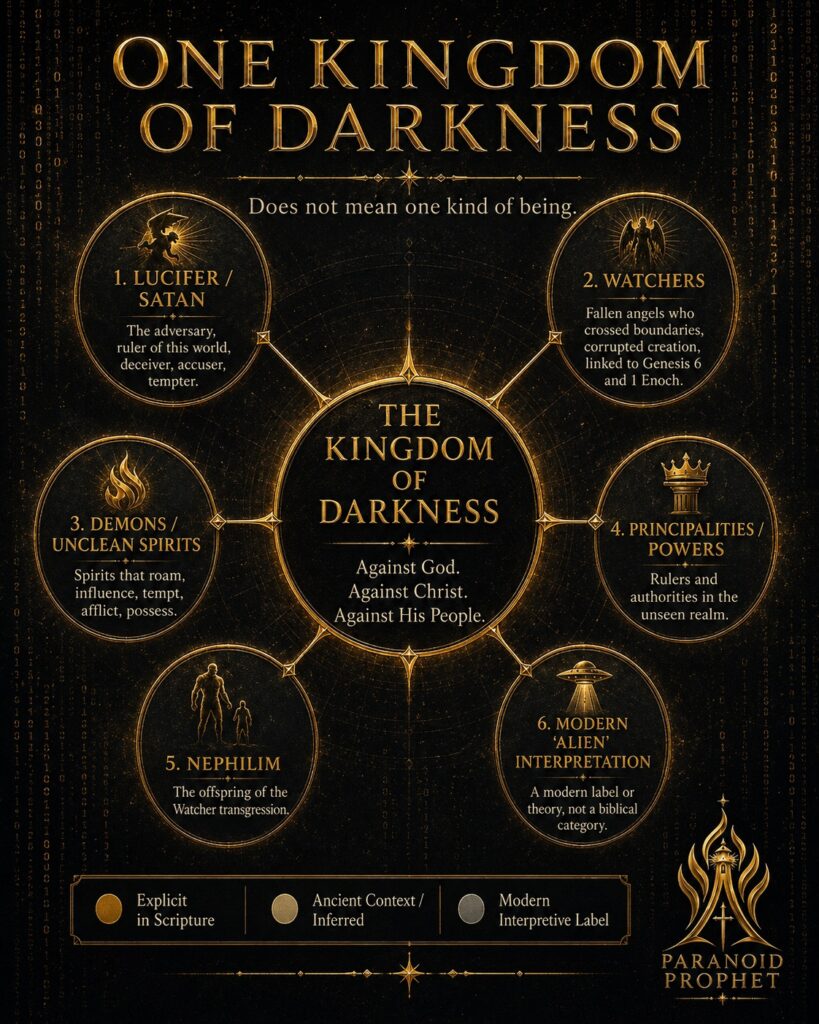
A comparison between Satan and the Watchers touches several neighboring categories. Those relationships matter, but this article should not turn them into one undifferentiated class called fallen angels, demons, or dark powers.
Demons Are Not Automatically Watchers
The Gospels portray demons or unclean spirits as active hostile agents who recognize Jesus, afflict people, seek continued influence, fear confinement, and obey Christ’s command. Jude and Peter emphasize sinning angels under restraint. Those conditions are related to one wider conflict, but they are not identical descriptions.
First Enoch’s spirits-of-giants theory offers an ancient explanation for active evil spirits while their angelic fathers remain bound. Christians may find that theory historically illuminating, but Scripture does not state one universal origin for every demon. The distinction belongs in the dedicated status article rather than being solved by the word “Watcher.”
Nephilim Are Not Watchers
The Watchers are heavenly rebels in Enochic interpretation; the Nephilim are embodied figures associated with the Genesis 6 unions and later giant tradition. Parent and offspring, cause and earthly result, or rebel and aftermath are relationships, not identities. Calling the Nephilim Watchers erases the very distinction the ancient story depends upon.
Rulers and Authorities Are Wider Categories
Paul’s language of rulers, authorities, powers, thrones, dominions, and spiritual forces is broader than the Genesis 6 event. Colossians 1 places all created orders under Christ; Ephesians 6 identifies hostile spiritual rulers. Context determines allegiance. A principality is not automatically Satan, a Watcher, or a possessing demon.
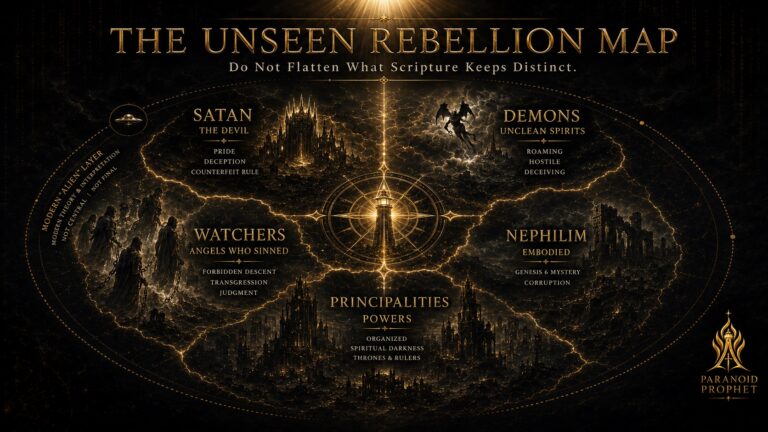
The Unseen Rebellion Map supplies the complete confidence key and taxonomy. This comparison only needs the guardrail: coordinated opposition does not require one origin, role, or present status for every power.
“Fallen Angels” as an Umbrella Term
“Fallen angels” can be useful as broad Christian shorthand for rebellious heavenly beings. It becomes misleading when it implies that Satan’s angels, the restrained angels of Jude and Peter, Enochic Watchers, active demons, and every hostile ruler are one fully mapped species with one history.
Use the umbrella when the shared rebellion is the point. Use the narrower biblical or ancient term when identity, role, source, or status matters. Careful language does not weaken belief in spiritual evil; it keeps conclusions proportional to revelation.
Why the Difference Matters for Christian Discernment
The comparison matters because the two patterns expose different ways spiritual rebellion can present itself. One offers counterfeit height, authority, and illumination. The other offers access, mediation, and power beyond appointed limits. Christian discernment tests both without becoming fascinated by either.
False Light
Second Corinthians 11 joins serpent-like deception, a different Jesus, a different gospel, false apostles, and Satan’s disguise as an angel of light. The test is not whether a messenger appears radiant, advanced, compassionate, or spiritually powerful. The test is whether the message remains faithful to the apostolic Christ and gospel.
False light commonly offers a shortcut: glory without the cross, authority without service, acquittal without repentance, spirituality without truth, or wisdom without the fear of God. The Satanic pattern warns Christians not to confuse elevated appearance with holy origin.
Forbidden Knowledge
The Watcher pattern warns about mediation as much as information. Knowledge becomes corrupt when it is offered through rebellion, used to dominate, severed from love and holiness, or treated as salvation. The problem is not learning, scientific investigation, craft, medicine, or technology in themselves. Created truth remains God’s truth, and wise skill can serve neighbor and worship.
The danger appears when knowledge promises transcendence apart from the Creator, dissolves moral boundaries, or makes the recipient dependent on a secret revealer. Christians should ask not only whether a claim is impressive, but what kind of person and worship it produces.
Modern Echoes Without Automatic Identity
Modern narratives about higher teachers, hidden revelation, nonhuman intelligence, hybridization, altered humanity, transhuman salvation, or transformation through superior beings may echo older rebellion patterns. Echoes can justify theological scrutiny. They do not prove that a reported phenomenon is Satan, a Watcher, a demon, or even spiritual in cause.
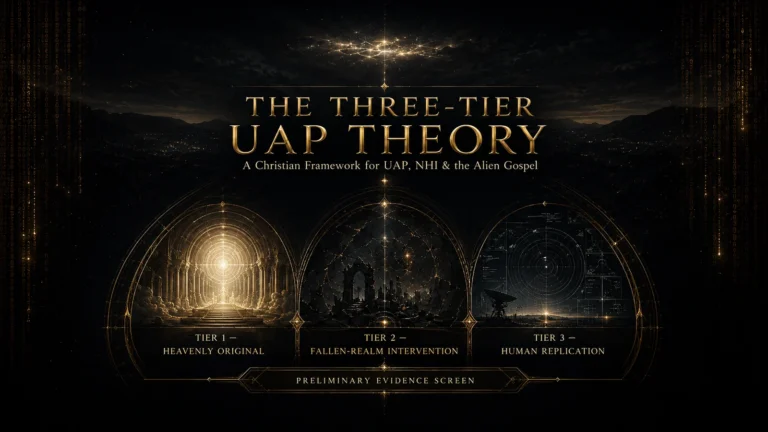
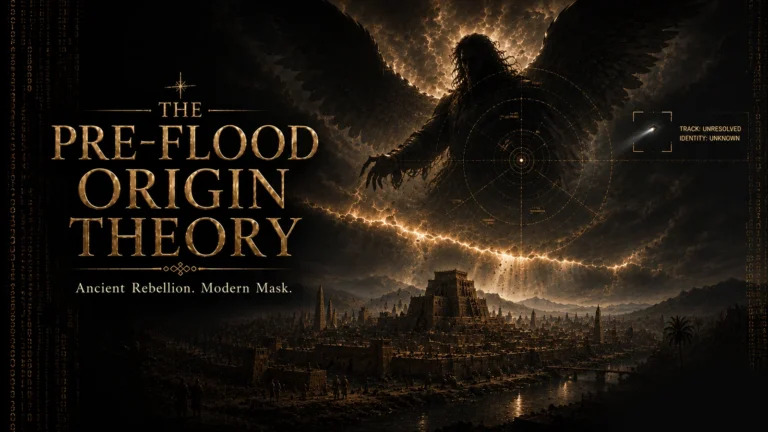
Physical cause and theological message are separate questions. A report may involve natural phenomena, human technology, misidentification, psychological experience, deception, spiritual manipulation, or an unresolved cause. The Pre-Flood Origin Theory examines the larger ancient-modern synthesis. Christian View of UFOs: The Three-Tier UAP Theory supplies the restrained framework for current UAP claims.
Test the Spirits Without Obsession
First John 4 commands believers to test the spirits because false prophets have gone into the world. Ask what a claim teaches about Jesus, his incarnation, cross, resurrection, and lordship. Ask what gospel it offers, what authority it demands, what worship it redirects, what fruit it bears, how it treats sin, and what kind of salvation and humanity it promises.
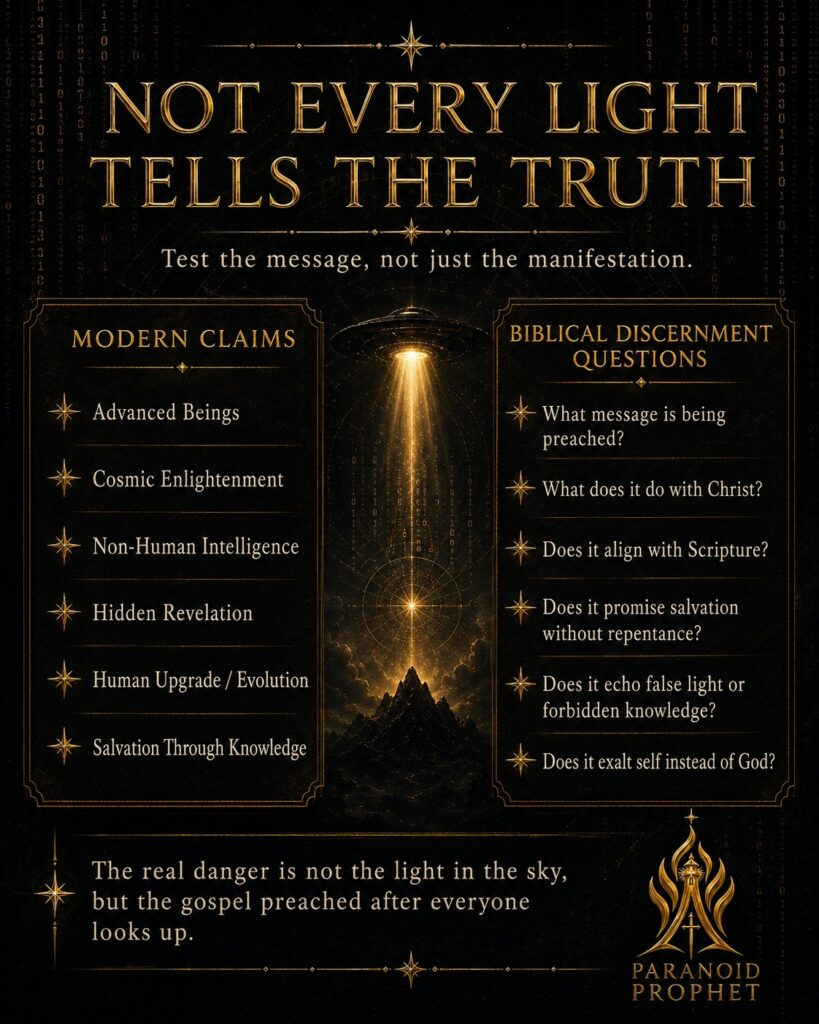
Testing does not require assigning a secret name to every influence. Christians can reject a false gospel without solving every anomaly, and they can acknowledge unresolved evidence without surrendering doctrine to it. The aim is faithful worship, sober judgment, prayer, truth, and love, not mastery of hidden ranks.
Frequently Asked Questions About Lucifer and the Watchers
Are Lucifer and the Watchers the same?
No. Lucifer is a traditional Christian label usually applied to Satan, one personal adversary. The rebel Watchers are a group in the Enochic interpretation of Genesis 6. They may share a wider rebellion without sharing identity, role, transgression, or present status.
Is Lucifer Satan’s biblical name?
Lucifer comes from the Latin and King James rendering of Isaiah 14:12 and became a traditional Christian name for Satan. The Hebrew text uses shining-one or morning-star imagery in a taunt against Babylon’s king. Satan is the clearer canonical name and category.
Does Isaiah 14 describe Satan?
Its direct subject is the king of Babylon. Christians have long seen a deeper Satanic pride pattern in its ascent and humiliation imagery. That layered application can be useful, but the passage should not be treated as a standalone biography of Satan’s primordial fall.
Does Ezekiel 28 describe Satan?
Its direct context addresses the ruler and king of Tyre. Eden, beauty, wisdom, cherubic imagery, pride, violence, and expulsion have encouraged a deeper spiritual reading in Christian tradition. Textual complexity makes it supporting evidence, not a simple Satan timeline.
Who are the Watchers?
Daniel 4 uses watcher for a holy heavenly figure. First Enoch applies the label to rebellious heavenly beings associated with Genesis 6, forbidden union, giants, corrupt teaching, and judgment. The rebel-Watcher framework is ancient interpretation built around biblical texts.
Does Genesis 6 call the sons of God Watchers?
No. Genesis 6 calls them sons of God. The specific identification of those figures as rebel Watchers comes primarily from First Enoch and related ancient Jewish interpretation.
Was Satan the leader of the Watchers?
Scripture does not say so. Genesis 6, Jude, and Second Peter do not name Satan as their leader. First Enoch gives Semjaza and Azazel prominent roles. A shared kingdom of rebellion is plausible, but the detailed command relationship is unrevealed.
Are the Watchers demons?
Not automatically. Jude and Peter emphasize restrained sinning angels, while the Gospels portray active demons or unclean spirits. First Enoch distinguishes bound Watchers from spirits proceeding from dead giants. Relationship within one rebellion does not establish identity.
Are the Nephilim Watchers?
No. Under the Enochic Genesis 6 interpretation, the Watchers are heavenly rebels and the Nephilim or giants are their embodied offspring or earthly result. Their relationship depends on keeping the categories distinct.
Are alien or NHI claims Watcher activity?
Not by default. Alien and NHI are modern interpretation labels. Some narratives may echo ancient themes, but resemblance does not prove identity. The evidence, physical cause, message, gospel, and spiritual fruit must be tested separately.
Selected Sources and Further Reading
Satan and the Biblical Adversary
Traditional Lucifer Passages
- Isaiah 14:4-15; Ezekiel 28:1-19; Luke 10:17-20.
- John N. Oswalt, The Book of Isaiah, Chapters 1-39.
- Daniel I. Block, The Book of Ezekiel, Chapters 25-48.
Genesis 6 and Angelic Rebellion
Ancient Sources and Scholarship
- George W. E. Nickelsburg and James C. VanderKam, 1 Enoch: The Hermeneia Translation, Book of the Watchers excerpt.
- Annette Yoshiko Reed, Fallen Angels and the History of Judaism and Christianity.
- Loren T. Stuckenbruck, The Myth of Rebellious Angels.
- Archie T. Wright, The Origin of Evil Spirits.
- Michael S. Heiser, The Unseen Realm, an accessible Christian synthesis best read beside the specialist works above.
Read Next
- The Unseen Rebellion Map places Satan, Watchers, demons, Nephilim, rulers, false gods, and modern labels in their proper source levels.
- The Watchers Explained develops the Genesis 6 and Enochic Watcher tradition.
- Where Are Demons and Fallen Angels Now? distinguishes active, restrained, and awaiting-judgment categories.
- The Pre-Flood Origin Theory examines the later synthesis without turning it into doctrine.
Christ Over Satan, the Watchers, and Every Rebel Power
Satan accuses, but Jesus Christ intercedes. Satan lies, but Christ is the truth. Counterfeit light offers glory without obedience, but the true Light entered the darkness, humbled himself to death, and was exalted by the Father. The Christian answer to accusation and deception is not secret knowledge of the accuser; it is union with the crucified and risen Son.
The Watcher tradition portrays mediation corrupted by rebellion. The gospel reveals the true mediator between God and humanity, Jesus Christ. Forbidden knowledge promises access apart from holiness; in Christ are hidden the treasures of wisdom and knowledge. He does not violate the boundary between Creator and creature. The eternal Son becomes human in obedient love, reconciles creation through his blood, and brings his people to God.
Colossians, Ephesians, Hebrews, and First Timothy place every comparison beneath him. All thrones, dominions, rulers, and authorities were created through him and for him. The cross disarms hostile powers, the resurrection vindicates his kingdom, and his exaltation places him above every rule and name.
Satan’s activity is limited and his final judgment certain. The angels who sinned cannot escape divine custody. The violence and renown associated with giants cannot outlast God’s verdict. No ancient name, modern revelation, hidden teacher, or promised human upgrade can replace the gospel of the Son.
Christians are therefore called to faithfulness rather than fascination. Resist the devil, test the spirits, reject corrupt mediation, pursue wisdom in obedience, remain in the apostolic gospel, and trust the judgment of God. The final answer to every rebel power is not fear. It is the supremacy of Jesus Christ.
There may be many patterns of rebellion, but there is one final King. Satan, the Watchers, and every hostile power are creatures beneath the throne of Jesus Christ, whose truth defeats deception, whose intercession answers accusation, and whose kingdom will outlast every rebellion.
CONTINUE THE INVESTIGATION
Next biblical question
Where Are Demons and Fallen Angels Now?
Move from category distinctions to the biblical texts used to discuss the present state of demons and fallen angels.