
GUIDED ARTICLE EXPERIENCE
The Martyrdom of Saint James | First Apostle to Die
Read along as the narration moves through the article.
Private device narration · No hosted audio or tracking
CONTINUE GUIDED TOUR
Continue where you left off.
GUIDED TOUR COMPLETE
You have reached the end of this study.
Study record saved on this device.
GUIDED TOUR
The Martyrdom of Saint James | First Apostle to Die
Narrator: Paranoid Prophet Recommended Voice Native device narration
Prepare to follow the article as it is narrated.
VOICE & TOUR OPTIONS
Voice & Listening
NARRATOR
Finding a narrator…
Checking the best narrator available on this device.
Restores the best curated narrator available on this device.
Narrator choices are curated for clear, long-form listening on this device.
Screen-awake support will be checked when narration starts.
CHOOSE A NARRATOR
Curated for this device
Choose a verified narrator for this browser, or use System Narrator. Automatic mode uses the best reliable route exposed by this device; your chosen narrator is preserved even if this device needs a temporary fallback.
Preparing the guided article experience…
RESUME GUIDED TOUR?
Continue where you left off.
GUIDED TOUR COMPLETE
You have reached the end of this study.
James son of Zebedee does not enter Christian memory as a distant medieval legend. The New Testament places him inside the circle closest to Jesus and then reports his death in the early life of the church.
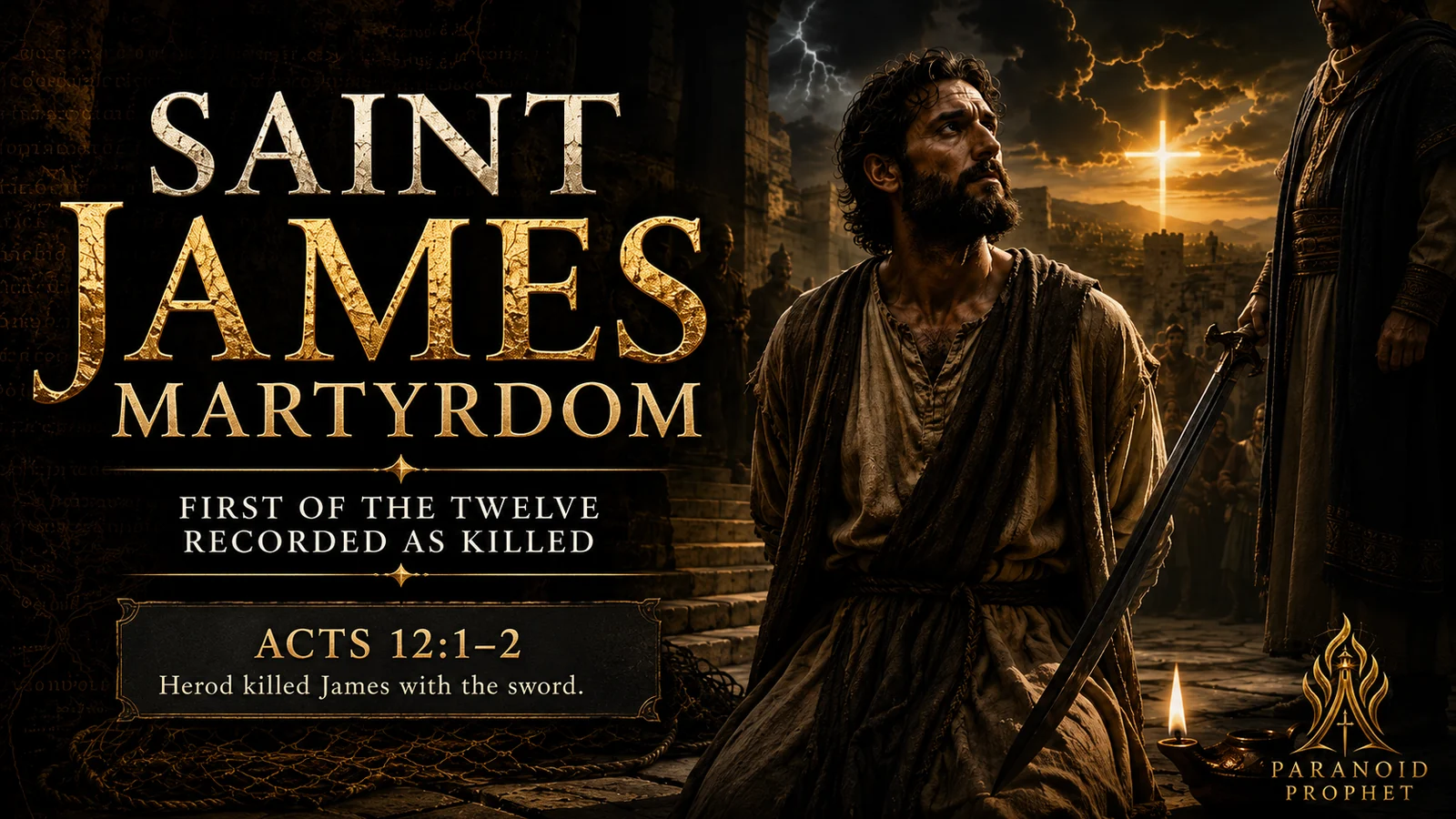
He was one of the Twelve, the brother of John, part of Jesus’ inner circle, and the first apostle whose death is recorded in Scripture. Acts says that Herod “killed James the brother of John with the sword” (Acts 12:1–2). The report is brief, but it carries serious weight.
James was not a later believer defending a tradition he had inherited from centuries of church history. He was one of the men closest to Jesus during His ministry and belonged to the apostolic circle that publicly proclaimed His resurrection. That makes his death important for the larger case for Jesus: it shows that the earliest resurrection witness was not safe, vague, or convenient.
James’s martyrdom does not prove the resurrection by itself. Martyrdom alone is not a shortcut around the evidence. But his execution places real cost around the first generation of apostolic testimony. One of Jesus’ closest disciples was killed, and the church did not stop preaching that the crucified Jesus had been raised and made Lord.
For the broader evidence-ranked overview of the apostles’ deaths, see Martyrdom of Jesus’ Disciples. For the larger case for Jesus’ identity, resurrection, and Sonship, see the main hub: Is Jesus the Son of God?
Article Guide13 sections
Which James Are We Talking About?
The New Testament mentions several men named James, so this article needs to be clear from the beginning.
This article is about James son of Zebedee, also known in later Christian tradition as James the Greater. He was the brother of John, one of the Twelve apostles, and one of the disciples closest to Jesus during His earthly ministry.
He should not be confused with James the brother of Jesus, also known as James the Just. James the brother of Jesus became a major leader in the Jerusalem church, is the James most likely in view in 1 Corinthians 15:7, and is traditionally associated with the New Testament letter of James.
James son of Zebedee also should not be confused with James son of Alphaeus, another member of the Twelve whose later death traditions are much less certain.
So when this article speaks of Saint James’s martyrdom, it is referring to James son of Zebedee, the brother of John, the apostle killed by Herod in Acts 12.
How Strong Is the Evidence for Saint James’s Martyrdom?
James son of Zebedee belongs near the top of any serious discussion of apostolic martyrdom because his death is directly reported in the New Testament. Still, not every claim connected to James carries the same weight. Acts gives us the strongest anchor. Later traditions add remembered detail. Apologetic reflection asks what his death contributes to the larger resurrection case.
| Claim | Evidence Type | Careful Weight |
|---|---|---|
| James was one of the Twelve apostles. | New Testament apostolic lists | Strong |
| James was part of Jesus’ inner circle with Peter and John. | Gospel narratives | Strong |
| James belonged to the apostolic resurrection-witness circle. | 1 Corinthians 15:3–8 and the apostolic category of “the Twelve” | Strong, with careful wording |
| James was killed by Herod Agrippa I. | Acts 12:1–2 | Very strong |
| James was killed “with the sword.” | Acts 12:1–2 | Strong |
| James was beheaded. | Common inference from “with the sword” and later Christian tradition | Plausible, but not explicitly stated in Acts |
| James’s accuser converted before his death. | Clement tradition preserved by Eusebius | Meaningful early tradition, not Acts-level certainty |
| James preached in Spain or is connected to Santiago de Compostela. | Later church memory and pilgrimage tradition | Important devotionally, weaker historically for martyrdom evidence |
| James’s martyrdom supports the resurrection case. | Apologetic inference from costly apostolic witness | Cumulative support, not standalone proof |
This evidence ranking keeps the article honest. James’s death does not depend on medieval legend or regional devotion. The central claim is anchored in Acts: Herod killed James the brother of John with the sword. Later tradition can enrich the picture, but Scripture gives the foundation.
That makes James different from apostles whose deaths are known only through later and more varied tradition. In James’s case, the martyrdom itself is directly reported in Scripture. The exact method behind “with the sword” can be discussed carefully, and later traditions can be weighed in their proper place, but the core fact is strong: James was one of the Twelve, and he was executed for the name of Christ in the earliest years of the church.
What This Article Is Arguing
This article is not arguing that James’s martyrdom, by itself, proves Christianity true. People can suffer sincerely for beliefs that are false. The stronger point is more focused: James was close to Jesus, belonged to the apostolic witness circle, and was executed early while the church was publicly proclaiming the risen Christ.
James did not die for a vague moral philosophy. He did not suffer for a distant legend. He was one of the men closest to Jesus during His ministry, and Acts places his death inside the early conflict surrounding the Christian proclamation.
That makes James’s martyrdom one important beam inside the larger resurrection case. It does not stand alone, but it gives the earliest apostolic witness historical cost. The message was not safe. The witnesses were not protected from danger. Yet the proclamation continued: Jesus was crucified, Jesus was raised, and Jesus is Lord.
Who Was James the Son of Zebedee?
James son of Zebedee was not a background figure in the Gospels. He was one of the Twelve apostles, the brother of John, and one of the few disciples repeatedly brought into Jesus’ closest moments of ministry.
That matters for this article because James’s martyrdom is not the death of a man who only knew Christianity from a distance. James had walked with Jesus. He had heard His teaching, seen His authority, witnessed His glory, and watched His suffering up close. When Acts later reports James’s death, it is speaking about a man who belonged to the circle closest to Christ.
James, John, and the Call from the Nets
The Gospels introduce James as a fisherman from Galilee. He and his brother John were sons of Zebedee, working in the boat when Jesus called them. Mark says Jesus saw “James the son of Zebedee and John his brother” mending nets, and immediately called them. They left their father Zebedee in the boat and followed Him (Mark 1:19–20).
That first scene tells us something important. James did not begin as a polished religious celebrity. He was a working man with a family, a trade, and a familiar future. Then Jesus called him. The authority of Christ reached into an ordinary boat and redirected the course of his life.
Matthew records the same call and says James and John left the boat and their father to follow Jesus (Matthew 4:21–22). From the beginning, James’s story is marked by costly discipleship. Following Jesus meant leaving behind what was familiar and placing his life under the authority of the One who called him.
One of Jesus’ Inner Circle
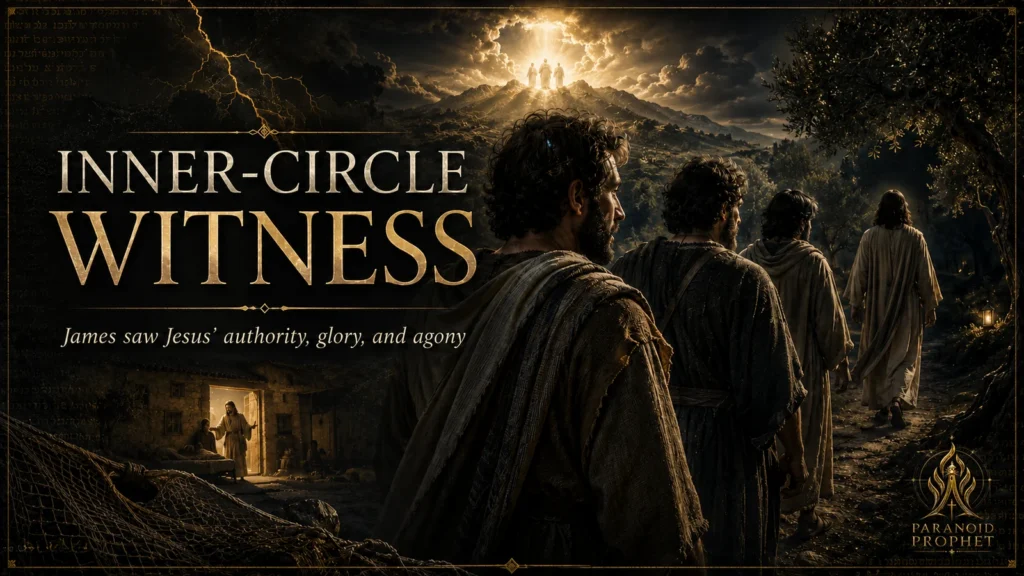
James was not merely one name in a list of apostles. Along with Peter and John, he was brought into several moments where Jesus revealed His power, glory, and sorrow in unusually direct ways.
When Jesus raised Jairus’s daughter, He allowed only Peter, James, John, and the child’s parents to enter with Him (Mark 5:37–43). James saw Jesus stand in the presence of death and speak life. That moment matters because the apostolic witness to Jesus was never merely about moral teaching. The disciples saw His authority over the powers that terrify mankind most.
That does not prove the resurrection by itself. But it shows why the later resurrection proclamation came from men who had already seen Jesus confront death with authority. James knew what kind of Lord the apostles were proclaiming.
James was also present at the Transfiguration. Jesus took Peter, James, and John up the mountain, where His appearance was changed before them and His glory was revealed (Mark 9:2–8; Matthew 17:1–8). James saw that Jesus was not merely another prophet. He stood in the presence of the Son whose glory was confirmed by the Father’s voice.
Then, in Gethsemane, Jesus again took Peter, James, and John close to Him as He entered the agony before the cross (Mark 14:32–34). James saw not only glory, but sorrow. He saw the obedience of the Son as Jesus moved toward the suffering that would redeem His people.
Taken together, these scenes give James’s later death real weight. James had seen Jesus’ authority over death, His unveiled glory on the mountain, and His agony before the cross. He knew Jesus not as an idea, symbol, or inherited tradition, but as the Lord whose power and suffering he had witnessed up close.
The Son of Thunder Who Had to Learn the Cross
James was close to Jesus, but he was not flawless. Mark says Jesus gave James and John the name Boanerges, meaning “Sons of Thunder” (Mark 3:17). The name suggests intensity, boldness, and zeal.
That zeal was not always mature. In Luke, James and John wanted to call down fire from heaven on a Samaritan village that rejected Jesus (Luke 9:51–56). They had courage, but their courage needed to be governed by the mercy and mission of Christ.
Another scene makes the lesson even clearer. James and John asked Jesus for places of honor at His right and left in glory. Jesus answered by asking whether they were able to drink the cup He would drink and be baptized with the baptism with which He would be baptized (Mark 10:35–40).
Jesus did not deny that glory was coming. But He taught James that the road to glory passed through suffering, service, and the cross. The kingdom of Christ is not built by ambition, violence, or self-exaltation. Its witnesses follow the crucified and risen King through service, suffering, and costly obedience.
That makes James’s death in Acts 12 more than an isolated tragedy. The man who once asked for a throne beside Jesus eventually became the first apostle whose death is recorded in Scripture. James wanted glory, and Jesus taught him about the cup. Acts does not give us every detail of James’s final moments, but it does show that his witness to Christ became costly in the first generation of the church.
That raises the next question: how does James son of Zebedee relate to the resurrection witnesses named in the earliest Christian proclamation?
Did James See the Risen Jesus?
The careful answer is this: James son of Zebedee belongs naturally within the apostolic resurrection-witness circle, but the New Testament does not record an individual appearance to him by name.
That distinction matters. A strong Christian case does not need to pretend the Bible says more than it says. James was one of the Twelve, and the earliest resurrection proclamation names “the Twelve” as a witness group. But the separate appearance to “James” in 1 Corinthians 15:7 is best understood as a different James: James the brother of Jesus.
So James son of Zebedee should be connected to the resurrection witness through the company of the apostles, not through the individually named appearance to James in 1 Corinthians 15:7. That keeps the argument honest and still leaves the point strong.
James and “the Twelve” in the Resurrection Witness
Paul gives one of the earliest summaries of the resurrection proclamation in 1 Corinthians 15:3–8. He says he delivered what he also received: that Christ died for our sins according to the Scriptures, that He was buried, that He was raised on the third day according to the Scriptures, and that He appeared to Cephas, then to the Twelve, then to others.
This is important because Paul is not describing a vague spiritual feeling or a slow medieval legend. He is preserving an early proclamation centered on the death, burial, resurrection, and appearances of Jesus Christ. The risen Jesus was proclaimed in connection with named witnesses and recognizable groups.
James son of Zebedee belonged to the Twelve during Jesus’ earthly ministry. He was not a later outsider to the apostolic story. He was part of the circle closest to Jesus, and Acts later still places him inside the early life of the church before his death under Herod.
When Paul says Jesus appeared to “the Twelve,” that phrase functions as an apostolic witness category. It does not require that the exact number twelve was present in every resurrection appearance after Judas’s betrayal. It points to Jesus’ chosen witnesses, the apostolic company identified with His ministry, death, and resurrection proclamation.
That is where James son of Zebedee belongs in the resurrection case. Scripture does not give us a scene where Jesus appears to him alone. But it does place him among the apostles who proclaimed the risen Christ, and Paul’s early summary names that apostolic company as part of the resurrection witness.
Why 1 Corinthians 15:7 Refers to a Different James
Paul also says that the risen Jesus appeared “to James” (1 Corinthians 15:7). That can confuse readers because the New Testament includes more than one James.
The named James in that verse is best understood as James the brother of Jesus, not James son of Zebedee. Paul has already mentioned “the Twelve” as a group. Then he names James separately. That separate mention fits James the Lord’s brother, who later became a major leader in the Jerusalem church.
Galatians supports that reading. Paul says that when he went to Jerusalem, he visited Cephas and also saw “James the Lord’s brother” (Galatians 1:18–19). That James is not James son of Zebedee. He is the brother of Jesus, the Jerusalem leader, and the James most naturally connected with the individual appearance in 1 Corinthians 15:7.
This distinction strengthens the article. It keeps the evidence ranked correctly. James son of Zebedee belongs to the apostolic witness group called “the Twelve.” James the brother of Jesus is the individually named James in 1 Corinthians 15:7. Confusing them would make the argument sound stronger for a moment, but weaker under scrutiny.
Why This Still Matters for the Case for Jesus
We do not need to invent a named resurrection appearance to James son of Zebedee for his witness to matter. The evidence is already strong enough. James was one of the Twelve, close to Jesus during His ministry, part of the apostolic company that proclaimed the risen Christ, and the first apostle whose death is recorded in Scripture.
That matters for the larger case for Jesus because the resurrection proclamation was not detached from real people. It was carried by men who had known Jesus before the cross and then publicly confessed Him as risen Lord after the cross. James belongs inside that company of witnesses.
For the broader historical case behind the early resurrection proclamation, see Historical Evidence for the Resurrection of Jesus.
James’s martyrdom does not prove the resurrection by itself. But it does place cost around the earliest resurrection witness. James was not defending an abstract philosophy. He belonged to the circle of witnesses whose message was that Jesus had died, had been raised, and now reigns as Lord.
With that resurrection-witness context in place, we can now turn to the clearest historical anchor for James’s martyrdom: Acts 12, where one of Jesus’ closest apostles becomes the first of the Twelve whose death is recorded in Scripture.
What Scripture Says About James’s Death
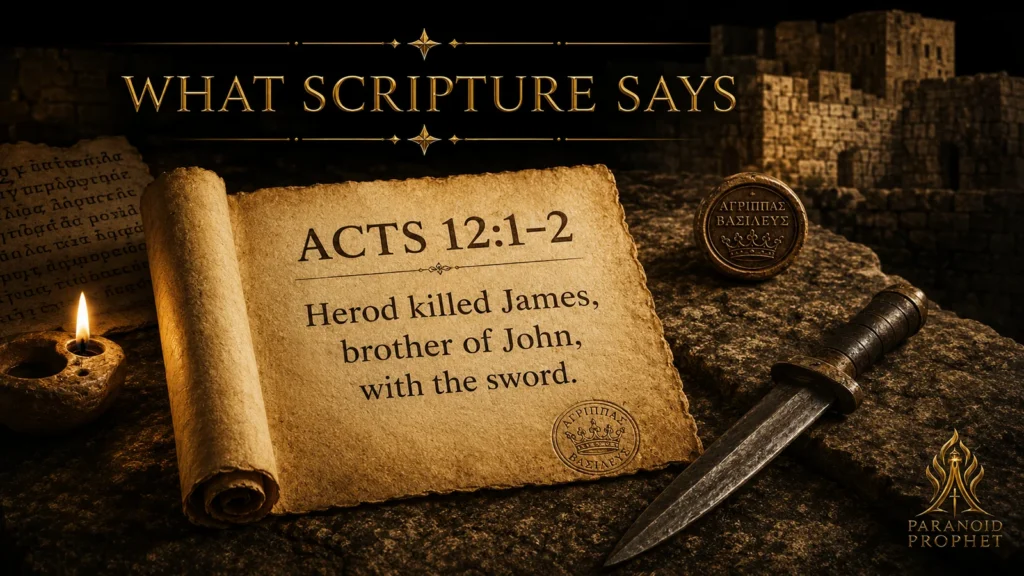
The clearest evidence for the martyrdom of James son of Zebedee comes from Acts 12:1–2. Luke writes that Herod laid violent hands on some who belonged to the church, and “he killed James the brother of John with the sword.”
The account is short, but it is direct. Acts does not leave us guessing which James is meant. This is James “the brother of John,” the son of Zebedee, one of the Twelve, and one of the disciples closest to Jesus.
That makes this one of the strongest apostolic death accounts in the New Testament. James’s martyrdom is not mainly built on late regional legend or medieval expansion. The core claim is anchored in Scripture: Herod had James killed during the early life of the church.
Acts does not pause to turn James into a legend. It records his death with chilling brevity. One of Jesus’ inner-circle apostles was killed, and the narrative immediately moves to Peter’s arrest because pressure against the church was still unfolding in real time.
Acts 12 and Herod Agrippa I
The “Herod” in Acts 12 is commonly identified as Herod Agrippa I, not Herod the Great from the birth narratives. Agrippa ruled Judea under Roman authority, and Acts presents him as a ruler willing to use violence against the church when it served public approval.
Acts says Herod laid violent hands on some who belonged to the church. After he killed James, he saw that it pleased influential opponents of the church, so he proceeded to arrest Peter also (Acts 12:1–3).
That detail is important. Acts does not give us Herod’s private thoughts, but it does show the political pattern: violence against the church pleased powerful opponents, and Herod pressed further by targeting another leading apostle.
This was not merely social embarrassment or private criticism. The pressure had reached the level of public authority. James was killed, Peter was imprisoned, and the early church learned that confessing the risen Christ could bring danger from rulers as well as rejection from religious opponents.
The issue was not that the apostles were offering harmless moral advice. They were publicly confessing that God had raised the crucified Jesus and made Him Lord. In Acts 12, that confession had consequences.
Executed by the Sword: What We Can and Cannot Say
Acts says James was killed “with the sword.” That phrase means execution by sword. Many Christians have understood this as beheading, and that may be the correct inference. But the biblical text itself does not describe the scene in detail.
The strongest claim is simple: Herod had James executed.
We can say with confidence that James son of Zebedee was killed by Herod, that his death is recorded in Acts, that he was one of the Twelve, and that his execution happened during the early public life of the church.
We should not claim more than Acts gives us. Acts does not record a final speech from James. It does not describe a trial scene. It does not tell us the exact words James spoke before death. It does not build the account into a dramatic martyrdom narrative.
That restraint does not weaken the evidence. It clarifies it. The evidence does not give us a dramatic death scene; it gives us something historically sturdier — a direct report that Herod executed James, the brother of John.
Was James the First Apostle Martyred?
James son of Zebedee was not the first Christian martyr in Acts. Stephen was killed earlier after bearing witness before the council (Acts 7). Stephen’s death shows that Christian witness faced lethal pressure before Acts 12.
But James is the first of the Twelve whose death is recorded in Scripture. That makes him especially important for the apostolic martyrdom evidence.
Stephen shows that the early Christian proclamation could bring death. James shows that this danger reached the apostolic circle itself. The pressure was not limited to lesser-known believers or later generations. One of Jesus’ inner-circle apostles was killed in the first generation of the church.
This matters for the case for Jesus and His resurrection because James was not suffering for a vague spiritual idea. He belonged to the apostolic company that proclaimed the crucified Jesus as risen Lord. His death does not prove the resurrection by itself, but it makes cheap fraud theories harder to sustain. The earliest apostolic message was not bringing safety to its witnesses. It was bringing danger.
Acts gives the strongest anchor: James was killed by Herod. Later Christian tradition adds a remembered story about James’s final witness, but that tradition needs to be handled at a different level of certainty.
Later Tradition About James’s Execution
Acts gives the strongest anchor for James’s martyrdom. Later Christian tradition adds remembered color, but it should not be treated as equal to Scripture. A careful article can honor those traditions without asking them to carry more weight than they can bear.
That distinction matters. James’s death does not depend on later legend. Acts already gives the central claim: Herod killed James the brother of John with the sword. Later tradition is useful because it shows how early Christians remembered James’s final witness, but Acts remains the foundation.
The best way to handle the evidence is simple: Acts gives us the death; later tradition gives us remembered testimony about the character of his witness.
The Accuser Who Converted
One of the most moving traditions about James comes from Clement of Alexandria, preserved later by Eusebius in Ecclesiastical History. According to this tradition, the man who brought James to judgment was moved by James’s courage. Seeing James confess Christ, the accuser also confessed himself to be a Christian and was led away to die with him.
The tradition says that the accuser asked James for forgiveness, and James responded with peace before they were both executed. The story is powerful because it remembers James’s final witness as contagious: even the man who accused him was portrayed as being overcome by the courage of the apostle he had helped condemn.
But this tradition needs to be handled carefully. It is not part of Acts 12. It is not the same kind of evidence as the direct New Testament report of James’s death. It may preserve meaningful early Christian memory, but the article should not build the main case on details that Acts itself does not record.
Used rightly, the tradition strengthens the portrait without overstating the proof. It remembers James not merely as a victim of persecution, but as a faithful witness to Jesus Christ, courageous in death, and marked by the mercy of the Lord he proclaimed.
The Spain and Santiago Tradition
James the Greater is also famously connected in later Christian tradition with Spain and with Santiago de Compostela. The name “Santiago” itself is connected to Saint James, and the pilgrimage tradition surrounding Santiago became one of the most important devotional movements in Western Christianity.
Those traditions matter for Christian history, but they should not carry the main historical argument in this article. The connection between James and Spain is much later and more difficult to verify than Acts 12. It should be described as later church tradition, not as a first-tier historical anchor for James’s martyrdom.
That does not mean the tradition should be mocked or ignored. It became deeply important in Christian memory, pilgrimage, and devotional history. But for an evidence-based article about James’s death, the central claim should remain where the strongest source places it: James son of Zebedee was killed by Herod in Acts 12.
How Much Weight Should Later Tradition Carry?
A strong Christian case does not need to flatten every source into the same category. Scripture, early Christian tradition, and later devotional memory are all valuable, but they do not carry the same historical weight.
For James son of Zebedee, the evidence should be ranked this way:
- Strongest anchor: Acts 12 reports that Herod killed James the brother of John with the sword.
- Useful early tradition: Clement of Alexandria, preserved by Eusebius, remembers the conversion of James’s accuser and James’s forgiving witness.
- Later church memory: the Spain and Santiago traditions became important in Christian history, but they are not the main evidence for James’s death.
This ranking does not weaken the article. It makes it harder to dismiss. The Christian case is strongest when each source is allowed to do its proper work.
Acts gives us the historical anchor. Later tradition shows how the church remembered the witness. Even in later memory, the point was not James’s bravery in isolation. The point was his allegiance to Jesus Christ, the crucified and risen Lord.
Once Acts and later tradition are properly ranked, the next question is what James’s martyrdom can and cannot prove for the larger case for Jesus and His resurrection.
What James’s Martyrdom Can and Cannot Prove
James’s martyrdom should not be used as a shortcut, but it should not be treated as a footnote either.
His death is not the whole resurrection argument. It does not prove every later tradition about him. It does not turn suffering into automatic truth. People can suffer sincerely for beliefs that are false.
But when James is placed in his proper historical setting, his martyrdom matters deeply. It shows that the apostolic witness became costly very early. It supports sincerity. It makes deliberate-fraud explanations harder to sustain. It shows that the men closest to Jesus were not protected from danger when they publicly confessed Him as risen Lord.
James was not a believer centuries removed from the events. He was not defending a distant legend. He was one of the Twelve, the brother of John, an inner-circle disciple of Jesus, and part of the apostolic company connected to the earliest resurrection proclamation.
That is why his death matters. Acts places the execution of James inside the first generation of Christian witness. One of the men closest to Jesus was killed, and the church did not retreat from the message that Jesus had been crucified, raised, and exalted by God.
So the strongest argument is not, “James died, therefore the resurrection is proven.” The stronger and more careful argument is this: James’s death places real human cost around the earliest apostolic witness to the risen Christ.
Why James Still Matters for the Resurrection Case
James matters because of where he stands in the story.
He was called by Jesus from the fishing nets. He walked with Jesus during His ministry. He saw Jesus’ authority over death in the house of Jairus. He saw Jesus’ glory on the mountain. He saw Jesus’ agony in Gethsemane. He belonged to the company of apostles connected to the earliest proclamation that Christ died, was buried, was raised, and appeared to witnesses (1 Corinthians 15:3–8).
Then Acts says Herod killed him with the sword.
That sequence is not small. James was close to Jesus before the cross, belonged to the apostolic witness after the resurrection, and was killed early in the church’s public confession. His death does not carry the whole resurrection argument, but it does become one strong beam in the larger case.
If the resurrection proclamation were merely a safe religious invention, James’s death cuts against that picture. If the apostles were simply building a comfortable movement for influence and approval, Acts 12 points in the opposite direction. The message about the risen Christ brought danger to the very men most publicly associated with Jesus.
History cannot force worship. But it can expose weak dismissals and show that the earliest Christian claim was not cheap mythology. The resurrection proclamation was not a late medieval story, a vague symbol, or a harmless private idea. It was a public confession carried by identifiable witnesses in the first generation.
One martyrdom alone is not the whole case. But James’s death, placed beside the early resurrection proclamation, the witness of the apostles, Paul’s transformation, and the church’s continued confession, becomes part of a much larger pattern.
James’s martyrdom belongs inside that pattern. It stands beside the early claim that Jesus died, was buried, was raised, and appeared to witnesses. It stands beside the transformation of frightened followers into public proclaimers. It stands beside the continued confession that Jesus is Lord. For the broader case, see Is Jesus the Son of God? and Historical Evidence for the Resurrection of Jesus.
The glory is not in James’s death by itself. The glory is in the Christ he followed. James’s witness points beyond James to Jesus: the crucified Messiah, the risen Lord, and the Son of God whose kingdom is worth suffering for.
Before closing, several common questions need clear answers, because James son of Zebedee is often confused with other New Testament figures and later traditions.
Frequently Asked Questions About Saint James’s Martyrdom
How did Saint James die?
Acts says Herod “killed James the brother of John with the sword” (Acts 12:1–2). The strongest claim is that James son of Zebedee was executed by Herod during the early life of the church.
Was Saint James the first apostle martyred?
James son of Zebedee was the first of the Twelve whose death is recorded in Scripture. He was not the first Christian martyr in Acts. Stephen was killed earlier after bearing witness before the council (Acts 7).
Is James son of Zebedee the same as James the brother of Jesus?
No. James son of Zebedee was the brother of John, one of the Twelve, and the apostle killed by Herod in Acts 12. James the brother of Jesus, also called James the Just, became a major leader in the Jerusalem church and is most likely the James named separately in 1 Corinthians 15:7.
Which James is named in 1 Corinthians 15:7?
The James named in 1 Corinthians 15:7 is best understood as James the brother of Jesus, not James son of Zebedee. Paul first mentions an appearance to “the Twelve,” then separately mentions an appearance to James. That separate James fits James the Lord’s brother, whom Paul also names in Galatians 1:18–19.
Did James son of Zebedee write the Book of James?
No. The New Testament letter of James is traditionally connected with James the brother of Jesus, not James son of Zebedee. James son of Zebedee is the apostle killed in Acts 12.
Did James see the risen Jesus?
James son of Zebedee belongs naturally within the apostolic resurrection-witness circle because Paul says the risen Christ appeared to “the Twelve” (1 Corinthians 15:5). However, the New Testament does not record an individual resurrection appearance to James son of Zebedee by name. His connection to the resurrection witness should be made through the apostolic company, not through the separate appearance to James in 1 Corinthians 15:7.
Was James beheaded?
Possibly. Many Christians have understood the phrase “with the sword” as beheading. But Acts itself does not describe the exact method beyond saying Herod killed James with the sword. A careful article should say execution by sword and treat beheading as a common interpretation, not as a detail Acts explicitly narrates.
Why is he called James the Greater?
“James the Greater” is a later traditional title used to distinguish James son of Zebedee from other New Testament figures named James, especially James son of Alphaeus. It does not mean James was spiritually superior. It is a way of identifying which James is being discussed.
What about Saint James and Spain?
Later Christian tradition connects James the Greater with Spain and with Santiago de Compostela. Those traditions became important in Christian history, pilgrimage, and devotional memory. But they are much later than Acts 12 and should not carry the main historical argument for James’s martyrdom.
Does James’s martyrdom prove the resurrection?
James’s martyrdom does not prove the resurrection by itself. But it does strengthen the cumulative case. James was close to Jesus, belonged to the apostolic company connected to the earliest resurrection proclamation, and was killed early in the church’s public witness. His death places real human cost around the first generation of apostolic testimony to the risen Christ.
Why does James’s martyrdom matter for the case for Jesus?
James matters because he was not a distant believer defending a tradition centuries removed from the events. He was one of Jesus’ closest disciples, part of the apostolic resurrection-witness circle, and the first of the Twelve whose death is recorded in Scripture. His martyrdom does not carry the whole resurrection argument, but it gives early apostolic testimony weight, cost, and historical seriousness.
Conclusion: James Died as a Witness to the Risen Christ
James son of Zebedee was not a distant name in church tradition. He was called by Jesus from the nets, brought into the company of the Twelve, and allowed to witness moments few others saw. He saw Jesus’ authority over death, His glory on the mountain, and His agony in Gethsemane.
He was also connected to the apostolic company behind the earliest resurrection proclamation. Scripture does not record a named individual appearance to James son of Zebedee, but Paul’s early summary names “the Twelve” as a resurrection-witness group. James belongs naturally inside that circle of testimony.
Then Acts tells us that Herod killed James with the sword. The account is brief, but its force is serious. The first of the Twelve whose death is recorded in Scripture was not killed for a harmless private idea. He died in the early public conflict surrounding the confession that Jesus Christ had been crucified, raised, and made Lord.
James is not the whole resurrection argument. But Acts 12 forces the reader to deal with a serious fact: one of Jesus’ closest apostles was killed early, and the church did not abandon the proclamation that Jesus had risen. The witness continued because the church was not built on James’s survival, but on Christ’s victory.
The glory is not in James’s death by itself. The glory is in the risen Lord he followed. James died, but the message did not. The apostolic witness continued because the church was not built on James’s courage, but on Jesus Christ: crucified, risen, exalted, and Lord.
Sources and Further Reading
This article uses Scripture as the foundation, early Christian tradition with caution, and modern scholarship for historical context. The goal is not to make every tradition sound equally certain, but to use each source according to its real strength.
Scripture
- Mark 1:19–20 — James and John called from the nets.
- Matthew 4:21–22 — parallel account of James and John following Jesus.
- Mark 3:17 — James and John called Boanerges, “Sons of Thunder.”
- Mark 5:37–43 — James present when Jesus raised Jairus’s daughter.
- Mark 9:2–8 and Matthew 17:1–8 — James present at the Transfiguration.
- Mark 10:35–40 — James, John, and the cup of suffering.
- Mark 14:32–34 — James present near Jesus in Gethsemane.
- 1 Corinthians 15:3–8 — early resurrection proclamation naming “the Twelve” and a separate appearance to James.
- Galatians 1:18–19 — Paul’s reference to James the Lord’s brother.
- Acts 7 — Stephen’s martyrdom.
- Acts 12:1–3 — James killed by Herod and Peter arrested.
Ancient and Early Christian Sources
- Eusebius, Ecclesiastical History 2.9 — preserves the tradition from Clement of Alexandria about James’s accuser converting and dying with him. Useful as early Christian tradition, not as the same kind of evidence as Acts.
- Clement of Alexandria — the source of the accuser tradition as preserved through Eusebius. Useful for how early Christians remembered James’s final witness.
- Josephus, Antiquities of the Jews 19 — useful historical background for Herod Agrippa I, though not the direct source for James son of Zebedee’s death.
Modern Scholarship and Source Discipline
- Sean McDowell, The Fate of the Apostles — useful for ranking apostolic death traditions by historical strength.
- Craig S. Keener, Acts: An Exegetical Commentary — detailed Acts context and historical background.
- F. F. Bruce, The Book of the Acts — classic commentary on Acts and early church history.
- Richard Bauckham, Jesus and the Eyewitnesses — helpful for the role of named witnesses and eyewitness memory in the Gospel tradition.
- N. T. Wright, The Resurrection of the Son of God — broader scholarly context for early resurrection belief.
- Michael Licona, The Resurrection of Jesus — historical method and resurrection evidence in modern apologetics.
Related Paranoid Prophet Articles
- Martyrdom of Jesus’ Disciples — the evidence-ranked overview article this James study supports.
- Is Jesus the Son of God? — the main Jesus Evidence hub.
- Historical Evidence for the Resurrection of Jesus — the broader resurrection case.
- Historical Reality of Jesus — evidence for Jesus’ existence and historical setting.
- Saint John’s Endurance — related article on John, James’s brother.
How These Sources Are Used
This article treats Acts 12:1–2 as the primary source for James’s death. That is the strongest historical anchor because the New Testament directly reports that Herod killed James the brother of John with the sword. The article uses Gospel passages to establish James’s identity, closeness to Jesus, and place among the Twelve. It uses 1 Corinthians 15:3–8 carefully, connecting James son of Zebedee to the apostolic witness group called “the Twelve,” not to the separate appearance to James in 1 Corinthians 15:7.
Later tradition about James’s accuser, preserved through Clement and Eusebius, is used as early Christian memory, not as equal to Scripture. The Spain and Santiago traditions are treated as later devotional history, not as the foundation for James’s martyrdom evidence. Modern scholarship is used for historical context, source ranking, Acts background, eyewitness memory, and resurrection evidence.
CONTINUE THE INVESTIGATION
Evidence standard continuation
Did the Apostles Die for the Resurrection? What We Can Honestly Say
Return from this individual witness tradition to the comparative source review that separates strong evidence, plausible tradition, and uncertainty.