
GUIDED ARTICLE EXPERIENCE
Saint Bartholomew Martyrdom | Flayed Alive for His Faith in Jesus
Read along as the narration moves through the article.
Private device narration · No hosted audio or tracking
CONTINUE GUIDED TOUR
Continue where you left off.
GUIDED TOUR COMPLETE
You have reached the end of this study.
Study record saved on this device.
GUIDED TOUR
Saint Bartholomew Martyrdom | Flayed Alive for His Faith in Jesus
Narrator: Paranoid Prophet Recommended Voice Native device narration
Prepare to follow the article as it is narrated.
VOICE & TOUR OPTIONS
Voice & Listening
NARRATOR
Finding a narrator…
Checking the best narrator available on this device.
Restores the best curated narrator available on this device.
Narrator choices are curated for clear, long-form listening on this device.
Screen-awake support will be checked when narration starts.
CHOOSE A NARRATOR
Curated for this device
Choose a verified narrator for this browser, or use System Narrator. Automatic mode uses the best reliable route exposed by this device; your chosen narrator is preserved even if this device needs a temporary fallback.
Preparing the guided article experience…
RESUME GUIDED TOUR?
Continue where you left off.
GUIDED TOUR COMPLETE
You have reached the end of this study.
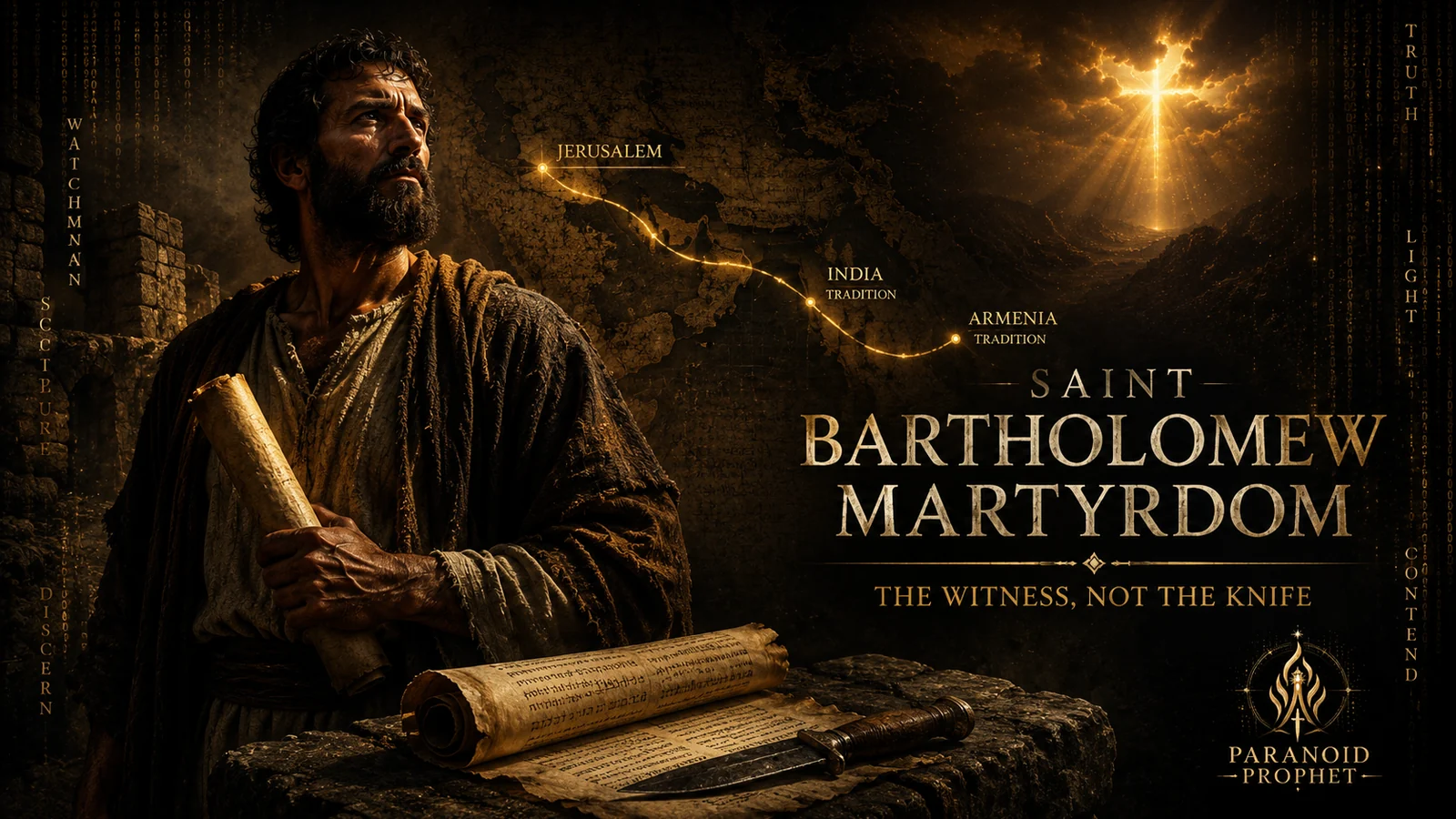
Saint Bartholomew is famously remembered as the apostle who was flayed alive for Christ.
That image is horrifying. It has followed Bartholomew through centuries of Christian memory, sacred art, martyrdom tradition, and preaching. He is often shown with a knife, sometimes even holding his own skin, because the church has long remembered him as a witness whose loyalty to Jesus cost him his body.
But Bartholomew’s death should not be used as Christian shock value. The serious question is not whether the story is graphic enough to move us. The serious question is what we can say responsibly.
So how did Saint Bartholomew die? The most famous answer is that he was flayed alive, often connected with beheading or crucifixion in later tradition. Yet the New Testament does not record his death, and the later accounts vary. That means this article needs to move in the right order: Scripture first, tradition second, apologetic reflection last.
Bartholomew’s martyrdom does not prove the resurrection by itself. No single martyrdom tradition can carry the whole weight of Easter. But his death is not meaningless either. If the tradition preserves the broad memory of his final witness, then it adds real cumulative weight to the wider apostolic pattern: the men connected to the resurrection proclamation did not treat Jesus as a safe idea, a private metaphor, or a convenient religious career. They carried the name of the risen Christ into danger when silence would have been safer.
Martyrdom does not prove a man is right. But it can show that he was not casually inventing a message he was willing to suffer for. That is where Bartholomew matters. Not because pain proves doctrine by itself, and not because every later detail can be reconstructed with certainty, but because the church remembered this quiet apostle in one consistent direction: as a witness who belonged to Jesus Christ and did not turn back.
Article Guide11 sections
Quick Answer: How Did Saint Bartholomew Die?
Saint Bartholomew is most famously remembered as having been flayed alive, though some traditions say he was beheaded, crucified, or suffered a combination of these deaths.
The careful answer is this: Scripture names Bartholomew as one of the Twelve, but it does not record his death. His martyrdom comes to us through later Christian tradition. That does not make the tradition worthless, but it does mean the exact method should be handled with historical caution.
| Question | Careful Answer |
|---|---|
| Was Bartholomew one of the Twelve? | Yes. Scripture names him among the apostles chosen by Jesus. |
| Does the Bible record Bartholomew’s death? | No. His death is known through later Christian tradition, not direct New Testament narration. |
| Was Bartholomew flayed alive? | That is the most famous and enduring tradition, but it should be presented as later tradition rather than certain biblical fact. |
| Was Bartholomew beheaded? | Some traditions say he was beheaded. Others combine beheading with flaying or crucifixion. |
| Did Bartholomew die for Jesus? | The major Christian traditions remember him as a martyr whose suffering was tied to his witness for Christ. |
| Does Bartholomew’s death matter for the resurrection case? | Yes, as cumulative support for costly apostolic witness. It does not prove the resurrection by itself, but it adds weight to the wider pattern. |
This is the balance the article will keep. We should not make Bartholomew’s martyrdom weaker than it is. The tradition is serious, deeply embedded, and important to Christian memory. The image of Bartholomew flayed alive did not come from nowhere, and it has shaped how generations of Christians have remembered his courage.
But we should not make it stronger than it is either. The New Testament does not record his execution, and later sources do not all describe the same method of death. Some remember him as flayed. Some remember him as beheaded. Some combine the two. Some traditions connect his death with Armenia and a hostile king. These differences matter because truth does not need exaggeration to be powerful.
The strongest way to handle Bartholomew is not to pretend we can reconstruct every wound. The strongest way is to let the evidence speak in its proper order. First, Bartholomew was one of the Twelve. Second, he was remembered by the church as a missionary witness who suffered martyrdom. Third, the most famous tradition says he was flayed alive, often connected with beheading. Fourth, his remembered death adds weight to the larger apostolic witness because it shows how costly the confession of the risen Jesus became.
That is not a weak claim. It is a disciplined one.
Bartholomew’s death tradition is powerful because it points beyond itself. The knife is not the center. The risen Christ is. The horror of the tradition matters only because it shows the cost attached to the confession: Jesus is Lord, and His witnesses did not carry that message as a theory. They carried it as testimony.
Who Was Saint Bartholomew?
Saint Bartholomew was one of the Twelve apostles chosen by Jesus. That is the firm biblical starting point.
His name appears in the apostolic lists in Matthew 10:2–4, Mark 3:16–19, and Luke 6:13–16. He also appears in Acts 1:13, where the apostles are gathered after Jesus’ resurrection and ascension. Bartholomew is not a later saint invented by church legend. He belongs to the apostolic company named in Scripture.
At the same time, Scripture does not give us a full biography of Bartholomew. It does not tell us where he preached after Pentecost. It does not narrate his mission field. It does not describe his final suffering. The Bible gives us his apostolic identity; later Christian tradition gives us the remembered shape of his mission and death.
That distinction protects the article from two mistakes. The first is treating later tradition as if it carried the same authority as Scripture. Bartholomew’s flaying tradition should not be placed on the same level as James the son of Zebedee, whose death is directly recorded in Acts 12:1–2. The second is dismissing the tradition as worthless simply because it is later.
Christian memory is not automatically false because it comes after the New Testament. The right question is not whether the tradition is useful or useless. The right question is how much weight it can carry.
For Bartholomew, the answer is careful but meaningful. Scripture firmly identifies him as one of the Twelve. The major Christian traditions remember him as a missionary apostle who suffered for the name of Jesus. The exact method of death is debated, but the direction of the memory is not neutral. Bartholomew was not remembered as a man who abandoned Christ, retired into comfort, or used the gospel for status. He was remembered as a witness whose loyalty to Christ became costly.
Before Bartholomew is remembered with a knife in Christian art, he is named among the Twelve in Scripture. His story begins not with torture, but with the call of Jesus Christ.
Where Does Bartholomew Appear in the Bible?
When readers ask where Bartholomew appears in the Bible, the answer is simple but important: he appears in the apostolic lists and in Acts among the gathered apostles after Jesus’ resurrection and ascension.
That may feel small compared to the later martyrdom traditions, but it is not weak. Scripture does not give Bartholomew a long biography. It gives him something more foundational: apostolic identity.
For a man later remembered through violent martyrdom, Scripture introduces Bartholomew quietly. He is not given a famous speech. He is given a place among the men Jesus chose.
Bartholomew in the Lists of the Twelve
Bartholomew appears in the lists of the Twelve in the Synoptic Gospels. Matthew names him among the apostles Jesus sent out with authority to preach, heal, cleanse lepers, raise the dead, and cast out demons (Matthew 10:1–4). Mark includes him among the Twelve whom Jesus appointed “so that they might be with him and he might send them out to preach” (Mark 3:13–19). Luke also lists Bartholomew after Jesus spends the night in prayer and then chooses twelve from among His disciples, whom He names apostles (Luke 6:12–16).
Those lists matter. Bartholomew is not introduced as a distant admirer of Jesus or a later church figure attached to the apostolic age. He is listed among the men Jesus personally appointed to bear witness, preach the kingdom, and stand near the center of His earthly ministry.
The Gospels do not pause to give Bartholomew a dramatic scene. They do not record a famous speech from him. They do not preserve a unique miracle attached to his name. Yet silence about his personality is not silence about his calling. He belonged to the Twelve.
That alone gives the later martyrdom tradition a meaningful subject: not an unknown outsider, but a man whose name already stood inside the apostolic circle formed by Jesus Himself.
The lists also place Bartholomew near Philip. That detail will matter when we ask whether Bartholomew may be the same man John calls Nathanael. But before making that connection, the simpler point should stand on its own: Scripture names Bartholomew as one of the apostles chosen by Christ.
Bartholomew After the Resurrection and Ascension
Bartholomew also appears in Acts 1:12–14. After Jesus’ ascension, the apostles return to Jerusalem and gather in the upper room. Bartholomew is named among them.
This matters for the resurrection witness, but it needs careful wording. Acts 1 does not give Bartholomew an individual resurrection appearance story. It does not record his private words about the empty tomb. It does not tell us exactly what he saw, said, or preached by himself.
But Acts does place him among the apostolic company after the resurrection and ascension of Jesus. He is not presented as someone who vanished after the crucifixion or walked away from the movement. He is gathered with the apostles in Jerusalem as they wait in prayer before Pentecost.
That location is important. The apostolic witness did not begin as a vague spiritual memory disconnected from the men Jesus chose. It began among the disciples who had followed Him, seen His ministry, endured the shock of His crucifixion, and then gathered after His resurrection and ascension to continue His mission.
Bartholomew’s presence in Acts 1 does not prove every later story about his death. It does not prove the flaying tradition. It does not tell us where he eventually preached. But it does keep him inside the first generation of apostolic witness. That is the biblical ground beneath the later tradition.
What Scripture Does Not Tell Us About Bartholomew
Scripture gives us Bartholomew’s apostolic identity, but it does not answer every question readers bring to his story.
The Bible does not tell us that Bartholomew preached in India or Armenia, converted a royal household, or died by flaying, beheading, crucifixion, or the command of a hostile king. Those claims belong to later Christian tradition, not direct biblical narration.
That distinction does not make the traditions worthless. It simply tells us where certainty ends and historical caution begins.
A faithful article should not force Scripture to say more than it says. Scripture is clear about Bartholomew’s calling, but silent about his death. So we should not pretend the Bible records his martyrdom. At the same time, we should not act as though biblical silence erases all later testimony. The right approach is to keep the categories clear.
Scripture gives the foundation: Bartholomew was one of the Twelve and remained among the apostolic company after Jesus’ resurrection and ascension. Later tradition gives the remembered mission and martyrdom. Apologetic reflection asks what that remembered suffering contributes to the larger case for costly apostolic witness.
That order matters because it keeps the article both reverent and credible. We do not begin with the knife. We begin with the call. We do not let later tradition overrule Scripture. We let Scripture establish Bartholomew’s place among the apostles, then we examine the tradition in its proper lane.
The next question is whether Scripture gives us more about Bartholomew under another name. Many Christians have identified Bartholomew with Nathanael, the man in John’s Gospel who confessed Jesus as the Son of God and King of Israel. That identification is not certain, but it matters enough to examine carefully.
Was Bartholomew the Same Person as Nathanael?
Was Bartholomew the same person as Nathanael? Possibly. Many Christians have thought so, but Scripture never states it directly.
If the traditional identification is correct, then John gives us a personal glimpse of Bartholomew that Matthew, Mark, Luke, and Acts do not give. We see him encounter Jesus. We hear his skepticism. We hear his confession. We see him named again in a resurrection setting by the Sea of Tiberias.
But because the identification is not explicit, we should not build the entire article on it as though it were settled biblical fact. The better approach is careful: Bartholomew may be Nathanael, the connection is meaningful, and under that identification, Nathanael’s confession gives us a powerful window into the kind of Christ-centered witness later remembered under Bartholomew’s name.
Why Many Christians Have Connected Bartholomew and Nathanael
The connection between Bartholomew and Nathanael is not random.
In the Synoptic Gospels, Bartholomew appears in the lists of the Twelve, often near Philip. In John’s Gospel, Nathanael appears in a scene closely connected to Philip. John does not name Bartholomew, while Matthew, Mark, and Luke do not name Nathanael among the Twelve.
That creates a natural question: are these two names pointing to the same man?
In John 1:43–51, Philip finds Nathanael and says, “We have found him of whom Moses in the Law and also the prophets wrote, Jesus of Nazareth, the son of Joseph.” Nathanael responds with skepticism: “Can anything good come out of Nazareth?” Philip does not give a long argument. He simply says, “Come and see.”
That scene matters for the Bartholomew question because Philip is the bridge. Philip is linked with Bartholomew in the apostolic lists, and Philip brings Nathanael to Jesus in John. That does not prove that Nathanael and Bartholomew are the same man, but it helps explain why many Christians have identified them.
There is another reason the identification makes sense. “Bartholomew” may function like a family name or patronymic, meaning something like “son of Tolmai” or “son of Talmai.” If that is the case, Bartholomew may be a family designation while Nathanael is the personal name preserved in John.
That is not proof, but it is a reasonable explanation for why Bartholomew appears in the Synoptic lists while Nathanael appears in John.
Why the Identification Should Still Be Used Carefully
The identification is useful, but it should not be smuggled into the article as a settled biblical fact.
John never says, “Nathanael, who is Bartholomew.” Matthew, Mark, Luke, and Acts never say, “Bartholomew, who is Nathanael.” The connection is traditional and plausible, not explicit.
That means our wording matters. We should not say, “Bartholomew was Nathanael,” as if the Bible directly states it. Better wording is: “Bartholomew may be Nathanael,” or “if Bartholomew is Nathanael.”
This caution does not weaken the article. It strengthens it. A serious Christian case does not need to turn a plausible identification into certainty. Truth does not become more persuasive when we press the evidence harder than it can bear.
Used carefully, the Nathanael connection enriches the article without distorting it. Scripture names Bartholomew among the Twelve. John names Nathanael in scenes of confession and resurrection setting. Christian tradition has often connected the two. That is enough to explore the possibility while keeping the categories clear.
If Bartholomew Is Nathanael, His First Confession Matters
Under that identification, the man later remembered through the flaying tradition first appears in John’s Gospel as a man seen and known by Jesus before he ever reaches Him.
Jesus sees Nathanael coming toward Him and says, “Behold, an Israelite indeed, in whom there is no deceit!” Nathanael asks, “How do you know me?” Jesus answers, “Before Philip called you, when you were under the fig tree, I saw you” (John 1:47–48).
John does not explain everything Nathanael understood in that moment. But Nathanael understands enough to answer with a remarkable confession: “Rabbi, you are the Son of God! You are the King of Israel!” (John 1:49).
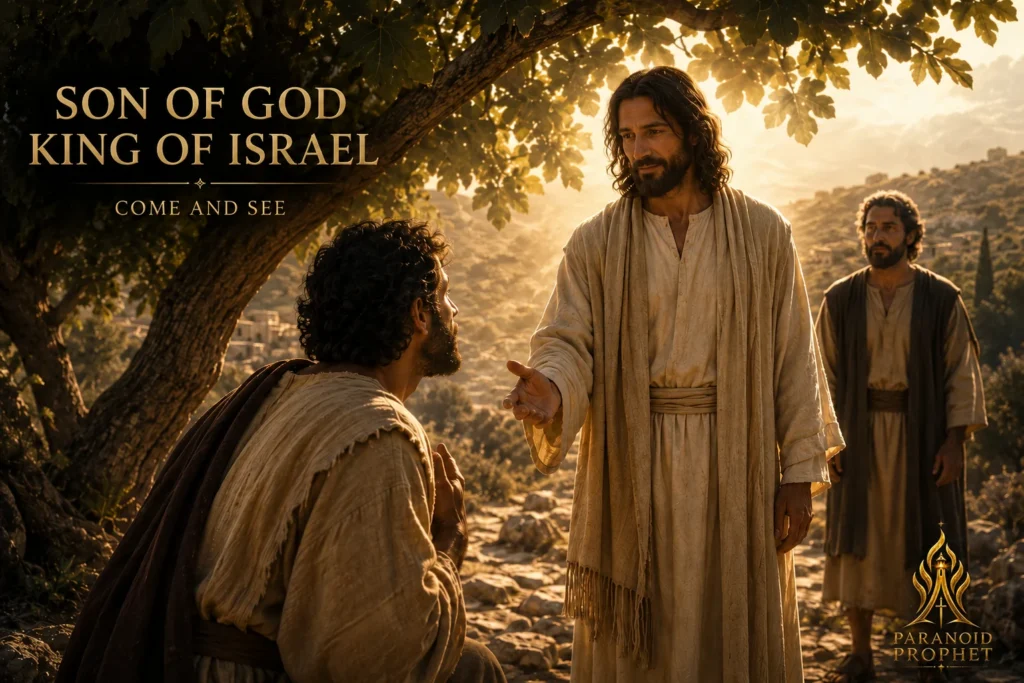
That confession matters more than the method of his death.
Before the article asks whether Bartholomew died by the knife, it must ask what kind of Jesus he confessed. If Bartholomew is Nathanael, his first recorded response to Jesus is not vague admiration. It is not merely, “You are a good teacher.” It is a confession of royal and divine identity: Son of God and King of Israel.
That gives the martyrdom tradition its proper center. The power of Bartholomew’s story is not merely that a man may have suffered horribly. Many people have suffered horribly. The power is that the suffering is attached, in Christian memory, to witness for Jesus Christ — the One confessed as Son of God, King of Israel, crucified Savior, and risen Lord.
Jesus then answers Nathanael with a promise of greater revelation: “You will see heaven opened, and the angels of God ascending and descending on the Son of Man” (John 1:50–51). The scene moves from Nathanael’s confession to Jesus’ own claim. Nathanael sees something true, but Jesus reveals that there is still more glory to behold.
Nathanael After the Resurrection
Nathanael appears again in John 21:1–14, where John names “Nathanael of Cana in Galilee” among the disciples by the Sea of Tiberias after Jesus’ resurrection.
This does not settle the Bartholomew question by itself. John 21 names Nathanael, not Bartholomew. But if the traditional connection is correct, then John places him not only in an early confession scene, but also in a resurrection setting with the disciples.
That connection should be used carefully, but it is still meaningful. Under the Bartholomew/Nathanael identification, the movement is beautiful: called through Philip, seen by Jesus, confessing Jesus as Son of God and King of Israel, and later present in a scene where the risen Jesus reveals Himself to His disciples.
Even if we keep the identification cautious, Nathanael helps us ask the right question about Bartholomew. The most important issue is not only how Bartholomew died. The deeper issue is whom he followed.
If Bartholomew is Nathanael, then the answer is clear: he followed the Christ who saw him before he came, called him into witness, revealed His glory, died under Roman power, and rose again.
Scripture gives us Bartholomew’s apostolic identity and, possibly through Nathanael, a glimpse of his confession. But Scripture still does not tell us where he went after Pentecost or how he died. For that, we have to move from biblical certainty into early Christian mission tradition.
Where Did Saint Bartholomew Preach?
Scripture names Bartholomew among the Twelve, but it does not tell us where he went after Pentecost. To answer the question of his mission field, we have to move from biblical certainty into early Christian and later church tradition.
That move requires care. Later tradition is not Scripture, but neither is it meaningless. It should be weighed, not worshiped; tested, not thrown away. The church did not preserve Bartholomew as an apostle who disappeared into comfort after the resurrection. The received picture moves in another direction: outward, eastward, into mission, confrontation, and eventually martyrdom.
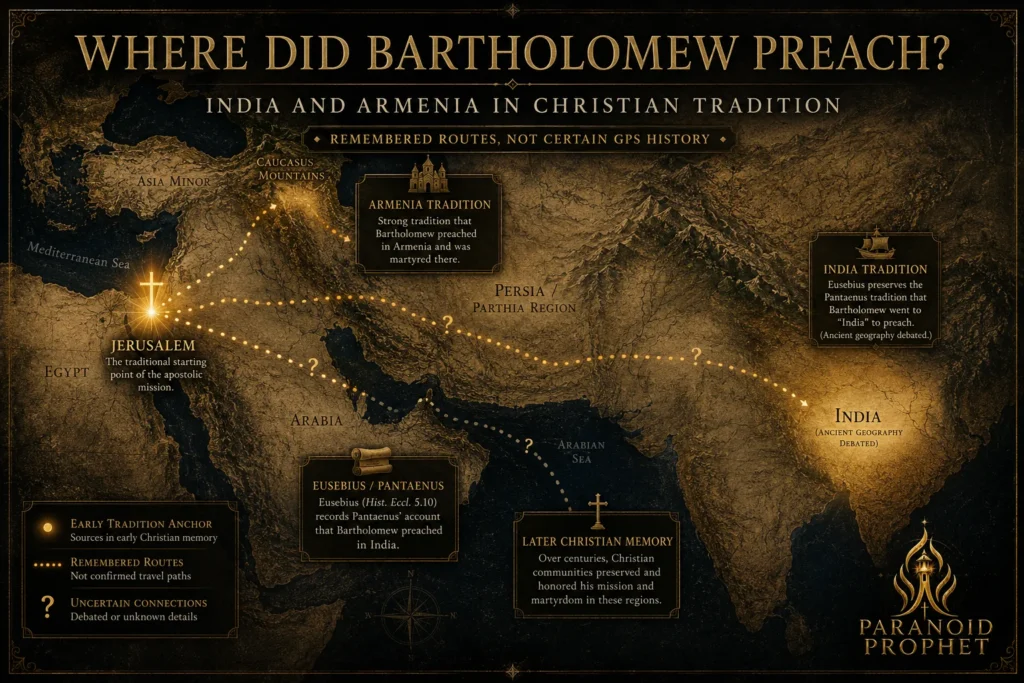
The two most important mission traditions connect Bartholomew with India and Armenia. The India tradition gives us one of the earlier church-history references to his missionary witness. The Armenia tradition becomes especially important because many later accounts connect Armenia with his final suffering and death.
The India Tradition in Eusebius
One of the most important early references to Bartholomew’s mission comes from Eusebius of Caesarea, the early church historian. In his account of Pantaenus, Eusebius says Pantaenus was reported to have traveled as far as India and found people there who already knew Christ. According to the report Eusebius preserves, Bartholomew had preached to them and left them a copy of Matthew’s Gospel in Hebrew letters (Eusebius, Church History 5.10).
That source is valuable, but it must be used honestly. Eusebius does not give us Bartholomew’s travel diary. He does not claim first-hand knowledge of the apostle’s route. He preserves a report handed down in connection with Pantaenus.
Still, the report matters. It shows that early Christian tradition connected Bartholomew with missionary work beyond the familiar borders of the New Testament narrative. By the time Eusebius wrote, Bartholomew was being remembered not merely as a name in an apostolic list, but as a missionary witness whose work was believed to have reached distant peoples.
When people say Bartholomew preached in India, the strongest early basis is this Eusebius/Pantaenus tradition, not a direct New Testament travel account. That makes the claim meaningful, but it also tells us how carefully it should be stated.
This is where Bartholomew’s story begins to resemble the wider pattern of apostolic mission. Like Saint Thomas, whose tradition is strongly connected with India, Bartholomew is remembered as an apostle whose witness moved eastward. The details differ, and the traditions must be weighed separately, but the direction is similar: the risen Christ was proclaimed beyond the first circle of Jerusalem and Galilee.
The Armenia Tradition
The Armenia tradition is also central to Bartholomew’s memory. In Armenian Christian tradition, Bartholomew is remembered alongside Thaddeus as one of the apostolic witnesses connected to the roots of Christianity in Armenia. The Mother See of Holy Etchmiadzin describes Saints Thaddeus and Bartholomew as apostles who carried the Gospel to Armenia and spread Christianity there (Armenian Church, Mother See of Holy Etchmiadzin).
The New Testament does not record Bartholomew preaching in Armenia. Acts does not give us a Bartholomew missionary journey. We do not have a first-century Armenian travel record written by Bartholomew himself.
That caution does not erase the Armenian tradition. It tells us how to use it. Armenia’s memory of Bartholomew is important because it shows how deeply his apostolic witness became embedded in the church’s understanding of its own beginnings. It also gives the later martyrdom accounts their setting, because many traditions place Bartholomew’s final suffering in or near Armenia.
In other words, Armenia is not just a location on a map. It is part of the remembered story of Bartholomew as a missionary apostle whose preaching brought him into conflict with earthly power.
Why Ancient Geography Requires Caution
Ancient geography does not always fit modern map lines. When an early source says “India,” modern readers should not immediately assume the exact borders of the modern nation-state. Ancient writers could use geographical names more broadly than we do, sometimes referring to lands east or southeast of the Roman world without the precision of a modern atlas.
That does not make the India tradition false. It means we should avoid over-mapping the tradition with modern certainty. The responsible claim is not, “We can reconstruct Bartholomew’s exact route through modern India.” The responsible claim is that early Christian tradition remembered Bartholomew as a missionary apostle connected with peoples and regions beyond the ordinary New Testament horizon.
The same caution applies to Armenia. The tradition is meaningful and deeply rooted, especially in Armenian Christian memory, but it is still not the same kind of evidence as a direct statement in Acts. Bartholomew’s witness does not become stronger if we pretend to know every road he walked. It becomes more credible when we say plainly what the sources allow.
What the Mission Traditions Still Tell Us
The value of Bartholomew’s mission traditions is not that we can trace every mile of his journey. The value is that the church did not preserve him as a comfortable religious official. It preserved him as a witness sent outward.
That matters for the martyrdom story. Bartholomew’s death traditions do not appear in isolation. They grow out of a larger memory of mission, preaching, confrontation, conversion, and opposition. Before the church remembered the knife, it remembered the witness. Before it remembered the flaying, it remembered the apostle sent with the name of Christ.
This is why the India and Armenia traditions matter even where the geography remains debated. They place Bartholomew in the same broad apostolic pattern we see throughout the early Christian story: the message of Jesus did not remain private, safe, or local. It moved. It crossed boundaries. It challenged idols, kings, households, and cultures.
Once Bartholomew is remembered as an apostle carrying Christ into hostile territory, the death traditions become easier to understand. The question is no longer only where he went. The question is what his witness cost him.
How Did Saint Bartholomew Die?
Saint Bartholomew is most famously remembered as the apostle who was flayed alive.
That is the short answer many readers are looking for. The full answer requires more care. The New Testament does not record Bartholomew’s death, and later Christian accounts describe his martyrdom in more than one way. Some say he was flayed. Some say he was beheaded. Some combine flaying, crucifixion, and beheading. Many connect his death with Armenia and a hostile ruler.
The exact method is debated, but the major accounts move in the same direction. Bartholomew was not remembered as an apostle who quietly faded from witness. He was remembered as a missionary disciple whose confession of Christ brought him into deadly conflict with earthly power.
That is where the death tradition should begin. Not with gore. Not with spectacle. Not with an attempt to make suffering impressive by itself. The core issue is witness. A martyr does not merely die. A martyr bears testimony.
The Core Tradition: Bartholomew Died as a Witness to Christ
The strongest claim is not that we can reconstruct every moment of Bartholomew’s execution. The strongest claim is that Christian tradition remembers him as dying because of his witness to Christ.
If we insist on every detail of the flaying tradition as if it were recorded in Acts, we overclaim. If we dismiss the whole tradition because the details vary, we underread the testimony the church preserved.
Bartholomew’s death accounts are not random stories about an unknown man. They are attached to one of the Twelve, a missionary tradition, and a pattern of opposition. They place him in conflict with idolatry, rulers, and religious resistance. They remember him as a man who preached Christ in places where Christ was not welcomed by all.
Before we ask whether the knife touched his skin, we need to see the deeper pattern: Bartholomew is remembered as a witness whose confession brought him into conflict with earthly power.
The Famous Flaying Tradition
The best-known account says Bartholomew was flayed alive.
If one asks which method became the dominant Christian memory of Bartholomew’s death, the answer is flaying. This is the form of martyrdom most deeply attached to his name in Christian art, preaching, and popular remembrance.
In many later summaries, Bartholomew’s death is connected with Armenia and a ruler sometimes named Astyages. The broad picture is that Bartholomew’s preaching brought conversion, opposition, and eventually execution.
Reference sources usually preserve this account with careful wording. The Britannica entry on Saint Bartholomew says he is traditionally said to have been martyred by flaying and beheading at the command of Astyages. The Catholic Encyclopedia entry on Saint Bartholomew also notes the uncertainty of the manner of his death while preserving accounts of beheading, flaying alive, and crucifixion head downward.
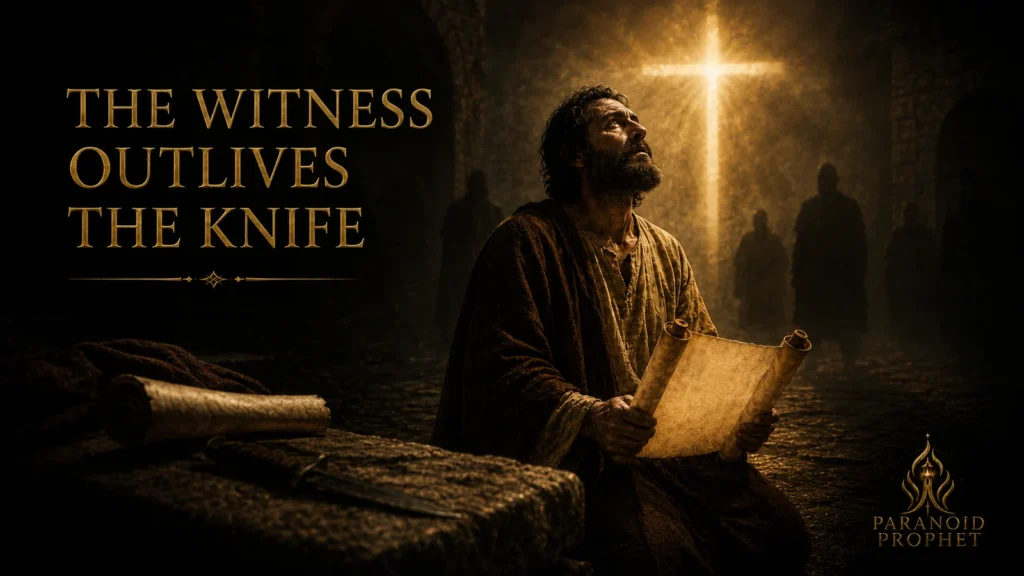
That is the right kind of source language for this article. Bartholomew is most famously remembered as flayed alive, but the detail should be presented as later tradition rather than direct biblical fact.
Still, we should not drain the account of its force. If the flaying tradition preserves the broad truth of Bartholomew’s final witness, then his death was not only execution but humiliation. It was an attempt to reduce a witness to flesh, to answer confession with violence, to make the body pay for the name of Christ.
But Christian memory did not preserve the hostile ruler as the victor. It preserved Bartholomew as the witness. The knife became a symbol not because suffering is holy by itself, but because Christ was worth more to Bartholomew than his own body.
That is why the flaying tradition remains powerful even when handled carefully. It does not need exaggeration. If true, it is already severe enough. If partly shaped by later memory, it still testifies to how the church understood Bartholomew: as an apostle whose confession could not be peeled away by force.
The Beheading Tradition
Some accounts say Bartholomew was beheaded.
This does not destroy the martyrdom tradition. It reminds us that the exact sequence of Bartholomew’s death is not preserved with the same clarity we have for James the son of Zebedee in Acts 12:1–2. James’s death is directly narrated in Scripture. Bartholomew’s death comes through later tradition.
Beheading appears in more than one stream of the Bartholomew tradition. Some accounts present beheading as the method of death. Others connect it with flaying, as though beheading was the final act after torture. The result is a martyrdom memory with a strong center but varied details.
The apocryphal Martyrdom of Bartholomew preserves one form of this account. It should not be treated as direct apostolic history, and it does not settle the event. Its value is more limited: it preserves another strand of the martyrdom memory. In that text, Bartholomew faces royal opposition, refuses false worship, is beaten, and is finally beheaded.
That version does not give us the famous flaying scene. But it does reinforce the deeper point: Bartholomew’s death was remembered as religious persecution tied to his refusal to abandon the God he proclaimed.
So the beheading tradition should not be treated as an embarrassment. It belongs in the article because it shows honesty. We are not hiding the variation. We are ranking it. The method varies; the martyrdom pattern remains.
The Crucifixion Tradition
Some later accounts also connect Bartholomew with crucifixion, even crucifixion head downward.
This detail belongs in the discussion, but it should not become the foundation of the article. Scripture does not record it. Eusebius does not establish it. It appears in some streams of the tradition alongside flaying, and in some summaries it becomes part of the larger picture of his suffering. Because crucifixion imagery also appears in other apostolic martyrdom traditions, it should be used cautiously.
Still, its presence points in the same broad direction. The fact that crucifixion appears in some versions shows how later Christians placed Bartholomew’s death inside the broader language of apostolic suffering, even when they did not preserve a single fixed sequence.
Bartholomew was remembered not as a peaceful retiree, but as an apostolic witness whose final testimony was bound to suffering, rejection, and death.
Why Is Bartholomew Shown Holding His Skin?
The flaying tradition explains why Bartholomew is often shown in Christian art with a knife. In some images, he is even shown holding his own skin.
That imagery is disturbing, but it is not random. It grows from the account that Bartholomew was flayed alive. The knife became his symbol because the church remembered his martyrdom through the language of stripping, bodily suffering, and unbroken confession.
Christian art does not prove that the event happened exactly as depicted. Paintings and sculptures are not court transcripts. But art does show how deeply the flaying tradition shaped Christian remembrance. For centuries, Bartholomew was not primarily represented through wealth, power, comfort, or status. He was represented through the image of a body stripped and a confession that remained.
That matters for the tone of this article. We should not turn Bartholomew’s skin into a spectacle. But we also should not pretend the image is meaningless. The visual tradition tells us how the church interpreted his death: earthly power could wound the body, but it could not own the witness.
That is the difference between gore and testimony. Gore stares at the wound. Testimony asks what the wound was endured for.
Why the Details Vary Without Erasing the Testimony
The details of Bartholomew’s death vary because we are dealing with later martyrdom tradition, not a direct biblical account.
That variation should make us careful. It should stop us from claiming to know the exact sequence of Bartholomew’s final hours or pretending that flaying, beheading, crucifixion, Armenia, and Astyages all carry the same evidential weight as the apostolic lists in Scripture.
But variation does not force us to erase the testimony. The accounts differ on method, but they do not point in opposite moral directions. They do not remember Bartholomew as a denier of Christ. They do not remember him as a man who used Jesus for safety, comfort, or status. They remember him as an apostle whose witness cost him dearly.
The responsible conclusion is therefore strong but disciplined: Bartholomew is traditionally remembered as a martyr for Christ. Flaying is the most famous and enduring form of that memory. Beheading and crucifixion appear in other versions or combinations. The exact method remains debated, but the tradition’s central direction is clear: Bartholomew’s loyalty to Jesus was remembered as costly unto death.
That still leaves the apologetic question. What does Bartholomew’s martyrdom actually prove? It cannot prove everything. It cannot prove the resurrection by itself. But neither does it count for nothing. It belongs to the larger pattern of apostolic witness where confession of the risen Christ carried real cost.
Does Bartholomew’s Martyrdom Prove the Resurrection?
Bartholomew’s martyrdom should not be asked to prove more than it can prove. It cannot carry the resurrection case alone, settle every detail of the flaying tradition, or remove every historical question about where he preached and how he died.
But it should not be dismissed as meaningless either. If the broad martyrdom memory is reliable, then Bartholomew belongs to the larger pattern of apostolic witnesses whose confession of the risen Christ carried real cost. His death does not stand as the foundation of the resurrection case, but it does add cumulative weight to the wider picture: the men attached to the resurrection proclamation did not carry Jesus’ name as a safe theory. They carried it into danger.
That is the right apologetic lane. Bartholomew’s martyrdom does not prove everything. But it does matter.
Martyrdom Does Not Prove a Claim Is True
People can die sincerely for things that are not true. Martyrdom proves commitment; it does not automatically prove the claim being confessed.
That distinction is essential. A person’s willingness to suffer can show conviction, courage, loyalty, or devotion. It cannot, by itself, turn a false claim into a true one. Christians should not argue as if every martyr in every religion proves the truth of that religion. That would be careless and unfair.
The same standard applies to Bartholomew. His martyrdom cannot carry the resurrection case by itself, and it cannot settle the exact method of his death. It does not carry the same evidential strength as a direct New Testament passage such as Acts 12:1–2, where James the son of Zebedee is explicitly executed by Herod.
Bartholomew’s death tradition is later and more varied. That means it should be used differently. It belongs in the cumulative case, not as a standalone proof.
This caution does not weaken the Christian argument. It strengthens it. A serious case for Jesus does not need to pretend all evidence is equal. Scripture gives us the firm foundation. Historical sources and martyrdom traditions can support the public credibility of the apostolic witness, but they must be weighed according to their strength.
Martyrdom Can Show Sincerity and Cost
Martyrdom cannot turn a false claim into a true one. But it can show that a witness was not treating the message as convenient, safe, or useful for worldly comfort.
That is where apostolic martyrdom matters. The earliest Christian proclamation was not that Jesus was merely a moral teacher whose ideas lived on after His death. The proclamation was far more dangerous: Jesus had been crucified, God had raised Him from the dead, and He was Lord.
That message confronted both religious and political power. It challenged idols. It challenged rival claims of lordship. It called people to repent, worship, and obey the risen Christ. In that world, preaching Jesus was not always a career advantage. It could cost reputation, safety, freedom, and life.
Bartholomew’s martyrdom belongs in that category. If the broad tradition is reliable, then his death shows that his witness to Christ was remembered as costly. He was not preserved in Christian memory as a man who used Jesus for status. He was remembered as a missionary apostle whose confession brought him into conflict and suffering.
That does not prove the resurrection directly. But it does make simplistic explanations harder to believe, especially the claim that the apostolic movement was built on a knowingly invented message with no real cost to its earliest witnesses.
The apostles were not merely dying for inherited opinions. They were proclaiming what they believed God had done in Jesus. Their message was tied to public claims: Jesus was crucified, Jesus was raised, Jesus appeared, Jesus reigns. When that proclamation became dangerous, the cost attached to it became part of the historical picture.
Why Bartholomew Still Matters for the Resurrection Case
So does Bartholomew’s martyrdom prove the resurrection? Not by itself. But as apostolic martyrdom evidence, it adds cumulative weight to the larger resurrection witness.
Bartholomew is not the strongest standalone piece of resurrection evidence. His death is not narrated in the New Testament, and the later accounts vary. We should say that plainly.
If someone wants the strongest historical anchors for the resurrection proclamation, they should begin with the earliest apostolic preaching, Paul’s received tradition in 1 Corinthians 15:3–8, Paul’s own transformation from persecutor to apostle, and the early claim that Jesus appeared to His followers.
Bartholomew does not replace those foundations. He supports the wider pattern around them.
Scripture places Bartholomew among the Twelve and among the apostolic company after Jesus’ resurrection and ascension. Later tradition remembers him as a missionary martyr. Together, those facts place Bartholomew inside the larger world of apostolic witness: called by Christ, attached to the first generation of disciples, remembered as sent outward, and remembered as suffering for the name he carried.
That matters because the resurrection proclamation did not remain an idea in a private room. It became public witness. It moved from Jerusalem into the nations. It confronted rulers and idols. It produced communities of worship. It brought persecution. Bartholomew’s remembered death belongs to that world.
His martyrdom is not the center of the resurrection case. The risen Christ is. But Bartholomew’s death helps show the cost that gathered around the apostolic confession of the risen Christ.
Where Bartholomew Fits in the Larger Apostolic Pattern
Bartholomew should not be ranked beside James in Acts 12 as if both deaths are equally documented. James has direct New Testament evidence. Bartholomew has later, varied martyrdom tradition. Those are not the same category.
But neither should Bartholomew be erased from the picture.
In the wider study of the martyrdom of Jesus’ disciples, the evidence does not all sit at the same level. Some deaths are directly recorded in Scripture. Some are supported by strong early external tradition. Some are remembered through later traditions that vary in detail. Bartholomew belongs in that later and more cautious category.
That category is not worthless. It simply carries a different weight.
Bartholomew is not a foundation stone for the resurrection argument in the same way the early apostolic proclamation is. He is a supporting witness in the larger pattern. His death tradition is valuable when it is used honestly: not as a magic proof, not as a graphic shortcut, but as one more sign that the apostolic confession of Jesus was remembered as costly unto death.
This is the difference between strong apologetics and careless apologetics. Careless apologetics says, “Bartholomew was flayed, therefore the resurrection is proven.” Strong apologetics says, “Bartholomew’s remembered martyrdom belongs to the cumulative pattern of apostolic witness, where men connected to the resurrection proclamation carried that confession into suffering rather than treating it as a safe invention.”
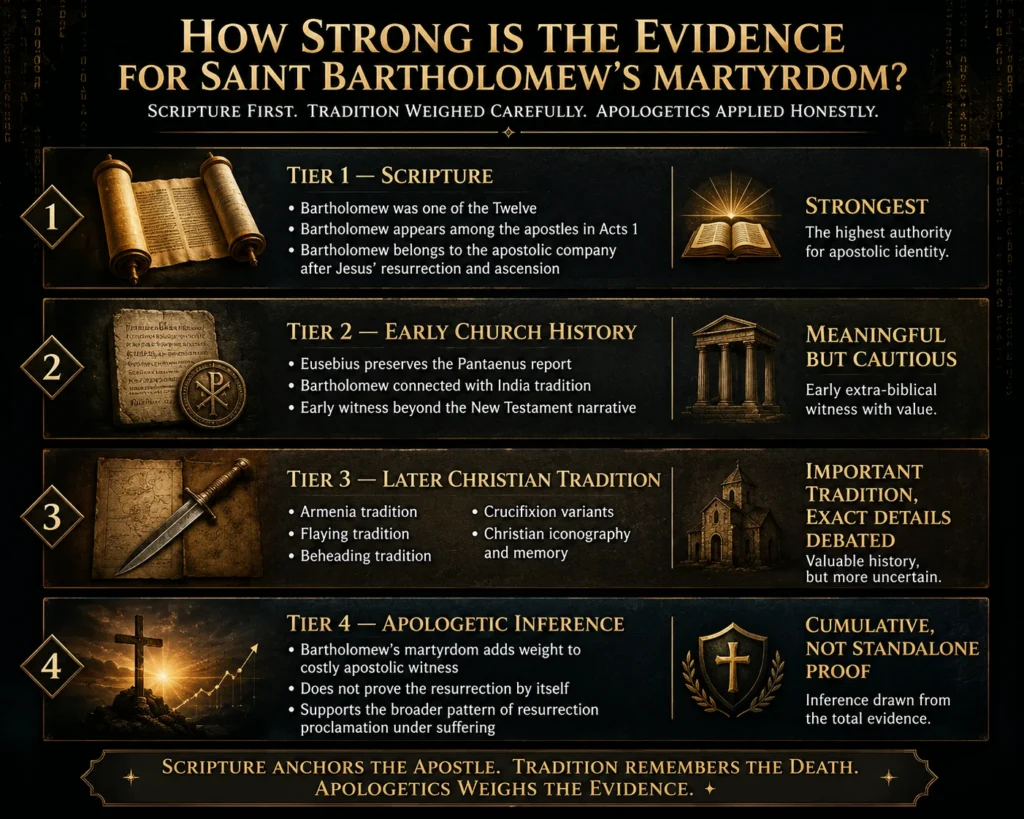
How Strong Is the Evidence for Bartholomew’s Martyrdom?
A serious article should not treat every claim about Bartholomew as if it has the same level of support. Some details rest directly on Scripture. Others come from early church history, later church tradition, or apologetic inference. The strength of the case depends on keeping those categories clear.
| Claim | Evidence Type | Careful Weight |
|---|---|---|
| Bartholomew was one of the Twelve apostles. | New Testament apostolic lists | Strong |
| Bartholomew remained among the apostolic company after Jesus’ resurrection and ascension. | Acts 1 | Strong |
| Bartholomew may be the same man as Nathanael. | Traditional identification based on apostolic-list patterns and John’s Gospel | Plausible but not certain |
| Bartholomew preached in India. | Eusebius / Pantaenus tradition | Meaningful but cautious |
| Bartholomew preached in Armenia. | Armenian Christian tradition | Strong church tradition, not direct New Testament narration |
| Bartholomew was flayed alive. | Later martyrdom tradition and Christian iconography | Famous and enduring, but exact certainty debated |
| Bartholomew was beheaded or crucified. | Variant martyrdom traditions | Possible, often connected with or set alongside the flaying tradition |
| Bartholomew’s death supports the resurrection case. | Apologetic inference from costly apostolic witness | Cumulative support, not standalone proof |
This evidence table is not meant to make Bartholomew’s witness weaker. It is meant to make it clearer. The article’s strongest claim is not that every later detail can be reconstructed with certainty. The strongest claim is that Bartholomew was one of the Twelve, remained within the apostolic company after Jesus’ resurrection and ascension, was remembered as a missionary witness, and was remembered by the church as a martyr for Christ.
That is enough to matter. Bartholomew’s death does not need to carry the entire resurrection case. It adds its weight to the larger pattern of men whose confession of the risen Jesus became costly.
Why Saint Bartholomew’s Witness Still Matters
After all the evidence is weighed, Bartholomew should not be reduced to the way he died. Scripture names him among the Twelve. Tradition remembers him as a missionary martyr. If the Nathanael connection is correct, John gives us a glimpse of his confession. But every part of his story points beyond the apostle himself.
Why does Saint Bartholomew still matter? Because his witness refuses to let the reader stop at the method of death. It presses the deeper question of Jesus’ identity.
Saint Bartholomew’s martyrdom matters because his witness points beyond the violence of his death to the worth of Jesus Christ. The article may begin with the question of flaying, but it cannot end there. The knife is not the center. Christ is.
He Points Beyond Himself to Jesus
The most important thing about Bartholomew is not how he died, but whom he followed.
If Bartholomew is Nathanael, then John’s Gospel gives us a remarkable beginning to his witness. Nathanael does not first confess Jesus as a vague religious teacher or moral example. He says, “Rabbi, you are the Son of God! You are the King of Israel!” (John 1:49).
That identification should still be handled carefully. Scripture does not explicitly say that Bartholomew and Nathanael are the same man. But under that traditional connection, Bartholomew’s story begins with a confession that goes straight to the identity of Jesus: Son of God, King of Israel, the One who sees and knows before Nathanael ever reaches Him.
Even apart from the Nathanael question, the point remains. Bartholomew belonged to the Twelve. He was not important because later Christians found his death dramatic. He was important because Jesus chose him, sent him, and placed him among the apostolic witnesses.
The church did not remember Bartholomew because suffering is impressive by itself. It remembered him because his suffering was attached to Jesus Christ. His martyrdom means nothing if Christ is removed from the center. But with Christ at the center, Bartholomew’s death tradition becomes more than an ancient horror story. It becomes a witness to the worth of the Lord he followed.
He Shows That Apostolic Witness Was Costly
Bartholomew’s tradition does not stand alone, and it should not be asked to. It belongs to a larger apostolic world in which the confession of Jesus moved from proclamation to persecution.
This pattern did not begin with later legends. Acts shows the apostles rejoicing that they were counted worthy to suffer dishonor for the name of Jesus, and continuing to teach and preach Him as the Christ (Acts 5:41–42). Bartholomew’s later martyrdom tradition belongs to that same kind of world: witness, opposition, and loyalty to Christ.
The apostles did not announce a safe religious slogan. They proclaimed a crucified and risen Lord. They preached that Jesus had conquered death, that He was exalted, that repentance and forgiveness were proclaimed in His name, and that every rival lordship would answer to Him.
That kind of message was never going to remain private. It created worship. It created mission. It created opposition.
Bartholomew’s remembered death belongs to that world. Whether the exact method was flaying, beheading, crucifixion, or some combination preserved through later accounts, the church did not remember him as a man who made peace with silence. It remembered him as a witness whose loyalty to Christ carried a cost.
Bartholomew does not need to be the whole resurrection argument to matter. His witness matters because it reminds us that the apostles did not speak of Jesus as a harmless memory. They spoke of Him as the living Lord.
He Warns Us Against Comfortable Christianity
Bartholomew’s story also warns modern readers against turning Jesus into a safe symbol: admired but not obeyed, quoted but not worshiped, respected but not followed.
The apostles did not carry Jesus as a brand. They carried Him as Lord. Their message was not that Jesus could make life slightly more meaningful while leaving every idol untouched. Their message was that the crucified Jesus had been raised, that He reigns, and that all people are summoned to repent, believe, and follow Him.
That confession is not comfortable. It never has been.
Bartholomew’s martyrdom tradition confronts the modern temptation to admire Jesus without submitting to Him. Many people are willing to appreciate Jesus as a teacher, symbol, reformer, or spiritual influence. But the apostolic witness does not leave Him there. The Jesus preached by the apostles is the risen Lord who claims worship, obedience, mission, and life itself.
A comfortable Jesus does not explain Bartholomew. A risen Lord does.
That should not become emotional pressure or religious spectacle. Bartholomew’s story is not a tool for manipulating readers with suffering. It is a call to ask whether we have understood the weight of the Christ he confessed. If Jesus is only a helpful religious idea, Bartholomew’s story makes little sense. If Jesus is Lord, then his witness becomes painfully coherent.
The Final Question Is Not the Knife, but Christ
Many readers come to Bartholomew because of the knife. They want to know whether he was really flayed alive. That question matters, and this article has treated it carefully. The flaying tradition is famous, deeply attached to his name, and powerful. But it is still not the deepest question.
The meaning of Saint Bartholomew’s martyrdom is not found in the violence itself, but in the witness it preserved: Jesus Christ was worth more than safety, status, or life.
That is where Bartholomew’s martyrdom still speaks. It does not ask us to worship the apostle. It asks us to look again at the Lord he followed. Bartholomew’s story begins with the call of Jesus, may include the confession of Nathanael, moves through missionary memory, and ends in martyrdom tradition. Yet every stage points beyond Bartholomew himself.
The apostle matters because the Lord he followed matters.
That is why the final question is not only, “How did Bartholomew die?” The final question is, “Who is Jesus, that men like Bartholomew would carry His name to the end?”
Frequently Asked Questions About Saint Bartholomew’s Martyrdom
How did Saint Bartholomew die?
Saint Bartholomew is most famously remembered as having been flayed alive, though some traditions say he was beheaded, crucified, or suffered a combination of these deaths. The New Testament does not record his death, so the exact method should be presented as later Christian tradition rather than certain biblical fact. The strongest claim is that Bartholomew was remembered as a martyr whose witness to Christ became costly unto death.
Was Saint Bartholomew really flayed alive?
Flaying is the most famous and enduring tradition about Bartholomew’s martyrdom. It is deeply embedded in Christian art, preaching, and popular memory. Still, it should not be treated as directly recorded in Scripture. The most responsible wording is that Saint Bartholomew is traditionally remembered as having been flayed alive, often with later accounts also connecting his death to beheading or crucifixion.
Does the Bible say Bartholomew was flayed alive?
No. The Bible names Bartholomew among the Twelve apostles and places him among the apostolic company after Jesus’ resurrection and ascension, but it does not describe his death. The flaying tradition comes from later Christian tradition, not direct New Testament narration. Scripture gives us Bartholomew’s apostolic identity; later tradition gives us the remembered shape of his mission and martyrdom.
Was Bartholomew the same person as Nathanael?
Possibly. Many Christians have identified Bartholomew with Nathanael because Bartholomew appears near Philip in the apostolic lists, while Nathanael is brought to Jesus by Philip in John 1. John does not name Bartholomew, and the Synoptic Gospels do not name Nathanael among the Twelve. The connection is plausible and meaningful, but not certain.
Where did Saint Bartholomew preach?
Later Christian tradition connects Bartholomew especially with India and Armenia. Eusebius preserves a report that Bartholomew had preached to people associated with India, while Armenian Christian tradition remembers him with Thaddeus as an apostolic witness connected to Armenia. These traditions are meaningful, but they should not be treated as detailed New Testament travel records.
Did Bartholomew preach in India?
Eusebius preserves a tradition that Bartholomew preached to people associated with India and left them a copy of Matthew’s Gospel in Hebrew letters. This is an important early church-history reference, but it must be used carefully. Ancient writers did not always use “India” with modern borders in mind, so the claim should be understood as an eastward mission tradition rather than a fully reconstructed travel route.
Did Bartholomew preach in Armenia?
Armenian Christian tradition strongly remembers Bartholomew, along with Thaddeus, as an apostolic witness connected to the roots of Christianity in Armenia. The New Testament does not record a Bartholomew mission to Armenia, but the Armenian tradition is important because many later accounts place his final suffering in or near Armenia.
Why is Saint Bartholomew shown holding his skin?
Bartholomew is often shown with a knife or holding his own skin because of the famous flaying tradition. Christian art does not prove that the event happened exactly as depicted, but it shows how deeply the flaying tradition shaped the church’s memory of his martyrdom. The image represents costly witness, bodily suffering, and loyalty to Christ.
Does Bartholomew’s martyrdom prove the resurrection?
No single martyrdom tradition proves the resurrection by itself. Bartholomew’s death does not replace stronger historical anchors such as early apostolic preaching, Paul’s received tradition in 1 Corinthians 15:3–8, and the first-generation proclamation that Jesus appeared to His followers. But Bartholomew’s remembered martyrdom adds cumulative weight to the wider pattern of apostolic witness.
Why does Saint Bartholomew still matter today?
Saint Bartholomew matters because his story points beyond the method of his death to the identity of Jesus Christ. Whether we focus on his place among the Twelve, the possible Nathanael connection, his missionary traditions, or his martyrdom, the final question is not the knife. The final question is who Jesus is, that men like Bartholomew would carry His name to the end.
Sources and Further Reading
This article uses Scripture as the foundation, early church history as historical context, later Christian tradition carefully, and apologetic inference only where the evidence supports it. Bartholomew’s place among the Twelve is grounded directly in the New Testament. His mission traditions and martyrdom details come through later Christian memory and should be weighed accordingly.
Biblical Passages
- Matthew 10:1–4 — Names Bartholomew among the Twelve apostles sent out by Jesus.
- Mark 3:13–19 — Shows Jesus appointing the Twelve to be with Him and to be sent out to preach.
- Luke 6:12–16 — Records Jesus choosing the Twelve after a night of prayer.
- Acts 1:12–14 — Places Bartholomew among the apostolic company after Jesus’ resurrection and ascension.
- John 1:43–51 — Records Nathanael’s encounter with Jesus and his confession, “You are the Son of God! You are the King of Israel!”
- John 21:1–14 — Names Nathanael in a resurrection setting by the Sea of Tiberias.
- Acts 5:41–42 — Shows the apostles suffering dishonor for the name of Jesus and continuing to preach Him as the Christ.
- Acts 12:1–2 — Gives a direct New Testament example of apostolic martyrdom in the death of James the son of Zebedee.
- 1 Corinthians 15:3–8 — Preserves Paul’s received summary of the early resurrection proclamation.
Early Church History
- Eusebius, Church History 5.10 — Preserves the report that Pantaenus found Christians associated with India who had received a copy of Matthew’s Gospel in Hebrew letters, said to have been left by Bartholomew. This is important for the India mission tradition, but it is not a direct New Testament travel account.
Later Tradition and Reference Sources
- Britannica, “Saint Bartholomew” — Summarizes Bartholomew’s biblical appearances, the traditional identification with Nathanael, and the later martyrdom tradition connecting him with flaying and beheading.
- Catholic Encyclopedia / New Advent, “St. Bartholomew” — Helpful for tracing the traditional claims about Bartholomew while also noting uncertainty around the exact manner of his death.
- Mother See of Holy Etchmiadzin, “Commemoration of the Apostles Sts. Thaddeus and Bartholomew” — Represents Armenian Christian memory connecting Bartholomew and Thaddeus with the apostolic roots of Christianity in Armenia.
- The Martyrdom of Bartholomew — An apocryphal martyrdom text that preserves a later tradition of royal opposition, refusal of false worship, beating, and beheading. This source is useful for studying the tradition, but it should not be treated as direct apostolic history.
How These Sources Are Used
This article does not treat every claim as equally certain. Bartholomew’s place among the Twelve is grounded directly in Scripture. His possible identification with Nathanael is plausible and traditional, but not explicitly stated in the Bible. His mission to India is supported by an early church-history report preserved by Eusebius. His connection with Armenia rests on strong Armenian Christian tradition. His flaying is the most famous martyrdom tradition attached to his name, but the exact method of death remains debated.
For that reason, Bartholomew’s martyrdom should be used carefully in the resurrection case. It does not prove the resurrection by itself. It does, however, add cumulative weight to the larger apostolic pattern: the men connected to the first resurrection proclamation carried the name of Jesus into public witness, mission, opposition, and suffering.
CONTINUE THE INVESTIGATION
Evidence standard continuation
Did the Apostles Die for the Resurrection? What We Can Honestly Say
Return from this individual witness tradition to the comparative source review that separates strong evidence, plausible tradition, and uncertainty.