
GUIDED ARTICLE EXPERIENCE
Saint John’s Endurance: Was John the Apostle Martyred?
Read along as the narration moves through the article.
Private device narration · No hosted audio or tracking
CONTINUE GUIDED TOUR
Continue where you left off.
GUIDED TOUR COMPLETE
You have reached the end of this study.
Study record saved on this device.
GUIDED TOUR
Saint John’s Endurance: Was John the Apostle Martyred?
Narrator: Paranoid Prophet Recommended Voice Native device narration
Prepare to follow the article as it is narrated.
VOICE & TOUR OPTIONS
Voice & Listening
NARRATOR
Finding a narrator…
Checking the best narrator available on this device.
Restores the best curated narrator available on this device.
Narrator choices are curated for clear, long-form listening on this device.
Screen-awake support will be checked when narration starts.
CHOOSE A NARRATOR
Curated for this device
Choose a verified narrator for this browser, or use System Narrator. Automatic mode uses the best reliable route exposed by this device; your chosen narrator is preserved even if this device needs a temporary fallback.
Preparing the guided article experience…
RESUME GUIDED TOUR?
Continue where you left off.
GUIDED TOUR COMPLETE
You have reached the end of this study.
John was not the apostle killed first. He was the apostle who remained.
James was killed by the sword. Peter was remembered by early Christians as a martyr in Rome, likely by crucifixion. John’s witness took another shape. Scripture does not tell us that John was executed. It gives us something just as weighty: a close apostolic witness who endured suffering, exile, Revelation, and long faithfulness because of “the word of God and the testimony of Jesus” (Revelation 1:9).
John belongs inside the larger disciple witness and martyrdom trail, but his testimony is different. He was not merely a survivor. He was one of Jesus’ closest disciples, part of the first generation brought near to His glory, His suffering, His death, and the first witness of His resurrection. Historic Christian tradition also connects John with the Gospel that opens by declaring that “the Word was God” and “the Word became flesh” (John 1:1–14).
John did not seal his witness by execution. He sealed it by endurance.
His life shows that apostolic witness was not only tested at the point of death. Sometimes it was tested by decades of obedience, suffering, exile, shepherding, and continued testimony to the divine glory of Jesus Christ.
Article Guide13 sections
Saint John’s Endurance: Evidence at a Glance
John’s story is strongest when the evidence is kept in order. Scripture gives us John’s closeness to Jesus, his place in the apostolic witness, and his exile on Patmos. Early Christian tradition then preserves memories of severe persecution, return from banishment, and long ministry in Ephesus.
| Person | John son of Zebedee |
| Also Known As | John the Apostle, John the Beloved, John the Evangelist |
| Relationship to Jesus | One of the Twelve; brother of James; part of Jesus’ inner circle with Peter and James |
| Gospel Connection | Historic Christian tradition identifies John with the beloved disciple and the Johannine witness behind the Gospel of John |
| Resurrection Connection | Connected with the empty tomb witness in John 20:1–10 and with apostolic witness in Acts |
| Divine Identity Witness | The Johannine witness presents Jesus as the Word made flesh, the Son of God, Lord, Life, Light, Lamb, and glorified Christ |
| Biblical Anchor | Revelation 1:9 places John on Patmos because of the word of God and the testimony of Jesus |
| Death Report | Scripture does not report John being executed as a martyr |
| Later Tradition | Early Christian tradition remembers John surviving severe persecution, being exiled, returning from banishment, and living into old age in connection with Ephesus |
| Boiling Oil | Tertullian preserves the tradition that John was plunged into boiling oil, emerged unharmed, and was then sent into exile |
| Evidence Strength | Strong biblical anchor for Patmos; meaningful early tradition for later details; strongest when Scripture and tradition are kept in order |
| Apologetic Use | John’s long witness supports the sincerity, continuity, and cost of apostolic testimony to Jesus as the crucified, risen, and divine Lord |
This evidence map keeps John’s story in the right category. John should not be treated as a failed martyr because he was not executed. He also should not be reduced to one dramatic tradition about boiling oil. The stronger picture is more biblical and more powerful: John was a close apostolic witness whose faithfulness was tested over time because of his testimony to Jesus Christ.
What This Article Is Arguing
This article argues that John’s endurance matters because of who he was, what he witnessed, and whom he refused to stop confessing.
John was not a distant believer defending a tradition centuries removed from Jesus. He belonged to the first generation of disciples. He was part of Jesus’ inner circle. He stood close to the events at the heart of Christianity. Christian tradition then remembers him as the apostle who survived when others died, endured exile when silence would have been easier, and continued bearing witness into old age.
This article follows the historic Christian identification of John the Apostle with the Johannine witness behind the Gospel, the letters, and Revelation, while recognizing that scholars discuss authorship and composition. Those questions matter, but they are not the center here. The center is the witness itself: Jesus Christ, crucified, risen, divine, and glorified.
The Johannine witness does not present Jesus merely as a teacher, prophet, reformer, or symbol of divine love. Jesus is the eternal Word who became flesh. He is the Son who reveals the Father. He is the Lamb of God who takes away the sin of the world. He is the risen Lord confessed by Thomas as “My Lord and my God” (John 20:24–29). He is the glorified Christ who stands before John in Revelation as the First and the Last, the Living One who died and is alive forevermore (Revelation 1:12–18).
This is why John belongs inside the wider identity argument explored in Who Was Jesus? Liar, Lunatic, or Lord?. John does not leave Jesus in the safe category of “great teacher.” He presses the reader toward the crucified, risen, and divine Christ.
That is why John’s long witness strengthens the case for Jesus. He did not endure for vague religion. He endured for the testimony of Jesus. He did not spend his final years protecting a harmless moral slogan. He bore witness to the crucified, risen, and glorified Christ.
John’s long life does not replace the resurrection. It points back to it. His endurance does not become the foundation of Christian faith. Christ is the foundation. But John’s story shows that the apostolic witness to Jesus’ divine identity did not collapse under pressure, exile, or time.
James shows that the apostles could die for Christ. Peter shows that a restored denier could suffer unto death for the risen Lord. John shows another kind of witness: the beloved disciple preserved through suffering, sent into exile, and remembered as enduring to the end with his eyes fixed on the glory of Jesus Christ.
John’s story is not the story of an apostle who escaped the cost. It is the story of a witness kept alive long enough to testify that the crucified Jesus is the eternal Son, the risen Lord, and the glorified Christ.
Who Was John to Jesus?
Before John is remembered as the apostle who endured, he must first be seen as the disciple who was brought near.
John was not a distant admirer of Christian ideas. He was one of the Twelve. He was the brother of James. He belonged to the smaller circle of disciples who saw moments not every disciple saw. Scripture places him close to Jesus’ authority, glory, sorrow, cross, and testimony.
That closeness gives weight to his later faithfulness. John did not suffer for a rumor handed down at a distance. His life had been bound to Jesus from the beginning of the Gospel story.
Called with James from the Nets
John’s story begins beside the sea. Matthew records Jesus calling James and John from their father Zebedee’s boat. They were working men, mending nets, when Jesus summoned them to follow Him. They left the boat and their father and followed Christ (Matthew 4:21–22).
That beginning is simple, but not small. John did not enter the story as a polished theologian writing from a desk. He entered as a fisherman called by Jesus. The one later associated with some of the New Testament’s highest language about Christ began as a disciple summoned by the voice of the Lord.
Mark adds a detail that keeps John human. Jesus gave James and John the name “Boanerges,” which means “Sons of Thunder” (Mark 3:17). That nickname reminds us not to turn John into a stained-glass abstraction. He was not naturally serene, soft, or detached from ordinary weakness. He was a real disciple with fire in him, ambition in him, and much to learn from Christ.
That makes his later long obedience more meaningful. John was not born as an icon of calm old age. He was shaped by Jesus. The Son of Thunder became the apostle of endurance because Christ did not merely call him; Christ formed him.
One of the Inner Circle
John was part of Jesus’ inner circle with Peter and James. The Gospels repeatedly place these three disciples near moments of unusual weight.
When Jesus raised Jairus’s daughter, He allowed no one to follow Him except Peter, James, and John (Mark 5:35–43). John saw Jesus enter the house of death and speak life where everyone else saw finality. Long before John’s own exile and old age, he had seen the authority of Jesus over death.
John was also present at the transfiguration. Jesus took Peter, James, and John up the mountain, and He was transfigured before them. His face shone like the sun, His clothes became white as light, and the voice from the cloud declared, “This is my beloved Son, with whom I am well pleased; listen to him” (Matthew 17:1–8).
That scene belongs near the center of John’s story. John’s later witness to the glory of Christ was not invented in old age. Scripture places him among the few disciples brought near when Jesus’ glory was unveiled before them.
But John was not only brought near to glory. He was also brought near to sorrow. In Gethsemane, Jesus took Peter, James, and John deeper into the garden as His soul was very sorrowful, even to death (Mark 14:32–42). John saw that the glory of Jesus did not cancel the agony of Jesus. The Christ who shone on the mountain also bowed in anguish before the cross.
This is one reason John’s witness is so important. The biblical portrait of Jesus is not a thin claim that He was divine instead of human, or human instead of divine. John’s story keeps both realities before us: glory and grief, majesty and suffering, the beloved Son and the obedient servant.
The Disciple Jesus Loved
The Gospel of John repeatedly speaks of “the disciple whom Jesus loved.” Historic Christian tradition identifies this beloved disciple with John the Apostle. The Gospel connects this disciple with intimate moments near Jesus, including the Last Supper, the cross, the empty tomb, and the final testimony of the book.
At the Last Supper, the beloved disciple is pictured reclining near Jesus (John 13:21–26). The point is not sentimentality. The point is nearness. This disciple is portrayed as one who stood close to Jesus’ words, Jesus’ heart, and Jesus’ final hours before the cross.
That keeps John’s long witness from becoming a cold evidence claim. His testimony is historical, but it is not sterile. It is personal. The same Jesus John followed, heard, loved, and confessed is the Jesus he continued to bear witness to when faithfulness became costly.
Near the Cross
John’s closeness to Jesus becomes especially vivid at the cross. In John’s Gospel, the beloved disciple stands near the crucified Christ with Mary, the mother of Jesus. From the cross, Jesus entrusts His mother to the beloved disciple’s care (John 19:25–27).
This scene matters deeply. John’s witness to Jesus’ glory did not keep him away from Jesus’ suffering. He stood near the place where the world saw shame, defeat, blood, and death. The disciple associated with the Gospel’s highest testimony to Christ’s divine identity is also connected to the cross where the Son of God gave Himself for sinners.
That keeps the argument Christian. John did not endure for a vague divine idea. He endured for the crucified Christ. The glory of Jesus and the cross of Jesus belong together.
The Gospel later connects the beloved disciple with testimony itself: “This is the disciple who is bearing witness about these things, and who has written these things” (John 21:20–24). However one handles the details of authorship and composition, the claim of the Gospel is clear: this is witness, not detached speculation.
Before John endured exile, he had been brought close to the Lord. He was remembered as a disciple brought near to Jesus’ call, power, glory, sorrow, cross, and testimony.
The next question is not merely what John survived. It is what John saw and proclaimed. The disciple brought near to Jesus’ glory, sorrow, and cross became a witness of Jesus Christ crucified and risen.
John as a Witness of the Crucified and Risen Jesus
John’s closeness to Jesus was not sentimental nostalgia. It became witness.
The New Testament does not present John as a man who simply admired Jesus from the edges of the story. It places him near the cross, connected to the empty tomb, standing with Peter in the public witness of Acts, and recognized as a pillar of the early church. His long faithfulness carries weight because it was tied to the central Christian claim: Jesus was crucified, Jesus rose, and the apostles bore witness to Him.
For the broader historical foundation that Jesus existed, was crucified, and stood at the center of the earliest Christian proclamation, see The Historical Reality of Jesus.
John did not endure for a vague memory of a beloved teacher. He endured because the crucified Jesus was proclaimed as the risen Lord.
The Cross as Witness, Not Symbol
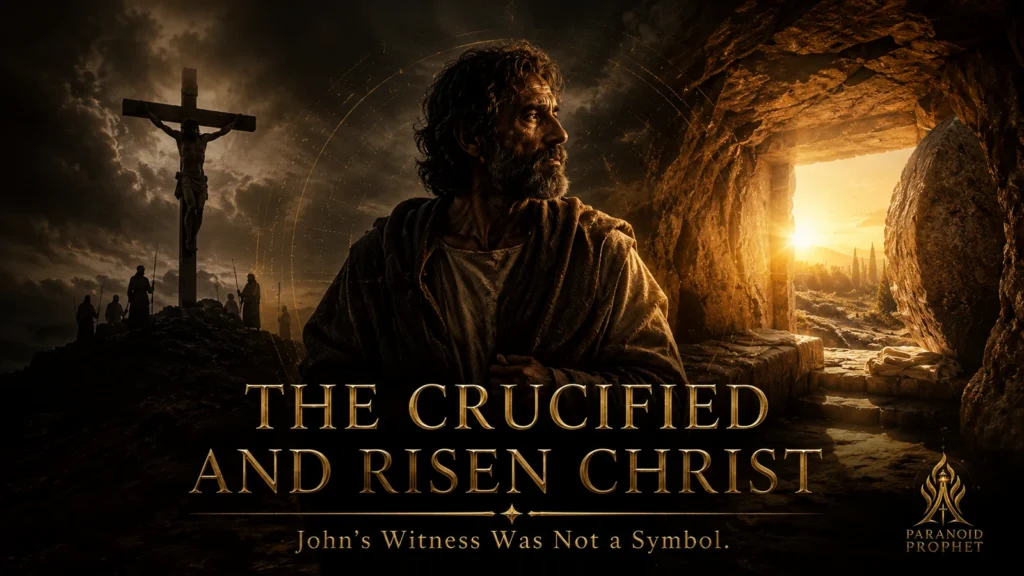
The previous section showed John near the cross as a disciple brought close to Jesus. Here the focus is different: John’s Gospel presents the cross as witness, not symbol only.
The Johannine witness does not rush past the death of Jesus as if the crucifixion were merely a tragic image or spiritual metaphor. It presents the death of Christ as real, public, witnessed, and full of saving meaning.
After Jesus dies, John’s Gospel says that one of the soldiers pierced His side with a spear, and at once there came out blood and water. Then the Gospel adds a direct testimony claim: “He who saw it has borne witness—his testimony is true” (John 19:31–37).
That language is important. The Gospel is tying theology to testimony. Jesus truly died. His death fulfilled Scripture. The Son of God did not merely appear to suffer. He gave Himself unto death.
This strengthens John’s place in the larger case for Christ. His later faithfulness was not built on an abstract spiritual message. It was attached to the crucified Christ, the Lamb of God who takes away the sin of the world.
John and the Empty Tomb
John’s Gospel also connects the beloved disciple to the empty tomb. On the first day of the week, Mary Magdalene comes to the tomb and finds the stone taken away. She runs to Simon Peter and the other disciple, “the one whom Jesus loved.” Peter and the beloved disciple then run to the tomb together (John 20:1–10).
The scene is vivid. The beloved disciple reaches the tomb first. Peter enters. They see the linen cloths lying there. The face cloth is folded separately. Then the Gospel says that the other disciple went in, “and he saw and believed.”
The Gospel is honest about their incomplete understanding. John 20 says they did not yet understand the Scripture, that He must rise from the dead. But it still places the beloved disciple at the threshold of resurrection faith. He sees the empty tomb. He sees the grave cloths. He begins to believe.
This gives John’s long witness weight. He was not simply preserving religious values. He was connected to the claim that the crucified Jesus had been raised.
The Gospel itself tells us why this witness was written down: “these are written so that you may believe that Jesus is the Christ, the Son of God, and that by believing you may have life in his name” (John 20:30–31).
That purpose statement is crucial. John’s witness does not stop at an empty tomb. It presses the reader toward the identity of Jesus. The risen Jesus is the Christ, the Son of God, the one in whose name life is found.
John in the Public Witness of Acts
John’s witness moved from the tomb to the temple.
Acts places John beside Peter in the early public mission of the church. In Acts 3, Peter and John go up to the temple. After the healing of the lame man, Peter preaches that the people denied the Holy and Righteous One and killed the Author of life, “whom God raised from the dead.” Then he says, “To this we are witnesses” (Acts 3:1–16).
John is not the speaker in that sermon, but he is present in the public witness. He stands with Peter as the name of Jesus is proclaimed in Jerusalem. The message is not vague inspiration. It is direct resurrection proclamation: the Author of life was killed, and God raised Him from the dead.
In Acts 4, Peter and John are arrested and brought before the rulers, elders, and scribes. The authorities recognize that they are uneducated, common men, and they are astonished. They also recognize that these men had been with Jesus (Acts 4:1–22).
That detail is powerful. The leaders do not merely see boldness. They see the mark of proximity to Christ. John’s testimony is public enough to provoke opposition and recognizable enough to be connected back to Jesus Himself.
When the authorities command Peter and John not to speak or teach at all in the name of Jesus, their answer is plain: “Whether it is right in the sight of God to listen to you rather than to God, you must judge.” Then they add, “for we cannot but speak of what we have seen and heard” (Acts 4:18–21).
That sentence belongs near the heart of John’s story. “What we have seen and heard” is witness language. It is the same kind of testimony that later frames John’s exile on Patmos. Revelation says John was there because of “the word of God and the testimony of Jesus” (Revelation 1:9). The pattern is already visible in Acts: public proclamation, opposition, and refusal to be silent.
John as a Pillar of the Early Church
John also appears in Paul’s letter to the Galatians as one of the recognized pillars of the early church. Paul says that James, Cephas, and John, “who seemed to be pillars,” gave him and Barnabas the right hand of fellowship when they recognized the grace given to him (Galatians 2:7–10).
This matters because Galatians is not a late church legend about John. It is one of Paul’s own letters, and it places John among the acknowledged leaders of the Jerusalem church. John was not only remembered inside Johannine tradition. Paul knew him as one of the recognized pillars of the earliest church.
That gives John’s long witness another layer of weight. He stands at the intersection of Gospel testimony, resurrection proclamation, public opposition, and early church leadership. He is connected to the cross, the empty tomb, the temple witness in Acts, and the apostolic fellowship recognized by Paul.
John was not a private mystic disconnected from the earliest Christian proclamation. He belonged to the first generation of witnesses. He stood with Peter. He was known to Paul. He was remembered as a pillar. Later, when Revelation places John on Patmos because of the word of God and the testimony of Jesus, that exile fits the trajectory of a life already marked by public witness.
John’s long faithfulness was attached to testimony about the crucified and risen Jesus. But the Johannine witness presses even deeper. It does not merely ask whether Jesus rose. It asks who the risen Jesus is: the Christ, the Son of God, the Word made flesh, and the Lord of glory.
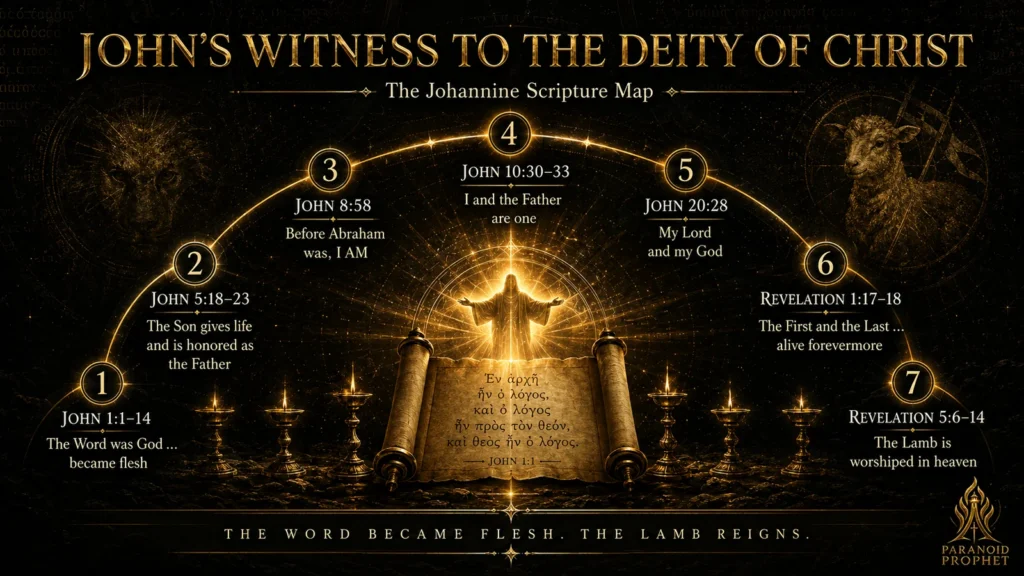
John’s Witness to the Deity of Christ
John’s witness does not leave the identity of Jesus vague.
The Johannine witness does not let the reader leave Jesus in the safe category of “great teacher.” It presses toward a far greater confession: Jesus is the eternal Word made flesh, the Son who reveals the Father, the Lord who gives life, the crucified and risen Christ, and the glorified King who lives forever.
This is why John’s long faithfulness matters so deeply. He did not endure for a softened version of Christianity. He endured for the testimony of Jesus Christ in all His glory.
The Word Became Flesh
John does not begin with Jesus as a religious improvement plan. He begins with eternity.
The Gospel opens: “In the beginning was the Word, and the Word was with God, and the Word was God” (John 1:1–18). Before the miracles, before the cross, before the empty tomb, John places Jesus in the frame of creation itself. The Word is not a creature inside the world. Through Him all things were made.
Then comes the staggering claim: “the Word became flesh and dwelt among us.” The Word did not become an idea. The Word became flesh. John’s witness does not ask the reader to choose between a divine Christ and a real human Christ. It presents the eternal Word entering real human history.
This is central to John’s long witness. He bore testimony to the incarnate Son of God. Jesus did not merely speak for God from a distance. God made Himself known in the Son. The glory John had seen was not imagined or invented. It was “glory as of the only Son from the Father, full of grace and truth.”
The Son Reveals the Father
John’s Gospel presents Jesus as the Son who reveals the Father with unique authority. Jesus does not merely point toward God as one teacher among many. He speaks and acts with divine authority because He shares perfect unity with the Father.
In John 5, Jesus says that the Son gives life to whom He will, that the Father has given all judgment to the Son, and that all may honor the Son just as they honor the Father (John 5:18–29). That is not ordinary prophetic language. The Son gives life. The Son executes judgment. The Son receives the honor due to God.
Later, Jesus tells Philip, “Whoever has seen me has seen the Father” (John 14:6–11). This does not erase the distinction between the Father and the Son. It reveals the Son’s perfect unity with the Father. To see Jesus truly is to see the Father revealed.
John’s witness is therefore not vague spirituality. It is revelation. The Son makes the Father known. This is the confession John carried through pressure, exile, and old age.
Before Abraham Was, I Am
John’s Gospel also records Jesus speaking with a divine identity that cannot be reduced to moral teaching.
In John 8, Jesus says, “Before Abraham was, I am” (John 8:48–59). The reaction is immediate: they pick up stones to throw at Him. The controversy is not caused by Jesus offering general religious advice. It is caused by the magnitude of His claim.
In John 10, Jesus says, “I and the Father are one.” His opponents again pick up stones, and they explain why: “because you, being a man, make yourself God” (John 10:27–39).
John wants the reader to feel the weight of this. Jesus’ identity was not a harmless side issue. His claims provoked worship, opposition, confession, and hatred. The same Jesus who gives His sheep eternal life is the one whose words force the question: who is this man?
John’s answer is not timid. Jesus is one with the Father. He is the Son who gives eternal life. He is the Good Shepherd whose sheep hear His voice and cannot be snatched from His hand.
My Lord and My God
John’s Gospel reaches one of its clearest climaxes after the resurrection. Thomas, who had doubted, sees the risen Jesus and confesses, “My Lord and my God” (John 20:24–29).
Jesus does not rebuke Thomas for blasphemy. He receives the confession and speaks blessing over those who have not seen and yet have believed. The point is not merely that Thomas changed his mind. The point is what Thomas confessed when confronted with the risen Christ.
Immediately after this scene, the Gospel explains its purpose: “these are written so that you may believe that Jesus is the Christ, the Son of God, and that by believing you may have life in his name” (John 20:30–31).
That purpose statement gives this article its center. John’s witness does not merely invite admiration for Jesus. It summons belief. It points to life in His name. It presses the reader toward the confession that the crucified and risen Jesus is Lord and God.
The Word of Life Seen and Touched
The same pattern appears in 1 John. The letter opens with witness language: “that which we have heard, which we have seen with our eyes, which we looked upon and have touched with our hands, concerning the word of life” (1 John 1:1–4).
This is crucial. John’s high view of Christ is not presented as a retreat from history into abstraction. The Word of life was heard, seen, looked upon, touched, and proclaimed. The witness is both theological and embodied.
John’s testimony to Jesus’ deity does not flatten Jesus’ humanity. It deepens the mystery of the incarnation. The eternal Son truly came. The Word truly became flesh. The Life was manifested and proclaimed.
The Glorified Christ in Revelation
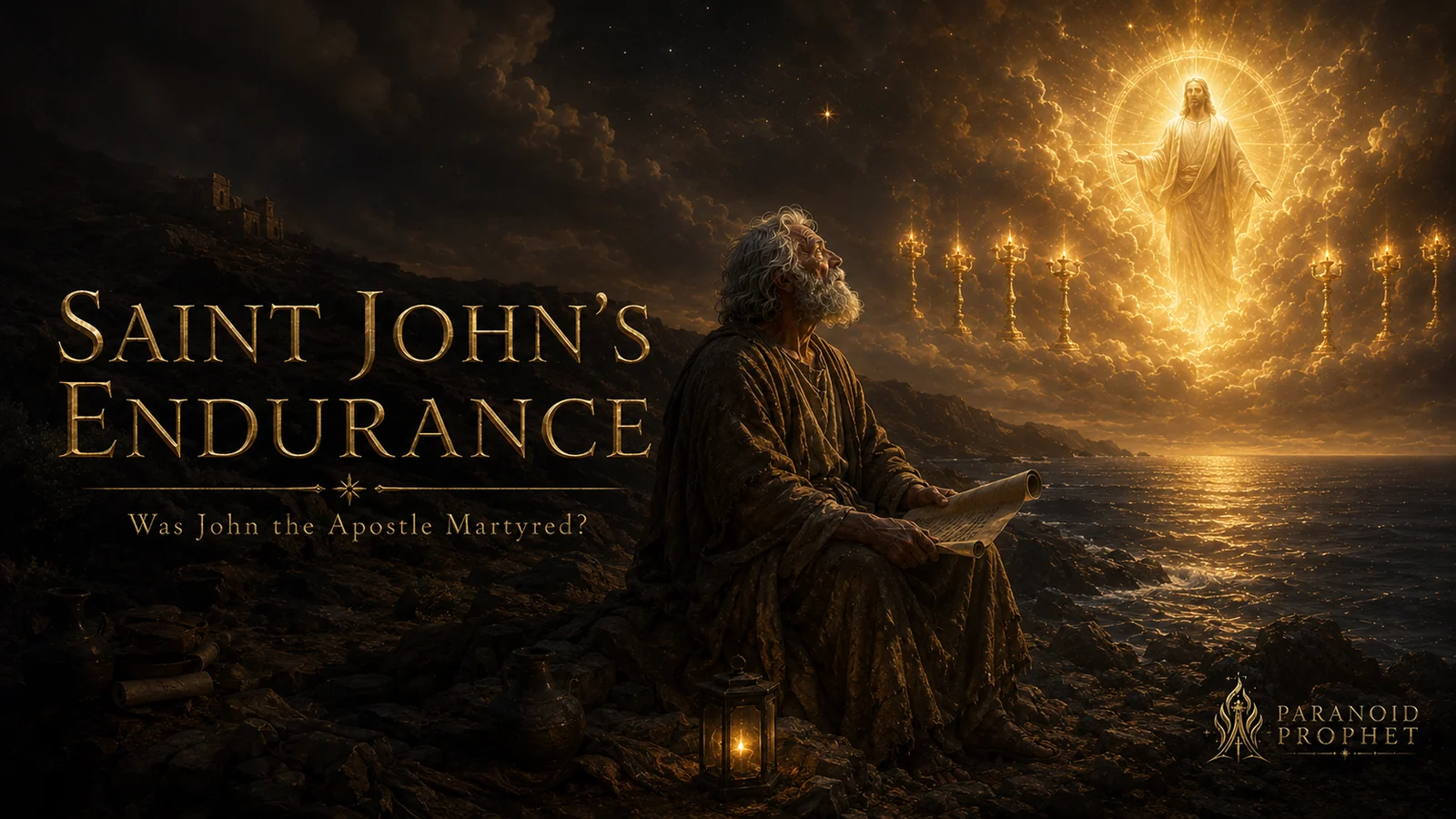
John’s clearest biblical suffering anchor is Patmos. Revelation opens with John saying that he was on the island “on account of the word of God and the testimony of Jesus” (Revelation 1:9).
Then John sees the glorified Christ. The vision is overwhelming. Jesus stands among the lampstands. His eyes are like a flame of fire. His voice is like the roar of many waters. He says, “Fear not, I am the first and the last, and the living one. I died, and behold I am alive forevermore” (Revelation 1:12–18).
Revelation does not replace the crucified Jesus with another figure. It shows the crucified One alive forevermore. The same Jesus who died now stands in divine majesty, sovereign over death, holding the keys of Death and Hades.
Revelation 5 presses the vision even further. The Lamb who was slain stands at the center of heaven’s worship. Every creature in heaven and on earth gives blessing, honor, glory, and might to the One seated on the throne and to the Lamb (Revelation 5:6–14).
Heaven does not merely honor the Lamb as a messenger. Heaven worships Him with the One seated on the throne. This is not a low view of Jesus. It is the worship of the crucified and risen Christ in divine glory.
John’s witness to Christ moves from incarnation to resurrection to heavenly glory. The Word became flesh. The Son died. The Lord rose. The Lamb reigns.
This is why John belongs inside the larger identity argument for Jesus. He did not simply preserve memories about Jesus’ kindness or wisdom. He bore witness to Jesus’ divine identity. For the wider case, see Who Was Jesus? Liar, Lunatic, or Lord?.
John endured not for a memory, but for the living Christ. The confession that carried him through suffering was the confession that Jesus is the eternal Word, the Son of God, the risen Lord, and the glorified King. The next question is how that witness was tested when John was sent into exile because of the word of God and the testimony of Jesus.
John on Patmos: Scripture’s Anchor for His Endurance
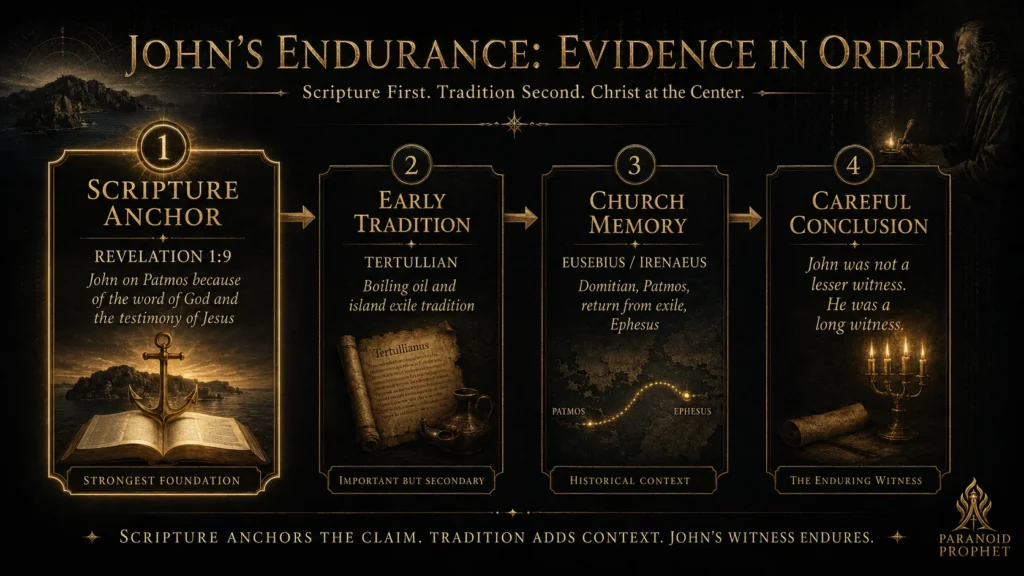
John’s endurance is not built first on legend. It is anchored in Scripture.
Revelation opens with John identifying himself as a brother and partner “in the tribulation and the kingdom and the patient endurance that are in Jesus.” Then he tells the reader where he is: “I was on the island called Patmos on account of the word of God and the testimony of Jesus” (Revelation 1:9).
That sentence gives us the strongest starting point for John’s later story. Scripture does not say John was executed like James. It does not narrate a final martyrdom like the later tradition surrounding Peter. But it does place John in suffering. He is separated, exiled, and enduring because he belongs to Jesus Christ.
John was not on Patmos because he retired into private spirituality. Revelation presents him there because of witness. He was there because of the word of God and the testimony of Jesus.
Exiled for the Word of God and the Testimony of Jesus
Patmos was not a retreat in Revelation’s own framing. It was the place where John suffered separation because of testimony. Whatever historical details we cannot recover, Revelation gives the theological reason for his exile: loyalty to God’s word and faithfulness to Jesus Christ.
This keeps John’s story in the right category. He was not a lesser witness because he was not killed. His testimony was tested in another form. James’ witness was sealed by the sword. Peter’s witness was remembered as ending in crucifixion. John’s witness was stretched through exile, patient suffering, and long obedience.
For the wider disciple witness trail, that distinction matters. John belongs beside the martyrs, not because his death matches theirs, but because his testimony was costly in its own form.
The Vision of the Glorified Christ
John’s exile does not lead to silence. It leads to Revelation.
On Patmos, John sees the glorified Christ standing among the lampstands. The vision is overwhelming: eyes like flame, voice like many waters, face like the sun shining in full strength. When John falls at His feet as though dead, Christ lays His right hand on him and says, “Fear not” (Revelation 1:12–18).
The Lord John had followed beside the Sea of Galilee is now seen in unveiled majesty. He is the First and the Last, the Living One. He died, and He is alive forevermore. He holds the keys of Death and Hades.
This is the heart of John’s tested witness. Exile did not shrink Jesus in John’s eyes. Suffering did not make Christ smaller. Patmos became the place where the apostle saw, with greater clarity, the glory of the One for whom he suffered.
That is why the next layer of tradition must be kept in order. The boiling oil story is memorable and worth addressing, but Revelation gives the anchor: John was already a suffering witness because of the word of God and the testimony of Jesus.
The Boiling Oil Tradition: The Apostle Who Wouldn’t Burn
The most dramatic tradition about John says that he was cast into boiling oil, survived unharmed, and was then sent into exile. This is where the old phrase “the apostle who wouldn’t burn” comes from.
It is a powerful tradition, and it should not be dismissed lightly. But it must be placed in the right evidence category. Scripture gives us John on Patmos because of the word of God and the testimony of Jesus. The boiling oil account comes from early Christian tradition.
That order matters. Revelation gives the anchor. Tertullian gives us one of the earliest surviving witnesses to the dramatic memory of John’s suffering before exile.
What Tertullian Says
One of the key sources is Tertullian, writing around the turn of the third century. In The Prescription Against Heretics 36, Tertullian points to Rome as a place where apostolic suffering was remembered. He says Peter endured a passion like the Lord’s, Paul was crowned with a death like John the Baptist’s, and John was plunged into boiling oil, came out unharmed, and was then sent to island exile.
That source is worth taking seriously. Tertullian is not a medieval writer inventing a distant legend. He is an early Christian voice preserving a memory of severe persecution connected to John.
At the same time, Tertullian is not Scripture, and he is not an eyewitness to the event. The tradition carries real historical weight as early Christian memory, but it should not be treated as if the New Testament itself narrates John standing unharmed in boiling oil.
How Strong Is This Tradition?
The boiling oil tradition is old enough to matter, vivid enough to have endured, and serious enough to include. It should not be mocked as a modern internet legend or ignored as worthless folklore.
But it should not become the foundation of the article either. The stronger foundation is John’s biblical exile because of the testimony of Jesus. The boiling oil tradition strengthens the portrait of John as an apostle tested by persecution, but the article does not need that tradition to prove John suffered for Christ.
Handled in the right order, the tradition adds weight without taking control. The early church did not remember John as an apostle who escaped the cost of witness. It remembered him as one who survived severe testing and continued bearing testimony to Christ.
That is the apologetic value of the tradition. Whether every detail can be reconstructed with certainty or not, the memory points in the same direction as Revelation 1:9: John was not preserved for comfort. He was preserved for witness.
John’s Later Years in Ephesus
Early Christian tradition does not remember John only as an exile. It also remembers him as returning from banishment and continuing to minister among the churches of Asia, especially in connection with Ephesus.
That matters because John’s long life was not merely survival. It was continued service. The old apostle was remembered not as disappearing into private safety, but as shepherding the churches and bearing witness into old age.
Exile Under Domitian and Return from Banishment
Eusebius preserves the early Christian memory that John’s banishment belonged to the reign of Domitian and that Revelation was seen near the end of that reign. In Church History 3.18, Eusebius says that John was condemned to dwell on Patmos because of his testimony to the divine word.
Eusebius then reports that after Domitian’s death and a change in imperial rule, those unjustly banished were released. John, according to the ancient tradition Eusebius records, returned from exile and took up residence again in Ephesus.
This is not as direct as Revelation 1:9, but it is important early Christian memory. It places John’s tested faithfulness in a recognizable historical setting: Roman pressure, exile, release, and continued ministry.
The Old Apostle and the Churches of Asia
The tradition of John’s later years is powerful because it gives a different kind of apostolic witness. James shows the cost of early execution. Peter shows the cost of martyrdom after restoration. John shows the cost of remaining.
Long life can sound easy until we remember what John had seen. He had seen Jesus crucified. He had seen the tomb opened. He had watched the church suffer. He had seen brothers die. He had known opposition from rulers and exile under imperial power. Then he was remembered as continuing to shepherd the churches as an old man.
That is not escape. That is endurance.
Eusebius also preserves Clement of Alexandria’s story of the aged John pursuing a young man who had fallen into sin (Church History 3.23). The details belong to tradition, but the portrait is consistent with the larger memory of John: he was remembered as a shepherd, not merely a survivor.
This makes John’s place in the disciple witness trail unique. He did not give one final witness in a single moment of execution. He gave a long witness through years of costly faithfulness. His life tells us that apostolic testimony was not only tested under the threat of death. It was also tested by time.
The question now is not whether John’s long life made him a lesser witness. It is what that long, costly witness shows about the apostolic testimony to Jesus Christ: crucified, risen, divine, and glorified.
What John’s Endurance Shows About the Case for Christ
John’s long life does not make him a lesser witness because he was not executed. It shows another form of apostolic cost.
Inside the wider disciple witness trail, John’s story stands in its own lane. James bore witness through early death. Peter was remembered as bearing witness through martyrdom in Rome. John bore witness through long obedience, exile, suffering, pastoral labor, and continued testimony to the glory of Christ.
His life reminds us that faithfulness is not only measured by the moment of death. Sometimes it is measured by decades of refusing to let go of Jesus.
John Was Not a Lesser Witness
Scripture does not tell us that John died as a martyr. That should not be treated as an embarrassment. Revelation gives us something different: John as a brother and partner in tribulation, exiled on Patmos because of the word of God and the testimony of Jesus (Revelation 1:9).
That is not comfort. That is not compromise. That is costly witness.
John’s story widens the way we think about apostolic testimony. Some witnesses were killed. Some were imprisoned. Some were beaten. John was preserved through suffering and remembered as continuing into old age. His long witness does not weaken the disciple-witness trail. It completes it.
John’s Long Life Strengthens Apostolic Continuity
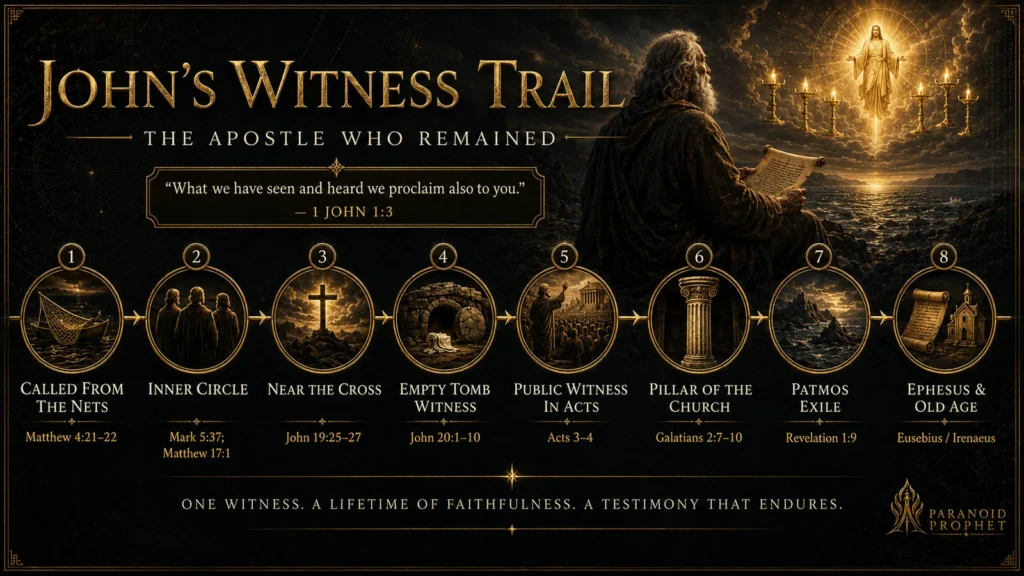
John’s life stretches across the whole apostolic arc: called by Jesus, brought into the inner circle, connected with the cross and empty tomb, standing with Peter in Acts, named by Paul as a pillar, and later placed on Patmos because of the testimony of Jesus.
That continuity matters. John was not remembered as a man who quietly outgrew his early faith. He was remembered as one who carried the testimony of Jesus through time, pressure, exile, and old age.
His tested faithfulness does not force belief by itself. But it does make shallow explanations harder. John was not remembered as a man who outgrew the resurrection message, softened Jesus into a symbol, or retreated from the claim that Christ is Lord.
The testimony continued. The confession deepened. The crucified Jesus was still proclaimed as the risen Lord and glorified Christ.
John’s Long Witness Points to the Divine Christ
The center of John’s story is not John. It is Jesus.
John’s lifelong testimony matters because of the Christ he confessed. The Johannine witness presents Jesus as the eternal Word who became flesh, the Son who reveals the Father, the Lamb of God, the risen Lord, the First and the Last, and the glorified King who lives forever.
That is why John’s long witness strengthens the larger case for Christ. John did not endure exile for a vague religious memory. He endured because of the testimony of Jesus. He did not spend his final years protecting a harmless moral slogan. He bore witness to the One who died, rose, and reigns.
The case is cumulative. John’s life connects the earthly ministry of Jesus, the cross, the empty tomb witness, the public apostolic mission, early church leadership, Patmos, Revelation, and the church’s memory of long faithful service.
John does not carry the whole case for Christ alone. But remove John from the story, and the apostolic witness loses one of its longest and most theologically powerful voices. His life joins the larger case: Jesus was crucified, God raised Him from the dead, and the earliest witnesses continued confessing Him as Lord.
Frequently Asked Questions About Saint John’s Endurance
Was John the Apostle martyred?
Scripture does not report John being executed as a martyr. In that narrow sense, John was not martyred like James, whose death is recorded in Acts 12:1–2. But that does not mean John avoided suffering. Revelation presents him as a brother and partner in tribulation, exiled on Patmos because of the word of God and the testimony of Jesus (Revelation 1:9).
How did John the Apostle die?
The traditional answer is that John died in old age, often connected with Ephesus. The New Testament does not narrate John’s death, so the strongest biblical point is not his final death scene, but his exile on Patmos because of the word of God and the testimony of Jesus.
Was John boiled in oil?
Tertullian, in The Prescription Against Heretics 36, preserves the tradition that John was plunged into boiling oil, came out unharmed, and was then sent into exile. This is an early and serious tradition, but it is not narrated in Scripture. The strongest foundation for John’s endurance remains Revelation 1:9.
Why was John exiled to Patmos?
Revelation says John was on Patmos “on account of the word of God and the testimony of Jesus” (Revelation 1:9). In the book’s own framing, John’s exile was connected to faithful witness. His suffering was not random background detail; it was part of the cost of bearing testimony to Christ.
What is the strongest evidence for John’s endurance?
The strongest biblical evidence is Revelation 1:9, which places John on Patmos because of the word of God and the testimony of Jesus. Later Christian tradition adds the boiling oil account, exile under Domitian, return from banishment, and long ministry connected with Ephesus. The evidence is strongest when Scripture and tradition are kept in the right order.
What did John teach about Jesus’ divinity?
The Johannine witness presents Jesus as the Word who was with God and was God, the Word made flesh, the Son of God, the risen Lord confessed as “My Lord and my God,” and the glorified Christ who is the First and the Last (John 1:1–18; John 20:24–31; Revelation 1:12–18). John’s long witness matters because the testimony he carried was not low or vague. It centered on Jesus’ divine identity.
Why does John’s endurance matter for the case for Christ?
John’s endurance supports the sincerity, continuity, and cost of apostolic witness. He was not remembered as a man who abandoned the resurrection message, softened Jesus into a symbol, or quietly outgrew his early faith. He remained a witness to Jesus Christ: crucified, risen, divine, and glorified.
Conclusion: John Endured as a Witness to the Glorified Christ
John did not die like James. He was not remembered like Peter, crucified in Rome. John’s witness took a different shape.
He remained.
He remained as one called from the nets, brought near to Jesus’ glory and sorrow, and connected to the cross and the empty tomb. He remained beside Peter in the public testimony of Acts. He remained known among the pillars of the early church.
He remained on Patmos because of the word of God and the testimony of Jesus. According to early Christian memory, he remained into old age, still shepherding, still testifying, still belonging to Christ.
That is not a lesser witness. It is a long witness.
John’s endurance does not replace the cross or resurrection. It points back to them. It does not make John the foundation of faith. Christ is the foundation. But John’s life shows that the apostolic witness to Jesus did not collapse under pressure, exile, or time.
His story stretches across the whole arc of apostolic testimony: the earthly ministry of Jesus, the cross, the empty tomb, the public witness of Acts, the recognition of the early church, Patmos, Revelation, and the church’s memory of long faithful service.
John endured because the Jesus he knew was not merely a teacher worth remembering. Jesus is the eternal Word made flesh, the Lamb who was slain, the Lord who rose, the First and the Last, and the glorified King who lives forever.
The apostle who remained did not remain silent. He bore witness to the living Christ, because the Lamb who was slain is alive forevermore.
Sources and Further Reading
This article uses Scripture as the final authority. Early Christian sources are used as historical context for John’s later tradition, not as Scripture and not as equal evidence. The strongest anchor for John’s endurance is Revelation 1:9; later sources help trace how the early church remembered John’s exile, survival, return, and long ministry.
Scripture
- Matthew 4:21–22 — Jesus calls James and John from the boat.
- Mark 3:17 — James and John are called “Sons of Thunder.”
- Mark 5:35–43 — Peter, James, and John are present when Jesus raises Jairus’s daughter.
- Matthew 17:1–8 — John is present at the transfiguration.
- Mark 14:32–42 — John is brought near in Gethsemane.
- John 1:1–18 — the Word was God and the Word became flesh.
- John 19:25–37 — the beloved disciple near the cross and witness language at Jesus’ death.
- John 20:1–31 — the empty tomb, Thomas’s confession, and the Gospel’s purpose statement.
- John 21:20–24 — the beloved disciple and testimony.
- Acts 3–4 — Peter and John in public witness and opposition.
- Galatians 2:7–10 — John named with James and Cephas as a pillar.
- 1 John 1:1–4 — the Word of life heard, seen, touched, and proclaimed.
- Revelation 1:9–18 — John on Patmos and the vision of the glorified Christ.
- Revelation 5:6–14 — the Lamb worshiped in heaven.
Early Christian Sources
- Tertullian, The Prescription Against Heretics 36 — preserves the tradition of John being plunged into boiling oil and then sent to island exile.
- Eusebius, Church History 3.18 — connects John’s banishment to Patmos with the reign of Domitian and the testimony to the divine word.
- Eusebius, Church History 3.20 and 3.23 — preserves traditions about John’s return from banishment and later ministry in Asia.
- Irenaeus, Against Heresies 2.22.5 and 3.3.4 — early witness connecting John with later life in Asia and Ephesus.
- Clement of Alexandria, preserved by Eusebius, Church History 3.23 — tradition of the aged John pursuing and restoring a fallen young man.
Continue the Trail
John’s endurance belongs inside the larger witness of Jesus’ disciples and the broader case for Jesus Christ. Continue with these related articles:
Disciple Witness Trail
- Martyrdom of Jesus’ Disciples: What History Really Shows — the master trail for the apostolic witness, martyrdom traditions, and what history can and cannot prove.
- Saint James’ Martyrdom: The First Apostle Killed for Christ — the clearest apostolic death recorded in Acts and the first disciple-martyr in this series.
- Peter’s Martyrdom: Was Peter Crucified Upside Down? — the restored denier remembered as a suffering witness who died for Christ in Rome.
Jesus Evidence Trail
- Who Was Jesus? Liar, Lunatic, or Lord? — the wider identity argument for why Jesus cannot be reduced to a safe moral teacher.
- The Historical Reality of Jesus — the broader historical foundation for Jesus’ existence, crucifixion, and early Christian proclamation.
CONTINUE THE INVESTIGATION
Evidence standard continuation
Did the Apostles Die for the Resurrection? What We Can Honestly Say
Return from this individual witness tradition to the comparative source review that separates strong evidence, plausible tradition, and uncertainty.