Last updated: June 6, 2026
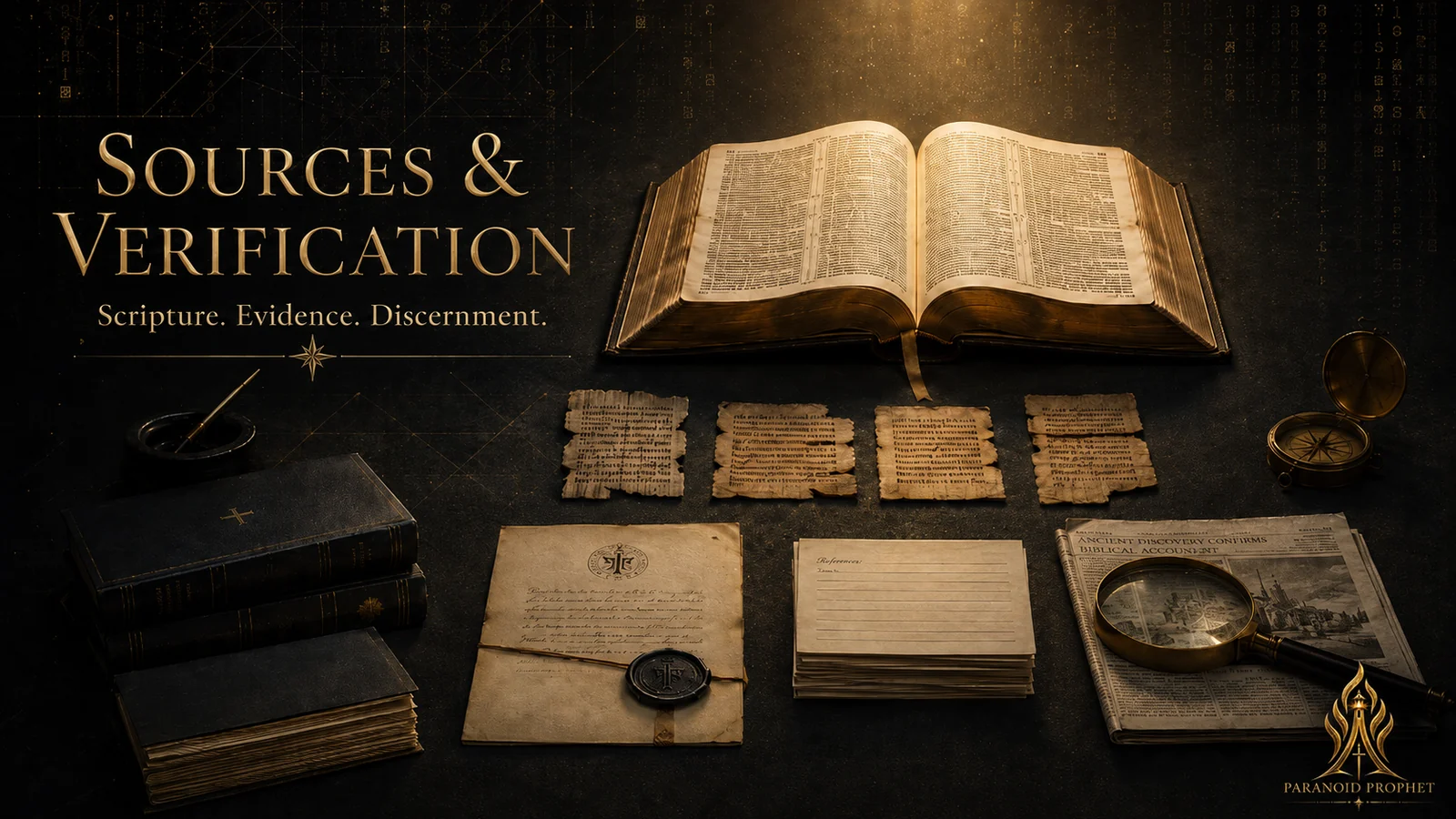
Sources and verification matter because truth should not be handled carelessly. Paranoid Prophet exists to seek truth under the lordship of Jesus Christ and the authority of Scripture. This page explains how we weigh sources, evidence, disputed claims, speculation, AI-assisted research, and corrections.
We do not treat every source, claim, article, theory, or opinion as equal. Some things are revealed by God in Scripture. Some things are historically strong. Some things are plausible but debated. Some things are speculative. Some things are useful for context, but not trustworthy as final authority.
In short: Scripture is final, evidence matters, speculation must be labeled, and no source outranks the Word of God.
Article Guide7 sections
Our Sources and Verification Standard
Our goal is not to chase every claim that sounds interesting. Our goal is to test what is true, separate strong evidence from weak evidence, and avoid pretending that uncertain claims are proven facts.
Paranoid Prophet articles may cover Scripture, theology, history, current events, spiritual deception, cultural narratives, UAPs, conspiracy claims, media manipulation, and unusual theories. Because those topics can easily become reckless, our standard is simple: truth must be handled with humility, evidence must be weighed carefully, and speculation must be labeled honestly.
Scripture Comes First
For doctrine, theology, salvation, sin, holiness, prophecy, spiritual warfare, angels, demons, judgment, the gospel, and the identity of Jesus Christ, Scripture is the final authority.
Scripture calls believers to test what they hear and hold fast to what is good (1 Thessalonians 5:21). It also teaches that Scripture is breathed out by God and profitable for teaching, correction, and training in righteousness (2 Timothy 3:16–17).
Historical evidence, scholarship, archaeology, journalism, commentary, and AI-assisted research can help provide context. They can support public claims. They can expose weak arguments. They can help readers understand the world around the Bible. But they do not outrank the Word of God.
Jesus Christ is Lord. Scripture is true. Every theory, source, argument, and interpretation must be tested under that foundation.
Our Hierarchy of Sources
Not every source carries the same weight. A primary document is not the same as a blog post. A biblical text is not the same as a popular theory. A serious scholar is not the same as a viral clip. A source may be useful for one purpose and unreliable for another.
1. Scripture and Biblical Truth
Scripture is the highest authority for what God has revealed. When an article deals with Christian doctrine, the nature of Christ, sin, salvation, prophecy, spiritual beings, judgment, holiness, or the gospel, the Bible is not one source among many. It is the standard by which all other claims are judged.
2. Direct Biblical Text
Before building a theory, we return to the text itself. What does the passage actually say? What does it not say? How does the immediate context shape the meaning? How does the rest of Scripture clarify it?
This matters because many errors begin when people start with a theory and then force the Bible to serve it. Paranoid Prophet should do the opposite: begin with Scripture, then test the theory.
3. Primary Historical Sources
For historical claims, primary or near-primary sources carry special weight. These may include ancient texts, public records, court documents, original interviews, official statements, manuscripts, archaeological reports, or early witnesses close to the events being discussed.
Primary sources are not automatically perfect, but they are closer to the claim than later summaries, recycled quotes, or second-hand commentary.
4. Scholarly and Expert Analysis
Scholarly work can be valuable for history, language, archaeology, medicine, law, politics, economics, textual criticism, theology, and ancient context. Serious scholarship helps us avoid lazy claims and shallow arguments.
But scholarship is not infallible. Scholars disagree. Their assumptions matter. A scholar may be useful on one question and weak on another. Academic sources should be weighed, not worshiped.
5. Reputable Journalism and Public Reporting
News reporting can help document current events, quotes, timelines, public statements, investigations, and official responses. When possible, current-event claims should be checked against multiple sources, especially when the topic is political, controversial, emotional, or rapidly developing.
Early reports can change. Headlines can frame a story unfairly. Anonymous sourcing can be useful but limited. Paranoid Prophet should avoid treating first-day reporting as final truth.
6. Christian Commentary and Apologetics
Christian commentary, apologetics, sermons, ministries, and study resources can be helpful for teaching, synthesis, application, and worldview framing. They can also help readers understand how Christians have answered major objections.
But Christian commentary does not replace Scripture. A popular apologetic argument is not automatically strong because it is useful. A quote from a scholar is not enough if it is ripped from context. A claim should be supported carefully, especially when defending the Bible, Jesus Christ, or the Christian faith.
7. Alternative Media, Speculation, and Claims Under Review
Paranoid Prophet sometimes explores disputed claims, unusual theories, media narratives, UAP claims, hidden-history arguments, Watcher speculation, spiritual deception, and cultural patterns. These topics require extra caution.
Alternative sources may raise real questions, preserve ignored details, or challenge mainstream blind spots. They may also exaggerate, speculate, misread evidence, or turn suspicion into certainty.
When a claim is speculative, it should be called speculative. When a theory is possible but unproven, it should not be presented as fact. When evidence is thin, the article should say so.
8. AI-Assisted Research
AI tools may be used to help brainstorm, organize research, test arguments, compare claims, edit drafts, summarize material, identify weak spots, and develop visuals or outlines.
AI is not an authority. It does not determine truth. It can make mistakes, invent details, flatten nuance, and sound confident when it should be cautious. Scripture, evidence, human judgment, and source verification must remain above AI output.
How We Handle Disputed Claims
Some claims are clear. Others are debated. Paranoid Prophet should not pretend those categories are the same.
When dealing with disputed claims, we try to distinguish between:
- What Scripture teaches
- What history strongly supports
- What scholars commonly argue
- What remains debated
- What is plausible but unproven
- What is speculation or hypothesis
- What should be rejected as weak, false, or misleading
This distinction matters. A Christian site should not need exaggerated certainty to defend truth. Strong claims should be supported strongly. Uncertain claims should be handled honestly.
What a Source Link Does Not Mean
A source link is not always an endorsement.
Sometimes a source is linked because it supports a factual claim. Sometimes it is linked because it represents a viewpoint being examined. Sometimes it is used for historical context, direct quotation, public record, criticism, comparison, or documentation of what someone said.
Linking to a source does not mean Paranoid Prophet agrees with everything that source teaches, publishes, believes, promotes, or assumes.
Corrections and Updates
Truth matters more than protecting a previous draft. If an article contains an error, outdated claim, broken link, weak source, unclear distinction, or overstated argument, it should be corrected.
Some articles may also be updated as new evidence appears, old links break, better sources become available, or a topic develops over time.
When better evidence changes the conclusion, the conclusion should change. When better evidence strengthens the conclusion, the article should become stronger. Either way, the goal is truth, not ego.
Related Trust Pages
For more about the mission behind this site, read About the Mission. For how this site handles reader privacy, read the Privacy Policy.
Our sources and verification standard is meant to support the whole site: Scripture first, evidence weighed carefully, speculation labeled honestly, and corrections made when better information requires it.