
GUIDED ARTICLE EXPERIENCE
The Book of Enoch Explained: Scripture, History, and the Watchers
Read along as the narration moves through the article.
Private device narration · No hosted audio or tracking
CONTINUE GUIDED TOUR
Continue where you left off.
GUIDED TOUR COMPLETE
You have reached the end of this study.
Study record saved on this device.
GUIDED TOUR
The Book of Enoch Explained: Scripture, History, and the Watchers
Narrator: Paranoid Prophet Recommended Voice Native device narration
Prepare to follow the article as it is narrated.
VOICE & TOUR OPTIONS
Voice & Listening
NARRATOR
Finding a narrator…
Checking the best narrator available on this device.
Restores the best curated narrator available on this device.
Narrator choices are curated for clear, long-form listening on this device.
Screen-awake support will be checked when narration starts.
CHOOSE A NARRATOR
Curated for this device
Choose a verified narrator for this browser, or use System Narrator. Automatic mode uses the best reliable route exposed by this device; your chosen narrator is preserved even if this device needs a temporary fallback.
Preparing the guided article experience…
RESUME GUIDED TOUR?
Continue where you left off.
GUIDED TOUR COMPLETE
You have reached the end of this study.
The Book of Enoch has become a test of judgment for modern Christians. Some treat it as a suppressed book of the Bible whose recovery will unlock what the church refused to teach. Others dismiss it as religious fiction with nothing useful to say. Neither response is careful enough.
When people speak of the Book of Enoch, they usually mean 1 Enoch: an ancient Jewish collection attributed to Enoch, the man in Genesis who “walked with God” and was taken by him. Its major sections explore heavenly rebellion, divine judgment, the ordering of creation, the suffering of the righteous, and the hope that God will finally remove evil. The collection became especially important because its Book of the Watchers offers an expansive interpretation of Genesis 6:1–4.
First Enoch is genuinely ancient. Aramaic fragments discovered among the Dead Sea Scrolls establish that Enochic writings circulated in Jewish communities before Christianity. The New Testament letter of Jude also uses Enochic material, including language closely related to 1 Enoch 1:9. Those facts make the collection important for understanding the religious world in which the New Testament was written.
They do not produce one simple answer to the canon question. Most Protestant, Roman Catholic, and Eastern Orthodox traditions do not receive 1 Enoch as Scripture. The Ethiopian and Eritrean Orthodox Tewahedo traditions do receive it within their biblical heritage, and their witness deserves accurate and respectful treatment. Christians therefore encounter 1 Enoch through different histories of reception, preservation, and authority.
The central question is not whether Enoch is fascinating. It is what kind of source it is and how much weight it can carry. An ancient manuscript can establish that a tradition existed without proving every event it describes. A New Testament citation can make material important without answering every later canon question. Keeping those distinctions clear allows the evidence to speak without forcing it into either a suppression story or a dismissal.
This guide explains what 1 Enoch is, how its books were composed, what the Qumran manuscripts prove, why Jude uses Enochic material, why the work is absent from most Christian Bibles, and how Christians can read it responsibly. The governing order is simple: Scripture first, ancient context second, modern theory last. The Book of Enoch may contain clues. But Scripture holds the keys.
Article Guide9 sections
What Is the Book of Enoch?
The title can be confusing because it sounds as if Genesis itself mentions a lost book written by Enoch. It does not. The Bible gives Enoch only a few verses, while 1 Enoch is a much larger body of Jewish apocalyptic literature written in his name. The two are related through the figure of Enoch, but they are not the same text or the same kind of authority.
Enoch in Genesis
Genesis 5:21–24 places Enoch in the line from Adam to Noah. It says twice that he walked with God and then reports that he was no longer present because God took him. Unlike the surrounding genealogy, the passage does not close his life with the usual notice that he died. Hebrews 11:5–6 later remembers Enoch as a man of faith who pleased God.
That compressed and mysterious portrait invited reflection. If Enoch was taken by God, what did he see? If he lived before the Flood, what might he have known about the corruption of that world? Later Jewish writers used Enoch as an ideal revealer: a righteous figure from the primordial age who could be shown heavenly places, cosmic patterns, and the judgment awaiting rebellious powers and violent people.
Those later stories may grow from the biblical mystery, but Genesis does not tell readers that Enoch wrote the collection now called 1 Enoch. The biblical notice is the seed of the tradition, not a publication record for the later books.
1 Enoch, 2 Enoch, and 3 Enoch
Three different works are commonly numbered under Enoch’s name. The numbering helps modern readers distinguish them; it does not mean they form three volumes written by one author.
- 1 Enoch, sometimes called Ethiopic Enoch, is the ancient Jewish collection at the center of this article. Substantial portions survive in Aramaic fragments from Qumran, other remains survive in Greek, and the complete collection was preserved in Ge’ez through the Ethiopian manuscript tradition.
- 2 Enoch, often called Slavonic Enoch, is a separate apocalypse preserved mainly through Slavonic manuscripts. It presents its own heavenly ascent and cosmology and should not be silently blended with 1 Enoch.
- 3 Enoch, sometimes called Hebrew Enoch, belongs to a later Jewish mystical setting. It associates Enoch with the exalted angelic figure Metatron and reflects a different stage of tradition.
Popular videos and summaries often move between these writings as though “Enoch says” were enough to identify a source. Responsible study names the work and passage. In the Genesis 6 cluster, the principal source is 1 Enoch, especially the Book of the Watchers in chapters 1–36.
One Collection, Several Enochic Books
First Enoch is better understood as a library gathered under Enoch’s name than as one book produced at a single moment. Its major works differ in subject, literary form, vocabulary, and likely date. They share an Enochic world of revelation and judgment, but they do not all answer the same questions.
The standard arrangement contains five major sections followed by shorter materials:
- The Book of the Watchers, chapters 1–36. This section interprets Genesis 6 through a rebellion of heavenly Watchers, their unions with women, the birth of destructive giants, the disclosure of forbidden arts, Enoch’s heavenly commission, and the judgment of the rebels. It is the most important part of 1 Enoch for this article cluster.
- The Book of Parables or Similitudes, chapters 37–71. These visions focus on final judgment, the vindication of the righteous, the condemnation of oppressive rulers, and a prominent Chosen One or Son of Man figure. The section’s date and relationship to other Enochic works remain major subjects of scholarship.
- The Astronomical Book or Book of the Luminaries, chapters 72–82. This material describes the movements of heavenly bodies, the calendar, and the ordered structure of creation. Its interests remind readers that 1 Enoch is not merely a Watcher narrative.
- The Dream Visions, chapters 83–90. These chapters include a vision of the Flood and an extended symbolic retelling of history, often called the Animal Apocalypse, moving toward judgment and restoration.
- The Epistle of Enoch, chapters 91–105, with concluding materials in chapters 106–108. This portion exhorts the righteous amid injustice and looks toward coming judgment. The final chapters include a birth account concerning Noah and another short Enochic writing.
This structure prevents two common mistakes. First, it keeps the Book of the Watchers from swallowing the whole collection. Readers interested in Genesis 6 often speak as though 1 Enoch contained nothing but fallen angels, giants, and occult teaching. In fact, its books also wrestle with persecution, cosmic order, faithful endurance, history, resurrection, and divine justice.
Second, the structure cautions against treating every sentence as the product of one mind. A claim found in the Parables cannot automatically be assigned the same date or setting as a passage in the Astronomical Book. A detail in the final Noah material may represent a different stage of tradition from the older Watcher narrative. The collection has coherence, but it also has layers.
Who Wrote 1 Enoch, and When?
Most scholars do not believe the man described in Genesis 5 personally wrote 1 Enoch in the form preserved today. The collection bears the marks of composition and editing across the Second Temple period, the centuries in which Jewish communities lived under successive empires, rebuilt and defended their institutions, debated calendars and priesthood, and hoped for God’s decisive judgment.
Dating each section is more complicated than assigning one year to “the Book of Enoch.” The Book of the Watchers and substantial Astronomical traditions are commonly placed among the older Enochic materials. The Dream Visions and Epistle reflect later developments, while the dating of the Parables has generated sustained debate. The responsible conclusion is a range, not a false precision: major parts of the collection are pre-Christian Jewish works, but they emerged at different times and reached their present arrangement through a process.
What Pseudepigraphy Means
First Enoch is commonly classified among the pseudepigrapha, writings presented in the name or voice of an authoritative figure from the past. The label describes the work’s attributed authorship; it should not be used as a shortcut for “worthless forgery.” Ancient literary practice was not identical to a modern bookstore contract, and scholars continue to debate how different communities understood named attribution.
Writing through Enoch gave later authors a vantage point before the Flood. From that literary position, Enoch could disclose the roots of evil, interpret the heavenly order, announce judgment, and encourage righteous readers living much later. The ancient patriarch functions as the collection’s revelatory voice and organizing figure.
Authorship still matters. A composite work from the Second Temple period makes a different claim on Christian confidence than a verified pre-Flood document written by the historical Enoch. Yet authorship is not the only question involved in canon. Communities also considered a work’s reception, use in worship and teaching, relationship to recognized revelation, transmission, and theological function. Pseudepigraphal attribution deserves honest attention without pretending that one label settles the entire history.
The balanced judgment is neither romantic nor dismissive. First Enoch is not a diary carried through Noah’s ark. It is also not a medieval invention. It is ancient Jewish apocalyptic literature that places developing traditions in Enoch’s mouth and preserves evidence of how influential readers interpreted Scripture and their world.
Enoch and the Dead Sea Scrolls
The Dead Sea Scrolls transformed modern discussion of 1 Enoch. Before the Qumran discoveries, the complete text was known primarily through Ge’ez manuscripts, alongside limited Greek and other witnesses. The recovery of Aramaic Enoch fragments in the Judean Desert demonstrated that important Enochic writings were copied in Jewish communities centuries before medieval manuscripts and before the later boundaries of Christian biblical canons.
The Aramaic Fragments from Qumran
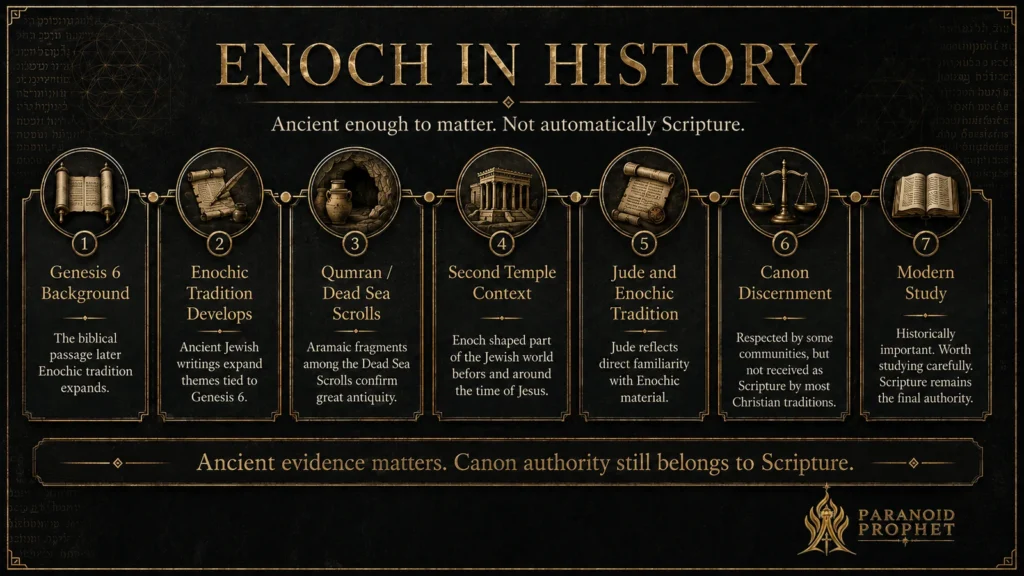
Several Enochic manuscripts were found at Qumran, especially in Cave 4. The Israel Antiquities Authority’s record for 4Q201, or 4Q Enoch, identifies an Aramaic parchment manuscript from Cave 4. Its featured Enoch entry dates the displayed 4Q Enoch manuscript broadly to the Hasmonean period and describes its Watcher material as an expansion of the episode hinted at in Genesis 6:1–4.
The Qumran collection preserves fragments from Enochic books rather than one complete copy of the present Ethiopic collection. That distinction is important. It supports the picture of separate writings that circulated, were copied, and were eventually transmitted together. It also leaves some questions open. No Aramaic fragments of the Parables have been identified at Qumran, for example, so scholars must evaluate that section through other evidence.
The site also yielded fragments of the Book of Giants, a related work that develops stories about the giants and their coming judgment. The presence of several Enochic and giant traditions shows that reflection on Genesis 6 was wider than one isolated manuscript.
What the Manuscripts Prove, and What They Do Not
The physical evidence settles one popular claim: 1 Enoch is not a modern fabrication. Its traditions were known before Christianity, and at least some Jewish readers considered them worthy of repeated copying. The manuscripts help historians study the language, development, and reception of Enochic literature rather than relying only on much later copies.
The same evidence cannot bear every conclusion placed upon it. A manuscript’s age does not prove that the biblical Enoch wrote it. Finding a work at Qumran does not certify every narrative detail as history. The Qumran library included biblical manuscripts, community rules, legal writings, hymns, commentaries, calendars, and other religious texts. Presence in that library demonstrates circulation and value, not a universally agreed Jewish canon.
Nor do the fragments provide a complete pre-Christian edition identical at every point to the later Ge’ez collection. Textual history is more interesting than that. Aramaic fragments preserve early forms of several Enochic writings; Greek remains witness to another stage of transmission; and the complete collection survived primarily through Ethiopic manuscripts.
Why Ge’ez Preservation Matters
The survival of 1 Enoch is inseparable from Ethiopian Christian history. Western readers sometimes speak as if Europeans “rediscovered” a book that had disappeared from the earth. More accurately, the complete work had ceased to circulate widely in many regions while Ethiopian Christians continued to transmit it in Ge’ez. Manuscripts brought to Europe in the modern period expanded Western scholarly access to a text that Ethiopian tradition had preserved.
That history calls for gratitude and precision. The Ge’ez text is not evidence that 1 Enoch began as a medieval Ethiopian composition; the Aramaic fragments rule that out. Neither should Ethiopian preservation be reduced to a footnote in a Western story. It is the reason the complete collection remained available at all.
Genesis 6, the Watchers, and Enochic Interpretation
The Book of the Watchers matters because it preserves one of the earliest extensive interpretations of Genesis 6. The canonical text says that the “sons of God” saw the daughters of humanity, took wives, and became associated with the appearance of the Nephilim. Genesis then widens its focus to human wickedness, corruption, violence, divine grief, judgment, and Noah’s favor. For the chapter’s full movement, begin with Genesis 6 Explained.
First Enoch develops the heavenly-being reading. It calls the rebels Watchers, narrates their descent and collective oath, names leaders, describes unions with women and giant offspring, adds a catalog of forbidden teachings, and portrays Enoch delivering God’s sentence. This expansion helps explain why the angelic interpretation was prominent in some ancient Jewish settings. It also supplies details Genesis itself never states.
That difference establishes the proper source order. Genesis is the inspired foundation. First Enoch is an ancient interpretation of that foundation. Readers may use the later work to understand how Genesis was received, but they should not quietly insert every Enochic name, location, speech, or teaching into Moses’ text. For the identity of the Genesis figures, see Sons of God and Daughters of Men. For the development of the Watcher name and storyline, see The Watchers Explained.
What Belongs in the Neighboring Articles
First Enoch connects the rebels’ unions with violent giant offspring, but the identity of the Nephilim and the Bible’s wider giant traditions require their own study. That question belongs in Who Were the Nephilim?.
The collection also attributes corrupting arts to the Watchers. Those teachings illuminate Enoch’s theology of rebellion, but Genesis does not enumerate them. Their content and moral logic belong in the principal next article, What Did the Watchers Teach?.
Finally, 1 Enoch 15–16 presents the spirits of dead giants as evil spirits active on earth while the Watchers remain bound. That theory became influential in later discussions of demons, but Scripture never gives the same explicit origin statement. The evidence and alternatives are handled in Where Are Demons and Fallen Angels Now?.
These routes keep 1 Enoch in its proper lane. This article explains the source, not every conclusion later readers have drawn from it.
Why Does Jude Use Enochic Material?
Jude prevents Christians from treating Enochic tradition as irrelevant. His short letter speaks of angels who abandoned their assigned place and later introduces a judgment oracle attributed to “Enoch, the seventh from Adam.” The relationship is direct enough to deserve more than a dismissive analogy, yet it still requires careful limits.
Jude 6–7 and the Angels Who Left
In Jude 5–7, examples of rebellion and judgment follow one another: unbelieving Israel, angels who failed to keep their own domain and abandoned their proper dwelling, and Sodom and Gomorrah’s sexual immorality. Jude says the angels are kept in eternal bonds under darkness for the judgment of the great day.
This language closely resembles the moral and judicial world of the Watcher tradition. Heavenly beings cross a God-given boundary, and God confines them until judgment. Jude does not retell all of 1 Enoch, identify every angel by name, or reproduce its full account. He uses the pattern because it serves his warning about teachers who reject authority, corrupt the body, and face certain judgment.
Jude 14–15 and 1 Enoch 1:9
Jude 14–15 is more explicit. Jude attributes to Enoch a prophecy of the Lord coming with myriads of holy ones to execute judgment. Its wording closely follows 1 Enoch 1:9. This is not merely a vague thematic resemblance; Jude knows and deploys recognizably Enochic material.
That use demonstrates that Enochic tradition carried real authority and relevance in Jude’s interpretive world. Jude could present this judgment saying as true and fitting for his inspired argument. Any account of 1 Enoch that treats Jude’s relationship as accidental or insignificant fails to respect the New Testament evidence.
At the same time, Jude’s use does not independently settle the canonical status of the complete Enochic collection for every Christian community. The five-part form of 1 Enoch reflects a composite history, and recognizing one oracle in Jude is not the same historical act as receiving every Enochic book as Scripture. The familiar observation that Paul cites nonbiblical poets in Acts 17:28 and Titus 1:12 shows that citation and canon are distinguishable, but Jude’s named attribution and extensive verbal relationship are more substantial than a passing cultural quotation. The tension should be acknowledged, not explained away.
Second Peter and the Same Interpretive World
Second Peter 2:4–5 places sinning angels, confinement for judgment, and the ancient Flood world in sequence. Peter does not name Enoch or quote 1 Enoch 1:9, so direct literary dependence should not be asserted more strongly than the evidence allows. Still, his argument belongs to a recognizable Jewish interpretive world in which angelic rebellion and the Flood were connected.
Jude and 2 Peter therefore do two things at once. They confirm that traditions about rebellious angels under judgment were relevant to apostolic teaching, and they make those themes serve their own pastoral warnings. They do not direct Christians to build doctrine from every surviving Enochic detail. The New Testament receives and governs the material it uses.
Is the Book of Enoch Scripture?
The fairest answer begins by asking, “Scripture for whom?” Christian canons have a shared center and real historical differences. Any answer that speaks about all Jews, all Christians, or all Orthodox churches as if their reception were identical will mislead readers.
Was Enoch Removed from the Bible?
The popular claim that church leaders removed Enoch from “the Bible” imagines one universally fixed collection that included 1 Enoch until a later authority secretly extracted it. That is not an adequate account of canon history. Enochic writings circulated in Second Temple Judaism, were copied at Qumran, influenced early Christian thought, and were valued by some writers. Yet they were never part of the rabbinic Jewish canon, and most Christian communities did not finally receive 1 Enoch in their Old Testament collections.
This does not mean the book was unknown. Knowledge, use, and canonicity are different questions. Early Christians could read or cite Enoch without agreeing about its scriptural status. As the work’s circulation narrowed in many regions, its complete text became unavailable to much of Western Christianity. Loss of broad access is not the same event as a coordinated removal from a universal Bible.
Use, Influence, and Canon Are Different Claims
Several levels of reception are often collapsed in online debate:
- A community may read a text without using it in worship.
- A teacher may value a text without treating every claim as inspired.
- Scribes may copy a text because it is important, useful, or beloved.
- A work may influence interpretation even where it is not canonical.
- An inspired author may cite material without thereby defining the status of the entire source.
- A church may receive a work as Scripture within its own canonical and liturgical tradition.
The Dead Sea Scrolls establish copying and circulation. Jude establishes meaningful use. Early Jewish and Christian literature establishes influence. None of those facts should be diminished, but none is identical by itself to universal canonical reception.
The Ethiopian and Eritrean Orthodox Tewahedo Witness
The Ethiopian Orthodox Tewahedo Church and Eritrean Orthodox Tewahedo Church preserve 1 Enoch within their scriptural tradition. The Ethiopian church’s own account of its literary heritage includes Enoch among the books of its Bible and emphasizes the importance of Ge’ez preservation. This is not an eccentric afterthought to the history of Enoch; it is a living Christian reception with deep roots and should be described on its own terms.
Specialists also caution that Ethiopian concepts and lists of canon do not always map neatly onto simplified Western charts. Bruk A. Asale’s study of the Ethiopian Orthodox Tewahedo canon, for example, emphasizes a reception history more fluid than a single modern table may suggest. A chart can mislead when it treats canon as one uniform category across traditions.
How Most Christian Traditions Receive 1 Enoch
Most Protestant churches do not include 1 Enoch in the Old Testament. The Roman Catholic canon does not include it. Eastern Orthodox Old Testament collections vary in some respects, but 1 Enoch is not generally included outside the Ethiopian and Eritrean Tewahedo traditions. Most Christians therefore meet it as ancient Jewish literature rather than as a book read with the same canonical standing as Genesis, Isaiah, or the Gospels.
For those readers, several considerations converge: 1 Enoch’s composite and pseudepigraphal character, its uneven reception, its disappearance from broad circulation in many regions, and its absence from most established canon lists. None makes the work historically worthless. Together they explain why most Christians use it as significant context beneath the authority of their received Scriptures.
Christians who differ about the canon can still agree on an important historical point: 1 Enoch is ancient, influential, and relevant to the interpretation of Genesis 6 and Jude. Respectful disagreement begins by representing each tradition accurately rather than accusing one side of hiding evidence or the other of worshiping a lost text.
Frequently Asked Questions About the Book of Enoch
What is the Book of Enoch?
The Book of Enoch usually means 1 Enoch, a composite collection of ancient Jewish apocalyptic writings attributed to Enoch from Genesis 5. Its major works discuss the Watchers, cosmic order, judgment, history, the suffering of the righteous, and future restoration.
How old is 1 Enoch?
Its sections come from different stages of the Second Temple period rather than one date. Aramaic manuscripts from Qumran prove that several Enochic writings circulated before Christianity. Dating remains debated in detail, especially for the Parables.
Did the biblical Enoch write the Book of Enoch?
Most scholars say no. The biblical Enoch is the collection’s attributed revelatory figure, but the work shows composite authorship and development across much later centuries. It is commonly classified as pseudepigraphal literature.
Is the Book of Enoch Scripture?
The answer differs by tradition. Ethiopian and Eritrean Orthodox Tewahedo Christians receive 1 Enoch within their scriptural heritage. Most Protestant, Roman Catholic, and other Eastern Orthodox traditions do not include it in their biblical canon.
Was the Book of Enoch removed from the Bible?
Not in the simplistic sense of a universally accepted book secretly deleted from one original Bible. Enoch was ancient, read, copied, and influential, but its canonical reception varied. It remained Scripture in Tewahedo traditions while most Jewish and Christian communities did not receive it into their canons.
Did Jude quote the Book of Enoch?
Jude 14–15 closely follows 1 Enoch 1:9 and attributes the prophecy to Enoch. This shows real Enochic influence and authority in Jude’s argument. It does not, by itself, establish the canonical status of every section of the complete collection for every church.
Why is the complete book preserved in Ge’ez?
Ethiopian Christians continued transmitting 1 Enoch after the complete work ceased to circulate widely elsewhere. Aramaic Qumran fragments and Greek remains witness to earlier stages, while the Ge’ez manuscript tradition preserves the full collection.
Should Christians read the Book of Enoch?
Christians can profit from reading it with a reliable translation, historical guidance, and clarity about their church’s canon. It is especially useful for studying Second Temple interpretation, the Watcher tradition, and Jude. Curiosity should remain disciplined by Scripture and centered on Christ.
How Christians Should Read the Book of Enoch
First Enoch deserves neither fear nor credulity. Christians who do not receive it as canon can read it as a major witness to ancient Jewish thought, much as they read other Second Temple literature to understand the world around the Bible. The goal is not to make the text say less than the evidence supports. It is to give each kind of evidence the authority it can actually bear.
A Three-Part Reading Rule
- Where Enoch agrees with Scripture, consider it seriously. Its insistence that God judges rebellion, violence, corrupt power, and arrogant rulers resonates deeply with the biblical witness.
- Where Enoch goes beyond Scripture, hold the added detail with appropriate caution. Ancient names, speeches, journeys, calendars, demon origins, and teaching catalogs may illuminate an interpretive tradition without becoming required doctrine.
- Where an interpretation of Enoch contradicts Scripture, Scripture governs. For Christians, no appeal to hidden antiquity can overturn the gospel, the character of God, or the apostolic witness to Christ.
What 1 Enoch Can Legitimately Illuminate
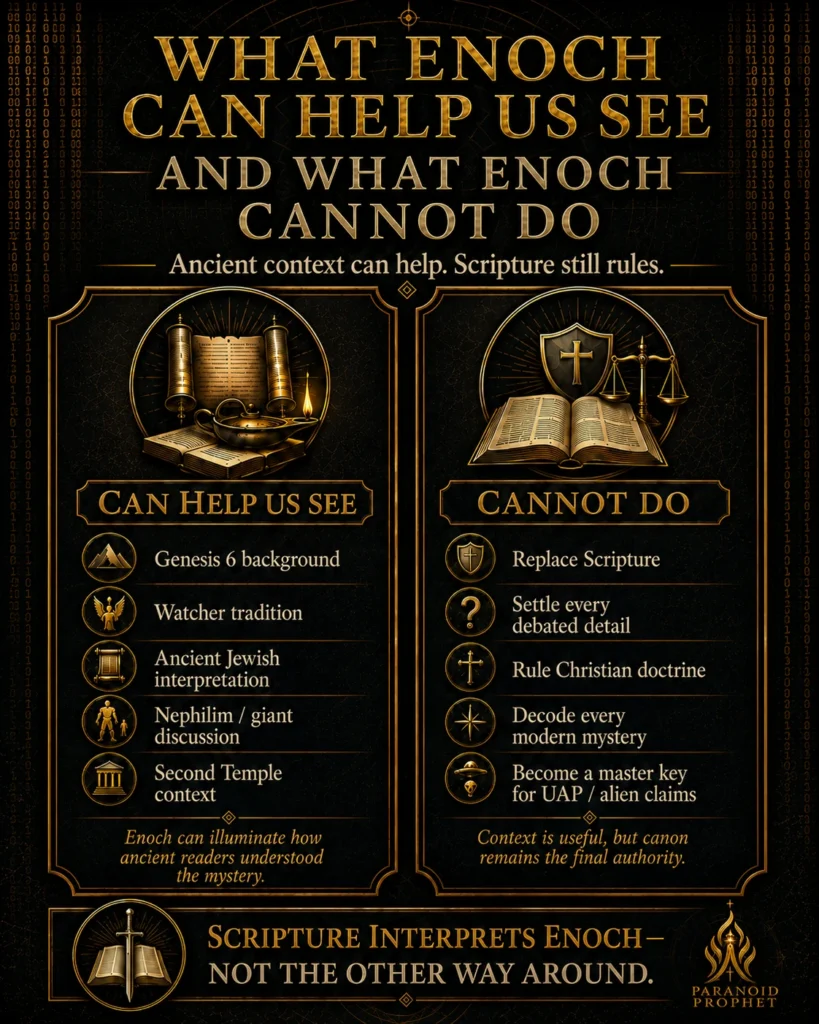
The collection gives historians access to ancient debates about the origin of evil, the justice of God, heavenly mediation, calendars, judgment, and the vindication of the righteous. The Book of the Watchers shows how some Jewish interpreters connected Genesis 6 with rebellious angels, giants, corrupt revelation, and the spread of violence. The Qumran manuscripts establish that these were not late Christian inventions. Jude shows that at least some Enochic material remained meaningful in the New Testament’s world.
Enoch can also expose the limits of modern assumptions. Ancient Jewish readers did not always flatten the supernatural features of Genesis into ordinary social conflict. They understood evil as both human and supra-human while still holding human beings accountable. That perspective can sharpen biblical questions even when readers decline to accept every Enochic answer.
Where Responsible Confidence Stops
First Enoch cannot make every ancient story detail historical simply because it is old. It cannot settle the origin of demons for all Christians, turn every named Watcher into established biblical fact, or make its calendar binding on the church. It does not supply a secret system that completes what Christ and the apostles left unfinished.
It also should not become a master key for modern reports of aliens, nonhuman intelligence, or UAPs. Patterns involving nonhuman revelation, hybridization, corrupting knowledge, and counterfeit elevation may raise legitimate discernment questions, but resemblance is not identity. Modern synthesis belongs late in the method and should be tested in the dedicated Pre-Flood Origin Theory and Three-Tier UAP Theory articles. Enoch does not define modern phenomena.
Selected Sources and Further Reading
- Scripture: Genesis 5–6; Jude; 2 Peter 2; Colossians 1–2.
- George W. E. Nickelsburg and James C. VanderKam, 1 Enoch: The Hermeneia Translation, introduction — structure, contents, development, and historical setting of the collection.
- Israel Antiquities Authority, 4Q201 / 4Q Enoch, with the Book of Giants manuscript record — official access to Qumran witnesses.
- Annette Yoshiko Reed, Fallen Angels and the History of Judaism and Christianity — reception of Enochic literature in Jewish and Christian history.
- Loren T. Stuckenbruck, The Myth of Rebellious Angels — studies of rebellious-angel traditions in Second Temple Judaism and New Testament texts.
- Richard J. Bauckham, Jude, 2 Peter — detailed commentary on Jude’s use of Enochic tradition and the relationship between Jude and 2 Peter.
- Daniel Assefa, “The Biblical Canon of the Ethiopian Orthodox Tewahedo Church”, and Bruk A. Asale, “The Ethiopian Orthodox Tewahedo Church Canon of the Scriptures” — specialist treatments of Ethiopian reception and canon.
Read Next
Now that the source, manuscripts, and authority question are clear, the natural next step is What Did the Watchers Teach? It examines the forbidden-knowledge catalog in its proper Enochic setting and asks why ancient writers treated those gifts as corrupting rather than liberating. For supporting paths, return to The Watchers Explained or continue to Who Were the Nephilim?.
Christ, Not Hidden Knowledge
The Watcher tradition presents beings who cross God’s boundaries and offer humanity power and knowledge outside God’s order. Their revelation does not heal the world. It feeds domination, violence, deception, and judgment. Even when Enoch’s details remain outside the canon received by most Christians, its moral diagnosis is recognizable: knowledge severed from obedience cannot save.
The gospel announces a radically different descent. God comes to humanity in Jesus Christ, not to corrupt human nature or recruit disciples through secret revelation, but to assume our humanity without sin and reconcile all things through the blood of the cross. Colossians 1:15–20 places every visible and invisible power beneath the Son through whom all things were created. Colossians 2:3, 13–15 locates the treasures of wisdom in Christ and declares that he disarmed the rulers and authorities through the cross.
Christians therefore do not need secret angelic knowledge to complete the gospel. Ancient context can be studied with gratitude, courage, and restraint because salvation does not depend on mastering every mystery. The final authority belongs to Scripture, and the final hope belongs to Christ.
Read 1 Enoch to understand the ancient conversation. Test its expansions with care. Receive what it can genuinely clarify, but keep curiosity in its proper place. Do not chase hidden knowledge and miss the Savior.
CONTINUE THE INVESTIGATION
Ancient-source continuation
What Did the Watchers Teach? Forbidden Knowledge in Enoch
Move from the status and contents of 1 Enoch to the specific forbidden-knowledge traditions attributed to the Watchers.