

GUIDED ARTICLE EXPERIENCE
Was Jesus a Liar, Lunatic, Legend, or Lord?
Read along as the narration moves through the article.
Private device narration · No hosted audio or tracking
CONTINUE GUIDED TOUR
Continue where you left off.
GUIDED TOUR COMPLETE
You have reached the end of this study.
Study record saved on this device.
GUIDED TOUR
Was Jesus a Liar, Lunatic, Legend, or Lord?
Narrator: Paranoid Prophet Recommended Voice Native device narration
Prepare to follow the article as it is narrated.
VOICE & TOUR OPTIONS
Voice & Listening
NARRATOR
Finding a narrator…
Checking the best narrator available on this device.
Restores the best curated narrator available on this device.
Narrator choices are curated for clear, long-form listening on this device.
Screen-awake support will be checked when narration starts.
CHOOSE A NARRATOR
Curated for this device
Choose a verified narrator for this browser, or use System Narrator. Automatic mode uses the best reliable route exposed by this device; your chosen narrator is preserved even if this device needs a temporary fallback.
Preparing the guided article experience…
RESUME GUIDED TOUR?
Continue where you left off.
GUIDED TOUR COMPLETE
You have reached the end of this study.
Many people want Jesus close enough to quote, but far enough away to ignore.
They admire His compassion. They borrow His ethics. They praise His courage. They may call Him a prophet, a reformer, a revolutionary, or the greatest moral teacher who ever lived. But the New Testament does not leave Jesus in any of those safe categories.
Jesus did not merely tell people to be kind. He called people to follow Him. He forgave sins. He claimed authority over the Sabbath. He spoke of judgment, eternal life, the kingdom of God, and the necessity of receiving Him. The Gospels present Him receiving worship. He identified Himself with the Son of Man who would come with the clouds of heaven. Then He pressed the question on His disciples: “Who do you say that I am?”
That question has not expired.
A merely helpful teacher cannot carry claims that high. A merely human prophet cannot rightly place Himself at the center of judgment, forgiveness, allegiance, and eternal life. A symbolic Jesus cannot explain the cross, the resurrection proclamation, or the earliest Christian worship of Him.
The real question is not whether Jesus influenced history. He did. The question is whether Jesus told the truth about Himself.
Christianity does not begin with vague admiration for Jesus’ values. It begins with the confession that the crucified Jesus is risen, exalted, and Lord. If that confession is false, Christianity collapses. If it is true, then Jesus is not one religious option among many. He is the Son of God, the promised Messiah, the crucified Savior, the risen King, and the Lord before whom every life must answer.
For the broader case, see the full Son of God evidence case. This article has a narrower purpose. It asks whether the common escape routes actually work. Was Jesus a liar? Was He delusional? Was He turned into a legend? Or is He who Scripture says He is?
Article Guide15 sections
What the Liar, Lunatic, Legend, or Lord Argument Means
The classic argument is often called “Liar, Lunatic, or Lord.” It is associated especially with C.S. Lewis, though the force of the question comes from the New Testament itself. If Jesus made the kinds of claims the Gospels attribute to Him, then He cannot be reduced to a harmless moral teacher.
A man who speaks and acts with divine authority cannot be filed away as harmless.
If Jesus knowingly made false claims about Himself, then He was a liar. That would not make Him a great moral teacher. It would make Him a religious fraud.
If Jesus sincerely believed false claims about Himself, then He was delusional. That would not make Him the clearest moral voice in history. It would make His self-understanding tragically false, even if some of His teachings remained memorable.
If Jesus never made those claims at all, and the church later placed them on His lips, then the issue becomes legend. In that case, the question is not simply whether Jesus was lying or delusional. The question is whether the Jesus worshiped by Christians was invented after the fact.
But if Jesus truly spoke and acted as the Gospels present Him, the easy reductions begin to fail. The same is true if He was crucified under Roman authority, if His followers proclaimed His resurrection from the beginning, and if the earliest Christians worshiped Him as Lord within the world of Jewish monotheism.
The point is not to win a word game. The point is to ask which explanation actually fits Jesus as He appears in Scripture and in the earliest Christian witness.
That is why this article adds a fourth category to the classic trilemma: Legend. Many modern skeptics do not argue that Jesus was intentionally deceptive or mentally unstable. They argue that the church exaggerated Him later. They claim the divine Jesus was a theological development, not the real Jesus of history.
That objection deserves a serious answer. A strong Christian case does not need weak evidence, careless claims, or forced certainty. If the legend theory fails, it should fail because it cannot account for the evidence, not because Christians refused to hear the objection.
So the question becomes sharper:
- Liar: Did Jesus knowingly deceive people about His identity?
- Lunatic: Was Jesus sincerely mistaken about who He was?
- Legend: Did later followers invent a divine Jesus after His death?
- Lord: Is Jesus truly the Son of God, crucified Savior, risen King, and rightful Lord?
Those options are not merely academic. They press on the conscience. If Jesus lied, He should be rejected. If He was delusional, He should be pitied. If He was invented, He can be dismissed. But if He is Lord, admiration is not enough. He calls for repentance, faith, worship, and allegiance.
How This Article Will Weigh the Evidence
This article will not pretend every objection is foolish. It will not claim that history can replace faith. It will not treat every tradition, prophecy, argument, and source as equally certain. The goal is more careful than that.
Scripture comes first. The Bible is the final authority for who Jesus is. It does not present Him as a mere teacher, symbol, or spiritual mascot. It presents Him as the eternal Son, the Word made flesh, the promised Messiah, the Lamb of God, the Son of Man, the crucified Savior, the risen Lord, and the coming Judge.

History serves a different role. Historical evidence can support public claims: that Jesus of Nazareth existed, that He was crucified under Roman authority, that His earliest followers proclaimed His resurrection very early, that Paul received resurrection tradition rather than inventing it from nothing, and that Jesus was worshiped as Lord by the early church. For a fuller historical foundation, see this study on historical evidence for Jesus.
Prophecy must also be handled carefully. The Old Testament does not function like a spreadsheet of disconnected predictions. It gives direct promises, covenant patterns, messianic offices, suffering-servant hope, royal expectation, priestly shadows, typology, and future fulfillment. The final point of prophecy is not a number. It is a Person.
Scholarship helps test claims about sources, dating, manuscript history, resurrection proclamation, early Christology, and rival explanations. It can clarify what historians broadly agree on, what remains debated, and where Christian theology goes beyond what historical method can prove by itself.
Apologetics brings these pieces together. It asks which explanation best fits the whole pattern: Jesus’ words, His works, His holiness, His death, the resurrection proclamation, the witness of His followers, and the worship of the early church.
So the argument will move in order. First, we will ask whether Jesus actually made claims that force a verdict. Then we will test the common reductions: good moral teacher, political rebel, failed prophet, delusional man, liar, and legend. Finally, we will ask why the resurrection and the earliest Christian worship of Jesus make the confession “Jesus is Lord” far more than a slogan.
For transparency about how this site handles sources, disputed claims, scholarship, and correction, see how Paranoid Prophet handles sources and verification.
Before the alternatives can be tested, one question must come first: did Jesus actually speak and act in ways that force such a verdict?
Did Jesus Actually Make Claims That Force a Verdict?
The identity argument only matters if Jesus actually spoke and acted in ways that force the question. If He never claimed unusual authority, never placed Himself at the center of salvation, never received divine honor, and never pointed to Himself as the decisive revelation of God, then the liar, lunatic, legend, or Lord argument loses its force.
But the New Testament does not present Jesus as a mild teacher who was later misunderstood by excited followers. It gives a repeated pattern. Jesus speaks with authority. He forgives sins. He commands allegiance. He identifies Himself with Daniel’s Son of Man. He speaks of judgment and eternal life. He reveals the Father. He receives worship. He goes to the cross not as a surprised victim, but as the Son who gives His life as a ransom.
The question is not whether Jesus used a modern theological formula. The question is whether He spoke and acted with divine authority, received divine honor, and revealed Himself as the Son who makes the Father known.
That pattern is why the alternatives cannot stay vague. Once Jesus’ claims are on the table, the reader has to ask what kind of man could rightly speak this way.

Jesus Forgave Sins
In Mark 2:1–12, a paralyzed man is lowered through a roof and placed before Jesus. The expected miracle would be physical healing. Instead, Jesus first says, “Son, your sins are forgiven.”
The scribes immediately understand the weight of the claim. They do not treat it as a harmless encouragement. They ask, “Who can forgive sins but God alone?” That is the right question. A prophet can announce God’s forgiveness. A priest can administer sacrifices under the covenant. But Jesus speaks directly, personally, and authoritatively: “Your sins are forgiven.”
Jesus then heals the man so that they may know “the Son of Man has authority on earth to forgive sins.” The miracle is not raw spectacle. It is a sign pointing to authority.
This scene does not invite the reader to admire Jesus as merely kind. It presses a deeper question: who has the authority to forgive sins committed against God?
Jesus Claimed Authority Over the Sabbath
Jesus also claimed authority over the Sabbath, one of Israel’s defining covenant signs. In Mark 2:23–28, after controversy over His disciples plucking grain on the Sabbath, Jesus says, “The Sabbath was made for man, not man for the Sabbath. So the Son of Man is lord even of the Sabbath.”
That is not the language of an ordinary teacher offering a footnote on religious custom. Jesus places His authority over the Sabbath itself. In Matthew 12:6–8, He goes even further, saying, “Something greater than the temple is here,” and again, “The Son of Man is lord of the Sabbath.”
The point is not that Jesus despised the law. He fulfilled it. He exposed man-made distortions, restored the Sabbath’s purpose, and spoke as the One with authority to interpret its deepest meaning.
A moral teacher can urge people to rest. A prophet can rebuke hypocrisy. But Jesus claims lordship over the Sabbath itself. That claim cannot be filed away as ordinary religious advice.
The Gospels Present Jesus Receiving Worship
The Gospels also present Jesus receiving worship. That language should be handled carefully, but it should not be ignored.
After Jesus walks on the sea and calms the fear of His disciples, Matthew 14:33 says those in the boat worshiped Him and said, “Truly you are the Son of God.” After the resurrection, Matthew 28:16–20 says the disciples worshiped Him, even while some doubted. Jesus then declared that all authority in heaven and on earth had been given to Him.
John’s Gospel gives one of the clearest moments. When Thomas sees the risen Jesus, he answers, “My Lord and my God” (John 20:24–29). Jesus does not rebuke him for blasphemy. Instead, He blesses those who have not seen and yet have believed.
This matters because biblical faith is not casual about worship. Worship belongs to God. The Gospel writers know this. Yet they present Jesus receiving honor that cannot be reduced to ordinary respect for a rabbi.
If Jesus were only a moral teacher, this would be dangerous exaggeration. If He is the Son of God, it is fitting worship.
Jesus Claimed Unique Union with the Father
John’s Gospel gives some of the clearest language about Jesus’ divine identity. In John 10:30–33, Jesus says, “I and the Father are one.” His opponents understand the claim as blasphemy, saying that He, being a man, makes Himself God.
In John 14:6–9, Jesus says, “I am the way, and the truth, and the life. No one comes to the Father except through me.” Then He tells Philip, “Whoever has seen me has seen the Father.” That is not merely a claim to teach truth. It is a claim to reveal God uniquely and decisively.
In John 5:22–23, Jesus says that the Father has given all judgment to the Son, “that all may honor the Son, just as they honor the Father.” The phrase “just as” carries tremendous weight. Jesus is not asking for polite respect. He speaks of divine honor given to the Son.
At the same time, the case should not depend only on John. The Synoptic Gospels also show Jesus forgiving sins, ruling over the Sabbath, commanding allegiance, redefining family around obedience to Him, receiving worship, predicting judgment, and identifying Himself with the Son of Man from Daniel 7. John gives concentrated theological clarity, but he is not inventing a Jesus foreign to the rest of the New Testament witness.
Jesus Identified Himself with the Son of Man
Jesus’ favorite title for Himself was “Son of Man.” At first, that title can sound humble, almost ordinary. The title sounds low until Daniel 7 opens behind it.
In Daniel’s vision, “one like a son of man” comes with the clouds of heaven and is presented before the Ancient of Days. To Him are given dominion, glory, and a kingdom. All peoples, nations, and languages serve Him. His dominion is everlasting, and His kingdom will not be destroyed.
That background matters when Jesus stands before the high priest in Mark 14:61–64. Asked whether He is the Christ, the Son of the Blessed, Jesus answers, “I am,” and then says they will see the Son of Man seated at the right hand of Power and coming with the clouds of heaven.
The high priest tears his garments and calls it blasphemy. He does not hear Jesus as merely saying, “I am human.” He hears a claim of messianic and heavenly authority.
This is one reason the “good teacher only” explanation fails. Jesus does not merely point away from Himself to God. He places Himself at the center of God’s kingdom, judgment, forgiveness, and final rule.

Was Jesus Just a Good Moral Teacher?
The safest modern Jesus is the moral teacher. He is inspiring but not sovereign. He is quoted but not obeyed. He blesses our values but does not judge our lives. This version of Jesus can be admired from a distance because he never demands surrender.
But that is not the Jesus of the New Testament.
A good moral teacher can call people to love their enemies. Jesus does that. A prophet can expose hypocrisy. Jesus does that too. But Jesus also calls people to leave everything and follow Him. He says that whoever loves father or mother more than Him is not worthy of Him. He speaks of Himself as the Son to whom the Father has given judgment. He says eternal life is found in knowing the Father and the Son whom He sent.
The moral beauty of Jesus is real, but it cannot be separated from His identity claims. His compassion is not the softness of a teacher with modest ambitions. It is the mercy of the King who has authority to forgive. His holiness is not the decency of a respectable rabbi. It is the purity of the Son who always does what pleases the Father.
That is why calling Jesus only a good moral teacher does not solve the problem. It avoids it. The issue is not whether Jesus taught noble ethics. He did. The issue is whether His moral authority can be separated from His claim to be the decisive revelation of God.
Once Jesus’ claims are on the table, the alternatives must carry the weight of the full portrait: His words, His works, His holiness, His authority, His death, and the witness that followed.
Was Jesus a Political Rebel?
Another explanation says Jesus was mainly a political rebel. On this view, He was not the divine Son of God or risen Lord. He was a first-century revolutionary whose message threatened Rome, inspired followers, and ended in the predictable brutality of crucifixion.
This theory has some surface plausibility because crucifixion was a Roman execution, and Jesus was crucified under the charge “King of the Jews.” The kingdom language around Jesus was not politically meaningless. Rome did not crucify people for being privately spiritual.
But the political-rebel theory cannot carry the whole Gospel witness. Jesus did proclaim the kingdom of God, but He did not build it by the sword. When Peter struck with the sword, Jesus rebuked him. When questioned by Pilate, Jesus said, “My kingdom is not of this world” (John 18:36). That does not mean His kingdom has no claim over the world. It means His kingdom does not arise from the world’s source, methods, or violence.
Jesus’ kingship is higher than a failed revolt. He calls for allegiance deeper than nationalism, judgment deeper than Roman law, and peace deeper than political arrangement. He exposes Caesar’s limits without becoming Caesar’s mirror image.
Rome could nail “King of the Jews” over His head. It could not understand the throne He came to claim.
So yes, Jesus’ kingdom has public implications. The lordship of Christ is not a private decoration for religious people. But reducing Jesus to a political rebel makes Him too small. The Gospels present Him as the Messiah whose kingdom confronts sin, Satan, death, false religion, human pride, and every rival claim to ultimate authority.
Did Jesus Get the End Times Wrong?
Some critics argue that Jesus was a failed apocalyptic prophet. They point especially to His warnings about the destruction of Jerusalem, the coming of the Son of Man, and the phrase “this generation” in passages like Matthew 24 and Mark 13.
This objection deserves a careful answer because Christians should not flatten difficult prophecy into easy slogans. Jesus really did speak of judgment. He really did warn that the temple would be destroyed. He really did call His disciples to watchfulness. And He really did speak of the Son of Man coming with power and glory.
The destruction of Jerusalem in AD 70 matters. Jesus warned that the temple would fall, and it did. That historical judgment gives serious weight to His prophetic warning. His words were not empty.
At the same time, AD 70 does not answer every interpretive question in the Olivet Discourse. Some of Jesus’ words reach beyond Jerusalem’s fall toward His final appearing. The language of the Son of Man coming with the clouds draws from Daniel 7, where the Son of Man receives dominion and kingdom authority. Prophecy often places near judgment and final fulfillment in the same field of vision.
Faithful Christians differ on how some details should be mapped. Some emphasize the near fulfillment in Jerusalem’s destruction. Others emphasize the future return of Christ. Many see both horizons woven together. This is not the place to settle every eschatological debate.
But the “failed prophet” objection is too simplistic. It often assumes that every line must refer to one event in one time frame, then treats the complexity as failure. Jesus’ prophecy deserves more careful handling than that.
Christian hope does not rest on pretending the passage is easy. It rests on the Lord who warned Jerusalem, went to the cross, rose from the dead, and promised to return in glory.
Was Jesus Sincerely Mistaken or Delusional?
The “lunatic” option in the classic argument is usually stated harshly. A better way to ask it is this: was Jesus sincerely mistaken about His identity? Did He truly believe He was sent by the Father, destined to suffer, and appointed to rule, while being tragically wrong?
This theory should be handled carefully. We are not diagnosing Jesus from a distance or using modern psychological categories as a weapon. The better question is simpler: does the Gospel portrait of Jesus fit moral confusion, incoherence, self-serving fantasy, or collapse under pressure?
The Gospel portrait points in the opposite direction.
Jesus is not portrayed as unstable, manipulative, or morally confused. He sees through hypocrisy with terrifying clarity. He refuses Satan’s shortcuts. He teaches secret prayer, hidden generosity, enemy love, costly discipleship, repentance, humility, and forgiveness. He rebukes pride, welcomes sinners, confronts religious pretense, and moves toward suffering with deliberate obedience.
False self-exaltation usually bends truth around the self. Jesus gives Himself away. He does not use power to protect His comfort. He does not flatter crowds to preserve popularity. He does not avoid the cross when obedience becomes costly.
Even under pressure, He remains coherent. Before His accusers, He is not frantic. Before Pilate, He is not desperate. On the cross, He prays, forgives, entrusts His mother to John, and gives Himself into the Father’s hands.
The delusion theory also struggles to explain why Jesus’ teaching has such moral depth and spiritual authority. His words do not sound like the wreckage of a confused ego. They expose the human heart, call sinners to repentance, and reveal the holiness and mercy of God.
That does not make the argument a medical diagnosis in reverse. It simply means that “sincerely mistaken” is a poor fit for the Jesus presented in the Gospels.
For a fuller treatment of this objection, see Was Jesus a Madman?, which examines whether the “lunatic” theory can actually account for the moral clarity, authority, and holiness of Jesus in the Gospels.
Was Jesus a Liar?
The liar theory says Jesus knew His claims were false but made them anyway. On this view, He intentionally deceived people about His identity, His authority, His mission, and His relationship to God.
That explanation has to accuse Jesus of more than error. It has to accuse the most morally serious figure in the Gospel witness of building His mission on deception.
This creates a serious problem. The Jesus who warns against hypocrisy would be the supreme hypocrite. The Jesus who commands truth would be lying about the most important truth. The Jesus who tells people to lose their lives for His sake would be exploiting them. The Jesus who rebukes religious fraud would Himself be the fraud.
That does not fit the moral texture of the Gospels. Jesus is severe with corruption, tender with the repentant, fearless before power, and obedient unto death. He does not use His authority to enrich Himself, protect Himself, or build a comfortable life. His path leads to rejection, suffering, and crucifixion.
The liar theory also struggles with the earliest Christian witness. It is one thing to claim that a religious leader deceived people for gain. It is another to explain why His followers proclaimed His resurrection, suffered for His name, and centered their lives on a crucified Messiah when that message brought danger rather than obvious earthly advantage.
That does not mean persecution proves the resurrection by itself. People can suffer for false beliefs. Martyrdom traditions should be used carefully. But suffering does support sincerity, and it makes deliberate fraud a weaker explanation for the earliest proclamation. For the fuller source-disciplined treatment, see the martyrdom of Jesus’ disciples.
For a fuller treatment of this objection, see Was Jesus a Liar?. The deeper issue is whether Jesus’ character, mission, death, and the costly witness of His followers fit deliberate fraud. They do not.
But deliberate fraud is not the only alternative people raise. The next objection shifts the accusation away from Jesus Himself and toward the church that proclaimed Him.
Was Jesus a Legend Invented by the Church?
Many modern skeptics do not claim Jesus was a liar or delusional. They take another route. They argue that the church later turned Jesus into something He never claimed to be.
On this view, Jesus may have been a real Jewish teacher. He may have preached the kingdom of God, gathered disciples, challenged authorities, and died under Rome. But after His death, the story supposedly grew. His followers exalted Him in memory. Paul reshaped Him into a divine Savior. John made Him speak in more heavenly language. Later councils gave the final stamp. The real Jesus, they argue, was buried under theology.
That objection deserves a serious answer because it tries to escape the force of the identity question. If Jesus never made high claims, and if His earliest followers did not worship Him as Lord, then the classic argument loses its force. But if the earliest Christian witness already centers on a crucified, risen, exalted, and worshiped Jesus, then the legend theory has a serious problem.
The issue is not whether Christian doctrine developed in vocabulary, precision, and controversy over time. It did. The issue is whether the divine identity of Jesus was invented late. The evidence does not fit that theory.
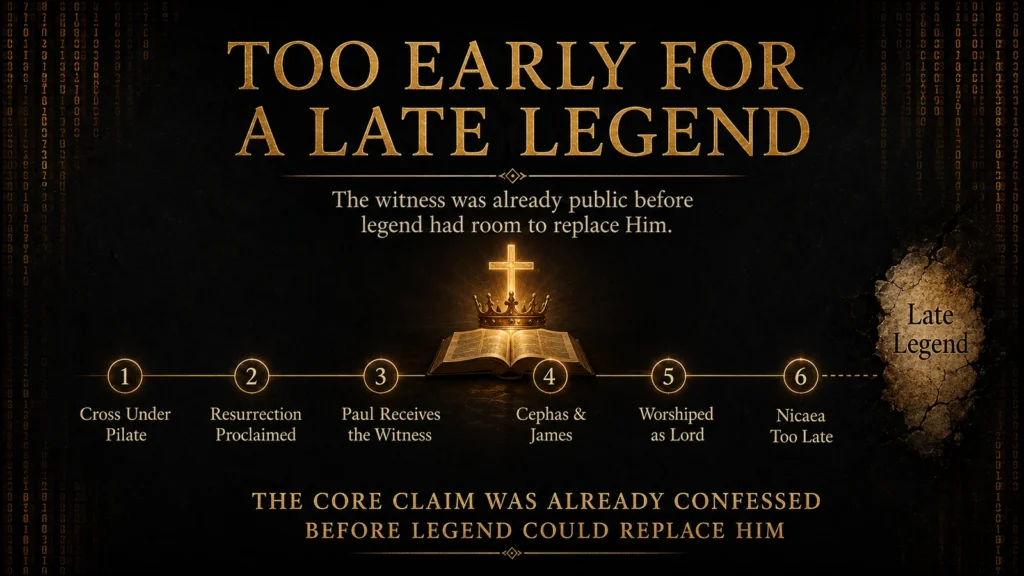
The legend theory has to move fast. By the time we reach Paul’s letters, Jesus is already crucified, raised, exalted, confessed as Lord, attached to named witnesses, and worshiped in the life of the church. That is a compressed timeline for a merely human teacher to be buried beneath a fully invented divine identity while first-generation witnesses and opponents were still part of the public memory.
That does not mean every doctrinal question was settled in the first decade. It does mean the worshiped, crucified, risen Jesus is not a late invention, a fourth-century political creation, or a distant legend detached from the earliest Christian proclamation.
The Crucifixion Is Not a Late Christian Myth
The first problem for the legend theory is the cross. The earliest Christian message does not begin with a polished hero tale. It begins with a crucified Messiah.
Paul says plainly that he preached “Christ crucified,” a stumbling block to Jews and folly to Gentiles (1 Corinthians 1:22–25). That is not the kind of detail religious movements usually invent to make their message easier to accept. A crucified Messiah was offensive, shameful, and costly to proclaim.
The Gospels place Jesus’ death under Pontius Pilate. Outside the New Testament, Tacitus also reports that Christus suffered the extreme penalty during the reign of Tiberius, under Pontius Pilate. Tacitus does not prove Christian doctrine, and he does not testify to the resurrection. But he does support the public historical claim that Jesus was executed under Roman authority.
That matters for the identity question because the church did not invent a triumphant hero and later add a cross. The cross stands at the beginning of the proclamation. The earliest Christians were not embarrassed into silence by Jesus’ death. They preached that the crucified One had been raised and exalted by God.
The Resurrection Proclamation Appeared Early
The second problem for the legend theory is the early resurrection proclamation. In 1 Corinthians 15:3–8, Paul reminds the Corinthians of what he had already delivered to them: that Christ died for our sins, was buried, was raised on the third day, and appeared to Cephas, then to the Twelve, then to more than five hundred, then to James, then to all the apostles, and last of all to Paul.
Paul does not present this as a private idea he invented. He says he “received” it and then “delivered” it. That language matters. It points to tradition Paul had received, not a resurrection message created from nothing by Paul’s imagination.
The appearance to more than five hundred is biblically important because Paul includes it, but it should be handled carefully. Historically, it is harder to evaluate because Paul gives no location, list of names, or independent narrative around it. The stronger historical anchors are the early tradition itself, Paul’s testimony, Cephas, James, and Paul’s contact with Jerusalem leaders.
The historical evidence does not replace faith, but it does challenge the idea that resurrection belief was a late symbolic invention. The proclamation appears early, attached to named witnesses, and central to the first Christian message.
The earliest Christians did not merely preach, “Jesus’ memory inspires us.” They preached, “God raised Him.” That is a very different claim.
Paul Did Not Invent a New Jesus
Another version of the legend theory claims that Paul invented Christianity. According to this objection, Jesus was a simple Jewish teacher, but Paul transformed Him into a divine Savior for the Gentile world.
Paul was enormously influential. That should not be denied. But influence is not invention.
Paul insists that the resurrection message was something he received and delivered. He also tells us that he met Cephas and James in Jerusalem (Galatians 1:18–19). Later, he describes meeting with recognized leaders again, including James, Cephas, and John (Galatians 2:1–10). That does not make every historical question easy, but it does make the idea of Paul inventing a disconnected Jesus much harder to sustain.
James is especially important because he anchors the discussion in Jerusalem, not merely in Paul’s later mission field. Paul names an appearance to James in 1 Corinthians 15, and Galatians places James among the recognized leaders of the early church. Josephus later refers to James as “the brother of Jesus who was called Christ.” That reference does not prove the resurrection, but it does support the historical reality of James as a known figure connected to Jesus. For the larger discussion, see James, the brother of Jesus.
Paul’s letters are early, passionate, and theologically rich. They present Jesus as crucified, risen, exalted, and Lord. But Paul is not preaching in a vacuum. He is connected to earlier witnesses, earlier proclamation, and the Jerusalem leadership he did not create.
So the question is not whether Paul mattered. He did. The question is whether Paul invented a new Jesus detached from the first Christian witness. The evidence points the other way.
Nicaea Did Not Turn Jesus into God
A later version of the legend theory says the Council of Nicaea turned Jesus into God in AD 325. This claim is popular in online debates and sensational retellings of church history, but it does not survive contact with the evidence.
Nicaea mattered. It gave the church precise language to defend the Son’s full deity against distortion. But it did not invent the worship of Jesus or promote Him from mere teacher to God. The council clarified and defended how the church should confess the divine Son in response to controversy. It was not the beginning of belief in Jesus’ divine identity.
Even many critical scholars reject the popular myth that Nicaea voted Jesus into divinity. The debate concerned how the church should confess the Son’s relationship to the Father, not whether Christians had ever regarded Jesus as divine before AD 325. A critical discussion of Nicaea itself can still recognize that the council did not create belief in Christ’s deity from nothing.
The New Testament itself already places Jesus in the sphere of divine honor. Thomas confesses Him as “My Lord and my God” (John 20:24–29). Paul says every knee will bow and every tongue confess that Jesus Christ is Lord (Philippians 2:5–11). Hebrews presents the Son as the radiance of God’s glory and the exact imprint of His nature (Hebrews 1:1–4).
Nicaea did not create the divine Christ. It argued about how to confess the divine Christ the church was already worshiping.
The Earliest Christians Worshiped Jesus as Lord
The earliest Christian worship of Jesus is one of the greatest problems for the legend theory. The first Christians were not pagans casually adding another divine figure to a crowded religious shelf. They were Jews shaped by Israel’s confession that the Lord alone is God.
Yet the New Testament places Jesus within the worship, confession, prayer, mission, and hope of the church. Paul can speak of “one God, the Father” and “one Lord, Jesus Christ” in a way that echoes Israel’s monotheistic confession while identifying Jesus as the one through whom all things exist (1 Corinthians 8:6).
Philippians 2 says the crucified and exalted Jesus receives the name above every name, so that every knee bows and every tongue confesses Him as Lord. Colossians 1 presents Him as the image of the invisible God, the One through whom and for whom all things were created (Colossians 1:15–20). Revelation 5 shows the Lamb receiving worship with the One seated on the throne (Revelation 5).
By the early second century, Pliny the Younger could describe Christians gathering before dawn to sing hymns to Christ as to a god. Pliny does not create New Testament Christology, and he does not prove every first-generation claim by himself. But he does show the early trajectory of devotion to Jesus outside the New Testament itself.
This does not require us to claim every early believer had later Nicene vocabulary fully developed. The point is not that the first Christians used fourth-century terms. The point is that the New Testament already presents Jesus receiving divine honor, being confessed as Lord, proclaimed in His name, and worshiped as risen from the dead.
That is why the legend explanation is too thin. It cannot simply point to later doctrinal development and ignore the first-generation witness. By the time we reach the earliest Christian sources, Jesus is already crucified, raised, exalted, confessed as Lord, and worshiped within the life of the church.
For a fuller vision of where this worship leads, see the glorified Christ in Revelation 1, where Jesus stands not as a faded memory of a teacher, but as the living Lord who holds the keys of Death and Hades.
The final question is not whether Christians later found language to defend Jesus’ identity. They did. The deeper question is why worship of the crucified Jesus appears so early in the life of the church.
Why the Resurrection Changes the Identity Question
The New Testament answer is not that Jesus’ memory survived. It is that God raised Him from the dead.
The resurrection does not merely add wonder to the story. It changes the verdict.
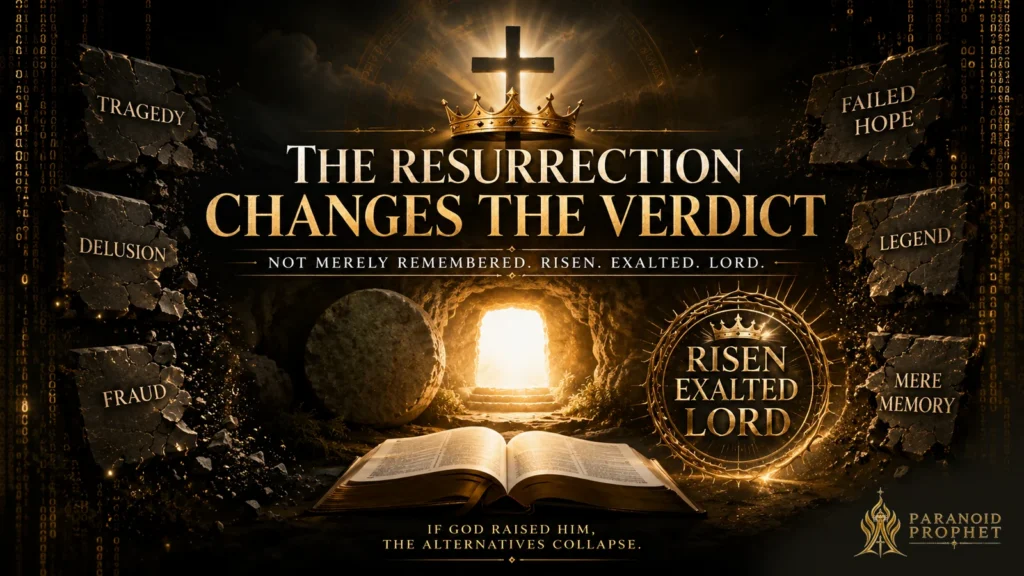
If Jesus remained in the grave, His claims could be dismissed as tragedy, delusion, fraud, or failed messianic hope. But if God raised Him, then His identity, His cross, His kingdom, and His authority are publicly vindicated.
Paul says Jesus was “declared to be the Son of God in power according to the Spirit of holiness by his resurrection from the dead” (Romans 1:3–4). Peter proclaims at Pentecost, “God has made him both Lord and Christ, this Jesus whom you crucified” (Acts 2:36).
History can support the early public proclamation. It can show that the resurrection message was not a late symbolic invention, that Paul received and delivered earlier tradition, and that the first Christians preached the risen Jesus while first-generation witnesses were still alive. But history does not replace faith, and it does not define the resurrection’s ultimate meaning. Scripture does that.
Scripture proclaims the resurrection as God’s vindication of the crucified Son. Jesus is not merely remembered. He is risen. He is not merely honored by later followers. He is exalted by the Father. He is not merely inspiring. He reigns.
That is why the resurrection changes the liar, lunatic, legend, or Lord question. It does not leave Jesus as one teacher among many. It reveals Him as the living Lord who conquered death and calls the world to repent, believe, and bow.
The Verdict Scripture Gives: Jesus Is Lord
After the alternatives have been tested, the Christian verdict is not vague admiration. Scripture gives a confession.
Jesus is not merely a teacher with useful ethics. He is the holy Son who reveals the Father. He is not merely a political rebel crushed by Rome. He is the King whose kingdom cannot be destroyed. He is not a failed prophet. He is the Son of Man who receives everlasting dominion. He is not a delusional man or a liar. He is the truth. He is not a late legend invented by the church. He is the crucified and risen Lord whom the church proclaimed from the beginning.
Thomas’s confession stands at the center of the question: “My Lord and my God.” Paul’s confession carries it outward: every knee will bow, and every tongue will confess that Jesus Christ is Lord. Revelation carries it into glory: the Lamb who was slain is worthy to receive power, wealth, wisdom, might, honor, glory, and blessing.
The alternatives explain fragments by cutting away the rest. Scripture reveals the whole. Jesus is the eternal Son, the Word made flesh, the promised Messiah, the sinless Lamb of God, the crucified Savior, the risen King, and the coming Judge.
From here, the deeper studies can trace the related questions one by one: history, prophecy, crucifixion, resurrection, early witnesses, deity, holiness, and glory. But the central verdict has already been given. Jesus is Lord.
Explore the Jesus Identity Mini-Hub
The identity of Jesus cannot be reduced to one slogan or one article. The question touches history, prophecy, crucifixion, resurrection, early witnesses, deity, holiness, and glory. This page serves as a central doorway into those related studies.
Start with the broader case, then follow the objections and evidence one step at a time.
- Is Jesus the Son of God? Evidence from History, Prophecy, Resurrection, and Scripture
- Historical Evidence for Jesus
- Was Jesus a Liar?
- Was Jesus a Madman?
- The Martyrdom of Jesus’ Disciples
- Prophecies of Jesus’ Divine Identity
- Prophecies of Jesus Fulfilled in Scripture
- Jesus in Revelation 1
- Sources and Verification
These studies separate related questions without flattening them into one vague argument. History asks whether Jesus lived, died, and was proclaimed risen. Prophecy asks how the Old Testament points to the Messiah. Resurrection evidence asks why the earliest Christian proclamation changed everything. Deity and holiness ask who Scripture reveals Jesus to be. Together, they press toward the same confession: Jesus is Lord.
Sources and Further Reading
This article uses Scripture as the final authority for who Jesus is. Historical sources and scholarship help test public claims about Jesus’ crucifixion, early resurrection proclamation, early Christian worship, and common objections. They do not replace Scripture, but they do help show that Christian faith is not built on a late or careless invention.
Primary Scripture Passages
- Mark 2:1–12 — Jesus forgives sins and demonstrates the Son of Man’s authority.
- Mark 14:61–64 and Daniel 7:13–14 — Jesus identifies Himself with the Son of Man who receives dominion and kingdom.
- John 1:1–18, John 10:30–33, and John 20:24–29 — the Word made flesh, Jesus’ unity with the Father, and Thomas’s confession.
- 1 Corinthians 15:3–8, Romans 1:3–4, and Acts 2:36 — early resurrection proclamation and resurrection vindication.
- Philippians 2:5–11, Colossians 1:15–20, Hebrews 1:1–4, and Revelation 5 — the supremacy, deity, glory, and worship of Christ.
Ancient Historical Sources
- Tacitus, Annals 15.44 — Roman reference to Christus suffering the death penalty under Pontius Pilate during the reign of Tiberius.
- Josephus, Antiquities 20.200 — reference to James as the brother of Jesus who was called Christ.
- Pliny the Younger, Letters 10.96–97 — early second-century Roman testimony describing Christians singing hymns to Christ as to a god.
- Ignatius of Antioch, To the Smyrnaeans — early second-century Christian witness to belief that Jesus truly suffered, truly died, and was truly raised.
Scholarly Works for Further Study
- Larry Hurtado, Lord Jesus Christ: Devotion to Jesus in Earliest Christianity — major study on early devotion to Jesus within the worship life of the early church.
- Richard Bauckham, Jesus and the God of Israel — important work on Jesus and divine identity within Jewish monotheism.
- N. T. Wright, The Resurrection of the Son of God — extensive historical and theological study of resurrection belief and early Christian origins.
- Dale C. Allison Jr., The Resurrection of Jesus: Apologetics, Polemics, History — careful discussion of resurrection evidence, objections, and historical limits.
- E. P. Sanders, The Historical Figure of Jesus — influential historical Jesus scholarship, especially useful for first-century context.
- Raymond E. Brown, The Death of the Messiah — detailed study of the passion narratives and the death of Jesus.
- Bart Ehrman, “The Council of Nicaea and the Resulting View of Christ” — useful critical context for correcting the popular myth that Nicaea decided Jesus was divine.
These sources are not all used in the same way. Scripture defines Jesus’ identity. Ancient sources help confirm public historical claims. Scholarly works help test dating, context, objections, and rival explanations. A careful Christian case should distinguish those categories rather than pretending every source proves the same thing.
Frequently Asked Questions About Jesus as Liar, Lunatic, Legend, or Lord
What is the liar, lunatic, legend, or Lord argument?
The liar, lunatic, legend, or Lord argument asks which explanation best fits Jesus’ identity claims. If Jesus knowingly made false claims, He was a liar. If He sincerely believed false claims, He was delusional. If the church invented the divine Jesus later, He became a legend. But if the New Testament witness is true, Jesus is Lord: the Son of God, crucified Savior, risen King, and rightful Judge.
Why add “legend” to the classic liar, lunatic, or Lord argument?
Many modern skeptics do not argue that Jesus was lying or sincerely mistaken about His identity. They argue that later Christians exaggerated Him after His death. Adding “legend” lets the article answer that objection directly. The question becomes whether the earliest Christian evidence already presents Jesus as crucified, risen, exalted, and worshiped as Lord. If it does, the late-legend explanation becomes much harder to sustain.
Did Jesus actually claim to be God?
Jesus’ claims are seen in both words and actions. He forgave sins, claimed authority over the Sabbath, received worship, identified Himself with the Son of Man from Daniel 7, spoke of unique union with the Father, and accepted Thomas’s confession, “My Lord and my God.” The issue is not whether Jesus used one modern theological formula. It is whether He spoke and acted with divine authority and revealed Himself as the Son who makes the Father known.
Could Jesus have been only a good moral teacher?
Jesus was a moral teacher, but He was not only a moral teacher. He called people to follow Him, placed Himself at the center of forgiveness and judgment, spoke of eternal life in relation to Himself, and received worship. His ethics cannot be separated from His identity. If His claims were false, He would not be the safest teacher in history. If His claims are true, He is Lord.
Was Jesus sincerely mistaken or delusional?
The Gospels do not portray Jesus as unstable, manipulative, or morally confused. They present Him as holy, clear, self-controlled, compassionate, fearless, and obedient even unto death. This does not mean we diagnose Jesus from a distance. It means the “delusional” theory does not fit the Gospel portrait. His words expose the human heart, reveal God’s mercy and holiness, and move steadily toward the cross.
Was Jesus lying about His identity?
The liar theory says Jesus knew His claims were false but made them anyway. That explanation has to turn the Jesus who condemned hypocrisy into the supreme hypocrite. It also has to explain why His mission led not to comfort, wealth, or safety, but to rejection and crucifixion. Deliberate fraud is a poor fit for Jesus’ character, mission, death, and the costly witness that followed.
Was Jesus turned into God by later Christians?
The New Testament already presents Jesus receiving divine honor, being confessed as Lord, and standing within the worship and hope of the early church. Later councils gave more precise language to defend Christian doctrine, but they did not invent the worship of Jesus. Nicaea mattered, but it did not promote a mere teacher into God. It clarified how the church confessed the Son it already worshiped.
Did Paul invent Christianity?
Paul was influential, but influence is not invention. In 1 Corinthians 15, Paul says he received and delivered resurrection tradition. In Galatians, he describes contact with Cephas, James, and other recognized leaders. That does not answer every historical question, but it does weaken the idea that Paul created a disconnected Jesus. Paul preached the crucified and risen Christ within an earlier witness he did not invent.
How does the resurrection affect the identity question?
The resurrection is the turning point. If Jesus stayed dead, His claims could be dismissed as failed. If God raised Him, then His identity, cross, kingdom, and authority are publicly vindicated. Historical evidence supports the early proclamation and witness, while Scripture gives the resurrection its full meaning: Jesus conquered death, fulfilled His mission, and reigns as the living Lord.
Where should I start if I still have doubts?
Start with the central question Jesus asked His disciples: “Who do you say that I am?” Then examine the related issues one by one. Begin with the broader Son of God evidence case, then study the historical evidence, resurrection proclamation, Gospel testimony, prophecy, deity, and holiness of Jesus. Christianity does not ask you to admire Jesus from a distance. It calls you to face who He is.
Conclusion: Not a Safe Teacher, but the Risen Lord
Jesus does not leave us with a safe version of Himself.
He is too authoritative to be reduced to a moral teacher. He is too holy to fit deliberate fraud. He is too clear to fit the theory of tragic self-deception. He is too early in the worship and proclamation of the church to be dismissed as a late legend. He is too crucified to be a fantasy of easy triumph, and too risen to be buried under human explanation.
The liar theory cannot explain His holiness. The delusion theory cannot explain His clarity. The rebel theory cannot explain His kingdom. The legend theory cannot explain the early worship and resurrection proclamation. Each alternative explains a fragment by cutting away the rest.
Scripture gives the whole verdict: Jesus is Lord.
The evidence does not end in an argument. It ends in a Person. The question is not whether Jesus is useful, inspiring, or historically interesting. The question is whether He is Lord. And if He is Lord, the right response is not distant admiration. It is repentance, faith, worship, and allegiance.
CONTINUE THE INVESTIGATION
Recommended continuation
Jesus in Revelation 1: What John Saw—and What It Means for Us
After comparing the major explanations, examine the canonical portrait of the risen and glorified Christ in Revelation 1.