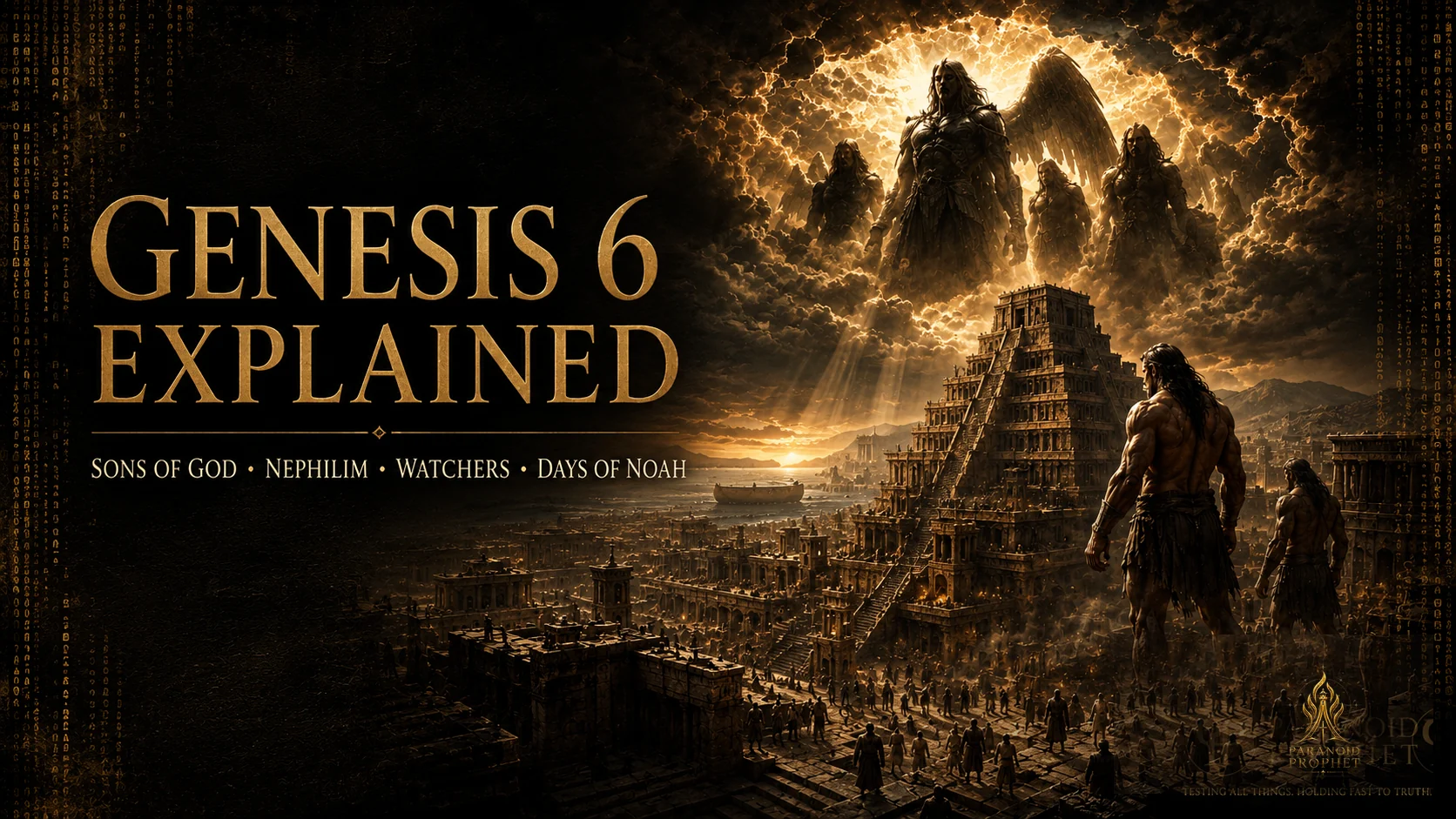

Genesis 6 is one of the strangest chapters in the Bible. It introduces the sons of God, the daughters of men, the Nephilim, a world overwhelmed by corruption, the grief of God, the judgment of the Flood, and the favor shown to Noah. Those subjects have generated centuries of debate, but the chapter itself has a clear movement that should govern every interpretation.
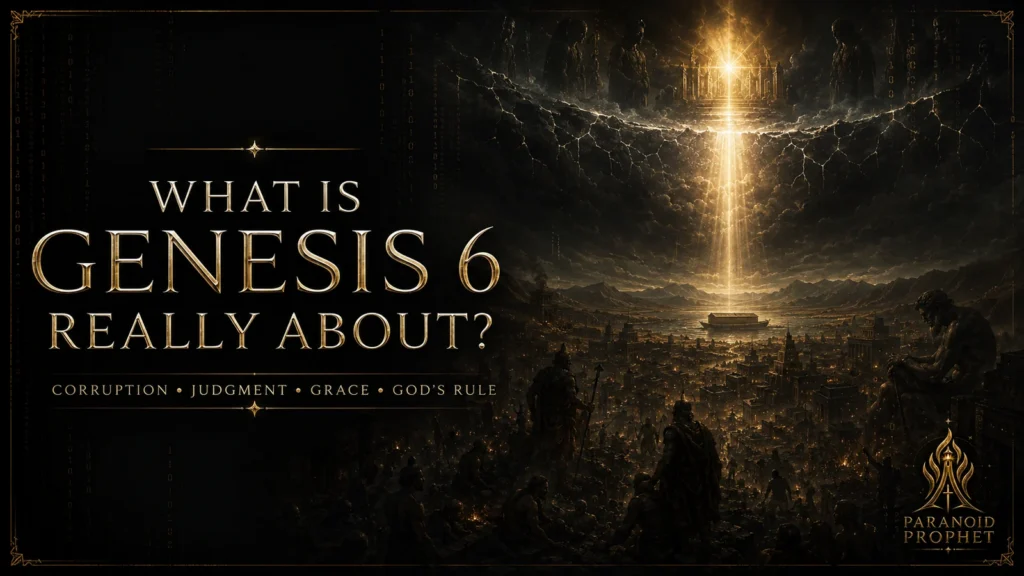
Humanity multiplies. Heavenly beings cross a forbidden boundary. The Nephilim appear. Human wickedness deepens until violence fills the earth. God announces judgment. Then, against that dark background, Noah finds favor in the eyes of the Lord.
The strongest reading is that the “sons of God” were heavenly beings who took human women and violated the order God had established. Yet Genesis 6 is not only about identifying those beings. The chapter explains why the pre-Flood world came under judgment and how grace remained present even as creation descended into corruption.
Genesis 6 is the foundation. The companion articles are the deeper rooms. This article is the front door.
GUIDED ARTICLE EXPERIENCE
Genesis 6 Explained: The Sons of God, Nephilim, and the Flood
Read along as the narration moves through the article.
Private device narration · No hosted audio or tracking
CONTINUE GUIDED TOUR
Continue where you left off.
GUIDED TOUR COMPLETE
You have reached the end of this study.
Study record saved on this device.
GUIDED TOUR
Genesis 6 Explained: The Sons of God, Nephilim, and the Flood
Narrator: Paranoid Prophet Recommended Voice Native device narration
Prepare to follow the article as it is narrated.
VOICE & TOUR OPTIONS
Voice & Listening
NARRATOR
Finding a narrator…
Checking the best narrator available on this device.
Restores the best curated narrator available on this device.
Narrator choices are curated for clear, long-form listening on this device.
Screen-awake support will be checked when narration starts.
CHOOSE A NARRATOR
Curated for this device
Choose a verified narrator for this browser, or use System Narrator. Automatic mode uses the best reliable route exposed by this device; your chosen narrator is preserved even if this device needs a temporary fallback.
Preparing the guided article experience…
RESUME GUIDED TOUR?
Continue where you left off.
GUIDED TOUR COMPLETE
You have reached the end of this study.
Article Guide7 sections
What Happens in Genesis 6?
Genesis 6 does not arrive as an isolated story about angels and giants. It belongs to the Bible’s account of creation, fall, spreading sin, judgment, and preserving grace. Reading the chapter in that sequence keeps its mysteries connected to its message.
From Genesis 4 to the Pre-Flood Crisis
The violence of Genesis 6 has roots in the chapters before it. Cain murders Abel in Genesis 4. Later, Lamech boasts that he has killed a man and claims vengeance far beyond the protection God gave Cain. Human culture develops at the same time: people build cities, raise livestock, make music, and work bronze and iron. Scripture does not condemn those skills. It shows that cultural achievement and moral corruption can grow beside one another.
Genesis 5 then traces the generations from Adam to Noah. The repeated words “and he died” reveal how deeply the sentence of Eden now shapes human life. Enoch stands out because he walks with God, and Noah’s name is connected with the hope of relief from the cursed ground. By the time Genesis 6 opens, humanity is multiplying under the shadow of death while longing for rest.
Then the boundaries of the created order are violated. The sons of God see the daughters of men and take wives. The Nephilim are mentioned in the same compressed scene. The narrative quickly widens from that transgression to the condition of humanity as a whole: wickedness is great, every intention of the heart is continually evil, and the earth is corrupt and filled with violence.
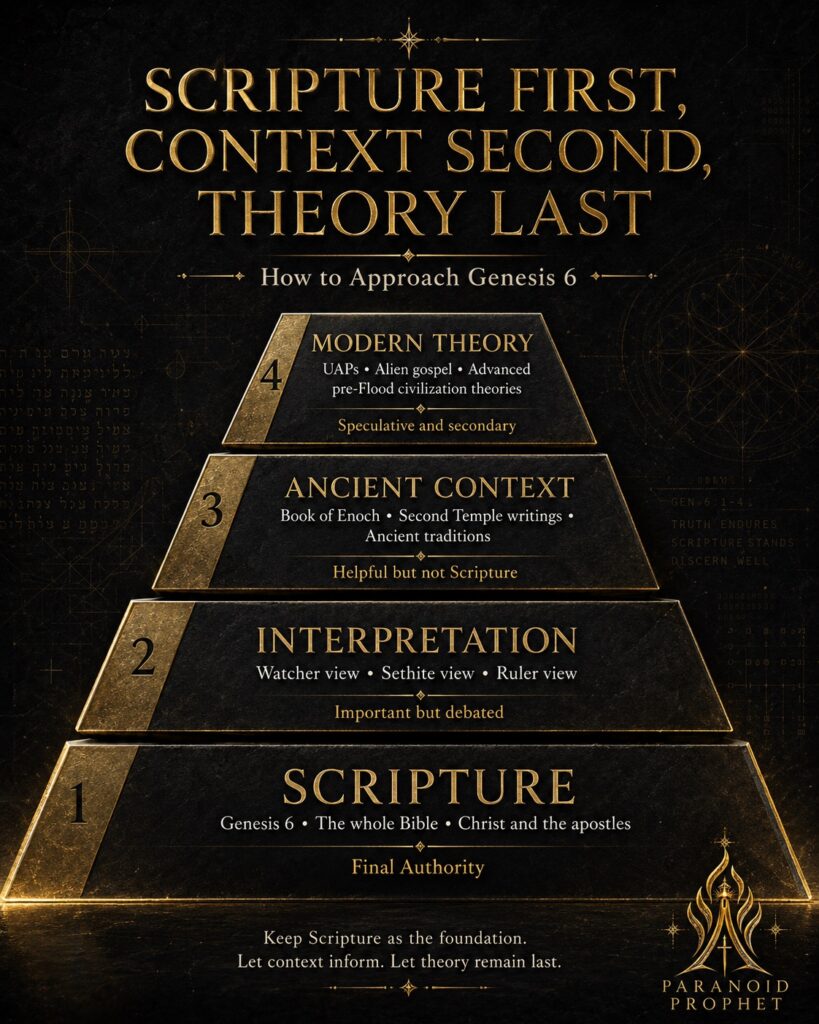
This context establishes the right order of study. Scripture is the authority. Other biblical passages can clarify its language and themes. Ancient Jewish texts can show how early readers interpreted the episode. Modern theories may ask further questions, but they cannot travel backward and take control of the chapter.
The Chapter’s Escalating Movement
The chapter unfolds as an escalating crisis rather than a collection of disconnected mysteries:
- Humanity multiplies across the earth.
- The sons of God take the daughters of men.
- The Nephilim appear in the same setting.
- Human wickedness reaches into every intention of the heart.
- The earth becomes corrupt and filled with violence.
- God declares that the corrupted world will face judgment.
- Noah finds favor and receives a covenant promise.
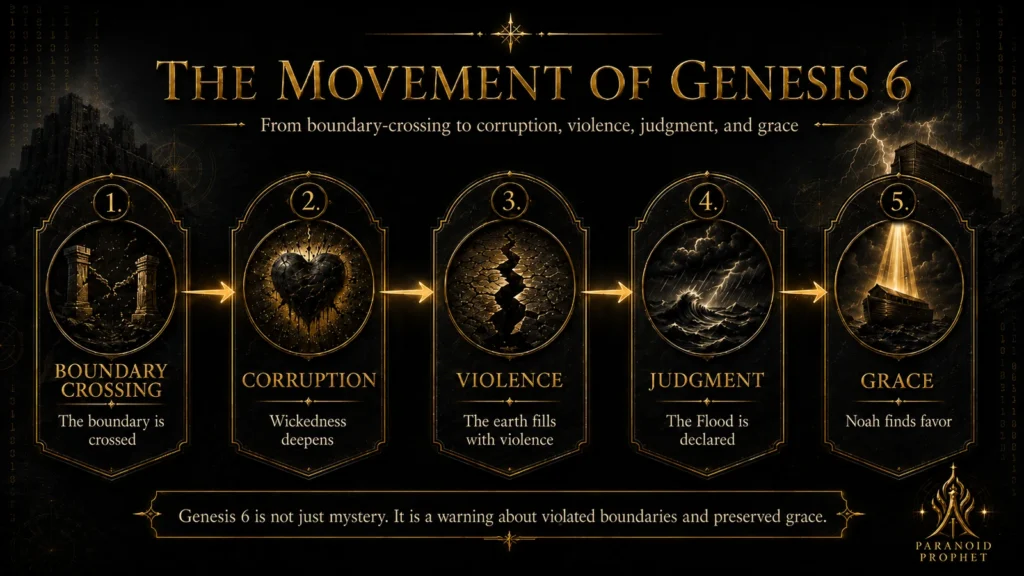
The first four verses matter, but they do not consume the chapter. Genesis moves from an extraordinary boundary violation to the moral condition of the entire world. The mystery is real, but the moral message is even clearer: rebellion has spread through humanity and is destroying the good world God made.
The Sons of God and Daughters of Men
Genesis 6:1–4 says that as humanity multiplied and daughters were born, the sons of God saw that the daughters of men were attractive and took as their wives any they chose. The passage is brief, but it places the initiating action on the sons of God: they see, choose, and take.
The daughters of men are human women. Genesis does not present them as a separate supernatural class or make them the principal offenders. Nor does the text give enough detail to settle every question about agency and consent. Its focus is the action of the sons of God and the disorder that follows.
The Three Major Interpretations
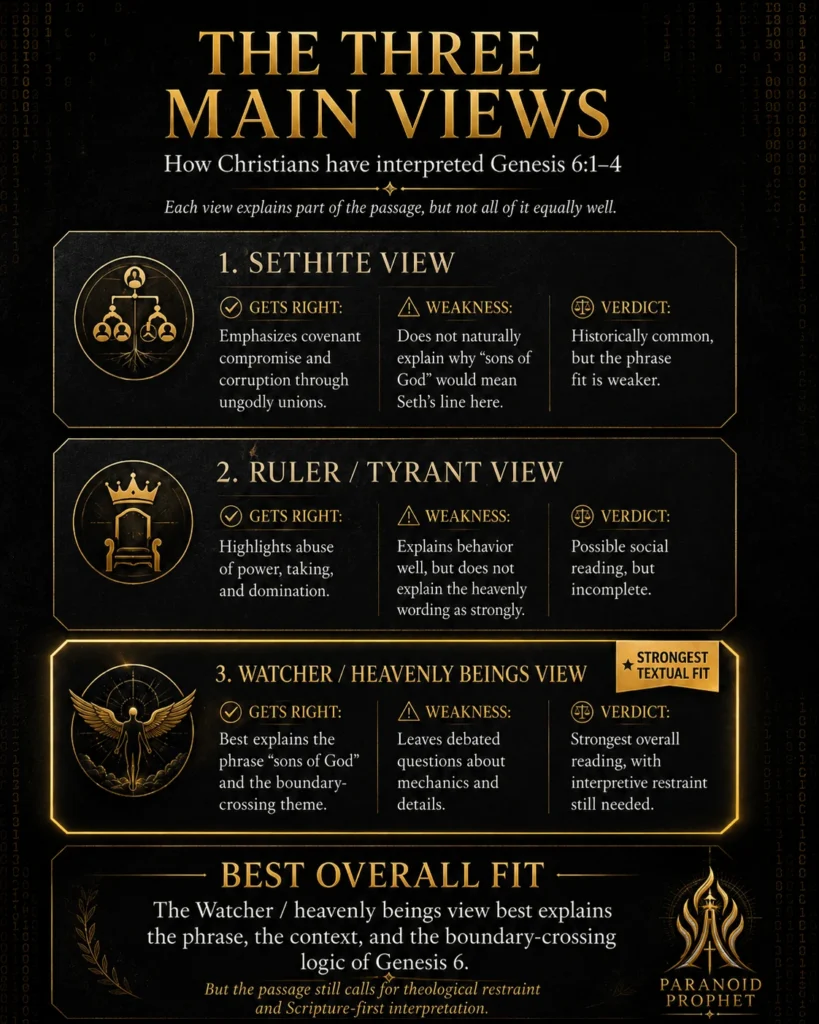
Three interpretations have received the most attention in Jewish and Christian discussion.
The Sethite interpretation identifies the sons of God with the godly line of Seth and the daughters of men with women from Cain’s line. This reading emphasizes covenant compromise and keeps the episode entirely human. Its main weakness is that Genesis never calls Seth’s descendants “sons of God” or identifies the women here as daughters of Cain.
The royal or tyrant interpretation sees the sons of God as rulers who claimed divine status and gathered women into royal households. It fits the passage’s atmosphere of power and taking, and ancient kings could be described in divine terms. Yet it does not explain the Old Testament’s heavenly use of the phrase as naturally as the third view.
The heavenly-being interpretation understands the sons of God as members of the unseen realm who crossed a forbidden boundary with human women. It accounts for the phrase’s clearest Old Testament parallels, the extraordinary nature of the episode, the Nephilim notice, and the ancient interpretation later developed in the Watcher tradition.
Why the Heavenly-Being Reading Is Strongest
The phrase translated “sons of God” appears in Job 1:6; 2:1; and 38:7 for heavenly beings who appear before God or celebrate creation. Those passages do not prove the meaning of Genesis 6 by themselves, but they provide the most direct biblical parallels to its wording.
Jude 6–7 speaks of angels who abandoned their proper dwelling and were kept for judgment. Second Peter 2:4–5 places sinning angels and the ancient Flood together in its sequence of judgment. Scholars disagree about how directly those texts interpret Genesis 6, but their language fits an early Jewish world in which the heavenly reading was already well established.
Jesus’ statement that angels in heaven do not marry does not overturn this conclusion. In Matthew 22:23–33, Jesus describes the ordered life of angels in heaven and the resurrection life of God’s people. Genesis 6, on the heavenly-being reading, describes rebellion against proper order, not ordinary heavenly marriage.
The heavenly-being interpretation is therefore the strongest reading, but this article does not need to reproduce every argument. The Hebrew phrase, competing interpretations, ancient reception, and major objections receive fuller treatment in Sons of God and Daughters of Men.
For Genesis 6 as a whole, the central point is that the sons of God episode belongs to the disorder preceding the Flood. Created beings seize what lies outside their appointed boundary, and the chapter moves immediately toward divine limits, pervasive human evil, and judgment.
The Nephilim and Men of Renown
The Nephilim appear in one dense sentence. Genesis 6:4 says they were on the earth “in those days, and also afterward,” when the sons of God came to the daughters of men and children were born to them. It then associates the scene with the mighty men of old, men of renown.
The Hebrew term Nephilim is difficult. It is often connected with the idea of falling, while the ancient Greek translation uses a word commonly rendered “giants.” Neither observation gives readers permission to construct a complete anatomy, genealogy, or survival history from the name alone.
Were the Nephilim the Offspring of the Union?
The strongest reading connects the Nephilim to the union between the sons of God and the daughters of men. Genesis places them together in the same compressed notice, and ancient Jewish interpretations such as 1 Enoch and Jubilees make the offspring connection explicit. That ancient agreement is historically significant.
Still, Genesis does not describe the mechanism, and its grammar allows some readers to understand the Nephilim as figures already present during the episode. The responsible conclusion is firm but measured: the text strongly connects the Nephilim to the forbidden union without explaining everything later traditions claim about them.
The description “mighty men” and “men of renown” should also be read inside the chapter’s dark setting. Renown is not the same as righteousness. Human cultures often celebrate strength, conquest, and fame, while Genesis is moving toward God’s verdict on a world corrupted by predatory power and violence.
What Does “And Also Afterward” Mean?
The phrase does not identify a single post-Flood survival mechanism. It may refer to a period after the unions but still before the Flood. It may also prepare readers for the later biblical memory of giant peoples. Numbers 13:32–33 uses Nephilim language in the spies’ fearful report, while Deuteronomy and Joshua speak of the Anakim, Rephaim, and other formidable peoples.
Those texts create a genuine continuity question, but they do not answer it with one clear genealogy. Recurrence, lineage, remembered giant traditions, rhetorical exaggeration, and other explanations must be weighed rather than collapsed into a single claim.
The Nephilim are therefore important without becoming the center of Genesis 6. They are not the sons of God, not the Watchers themselves, not a biblical synonym for demons, and not proof of extraterrestrial visitors. Their identity and the later giant traditions are examined in Who Were the Nephilim?. The unresolved post-Flood mechanism belongs in the planned article Did the Nephilim Survive the Flood?
God’s Limit and the Deepening Corruption
The strange opening scene is followed by a divine declaration. God will not allow the present condition to continue without limit. Human life is mortal, divine patience is not indifference, and the world moving toward the Flood is living on borrowed time.
The Spirit and the 120 Years
In Genesis 6:3, the Lord declares that his Spirit will not abide in humanity forever because humanity is flesh, and that human days will be 120 years. Both the Hebrew verb and the function of the number have been interpreted in more than one way.
One reading understands the 120 years as a countdown to the Flood: God grants a final period before judgment. Another understands the number as a limitation on ordinary human lifespan. The long lives recorded after the Flood decline gradually rather than ending at 120 immediately, which is one reason many interpreters prefer the countdown view in this context. Yet the larger point does not depend on settling every detail. God places a limit on a rebellious world. Humanity is flesh and cannot make its corruption permanent.
This verse stands between the boundary crossing and the description of human evil. It reminds the reader that neither heavenly rebellion nor human ambition can escape the Creator’s authority. God has not lost control of the earth. He determines when patience gives way to judgment.
Every Intention of the Human Heart
The narrative then turns directly to humanity. Genesis 6:5–8 says the Lord saw that human wickedness was great and that every intention of the thoughts of the human heart was only evil continually. The language is deliberately comprehensive. Evil is not confined to a handful of violent rulers or blamed entirely on supernatural influence. It has reached the inner life of humankind.
Genesis therefore holds heavenly and human rebellion together without confusing them. The sons of God are responsible for crossing their appointed boundary. Human beings are responsible for the wickedness filling their own hearts and society. The presence of a supernatural transgression does not erase human agency.
God’s response is not detached. The text says he regretted making humanity and was grieved to his heart. This does not portray God as discovering that creation was an accidental mistake. It describes, in the personal language of the narrative, the real grief caused by creatures who have turned his good world toward evil. The Judge of Genesis 6 is not cruel or impulsive. He is the Creator whose world has been devastated by rebellion.
That grief leads to a severe verdict: humanity and the land animals caught within its ruined world will face removal. But judgment is not the final sentence in the paragraph. Noah finds favor in the eyes of the Lord. Grace appears before the ark is built and before Noah’s obedience is described.
Violence Fills the Earth
Genesis 6 does not leave corruption as a private or invisible condition. Evil in the heart becomes violence in the world. The good creation is being unmade socially, morally, and relationally by the people appointed to bear God’s image within it.
The Corruption of All Flesh
Genesis 6:9–13 repeats the word “corrupt” as it describes the earth in God’s sight. The earth is corrupt because all flesh has corrupted its way. The language concerns conduct and the ruined condition of life before God. It should not be converted into a technical claim that every living creature had undergone genetic alteration.
The phrase “all flesh” broadens the scale of the crisis. Human sin has consequences beyond isolated offenders. The earth itself has become the theater of pervasive disorder, and the creatures dependent on that world are drawn into the catastrophe. Genesis has moved far beyond the first murder outside Eden. Violence now characterizes an entire civilization.
The Hebrew word translated “violence,” hamas, can include cruelty, oppression, wrongdoing, and bloodshed. It describes more than armed conflict. It is a social order in which strength devours weakness and life is treated as disposable. The sons of God episode may stand near the beginning of the chapter’s collapse, but Genesis explicitly places the violence of the earth within the corruption of all flesh.
Why the Flood Is Righteous Judgment
God tells Noah that he has determined to make an end of all flesh because the earth is filled with violence. The judgment corresponds to the crime. The same Hebrew root can describe the earth as corrupted and God’s determination to destroy what has corrupted it. Humanity has brought ruin into creation; God will bring that violent world to an end.
The Flood is therefore not a divine tantrum triggered by human imperfection. It is the judicial answer to a world in which evil has become continual and violence has filled the earth. God’s patience in Genesis 6:3, grief in Genesis 6:6, and close inspection in Genesis 6:5 and 6:12 all precede the verdict. He sees before he judges.
This is also why the pre-Flood world must not be romanticized. Genesis 4 shows genuine cultural achievement, and ancient traditions later speak of unusual knowledge. But Scripture’s controlling assessment is moral, not technological. Whatever that civilization built or knew, it became corrupt enough that power served violence rather than the Creator.
The chapter should make readers sober about sin in every age. Rebellion does not remain an inward preference. It reshapes families, institutions, cultures, and the treatment of human life. A society may be inventive, celebrated, and powerful while becoming intolerable in the sight of God.
Noah Finds Favor
Genesis 6 is severe, but it is not hopeless. Before the Flood begins and before Noah completes a single instruction, the text announces that Noah found favor in the eyes of the Lord. Judgment will not erase God’s purpose for creation.
Righteous, Blameless, and Walking With God
Genesis describes Noah as righteous and blameless among the people of his generation, and says that he walked with God. “Blameless” does not mean that Noah was sinless or that he earned deliverance by moral perfection. The later failure recorded in Genesis 9 makes that impossible. It describes integrity and faithfulness in contrast with the violent world around him.
The phrase “walked with God” recalls Enoch in Genesis 5. Noah lives in fellowship with God when the surrounding culture has turned from him. His righteousness is not heroic self-salvation. It is the visible life of a man who has received favor, trusts God’s warning, and orders his household around God’s word.
The Ark, the Covenant, and Noah’s Obedience
God does not merely announce judgment. He gives Noah detailed instructions for an ark that will preserve his family and representatives of the land animals. The dimensions, rooms, covering, provisions, and occupants matter because deliverance takes the form God provides. Noah is not asked to invent a rescue. He is asked to trust and obey.
In Genesis 6:18–22, God promises to establish his covenant with Noah. This is the Bible’s first explicit use of covenant language. The promise reaches beyond survival: God is preserving a family, the created kinds dependent on the ark, and the future through which his purposes for humanity will continue.
The chapter closes with a simple description of Noah’s response: he did everything God commanded him. That obedience is part of what distinguishes Noah from his generation. The violent world takes according to its own desire; Noah receives God’s word and acts according to it.
Genesis 7–9 completes the movement begun here. The waters come, the violent world passes under judgment, and God remembers Noah. The earth dries, Noah worships, and God places the rainbow as the sign of his covenant with creation. Humanity receives the creation mandate again, while the sanctity of human life is reaffirmed because people bear God’s image.
Noah’s later sin prevents readers from turning him into the final answer to the human condition. The Flood judges a corrupt world, but it does not remove sin from the human heart. Genesis 8:21 still speaks of the evil inclination of humanity. Noah is a recipient of grace and a faithful witness, but the story leaves the world waiting for a greater deliverance.
Why Genesis 6 Still Matters
Genesis 6 gives Christians more than a collection of ancient mysteries. It reveals that created boundaries matter, human evil reaches both heart and society, violence brings the world under God’s judgment, and grace is the only reason a remnant survives. Those truths remain urgent even when the stranger details of the chapter are interpreted carefully.
The chapter also teaches readers how to approach difficult subjects. Mystery should produce humility, not permission to erase distinctions. The sons of God, Watchers, Nephilim, demons, giants, aliens, and UAPs are not interchangeable names. Connection is not identity, and resemblance is not proof.
How Ancient Context Helps Without Ruling the Text
The word “Watchers” does not appear in Genesis 6. Genesis calls the beings “sons of God.” Watcher became a major label in later Jewish interpretation, especially in the Book of Enoch and related writings from the Second Temple period.
First Enoch 6–16 expands the brief Genesis notice into a developed account of heavenly descent, giant offspring, forbidden teaching, violence, and judgment. Aramaic fragments discovered among the Dead Sea Scrolls confirm that Enochic traditions circulated before Christianity. This makes the Watcher interpretation ancient and historically important, not a modern conspiracy theory.
Ancient does not mean inspired, and expansion does not equal explanation. First Enoch may preserve early interpretation, theological reflection, ancient memory, and literary development at the same time. It can illuminate the world in which Jude and 2 Peter were read, but it cannot add details to Genesis as though Moses had written them there.
The full history belongs in The Watchers Explained and The Book of Enoch Explained. The catalog of weapons, enchantments, heavenly signs, and other illicit teachings belongs in What Did the Watchers Teach?. Here the ancient material serves one limited purpose: it supports the antiquity of the heavenly-being reading without replacing the biblical chapter.
A Pattern for Discernment, Not a Proof Text
Genesis 6 establishes a biblical pattern: rebellion crosses boundaries, power becomes predatory, corruption spreads, violence follows, and judgment comes. Later claims may echo parts of that pattern. An echo can justify a question, but it cannot establish an identity or cause.
Jesus uses the days of Noah as a warning about readiness. In Matthew 24:37–39 and Luke 17:26–27, ordinary life continues until judgment arrives. Eating, drinking, and marrying are not presented as the sins that caused the Flood. The danger is blindness to God while life appears to continue as usual.
Genesis 6 does not directly identify the causes of modern UFO or UAP reports. It does give Christians categories for testing religious claims involving non-human contact, forbidden revelation, hybridization, altered humanity, or salvation through superior knowledge. Those applications belong primarily in The Pre-Flood Origin Theory and Christian View of UFOs: The Three-Tier UAP Theory.
Similarity can raise a question, but it cannot carry the weight of proof. Genesis 6 should make Christians more discerning without making them more gullible, and more attentive to Christ without making them fascinated with rebels.
Frequently Asked Questions
What is Genesis 6 about?
Genesis 6 describes an escalating pre-Flood crisis: humanity multiplies, the sons of God take human women, the Nephilim appear, human wickedness deepens, violence fills the earth, God announces judgment, and Noah finds favor. The chapter is about heavenly boundary crossing and human corruption, but also about righteous judgment and preserving grace.
Who were the sons of God in Genesis 6?
The strongest interpretation identifies them as heavenly beings. This view best explains the phrase’s use in Job, the forbidden-boundary character of the episode, the Nephilim notice, and the ancient Jewish interpretation reflected in the Watcher tradition. Sethite and royal-ruler interpretations remain important alternatives, but they explain the wording less completely.
What do the 120 years in Genesis 6:3 mean?
They may describe a 120-year period before the Flood or a limitation on human lifespan. The countdown interpretation fits the immediate movement toward judgment, while the lifespan interpretation remains possible. In either case, God declares that humanity’s rebellious condition will not continue without limit.
Who were the Nephilim?
The Nephilim were mysterious figures connected to the Genesis 6 union and associated with mighty men and later giant traditions. The strongest reading treats them as offspring of the forbidden union, although Genesis does not explain the mechanism. They should not be equated automatically with Watchers, demons, or aliens.
Does Genesis 6 prove that the Book of Enoch is Scripture?
No. First Enoch is an ancient and influential witness to Jewish interpretation of Genesis 6, and Jude uses Enochic material. That does not make every Enochic detail inspired or equal to Genesis. Scripture remains the controlling authority for Christian doctrine.
Did the Nephilim survive the Flood?
Genesis 6:4 and later giant traditions create a real continuity question, but Scripture does not identify one mechanism. The possibilities include recurrence, lineage, remembered giant traditions, rhetorical language, or other models. A straightforward biological survival claim is not established by Genesis 6 alone.
Does Genesis 6 explain UFOs or UAPs?
Not directly. Genesis 6 describes the pre-Flood world, not a modern observation category. Some contemporary narratives may echo older themes such as non-human contact, boundary crossing, forbidden knowledge, or counterfeit transformation. Echoes should be tested as possible patterns, not treated as proof that every unexplained report is spiritual.
Selected Sources and Further Reading
- Genesis 4–9 – the canonical context for spreading violence, the sons of God, Nephilim, corruption, Noah, the Flood, and the covenant.
- Gordon J. Wenham, Genesis 1–15, Word Biblical Commentary, 1987.
- Victor P. Hamilton, The Book of Genesis, Chapters 1–17, New International Commentary on the Old Testament, 1990.
- George W. E. Nickelsburg and James C. VanderKam, 1 Enoch: The Hermeneia Translation, Fortress Press, 2012.
- Loren T. Stuckenbruck, The Myth of Rebellious Angels, Eerdmans, 2017.
- Annette Yoshiko Reed, Fallen Angels and the History of Judaism and Christianity, Cambridge University Press, 2005.
Read Next: Follow the Genesis 6 Trail
- Sons of God and Daughters of Men: What Genesis 6 Really Means
- The Watchers Explained: Fallen Angels, Genesis 6, and the Book of Enoch
- Who Were the Nephilim? Giants, Demons, and the Pre-Flood World
- The Book of Enoch Explained: Scripture, History, and the Watchers
- Did the Nephilim Survive the Flood? – planned deep dive.
- The Pre-Flood Origin Theory
- Christian View of UFOs: The Three-Tier UAP Theory
Noah, Christ, and the Greater Refuge
Noah believed God’s warning about a judgment he had not yet seen. Hebrews 11:7 presents his construction of the ark as an act of faith through which his household was preserved. Yet Noah could preserve neither himself nor his descendants from the deeper problem of sin. The world after the Flood still needed redemption.
The New Testament brings Noah’s story under the victory of Jesus Christ. Second Peter 2:4–9 joins the judgment of sinning angels, the ancient Flood, Noah’s preservation, and the assurance that the Lord knows how to rescue the godly and keep the unrighteous for judgment. Evil is neither ignored nor beyond God’s reach.
First Peter 3:18–22 moves from the days of Noah to Christ’s suffering, resurrection, ascension, and authority. Jesus is at the right hand of God with angels, authorities, and powers subjected to him. The heavenly rebels of Genesis 6 are not rivals to Christ, and hidden knowledge is not humanity’s rescue.
Genesis 6 should therefore leave readers sober, but not afraid. God sees corruption, sets limits on rebellion, judges violence, preserves by grace, and keeps his promises. Noah points beyond himself to the greater refuge God has provided. Safety is not found in decoding every mystery or mastering forbidden knowledge. It is found in Jesus Christ, the risen Lord over heaven and earth.
CONTINUE THE INVESTIGATION
Next discernment study
Sons of God and Daughters of Men in Genesis 6 | Biblical Meaning
Narrow the broad Genesis 6 overview to the identity and meaning of the sons of God and daughters of men.