
GUIDED ARTICLE EXPERIENCE
Prophecies of Jesus Fulfilled: 351 Old Testament Scriptures Explained
Read along as the narration moves through the article.
Private device narration · No hosted audio or tracking
CONTINUE GUIDED TOUR
Continue where you left off.
GUIDED TOUR COMPLETE
You have reached the end of this study.
Study record saved on this device.
GUIDED TOUR
Prophecies of Jesus Fulfilled: 351 Old Testament Scriptures Explained
Narrator: Paranoid Prophet Recommended Voice Native device narration
Prepare to follow the article as it is narrated.
VOICE & TOUR OPTIONS
Voice & Listening
NARRATOR
Finding a narrator…
Checking the best narrator available on this device.
Restores the best curated narrator available on this device.
Narrator choices are curated for clear, long-form listening on this device.
Screen-awake support will be checked when narration starts.
CHOOSE A NARRATOR
Curated for this device
Choose a verified narrator for this browser, or use System Narrator. Automatic mode uses the best reliable route exposed by this device; your chosen narrator is preserved even if this device needs a temporary fallback.
Preparing the guided article experience…
RESUME GUIDED TOUR?
Continue where you left off.
GUIDED TOUR COMPLETE
You have reached the end of this study.
Jesus did not appear out of nowhere.
Long before the manger, the cross, the empty tomb, and the throne at God’s right hand, the Old Testament was preparing the way for Him through promise, prophecy, covenant, sacrifice, kingship, priesthood, suffering, resurrection hope, and kingdom expectation.
This article is the central hub for the prophecies of Jesus fulfilled in Scripture. It explains the 351-item prophecy list carefully, shows how the Old Testament points to Christ, and guides readers into deeper studies on His birth, ministry, betrayal, crucifixion, resurrection, divine identity, redemption, and coming kingdom.
The goal is not to turn Jesus into a math problem or to win an argument by exaggerating a prophecy count. The stronger claim is narrower and better: the Old Testament gives a vast, unified witness that reaches its fulfillment in Jesus Christ.
Scripture presents Him as the seed of the woman, Son of Abraham, Lion from Judah, Son of David, ruler from Bethlehem, Immanuel, Prophet like Moses, suffering Servant, rejected Stone, pierced One, risen Lord, Son of Man, priest-king, Lamb of God, Redeemer, and coming King.
Fulfillment is not only prediction coming true. It is promise, pattern, office, covenant, sacrifice, kingdom, and story reaching their intended goal in Christ.
Article Guide12 sections
Prophecies of Jesus Fulfilled: Start Here
This page is designed as a map. It gives the big picture first, then points you toward deeper prophecy studies by theme. If you are trying to understand how the Old Testament prepares for Jesus, start here. If you already know the theme you want to study, use this hub to find the right path.
The 351-prophecy list can be useful, but this hub does not treat it as an inspired count or a shortcut around Scripture. Some passages are direct messianic promises. Some are New Testament fulfillment texts. Some are types, shadows, messianic offices, covenant patterns, or future kingdom promises. A faithful article must tell those categories apart.
What This Hub Is For
This hub is for readers who want the whole prophecy map without losing the details. It gives a responsible overview of the Old Testament’s witness to Jesus, then sends readers into focused studies where each theme can be handled with more depth.
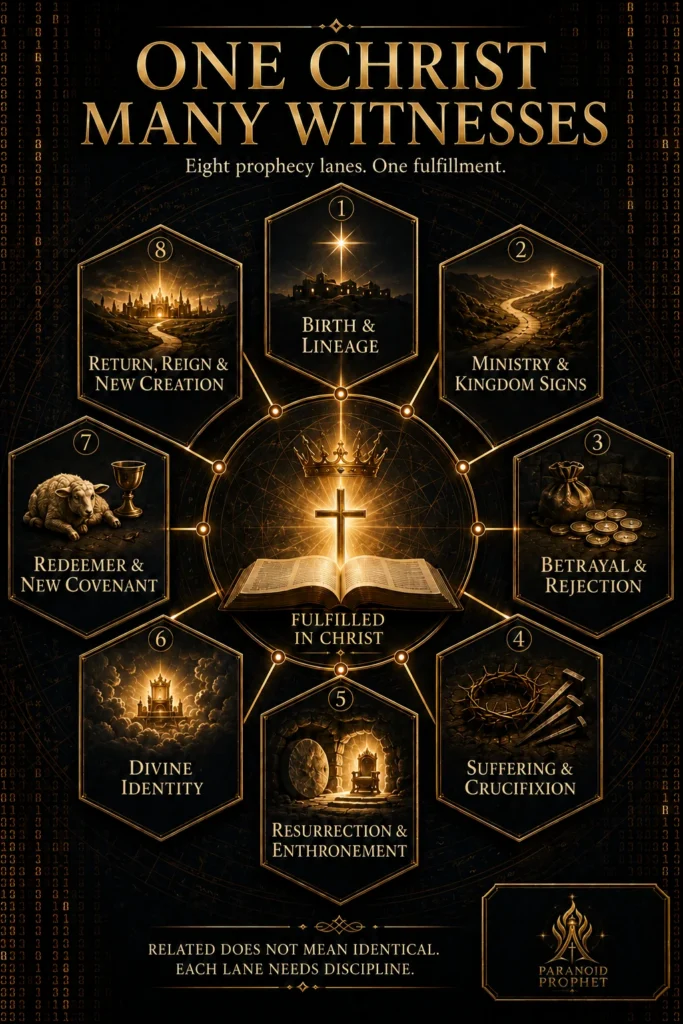
Use this article to follow the major prophecy lanes:
- Birth, lineage, and messianic identity: the promised seed, Son of Abraham, Son of David, Bethlehem, Immanuel, Son of God, Son of Man, and priest-king.
- Ministry, kingdom signs, and prophetic authority: the messenger in the wilderness, the Prophet like Moses, good news to the poor, healing, restoration, and the arrival of God’s kingdom.
- Betrayal, rejection, suffering, and crucifixion: the rejected stone, close companion betrayal, thirty pieces of silver, Isaiah 53, Psalm 22, piercing, mockery, and substitution.
- Resurrection, enthronement, redemption, and new covenant: Psalm 16, Jonah, Psalm 110, Daniel 7, Passover, sacrifice, forgiveness, and the risen Lord who reigns.
- Return, reign, judgment, and new creation: the final kingdom, resurrection, restoration, judgment, and visible consummation of Christ’s reign.
Each lane matters, but each lane needs its own discipline. Related does not mean identical. A prophecy about Bethlehem should not be handled the same way as the Passover lamb. Psalm 16 should not be handled the same way as Jonah. Isaiah 53 should not be handled as if Jewish objections do not exist.
How This Article Fits the Jesus Evidence Case
This page belongs inside the larger Jesus Evidence cluster. The broader question is not only whether Jesus fulfilled prophecy, but who Jesus is. Scripture presents Him as the promised Messiah, the Son of God, the crucified Savior, the risen Lord, and the coming King.
For the master Jesus Evidence case, start with Is Jesus the Son of God?. That article gathers the larger case from history, prophecy, resurrection, divine identity, redemption, and Scripture.
For the public historical foundation, see Historical Evidence for Jesus. History can support public claims such as Jesus’ existence, crucifixion under Roman authority, and early resurrection proclamation. But Scripture is the final authority for who Jesus is and what His death and resurrection mean.
This article is the prophecy wing of that larger case. It does not replace history. It does not replace the resurrection. It does not reduce Jesus to a list of proof-texts. It shows how the Law, Prophets, and Writings prepare for Christ and how the New Testament presents Him as the fulfillment of God’s promises.
Source discipline: Scripture is the foundation. The 351-item list is a study aid, not an inspired count. This hub distinguishes direct prophecy, New Testament fulfillment, typology, messianic offices, covenant patterns, future kingdom hope, and debated texts so the case for Christ stays faithful, credible, and clear.
Before we walk the prophecy map, we need to handle the number honestly: what does the 351-prophecies claim actually mean?
What Does the 351 Prophecies Claim Mean?
The phrase “351 prophecies of Jesus” can be useful, but it can also be misunderstood. The Bible does not contain a verse saying, “There are exactly 351 messianic prophecies.” That number comes from a compiled study list of Old Testament passages Christians have connected to Jesus through direct prophecy, New Testament fulfillment, typology, messianic titles, covenant themes, biblical patterns, and future kingdom hope.
That distinction matters. The 351 list can help readers see the breadth of Scripture’s witness to Christ, but it should not be treated as inspired math. Scripture is inspired. A chart is not. Scripture defines who Jesus is. A study list can only help us trace the passages that point to Him.
Used carelessly, the number can make the article sound stronger while actually making the case weaker. If every item is presented as an equally direct prediction, careful readers will notice the problem quickly. Some passages are explicit and central. Others are typological. Some depend on New Testament application. Some are debated. Some are fulfilled in Jesus’ first coming, while others await final consummation when He returns.
The point is not that every item in a 351 chart works the same way. The point is that the Old Testament gives a vast, unified witness that reaches its goal in Christ. Jesus fulfills promise, prophecy, pattern, office, covenant, sacrifice, suffering, resurrection hope, and kingdom expectation.
Scripture Is Inspired. A Chart Is Not.
The 351-item list should be treated as a study guide. It can organize passages and themes, but it does not carry the authority of Scripture. The list is useful only when it serves the text, not when it starts controlling the text.
A responsible article should therefore name the kind of fulfillment being discussed. If a passage is a direct messianic promise, say that. If it is typology, call it typology. If the connection depends on how the New Testament applies the Old Testament, show the New Testament text. If a passage is debated, acknowledge the debate without surrendering the Christian claim.
This is not weakness. It is honesty. A strong Christian case does not need weak evidence.
Why Not Every Fulfillment Works the Same Way
Fulfilled prophecy is not one flat category. A prophecy about Bethlehem does not work the same way as the Passover lamb. Psalm 16 in Acts does not work the same way as Jonah’s three days. Isaiah 53 should not be handled as if Jewish objections do not exist. Psalm 110 gives royal-priestly enthronement language, while Daniel 7 gives Son of Man kingdom language.
That does not weaken the article. It strengthens it. Scripture is rich enough to handle careful categories. The Old Testament points to Jesus through direct promises, prophetic patterns, messianic offices, covenant lines, sacrifice, priesthood, suffering, vindication, kingdom hope, and the whole biblical storyline.
The goal of this hub is not to flatten those categories. The goal is to help readers see how they converge in Christ.
How This Hub Handles Fulfilled Prophecy
To keep the prophecy case faithful and credible, this hub uses several fulfillment categories. These categories are not meant to make Scripture mechanical. They are meant to keep the argument honest, readable, and anchored in the text.
Direct Messianic Promises
Direct messianic promises are passages that naturally point toward a coming Messiah, ruler, servant, prophet, priest, king, deliverer, or kingdom figure. These are the passages many readers think of first when they hear the phrase “messianic prophecy.”
Examples include Bethlehem in Micah 5:2, the Davidic throne in 2 Samuel 7, the Son of Man in Daniel 7, and the priest-king of Psalm 110. These passages can be used confidently, but they should still be read in context. Scripture often reveals the Messiah progressively, not all at once in one verse.
Explicit New Testament Fulfillment
Some Old Testament passages become especially clear because the New Testament directly applies them to Jesus. Matthew connects Jesus’ birth in Bethlehem with Micah 5:2. John connects Jesus’ piercing with Zechariah 12:10. Peter and Paul apply Psalm 16 to the resurrection of Christ.
These explicit New Testament connections are major guideposts. They show how the apostles read the Old Testament in light of Jesus’ life, death, resurrection, and exaltation. They do not exhaust every possible connection to Christ, but they give Christians the clearest interpretive anchors.
Typology and Biblical Patterns
Typology is one of the most important ways the Old Testament points to Jesus. A type is a real person, event, office, institution, or pattern that foreshadows a greater fulfillment in Christ. The Passover lamb, the temple, priesthood, sacrifice, Jonah, and the kinsman-redeemer pattern all belong in this category.
Typology should not be treated as second-class fulfillment. It is deeply biblical. But it should not be confused with direct prediction. A type is not the same thing as a plain verbal prophecy. The strength of typology is that it shows how God shaped the story of Scripture so earlier patterns find their fullness in Jesus.
Messianic Offices and Titles
Jesus fulfills the Old Testament through the offices and titles attached to Israel’s hope. He is prophet, priest, king, Son of David, Son of God, Son of Man, servant, Lord, redeemer, and priest-king at God’s right hand.
These titles are not decorative. They are biblical categories. Deuteronomy 18 speaks of a prophet like Moses. Psalm 110 joins kingship and priesthood. Daniel 7 gives the Son of Man kingdom vision. Isaiah 53 presents the suffering servant. The New Testament identifies Jesus as the One in whom these offices and titles converge.
Covenant Promises and Whole-Bible Patterns
Some fulfillment claims are bigger than one isolated verse. God promises blessing through Abraham’s seed. He narrows kingship through Judah and David. He gives Israel priesthood, sacrifice, temple, exile, return, and new covenant hope. These themes do not disappear when Jesus arrives. They reach their intended goal in Him.
The Abrahamic promise reaches toward blessing for the nations. The Davidic covenant reaches toward an everlasting throne. The sacrificial system reaches toward atonement. The temple points toward God dwelling with His people. The new covenant promises forgiveness, transformation, and the law written on the heart. Jesus fulfills not only scattered texts, but the deep structure of Scripture itself.
Future Fulfillment
Some messianic promises are fulfilled in Jesus’ first coming. Others are inaugurated by His first coming and await final consummation at His return. This already-and-not-yet pattern is essential for reading messianic prophecy responsibly.
Jesus has already come, suffered for sin, risen from the dead, ascended to the right hand of God, poured out the Spirit, and begun His kingdom mission. But final judgment, resurrection, restoration, and the visible reign of Christ are still future. Christ has come, and Christ will come again.
Debated Texts That Require Care
Some passages require extra care because they are disputed in Jewish, Christian, or scholarly interpretation. Isaiah 7:14, Isaiah 53, and some typological claims are examples. A faithful article should not pretend those debates do not exist.
Care does not mean silence. Christians can make a clear case for Jesus while still acknowledging interpretive complexity. The point is not to soften Scripture. The point is to avoid careless claims that make the biblical case easier to dismiss.
A Strong Prophecy Case Does Not Need Weak Evidence
Fulfilled prophecy is one of the most powerful parts of the biblical witness to Jesus, but it becomes less persuasive when it is handled carelessly.
Weak prophecy arguments usually make one of several mistakes. They count every repeated word as a separate proof. They treat typology as if it were identical to direct prediction. They ignore context or Jewish objections. They make a chart carry more authority than the Bible itself. Or they speak as if every kingdom promise has already been visibly completed, leaving no room for Christ’s return and final reign.
Bad prophecy arguments make fulfillment look forced. Careful prophecy arguments let Scripture speak with its own depth.
This hub will therefore use the 351 list as a map, not as a scoreboard. It will not reduce Jesus to a collection of proof-texts. The aim is better: to show that the Law, Prophets, and Writings form a unified witness that reaches its goal in Christ.
With these guardrails in place, we can use the prophecy map rightly. The next section turns those categories into a reading path, sending readers into the focused prophecy studies that belong under this hub.
Explore the Prophecies of Jesus by Theme
The prophecy case for Jesus is strongest when each theme is handled in its own lane. Birth prophecies, ministry signs, betrayal texts, crucifixion prophecies, resurrection hope, divine identity, redemption, and future kingdom promises all belong together, but they should not be flattened into one vague argument.
Use this section as the map. Each theme below gives the big picture, names several key Scriptures, explains why the theme matters, and points to a focused study where that lane can be explored in more depth. These are not competing arguments. They are coordinated witnesses to the same Christ.
Birth and Lineage
The birth and lineage lane follows the promise as it narrows through Scripture: from the seed of the woman, to Abraham’s family, to Judah’s tribe, to David’s throne, to Bethlehem. Jesus is not presented as a random religious teacher who appeared without roots. He enters Israel’s story exactly where the covenant promises were heading.
This theme draws especially from Genesis 3:15, Genesis 12:1–3, Genesis 49:10, 2 Samuel 7:12–16, Isaiah 7:14, and Micah 5:2. Together, these texts form a line of promise: a coming seed, blessing for the nations, a ruler from Judah, a Davidic king, Immanuel, and a ruler from Bethlehem.
The force of this lane is identity. The Messiah is not invented after the fact. Scripture narrows the promise over time until Israel’s hope is increasingly focused on the coming King. Study that theme in more detail here: Prophecies About Jesus’ Birth.
Ministry and Kingdom Signs
The Messiah does not only arrive with the right lineage. He comes with a mission. The Old Testament prepares readers for a messenger in the wilderness, a Prophet like Moses, a humble King, restoration signs, good news for the poor, healing for the broken, and the arrival of God’s kingdom.
The main texts here include Isaiah 40:3, Deuteronomy 18:15–19, Isaiah 35:5–6, Isaiah 61:1–2, and Zechariah 9:9. These passages do not merely predict activity around the Messiah. They reveal what His public ministry would mean: God was visiting His people, confronting evil, restoring the broken, and announcing His reign.
Jesus’ miracles and preaching are not random displays of power. They are kingdom signs and confirmations of His messianic mission. The full article for this lane is Prophecies About Jesus’ Ministry.
Betrayal and Rejection
The rejection of Jesus is not an embarrassment to the Christian claim. Scripture had already prepared readers for the rejected righteous one, the betrayed servant, the despised sufferer, and the stone cast aside by the builders. The Messiah would not be received by everyone who saw Him.
This lane runs through passages such as Psalm 41:9, Psalm 118:22–23, Zechariah 11:12–13, and Isaiah 53:3. These texts help explain why betrayal and rejection belong in the prophecy map. Before Jesus is condemned by Rome, He is betrayed by a companion, rejected by leaders, and treated as worthless by those who fail to recognize the King.
That prepares the reader for the path to the cross: betrayal, rejection, condemnation, and Roman execution. This lane is expanded in Prophecies of Jesus’ Betrayal and Rejection.
Suffering and Crucifixion
The cross was not a failure of prophecy. It was the place where the suffering Servant, rejected King, pierced One, mocked righteous sufferer, and atoning sacrifice converged. This is one of the most serious lanes in the whole prophecy case, and it should be handled with reverence and care.
This lane is especially shaped by Psalm 22, Isaiah 52:13–53:12, Zechariah 12:10, Psalm 69, and the lifted serpent pattern in Numbers 21:8–9. These texts and patterns should not be forced into cheap slogans, but they should not be ignored. The Old Testament repeatedly joins suffering, rejection, substitution, piercing, and vindication in ways the New Testament brings to Jesus.
Christianity does not explain the cross as a tragic accident God later repaired. The crucifixion stands at the center of God’s redemptive plan. Continue this study in Messianic Prophecies of Jesus’ Suffering and Crucifixion.
Resurrection, Ascension, and Enthronement
The Messiah’s story does not end in death. The Old Testament gives patterns and promises of vindication, life after suffering, preservation from corruption, ascension, enthronement, and kingdom authority. The New Testament proclaims that these hopes reach their decisive fulfillment in the resurrection and exaltation of Jesus.
This theme is anchored in Psalm 16:8–11, Jonah 1:17, Isaiah 53:10–12, Psalm 110:1, and Daniel 7:13–14. Psalm 16 is applied to the resurrection in apostolic preaching. Jonah becomes a sign of death and deliverance. Isaiah 53 looks beyond the Servant’s suffering to His continued life and victory. Psalm 110 and Daniel 7 point toward the enthroned Lord and Son of Man.
Fulfilled prophecy moves through the cross, but it does not stop at the cross. The crucified Messiah is also the risen and reigning Lord. Study that lane here: Prophecies of Jesus’ Resurrection.
Divine Identity
This lane presses the prophecy case into the question of who Jesus is. Does messianic prophecy only point to a human ruler, or does the Old Testament also give categories of divine authority, heavenly rule, worship, throne, Sonship, and the Lord coming to His people?
Several passages carry this theme, including Psalm 2, Psalm 45:6–7, Psalm 110:1, Isaiah 9:6–7, Daniel 7:13–14, and Malachi 3:1. These texts should be handled with care, but together they show that Israel’s messianic hope was larger than political rescue. The promised King bears divine weight.
The New Testament does not present Jesus as a mere prophet with a high calling. It presents Him with divine identity, authority, titles, worship, and glory. The Messiah is not merely useful. He is Lord. The focused study is Prophecies of Jesus’ Divine Identity.
Redeemer and New Covenant
The Old Testament gives more than royal promises. It also gives Passover, sacrifice, priesthood, blood, atonement, redemption, cleansing, forgiveness, and new covenant hope. This lane shows why Jesus is not only the promised King, but the Redeemer who saves His people.
The central texts and patterns include Exodus 12, Leviticus 16, the kinsman-redeemer pattern in Ruth, Isaiah 53, Jeremiah 31:31–34, and Ezekiel 36:25–27. These passages help explain why the New Testament calls Jesus the Lamb of God, the mediator of the new covenant, the Redeemer, and the One whose blood secures forgiveness.
Jesus does not only reveal truth or model holiness. He saves sinners. He fulfills the sacrificial system by offering Himself. He brings the forgiveness and heart transformation promised in the new covenant. Read more in Messianic Prophecies of Jesus the Redeemer.
Return, Reign, and New Creation
The prophecy map does not end with the first coming of Christ. Jesus has already come, suffered, risen, ascended, and begun His reign. But Scripture also promises final judgment, restoration, resurrection, renewed creation, and the visible triumph of God’s kingdom.
This future-facing lane draws from Daniel 7:13–14, Zechariah 12–14, Isaiah 11, Isaiah 65, Psalm 2, and Psalm 110. These texts point toward the King who receives dominion, judges the nations, restores creation, defeats His enemies, and brings God’s purposes to their appointed end.
Fulfillment is already here, and fulfillment is still moving toward final consummation. The King has come. The King is reigning. The King will return. The full study is Eschatological Prophecies of Jesus.
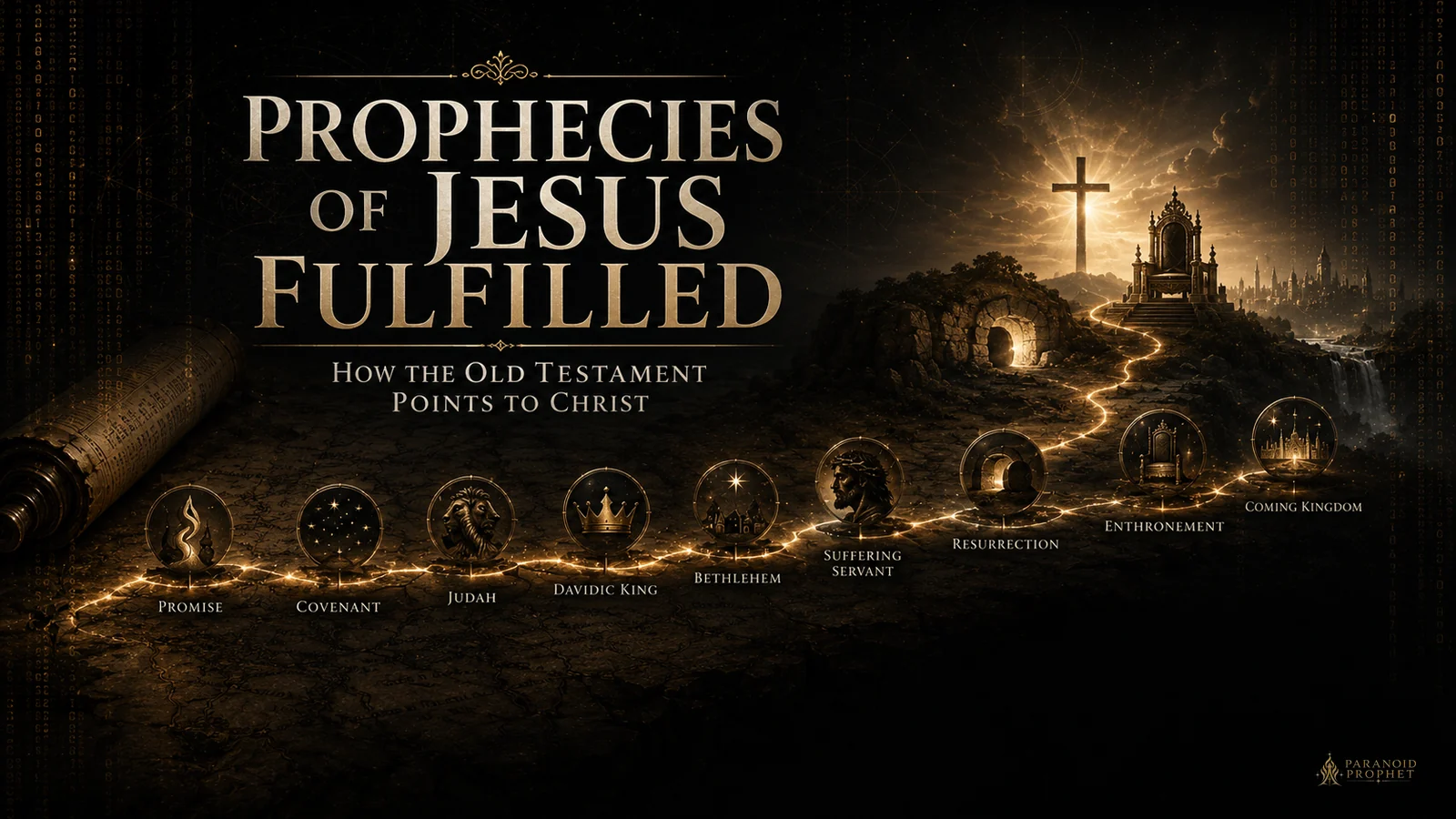
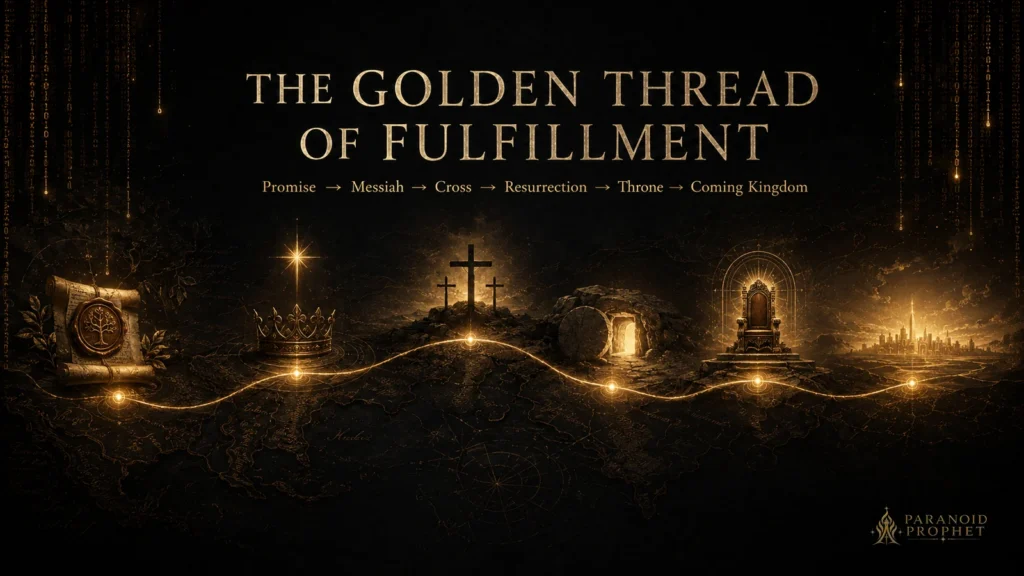
These theme studies give readers the detailed paths. Now we can step back and trace the larger prophecy route through Scripture: from promise, to Messiah, to cross, to resurrection, to throne, to coming kingdom.
The Prophecy Route Through Scripture
The Old Testament does not merely scatter predictions across disconnected books. It builds expectation. Promise leads to covenant. Covenant leads to kingship. Kingship leads to hope. Sacrifice points toward atonement. Exile creates longing for restoration. The prophets speak of judgment, mercy, suffering, renewal, resurrection, and kingdom. All of it moves toward Christ.
Jesus did not merely fit a list. He fulfills the storyline. He is the promised seed, the Son of Abraham, the Son of David, the Servant who suffers, the Lamb who takes away sin, the Lord who rises, the Son of Man who receives the kingdom, and the King who will return.
Fulfilled prophecy should therefore be read as more than a collection of isolated verses. The question is not only, “How many prophecies did Jesus fulfill?” The deeper question is, “How does the whole witness of Scripture lead us to Him?”
From Promise to Messiah
The prophecy route begins with promise. After the fall, Scripture speaks of the seed of the woman who will crush the serpent. The promise then moves through Abraham, through whom all the families of the earth will be blessed. It narrows through Judah, then through David, whose throne is tied to an enduring royal hope.
That narrowing does not shrink God’s purpose. It clarifies the path. The Messiah comes through Israel, but the blessing is never meant to stop with Israel. From the beginning, the promise aims toward the nations.
By the time the prophets speak of Bethlehem, Immanuel, the branch from David’s line, and the ruler whose kingdom will not end, the biblical hope has become intensely focused. The Messiah will be truly human, truly connected to Israel’s covenants, truly royal, and truly given for a purpose larger than national politics.
The manger is not the beginning of God’s plan. It is the arrival of the promised One inside the plan God had already been unfolding.
From Ministry to Rejection
The prophecy route does not stop with ancestry. The Messiah is also recognized by His mission. The Old Testament prepares readers for a messenger who prepares the way, a prophet like Moses, a King who comes humbly, and a servant anointed to bring good news, healing, liberty, and restoration.
That is why the ministry of Jesus matters. His preaching, miracles, mercy toward sinners, confrontation of hypocrisy, authority over evil, and command over creation are not random displays of power. They are kingdom signs. They reveal that God’s reign has broken into history through the person and work of Christ.
Yet Scripture also prepares readers for rejection. The righteous one is opposed. The stone is rejected by the builders. The servant is despised. The King is not received by all who hear Him. Jesus’ rejection does not disprove His messiahship. It exposes the blindness of those who refuse the King standing in front of them.
The same light that heals the blind also reveals the blindness of the proud. The Messiah reveals the kingdom, and then the kingdom exposes the heart.
From Suffering to the Cross
The cross was not a detour from messianic hope. It was the place where suffering, sacrifice, priesthood, kingship, and covenant promise met in one terrible and glorious hour.
Psalm 22 gives the language of the mocked and suffering righteous one. Isaiah 53 speaks of the servant who is despised, pierced, crushed, and yet somehow bears the sins of many. Zechariah 12:10 speaks of the pierced one who is mourned. The sacrificial system teaches the logic of blood, substitution, atonement, and mediation. Passover teaches deliverance through the death of the lamb.
These texts and patterns should be handled carefully. They should not be forced into cheap slogans, but they should not be softened either. The Old Testament repeatedly joins suffering, guilt-bearing, rejection, sacrifice, and vindication. The New Testament gathers those threads at the cross of Jesus Christ.
Christianity does not proclaim a Messiah who accidentally died before the real plan could happen. It proclaims the crucified Messiah as the center of the plan. The King conquers by giving Himself. The Priest offers the sacrifice. The Lamb is slain. The Servant bears sin. The rejected Stone becomes the cornerstone.
The cross is where prophecy becomes bloody, public, costly, and saving. It is not merely evidence that Jesus matches Scripture. It is the place where Scripture reveals why the Messiah came.
From Resurrection to the Throne
The prophecy route moves through death, but it does not end in death. The suffering Messiah is also the vindicated Messiah. Psalm 16 speaks of God’s Holy One not being abandoned to corruption. Jonah becomes a sign of death and deliverance. Isaiah 53 looks beyond the Servant’s suffering to His continued life, victory, and portion with the many.
The resurrection is not an optional add-on to prophecy. It is the public vindication of the suffering Messiah. The rejected One is not rejected by God. The crucified One is raised. The buried One lives. The One condemned by men is declared Lord by God.
Then the prophecy route rises from the empty tomb to the throne. Psalm 110 speaks of the Lord seated at God’s right hand. Daniel 7 speaks of the Son of Man receiving dominion, glory, and a kingdom. The right hand of God is not a symbol of retirement. It is the place of highest honor and active reign.
This matters because Jesus’ resurrection and exaltation are not separate from His messianic identity. The Messiah suffers, rises, ascends, and reigns. He is not merely remembered by His followers. He is enthroned as Lord.
From Redemption to New Covenant
The prophecy route is not only royal. It is also redemptive. Scripture does not merely identify the Messiah. It reveals what He came to accomplish: forgiveness, cleansing, covenant, redemption, and reconciliation with God.
Passover prepares the category of deliverance through the blood of the lamb. The priesthood prepares the category of mediation. The sacrifices prepare the language of atonement. The kinsman-redeemer pattern prepares the idea of rescue through a qualified redeemer who acts on behalf of another. The prophets speak of forgiveness, cleansing, new hearts, the Spirit, and the law written within God’s people.
Jesus gathers these lines into Himself. He is not only the teacher of the new covenant. He is its mediator. He is not only the preacher of forgiveness. He secures it by His blood. He is not only an example of holiness. He is the holy Redeemer who makes unholy people clean.
This keeps fulfilled prophecy from becoming a cold academic exercise. God kept His promises in a Savior who redeems, forgives, cleanses, and transforms.
From First Coming to Coming Kingdom
Some messianic prophecy is fulfilled in Jesus’ first coming. Some is inaugurated in His first coming and awaits final consummation at His return. That already-and-not-yet pattern protects the article from two errors: pretending nothing has been fulfilled, or pretending everything has already been visibly completed.
Jesus has come. He has suffered. He has risen. He has ascended. He reigns at the right hand of God. He is gathering His people from the nations by the gospel. Yet Scripture still speaks of final judgment, resurrection, restoration, renewed creation, and the visible triumph of the kingdom.
Psalm 2, Psalm 110, Daniel 7, Isaiah 11, Isaiah 65, Zechariah 12–14, and many other texts push the reader beyond the first coming toward the final reign of the King. The Christian confession is not only that Christ came once, but that Christ will come again.
The King has come. The King is reigning. The King will return.
That is the prophecy route through Scripture. Promise becomes Messiah. Ministry exposes rejection. Suffering leads to the cross. The cross leads to resurrection. Resurrection leads to enthronement. Redemption opens the new covenant. The kingdom has begun, and the kingdom will be consummated when Christ returns.
Prophecy gives the biblical map. But the Jesus Evidence case also asks how prophecy relates to history, the cross, the resurrection, and the identity of Christ. That is where this prophecy hub connects back to the larger question: who is Jesus?
How Prophecy Supports the Case for Jesus
Fulfilled prophecy is not a detached trick or a scoreboard of impressive numbers. It belongs inside the larger biblical case for Jesus Christ. Prophecy gives the map. The cross reveals the cost. The resurrection vindicates the Messiah. History supports public claims. Scripture defines who Jesus is.
That order matters. History can support the claim that Jesus of Nazareth existed, that He was crucified under Roman authority, and that His earliest followers proclaimed His resurrection very early. But history does not replace Scripture. Scripture reveals Jesus as Messiah, Son of God, Lord, Redeemer, Lamb of God, risen King, and coming Judge.
Prophecy strengthens the case by showing that the New Testament claim did not appear out of nowhere. The apostles did not present Jesus as a disconnected religious figure. They proclaimed Him as the fulfillment of Israel’s Scriptures: the promised seed, Davidic King, suffering Servant, crucified Savior, risen Lord, and Son of Man who receives the kingdom.
Scripture Reveals His Identity
The deepest question is not merely whether Jesus fulfilled a list of prophecies. The deepest question is who Jesus is.
The Old Testament prepares categories that the New Testament applies to Him: Son of David, Son of God, Son of Man, Prophet like Moses, priest-king, suffering Servant, Redeemer, Lord, and coming Judge. These are not decorative titles. They are biblical identity markers. They tell readers what kind of Messiah Scripture was preparing them to recognize.
That is why prophecy belongs inside the larger Jesus Evidence case. It does not merely say, “Jesus matched some predictions.” It shows that Jesus stands at the center of the biblical storyline. He fulfills the promises, offices, sacrifices, covenant hopes, resurrection hope, and kingdom expectations God had already revealed.
For the broader case that gathers history, prophecy, resurrection, divine identity, redemption, and Scripture, see Is Jesus the Son of God?.
History can tell us that Jesus was crucified. Scripture tells us why the cross matters. History can show that His followers proclaimed resurrection. Scripture tells us what resurrection means. Prophecy shows that the crucified and risen Jesus is not a surprise ending. He is the fulfillment of God’s promises.
History Supports Public Claims
The prophecy case should not be separated from the historical reality of Jesus. Christianity is not a claim suspended above history. It makes public claims: Jesus lived, taught, was crucified under Roman authority, and was proclaimed risen by His earliest followers.
Historical evidence can support several important claims. Jesus was a real first-century Jewish teacher. He was crucified under Roman authority. His followers proclaimed very early that God raised Him from the dead. The movement did not begin as a vague moral philosophy, but as a public proclamation about Jesus crucified and risen.
That matters for prophecy because fulfilled prophecy is not about an imaginary figure being fitted into ancient texts. The Christian claim is that the Jesus who stands in history is the same Jesus to whom Scripture bears witness.
For the public historical foundation, see Historical Evidence for Jesus.
This distinction protects the argument from overclaiming. History can support public claims. Scripture carries doctrinal authority. Prophecy shows biblical continuity. The resurrection publicly vindicates the rejected and crucified Messiah.
The Resurrection Vindicates the Messiah
The resurrection is where the prophecy case becomes impossible to treat as merely literary. If Jesus remained in the grave, messianic claims about His suffering, Sonship, kingdom, and lordship would collapse. But the New Testament proclaims that God raised Him from the dead, vindicating the One rejected by men.
The resurrection does not cancel the cross. It interprets it. The crucified Messiah was not abandoned by God. The suffering Servant lives. The rejected Stone becomes the cornerstone. The Lord who was mocked is enthroned. The Son of Man receives the kingdom.
This is why resurrection prophecy matters. Psalm 16, Jonah, Isaiah 53, Psalm 110, and Daniel 7 do not all work the same way, but together they help readers see that suffering, vindication, life, exaltation, and kingdom belong together in the biblical witness to Christ.
For a focused study of this lane, see Prophecies of Jesus’ Resurrection.
Prophecy prepares the reader for the Messiah. The cross reveals His mission. The resurrection vindicates His identity. The throne declares His reign.
Objections and Cautions About Messianic Prophecy
A strong prophecy hub should not pretend there are no objections. Some readers question whether Christians are reading Jesus back into the Old Testament. Many Jewish interpreters reject Christian messianic conclusions. Some prophecy lists overstate the evidence. Some typological claims are mishandled. These objections should be answered honestly, not brushed aside.
Careful answers do not weaken the case for Christ. They keep the witness honest. The goal is not to protect a chart from criticism. The goal is to bear faithful witness to Jesus.
Are Christians Reading Jesus Back Into the Old Testament?
Christians do read the Old Testament in light of Jesus. The New Testament teaches us to do that. Jesus Himself taught that the Scriptures bear witness to Him, and the apostles preached Him as the fulfillment of the Law, the Prophets, and the Writings.
But Christ-centered reading is not permission to make any verse mean anything. The Christian claim is not that Jesus can be inserted randomly into disconnected passages. The claim is that the Old Testament already contains promises, patterns, offices, sacrifices, kingdom hopes, and prophetic trajectories that find their appointed goal in Christ.
The question is not whether Christians read the Old Testament in light of Jesus. They do. The question is whether Jesus is the rightful fulfillment of the story the Old Testament was already telling.
Why Do Many Jewish Readers Reject Jesus as Messiah?
Many Jewish readers reject Jesus as Messiah because they do not accept the New Testament’s claims about Him. They also read key passages differently, including Isaiah 7:14, Isaiah 53, Psalm 110, Daniel 7, and other texts Christians connect to Jesus.
Some objections focus on context. Some focus on translation. Some argue that the servant in Isaiah refers to Israel rather than an individual Messiah. Others emphasize kingdom promises that do not yet appear visibly complete, expecting the Messiah to bring peace, judgment, national restoration, and worldwide recognition of God’s reign.
Christian interpretation must be firm without pretending Jewish objections are imaginary. The Christian answer is not that kingdom promises disappeared or became meaningless. The Christian answer is that Jesus inaugurated the kingdom in His first coming and will consummate it at His return. He has come as suffering Servant and Redeemer. He will return as Judge and King.
That already-and-not-yet pattern does not erase the Old Testament hope. It explains why the Messiah can suffer before He reigns visibly over all things.
Are All 351 Items Direct Predictions?
No. They should not be presented that way.
Some items in the 351 list are direct messianic promises. Others are explicit New Testament fulfillment texts, typology, covenant patterns, messianic offices, sacrificial shadows, kingdom hopes, or future fulfillment passages. Some are debated and need careful handling.
The list is helpful only when those categories are protected. If everything is called a direct prediction, the argument becomes less credible. If each passage is handled according to its own literary, biblical, and theological context, the case becomes stronger.
Does Fulfilled Prophecy Prove Christianity by Itself?
Fulfilled prophecy is powerful, but it is not a stand-alone trick. It is one strand in a larger biblical and historical case for Christ.
Prophecy shows that Jesus stands in continuity with the Old Testament Scriptures. The Gospel accounts proclaim His life, death, and resurrection. The apostolic witness declares Him risen and exalted. Historical evidence supports important public claims. Scripture reveals His identity and the meaning of His work.
That cumulative case matters. Fulfilled prophecy should lead the reader to Christ, not merely to amazement at a list. The aim is not for readers to say, “That number is impressive.” The aim is for readers to see that God kept His word in Jesus.
What Should Christians Avoid When Using Prophecy?
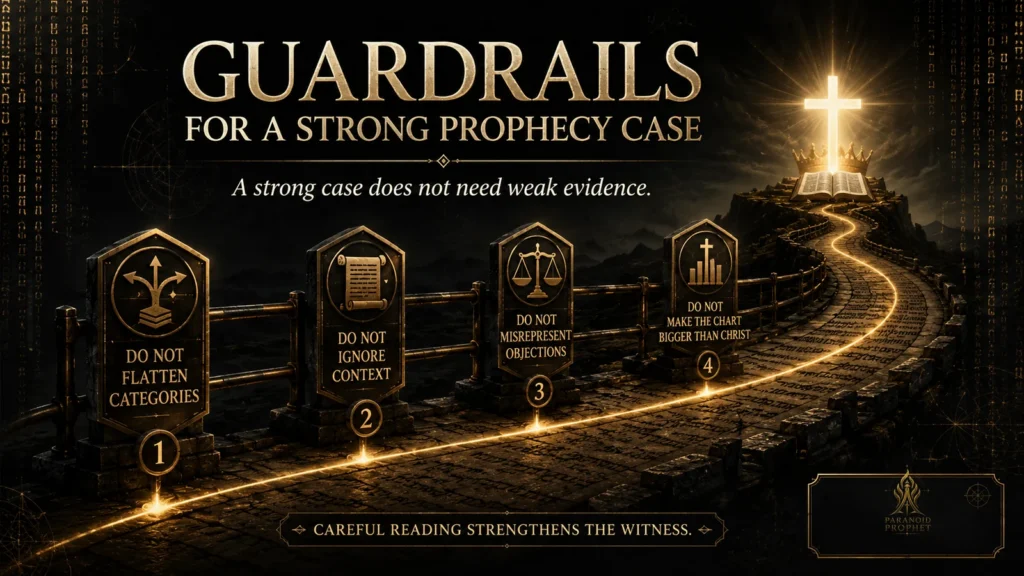
Christians should avoid prophecy arguments that sound impressive but collapse under careful reading. A faithful case should not depend on inflated counts, ignored context, careless typology, or pretending disputed texts are simple when they are not.
When using messianic prophecy, avoid these mistakes:
- treating every item in a 351 list as a direct prediction;
- using typology without explaining how typology works;
- ignoring the original Old Testament context;
- misrepresenting Jewish objections;
- speaking as if every kingdom promise is already visibly complete;
- using weak claims because they sound dramatic;
- letting the chart become more important than Christ.
For more on how this site weighs Scripture, sources, disputed claims, and corrections, see Sources & Verification.
The point is not to win a counting contest. The point is to bear faithful witness to Jesus Christ.
Frequently Asked Questions About Prophecies of Jesus
These questions give direct answers to common search-intent issues around fulfilled prophecy, the 351 count, direct prediction, typology, birth, death, resurrection, future fulfillment, and Jewish objections.
How many prophecies did Jesus fulfill?
Christians often cite many Old Testament prophecies fulfilled by Jesus, and some study lists collect more than 300 passages. One common list gives 351 Old Testament passages connected to Christ. The exact number depends on how direct prophecy, New Testament fulfillment, typology, covenant patterns, messianic titles, and future kingdom promises are counted.
The number matters less than the witness itself. The Old Testament repeatedly points toward the Messiah through promise, sacrifice, kingship, suffering, resurrection hope, divine authority, redemption, and kingdom expectation.
Did Jesus fulfill 351 Old Testament prophecies?
The 351 number comes from a compiled study list, not from a verse in the Bible. The list can be useful because it gathers many Old Testament passages Christians have connected to Jesus. But the number should not be treated as inspired, and the items should not all be presented as independent direct predictions.
Use the 351 list as a study map, not as an authority over the text.
Are all 351 prophecies direct predictions?
No. Some Old Testament passages are direct messianic promises. Others point to Jesus through typology, covenant patterns, messianic titles, New Testament application, or future kingdom hope. Some texts are debated and require careful handling.
A strong prophecy case explains the kind of fulfillment being claimed instead of flattening every passage into the same category.
What are the strongest Old Testament prophecies about Jesus?
Some of the strongest Old Testament prophecy texts in the Christian case include Micah 5:2, Isaiah 52:13–53:12, Psalm 22, Psalm 16, Psalm 110, Daniel 7:13–14, Zechariah 9:9, and Zechariah 12:10. These passages connect to Jesus’ birthplace, suffering, crucifixion, resurrection, enthronement, kingly rule, humble arrival, and piercing.
These texts do not all work the same way, but together they form a serious biblical witness to the Messiah who suffers, redeems, rises, reigns, and receives the kingdom.
What prophecies did Jesus fulfill at His birth?
Jesus’ birth connects to the promised seed of the woman, the offspring of Abraham, the ruler from Judah, the Son of David, the child connected to Immanuel, and the ruler born in Bethlehem.
Important passages include Genesis 3:15, Genesis 12:1–3, Genesis 49:10, 2 Samuel 7:12–16, Isaiah 7:14, and Micah 5:2. For a focused study, see Prophecies About Jesus’ Birth.
What prophecies did Jesus fulfill in His death?
Jesus’ death connects to the rejected righteous sufferer, the suffering Servant, the pierced One, and the sacrificial patterns of the Old Testament. Psalm 22 gives language of mockery and suffering. Isaiah 53 speaks of the Servant who bears sin. Zechariah 12:10 speaks of the pierced One. Passover and the sacrificial system prepare the categories of blood, substitution, atonement, and deliverance.
The cross was not a failure of prophecy. It was where suffering, sacrifice, priesthood, kingship, and redemption met. For a focused study, see Messianic Prophecies of Jesus’ Suffering and Crucifixion.
What Old Testament passage points to Jesus’ resurrection?
Psalm 16:8–11 is one of the clearest Old Testament passages connected to Jesus’ resurrection in apostolic preaching. Peter and Paul apply it to Christ, arguing that God’s Holy One was not abandoned to corruption. Jonah also becomes a sign of death and deliverance. Isaiah 53:10–12 looks beyond the Servant’s suffering to His continued life and victory.
Psalm 110 and Daniel 7 then move the resurrection hope toward enthronement and kingdom authority. For a focused study, see Prophecies of Jesus’ Resurrection.
Are some prophecies about Jesus still future?
Yes. Christian prophecy interpretation includes both fulfillment and future consummation. Jesus has come, suffered, risen, ascended, and begun His reign. But Scripture also speaks of final judgment, resurrection, restoration, visible kingdom triumph, and new creation.
This already-and-not-yet pattern explains why Jesus can truly fulfill messianic prophecy in His first coming while some kingdom promises await His return. For a focused study, see Eschatological Prophecies of Jesus.
Why do many Jewish readers reject Jesus as Messiah?
Many Jewish readers reject Jesus as Messiah because they do not accept the New Testament’s claims about Him and often read key Old Testament texts differently. Important disputed passages include Isaiah 7:14, Isaiah 53, Psalm 110, Daniel 7, and other texts Christians connect to Jesus.
Some objections emphasize visible kingdom promises that do not yet appear complete. The Christian answer is that Jesus inaugurated the kingdom in His first coming and will consummate it at His return.
Does fulfilled prophecy prove Jesus is the Messiah?
Fulfilled prophecy is a major part of the Christian case, but it should be understood as part of a cumulative witness. Prophecy shows continuity between the Old Testament and Jesus. The Gospels proclaim His life, death, and resurrection. Historical evidence supports important public claims. The resurrection vindicates the rejected and crucified Messiah. Scripture reveals His identity and the meaning of His work.
Prophecy should lead readers to Christ, not merely to amazement at a list. The point is not that a number is impressive. The point is that God kept His word in Jesus.
Continue Studying the Prophecies of Jesus
Use the links below as the next step after this overview.
Prophecy Theme Studies
- Prophecies About Jesus’ Birth
- Prophecies About Jesus’ Ministry
- Prophecies of Jesus’ Betrayal and Rejection
- Messianic Prophecies of Jesus’ Suffering and Crucifixion
- Prophecies of Jesus’ Resurrection
- Prophecies of Jesus’ Divine Identity
- Messianic Prophecies of Jesus the Redeemer
- Eschatological Prophecies of Jesus
Jesus Evidence Studies
Site Sources and Verification
Sources and Further Reading
This article uses Scripture as the foundation. Because Scripture is treated as final authority, the Scripture list comes first. Outside resources are included only as study aids for prophecy lists, biblical theology, New Testament use of the Old Testament, historical context, and fair examples of disagreement. They do not replace Scripture’s authority.
Scripture Foundations
- Promise and covenant: Genesis 3:15; Genesis 12:1–3; Genesis 49:10; 2 Samuel 7:12–16.
- Psalms: Psalm 2; Psalm 16; Psalm 22; Psalm 45; Psalm 69; Psalm 110; Psalm 118.
- Prophets: Isaiah 7; Isaiah 9; Isaiah 11; Isaiah 35; Isaiah 52:13–53:12; Isaiah 61; Jeremiah 31:31–34; Ezekiel 36:25–27; Daniel 7; Micah 5:2; Zechariah 9; Zechariah 11; Zechariah 12.
- New Testament fulfillment and interpretation: Matthew 1–2; Luke 4; John 19; Acts 2; Acts 13; 1 Corinthians 15; Hebrews 1; Hebrews 7–10.
Study Lists and Biblical Theology
- 351 Old Testament Prophecies Fulfilled in Jesus Christ — useful as a compiled study list, not as inspired authority.
- BibleProject: How Does the Bible’s Story Lead to Jesus? — helpful for seeing the Bible as a unified story that leads to Christ.
- G. K. Beale, Handbook on the New Testament Use of the Old Testament — useful for studying how the New Testament interprets and applies the Old Testament.
- Jews for Judaism: Isaiah 53 — A Jewish Perspective — useful for understanding a major Jewish objection to the Christian reading of Isaiah 53.
The Prophecies of Jesus Lead to Christ
The final point of prophecy is not a number. It is a Person.
The 351-item list can be useful as a study guide, but it is not the authority. Scripture is the authority. A chart can help organize passages, but the Bible itself bears witness to Christ through promise, covenant, sacrifice, kingship, suffering, resurrection hope, divine identity, redemption, and kingdom expectation.
Jesus does not merely fit a list of predictions. He fulfills the storyline. He is the promised seed, the Son of Abraham, the Lion from Judah, the Son of David, the ruler from Bethlehem, the Prophet like Moses, the suffering Servant, the rejected Stone, the pierced One, the Lamb of God, the Redeemer, the risen Lord, the Son of Man, the priest-king at God’s right hand, and the coming Judge.
That is why messianic prophecy should be handled with both confidence and care. Confidence, because God has spoken and kept His word in Christ. Care, because not every passage works the same way. Some texts are direct promises. Some are apostolic fulfillment texts. Some are typology. Some are covenant patterns. Some are future kingdom promises. Some are debated. A faithful Christian case does not need to flatten those categories. Scripture is strong enough to be read honestly.
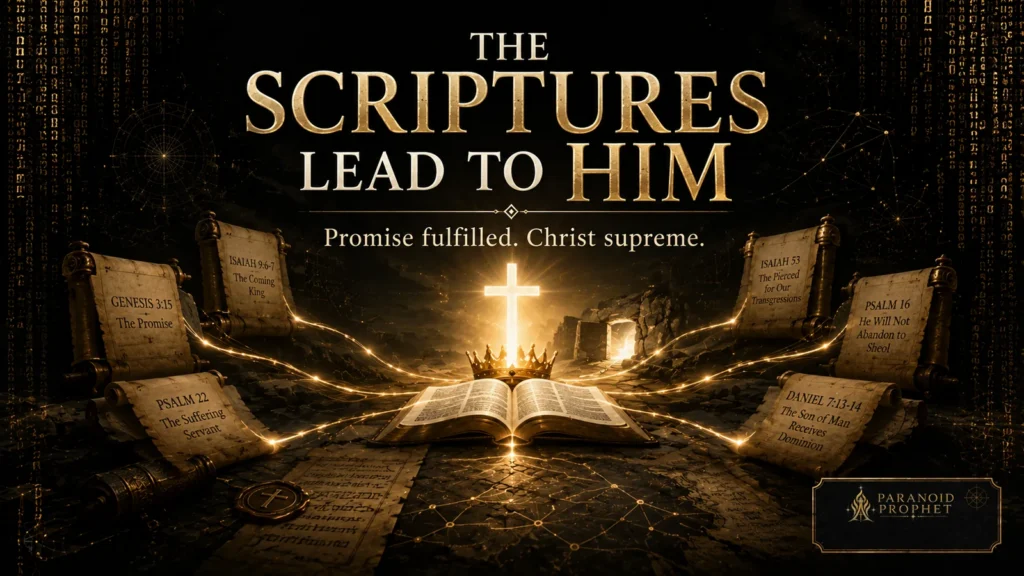
The Old Testament gives the map. The Gospels show the Messiah walking into history. The cross reveals the cost of redemption. The resurrection vindicates the rejected King. The ascension declares His reign. The new covenant announces forgiveness and transformation. The promised kingdom still moves toward its final visible consummation when Christ returns.
Prophecy does not lead us merely to an argument. It leads us to Jesus Christ: crucified for sinners, risen from the dead, reigning at the right hand of God, and coming again in glory.
The Scriptures do not merely point beyond themselves. They point to Him.
CONTINUE THE INVESTIGATION
Recommended continuation
25 Jesus Birth Prophecies Fulfilled in the Bible
Begin a chronological prophecy study with the promises Christians understand as fulfilled in Jesus’ birth and lineage.