
GUIDED ARTICLE EXPERIENCE
The Unseen Rebellion Map: Satan, Watchers, Demons, Nephilim, and Rebel Powers
Read along as the narration moves through the article.
Private device narration · No hosted audio or tracking
CONTINUE GUIDED TOUR
Continue where you left off.
GUIDED TOUR COMPLETE
You have reached the end of this study.
Study record saved on this device.
GUIDED TOUR
The Unseen Rebellion Map: Satan, Watchers, Demons, Nephilim, and Rebel Powers
Narrator: Paranoid Prophet Recommended Voice Native device narration
Prepare to follow the article as it is narrated.
VOICE & TOUR OPTIONS
Voice & Listening
NARRATOR
Finding a narrator…
Checking the best narrator available on this device.
Restores the best curated narrator available on this device.
Narrator choices are curated for clear, long-form listening on this device.
Screen-awake support will be checked when narration starts.
CHOOSE A NARRATOR
Curated for this device
Choose a verified narrator for this browser, or use System Narrator. Automatic mode uses the best reliable route exposed by this device; your chosen narrator is preserved even if this device needs a temporary fallback.
Preparing the guided article experience…
RESUME GUIDED TOUR?
Continue where you left off.
GUIDED TOUR COMPLETE
You have reached the end of this study.
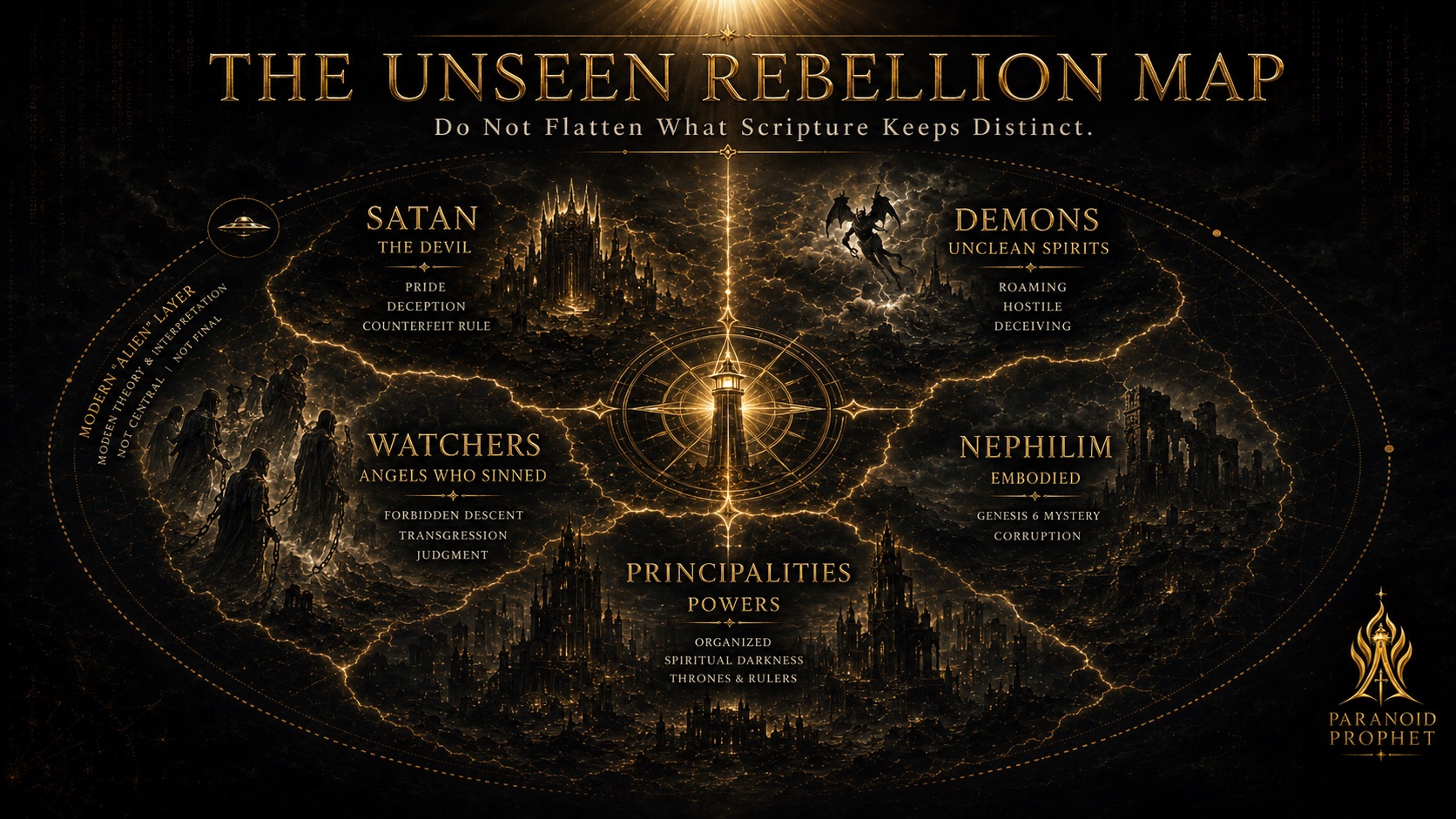
The unseen realm is real, but wisdom refuses to flatten what Scripture keeps distinct. Satan, demons, angels who sinned, Watchers, Nephilim, rulers and authorities, false gods, and modern claims about aliens or nonhuman intelligence often enter the same conversation. They do not all come from the same source level, name the same kind of being, or describe the same role.
Category collapse begins when similarity is treated as identity. Demons become fallen angels. Fallen angels become Watchers. Watchers become Nephilim. Nephilim become aliens. Every principality becomes a possessing spirit, every false god receives a tidy demonic name, and Satan becomes shorthand for the entire rebellion. That is not discernment. It is category collapse.
The Unseen Rebellion Map is a Scripture-governed field guide for avoiding that mistake. It identifies the major categories, marks the confidence level behind disputed relationships, shows where categories overlap without becoming interchangeable, and routes deeper questions to the correct studies. It maps what readers can responsibly say, not every hidden rank in the invisible world.
The core rule is simple: Related does not mean identical. Two beings may participate in the same rebellion without sharing the same origin or present condition. Two texts may stand in the same interpretive neighborhood without saying precisely the same thing. A modern story may echo an ancient pattern without proving that the same actors are involved.
Source order therefore matters. Scripture defines what Christians are required to believe. Ancient Jewish sources can show how biblical passages were interpreted and expanded. Modern labels can describe observations, claims, and cultural stories, but they remain downstream. When those levels are reversed, Enoch begins ruling Genesis, disclosure language begins ruling angelology, and unresolved experiences begin writing doctrine.
This map also begins with a positive truth: not every heavenly being is rebellious. Scripture portrays a created heavenly host, court, and assembly within which some beings serve faithfully and others oppose God. The rebellion matters because it takes place inside an ordered creation whose uncreated Lord remains incomparable. Every visible and invisible power is accountable to him and ultimately subject to Jesus Christ.
That makes the article a confidence map as much as a category map. A reader should be able to see where the Bible speaks directly, where an interpretation joins several texts, where ancient literature supplies a name or storyline, and where a modern theory enters. The goal is not permanent uncertainty. It is proportion: strong conclusions where the source is strong, honest qualification where the relationship is reconstructed, and restraint where evidence runs out.
Article Guide11 sections
What Is the Unseen Rebellion Map?
The Unseen Rebellion Map is a taxonomy and routing guide. It does not claim to be a complete hierarchy of the invisible world, a list of separate spiritual species, a chart of exact locations, or proof that every mystery has been solved. Its purpose is more useful and more modest.
- Identify categories: preserve the different biblical and ancient terms rather than pushing them into one dark category.
- Mark source confidence: distinguish direct biblical teaching, strong or debated inference, ancient context, and modern interpretation.
- Show relationships and limits: explain meaningful overlaps while stating where identity has not been established.
- Route deeper questions: direct readers to the cluster article that owns each full argument.
A good map does not replace the road. It shows the road. This article can define the sons of God, Watchers, Nephilim, demons, or rulers well enough to place them. It should not repeat the complete exegetical case for each one. The dedicated studies supply that depth.
The map is also relational rather than merely alphabetical. The important questions are not only “What does this term mean?” but also “What source names it?” “How certain is the proposed relationship?” and “What should remain distinct?” Those questions turn a collection of strange words into a disciplined Christian framework.
Readers can use the map in either direction. Begin with a biblical term and follow its strongest relationships outward, or begin with a modern claim and move backward until reaching the first firm biblical category. In both cases, each step should remain visible. If an argument crosses from Scripture to ancient reception to modern application without marking the crossings, the map has exposed its central weakness.
The map is deliberately incomplete in another sense: it gives more attention to categories that affect interpretation and discernment than to speculative hierarchies. Scripture’s purpose is not to satisfy curiosity about every rank. It reveals enough for worship, resistance to evil, wise judgment, and confidence in God’s reign.
The Map Key: Scripture, Ancient Context, and Modern Theory
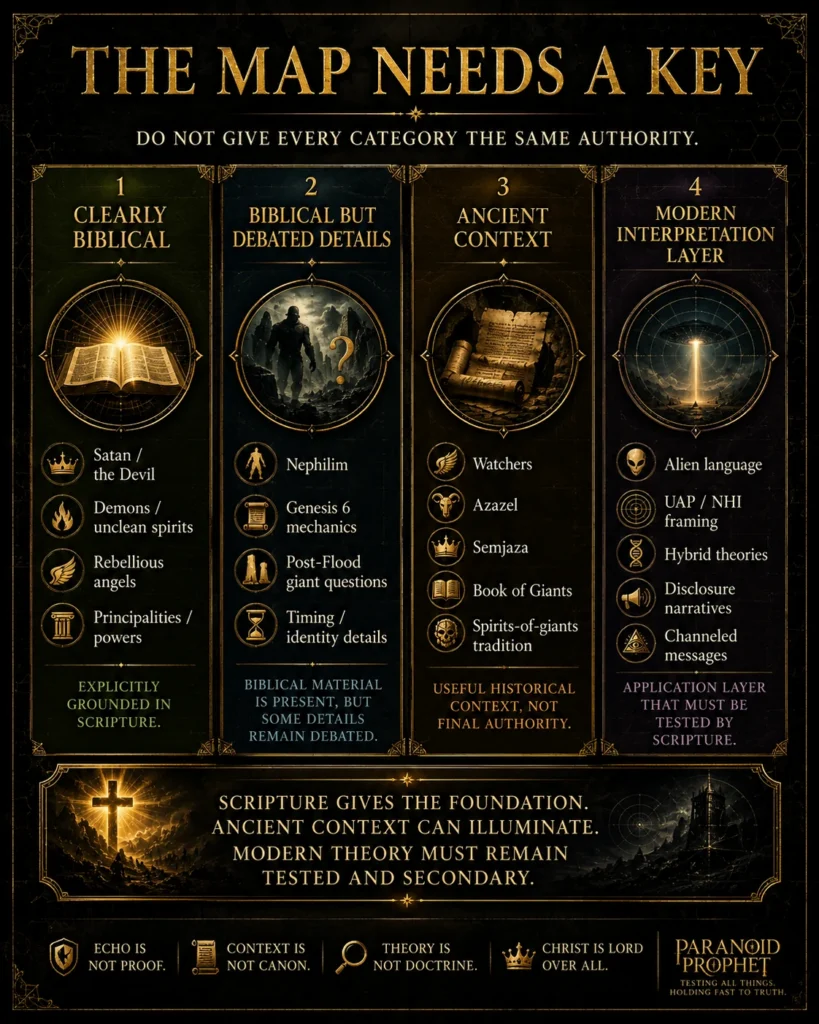
Not every term on the map carries the same authority. The confidence key prevents a modern label, an ancient expansion, and a direct biblical category from being presented as though they were three equally certain facts.
Level One: Scripture Clearly Names
Scripture directly presents Satan or the devil, Satan’s angels, angels who sinned, demons and unclean spirits, the heavenly host and heavenly assemblies, rulers and authorities, thrones and dominions, spiritual forces of evil, the Nephilim, giant-associated peoples, false worship with demonic participation, and several uses of the word spirit.
Direct naming does not mean every relationship is fully explained. The Bible names demons and sinning angels without stating one technical origin for every demon. It names thrones and authorities without making every such order evil. Confidence should be firm about the category and careful about conclusions the category alone cannot bear.
Level One also includes distinctions inside the category. The heavenly host is real, but Scripture does not portray the entire host as fallen. Rulers and authorities are created orders before hostile contexts identify particular rulers as evil. The word spirit is biblical, but its identity changes from passage to passage. Direct language must still be interpreted in context.
Level Two: Strong Biblical Inference or Debated Interpretation
This level includes the heavenly-being interpretation of the sons of God in Genesis 6, the connection of Jude 6 and 2 Peter 2:4 with that rebellion, the identification of First Peter’s spirits in prison with Noah-era rebels, later giants as part of Nephilim continuity, some territorial princes as rebellious heavenly rulers, and demons as part of Genesis 6’s aftermath.
Many of these readings are strong, ancient, and coherent. “Debated” does not mean useless or barely possible. It means the claim includes interpretive work and should be stated at the confidence the evidence supports. Connection is not identity.
For example, Jude’s abandoned angels, the sexual transgression in the neighboring Sodom example, Peter’s Noah sequence, and Enochic reception make a Genesis 6 connection persuasive to many readers. The connection still differs from the direct statement “Jude is explaining Genesis 6,” which the letter never writes. The map can call the relationship strong without disguising the inferential step.
Level Three: Ancient Interpretive Context
Enochic literature identifies the Genesis 6 rebels as Watchers and adds Semjaza, Azazel, the Hermon oath, expanded lists of forbidden teaching, the binding of the Watchers, and spirits proceeding from dead giants. Jubilees and the Book of Giants preserve related developments. These sources reveal how influential Jews interpreted heavenly rebellion before and around the New Testament period.
Precision matters even with the label watcher. Daniel 4 uses “watcher” for a holy heavenly figure. Genesis 6 calls its actors sons of God, not Watchers. The specific rebel-Watcher framework tied to Genesis comes primarily through Enochic interpretation. Ancient context is not canon.
Ancient context is also plural rather than perfectly uniform. First Enoch, Jubilees, and the Book of Giants share a world of Watcher and giant traditions while arranging details differently. Their agreement can demonstrate the antiquity and influence of an interpretation. Their differences warn against treating “the ancient view” as one seamless extra chapter of Scripture.
Level Four: Modern Labels and Discernment
Alien, NHI, UAP, interdimensional entity, disclosure, and alien-gospel language belongs at the modern layer. UAP is an observation category for something not yet identified. NHI is a broad claim about nonhuman agency. Alien commonly implies an extraterrestrial interpretation. None is a biblical identity category.
A modern label may describe the story being told without identifying the being behind it. Such language may document a report or worldview, but it cannot replace demon, angel, Watcher, Nephilim, or principality as though the Bible used those terms interchangeably. Modern theory is not doctrine.
This level can still contain real evidence. A UAP report may be carefully documented, and a witness may sincerely describe apparent nonhuman agency. The map does not dismiss the observation. It separates observation from ontology. “Unidentified” names the present limit of explanation; it does not grant permission to import a biblical or extraterrestrial identity without further evidence.
The governing order appears once and controls the entire map: Scripture first, ancient context second, modern theory last.
The Main Biblical Categories
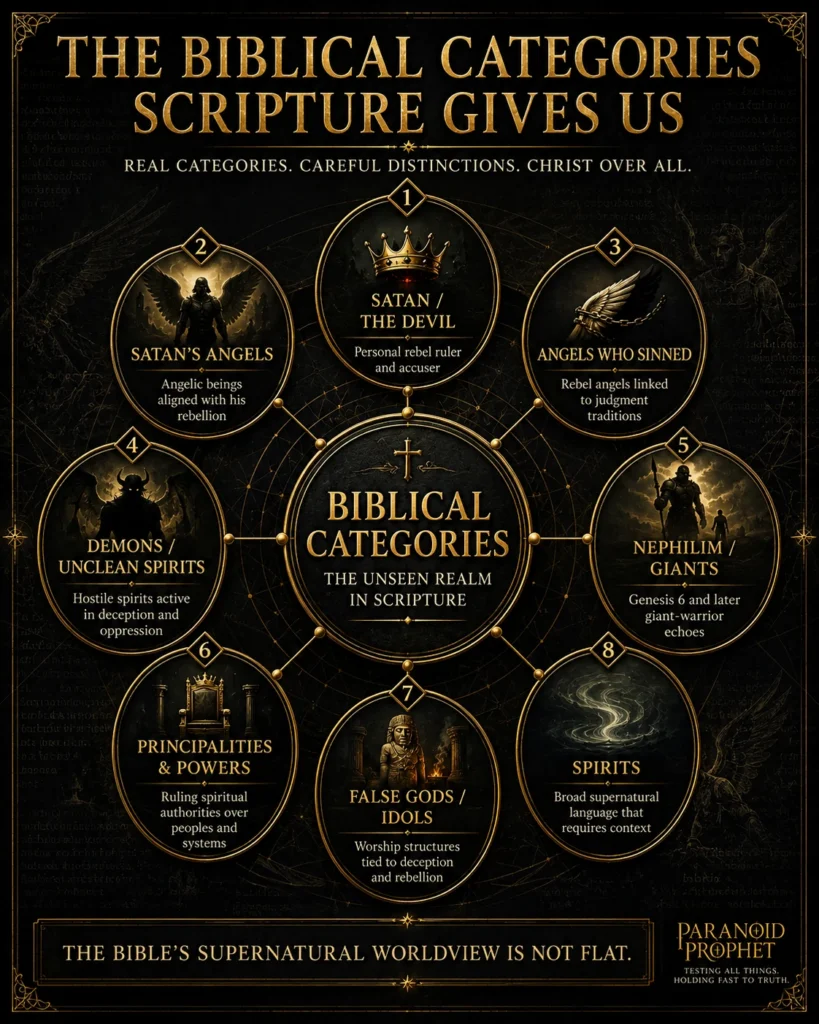
The direct biblical layer is not a flat list of dark beings. It includes faithful heavenly servants, rebels under different conditions, embodied enemies, hostile spirits, authority language that changes with context, and idolatrous worship that can involve more than a carved object.
The Heavenly Host and Divine-Council Background
Scripture depicts an ordered heavenly realm before it maps rebellion. Job 1-2, 1 Kings 22, Psalm 82, and Daniel 7 portray heavenly-court or assembly scenes. The host of heaven can serve God; holy ones attend his court; heavenly messengers carry out assignments. The map concerns rebellion within that larger created order, not an invisible realm in which every inhabitant is corrupt.
“Sons of God,” heavenly host, angels, holy ones, rulers, authorities, and elohim language should not be treated as automatic synonyms. Context determines whether a term names identity, office, location, allegiance, or a broad class of spiritual beings. A divine council does not mean a parliament of equal gods. The God of Israel is uncreated, incomparable, and sovereign; every other being is created, contingent, and accountable.
First Kings 22 is especially useful for the guardrail. Micaiah sees the Lord enthroned with the host standing around him. The scene includes deliberation and a spirit volunteering for an assignment, yet the Lord remains the enthroned judge whose word determines the outcome. Heavenly participation does not dilute sovereignty. Daniel 7 likewise surrounds the Ancient of Days with a vast court while the Son of Man receives dominion by divine decree.
Psalm 82’s assembly and elohim language has been read through heavenly rulers, human rulers, or a relationship between the two. Whatever position one takes on every detail, the psalm does not place its judged figures beside God as equals. He stands in judgment over them, condemns corrupt rule, and claims the nations. The council scene magnifies his supremacy.
Satan and His Angels
Satan appears as adversary, accuser, tempter, deceiver, and the ancient serpent. He opposes God’s people, tempts Jesus, and deceives the nations. Scripture also speaks of “the devil and his angels” in Matthew 25:41 and portrays the dragon and his angels in Revelation 12. These rebels share Satan’s opposition and final judgment.
Satan is neither God’s equal nor the personal name of every rebel power. Demons are not simply “Satan”; the Watchers are not another name for him; rulers and authorities should not all be absorbed into his individual identity. Lucifer vs. the Watchers owns the fuller comparison.
The New Testament holds his present activity and decisive defeat together. Satan tempts, accuses, deceives, and prowls, but believers are commanded to resist him rather than treat him as irresistible. Jesus speaks of the ruler of this world as judged. Revelation gives his rebellion a final horizon, not an endless rivalry. His remaining activity occurs inside a sentence already secured by Christ’s victory.
Angels Who Sinned
Jude 6 and 2 Peter 2:4 describe angels who transgressed, abandoned a proper boundary, and are kept under gloomy restraint until judgment. First Peter 3 may refer to related “spirits in prison” from Noah’s days, though that passage has several major interpretations.
The connection with Genesis 6 and the Enochic Watchers is historically strong and textually coherent, but Jude and Peter use biblical angel language rather than supplying Enoch’s complete cast. Their present restraint also differs from the active demons encountered in the Gospels. Where Are Demons and Fallen Angels Now? develops that status distinction.
Jude and Peter use the restrained angels as evidence that privilege cannot shield rebellion from judgment. Their purpose is pastoral warning, not hidden-world cataloging. The map should preserve that emphasis: the category tells readers that angelic sin is real, boundary violation is judged, and divine custody cannot be escaped.
Demons and Unclean Spirits
The Gospels frequently use demon and unclean spirit for the same hostile spiritual agents. They speak, recognize Jesus, afflict people, resist departure, fear confinement, and obey Christ’s command. Matthew 12 and Luke 11 portray an unclean spirit seeking rest and returning to a “house”; the Gerasene spirits seek access to pigs.
Those narratives suggest a desire for habitation, embodied access, or continued influence, but they do not offer a complete metaphysical account of why. Nor do they identify every demon as one of the restrained angels. The ancient spirits-of-giants view offers one explanation; Scripture itself leaves the universal origin question open.
The Gospel focus remains the authority and compassion of Jesus. Unclean spirits identify him, fear appointed confinement, and leave when commanded. People are restored to community and soundness. A sound taxonomy should not reverse that emphasis by making demonic behavior more interesting than the King who overcomes it, or by diagnosing every illness, hardship, or unusual experience as demonic.
Rulers, Authorities, Powers, Thrones, and Dominions
These terms can describe orders, offices, spheres of authority, or powers, and they are not always evil. Colossians 1 places every throne, dominion, ruler, and authority within Christ’s creation. Ephesians 6 identifies hostile rulers and spiritual forces of evil, while Colossians 2 announces their disarmament through the cross. Context determines allegiance.
Daniel 10 adds conflict involving the “prince” of Persia, the “prince” of Greece, and Michael, a chief prince. That scene supports a wider spiritual dimension to national conflict. It does not make “power” a lexical synonym for a dark spirit behind every institution or human system.
Paul’s language is flexible because authority language can describe created order as well as rebellion within it. Romans 8 can list rulers among powers unable to separate believers from God’s love; Ephesians 1 places every rule beneath the exalted Christ; Ephesians 6 identifies hostile rulers against whom the church stands. The adjective, argument, and larger context tell readers whether a power is faithful, neutral, or rebellious.
It is reasonable to infer that spiritual rebellion can influence cultures, systems, and authorities. It is less responsible to assign a named principality behind every city, institution, or political movement. The map supports prayerful awareness of a larger conflict while refusing an occult-style hierarchy built from speculation.
Nephilim and Giant-Associated Peoples
Nephilim appear in Genesis 6:4 and Numbers 13:33. Later Scripture preserves giant-associated peoples and figures through the Anakim, Rephaim, Og, and warriors from Gath. Not every giant is explicitly called a Nephilim, and the biblical texts do not provide a complete genealogy connecting every group.
These are embodied figures or peoples, not a synonym for demons. Who Were the Nephilim? owns the identity question. Did the Nephilim Survive the Flood? distinguishes the post-Flood giant trail from ancient theories about spiritual aftermath.
The Flood is the hinge between those lanes. Genesis 7 makes simple bodily survival outside the ark difficult, while Genesis 6:4 anticipates an “afterward” and Numbers 13 connects Anakim with Nephilim language in the Hebrew text. Continuity is biblically indicated more clearly than its mechanism is revealed. That question should not be answered by importing the Enochic spirits-of-giants theory, which concerns dead spirits rather than later embodied clans.
False Gods, Idols, and Context-Dependent Spirit Language
A crafted idol has no divine life in wood, stone, or metal, yet idolatry is spiritually serious. Deuteronomy 32, Psalm 106, and 1 Corinthians 10 connect pagan sacrifice with demons. Psalm 82 portrays God judging figures called elohim within assembly language. False worship can therefore involve real hostile participation without validating a pagan story about its gods.
Pagan mythology is not a trustworthy directory of the unseen realm, and every divine name should not be assigned automatically to one identifiable demon. The broader word spirit also changes with context: the Holy Spirit, the human spirit, ministering spirits, unclean spirits, spirits in prison, and spiritual forces are not one paranormal category. Context determines the identity.
First Corinthians 10 holds two truths together: an idol is nothing as a supposed god, and pagan sacrifice can still involve demons. The object does not become divine, but worship is never spiritually neutral. This distinction protects biblical monotheism while taking idolatry seriously. It also prevents pagan claims from gaining authority merely because hostile spirits may exploit them.
What Ancient Context Adds
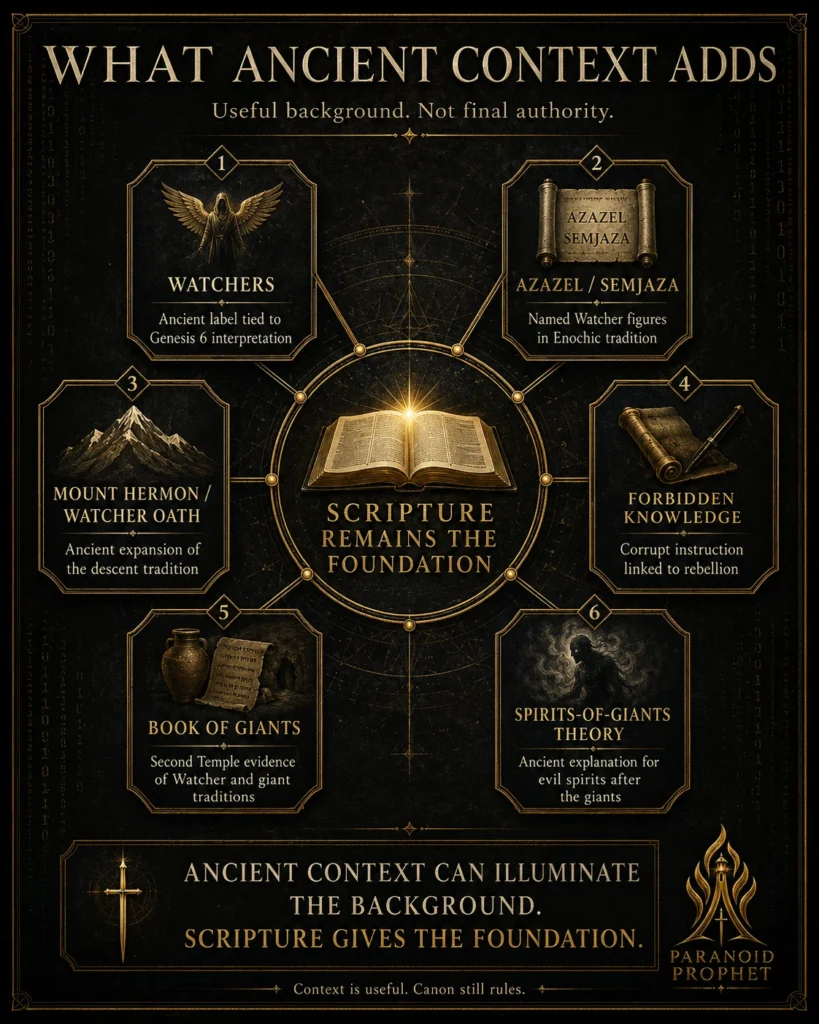
Ancient Jewish literature matters because it preserves how influential readers developed the compressed biblical stories of heavenly transgression, giant violence, forbidden knowledge, judgment, and evil spirits. It clarifies an interpretive world without replacing Scripture as the foundation.
The New Testament’s relationship to that world requires the same discipline. Jude can quote a prophecy preserved in First Enoch and still write inspired Scripture without making every section of First Enoch canonical. Peter can use themes familiar from Watcher tradition while selecting the claims that serve his own argument. An inspired author’s use of a tradition confirms the point he makes with it; it does not automatically confirm every detail found in the larger work.
This distinction avoids two opposite mistakes. Dismissing ancient literature entirely can hide the interpretive setting shared by early Jewish and Christian readers. Treating it as a lost biblical volume can make later expansions control earlier revelation. The better approach asks what the ancient source says, whether a biblical writer uses the same idea, and exactly how far that biblical use extends. Ancient context can sharpen exegesis without acquiring canonical authority.
The Rebel Watchers of Enochic Tradition
First Enoch identifies the Genesis 6 sons of God with Watchers who descend, enter forbidden unions, produce giant offspring, transmit corrupting knowledge, and come under judgment. This storyline helps explain why ancient readers connected Genesis 6 with Jude and 2 Peter. It also gives the cluster its common rebel-Watcher vocabulary.
The label must remain source-conscious. Genesis says sons of God. Daniel 4 knows holy Watchers. Enochic tradition applies the rebel-Watcher framework to Genesis 6. The Watchers Explained develops the tradition, while The Book of Enoch Explained governs its authority and limits.
This makes the Watcher identification more than a modern theory but less than Genesis’s explicit vocabulary. It is an ancient interpretive bridge with significant explanatory power. Readers can use the label confidently when naming the Enochic tradition and carefully when applying it to the biblical sons of God.
Named Watchers, Hermon, and the Book of Giants
Enochic texts name Semjaza as a leader, feature Azazel as a major corrupter, and locate a binding oath at Mount Hermon. They expand the teaching tradition with weapon-making, adornment, sorcery, celestial interpretation, and other illicit arts. The Book of Giants preserves giant figures, ominous dreams, and approaching judgment among the Dead Sea Scroll traditions.
These details show historical development and circulation; they should not dominate a biblical taxonomy. The names and oath belong to the ancient expansion, while the dedicated What Did the Watchers Teach? article owns the forbidden-knowledge catalog.
The Book of Giants is particularly valuable as reception evidence because manuscript fragments show these traditions circulating within Second Temple Judaism. Fragmentary survival limits confident reconstruction of every scene. Its significance lies in the ancient life of the tradition, not in supplying a complete history omitted from Genesis.
The Spirits-of-Giants Theory
First Enoch 15-16 says that after the fleshly giants die, spirits proceeding from their bodies become evil spirits on earth. The Watchers remain bound while the giant spirits continue hostile activity. Jubilees 10 preserves a related post-Flood spiritual-aftermath tradition. This ancient account explains why some readers distinguish active demons from restrained heavenly rebels.
Bodily giant continuity and spiritual aftermath are separate questions. The Enochic demon-origin theory does not itself explain the later Anakim or Rephaim, and the later giant trail does not prove the spirits-of-giants theory. The status article on demons and fallen angels compares the origin views. Ancient context is influential and explanatory, but it is not binding where Scripture remains silent.
The theory nevertheless solves a real ancient classification problem: how restrained Watchers and active evil spirits could belong to one rebellion without being the same beings. That coherence explains its endurance in Jewish and early Christian reception. Historical usefulness and doctrinal obligation remain different judgments.
Where the Categories Overlap Without Becoming Identical
A map needs both boundaries and connecting roads. Categories may share allegiance, behavior, narrative setting, or judgment without sharing the same identity or origin.
Overlap can be established at several strengths. A shared biblical passage is stronger than a shared visual motif. A direct statement of allegiance is stronger than similar behavior. An ancient explanatory tradition can connect categories historically without proving the tradition’s ontology. Naming the kind of overlap is more useful than simply drawing a line between two boxes.
Four tests help grade any proposed connection. First, does Scripture directly identify one category with another? Second, do multiple biblical passages support the relationship by strong inference? Third, is the connection supplied mainly by ancient reception? Fourth, is it being proposed from modern resemblance alone? The farther an argument moves down that sequence, the more openly it should display its assumptions.
The map also separates four dimensions that are often confused: identity, what a being is; allegiance, whom it serves; role, what it does; and status, whether it is active, restrained, judged, embodied, or disembodied. Two categories can share allegiance while differing in identity, or share a role while differing in status. That is why deception, violence, or opposition alone cannot prove that two names refer to the same kind of being.
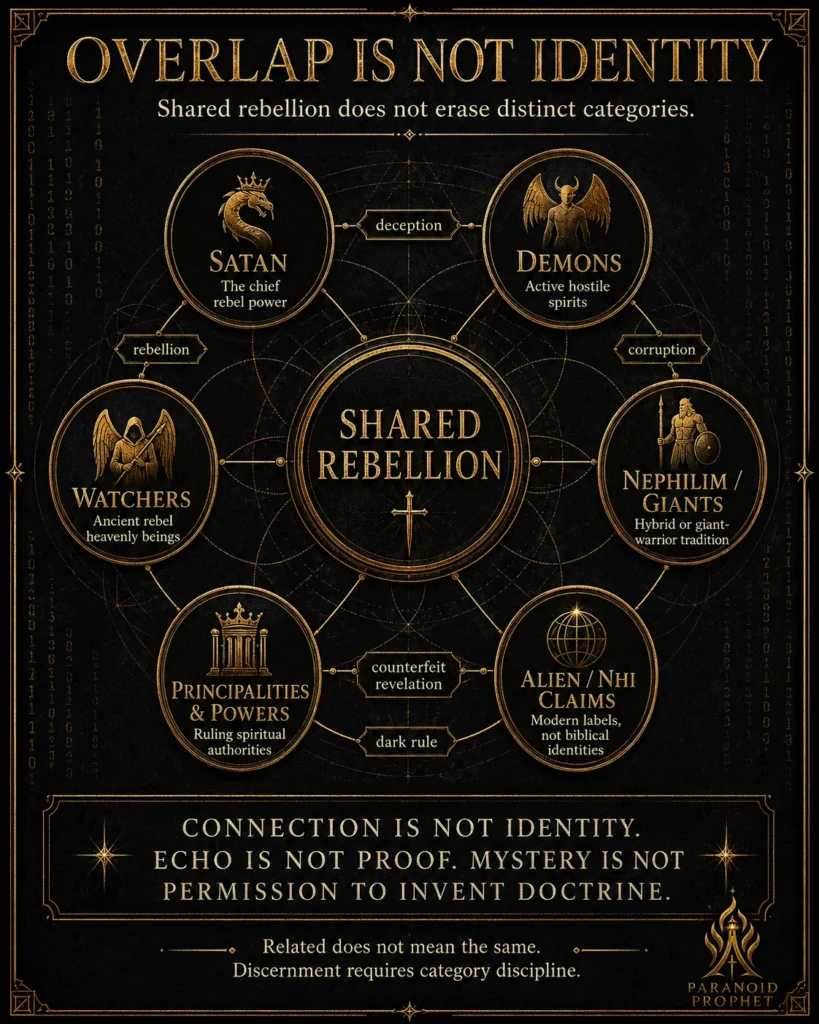
Satan, His Angels, and Wider Rebel Powers
These categories overlap in opposition, deception, accusation, and coming judgment. Satan is one personal adversary; his angels are aligned rebels; rulers and authorities can describe wider orders or offices. Satan may lead and influence a kingdom of darkness without becoming the personal identity of every member within it.
Kingdom language explains unity of purpose without erasing diversity of role. Human empires also contain rulers, messengers, soldiers, institutions, and subjects who share an allegiance without becoming one person. The analogy is limited, but it shows why coordinated opposition does not require a single spiritual category.
Angels Who Sinned and the Watcher Tradition
Angelic transgression, abandoned boundaries, Noah-era judgment, and present restraint make the connection between Jude, 2 Peter, Genesis 6, and the Watcher tradition strong. “Angels who sinned” is biblical wording. Rebel Watchers are the ancient interpretive identification. Accuracy requires stating both the relationship and the source difference.
Watchers, Nephilim, and Giant Peoples
The Watchers are heavenly rebels in Enochic interpretation; the Nephilim are the offspring or earthly result under the strongest reading of Genesis 6; later giant-associated peoples preserve a related but incompletely traced continuity. Forbidden union, corruption, violence, and judgment join the discussion. Extraordinary origin does not turn any category into “alien” by definition.
Bound Angels, Demons, and Spirits of Giants
All three categories can be placed within a wider rebellion and its Genesis 6 interpretive aftermath. Their conditions differ: Jude and Peter describe restrained angels, the Gospels portray active demons, and spirits of giants belong to an ancient demon-origin theory. Similar behavior or shared allegiance does not establish one nature.
This distinction changes the answer to “Where are fallen angels now?” Some angelic rebels are explicitly restrained, while other hostile powers remain active. Calling all of them demons may be convenient, but it removes the very status difference the texts preserve.
Principalities, False Gods, and Demonic Idolatry
These terms overlap around corrupt worship, authority, oppression, deception, and resistance to God’s kingdom. A principality is not necessarily an individual possessing demon. An idol has no life merely because sacrifice around it may involve demons. A being called a “god,” a ruler, a demon, and a principality are not interchangeable words. Context must govern each use.
The relationship can also include human participation. Idolatrous systems are maintained through human desire, political power, cultural memory, and economic interest even where Scripture reveals a spiritual dimension. The presence of hostile powers never removes human responsibility, and human mechanisms do not make the spiritual conflict unreal.
Related does not mean identical, and distinction does not mean there is no relationship.
Where Alien, NHI, and UAP Claims Fit
Modern claims belong at the edge of the map, where biblical discernment can test them without allowing them to redefine the center.
A disciplined evaluation begins by separating four questions. What was observed? What interpretation did the witness or investigator give it? What worldview or message accompanies the claim? What biblical category, if any, is actually warranted? A credible observation may still receive a weak explanation, and a false religious message can be rejected without pretending to know the physical cause of every reported event.
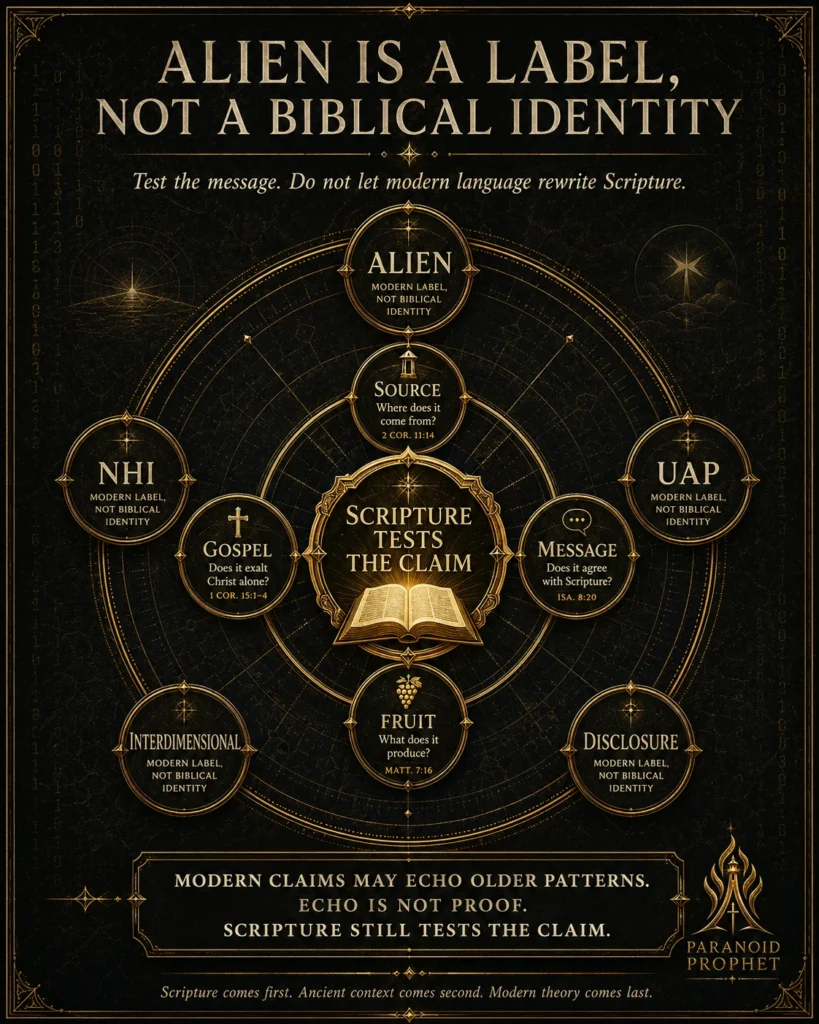
Modern Labels Are Not Biblical Ontology
UAP describes an observation or unresolved report. Alien implies an extraterrestrial interpretation. NHI describes claimed nonhuman agency without identifying its nature. “Interdimensional entity” supplies another explanatory framework. None can simply replace angel, demon, Watcher, Nephilim, or principality, and none settles what caused a report.
Ancient Echoes May Raise Discernment Questions
Stories about nonhuman teachers, forbidden knowledge, hybridization, altered humanity, false revelation, cosmic salvation, spiritual elitism, or transformation apart from Christ can echo older rebellion patterns. Echo is not proof. A report may involve misidentification, natural phenomena, human technology, psychological experience, deception, religious imagination, propaganda, spiritual manipulation, or an unresolved cause.
Theological resemblance becomes most relevant when a claim carries a message. A light in the sky and a movement preaching salvation through superior beings are not the same kind of evidence. The first may remain an observation problem. The second can be tested as a religious claim, whatever produced the reported experience.
Test the Message and Route the Application
First John 4:1-6 directs Christians to test the spirits. Ask what a claim says about Jesus, the gospel, authority, worship, sin, humanity, promised salvation, and spiritual fruit. A spectacle that dethrones Christ or replaces grace with elite knowledge has already exposed its theological direction.
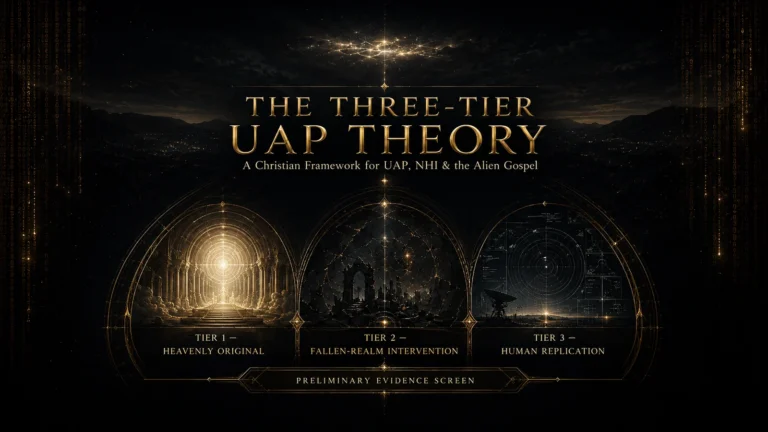
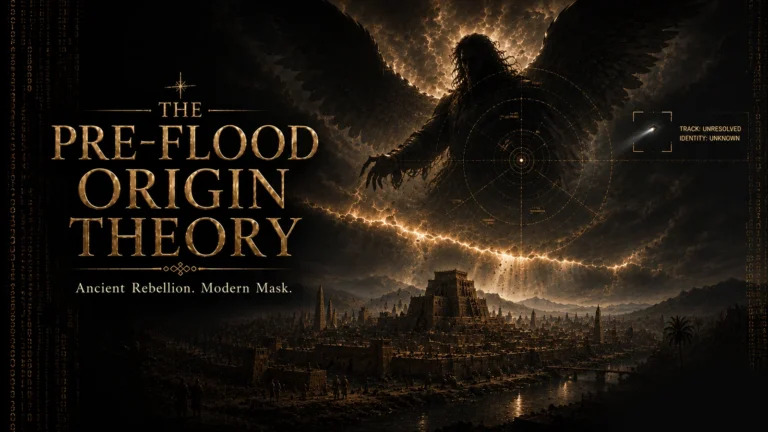
The Pre-Flood Origin Theory examines broad ancient-modern synthesis. Christian View of UFOs: The Three-Tier UAP Theory supplies the restrained framework for current reports. This map only marks where that application belongs.
How Christians Should Use the Map
The map serves interpretation and discipleship. It should make readers more accurate, more honest about confidence, and less vulnerable to fascination.
A useful practice is to write the category and source level beside every major claim. “Demon” may be Level One. “Spirit of a dead giant” belongs to Level Three. “The witness called it NHI” belongs to Level Four. The exercise makes hidden leaps visible before they harden into conclusions.
Then write the relationship verb as carefully as the category: Scripture states, a passage suggests, an ancient source interprets, a report describes, or a theory proposes. Those verbs prevent confidence inflation. They also let readers disagree about one connection without discarding the entire map, because the firm biblical categories remain distinct from the debated roads drawn between them.
Avoid Category Collapse
Careful categories protect careful conclusions. They prevent a strong case in one lane from being stretched into an unsupported claim in another. When an author moves from biblical demon to Enochic giant spirit to modern NHI without marking the transitions, the map shows where the evidence changed.
Match Confidence to Evidence
State direct biblical teaching firmly. Label debated inference as interpretation. Present ancient material as ancient context. Keep modern theories as theories. Intellectual humility does not require vague conclusions where Scripture is clear, and conviction does not require pretending every relationship is equally certain.
Route Deeper Questions
- Genesis 6: Genesis 6 Explained and Sons of God and Daughters of Men.
- Watchers and Enoch: The Watchers Explained and The Book of Enoch Explained.
- Forbidden knowledge: What Did the Watchers Teach?
- Nephilim and continuity: Who Were the Nephilim? and Did the Nephilim Survive the Flood?
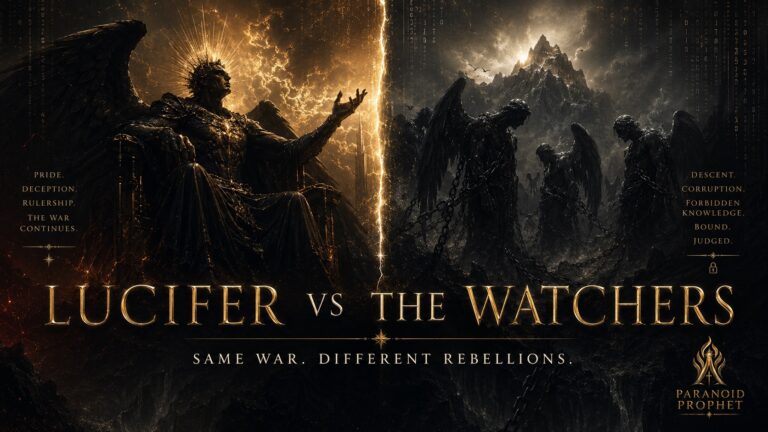
- Demon status and Satan-Watcher distinctions: Where Are Demons and Fallen Angels Now? and Lucifer vs. the Watchers.
- Modern synthesis and reports: The Pre-Flood Origin Theory and The Three-Tier UAP Theory.
Discern Without Obsession
Do not deny spiritual evil, chase secret names, diagnose every hardship as demonic, build doctrine from anomalous experiences, or make mystery central. Test claims through Scripture and the gospel. Pray, remain rooted in Christian community, and keep ordinary faithfulness above speculative mastery. Mystery is not permission to invent doctrine.
Frequently Asked Questions About the Unseen Rebellion
What is the Unseen Rebellion Map?
It is a Scripture-governed taxonomy and routing guide. It identifies categories, marks confidence levels, shows relationships without forcing identity, and sends deeper questions to focused studies.
Are Satan, demons, and Watchers the same?
No. They overlap within a wider rebellion. Satan is a personal adversary, demons are active hostile spirits in the Gospels, and rebel Watchers are the Enochic interpretation of the Genesis 6 heavenly rebels.
Are the Watchers fallen angels?
In Enochic tradition, yes: they are rebellious heavenly beings who descend and are bound. Genesis 6 calls its actors sons of God, while Daniel 4 uses “watcher” for holy heavenly figures. The specific rebel-Watcher identification is ancient interpretation.
Are demons fallen angels?
“Fallen angels” can function as a broad kingdom-of-darkness label, but Scripture does not state one origin for every demon. Some sinning angels are restrained, while Gospel demons remain active. Ancient tradition also proposes the spirits of dead giants.
Are the Nephilim demons?
No. The Nephilim are embodied figures associated with Genesis 6 and later giant tradition. First Enoch says spirits from dead giants became evil spirits, but that is an ancient demon-origin theory about aftermath, not an identity between living Nephilim and demons.
Are principalities, false gods, and demons the same?
Not automatically. Principalities and powers can name wider orders or offices, and context determines whether they are hostile. Idols have no life in themselves, though sacrifice can involve demons. The terms overlap around rebellion and worship without becoming synonyms.
Are aliens or NHI the same as demons?
Alien and NHI are modern interpretation labels, not biblical categories. Some claims may echo ancient deception patterns, but a report can have natural, human, psychological, cultural, deceptive, spiritual, or unresolved causes. It must be tested rather than automatically classified.
What is the safest rule for unseen-realm study?
Let confidence match the source: Scripture governs, ancient context clarifies, modern theory remains downstream, and every claim is tested by its treatment of Christ and the gospel.
The safest rule does not leave every question unanswered. It says Satan is real, demons are hostile spirits, some angels are restrained, the unseen conflict includes rulers and authorities, idolatry can involve demons, and Christ is above them all. It remains careful about the relationships Scripture does not fully define.
Selected Sources and Further Reading
Scripture
Ancient Sources
- George W. E. Nickelsburg and James C. VanderKam, 1 Enoch: The Hermeneia Translation, Book of the Watchers excerpt.
- James C. VanderKam, Jubilees: A Commentary.
- Loren T. Stuckenbruck, The Book of Giants from Qumran.
Scholarship
- Archie T. Wright, The Origin of Evil Spirits.
- Annette Yoshiko Reed, Fallen Angels and the History of Judaism and Christianity.
- Loren T. Stuckenbruck, The Myth of Rebellious Angels.
- Gene L. Green, Jude and 2 Peter.
- Clinton E. Arnold, Powers of Darkness: Principalities and Powers in Paul’s Letters.
- Mark S. Smith, The Origins of Biblical Monotheism.
- Michael S. Heiser, The Unseen Realm, an accessible Christian synthesis best read alongside the specialist works above.
Read Next
- Where Are Demons and Fallen Angels Now? explains present activity, restraint, location language, and destiny.
- Lucifer vs. the Watchers separates Satan’s rebellion from the Genesis 6 tradition.
- Did the Nephilim Survive the Flood? maps bodily continuity, giant peoples, and spiritual aftermath.
- The Pre-Flood Origin Theory moves carefully from biblical categories into modern synthesis.
Christ Over Every Rebel Power
Every visible and invisible power was created through Christ and for Christ. Thrones, dominions, rulers, and authorities do not form a second universe outside his claim. The faithful host serves him, rebels remain under his limits, and the cross exposes every hostile power as unable to overturn God’s saving purpose.
Philippians 2, Hebrews 2, and Ephesians 1 give that supremacy its Christian shape. The exalted name belongs to the Son who humbled himself to death, shared our humanity, broke the enslaving use of death, rose, and was seated above every rule and authority. His victory is not abstract rank; it is saving power for people held by sin and fear.
The map’s categories all meet their limit in him. Demons obey his command. Angels who sinned remain in divine custody. Satan awaits final judgment. Giant renown cannot resist God’s verdict. False gods cannot save their worshipers. Modern revelations cannot replace the gospel of the crucified and risen Son.
Christ also determines how the church engages the conflict. Believers stand in truth, righteousness, gospel peace, faith, salvation, the word of God, and prayer. They do not seek occult mastery of the powers or build identity around secret knowledge. The armor of God forms ordinary faithfulness under an extraordinary King.
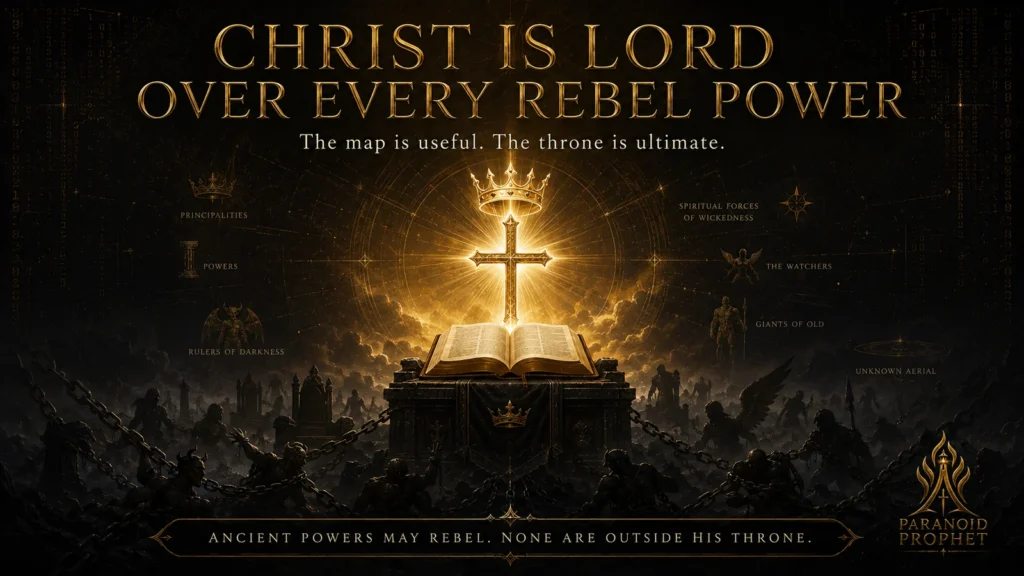
The unseen rebellion is real, but it is not supreme. The church is called to faithfulness rather than fascination: to truth, prayer, holiness, witness, compassion, and confidence in the King. Resurrection and Christ’s coming kingdom, not mastery of secret ranks, form the believer’s hope.
The point of the map is not to make mystery central. It is to make discernment clearer and Christ’s supremacy more visible. Every road on the map ends beneath the authority of Jesus Christ, whose name is above every name and whose kingdom will outlast every rebel power.
CONTINUE THE INVESTIGATION
Clarify the categories
Lucifer vs. the Watchers: Why This Difference Matters
Clarify why Scripture’s portrait of Satan should not be casually collapsed into every Watcher or fallen-angel tradition.