
GUIDED ARTICLE EXPERIENCE
Historical Evidence for Jesus: Why Jesus Was Not a Myth or Legend
Read along as the narration moves through the article.
Private device narration · No hosted audio or tracking
CONTINUE GUIDED TOUR
Continue where you left off.
GUIDED TOUR COMPLETE
You have reached the end of this study.
Study record saved on this device.
GUIDED TOUR
Historical Evidence for Jesus: Why Jesus Was Not a Myth or Legend
Narrator: Paranoid Prophet Recommended Voice Native device narration
Prepare to follow the article as it is narrated.
VOICE & TOUR OPTIONS
Voice & Listening
NARRATOR
Finding a narrator…
Checking the best narrator available on this device.
Restores the best curated narrator available on this device.
Narrator choices are curated for clear, long-form listening on this device.
Screen-awake support will be checked when narration starts.
CHOOSE A NARRATOR
Curated for this device
Choose a verified narrator for this browser, or use System Narrator. Automatic mode uses the best reliable route exposed by this device; your chosen narrator is preserved even if this device needs a temporary fallback.
Preparing the guided article experience…
RESUME GUIDED TOUR?
Continue where you left off.
GUIDED TOUR COMPLETE
You have reached the end of this study.
The historical evidence for Jesus does not lead into a distant world of anonymous gods and timeless symbols. It leads to first-century Galilee and Judea, Jewish villages and Roman rule, named leaders and public conflict, crucifixion under Pontius Pilate, and a movement that began by proclaiming that the crucified Jesus had been raised.
Someone may reject Christianity, question miracles, dispute the resurrection, or deny that Jesus is the Son of God. Those are larger arguments. But denying that Jesus of Nazareth existed creates a different problem. It requires the reader to explain why the earliest Christian writings, the Gospel traditions, Roman and Jewish references, and the historical setting all converge on a real Jewish man whose death became the center of a rapidly expanding movement.
This article addresses that first gate of the case. Did Jesus really exist? What sources place Him in history? What can Paul, the Gospels, Tacitus, Josephus, Pliny, and archaeology actually establish? Which evidence is strong, which is limited, and which is debated?
The answer must be disciplined. History should not be asked to prove the Trinity, define the atonement, or force belief in the resurrection. Archaeology should not be advertised as direct proof when it confirms only the setting. Late hostile sources should not be treated like first-generation testimony. A strong case does not need weak evidence to pretend it is strong.
History can establish the public ground on which the Christian claim stands. Scripture gives the final interpretation. The historian can investigate Jesus’ existence, crucifixion, early followers, and the rise of resurrection proclamation. The Bible reveals that this Jesus is the Messiah, the Son sent by the Father, the crucified Savior, the risen Lord, and the King who will return.
The Historical Verdict
Core claim: Jesus of Nazareth was a real first-century Jewish man, known through the earliest Christian sources, executed under Pontius Pilate, remembered outside the church, and proclaimed risen from the beginning of the Christian movement.
This historical foundation belongs inside the larger evidence that Jesus is the Son of God. It does not finish the case. It closes the mythic escape hatch and brings the reader to the more serious question: who is the Jesus who stands in history?
Article Guide14 sections
Short Answer and Case at a Glance
Did Jesus really exist? Yes. The best historical conclusion is that Jesus of Nazareth was a real Jewish figure associated with Galilee and Judea, public teaching, disciples, conflict with authorities, and crucifixion under Pontius Pilate. His followers did not begin with a vague spiritual symbol. They preached a named Jesus who had been killed and whom they said God had raised.
The evidence does not rest on one disputed sentence in Josephus or one archaeological artifact. It begins inside the first Christian generation. Paul’s letters speak naturally of Jesus as born under the law, descended from David, connected to brothers and to James, crucified, buried, and proclaimed risen. Paul also knew Cephas and James and met recognized leaders in Jerusalem.
The Gospels provide fuller ancient testimony. They place Jesus in the recognizable world of Galilee, Nazareth, Capernaum, Jerusalem, the temple, Jewish feasts, Pharisees, Sadducees, Herodian rulers, and Roman government. Their theological purpose is open, but theological purpose does not transform a first-century setting into myth.
Outside the New Testament, Tacitus connects Christus to execution under Pontius Pilate. Josephus refers to James as the brother of Jesus who was called Christ. Pliny describes Christians worshiping Christ in the early second century. Other references are later or less certain, but they show that Jesus and His movement were discussed by critics rather than remembered as an admitted fiction.
Archaeology performs a different job. The Pilate Stone confirms the Roman official named in the Passion accounts. The remains of Yehohanan illuminate Roman crucifixion in Judea. Excavations support an inhabited Jewish settlement at Nazareth in the early first century. Tombs, ossuaries, and the possible Caiaphas-family inscription illuminate the priestly and burial world around Jerusalem.
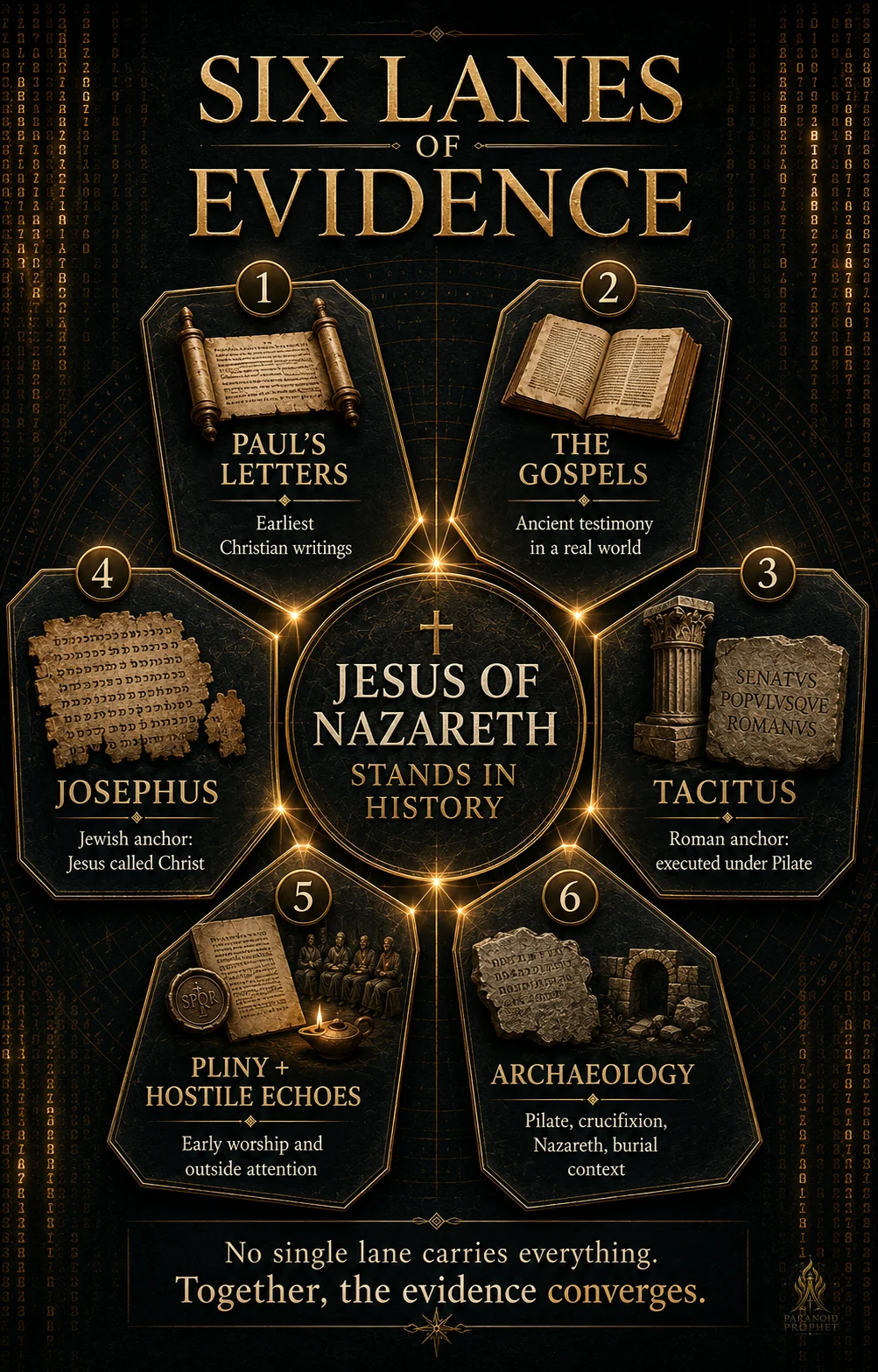
No single lane establishes everything Christians confess about Jesus. Together, however, the sources make the claim that Jesus never existed historically strained. The stronger skeptical position is not that Jesus was invented. It is that Jesus existed but Christians are wrong about His identity. That argument still has to face His claims, His crucifixion, the early resurrection proclamation, and the scriptural witness to who He is.
How Historical Evidence Must Be Weighed
Ancient history rarely supplies the records modern readers instinctively request. We do not have video, a Roman trial transcript, a government birth certificate, or Jesus’ personal archive. Most people in antiquity left none of those things. Historians work with surviving texts, chronology, source relationships, named people, public events, geography, inscriptions, archaeology, social context, and the ability of an explanation to account for the evidence as a whole.
The first question is not whether a source is Christian. The question is what kind of source it is and what it can responsibly establish. Paul is early but does not write a biography. The Gospels narrate Jesus’ life but do so with theological purpose. Tacitus is hostile but later. Josephus is valuable, although one passage has a difficult transmission history. Archaeology confirms context more often than an individual event.
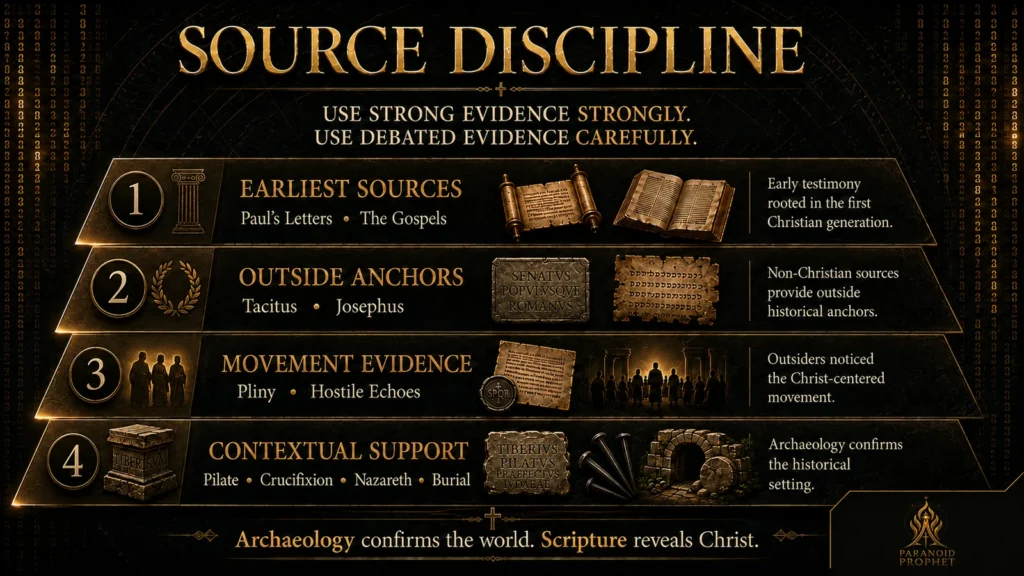
Friendly, hostile, and contextual sources each contribute differently. Christian sources tell us what the first believers proclaimed and preserve the fullest testimony about Jesus. Non-Christian sources provide narrower external anchors. Archaeology checks whether the rulers, places, practices, and material world described by the written sources belong to first-century Judea.
None should be inflated. A committed source can preserve history, and a hostile source can be mistaken. An inscription can confirm a ruler without confirming every event attached to him. Proper confidence depends on proximity, genre, transmission, specificity, and the claim being asked of the evidence.
| Evidence | Proper Historical Use | Important Limit | Confidence |
|---|---|---|---|
| Paul’s undisputed letters | Place Jesus, His family connections, crucifixion, and resurrection proclamation inside the first Christian generation. | Paul does not write a full life of Jesus or claim to have followed His earthly ministry. | Very strong |
| The canonical Gospels | Provide ancient theological testimony about Jesus’ ministry, setting, death, burial, and proclaimed resurrection. | They are not neutral transcripts, and their literary relationships and chronology require careful study. | Strong, read carefully |
| Josephus, Antiquities 20.200 | Connects James to Jesus who was called Christ in a brief Jewish historical reference. | The reference is short and does not describe Jesus’ ministry. | Strong outside anchor |
| Tacitus, Annals 15.44 | Connects Christus, execution under Pilate, and the later movement in Roman historical writing. | Tacitus writes decades later and does not identify his information source. | Strong outside anchor |
| Josephus, Antiquities 18.63-64 | May preserve a Josephan core about Jesus, His execution, and continued followers. | The surviving wording includes likely Christian alteration and cannot carry the case. | Debated wording |
| Pliny, Letters 10.96-97 | Shows visible early second-century Christian worship and devotion centered on Christ. | It does not independently report Jesus’ earthly life. | Strong movement evidence |
| Later outsider echoes | Show later Roman, Jewish, and pagan criticism of Jesus and Christians. | They are late, polemical, indirect, or disputed and should remain secondary. | Supporting only |
| Archaeology | Confirms rulers, places, execution practices, settlements, tombs, and the material setting. | It does not directly prove Jesus’ identity, crucifixion, burial, or resurrection. | Contextual |
This hierarchy protects the argument from two errors. The first is dismissing Christian testimony simply because Christians believed what they wrote. The second is exaggerating an outsider reference because it appears more neutral. Every source must be allowed to say what it says, no more and no less. This article follows the site’s Sources and Verification standard: Scripture first, primary ancient sources next, responsible scholarship after that, and apologetic synthesis last.
Paul’s Letters: Evidence Within the First Generation
The earliest surviving Christian writings are not medieval legends or second-century biographies. They are letters written by Paul within the first Christian generation. Several are accepted as authentic across a broad range of New Testament scholarship, including Galatians, 1 Corinthians, Romans, and Philippians. They do not attempt to prove that Jesus existed because Paul’s churches were not debating a fictional founder. They assume a real Jesus whose death and proclaimed resurrection already defined the movement.
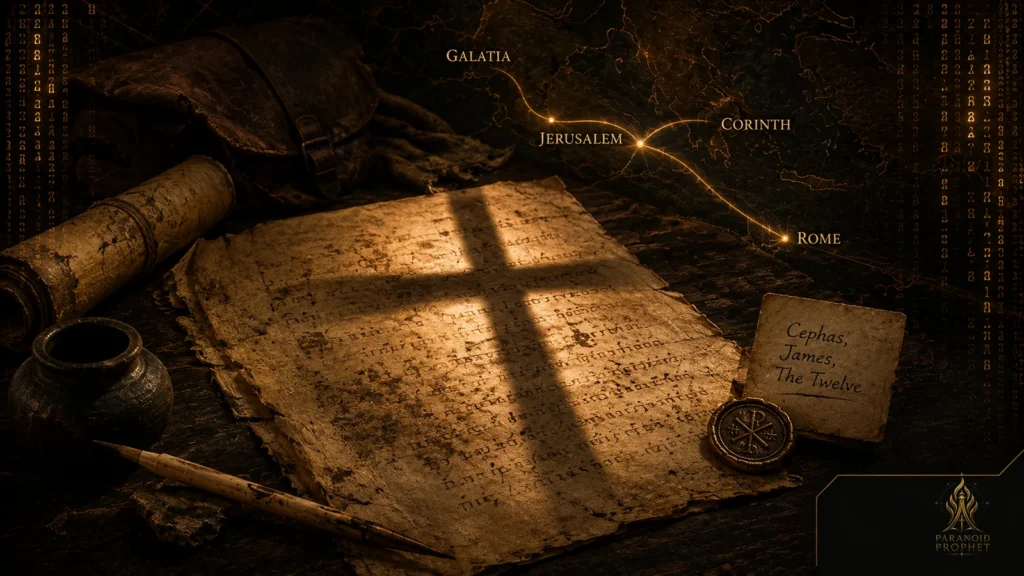
- 01Human BirthBorn of woman, under the law
- 02Family and IsraelDavidic descent, brothers, James
- 03CrucifixionChrist crucified at the center
- 04Received ProclamationDied, buried, raised, appeared
Paul Places Jesus in Human and Jewish History
In Galatians 4:4, Paul says that God sent His Son, born of woman and born under the law. The statement is theological, but its theology depends on incarnation in human and Jewish history. Jesus is not described as a timeless symbol who never entered the world. He is born, and He belongs to Israel’s covenant setting.
Romans 1:3-4 speaks of God’s Son as descended from David according to the flesh and declared Son of God in power by resurrection from the dead. Paul joins real human descent to the resurrection confession. History can examine the human and proclamational claims. Scripture reveals their full meaning: the eternal Son truly entered David’s line and was vindicated in power.
Paul also refers to the Lord’s brothers in 1 Corinthians 9:5. In Galatians 1:18-19, he identifies James as the Lord’s brother. Mythicist interpretations sometimes attempt to make these references purely spiritual, but the natural contrast with Cephas and the apostles makes James a concrete personal connection to Jesus.
Paul’s letters also preserve contact with Jesus’ teaching and final meal. In 1 Corinthians 7:10-11, Paul distinguishes a command of the Lord about divorce from his own pastoral judgment. In 1 Corinthians 11:23-26, he recounts received tradition about Jesus taking bread and the cup on the night He was betrayed. These references are brief, but they make little sense if Paul’s Christ never lived or taught on earth.
The Crucifixion Is Already Central
Paul does not treat the cross as a symbol invented after Jesus disappeared into legend. His preaching is organized around a crucified Christ. In 1 Corinthians 1:23, he says that Christians preach Christ crucified. First Corinthians 2:2 repeats that center. Galatians 3:1 assumes the same public proclamation, while Philippians 2:8 names death on a cross.
Roman crucifixion communicated shame and defeat. It was not an obvious feature for inventors seeking a culturally impressive Messiah. Paul does not hide the scandal. He argues that the cross reveals God’s wisdom and saving action. The theology is Christian revelation; the historical point is narrower. Within the earliest surviving Christian letters, Jesus is already the man who was crucified.
The historical case for the execution itself is treated fully in Was Jesus Crucified?. Here, Paul’s testimony establishes that the cross was not added centuries later. It stood at the center while people connected to the first Jerusalem community were still known.
Paul Knew Cephas, James, and Jerusalem Leaders
Paul was not isolated from the people who led the movement before him. Galatians says that he visited Cephas and saw James, the Lord’s brother. Later, Galatians 2:1-10 names James, Cephas, and John as recognized pillars. Paul could dispute Peter’s behavior openly, which makes the contact more historically useful, not less. He was not writing a sanitized story in which every leader always agreed.
These meetings do not give us transcripts of long interviews. They do show that Paul interacted with named leaders tied to the Jerusalem movement. He did not invent Christianity in a distant region centuries later. He entered an existing movement, met its recognized figures, and proclaimed a message centered on the same crucified and risen Jesus.
James supplies an especially important bridge. Paul calls him the Lord’s brother, and Josephus later identifies James as the brother of Jesus who was called Christ. The focused study of James the brother of Jesus examines his leadership, witness, and death without making him carry more evidence than the sources allow.
Paul Received the Resurrection Proclamation
In 1 Corinthians 15:1-8, Paul reminds the Corinthians of what he had received and delivered: Christ died for sins according to the Scriptures, was buried, was raised, and appeared. He names Cephas, the Twelve, James, all the apostles, and himself. He also mentions more than five hundred at one time.
The passage should be used carefully. Paul does not date every line of the summary, and assigning the entire formulation to one exact year can outrun the text. The appearance to more than five hundred lacks names, place, and a second narrative source. Those limitations do not erase what the passage securely establishes: Paul received resurrection tradition before writing 1 Corinthians, and the proclamation belonged inside the first Christian generation.
That does not prove by historical method alone that God raised Jesus. It does rule out the idea that resurrection belief appeared only after a long legendary silence. The claim was early, specific, and attached to a crucified Jesus and named leaders. The focused studies on how early the resurrection claim is and what the first witnesses claimed take that evidence further.
The shape of Paul’s writings matters. Romans, Galatians, and Corinthians are letters sent to existing churches about disputes, doctrine, worship, conduct, and mission. They are not attempts to introduce Jesus to readers who had never heard His story. We should not demand a biography from occasional correspondence. The surprising fact is how many historical anchors appear even when narrating Jesus’ ministry is not Paul’s immediate task.
The Gospels: Ancient Testimony in a Real World
Paul’s letters are earlier than the Gospels in their final written forms, but they do not replace them. The Gospels preserve the fullest ancient testimony about Jesus’ teaching, actions, followers, conflicts, death, burial, and proclaimed resurrection. They were written to persuade. John says openly that his purpose is belief in Jesus as the Christ and Son of God. Luke describes an ordered account connected to earlier reports and eyewitness tradition.
Theological purpose is not a confession of fiction. Ancient historians and biographers wrote with moral, political, philosophical, and religious aims. The proper questions concern genre, date, access to tradition, literary relationships, setting, and the claims preserved. Richard Burridge’s comparison with Greco-Roman biography and Craig Keener’s historical work on the Gospels help frame those questions without pretending the books are modern journalism.
Calling the Gospels ancient biographies does not settle every disputed event. It identifies the kind of claim they make. Their central subject is a recent person whose character is revealed through words, deeds, relationships, conflict, death, and remembered aftermath. Readers may reject the evangelists’ interpretation, but they cannot fairly recategorize the books as timeless myths merely because the authors write to produce faith.
A Stable Historical Core
The four Gospels differ in arrangement, selection, wording, and theological emphasis. The Synoptic Gospels share material and raise real questions about literary dependence. John often organizes and presents Jesus’ ministry differently. Those facts should not be hidden. They also do not remove the stable historical figure shared across the accounts.
Jesus is a Jewish teacher associated with Nazareth and Galilee. He announces God’s kingdom, gathers disciples, is remembered as performing mighty works, debates Scripture and the Sabbath, confronts religious authorities, enters Jerusalem, and is executed under Pontius Pilate. His followers bury Him and proclaim Him raised. The Gospels interpret that story, but they do not detach it from people, places, rulers, and public events.
The Setting Is Concrete, Not Mythic
The narrative world includes Galilee, Judea, Jerusalem, Nazareth, Capernaum, the Jordan, synagogues, the temple, Passover, purity disputes, Pharisees, Sadducees, chief priests, tax collectors, Herodian rulers, and Roman authority. These details do not prove every episode. They show that the evangelists situate Jesus inside the social, religious, and political world of Second Temple Judaism.
A responsible argument does not call the four Gospels four fully independent eyewitness reports. It does not need to. The Gospels preserve overlapping traditions within a connected early movement. Their relationships must be studied rather than ignored. For the existence of Jesus, the narrower conclusion is enough: the Gospel witness coheres with Paul’s earlier letters and belongs to a recognizably first-century world.
Dependence and corroboration are not opposites. Matthew and Luke can use Mark while also preserving material not found in Mark. John can differ sharply in presentation while sharing the basic public outline of ministry, conflict, execution, burial, and resurrection proclamation. The evidence must be weighed passage by passage. The cumulative core does not require pretending that every parallel account arose in isolation.
The Gospels also make the historical question impossible to separate permanently from the theological one. They do not preserve Jesus merely to prove that He lived. They present His words, authority, death, and resurrection so readers may know who He is. History can evaluate their setting and testimony. Scripture speaks with final authority about the Christ they proclaim.
Tacitus and Josephus: The Strongest Outside Anchors
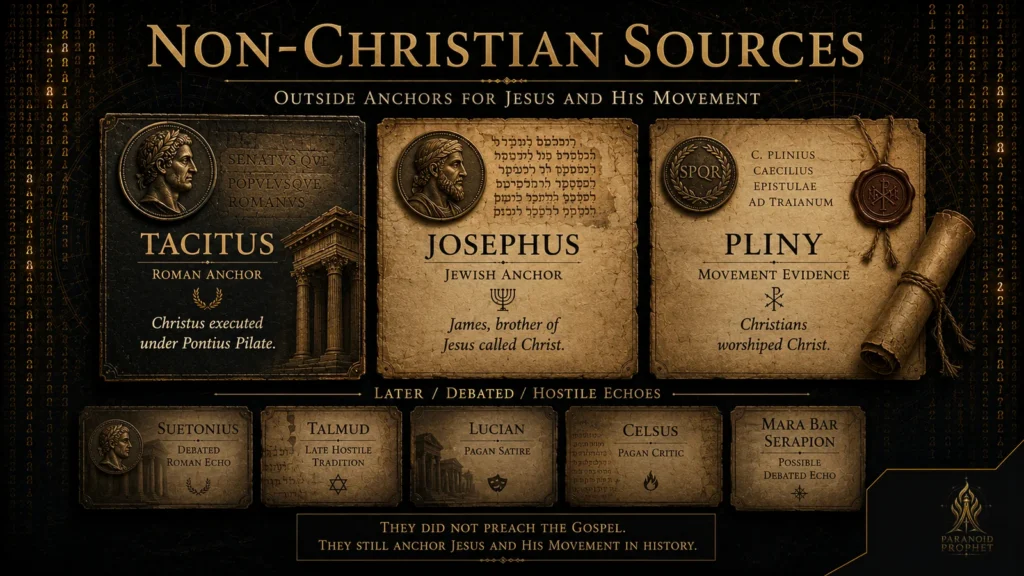
The New Testament remains the central historical witness to Jesus. Non-Christian writers do not provide a second Gospel, and they should not be sold as though they do. Their contribution is narrower: they show that Jesus, His execution, His brother James, and the movement associated with Him were known in Roman and Jewish historical writing outside the church.
Tacitus and the Execution Under Pilate
Writing around the early second century, the Roman historian Tacitus discusses Nero’s punishment of Christians after the fire of Rome. In Annals 15.44, he connects the name Christian to Christus and reports that Christus suffered the extreme penalty during Tiberius’s reign under Pontius Pilate.
Tacitus is openly hostile toward Christians. That makes Christian interpolation into his contemptuous paragraph unlikely, but hostility does not make every statement automatically true. He writes decades after Jesus and does not identify whether his information came from Roman records, common knowledge, interrogation of Christians, or another source. The article should not claim more independence than the text demonstrates.
Even with that limitation, Tacitus is significant. A Roman historian treats Christus as the executed founder connected to a movement he despises. He places the execution under Pilate during Tiberius’s reign and knows that the movement later reached Rome. Tacitus does not establish resurrection, deity, or the reliability of every Gospel detail. He supplies a strong external anchor for execution and movement.
Tacitus calls Pilate a procurator, while the Pilate Stone identifies him by the more precise title prefect. Roman administrative titles changed, and Tacitus wrote with later terminology. The difference is worth acknowledging because small details should not be concealed. It does not overturn the shared identification of Pilate as the Roman official under whom Jesus was executed.
Josephus and James, the Brother of Jesus
The Jewish historian Josephus offers a different and especially valuable reference. In Antiquities 20.200, written near the end of the first century, Josephus reports the execution of James and identifies him as the brother of Jesus who was called Christ. The phrase is brief and incidental to Josephus’s account of the high priest Ananus.
Its incidental character is part of its strength. Josephus is not stopping to preach about Jesus or defend Christianity. He identifies which James he means by reference to a known Jesus distinguished by the title Christ. The passage fits naturally beside Paul’s earlier identification of James as the Lord’s brother.
This text does not tell us what Josephus believed about Jesus. The phrase “who was called Christ” identifies Jesus by the designation associated with His followers; it is not Josephus’s confession of faith. Used properly, the passage is a strong Jewish historical anchor linking Jesus, James, and the early movement.
The Testimonium Flavianum Must Remain Debated
Josephus also contains the longer passage about Jesus known as the Testimonium Flavianum in Antiquities 18.63-64. In its surviving Greek form, the text describes Jesus, His teaching, condemnation under Pilate, and continued followers. Some phrases sound like Christian confession and are difficult to attribute to Josephus unchanged.
Many scholars think the passage preserves a Josephan core that was later edited by Christian copyists. Others argue for heavier alteration or remain less confident about reconstruction. Because the original wording cannot be recovered with certainty, the Testimonium should never carry the existence case. The less disputed James passage, Paul’s letters, the Gospels, and Tacitus do not depend on it.
The proper conclusion is modest. The current text witnesses to the transmission of a Josephus passage about Jesus, but its wording contains a real textual problem. A historically responsible Christian argument gains credibility by stating that problem plainly.
Pliny and the Later Outsider Echoes
After Tacitus and Josephus, the remaining outsider sources should be arranged by what they actually contribute. Pliny gives strong evidence for an early public movement centered on devotion to Christ. Suetonius may preserve a related Roman disturbance, but the identification is disputed. Rabbinic and pagan critics are later. They illuminate reception and controversy more than the earthly life of Jesus.
Pliny Describes Worship Centered on Christ
In Letters 10.96-97, Pliny the Younger asks Emperor Trajan how Christians should be investigated and punished. Writing in the early second century, he describes people who met before dawn on a fixed day and sang responsively to Christ as to a god. He also reports ethical commitments and a shared meal.
Pliny is not a source for Jesus’ birthplace, teaching, trial, or resurrection appearances. He is describing Christian practice in his province decades later. His value is movement evidence. Devotion to Christ was public and organized enough to become an administrative concern for a Roman governor.
This supports a limited but important conclusion. Christianity was not merely a philosophical school preserving admiration for a dead teacher. It was a worshiping community centered on Christ. The New Testament already shows that devotion earlier; Pliny confirms that Roman authorities encountered it outside Christian literature.
Suetonius Is Possible but Uncertain
Suetonius reports that Emperor Claudius expelled Jews from Rome because of disturbances associated with “Chrestus.” The phrase may reflect conflict over Christ among Roman Jews, a setting compatible with Acts 18:2. It may instead refer to another person imagined as present in Rome. The spelling was common enough that certainty is not possible.
Suetonius therefore belongs in the case only as a possible Roman echo. He cannot be used to establish Jesus’ life, death, or even the precise cause of the expulsion. The argument remains intact if this reference is removed, which is exactly how debated evidence should be handled.
The Talmud Is Late and Polemical
Later rabbinic material includes traditions sometimes connected with Jesus, including Babylonian Talmud, Sanhedrin 43a. The passage describes a Yeshu executed near Passover and accused of leading Israel astray. Identifications, chronology, textual development, and the relationship to Christian claims are debated.
This material is far too late to rank beside Paul, the Gospels, Josephus, or Tacitus. It may preserve hostile Jewish countertradition, but it is not first-century testimony. Its safest use is as evidence that later polemic attacked Jesus rather than as a direct foundation for His existence.
Lucian, Celsus, and Mara Bar Serapion Are Aftershocks
Lucian of Samosata mocks Christians and their devotion to a crucified teacher in The Passing of Peregrinus. Celsus, whose second-century criticism survives through Origen’s Against Celsus, attacks Jesus’ origins, miracles, followers, and claims. Mara Bar Serapion writes of a wise king of the Jews, although identifying that figure with Jesus remains uncertain.
These sources are late and cannot independently reconstruct Jesus’ ministry. Their value is cultural and polemical. Outsiders knew Christians as people centered on a crucified figure, and critics contested Christian claims rather than preserving a simple ancient memory that the founder never existed.
That observation must not be exaggerated into an argument from silence. Ancient critics were not obligated to frame their attacks around modern mythicism. The point is cumulative and secondary: the outsider evidence fits a movement built around a real executed person better than a movement whose supposed founder was openly known to be fictional.
Archaeology Confirms the World of Jesus
Archaeology is often oversold in popular apologetics. No accepted inscription says that Jesus of Nazareth preached in Galilee or was condemned by Pilate. No artifact proves that He is the Son of God. Archaeology contributes by testing the setting: rulers, settlements, execution practices, priestly families, tombs, and the physical world in which the texts place Jesus.
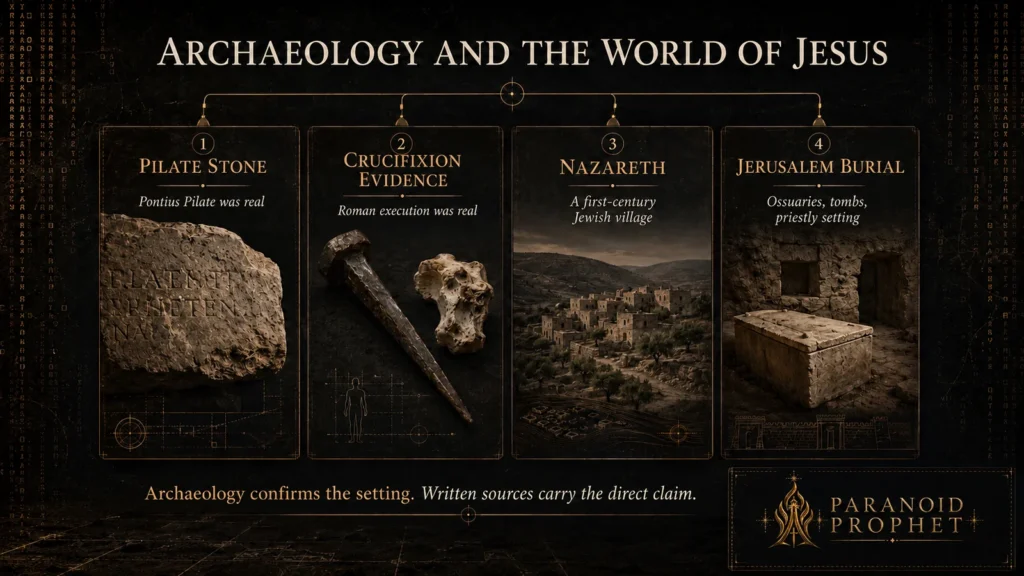
Paul, the Gospels, Tacitus, and Josephus speak about Jesus or His movement.
Pilate, crucifixion, Nazareth, Jerusalem tombs, and priestly context belong to the real world.
The Pilate Stone Confirms the Roman Official
A damaged Latin inscription discovered at Caesarea Maritima names Pontius Pilate and identifies him with the prefectural administration of Judea. The Israel Museum preserves the inscription. It is the clearest archaeological confirmation of the Roman official named in the Gospel Passion accounts and in Tacitus.
The stone does not say that Pilate tried Jesus. Its importance is contextual and convergent. The Gospels place Jesus’ execution under Pilate. Tacitus later reports that Christus suffered under Pilate. The inscription confirms that Pilate was a real prefect operating in the correct region and period.
Yehohanan Illuminates Crucifixion in Judea
The remains of a first-century man named Yehohanan were found in a Jerusalem tomb with a nail preserved through the heel area. Later reassessment corrected parts of the first reconstruction, but the basic evidence remains: a man in Roman Judea had been crucified and then placed in a tomb. Jodi Magness discusses the find within the burial archaeology of the period.
Yehohanan is not Jesus, and his burial does not prove the Gospel burial account. His remains demonstrate that crucifixion was a material Roman practice in the same world and that at least one crucified person received tomb burial. This prevents overly absolute claims about what Rome always did with every crucified body while leaving the specific burial of Jesus to the written evidence.
Nazareth Was an Early First-Century Jewish Settlement
Claims that Nazareth did not exist in Jesus’ lifetime have not survived the archaeological evidence well. Tombs, agricultural installations, pottery, and domestic remains support Jewish habitation in the early Roman period. Ken Dark’s Archaeology of Jesus’ Nazareth surveys the evidence and distinguishes first-century remains from later Christian veneration.
Archaeology does not identify the childhood home of Jesus with certainty. It does establish the more modest point needed here: Nazareth was not a fantasy city invented by Gospel writers. It was a small Jewish settlement in Galilee, which fits the unimpressive hometown assumed in the Gospel traditions.
Caiaphas, Tombs, and Jerusalem Burial Practice
An ornate ossuary discovered in Jerusalem bears an inscription commonly read as “Joseph son of Caiaphas.” Many scholars connect the tomb with the high-priestly family known from Josephus and the Gospels, although the precise identification should remain cautious. Even without certainty about the individual, the find belongs to the elite priestly and burial world described around Jesus’ final days.
Rock-cut tombs, loculi, primary burial, and later ossuary collection are well attested around first-century Jerusalem. These practices do not prove that Joseph of Arimathea buried Jesus, that the tomb was later empty, or that Jesus rose. They show that the Gospel burial setting uses practices and places rooted in the material culture of the period.
What Archaeology Adds to the Case
Archaeology confirms that the written sources do not place Jesus in a vague dreamscape. Pilate belonged to Roman Judea. Crucifixion left recoverable wounds. Nazareth was inhabited. Jerusalem had priestly families, rock-cut tombs, and ossuary customs. Each point is limited, but together they establish a historically recognizable setting.
The direct claim that Jesus lived still comes from texts, especially the earliest Christian sources and the external references. Archaeology strengthens the context around them. It cannot reveal the eternal Son or explain the cross. Scripture does that. The distinction is not a retreat; it is the discipline that keeps historical evidence credible.
The Cumulative Verdict: Why the Myth Theory Fails
The claim that Jesus never existed must explain more than one Christian document. It must explain why Paul’s early letters assume a human, Jewish, crucified Jesus connected to brothers and known Jerusalem leaders. It must explain why the Gospels place that same figure inside a concrete first-century world. It must explain why Josephus identifies James by reference to Jesus called Christ and why Tacitus connects Christus to execution under Pilate.
It must also explain the origin of a movement whose earliest surviving writings center on Jesus’ death and proclaimed resurrection. Pliny later encounters communities worshiping Christ. Roman, Jewish, and pagan critics attack Jesus and His followers. Archaeology confirms that the rulers, places, punishments, and burial world surrounding the written testimony are historically recognizable.
None of this means every Gospel episode has been historically demonstrated. It does not turn the Testimonium into an undisputed text or make the Talmud early. It does not prove resurrection by counting sources. The cumulative verdict is narrower and firmer: the hypothesis of a wholly fictional Jesus explains the evidence less naturally than the existence of a real Jewish teacher who was crucified and became the center of the Christian movement.
This conclusion is not restricted to Christian scholars. Critical historians such as Bart Ehrman and Maurice Casey have argued directly against mythicism while disagreeing with traditional Christianity on major theological questions. Their conclusions do not establish Christian doctrine, but they expose the mistake of treating Jesus’ existence as a conclusion produced only by faith.
Scholarly consensus is not infallible, and Christian faith should not rest on a head count. Its relevance here is diagnostic. Specialists with sharply different views of miracles, inspiration, and Jesus’ identity still recognize that the surviving evidence requires a historical Jesus. A theory that rejects that shared judgment needs source-level arguments stronger than general suspicion toward Christian texts.
The stronger debate begins after existence is established. What did Jesus claim? Why was He crucified? What produced the resurrection proclamation? Why did Jewish followers worship Him as Lord? History closes one exit, but it does not answer every question. The evidence web must continue.
Serious Objections Answered
A strong case should answer the best version of an objection rather than mock a weak version. Some skeptical concerns identify real limitations: Christian sources are committed, Paul gives fewer biographical details than the Gospels, Roman records are incomplete, the Gospels were written after Jesus’ ministry, outsider sources are brief, and archaeology is indirect. Those limits deserve direct answers.
| Objection | What It Correctly Notices | Why It Does Not Erase Jesus |
|---|---|---|
| Christian sources are biased | Paul and the Gospel writers believe the message they communicate. | Commitment requires evaluation, not automatic dismissal. Early, situated, interested sources remain historical sources. |
| Paul says little about Jesus’ ministry | Paul’s letters do not narrate a complete biography or claim discipleship during Jesus’ ministry. | Paul still anchors Jesus in birth, Jewish law, Davidic descent, family, crucifixion, burial, named leaders, and received proclamation. |
| There are too few Roman records | No surviving Roman trial transcript or execution order names Jesus. | Such records rarely survive for non-elite provincial people, while Tacitus still preserves a later Roman execution reference. |
| The Gospels were written later | The Gospels reached written form after the events and preserve theological testimony. | Later does not mean centuries later or fictional. They preserve earlier tradition and a stable first-century historical core. |
| Outside sources are brief or dependent | Tacitus and Josephus write later, and the exact sources behind some statements are unknown. | Their narrow references still fit the earlier Christian evidence and provide external anchors without carrying the whole case. |
| Archaeology does not prove Jesus | No accepted artifact directly identifies Jesus of Nazareth. | Written testimony carries the personal claim; archaeology tests and confirms the historical setting. |
Can Believing Sources Count as Evidence?
Yes, but not uncritically. Historians do not discard Livy because he cared about Rome, Josephus because he defended himself, or Tacitus because he despised Christians. Purpose, loyalty, and hostility affect how a source is read. They do not eliminate it. Paul and the evangelists should be tested for date, genre, setting, claims, relationships, and proximity to the movement they describe.
The attempt to exclude the New Testament before the investigation begins is methodologically circular. It removes the earliest and fullest evidence because later believers regarded it as Scripture. Christian confession does not grant every historical inference automatically, but neither does it make ancient documents disappear.
Does Paul’s Silence About Many Gospel Details Suggest a Myth?
Paul does not retell the parables, Bethlehem, most miracles, or the trial before Pilate. His occasional letters address church problems and explain the gospel rather than provide a life of Jesus. Arguments from silence must account for genre. A letter correcting factions or defending justification should not be expected to read like Mark or Luke.
What Paul does mention is enough to defeat a purely celestial founder: human birth, Jewish law, Davidic descent, brothers, James, crucifixion, burial, received tradition, and meetings with Jerusalem leaders. One may debate individual interpretations, but the combined pattern is grounded in earthly history.
Should More Roman Records Have Survived?
Jesus was not an emperor, senator, governor, or general. To Roman officials, He was one of many provincial people executed in a troubled region. Administrative records on papyrus or perishable materials were not preserved as a comprehensive archive. Expecting a surviving Roman case file imposes modern documentary assumptions on antiquity.
The surprising fact is not the absence of a trial transcript. It is that a crucified Galilean teacher appears in first-generation Christian letters, multiple Gospel narratives, a Jewish historian, and a hostile Roman historian, then becomes the center of a movement visible across the empire.
Does a Later Written Gospel Automatically Become Legend?
No ancient source becomes reliable merely because it is early, and no source becomes fictional merely because it was written later than its events. Historians ask how much time passed, whether earlier traditions are embedded, whether named people and places fit the period, and whether the account can be compared with other evidence.
The Gospels were not written centuries after Jesus. Paul’s earlier letters already establish the movement’s center before the Gospels reached final form. The evangelists preserve theological biography in continuity with that earlier proclamation. Their differences require interpretation; they do not create a fictional Jesus.
Are Tacitus and Josephus Too Brief or Too Late?
They are brief and later than the New Testament’s earliest material. That is why they remain outside anchors rather than the center. Josephus does not narrate Jesus’ ministry. Tacitus does not reveal his source. The Testimonium has textual problems. A careful case states all three facts.
Brevity does not make the references worthless. Josephus identifies James through Jesus called Christ. Tacitus connects Christus to execution under Pilate and the later movement. The references agree with earlier evidence on limited public claims. They are useful precisely because the argument does not demand more from them.
If Archaeology Is Indirect, Why Include It?
Because contextual testing matters. Historical narratives can place people in invented kingdoms, use anachronistic officials, or misunderstand local customs. Archaeology cannot certify every event, but it can reveal whether the described world is plausible and concrete. Pilate, crucifixion, Nazareth, priestly Jerusalem, tombs, and ossuaries belong to the period in which the Gospels place them.
The correct answer to the objection begins with agreement: archaeology does not directly prove Jesus. It then makes the positive point. The material evidence confirms that the testimony is set in the real landscape and institutions of first-century Judea rather than a later fantasy environment.
What History Can and Cannot Conclude
Historical restraint should work in both directions. Evidence should not be forced to say more than it can. It also should not be made to say less because the implications are uncomfortable. The evidence examined here supports a set of conclusions that are modest compared with the whole Christian confession but substantial compared with the myth theory.
- Jesus of Nazareth was a real first-century Jewish man.
- He belonged to the world of Galilee, Judea, and Second Temple Judaism.
- He had followers and family connections known inside the earliest movement.
- He was crucified under Roman authority during the administration of Pontius Pilate.
- His followers proclaimed very early that God had raised Him from the dead.
- The movement centered on Him spread quickly enough to attract Roman, Jewish, and pagan attention.
- Christians worshiped Him as Lord long before the Council of Nicaea.
Those conclusions do not prove that every remembered saying is verbatim, settle every Gospel chronology, reconstruct the original Testimonium, or establish every burial detail. Costly Christian witness can support sincerity but does not prove resurrection. Later devotion can show what Christians believed but cannot by itself establish what happened during Jesus’ ministry.
History also cannot pronounce Jesus the eternal Son by its own authority. The identity of Christ is not a conclusion granted by Tacitus or an inscription. Scripture reveals the Word made flesh, the promised Messiah, the Lamb who bears sin, the risen Lord, and the coming Judge. Historical evidence serves that proclamation by showing that Christianity concerns a real Jesus in public history.
The reader should therefore avoid two reductions. Jesus cannot be reduced to a myth because the sources place Him in history. He also cannot be reduced to a bare historical figure because His words, works, cross, resurrection proclamation, and scriptural identity demand a verdict. The first conclusion opens the door to the rest of the evidence web.
This is why the case should be tested as a web rather than as one quotation. Paul’s letters establish first-generation contact. The Gospels preserve the narrative witness. Josephus and Tacitus anchor Jesus outside Christian confession. Pliny and later critics show the movement’s public footprint. Archaeology verifies the world in which the written claims belong. No single lane proves the Christian faith, but together they leave the myth theory with far more evidence to explain away than it can naturally account for.
Continue Through the Jesus Evidence Web
This article establishes the historical ground. The focused studies below follow the questions that ground raises without forcing every argument into one page.
The order is not a ladder that places Scripture beneath historical permission. Begin where the obstacle is strongest, follow the evidence honestly, and let every lane lead back to Jesus Christ.
Frequently Asked Questions
Did Jesus Really Exist?
Yes. The strongest historical conclusion is that Jesus of Nazareth was a first-century Jewish man associated with Galilee and Judea. Paul’s early letters, the Gospel testimony, Josephus, Tacitus, and the movement that formed around Him make a wholly fictional Jesus historically implausible.
What Is the Earliest Evidence for Jesus?
The earliest surviving Christian evidence comes from Paul’s undisputed letters. They place Jesus in human and Jewish history, connect Him to brothers and James, center on His crucifixion, and preserve received resurrection proclamation. Paul also reports contact with Cephas, James, and recognized Jerusalem leaders.
Is There Evidence for Jesus Outside the Bible?
Yes, although it is narrower and later than the earliest Christian evidence. Josephus identifies James as the brother of Jesus who was called Christ. Tacitus connects Christus to execution under Pontius Pilate. Pliny confirms early public devotion to Christ. Other outsider references are later or debated.
Does Tacitus Prove Jesus Existed?
No single source should be described as proof of the entire case. Tacitus is a strong Roman anchor because he treats Christus as the executed source of the Christian name and places the execution under Pilate. He writes later, does not disclose his source, and says nothing that establishes resurrection or divine identity.
Does Josephus Mention Jesus?
Yes. The strongest passage is Antiquities 20.200, where Josephus identifies James as the brother of Jesus who was called Christ. The longer Testimonium in Book 18 also discusses Jesus, but its surviving wording shows likely Christian alteration and must be treated more cautiously.
Does Archaeology Prove Jesus Existed?
Not directly. Archaeology confirms the world around the written testimony: Pontius Pilate, Roman crucifixion in Judea, early first-century Nazareth, priestly Jerusalem, tombs, ossuaries, and burial customs. Those findings strengthen historical context but do not independently identify Jesus or prove resurrection.
Can History Prove Jesus Is the Son of God?
History can establish that Jesus belongs to the public world of ancient evidence and that His followers proclaimed Him risen very early. Scripture gives the decisive revelation of His identity. The Bible declares that the historical Jesus is the Christ, the eternal Son, the crucified Savior, the risen Lord, and the coming King.
Sources and Further Reading
This study uses Scripture as the final authority for the identity and saving work of Jesus. Ancient sources and modern scholarship are used to investigate historical claims, textual disputes, genre, and material context. The works below do not all share the same theological commitments. Their disagreements help distinguish public historical conclusions from Christian revelation.
Primary Ancient Sources
- New Testament: Galatians, 1 Corinthians, Romans, Philippians, and the four canonical Gospels.
- Tacitus, Annals 15.44.
- Josephus, Jewish Antiquities 20.200 and 18.63-64.
- Pliny the Younger, Letters 10.96-97.
- Suetonius, Claudius 25.4.
- Babylonian Talmud, Sanhedrin 43a.
- Lucian of Samosata, The Passing of Peregrinus, especially sections 11-13.
- Origen, Against Celsus, especially Books 1-2.
- Mara Bar Serapion, letter to his son, possible reference to a wise king of the Jews.
Historical Jesus and Source Studies
- Bart D. Ehrman, Did Jesus Exist? The Historical Argument for Jesus of Nazareth. New York: HarperOne, 2012.
- Maurice Casey, Jesus: Evidence and Argument or Mythicist Myths? London: T&T Clark, 2014.
- E. P. Sanders, The Historical Figure of Jesus. London: Penguin, 1993.
- Robert E. Van Voorst, Jesus Outside the New Testament: An Introduction to the Ancient Evidence. Grand Rapids: Eerdmans, 2000.
- Richard A. Burridge, What Are the Gospels? A Comparison with Graeco-Roman Biography, 2nd ed. Grand Rapids: Eerdmans, 2004.
- Craig S. Keener, The Historical Jesus of the Gospels. Grand Rapids: Eerdmans, 2009.
Archaeology and Material Context
- Jodi Magness, The Archaeology of the Holy Land: From the Destruction of Solomon’s Temple to the Muslim Conquest. Cambridge: Cambridge University Press, 2012.
- Ken Dark, Archaeology of Jesus’ Nazareth. Oxford: Oxford University Press, 2023.
- Joseph Zias and Eliezer Sekeles, “The Crucified Man from Giv’at ha-Mivtar: A Reappraisal.” Israel Exploration Journal 35, no. 1 (1985): 22-27.
- The Israel Museum, Pontius Pilate inscription.
These sources should be read according to their proper roles. Scholarship can clarify historical method and expose weak claims, but it does not sit above Scripture as a judge of Christ. The historical investigation serves the truth; it does not create the Lord whom Scripture reveals.

Final Question: Who Is the Jesus of History?
Jesus stands in history, but He is not trapped there.
The evidence places Him in first-century Galilee and Judea. Paul writes within the first Christian generation and knows leaders connected to Jerusalem. The Gospels preserve His ministry in a concrete Jewish and Roman world. Josephus connects Him to James. Tacitus connects Him to execution under Pilate. Archaeology confirms the rulers, places, practices, and material setting.
That historical conclusion removes one easy dismissal. Jesus is not a religious character invented in a distant legendary fog. Yet existence alone is not the gospel. A real teacher can still be misunderstood. A real martyr can still remain dead. A real movement can still make false claims. The historical case forces the reader to face the evidence that follows.
Why did Jesus speak and act with divine authority? Why did He accept the allegiance that belongs to God? Why did Scripture prepare for a suffering and reigning Messiah? Why did the earliest message proclaim His death for sins and resurrection? Why did Jewish followers worship the crucified Jesus as Lord?
Scripture gives the answer history cannot author. Jesus is the Word made flesh, the Christ, the Son of the living God. He entered the world He made, fulfilled the Father’s will, bore sin at the cross, rose in victory, and reigns. Historical evidence does not confer that identity upon Him. It shows that God’s revelation concerns a real person who came in the flesh.
John explains the purpose of his testimony in John 20:30-31: these things were written so readers may believe that Jesus is the Christ, the Son of God, and have life in His name. The evidence is not meant to end in admiration for a successful argument. It points to Him.
The final question is therefore no longer whether Jesus existed. It is whether we will receive the testimony God has given concerning His Son. Jesus stands in history. He is risen, reigning, and coming again.
CONTINUE THE INVESTIGATION
Recommended continuation
Was Jesus Crucified? Historical Evidence for the Cross
Deepen the broad historical case by examining one of the most widely accepted events in Jesus’ life: His crucifixion.