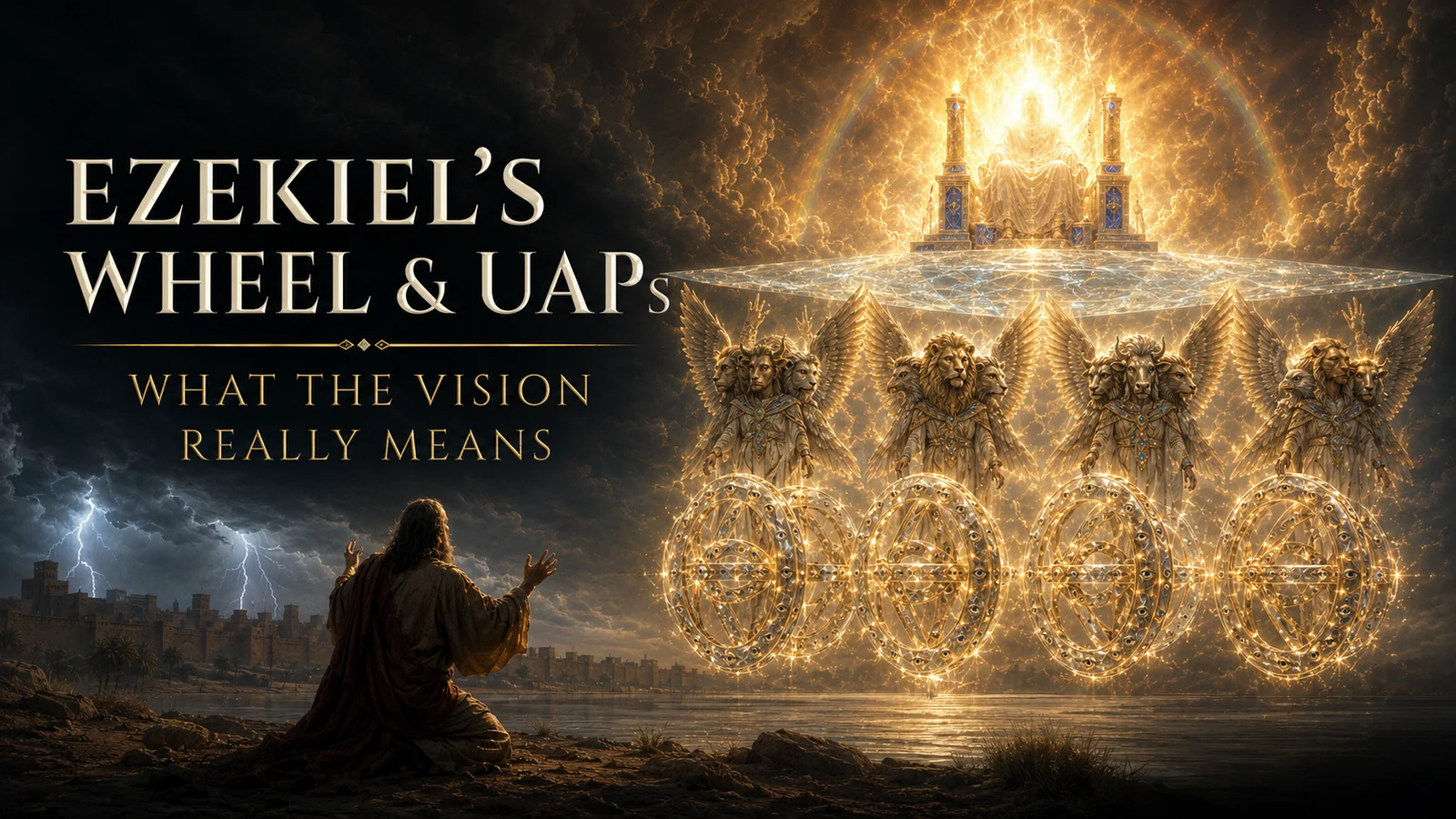

Few biblical visions attract more modern speculation than Ezekiel’s wheel. Readers encounter a violent storm, flashing fire, four living creatures, wheels intersecting wheels, rims covered with eyes, and movement in every direction. It is easy to understand why Ezekiel’s wheel and UAPs are so often discussed together.
But the biblical text does not leave the vision unidentified. Ezekiel tells us what he saw: a vision of God that culminated in “the appearance of the likeness of the glory of the Lord” (Ezekiel 1:28). The prophet witnessed the mobile throne-glory of God, not an ancient spacecraft.
That conclusion does not make the vision less mysterious. It makes the mystery theological rather than technological. Ezekiel was not handed an engineering diagram. He was shown that the God of Israel remained sovereign, present, and free to act even when his people were exiled far from Jerusalem.
So what did Ezekiel actually see, and why do modern readers compare it to a UFO? The responsible answer begins with Ezekiel’s own setting, language, and conclusion before importing any modern category into the passage.
GUIDED ARTICLE EXPERIENCE
Ezekiel’s Wheel and UAPs: What Did Ezekiel Actually See?
Read along as the narration moves through the article.
Private device narration · No hosted audio or tracking
CONTINUE GUIDED TOUR
Continue where you left off.
GUIDED TOUR COMPLETE
You have reached the end of this study.
Study record saved on this device.
GUIDED TOUR
Ezekiel’s Wheel and UAPs: What Did Ezekiel Actually See?
Narrator: Paranoid Prophet Recommended Voice Native device narration
Prepare to follow the article as it is narrated.
VOICE & TOUR OPTIONS
Voice & Listening
NARRATOR
Finding a narrator…
Checking the best narrator available on this device.
Restores the best curated narrator available on this device.
Narrator choices are curated for clear, long-form listening on this device.
Screen-awake support will be checked when narration starts.
CHOOSE A NARRATOR
Curated for this device
Choose a verified narrator for this browser, or use System Narrator. Automatic mode uses the best reliable route exposed by this device; your chosen narrator is preserved even if this device needs a temporary fallback.
Preparing the guided article experience…
RESUME GUIDED TOUR?
Continue where you left off.
GUIDED TOUR COMPLETE
You have reached the end of this study.
Article Guide8 sections
Why Ezekiel Gets Compared to a UFO
The comparison does not come from nowhere. Ezekiel 1 describes an overwhelming scene in the sky: a windstorm advances from the north, an immense cloud flashes with fire, brilliant light surrounds it, and something like glowing metal appears within it. The living creatures move with startling speed. Beside them are unusual wheels capable of moving in any direction without turning.
Those details sound strange to any reader. To a modern imagination shaped by aircraft, science fiction, military sightings, and UAP footage, they can sound technological. Familiar modern explanations rush in before the passage has been allowed to explain itself.
Yet resemblance at the level of description is not the same as identity. A modern UAP report is called unidentified because the available evidence has not established what caused it. Ezekiel’s vision is different. Its identity is disclosed within the passage. Above the living creatures and wheels is an expanse; above the expanse is a throne; and above the throne is a radiant humanlike figure. The vision ends with Ezekiel recognizing the glory of the Lord, falling facedown, and hearing God’s voice.
This is where many popular interpretations reverse the order of authority. They begin with the modern UFO category and use it to redefine the biblical vision. A disciplined reading moves in the other direction. It begins with what Ezekiel says the vision is, then asks why some features remind modern readers of UAP reports.
The comparison may help explain a reader’s reaction, but it cannot control the meaning of the passage. Ezekiel’s language belongs to prophetic revelation: storm, fire, living creatures, spirit-directed movement, throne, radiance, and divine glory. Reading those elements as machinery does not explain the text. It replaces the text’s own categories with ours.
This distinction also protects Christian discernment. Not every light in the sky is divine, and not every biblical heavenly vision should be relabeled as a UFO. The fuller modern framework belongs in Christian View of UFOs: The Three-Tier UAP Theory. Here the narrower question is more important: what did Ezekiel intend his readers to understand?
What Ezekiel Actually Saw
Ezekiel’s location is the first interpretive guardrail. He was not standing in Jerusalem’s temple courts. He was among Judean exiles by the Kebar River in Babylon, in the fifth year of King Jehoiachin’s exile (Ezekiel 1:1-3). The priest was far from the land, the temple, and the visible center of Israel’s worship. Then the heavens opened, and he saw visions of God.
That setting gives the vision its force. Jerusalem’s fall was approaching, and exile could feel like divine absence or defeat. Ezekiel’s opening vision answers that fear. The Lord is not confined to one building, city, or border. His throne can appear in Babylon. His glory can confront, commission, judge, and sustain his people wherever they are.
The vision begins with a storm coming from the north: an immense cloud, fire flashing within it, brilliant light, and a center that looked like glowing metal. In Scripture, storm, cloud, fire, brightness, and overwhelming sound regularly accompany the manifestation of God’s presence and authority. Ezekiel is not watching a neutral object drift into view. He is being overtaken by a divine revelation.
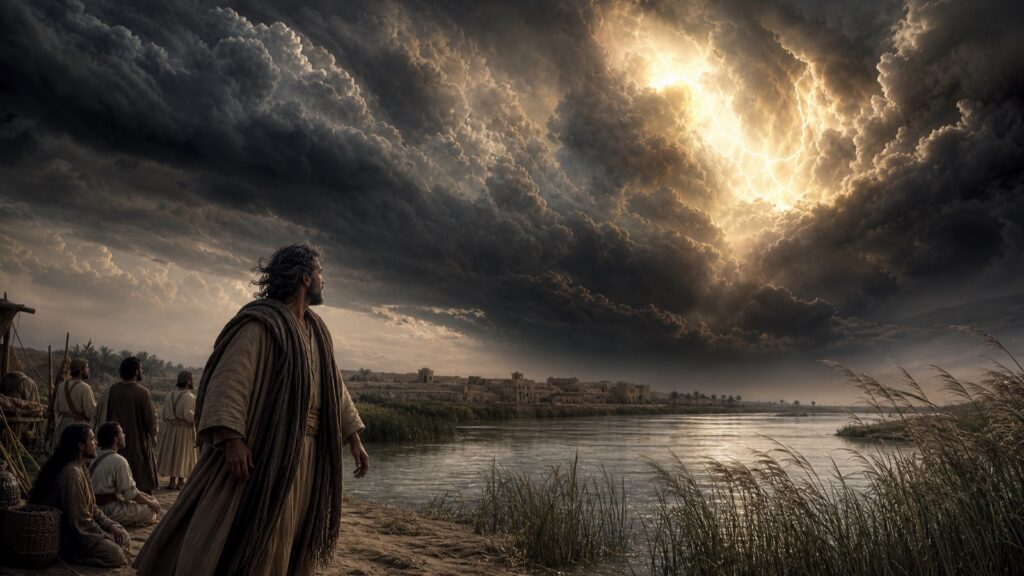
Within the fire Ezekiel sees four living creatures. Each has four faces, four wings, straight legs, and feet that gleam like polished bronze. They move together wherever the spirit directs them. Beside each creature is a wheel whose structure appears like a wheel intersecting another wheel. The wheels move with the creatures because the spirit of the living creatures is in them.
Above the creatures is an awe-inspiring expanse. Above that expanse is what looks like a sapphire throne. Seated above the throne is a figure with a humanlike appearance, surrounded by fire, brightness, and rainbowlike radiance. The scene has an unmistakable order: creatures and wheels below, expanse above them, throne above the expanse, and the radiant enthroned figure over all.
Ezekiel repeatedly uses phrases such as “the appearance of,” “the likeness of,” and “what looked like.” This is not the vocabulary of a mechanic struggling to name unfamiliar equipment. It is the careful language of a prophet describing a revelation whose reality exceeds ordinary comparison. He uses visible analogies without pretending that the analogies contain or exhaust what he saw.
The decisive interpretation arrives at the end of the chapter. Ezekiel does not say, “This was the appearance of a vehicle I could not identify.” He identifies the whole vision as the appearance of the likeness of the glory of the Lord. His response is not technical curiosity but worshipful collapse: he falls facedown and hears the voice of the One who sends him.
That final moment governs every strange detail that comes before it. The storm announces divine approach. The living creatures serve beneath the throne. The wheels express unhindered, spirit-directed movement. The throne declares kingship. The radiance reveals glory. Ezekiel saw the sovereign God making his presence known in exile.
The vision is therefore not an ancient attempt to describe advanced technology. It is a prophetic revelation of God’s mobile throne-glory. Before asking what the wheels symbolize or how the creatures should be understood, readers must keep that center fixed: the Lord reigns, his glory is not trapped in Jerusalem, and no earthly empire can place him in exile.
The Living Creatures
Ezekiel 1 initially calls the four beings “living creatures.” Their identity becomes explicit when the vision returns in the temple scenes of Ezekiel 10. Looking back on what he had seen by the Kebar River, the prophet says he realized that the living creatures were cherubim (Ezekiel 10:15-22).
That identification matters. Ezekiel is describing a class of heavenly beings already associated in Scripture with holy space and the presence of God. Cherubim guard the way to Eden, appear over the ark of the covenant, and are connected with the Lord’s royal presence (Genesis 3:24; Exodus 25:18-22; Psalm 99:1).
Yet Ezekiel’s cherubim do not resemble the soft, childlike figures of later art. Each has a humanlike form, four faces, four wings, straight legs, and gleaming feet. Human hands appear beneath their wings. Their faces bring together the human, lion, ox, and eagle. The result is not a natural species but a symbolic, awe-inspiring presentation of heavenly servants suited to the throne-glory above them.
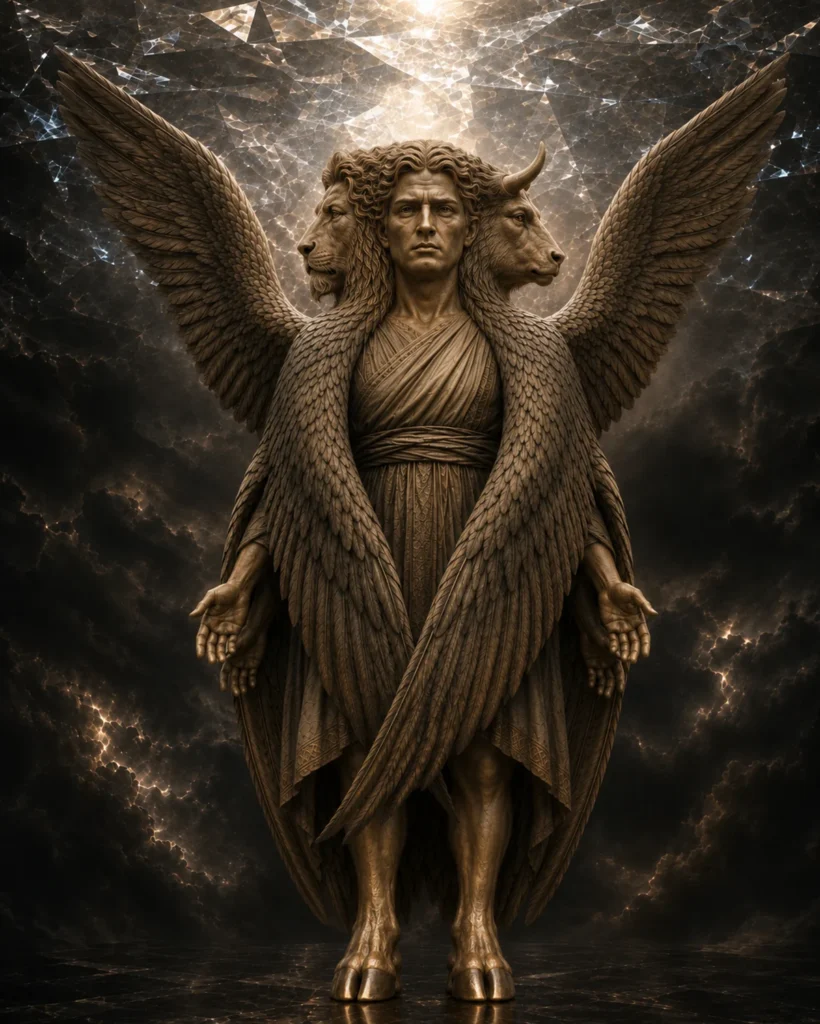
Readers have proposed many meanings for the four faces. They have been connected with intelligence, royalty, strength, service, swiftness, the created order, or the four directions. Some of those associations may be suggestive, but Ezekiel does not provide a decoding key. The clearest claims are the ones the passage makes directly: the creatures are living, powerful, many-sided, and completely responsive to the divine will.
Their movement is especially important. Each creature goes straight ahead. They do not wander, collide, or choose an independent course. Wherever the spirit directs, they go; when they stop, the wheels stop; when they rise, the wheels rise. Even their thunderous wings become still when the voice speaks from above the expanse. Their power is real, but it is ordered power under God’s command.
Ezekiel 10 repeats this coordinated movement during a darker moment. The glory that had filled the temple is preparing to depart because of Jerusalem’s rebellion. The cherubim rise, the wheels accompany them, and the glory of the God of Israel moves with them. The repeated vision confirms both identity and function: these are throne attendants within a revelation of divine kingship, holiness, and judgment.
The living creatures therefore belong to the vision’s heavenly category. Their unusual anatomy should not be flattened into either ordinary zoology or science-fiction biology. Ezekiel sees cherubim, and the text keeps their attention directed upward. They serve beneath the expanse and beneath the throne. They are astonishing, but they are not the center.
The Wheel Within a Wheel
The wheels are the feature most often detached from the rest of Ezekiel’s vision. The traditional phrase “wheel within a wheel” has become almost a symbol of mystery by itself. In the NIV, Ezekiel says each wheel appeared to be constructed like “a wheel intersecting a wheel” (Ezekiel 1:15-21). Whatever precise geometry the image suggests, the passage never presents a wheel alone. There are four wheels, one beside each cherub.
The wheels sparkle like topaz. Their rims are high and awesome, and eyes cover the rims all around. They can move in any of the four directions without turning as an ordinary wheel would. These details create an image of unhindered motion joined with watchfulness. The emphasis falls on coordinated freedom of movement, not technical reconstruction.
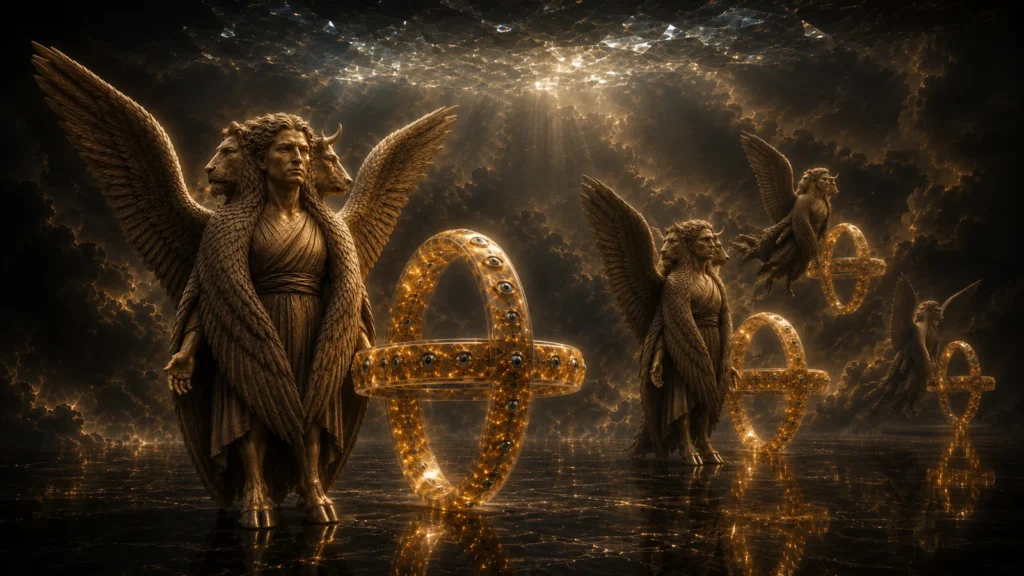
In prophetic imagery, eyes can communicate awareness and perception, though Ezekiel does not pause to assign them a single symbolic definition. The safer observation is simply that the vision is filled with living, watchful imagery under the rule of the enthroned Lord.
More important than the wheels’ shape is their relationship to the cherubim. Ezekiel repeats the pattern for emphasis: when the living creatures move, the wheels move; when the creatures stand still, the wheels stand still; when the creatures rise, the wheels rise. The reason given is that the spirit of the living creatures is in the wheels. Ezekiel 10 restates the same unity rather than introducing controls, operators, or mechanical independence.
This does not mean the wheels and cherubim are the same thing. The text distinguishes them while presenting them as a perfectly coordinated whole. Their motion follows the same spirit-directed purpose. Nothing in the throne vision is confused, delayed, or beyond God’s command.
Scholars often use the term “throne-chariot” for this scene. The phrase can be useful if it keeps the emphasis on royal presence and unhindered movement. It becomes misleading if “chariot” makes readers ask how the throne works instead of what the vision reveals. The prophet’s concern is that the Lord’s kingship and presence are not confined to Jerusalem.
The wheel within a wheel belongs to that message. Babylon cannot surround God. Distance cannot strand him. No direction lies outside his authority, and no part of the vision moves beyond his awareness. The wheels reveal mobility in service of sovereignty, not technology offered as an explanation for glory.
The Throne and Glory of God
Ezekiel’s description leads the reader upward. Above the cherubim is an expanse that gleams like crystal. Above the expanse is the likeness of a throne, brilliant blue like sapphire or lapis lazuli. High above the throne is a figure with a humanlike appearance, radiant with fire and surrounded by brilliant light (Ezekiel 1:22-28).
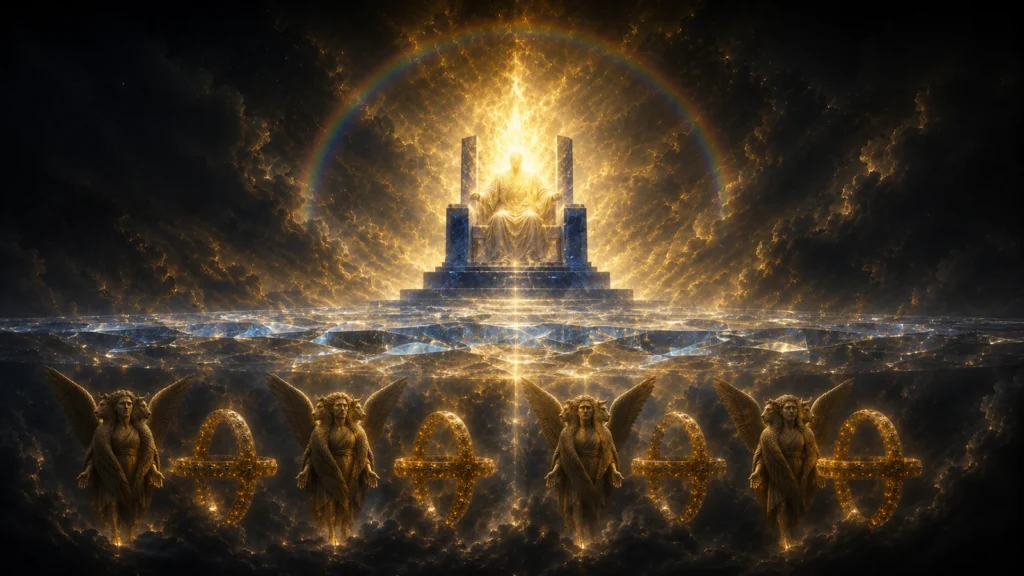
This vertical order tells the reader where the vision’s center lies. The wheels do not carry the meaning by themselves. The cherubim are not objects of worship. Both stand beneath the expanse, and the expanse stands beneath the throne. The vision is structured around the supremacy of the One enthroned above it all.
Ezekiel remains careful with his language. He sees what looks like a throne and a figure with the appearance of a man. He describes glowing metal, fire, brightness, and rainbowlike radiance. These comparisons allow him to speak truthfully about the vision without claiming that God’s glory can be reduced to the created things it resembles.
The rainbowlike radiance matters because the scene is not merely frightening. Fire and overwhelming brightness communicate holiness and majesty, while the rainbow recalls God’s covenant faithfulness after the Flood. Judgment is present in Ezekiel’s message, but it is not detached from the character and promises of God.
Other biblical throne visions use similarly symbolic language. Daniel 7:9-14 presents thrones, fire, the Ancient of Days, the heavenly court, and one like a son of man receiving an everlasting kingdom. These visions belong to the Bible’s revelation of divine rule. Their shared throne, fire, glory, and heavenly-attendant imagery is not evidence of a recurring vehicle type.
Ezekiel 10 develops the same theology through the departure of God’s glory from the temple. The glory moves from above the cherubim to the threshold, then rises with them and moves to the temple’s east gate. In the following chapter, the glory departs from the city (Ezekiel 10:18-19; 11:22-23). This is a solemn act of judgment against persistent idolatry. God is not being driven away by a stronger power. The sovereign Lord withdraws his presence on his own terms.
That departure also confirms what the opening vision announced in Babylon: the Lord is not trapped inside the temple. His presence is holy, personal, and free. He can depart from a defiled sanctuary, appear among exiles, and later promise restoration. The mobile throne-glory is therefore a declaration of divine freedom and kingship, not divine dependence on transportation.
The final line of Ezekiel 1 settles the interpretation. This was the appearance of the likeness of the glory of the Lord. Ezekiel falls facedown because he has encountered the majesty of God. Every creature, wheel, eye, wing, sound, flame, and flash serves that revelation. The vision is extraordinary because of who is present, not because it conceals an ancient machine.
Why the Vision Is Not Machinery
The ancient spacecraft interpretation usually begins with a simple argument: Ezekiel saw advanced technology but lacked modern words to describe it. Wheels become rotating equipment, eyes become sensors, fire becomes exhaust, and the movement of the cherubim becomes a flight system. The interpretation can sound persuasive because it turns unfamiliar imagery into objects modern readers recognize.
The problem is not that modern readers notice visual similarities. The problem is allowing those similarities to overrule the passage. Ezekiel never presents the scene as an unidentified machine. He calls it a vision of God, describes a throne above the living creatures, identifies the beings as cherubim in chapter 10, and concludes that he has seen the appearance of the likeness of the glory of the Lord.
The vision’s architecture is theological from bottom to top. The wheels stand beside the cherubim. The cherubim move beneath the expanse. The expanse lies beneath the throne. The radiant enthroned figure rules above everything. Removing the wheels from that order and treating them as the main object reverses the emphasis Ezekiel carefully builds.
Ezekiel’s repeated use of “appearance” and “likeness” also matters. Ancient-spacecraft theories often treat those words as evidence that the prophet was guessing at unfamiliar equipment. Within prophetic vision, however, comparison is how transcendent reality is described without reducing it to ordinary created things. A vision can disclose real heavenly reality through symbolic language. Symbolic does not mean imaginary, and real does not mean mechanical.
The movement of the wheels does not function like a technical explanation either. Ezekiel does not discuss fuel, controls, construction, operators, dimensions, or a destination. He repeatedly says that the wheels move, stop, and rise with the living creatures because the spirit of the living creatures is in them. His emphasis is unity under divine direction, not a hidden account of how a device operates.
The purpose of the vision is equally clear. Ezekiel is commissioned to speak God’s word to a rebellious people (Ezekiel 2:1-7). Later appearances of the throne-glory reveal the seriousness of Jerusalem’s idolatry, the departure of glory from the temple, and the Lord’s freedom to judge and restore. Nothing in that prophetic mission asks the reader to recover a forgotten technology.
This is why the phrase “throne-chariot” must be handled carefully. It is a scholarly description of royal mobility, not permission to convert the vision into a vehicle schematic. The throne is mobile because the God of Israel is not confined to the temple or defeated by Babylon. The image reveals sovereignty in motion.
It is always possible to imagine a technological parallel to a strange image. But possibility is not interpretation. A responsible reading asks what the details do within the passage, what the prophet says the vision is, and what response the vision produces. In Ezekiel 1, the answer is divine glory, prophetic commission, and worshipful fear. The machinery reading does not uncover the chapter’s secret meaning. It replaces the chapter’s stated meaning with a modern story.
What Ezekiel Means for UAP Discernment
Ezekiel’s vision matters for UAP discernment precisely because it should not be turned into a UAP case file. It gives Christians a Tier 1 guardrail: true heavenly reality comes before every fallen counterfeit, human imitation, or modern projection. God is not one unexplained intelligence among many. His glory is holy, sovereign, self-identifying, and worthy of worship.
That guardrail does not mean every unexplained light or extraordinary movement belongs to Tier 1. A UAP is an observation category. It means something reported or recorded has not yet been satisfactorily identified. The label does not establish an angel, demon, extraterrestrial visitor, divine manifestation, or secret aircraft. Unidentified is a limit on present knowledge, not a license to choose the most dramatic explanation.
The order of investigation should therefore begin with ordinary and human possibilities: misidentification, atmospheric effects, sensor limitations, aircraft, drones, classified systems, hoaxes, psychological factors, or deliberate manipulation. Some cases may remain unresolved after those possibilities are tested. Unresolved still does not mean spiritual, and spiritual still does not mean divine.
If a modern claim includes contact, revelation, religious teaching, promises of human transformation, or a new account of creation and salvation, Christians should test more than the reported phenomenon. Scripture commands believers to test the spirits (1 John 4:1-3) and reject any message that replaces the apostolic gospel (Galatians 1:6-9). The source, message, fruit, and view of Jesus Christ matter more than spectacle.
Ezekiel also warns against category collapse. Cherubim are not UAPs. God’s glory is not an alien encounter. A mysterious modern report is not automatically a demon, angel, Watcher, or heavenly sign. Related imagery does not prove identical identity. The Unseen Rebellion Map develops this category discipline across the wider biblical and modern discussion.
The interpretive pattern is straightforward. Begin with the biblical text: Ezekiel sees cherubim, wheels, an expanse, a throne, and the glory of the Lord. Identify the modern projection: readers imagine a craft because some visual features resemble modern UFO stories. Then state the disciplined conclusion: resemblance explains the comparison, but Ezekiel’s own words determine the vision’s identity.
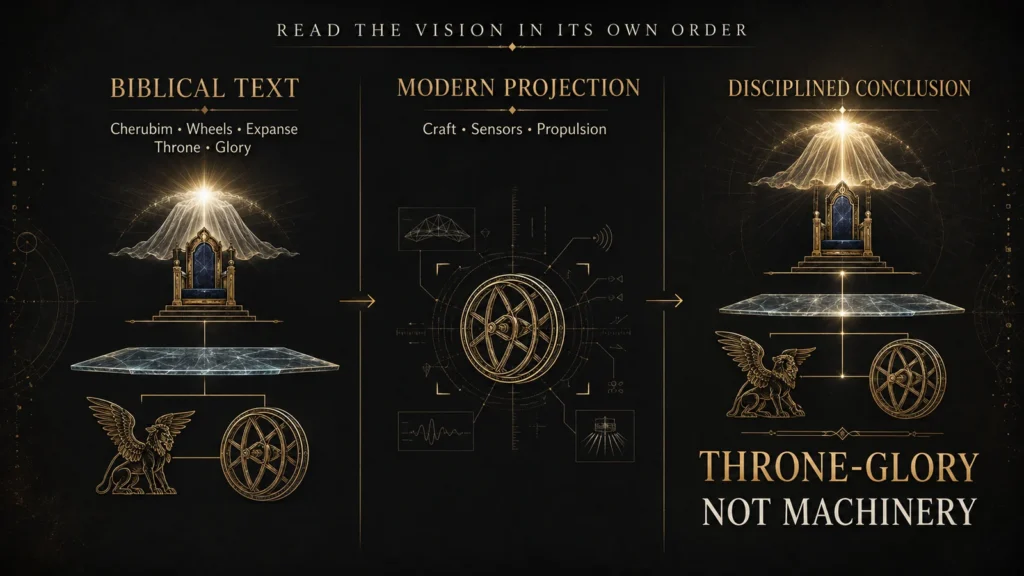
This approach leaves room for genuine mystery without making mystery an authority. Christians do not need to ridicule every report, accept every theory, or force every case into one spiritual category. They can investigate evidence, distinguish observation from interpretation, test religious claims, and remain anchored in Scripture.
For the full framework, continue to Christian View of UFOs: The Three-Tier UAP Theory. That model keeps the ontological order clear: heavenly original, fallen counterfeit, then human imitation and exploitation. It also keeps the investigative order practical by testing ordinary and human explanations before reaching for unseen ones.
FAQ: Ezekiel’s Wheel, UFOs, and UAPs
Was Ezekiel’s wheel a UFO?
No. A modern observer might compare parts of the vision to a UFO because it includes light, aerial movement, and unfamiliar forms. But Ezekiel does not leave the event unidentified. He presents it as a vision of God and identifies it as the appearance of the likeness of the glory of the Lord.
What does the wheel within a wheel mean in the Bible?
Ezekiel describes four wheels, one beside each cherub, with an intersecting structure that allows movement in any direction without turning. The text does not provide enough information to reconstruct their exact geometry. Within the vision, the wheels communicate unhindered, spirit-directed movement in service of God’s mobile throne-glory.
Were Ezekiel’s living creatures angels or aliens?
Ezekiel 10:20 identifies the living creatures as cherubim. They are heavenly throne attendants within the biblical vision, not extraterrestrial beings imported from a modern theory.
Why were the wheels covered with eyes?
Ezekiel does not give a complete symbolic glossary. Eyes can suggest awareness, perception, or watchfulness, but that should be stated with humility. The clear point is that the wheels belong to living, watchful prophetic imagery under God’s rule; the passage does not identify the eyes as technological sensors.
Did Ezekiel describe technology he could not understand?
That claim is possible only after modern technological assumptions are placed over the passage. Ezekiel understood the vision well enough to identify its central reality, fall facedown, hear God’s voice, and receive a prophetic commission. His comparison language reflects the difficulty of describing divine glory, not ignorance about an ancient spacecraft.
Does Ezekiel prove that modern UAPs are biblical?
No. Ezekiel establishes that Scripture contains true heavenly visions and manifestations of divine glory. It does not identify the cause of every modern UAP report. Each report must be investigated on its own evidence, and any spiritual or religious claims attached to it must be tested under Scripture.
Selected Sources and Further Reading
Scripture remains the controlling authority for this article. The following commentaries and studies provide responsible historical, literary, and theological background for Ezekiel’s vision, exile setting, throne imagery, and theology of divine presence.
- Ezekiel 1 and Ezekiel 10 – the inaugural throne-glory vision and its later identification of the living creatures as cherubim.
- Daniel I. Block, The Book of Ezekiel, Chapters 1-24, New International Commentary on the Old Testament, Eerdmans, 1997.
- Iain M. Duguid, Ezekiel, NIV Application Commentary, Zondervan, 1999.
- Walther Zimmerli, Ezekiel 1: A Commentary on the Book of the Prophet Ezekiel, Chapters 1-24, Hermeneia, Fortress Press, 1979.
- John F. Kutsko, Between Heaven and Earth: Divine Presence and Absence in the Book of Ezekiel, Eisenbrauns, 2000.
Read Next
- Genesis 6 Explained: The Sons of God, Nephilim, and the Flood
- Sons of God and Daughters of Men: What Genesis 6 Really Means
- The Book of Enoch Explained: Scripture, History, and the Watchers
Christ Above Every Visible and Invisible Power
Ezekiel’s vision assured the exiles that Babylon had not defeated, confined, or displaced the Lord. God’s throne was not trapped in Jerusalem. His glory could appear by the Kebar River, confront sin in the temple, depart in judgment, and promise a future restoration. The mobile throne-glory revealed a King whose rule crossed every human border.
The New Testament brings that confession into its Christ-centered fullness. Colossians 1:15-20 declares that all things, visible and invisible, including thrones, powers, rulers, and authorities, were created through Christ and for Christ. He is before all things, holds all things together, and reconciles through the blood of his cross.
Colossians 2:13-15 adds that Christ has disarmed the rulers and authorities and triumphed over them. Whatever exists in the unseen realm, and whatever may eventually be learned about modern UAP reports, nothing stands outside his creation, authority, judgment, or victory.
Ezekiel’s wheel should therefore leave readers with more than curiosity. The prophet does not end the chapter studying a mechanism. He falls facedown before the glory of the Lord and listens to the word of God. That is the vision’s proper center and the Christian response: worship Christ, search the Scriptures, test every claim, and refuse to let mystery take the throne.