
GUIDED ARTICLE EXPERIENCE
The Watchers Explained: Fallen Angels, Genesis 6, and the Book of Enoch
Read along as the narration moves through the article.
Private device narration · No hosted audio or tracking
CONTINUE GUIDED TOUR
Continue where you left off.
GUIDED TOUR COMPLETE
You have reached the end of this study.
Study record saved on this device.
GUIDED TOUR
The Watchers Explained: Fallen Angels, Genesis 6, and the Book of Enoch
Narrator: Paranoid Prophet Recommended Voice Native device narration
Prepare to follow the article as it is narrated.
VOICE & TOUR OPTIONS
Voice & Listening
NARRATOR
Finding a narrator…
Checking the best narrator available on this device.
Restores the best curated narrator available on this device.
Narrator choices are curated for clear, long-form listening on this device.
Screen-awake support will be checked when narration starts.
CHOOSE A NARRATOR
Curated for this device
Choose a verified narrator for this browser, or use System Narrator. Automatic mode uses the best reliable route exposed by this device; your chosen narrator is preserved even if this device needs a temporary fallback.
Preparing the guided article experience…
RESUME GUIDED TOUR?
Continue where you left off.
GUIDED TOUR COMPLETE
You have reached the end of this study.
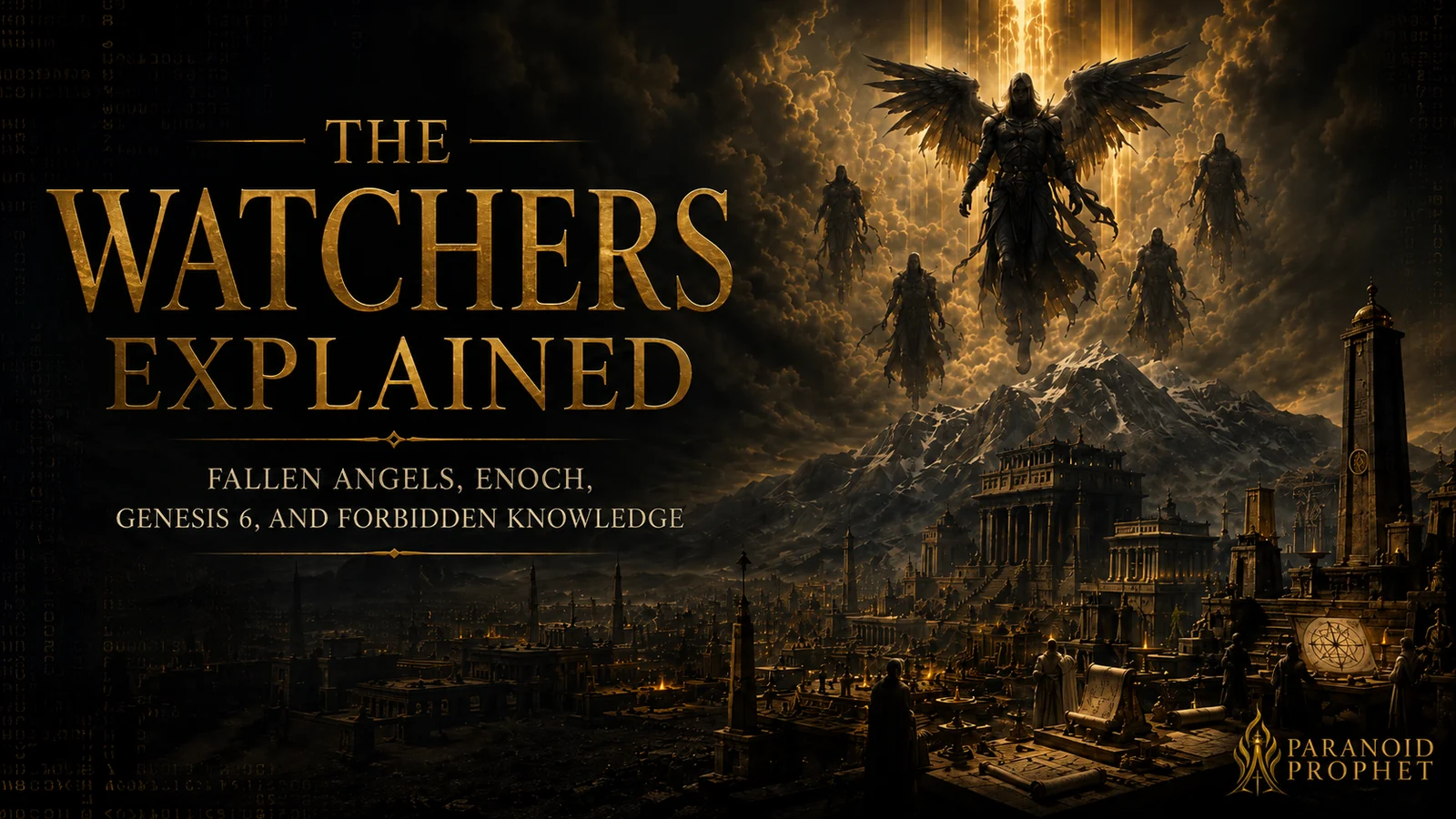
Who were the Watchers? In ancient Jewish tradition, the Watchers were rebellious heavenly beings identified with the “sons of God” in Genesis 6. The Book of the Watchers in 1 Enoch says they descended to earth, took human wives, produced giant offspring, transmitted forbidden knowledge, intensified corruption, and were sentenced to judgment.
Genesis itself does not call these beings Watchers. It calls them sons of God. The Watcher name and the expanded story come from later Jewish interpretation, especially the Book of Enoch. That tradition is ancient and historically important, but it does not carry the same authority as Scripture.
Spiritual rebellion does not always announce itself as rebellion. Sometimes it arrives as enlightenment, secret wisdom, or power offered outside the order of God. The Watcher tradition explores that danger. This article explains where the name comes from, what 1 Enoch claims happened, how Jude and 2 Peter relate to that interpretive world, and how Christians can study it without quietly turning ancient expansion into biblical doctrine.
Article Guide8 sections
Who Were the Watchers?
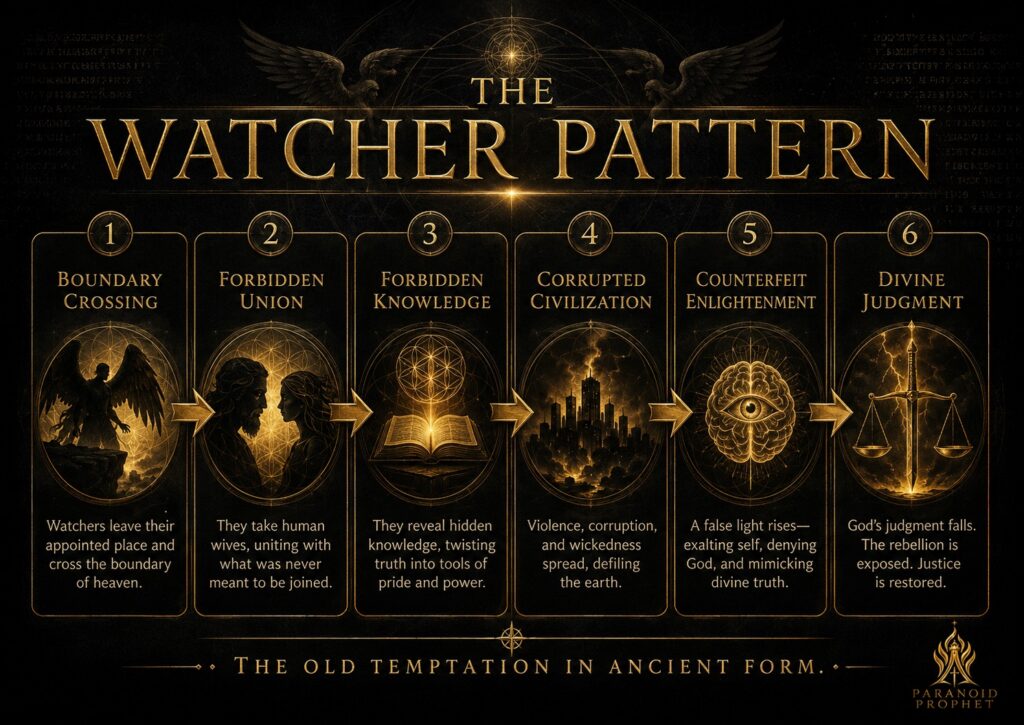
The Watchers were heavenly beings in ancient Jewish literature. Some Watchers remain holy servants; others rebel. In the Enochic story attached to Genesis 6, the rebellious group abandons its appointed role, enters unlawful unions with human women, shares corrupting instruction, and comes under divine judgment.
They can be described broadly as fallen angels because they are heavenly beings who rebel. Yet “fallen angel” is a category, while “Watchers” names a particular ancient tradition. Not every hostile spirit, rebellious power, or sinful angel in Scripture should automatically be identified as one of the Genesis 6 Watchers.
The name itself points to vigilance. A watcher is one who stays awake, observes, or carries out a heavenly commission. That function is not evil. The tragedy of the Enochic story is that beings associated with heavenly oversight abandon the order they should have served.
Their rebellion unfolds along several connected lines:
- They cross from the heavenly realm into forbidden unions with human women.
- They bind themselves together in a deliberate oath.
- They become corrupt teachers rather than faithful heavenly servants.
- Their giant offspring spread violence through the earth.
- God confines the rebels and announces judgment.
Those details describe the Watcher tradition. Genesis supplies the compressed biblical episode beneath it, but Genesis does not contain the full Enochic storyline.
Does Genesis 6 Call Them Watchers?
No. Genesis 6:1–4 calls the boundary-crossers “sons of God.” The strongest biblical interpretation identifies them as heavenly beings who took human women and violated their appointed order. The phrase study, competing interpretations, and major objections are handled in Sons of God and Daughters of Men.
For this article, the essential distinction is simple: sons of God is the wording of Genesis; Watchers is the later ancient name applied to those beings. The two are connected by interpretation, not by identical vocabulary.
Genesis also keeps the episode inside a much larger crisis. Humanity multiplies, the sons of God cross a boundary, the Nephilim appear, human wickedness deepens, violence fills the earth, and God announces judgment while Noah finds favor. That chapter-wide movement belongs to Genesis 6 Explained. The Watcher tradition later attempts to explain how heavenly rebellion contributed to the corruption preceding the Flood.
The Holy Watcher in Daniel
The Bible does use watcher terminology, but not in Genesis 6. In Daniel 4:13–17 and 23–24, Nebuchadnezzar sees a “watcher, a holy one” descend from heaven and announce judgment on the proud king. Daniel then identifies the sentence as the decree of the Most High.
Daniel’s watcher is holy and carries out God’s judgment. He is not a fallen being and the chapter is not retelling Genesis 6. The passage establishes that watcher language could describe a heavenly messenger associated with vigilance and divine decree. First Enoch applies related terminology to heavenly beings who abandoned that appointed role.
The shared name supplies conceptual background, not identity. Calling a heavenly being a watcher does not tell us whether that being is faithful or rebellious; the surrounding text must do that work.
Where the Watcher Tradition Comes From
The fullest ancient account appears in 1 Enoch. The collection’s opening section, usually called the Book of the Watchers, covers chapters 1–36. The descent, unions, illicit teaching, giant violence, heavenly complaint, and sentences against the rebels are concentrated especially in chapters 6–16.
First Enoch is not one book written at one moment by the patriarch Enoch. It is a collection of Jewish apocalyptic works composed and edited across time under Enoch’s name. Ancient writers used the voice of a revered figure to present revelation and interpretation. Understanding that literary setting does not make the work worthless; it helps readers use it honestly.
An Interpretation Older Than Christianity
Aramaic fragments of Enochic books were discovered among the Dead Sea Scrolls. The Israel Antiquities Authority dates the featured 4Q Enoch manuscript to roughly 150–50 BC. Those manuscripts establish that the Watcher interpretation circulated in Jewish communities before the New Testament was written. Related material also appears in Jubilees and the Book of Giants.
This evidence defeats the claim that the angelic or Watcher reading is a modern invention. Ancient readers were already interpreting Genesis 6 through a story of heavenly descent, giant offspring, corrupting revelation, and judgment.
Antiquity, however, is not inspiration. An old interpretation can preserve early memory, careful exegesis, theological reflection, literary development, and legendary expansion at the same time. Christians should neither dismiss it because it is outside most biblical canons nor accept every detail because it is ancient.
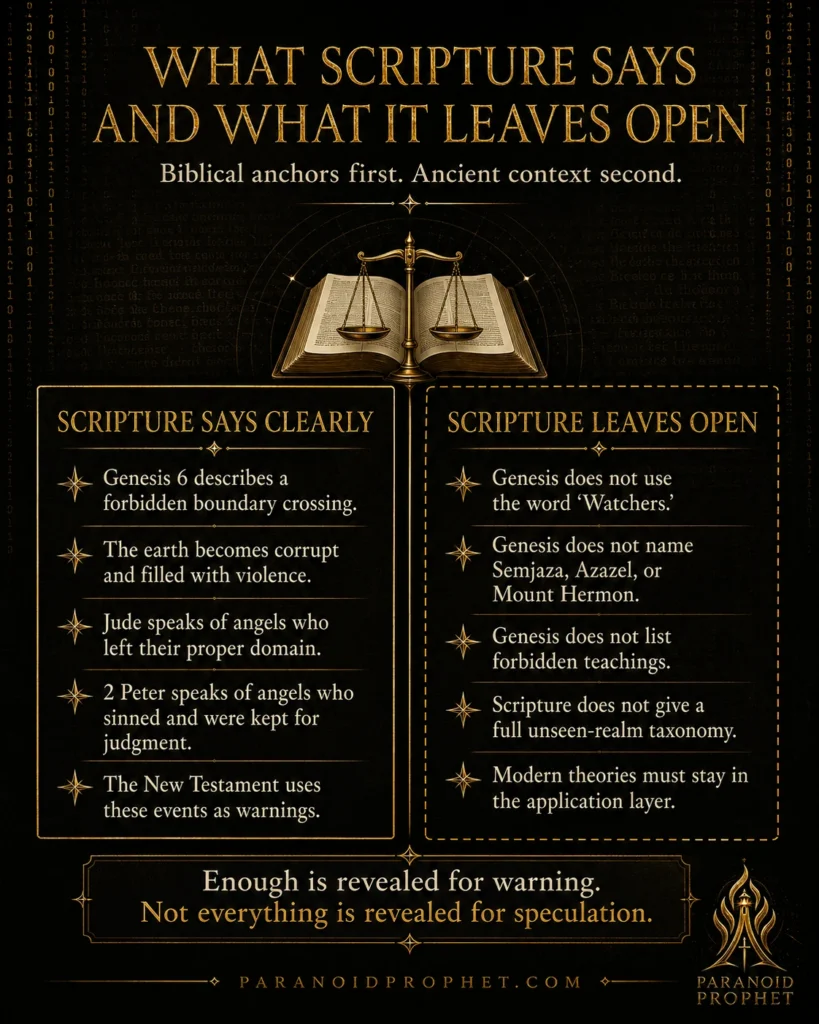
The governing order is Scripture first, ancient context second, and modern theory last. When that order is preserved, Enoch can clarify the world in which ancient Jews and early Christians discussed rebellious angels. When it is reversed, the Bible becomes a costume for conclusions drawn from somewhere else.
What the Watchers Did in 1 Enoch
In the Enochic account, a company of heavenly Watchers desires human women and agrees to descend. Their unions produce giants whose appetite and violence devastate the earth. The Watchers also disclose teachings that human beings use for warfare, manipulation, occult practice, and distorted reading of the heavens. The earth cries out, faithful heavenly beings appeal to God, and judgment is commissioned.
The expansion gives ancient readers a larger explanation for the pre-Flood crisis. Rebellion begins above, enters human households, spreads through culture and violence, and damages creation. The Watchers become corrupt mediators: beings who should serve God’s order instead communicate disorder.
Mount Hermon and the Collective Oath
First Enoch 6 places the descent on Mount Hermon. The Watchers fear that some will withdraw and leave others to bear the punishment, so they swear together and bind themselves to the plan. The story connects the mountain’s name with that binding oath.
Genesis does not name Mount Hermon or describe an oath. These details belong to Enochic tradition. Within that tradition, they make the rebellion deliberate and corporate rather than accidental. The Watchers knowingly cross a boundary and make solidarity in sin part of the act.
Semjaza and Azazel
The account names leaders, most prominently Semjaza, whose name also appears in forms such as Shemihazah, and Azazel. Semjaza is associated with leadership of the descending group and its oath. Azazel is especially blamed for teaching the manufacture of weapons and ornaments and for spreading corruption.
They are not interchangeable figures. First Enoch assigns them overlapping participation in one rebellion but different narrative roles and judgments. Genesis 6 names neither of them, and Scripture never identifies either as the leader of the sons of God.
Forbidden Teaching
The Watcher tradition includes instruction in weapons and warfare, enchantments and occult arts, adornment used for manipulation, roots and plants, and celestial signs. Its concern is not that learning or technical skill is inherently evil. Scripture honors wisdom, craftsmanship, and truthful study of creation.
The corruption lies in the source, purpose, and use of the teaching. Knowledge is transmitted through rebellion, used outside God’s order, and directed toward violence, domination, deception, or self-exaltation. Humanity receives power faster than righteousness, and the new capacity magnifies the condition of the human heart.
The full teaching catalog, its ancient meanings, and the difference between godly skill and forbidden practice belong in What Did the Watchers Teach?.
Giants and the Nephilim
First Enoch presents giants as the offspring of the Watchers and human women. They consume the produce of humanity, turn against living creatures and one another, and fill the earth with blood. This development is one reason ancient readers connected the brief Nephilim notice in Genesis 6:4 with the forbidden union.
The categories must remain distinct. Watchers are the rebel heavenly beings in the ancient tradition. Nephilim are the separate group associated with the Genesis 6 event, commonly understood in the tradition as giant offspring. “Giant” is a broader word and should not be treated as an automatic synonym for every Nephilim reference. The identity and later biblical giant traditions continue in Who Were the Nephilim?.
Jude, 2 Peter, and Angels Under Judgment
The New Testament never provides a complete inspired summary of the Book of the Watchers. It does, however, speak in ways that show familiarity with an interpretive world where angels rebelled, left their proper order, and were confined in connection with ancient judgment.
Jude 6–7: Angels Who Left Their Proper Place
Jude 6–7 describes angels who did not remain within their own position of authority but left their proper dwelling. God keeps them in bonds under darkness for the judgment of the great day. Jude then places Sodom and Gomorrah nearby as an example of grave sexual transgression and judgment.
Scholars debate exactly how tightly Jude connects the examples. Even with that caution, his language of angels abandoning their assigned domain fits the Watcher interpretation remarkably well. The passage gives biblical weight to the theme of heavenly beings violating proper order without importing Enoch’s entire storyline.
Jude 14–15: Using Enochic Material
Jude 14–15 attributes a judgment saying to Enoch that closely follows 1 Enoch 1:9. The relationship is direct enough that readers should not pretend Jude had no contact with Enochic tradition.
Quotation does not automatically canonize an entire source. Biblical writers can use a true statement, familiar proverb, poem, historical record, or known tradition without granting every line of that source equal authority. Jude’s inspired use tells Christians to take the statement as he uses it seriously. It does not settle every question about the composition or authority of 1 Enoch.
Second Peter 2:4–5: Angels, Confinement, and the Flood
Second Peter 2:4–5 says God did not spare angels when they sinned but committed them to gloomy confinement until judgment. Peter immediately moves to the ancient world, the Flood, and the preservation of Noah.
The sequence is important: sinning angels, confinement, the ancient world, Noah, judgment, and rescue. Peter does not name Watchers, Hermon, Semjaza, or Azazel. Still, his arrangement strengthens the historical connection between angelic rebellion and the Flood era.
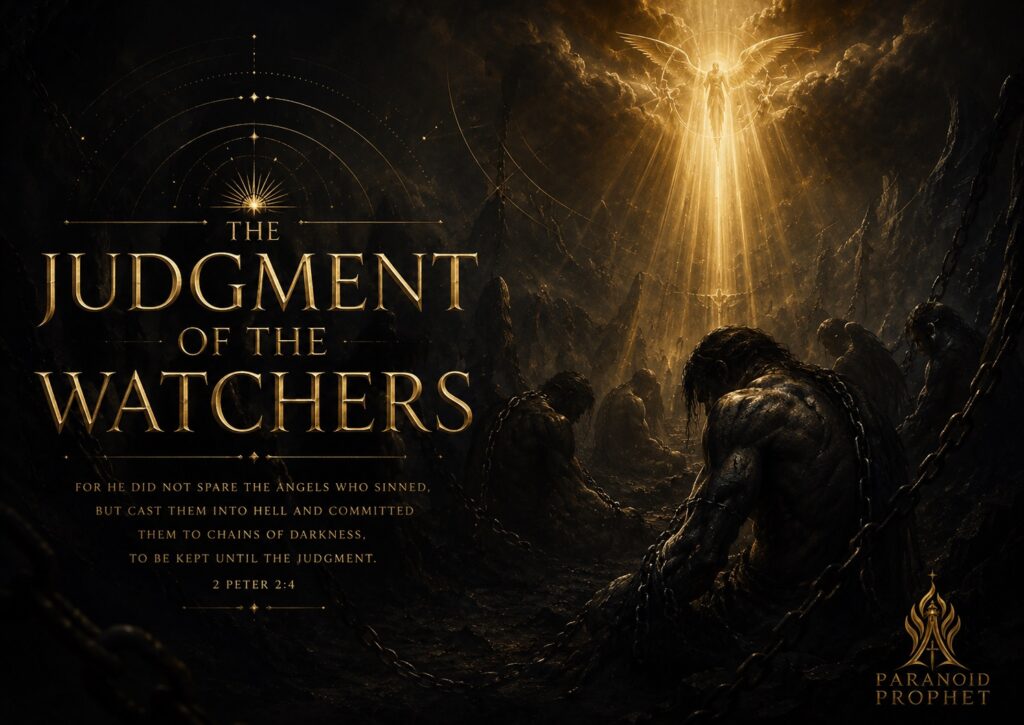
Jude and Peter are not trying to satisfy curiosity about every rebel being. Their purpose is moral and pastoral. If God judged angels who sinned and the violent ancient world, false teachers and unrepentant rebels should not mistake delayed judgment for divine indifference.
How Christians Should Evaluate the Watcher Tradition
Christians do not have to choose between pretending 1 Enoch never mattered and treating it as a lost book secretly controlling the Bible. A disciplined approach can recognize its historical value while keeping canonical authority clear.
- Scripture establishes doctrine. Genesis 6, Daniel 4, Jude, and 2 Peter provide the canonical anchors.
- Ancient texts illuminate reception. First Enoch, Jubilees, and the Book of Giants show how Jewish readers developed the Genesis episode.
- Manuscripts establish circulation. The Dead Sea Scrolls demonstrate that Enochic traditions existed before Christianity; they do not prove that every detail is historical.
- Scholarship helps trace relationships. Historical and textual study can clarify composition, vocabulary, influence, and reception without deciding theology by academic vote.
- Modern theory remains application. Contemporary categories cannot travel backward and redefine Genesis or 1 Enoch.
What the Tradition Can Genuinely Clarify
The Watcher tradition confirms that ancient interpreters saw more than ordinary human intermarriage in Genesis 6. It helps explain the conceptual world behind angels leaving their domain, sinning before the Flood, and being held for judgment. It also develops a serious theology of corrupt mediation: knowledge from a rebellious source can carry destructive moral direction even when it arrives as enlightenment.
It also warns that rebellion does not remain private. In the Enochic story, heavenly disobedience enters human relationships, instruction, violence, and worship. Power without holiness does not elevate the world. It makes corruption more efficient.
Where Responsible Confidence Stops
Genesis does not explicitly name Watchers, Mount Hermon, Semjaza, Azazel, or a teaching catalog. Scripture does not explain every connection among fallen angels, hostile spirits, giants, and other rebel powers. Christians can discuss Enochic proposals without presenting them as facts the Bible directly teaches.
The dedicated Book of Enoch Explained article examines the collection’s composition, manuscripts, influence, authorship claims, and authority in greater depth. That is the natural next step once the Watcher tradition itself is understood.
What the Watchers Were Not
Clear categories protect the article from becoming a theory of everything.
The Watchers were not the Nephilim. In the Enochic tradition, the Watchers are heavenly rebels and the giants are their offspring. The groups are related within the story but not identical.
The Watchers were not simply demons. The Enochic tradition later explains evil spirits as the surviving spirits of dead giants. Whether that theory is accepted or not, it distinguishes those spirits from the bound Watchers. Scripture does not require Christians to identify every demon with either group.
The Watchers were not automatically Satan’s Genesis 6 army. Satan is a rebel power, and the Watchers are rebel heavenly beings, but relationship does not prove identity or command structure. Scripture never names Satan as the leader of the Genesis 6 sons of God. The broader distinctions belong in Lucifer vs. the Watchers and The Unseen Rebellion Map.
The Watchers were not extraterrestrials or UAP. Those are modern categories. Genesis speaks of sons of God, and Enochic tradition speaks of heavenly Watchers. Similarity between an ancient theme and a modern claim does not establish that they describe the same beings or events.
Fallen angel is the broadest useful description. The rebellious Watchers fit within that category, but the category should not erase every distinction among rebellions, beings, and judgments in Scripture and ancient literature.
Why the Watcher Rebellion Still Matters
The Watcher tradition is not valuable because it offers Christians a secret map of the unseen realm. It is valuable because it preserves an ancient warning about created beings who reject God’s order and offer power without holiness.
Its pattern remains morally recognizable. A voice claims access to higher knowledge. The gift promises advancement or liberation. God’s boundaries are treated as obstacles. Power grows while character collapses. What appears to elevate humanity finally deepens bondage and judgment.
That is why Christian discernment tests more than whether a claim seems supernatural, ancient, impressive, or useful. Believers ask whether it agrees with God’s revelation, honors the Creator-creature distinction, produces truth and holiness, and submits to Jesus Christ. No claimed messenger receives trust merely for being powerful or nonhuman.
Frequently Asked Questions
Who were the Watchers in the Bible and Book of Enoch?
Daniel uses watcher language for a holy heavenly messenger. First Enoch uses Watchers for heavenly beings, including a rebellious group identified with the sons of God in Genesis 6. Genesis itself does not use the name Watchers.
Were the Watchers fallen angels?
The rebellious Watchers can be described as fallen angels because they are heavenly beings who disobey God and face judgment. Not every fallen angel or hostile spirit should automatically be identified as a Watcher.
Does Genesis 6 call the sons of God Watchers?
No. Genesis calls them sons of God. The Watcher identification comes from ancient Jewish interpretation, especially 1 Enoch.
Is Daniel’s holy watcher one of the fallen Watchers?
No. Daniel 4 presents a holy watcher carrying out God’s decree against Nebuchadnezzar. The passage supplies biblical background for the term, not an identity with the rebellious Watchers of Enoch.
Is the Book of Enoch Scripture?
First Enoch is not part of the Jewish canon or the canon received by most Christian traditions, though the Ethiopian Orthodox Tewahedo Church is a notable exception. It remains valuable ancient Jewish literature, but this article does not treat it as equal to Genesis, Jude, or 2 Peter.
What did the Watchers teach?
First Enoch associates them with weapons, occult practices, adornment, roots, and celestial signs. The problem is not knowledge itself but knowledge transmitted through rebellion and directed toward corruption, domination, or false worship.
Were Semjaza and Azazel the same figure?
No. Semjaza is associated especially with leadership of the descending group and its oath. Azazel is singled out for corrupting instruction and receives his own sentence in 1 Enoch. Neither is named in Genesis 6.
Sources and Further Reading
- Genesis 6:1–4; Daniel 4:13–17, 23–24; Jude 6–7, 14–15; 2 Peter 2:4–5; Colossians 1:15–20; 2:15.
- George W. E. Nickelsburg and James C. VanderKam, 1 Enoch: The Hermeneia Translation.
- The Leon Levy Dead Sea Scrolls Digital Library: 4Q Enoch, Israel Antiquities Authority.
- Annette Yoshiko Reed, Fallen Angels and the History of Judaism and Christianity.
- Loren T. Stuckenbruck, The Myth of Rebellious Angels.
- Richard J. Bauckham, Jude, 2 Peter, Word Biblical Commentary.
Read Next
- Principal next step: The Book of Enoch Explained examines what the book is, how it was composed and preserved, and how much authority Christians should give it.
- What Did the Watchers Teach? develops the forbidden-knowledge theme without making knowledge or technology inherently evil.
- Who Were the Nephilim? follows the distinct giant and men-of-renown questions.
Christ, Not Forbidden Revelation
The Watcher story is a warning, not a gospel. Its rebels seek to elevate themselves and humanity outside God’s order, but their gifts deepen corruption and end in bondage. The gospel announces a radically different descent: God comes to humanity in Jesus Christ, not to violate human nature or offer salvation through secret knowledge, but to assume our humanity without sin, reconcile all things through the cross, and make his people new.
Colossians 1:15–20 and 2:13–15 places every throne, dominion, ruler, and authority beneath Christ as Creator and victorious Lord. The Watchers are not rival gods. They are accountable creatures, and no forbidden revelation can free humanity from sin or judgment.
Christians do not need angelic secrets to become more than human. We need the Savior who restores human beings to faithful life under God. Study the ancient tradition, respect what it can illuminate, and keep its mysteries in their proper place. The final word belongs to Christ.
CONTINUE THE INVESTIGATION
Ancient-source continuation
Book of Enoch Explained: What It Says and Why Christians Debate It
Examine the ancient source most associated with the Watchers tradition and why Christians debate its authority and usefulness.