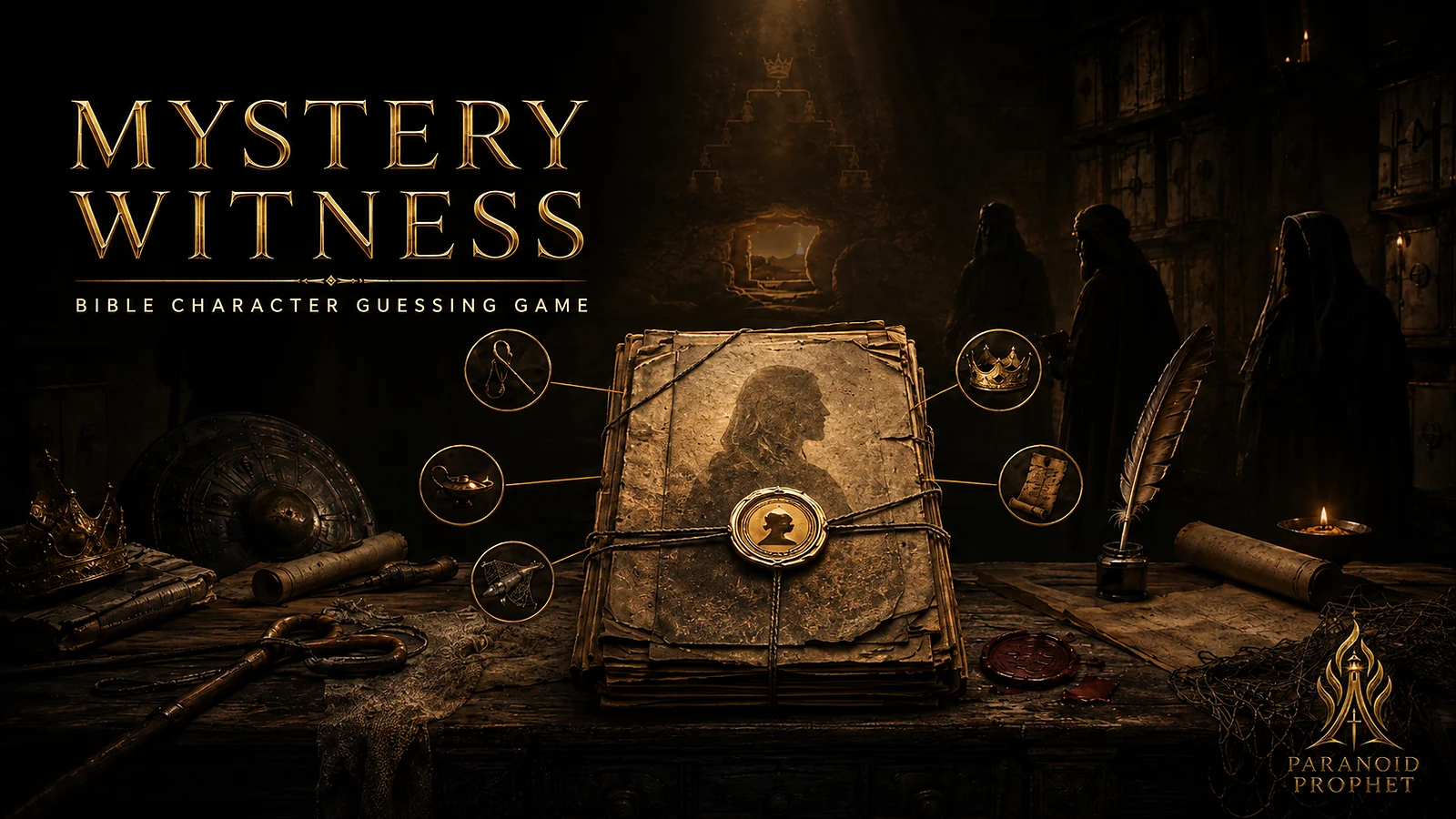
Mystery Witness: Bible Character Guessing Game

Mystery Witness is a free Bible character guessing game that challenges you to identify the people of Scripture from progressive evidence clues. Instead of showing the name, each round asks you to open a sealed file, weigh the evidence, and decide when the identity is clear.

Open the first clue and answer early for a higher score. However, you can reveal up to five clues when the evidence remains uncertain. Every choice turns the round into a small Scripture investigation rather than a blind guess.

In addition, the game includes 131 witness files drawn from across the Old and New Testaments. You will encounter patriarchs, prophets, disciples, judges, kings, women of Scripture, early church witnesses, resurrection witnesses, lesser-known servants, and sobering warning figures.

A second investigation mode, Who Wrote It?, examines the people connected with biblical books, letters, prophetic scrolls, scribal work, dictation, and traditional attribution. Unlike a basic authorship quiz, it asks who sent a letter, who physically wrote it down, who received a revelation, and what the text identifies directly rather than through later tradition.

Therefore, this is not merely a test of names and isolated facts. Every completed file reveals Scripture references, important distinctions, common points of confusion, and a concise explanation of why the witness or writing connection matters.

Open the console. Weigh the clues. Return to the text.

Interactive Bible Evidence Game

Mystery Witness

Open the sealed Scripture evidence console. Identify biblical witnesses, investigate authorship clues, and test how carefully you read the record.

131 witness files 26 authorship cases Mobile optimized

How to Play This Bible Character Guessing Game

Mystery Witness gives new players a clear starting point while still challenging experienced Bible readers.

First, choose one of the two investigation types:

  • Mystery Witness asks you to identify biblical people and witness groups.
  • Who Wrote It? asks you to identify writers, senders, scribes, scroll-bearers, and other people connected with the writing and transmission of Scripture.

Then, select the biblical archive you want to investigate in the main Mystery Witness mode. You can focus on one part of Scripture or move between several kinds of witnesses.

Next, choose your investigation level:

  • Easy provides four possible answers and more recognizable clues.
  • Normal provides six choices and introduces closer comparisons.
  • Hard provides eight choices and uses more detailed evidence, careful distinctions, and less obvious wording.

After that, each round begins with one revealed clue. You can select an answer immediately or open another evidence seal. Five clues are available in every file.

Because the scoring system rewards careful confidence, a correct answer after the first clue earns the most points. Each additional clue lowers the available score. Still, guessing blindly offers no benefit. The goal is to recognize the witness from the evidence rather than gamble on a name.

Afterward, the file opens fully. You will see:

  • the correct identity or writing connection;
  • a summary of the person’s role;
  • Scripture references connected with the clues;
  • distinctions between commonly confused answers;
  • an explanation of what the evidence supports;
  • cautions against claiming more than the text establishes.

In addition, a standard session contains ten files. Correct answers build your Witness Chain and can earn additional streak bonuses.

Study Mode for Bible Character Practice

For practice, Study Mode removes competitive penalties and prioritizes files that need more attention. It works well when learning a new archive, preparing for a Bible class, or reviewing people you previously missed.

Study sessions do not artificially raise your competitive score or mastery record.

Review Missed Bible Character Files

At the end of a competitive session, Mystery Witness can create a focused review from the files you missed.

As a result, the review keeps the original investigation mode and difficulty. You can examine the same kind of evidence again without changing the character of the challenge.

Build Your Evidence Archive

Meanwhile, the game’s local Evidence Archive records your progress.

As you play, files move through several stages:

  • Sealed
  • Discovered
  • Identified
  • Mastered
  • Needs Review

Therefore, a file reaches Mastered status only after repeated competitive success. The player must answer correctly on Normal or Hard and make at least one strong identification with three clues or fewer.

Your browser saves progress on the device you use. However, you never need an account.

Two Ways to Play This Bible Character Guessing Game

Mystery Witness contains two connected games inside the same evidence console. Although they share the same clue-and-investigation structure, they test different forms of biblical knowledge.

Guess the Bible Character in Mystery Witness Mode

In the main mode, you identify people and groups from Scripture.

Instead of presenting a direct question such as “Who defeated Goliath?” the game opens a witness file one clue at a time. Early clues may describe family connections, historical settings, responsibilities, failures, promises, or moments of faith. Later clues become more decisive.

Eleven archives organize the 131 files:

  • Old Testament
  • The Disciples
  • Prophets
  • Warriors, Judges, and Kings
  • Women of Scripture
  • Early Church Witnesses
  • Resurrection Witnesses and Evidence
  • Promise and Messianic Line
  • Warnings and Rebels
  • Lesser-Known Witnesses
  • Inspired Writers and Scroll-Bearers

Some identities are immediately familiar. Others receive only a few verses in Scripture. Both kinds of witnesses matter.

For example, a lesser-known servant may reveal how God worked through quiet faithfulness. Meanwhile, a king’s file may combine courage, compromise, judgment, and restoration. A resurrection witness may clarify who saw the empty tomb, who encountered the risen Christ, and who later proclaimed what happened.

Moreover, the game distinguishes people whom readers often confuse with one another.

James son of Zebedee is not James son of Alphaeus. John the Baptist is not John the apostle. Philip the apostle is not Philip the evangelist. Joseph the son of Jacob is not Joseph the husband of Mary.

The game does not include these distinctions merely to make the challenge harder. Instead, they help players read Scripture carefully and avoid blending different witnesses into one vague biblical memory.

Who Wrote It? Mode

Who Wrote It? investigates the human connections behind biblical books, letters, visions, prophetic words, and preserved scrolls.

Some cases have a direct answer. For instance, a biblical writer may identify himself, a prophetic book may open with the prophet’s name, or a letter may clearly name its sender.

However, other cases require a more precise distinction.

Paul is the named apostolic sender of Romans, but Tertius identifies himself as the person who wrote the letter down. Jeremiah received and dictated prophetic words, while Baruch served as the scribe who recorded them. Peter is named as sender of 1 Peter, while Silvanus is connected with the letter’s help or transmission.

Therefore, the mode distinguishes several levels of evidence:

  • direct textual identification;
  • named sender;
  • named scribe;
  • internal literary linkage;
  • traditional attribution;
  • association with a scroll or collection;
  • a work whose human writer is not named in Scripture.

That final category matters because Scripture does not name a human writer for Hebrews. Therefore, the game never forces a confident candidate onto the book.

Who Wrote It? therefore teaches more than a list of traditional answers. It teaches players to ask what kind of connection the evidence actually supports.

The 26 authorship cases include the Torah, Psalms, wisdom literature, prophetic books, the Gospels, Acts, apostolic letters, Revelation, and important sender-versus-scribe distinctions.

Finally, every resolved case explains both what the evidence supports and what players should not overstate.

Why This Bible Character Guessing Game Goes Beyond Trivia

Many Bible trivia games reward the ability to recall a disconnected name, number, location, or event. That can be enjoyable, but Mystery Witness was built to go further.

Each file works as a small investigation.

The clues reveal the witness gradually. First, they may provide broad context. Then, they move toward more decisive evidence. As a result, the player must think about the whole biblical record rather than wait for one famous keyword.

After the answer, the game does not stop at “correct” or “incorrect.” It opens a learning summary that can include:

  • why the correct answer fits;
  • why the selected answer may have seemed plausible;
  • the central difference between two similar witnesses;
  • the person’s place in the biblical story;
  • the connection between the file and Christ, covenant, resurrection, warning, or faithful witness;
  • direct Scripture anchors for further reading.

In addition, the Evidence Archive adds a longer-term purpose. A player is not simply trying to finish ten random questions. The archive records which files the player encountered, identified correctly, mastered, or marked for review.

This creates a satisfying progression while keeping the focus on biblical literacy.

Mystery Witness does not replace reading Scripture. Instead, it sends the player back to the text with sharper questions, clearer distinctions, and a stronger memory of the people whose lives appear in the biblical record.

The goal is not merely to know more names.

It is to recognize the witnesses, understand the evidence, and handle the text with greater care.

Why Bible Authorship Requires Careful Wording

People often present questions about who wrote the Bible as if every book has the same kind of evidence behind its human authorship.

They do not.

Some biblical works directly name a prophet, writer, sender, or witness. Others identify a person through an opening line, an internal statement, or a clear relationship with another book. Meanwhile, ancient attribution and early Christian testimony connect some works with a writer whom the text does not directly name. In at least one important case, Scripture does not identify the human writer at all.

Mystery Witness treats those differences as part of the investigation rather than as a problem to hide.

Paul and Tertius

Romans 1:1 and 16:22 identify Paul as the apostolic sender and Tertius as the person who wrote the letter down.

That does not make Paul and Tertius competing authors in the same sense.

Paul is the named apostolic source and sender. Tertius is the scribe, sometimes called an amanuensis, who physically wrote the letter down.

Who Wrote It? includes separate cases so the player must recognize the role being asked about.

Jeremiah and Baruch

Jeremiah received and proclaimed the prophetic message. Baruch served as the scribe who wrote Jeremiah’s dictated words on a scroll.

After the king cut apart and burned the first scroll, Jeremiah dictated the words again, and Baruch recorded them. Jeremiah 36:4, 27–32 records that process.

Therefore, the distinction matters. We should not hide Jeremiah behind the scribe, nor should we ignore Baruch as though the writing process involved no human assistance.

Peter and Silvanus

First Peter 1:1 and 5:12 name Peter as the apostolic sender and connect Silvanus with the letter’s help or transmission.

However, we should describe the exact nature of that involvement carefully. The text supports Peter as the named sender and Silvanus as an important helper. It does not explain every detail of the production process.

John and the Johannine Writings

Revelation 1:1–11 directly names John and commands him to write what he sees.

The Gospel of John and the Johannine letters require more carefully qualified wording. The Gospel speaks of the testimony of the beloved disciple, and ancient Christian tradition strongly connects the work with John. That is meaningful evidence, but it is not the same kind of direct title-line identification found in some prophetic books and letters.

Hebrews

The human writer of Hebrews is not named in Scripture.

Christians throughout history have proposed many candidates, including Paul, Barnabas, Luke, and Apollos. Readers may study those proposals. However, no one should present a candidate as though Scripture settles the question.

The correct answer in Mystery Witness is therefore not a speculative name.

It is:

The human writer is not named in Scripture.

This does not weaken the authority or value of Hebrews. It simply respects the limits of the available evidence.

Confidence in Scripture does not require pretending the evidence says more than it does. Careful wording protects truth from both careless skepticism and careless overstatement.

Bible Character Guessing Game Features

FeatureWhat It Adds
131 witness filesBroad coverage of biblical people and witness groups from across Scripture
11 biblical archivesFocused play involving disciples, prophets, kings, women, resurrection witnesses, and more
26 authorship casesInvestigations involving writers, senders, scribes, scroll-bearers, and attribution
Three difficulty levelsAccessible entry for developing players and deeper challenges for experienced Bible readers
Progressive Scripture cluesDecide when enough evidence has been revealed before choosing an answer
Study ModePractice difficult or undiscovered files without altering competitive mastery
Review ModeRevisit missed witnesses and authorship cases after a session
Evidence comparisonsLearn why two similar or commonly confused answers are not interchangeable
Scripture anchorsReturn to the biblical passages connected with each completed file
Evidence ArchiveTrack sealed, discovered, identified, mastered, and review-needed files
Local saved progressContinue building the archive without creating an account
Fullscreen mobile consolePlay on iPhone, Android, tablet, laptop, or desktop

Who Is This Bible Character Guessing Game For?

This Bible character guessing game serves players who want more than a collection of surface-level Bible questions.

It can work well for:

  • adults who enjoy Bible trivia and Scripture study;
  • teenagers developing stronger biblical literacy;
  • Christian families playing together;
  • homeschool Bible lessons;
  • Sunday school classes;
  • youth groups;
  • small-group review activities;
  • Bible teachers introducing a new biblical book;
  • pastors or ministry leaders looking for an interactive learning tool;
  • readers interested in biblical authorship and historical source questions.

Easy mode is the best entry point for younger players or anyone still learning the major people of Scripture.

Normal mode provides a balanced challenge with closer distractors and more detailed clues.

Hard mode is intended for players who already know many familiar stories and want to test distinctions involving chronology, identity, textual evidence, apostolic relationships, writing roles, and lesser-known figures.

The game remains family-friendly, but it avoids childish Sunday-school entertainment. Its interface, clue writing, feedback, and authorship cases also serve serious adult players.

What Progress Does Mystery Witness Save?

Mystery Witness saves progress locally in the browser on the device you use.

No account, email address, external leaderboard, or login is required.

For example, the saved investigation record may include:

  • discovered files;
  • correctly identified witnesses;
  • mastered files;
  • cases marked for review;
  • competitive sessions;
  • Study Mode sessions;
  • Review Mode sessions;
  • highest scores;
  • first-clue identifications;
  • performance by difficulty;
  • commonly selected wrong answers.

This progress remains inside the browser’s local storage.

However, progress saved on an iPhone will not automatically appear on a separate computer or tablet. Clearing browser data, using private-browsing mode, changing browsers, or removing site storage may also erase the local record.

The game remains fully playable when storage is unavailable, but progress may not survive a refresh.

Use This Bible Character Guessing Game for Bible Study

You can use Mystery Witness as a study aid before, during, or after reading Scripture.

Family Bible Time

Choose one archive and complete a ten-file session together. Pause after each answer to read one of the listed Scripture passages.

Parents can allow younger players to discuss the clues before selecting an answer.

Homeschool Lessons

Use Easy mode when introducing a biblical period or group of people. Move to Normal or Hard after completing the related reading.

In addition, the Inspired Writers archive and Who Wrote It? mode can support lessons about how people wrote, recorded, sent, and preserved biblical books.

Sunday School and Youth Groups

Project the game on a screen and allow teams to discuss each clue.

Although points reward early identification, the Scripture references and explanation should remain the center of the activity.

Personal Bible-Literacy Review

Study Mode is useful for exploring an unfamiliar archive without affecting competitive mastery.

For example, a player can focus on prophets, resurrection witnesses, women of Scripture, early church figures, or lesser-known servants instead of receiving only random questions.

Preparing to Read a Biblical Book

Before beginning Romans, Jeremiah, Revelation, or another biblical work, open the related authorship cases.

As a result, this can clarify the difference between:

  • the sender and the scribe;
  • the prophet and the recorder;
  • direct internal evidence and historical attribution;
  • what the text states and what tradition proposes.

Reviewing Commonly Confused People

Finally, use the comparison feedback to separate witnesses whom players often blend together.

Examples include:

  • the different men named James;
  • John the Baptist and John the apostle;
  • Philip the apostle and Philip the evangelist;
  • Judas Iscariot and Jude, brother of James;
  • Joseph son of Jacob and Joseph husband of Mary;
  • Elijah and Elisha;
  • Ezra and Nehemiah.

The game should support Bible study, not replace it. Its best use is to sharpen memory, expose confusion, and send the player back to the biblical text.

Continue Exploring Christian Bible Games

Mystery Witness is part of the growing Paranoid Prophet collection of Scripture-centered games and interactives.

Explore the full Christian Bible Games Online library for more free games that make biblical knowledge, theology, strategy, and evidence more engaging.

You can also play:

More Scripture games, prophecy challenges, evidence investigations, and Bible-study tools will continue to be added to the library.

Bible Character Guessing Game FAQs

What is Mystery Witness?

Mystery Witness is a free online Bible character guessing game. Players identify biblical people, groups, writers, senders, scribes, and scroll-bearers through progressive Scripture clues.

Is Mystery Witness free to play?

Yes. The game is free to play on Paranoid Prophet. No paid account or subscription is required.

How many Bible characters are included?

The main Mystery Witness mode contains 131 witness files. These include individual people as well as a limited number of significant biblical witness groups.

Does the game include both the Old and New Testaments?

Yes. The archives include people and groups from across both Testaments, including patriarchs, prophets, kings, judges, disciples, women of Scripture, early church witnesses, resurrection witnesses, and inspired writers.

What is Who Wrote It? mode?

Who Wrote It? is an authorship evidence mode containing 26 curated cases. It examines people connected with biblical books, letters, prophetic words, visions, scribal work, sending, dictation, and traditional attribution.

Does the game claim certainty about disputed Bible authorship?

No. The game distinguishes direct textual evidence, named senders, named scribes, internal linkage, traditional attribution, associated scroll-bearers, and works whose human writer is not named.

The game never presents disputed questions with false certainty.

Is Mystery Witness suitable for children?

Easy mode can work well for families, older children, and teenagers. Some clues and authorship cases involve distinctions that younger players may understand better with help from a parent or teacher.

Can I play Mystery Witness on an iPhone or tablet?

Yes. The game and fullscreen console work on phones, tablets, laptops, and desktop computers. In addition, the interface includes thumb-friendly controls and mobile-responsive layouts.

Does Mystery Witness save my progress?

Yes. The current browser and device can save progress locally. However, it does not automatically transfer to another device, and clearing browser storage may remove it.

Do I need an account?

No. Mystery Witness does not require an account, login, email address, or external profile.

Can Mystery Witness replace reading the Bible?

No. The game is a Bible-study aid. Its clues, feedback, and Scripture anchors help players return to the text with stronger memory and more careful questions.

Open the File. Weigh the Evidence.

Scripture contains kings and servants, prophets and scribes, disciples and doubters, faithful witnesses and sobering warnings.

Some stand at the center of familiar stories. Others appear only briefly. Every one of them belongs to the biblical record for a reason.

Finally, Mystery Witness invites you to slow down, examine the clues, distinguish what Scripture clearly states from what people often assume, and remember the lives and voices Scripture preserves.

Open the file.

Weigh the evidence.

Search the Scriptures.

Hold fast to truth.