
GUIDED ARTICLE EXPERIENCE
Did the Nephilim Survive the Flood? Biblical Evidence and Theories
Read along as the narration moves through the article.
Private device narration · No hosted audio or tracking
CONTINUE GUIDED TOUR
Continue where you left off.
GUIDED TOUR COMPLETE
You have reached the end of this study.
Study record saved on this device.
GUIDED TOUR
Did the Nephilim Survive the Flood? Biblical Evidence and Theories
Narrator: Paranoid Prophet Recommended Voice Native device narration
Prepare to follow the article as it is narrated.
VOICE & TOUR OPTIONS
Voice & Listening
NARRATOR
Finding a narrator…
Checking the best narrator available on this device.
Restores the best curated narrator available on this device.
Narrator choices are curated for clear, long-form listening on this device.
Screen-awake support will be checked when narration starts.
CHOOSE A NARRATOR
Curated for this device
Choose a verified narrator for this browser, or use System Narrator. Automatic mode uses the best reliable route exposed by this device; your chosen narrator is preserved even if this device needs a temporary fallback.
Preparing the guided article experience…
RESUME GUIDED TOUR?
Continue where you left off.
GUIDED TOUR COMPLETE
You have reached the end of this study.
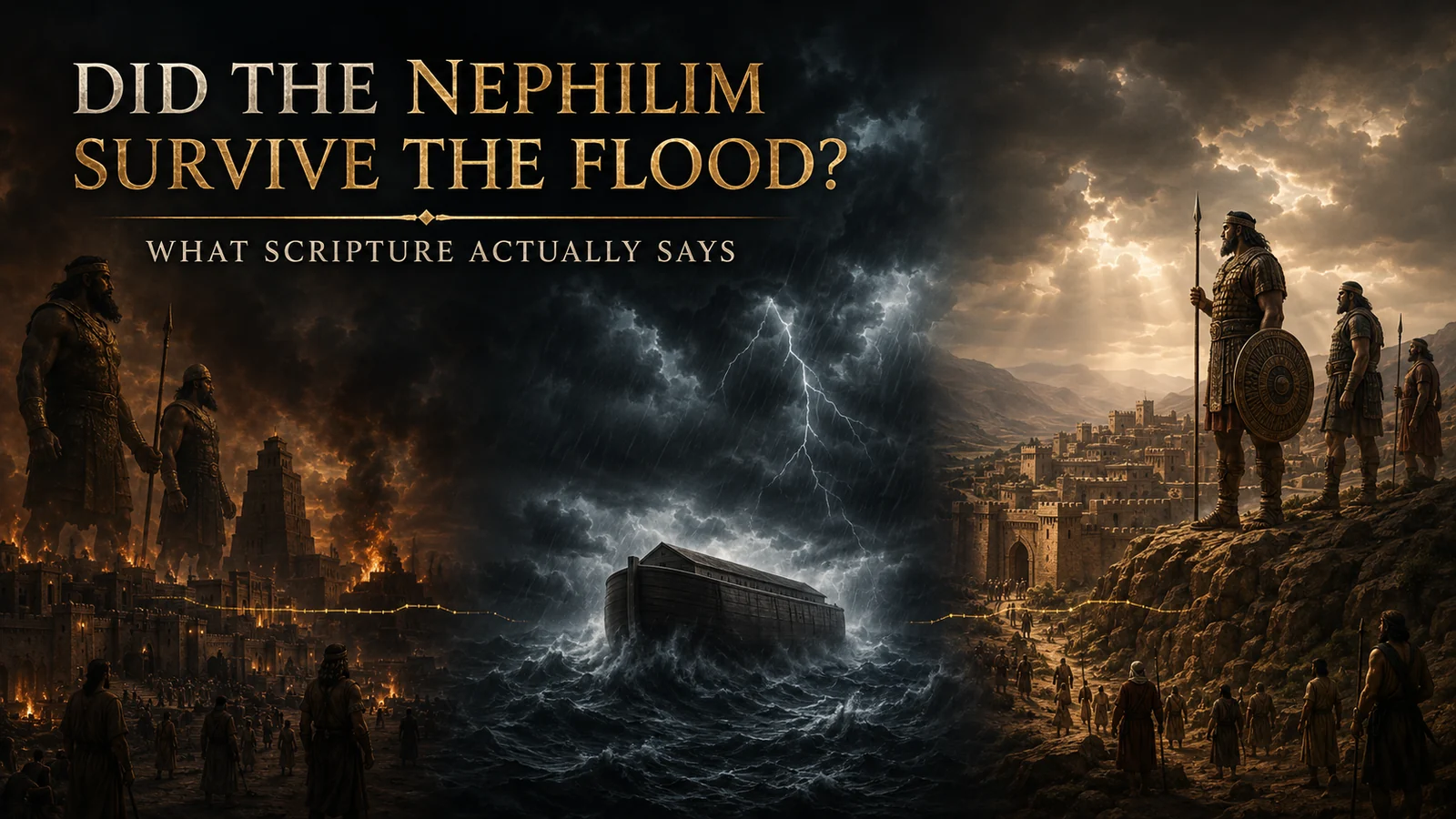
Did the Nephilim survive the Flood? Yes, in the important sense that the biblical record preserves some form of Nephilim continuity after the Flood. Genesis 6:4 anticipates an “afterward,” the Hebrew text of Numbers 13 connects the sons of Anak with the Nephilim, and later Scripture records an extensive trail of giant-associated peoples. But the Bible does not say that the original pre-Flood Nephilim personally remained alive outside Noah’s ark. Scripture establishes continuity more clearly than it explains the mechanism.
That distinction keeps two biblical truths in view. Genesis 6:4 places the Nephilim both “in those days” and “also afterward.” Yet Genesis 7:21-23 says that land-dwelling life outside the ark died and that only Noah and those with him remained. Any responsible explanation must honor both passages rather than building a theory from one and quietly setting aside the other.
The evidence therefore asks a narrower question than the title may first suggest. Did the same individual giant bodies walk out of the pre-Flood world by escaping judgment? Scripture gives no such account. Did the Nephilim problem, lineage, classification, memory, or phenomenon appear on the far side of the Flood? The canonical record says yes. The mystery lies in the transition.
This study follows that trail in order: Scripture first, ancient context second, and modern theory last. Readers who need the identities established before following the survival question can begin with Genesis 6 Explained, Sons of God and Daughters of Men, The Watchers Explained, and Who Were the Nephilim?. Here the task is to weigh what continued, what ended, and what the text leaves unresolved.
Article Guide11 sections
Did the Nephilim Survive the Flood?
The question becomes clearer when it is separated into three questions that are often blended together.
- Were there giants after the Flood? Yes. Genesis, Numbers, Deuteronomy, Joshua, Samuel, and Chronicles remember formidable peoples and warriors associated with unusual stature, strength, or giant tradition.
- Does Scripture connect later giants with Nephilim language? Yes. The strongest direct connection appears in the Masoretic Hebrew of Numbers 13:33, where the scouts identify the sons of Anak with the Nephilim.
- Does Scripture explain how that connection crossed the Flood? No. It never narrates an original Nephilim escaping outside the ark, names a carrier aboard the ark, or records a second heavenly incursion after it.
Continuity is biblically indicated. A particular survival mechanism is not revealed. This is not a retreat into complete uncertainty. The post-Flood evidence is too substantial for that. It is a calibrated conclusion that refuses to turn a real textual connection into an invented history.
The word survive can also mislead if it is left undefined. A person can survive by remaining bodily alive through an event. A lineage can survive through descendants. A category can survive when later people are identified with an earlier group. A phenomenon can recur. A memory can shape the way later enemies are named and understood. More than one of those forms of continuity could operate at once, but they are not interchangeable.
Modern readers often approach the question as though only a genetic answer would count. The biblical writers use thicker forms of identity. Peoples can be known by ancestry, homeland, covenant relation, reputation, and the names inherited from earlier generations. That does not make physical descent irrelevant, but it means a later group can bear an ancient classification without Scripture pausing to explain the biology. The task is to discover which kind of continuity each passage actually claims.
The Bible deliberately preserves a post-Flood Nephilim problem. It gives readers a forward-looking phrase in Genesis, a direct Hebrew association in Numbers, and a wider giant trail across Israel’s history. It also gives a Flood narrative whose ordinary force excludes fleshly life outside the ark. The best answer must be strong enough to account for the later evidence and restrained enough to respect the silence between the two worlds.
“And Also Afterward” in Genesis 6:4
Genesis 6:4 is the first and most important clue. The verse places the Nephilim on the earth “in those days, and also afterward,” then describes the sons of God going in to human women, children being born, and the resulting figures being remembered as mighty men of old, men of renown. The notice is compressed, but its position is deliberate. It ties the Nephilim to the forbidden unions and opens a horizon beyond the immediate scene.
“In those days” points to the world before the Flood. The surrounding chapter describes humanity multiplying, heavenly beings crossing a created boundary, human wickedness becoming great, and violence filling the earth. The Nephilim belong inside that crisis. Genesis does not isolate them as a curiosity unrelated to judgment, nor does it make them the only source of the world’s corruption.
“And also afterward” prevents readers from sealing the name entirely inside the pre-Flood era. At minimum, the narrator knows a later horizon in which Nephilim language or its associated phenomenon remains relevant. The phrase is especially striking because the name appears again only in Numbers 13:33, where the scouts report seeing the Nephilim in Canaan. Genesis and Numbers invite readers to hear the echo.
The Hebrew wording describing the unions may carry an iterative sense: the women bore children when, or whenever, the sons of God entered them. That can suggest an activity repeated within the period rather than one isolated incident. Robin Routledge notes this possibility in his study of the Nephilim and the Flood. Even so, repeated unions before judgment do not amount to a narrated second incursion after judgment. Grammar can describe a pattern without locating that pattern in every later era.
The relationship among the named groups also requires care. The verse places Nephilim, forbidden unions, births, mighty men, and ancient renown in one sentence. The strongest reading identifies the Nephilim as the offspring or earthly result of those unions, though the compact syntax has allowed alternatives. Whatever position one takes on the final grammatical details, the verse does not describe the Nephilim as an unrelated tribe that happens to wander through the paragraph.
What, then, does “afterward” prove? It proves less than a complete survival theory and more than a meaningless aside. It tells readers that the Nephilim category is not exhausted by its pre-Flood setting. It does not identify whether later continuity came through bodily survival, descent, recurrence, inherited traits, traditional classification, remembered ancestry, or a combination of factors.
The phrase is therefore a doorway, not a diagram. It prepares the canonical question that Numbers and the later giant texts will intensify. It cannot, by itself, prove a second heavenly rebellion, an ark-based bloodline, or an escape from the Flood. Those proposals must be tested against the rest of Scripture rather than read back into two words.
Genesis 7 and the Flood Constraint
A survival theory that begins with “also afterward” but never faces Genesis 7 is incomplete. The Flood account says that all flesh moving on the earth perished, including humanity, and that everything on dry land in whose nostrils was the breath of life died. It then gives the decisive summary: every living thing on the face of the ground was blotted out, and “only Noah was left, and those who were with him in the ark.”
Under the natural reading of the narrative, original fleshly Nephilim surviving somewhere outside the ark is textually difficult. Genesis does not leave a hidden band of unusually powerful people beyond the reach of the waters. The same judgment that reaches ordinary humans reaches the renowned, the violent, and the mighty. Size, fame, and pre-Flood origin provide no exemption.
This matters because some explanations quietly change the meaning of continuity. The Nephilim appearing “afterward” does not require that the same individuals remained alive throughout the Flood. A lineage can reappear without its earliest members surviving. A classification can be applied to later peoples. A similar phenomenon can recur. An ancestral memory can be attached to a formidable clan. Those are different claims from saying pre-Flood bodies found a place outside the ark and endured.
A regional-Flood interpretation would alter part of this logic by limiting the geographic scope of the destruction. That debate involves wider questions from Genesis 6-9, geology, ancient geography, and biblical language. It is not necessary to settle it here. Within the narrative’s own presentation, the Flood is the comprehensive end of the violent world being judged, and Noah’s household is the preserved human remnant.
Genesis also gives no reason to turn Noah’s description as blameless in his generations into a statement about genetic purity. In context, Noah is righteous, walks with God, obeys the divine command, and receives favor. The wording commends his integrity amid a corrupt generation. It does not identify hybrid ancestry in another ark passenger or provide a biological filter through which every member of the household must be classified.
Ancient interpreters generally felt this constraint rather than ignoring it. The Book of the Watchers, Jubilees, the Book of Giants, Sirach, and Wisdom of Solomon all emphasize the destruction of the ancient giants or the unique preservation of Noah. Later traditions invented exceptional rescues for Og precisely because the canonical account did not provide one. The existence of those legends confirms the problem; it does not solve it.
Genesis 7 therefore rules out the easiest sensational answer. It does not erase post-Flood continuity, but it forces that continuity to be explained in some way other than a confident claim that the original Nephilim simply outlasted the judgment beyond the ark. The Flood is not a gap in the evidence. It is one of the controlling pieces of evidence.
What Numbers 13:33 Actually Claims
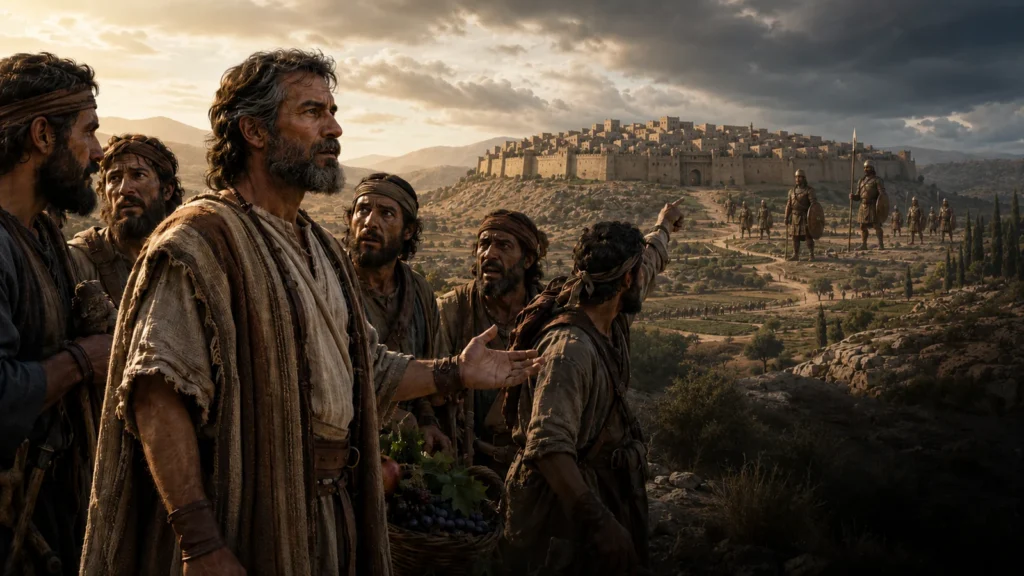
Numbers 13 supplies the strongest direct post-Flood Nephilim text, but it arrives inside a disputed report. Moses sends twelve scouts to examine Canaan. Their first account contains sober observations: the land is fruitful, the people are strong, the cities are fortified, and descendants of Anak are present. These are not dream figures. They are inhabitants attached to known places.
Caleb urges Israel to go up and take the land because God has promised it. The other scouts then intensify their language. They say the people are stronger, describe the land as one that devours its inhabitants, call the people unusually tall, invoke the Nephilim, and compare themselves to grasshoppers. The rhetoric escalates as the dispute shifts from reconnaissance to whether Israel will trust God.
The Hebrew and Greek Evidence
The Masoretic Hebrew of Numbers 13:33 contains the strongest wording: the scouts say they saw the Nephilim, then identify the sons of Anak as being “from the Nephilim.” The precise literary function of the explanatory clause is debated. It may continue the scouts’ speech, preserve a narratorial clarification, or reflect an editorial explanation embedded in the received Hebrew text. Each option affects how the clause is heard, but none makes it disappear from the final Hebrew form of Numbers.
The surviving Old Greek text is shorter at this point. In the NETS translation of Greek Numbers, the scouts first identify the “generation of Enak,” and the later report says they saw “the giants.” It does not preserve the full Hebrew clarification that the sons of Anak came from the Nephilim. Both textual traditions retain giant language and the Anakite threat, but the Hebrew preserves the stronger direct relationship.
This variation should neither be hidden nor exaggerated. It cautions against claiming that every ancient witness had exactly the same wording. It does not reduce the chapter to a late fantasy, because the Greek still knows the Anakites and giants in the report, and the wider canon independently remembers the Anakim as unusually formidable. Textual complexity calls for precision, not dismissal.
For an article interpreting the received Old Testament, the Masoretic wording remains evidence that must be explained. The shorter Greek form may preserve an earlier wording, a translator’s abbreviation, or another stage in the text’s transmission; the surviving witnesses do not let us reconstruct that history with complete certainty. What can be said securely is that the Hebrew explicitly links Anakite descent to the Nephilim, while the Greek independently keeps the report inside a giant framework.
Fear, Rhetoric, and Real Enemies
Numbers 13 is rhetorically charged evidence, not worthless evidence. The grasshopper comparison is an image of helplessness, not a measurement. The claim that the land devours its inhabitants sits awkwardly beside the claim that the land is populated by strong people in great cities. Sarah Schwartz’s study of the report shows how the scouts’ speech moves from reconnaissance toward demagoguery as they try to overcome Caleb’s call to faith.
Yet exaggeration does not mean the speakers fabricated every noun. Caleb does not answer, “There are no Anakim.” Joshua and Caleb do not expose the inhabitants as imaginary. They reject Israel’s rebellion and reframe the danger beneath God’s promise: the people should not fear because the Lord is with Israel. The theological failure lies in treating formidable enemies as greater than the God who brought Israel from Egypt.
The later biblical record confirms the underlying geography and people. Deuteronomy 1 and 9 remembers the Anakim as a people great and tall, associated with fortified cities and a reputation that inspired fear. Joshua 11 records their removal from the hill country while noting remnants in Gaza, Gath, and Ashdod. Those references do not depend on the grasshopper metaphor.
Numbers 14 also clarifies the moral issue. The scouts who brought the bad report die under judgment, but the chapter never says their sin consisted of inventing the Anakim or introducing a false Nephilim name. Their report becomes evil because it turns real obstacles into arguments for unbelief and spreads fear through the congregation. They interpret the land as though God’s presence were irrelevant.
Numbers 13 therefore contributes two kinds of evidence at once. Its Hebrew wording directly links Anakim and Nephilim, while its narrative setting warns that frightened witnesses can magnify a genuine threat. Readers should accept both. Fear magnified the threat, but it did not invent the entire post-Flood giant tradition.
The Post-Flood Giant Trail
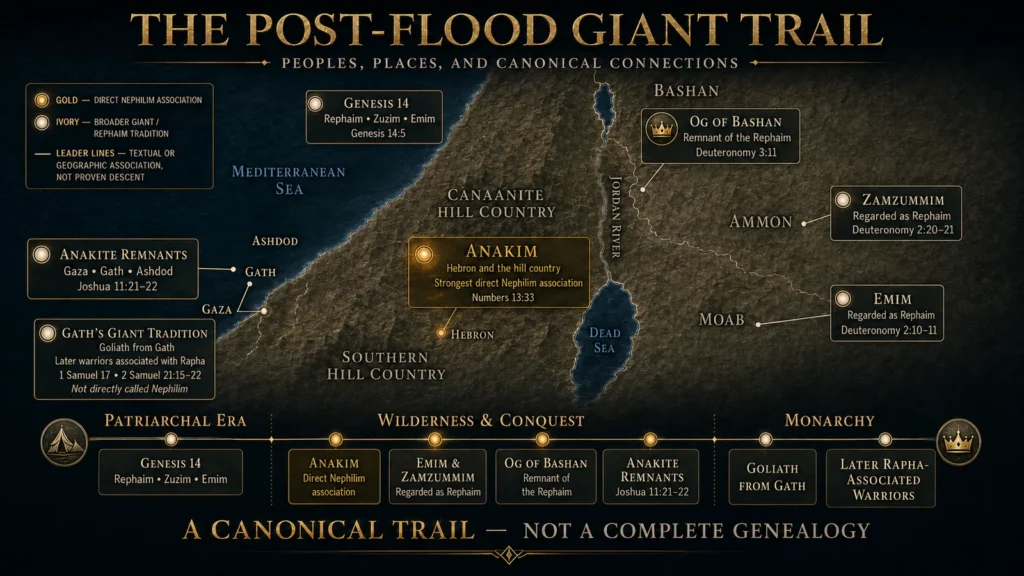
Numbers 13 is not an isolated flash of giant language. The Old Testament preserves a network of peoples and warriors associated with extraordinary size, fearsome strength, or the older Rephaim tradition. The terms overlap, but they do not collapse into one label. The cumulative case grows stronger when each group is allowed to remain distinct.
The trail also has a consistent narrative purpose. These peoples are not cataloged so readers can admire lost bloodlines. They appear at moments when God’s people face powers whose age, stature, territory, or military reputation seems to make the promise impossible. The writers preserve the intimidating details, then place those details inside accounts of divine judgment and gift. That purpose does not cancel the historical claims. It explains why the canon remembers giant power as both real and limited. The danger is never minimized, and God’s rule is never made abstract.
Genesis 14: Rephaim, Zuzim, and Emim
Genesis 14 places Rephaim, Zuzim, and Emim in the world of Abraham. They appear as established peoples defeated during the eastern kings’ campaign. The passage does not call them Nephilim, describe their origin, or explain their physical traits. Its value is chronological and geographic: peoples later associated with giant tradition are already rooted in the post-Flood patriarchal world.
This early appearance also prevents Og or the Anakim from being treated as isolated mutations in Israel’s conquest story. A broader memory of formidable ancient populations lies behind the later texts. Still, “related giant tradition” is a safer category than “proven Nephilim descendant” wherever the canon itself does not draw the line.
The Anakim
The Anakim form the strongest bridge category. Numbers 13 names the sons of Anak and, in the Hebrew text, connects them to the Nephilim. Deuteronomy remembers their stature and reputation. Joshua locates them in the hill country and then in the Philistine cities that remain beyond Israel’s immediate victory. No other later group receives so direct a connection to the rare Nephilim name.
The language of ancestry is real, but the surviving texts do not provide a generation-by-generation genealogy from Genesis 6 to Anak. The connection may preserve biological descent, an ancestral claim, a traditional classification, a comparison to legendary predecessors, or several of these at once. Numbers invites a relationship stronger than mere similarity while stopping short of explaining its transmission.
Emim and Zamzummim
Deuteronomy 2 explains that the Emim once lived in Moab and were regarded as Rephaim, a people great, numerous, and tall like the Anakim. It then describes the Zamzummim in Ammon with nearly parallel language and says they too were regarded as Rephaim. Regional names and broader classification operate together.
These notices reveal a world more textured than a single race called “giants.” Emim, Zamzummim, Anakim, and Rephaim can be related through remembered stature and classification while retaining different names, territories, and histories. Deuteronomy uses those comparisons to reassure Israel: God had already displaced formidable peoples for Moab, Ammon, and Edom. Israel’s enemies were intimidating, but not unprecedented and never sovereign.
Og of Bashan
Deuteronomy 3 identifies King Og of Bashan as remaining from the remnant of the Rephaim. His iron bed, couch, or funerary bier is given extraordinary dimensions, about nine cubits long and four cubits wide. The object confirms a reputation for exceptional scale, though interpreters debate its exact function and how directly its size maps onto Og’s height.
The word remnant means that Og belonged to a surviving remainder of a larger Rephaite population. It does not say that he personally lived before the Flood. Deuteronomy locates him in a historical kingdom east of the Jordan, defeated by Moses and Israel. Turning “last of the Rephaim” into “survivor from Noah’s day” imports centuries into a word that the context does not supply.
Og matters because he brings giant tradition into a named royal figure and a concrete military victory. Israel does not defeat him by discovering his secret origin. God gives the kingdom into their hand. The narrative’s emphasis falls on divine faithfulness in the face of a ruler whose reputation might otherwise paralyze the next generation.
Joshua, Gath, and the Later Warriors
Joshua 11 says that Anakim remained in Gaza, Gath, and Ashdod. That geographic note becomes important when 1 Samuel 17 introduces Goliath from Gath, a champion whose stature and armor dominate Israel’s attention. The story never calls him a Nephilim. It presents a giant warrior emerging from a city already linked with surviving Anakim.
2 Samuel 21 and 1 Chronicles 20 preserve further battles with unusually formidable warriors from Gath. The Hebrew associates them with Rapha, a name linguistically and traditionally related to the Rephaim complex. The texts remember a local line of giant champions, including a man with six fingers on each hand and six toes on each foot.
These stories create a plausible line of traditional continuity: Anakim remain in Gath, Goliath comes from Gath, and Rapha-associated warriors continue there. They do not authorize the sentence “Goliath was a Nephilim” as though Scripture used the name. The evidence is associative and cumulative, not a surviving birth register.
A strong canonical trail is not the same as a scientifically documented genealogy. The trail is still strong. From Abraham’s Rephaim-related peoples to the Anakim, Og, and Gath, Scripture repeatedly remembers post-Flood giant power as a real feature of Israel’s world. What remains missing is the revealed bridge back across the Flood.
What Ancient Traditions Said Happened to the Giants
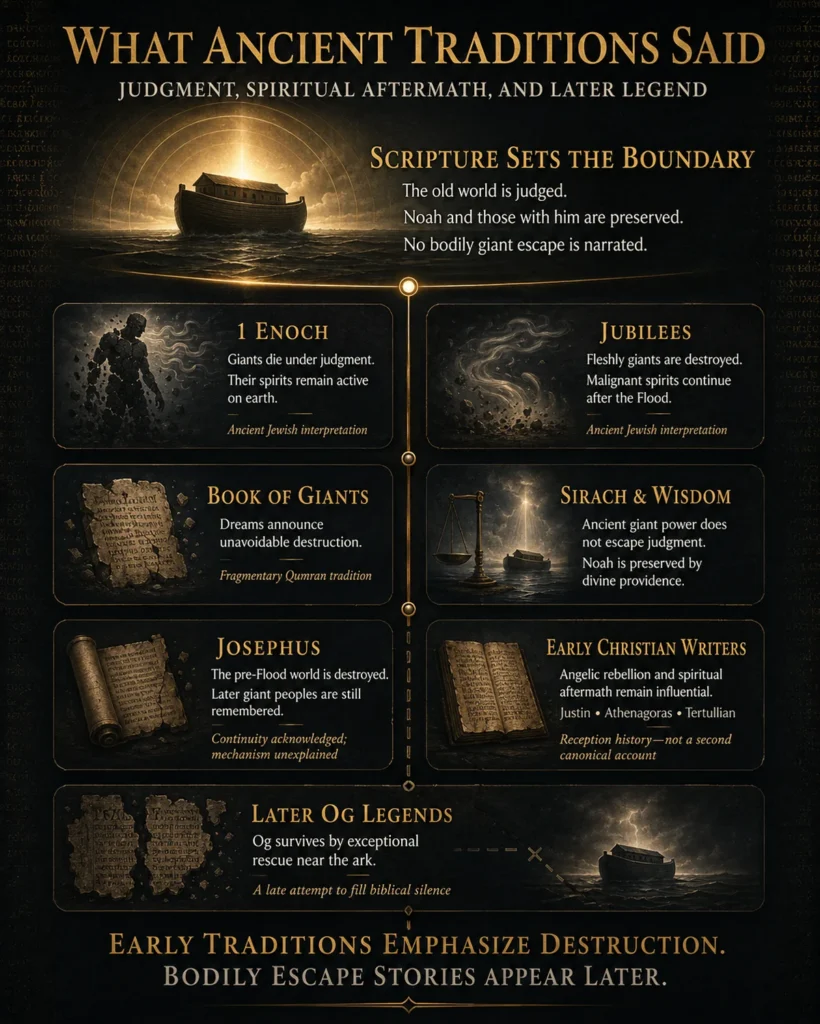
Ancient Jewish and early Christian sources show how earlier readers understood Genesis 6 and its aftermath. They are valuable witnesses to reception, vocabulary, and the questions readers were already asking. They do not carry the authority of Scripture, and their expansions should not be smuggled back into Genesis as missing verses.
1 Enoch: Dead Giants and Living Spirits
The Book of Enoch develops Genesis 6 through the Watchers story. In 1 Enoch 7-10, the giants consume, oppress, and destroy until divine judgment is announced. The giants are killed, while the rebellious Watchers are bound to await further judgment. The text does not send fleshly giants safely through the Flood.
First Enoch 15-16 then makes a different claim: the spirits proceeding from the dead bodies of the giants become evil spirits on earth. Within this tradition, bodily giant continuity and spiritual aftermath are separate categories. The former ends in death; the latter continues as hostile spiritual activity. That distinction later became influential in explanations of demons, but it remains an ancient interpretation rather than an explicit teaching of Genesis.
Jubilees: Destruction and Malignant Spirits
Jubilees likewise treats the fleshly giants as destroyed in the judgment. Its post-Flood narrative focuses instead on malignant spirits afflicting Noah’s descendants and on Mastema’s request that some remain active. The story distinguishes dead giants from surviving spirits. It does not preserve the original giant bodies or supply a giant genealogy through Noah’s family.
This distinction matters for the cluster of questions surrounding fallen angels and demons. A tradition may affirm spiritual consequences after the Flood without claiming fleshly Nephilim escaped it. Readers pursuing that separate issue can continue with Where Are Demons and Fallen Angels Now?
The Book of Giants: Dreams of Judgment
The fragmentary Book of Giants from Qumran gives giant figures ominous dreams and messages of approaching destruction. Its surviving scenes emphasize violence, dread, interpretation, and a judgment that cannot be escaped. Because the work survives in fragments, reconstructions require care. Its broad direction is nevertheless clear: it expands the doom of the giant world rather than celebrating a successful refuge from the Flood.
Sirach and Wisdom: Strength Does Not Escape Judgment
Sirach 16:7-10 recalls that God did not spare the ancient giants who revolted in their strength. Wisdom of Solomon 14:6 remembers the arrogant giants perishing while the hope of the world took refuge on a raft and was guided by divine providence. Both texts interpret the Flood as the defeat of primordial giant power and the preservation of Noah.
Josephus: Destruction Before, Giants After
Josephus offers a particularly revealing combination. In Antiquities Book 1, he accepts the angelic interpretation of Genesis 6, compares the offspring to the giants of Greek tradition, and says the Flood destroyed that world while Noah and his household were preserved. Yet in Antiquities Book 5, he describes a later race of giants at Hebron as real and memorable.
Josephus therefore holds together pre-Flood destruction and post-Flood giant peoples without explaining the mechanism. He does not appear embarrassed by the combination, nor does he use it to invent an escape narrative. His account shows that ancient readers could affirm continuity of giant tradition while leaving the transition unfilled.
Early Christian Reception
Several early Christian writers, including Justin Martyr, Athenagoras, and Tertullian, received Genesis 6 through the angelic interpretation already developed in Jewish tradition. They connected rebellious angels, giant offspring, corrupting influence, and demonic activity in different ways. Their agreement is not uniform enough to create a second canonical account, but it shows that the supernatural reading and the distinction between judged giants and continuing spiritual evil remained influential.
These writers are most useful as witnesses to reception, not as eyewitnesses to a survival mechanism. Their discussions continue the Enochic concern with angelic rebellion and evil spirits; they do not produce a clear historical chain by which original giant bodies passed through the Flood. The early interpretive weight remains on judgment and aftermath rather than fleshly escape.
Later Og Legends: Filling the Silence
Much later Jewish legends tried to provide the missing bridge through Og. Versions of the story imagine him clinging to the ark, being fed by Noah, or receiving exceptional protection from the Flood. Babylonian Talmud, Zevachim 113b, preserves part of this later discussion, and related retellings elaborate it further.
These stories are evidence that interpreters noticed the tension between Genesis 7 and later giant traditions. They are not explanations supplied by Genesis or Deuteronomy. Their lateness and imaginative detail place them in reception history, not in the evidentiary foundation. Og’s biblical identity as a remnant of the Rephaim does not make him a personally named passenger from the pre-Flood world.
The earliest trajectory is therefore consistent: giant flesh dies under judgment, Noah is preserved, and some traditions distinguish that death from a continuing spiritual aftermath. A bodily escape story develops later as an attempt to answer a question the biblical text leaves open.
The Main Continuity Theories Ranked
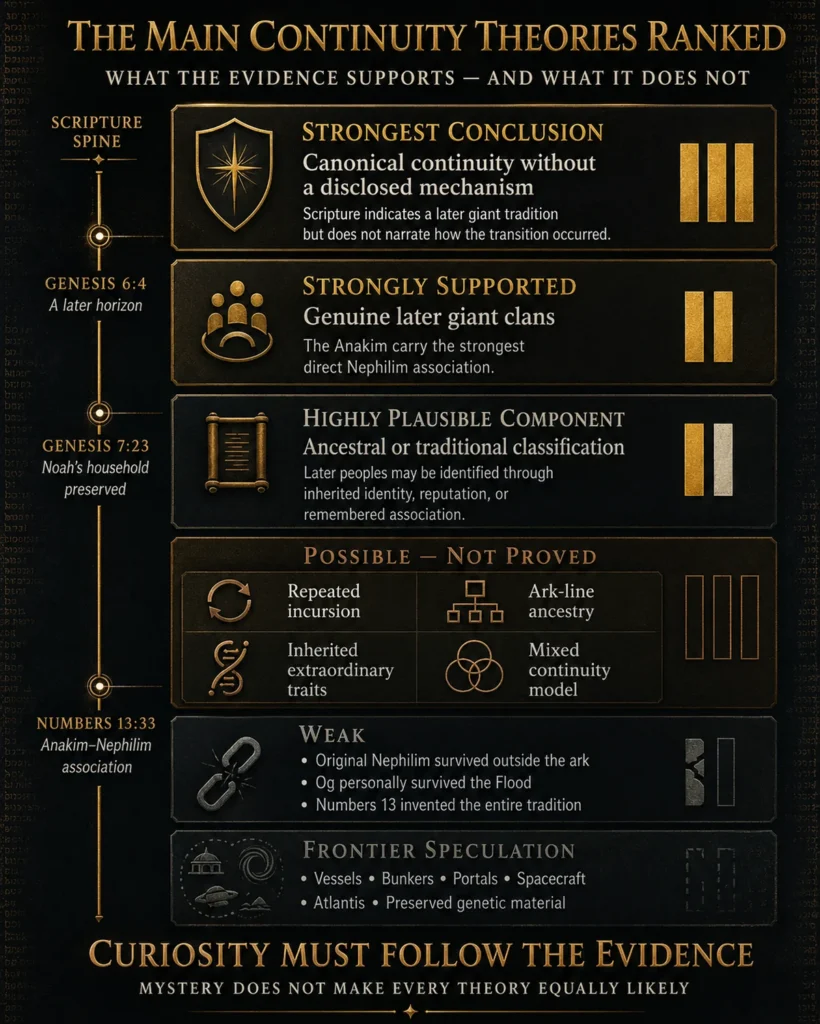
The major explanations should not be presented as equally supported options in a mystery menu. Some are conclusions drawn directly from the canonical pattern. Others are plausible reconstructions. A few conflict with controlling texts or depend almost entirely on later imagination. Ranking them keeps curiosity accountable to evidence.
Strongest: Canonical Continuity Without a Disclosed Mechanism
This is the strongest conclusion because it accounts for the whole record without manufacturing a missing episode. Genesis anticipates an afterward. Hebrew Numbers links Anakim and Nephilim. Deuteronomy and Joshua confirm the Anakim and Rephaim traditions. Samuel and Chronicles preserve giant warriors from Gath. Genesis 7 still says that life outside the ark died.
The canon therefore preserves continuity of lineage, phenomenon, classification, memory, or some combination, but it does not identify the bridge. This position is specific about what the texts establish and modest only where they are silent. It should control every more detailed model.
Strongly Supported: Genuine Later Giant Clans With Nephilim Association
The Anakim, Rephaim-related peoples, Og, and the warriors from Gath are not merely symbols for fear. They belong to named places, conflicts, and remembered populations. The Anakim receive the clearest Nephilim association; the remaining groups join a wider giant complex through biblical comparison, geography, reputation, and related terminology.
This conclusion does not require every group to share one ancestry or every tall warrior to bear the Nephilim name. It says that the later biblical world genuinely contains clans and figures understood through the same giant horizon. That is more than metaphor, though less than a complete genealogy.
Highly Plausible Component: Ancestral or Traditional Classification
“Nephilim” may function partly as an ancestral or type-based designation for later people associated with primordial giant renown. Ancient communities often understood identity through remembered ancestors, regional traditions, and representative founders. Numbers could therefore preserve a genuine Anakite claim or classification without implying that the same Genesis 6 individuals remained alive.
This should not be reduced to “the scouts used a scary metaphor.” The Hebrew wording is genealogical or classificatory enough to demand more respect than that, and the wider giant trail gives the label a real context. Traditional memory may carry history even when it does not preserve a modern family record.
Plausible but Unproved Models
A second or repeated heavenly incursion fits the supernatural framework of Genesis 6 better than naturalistic readings may allow, but no second post-Flood event is narrated. The iterative wording in Genesis 6:4 can describe repeated unions in the original period. It does not supply a date, actors, location, or judgment account for another incursion after Noah.
Ark-line ancestry proposes that some relevant human ancestry passed through one of the women aboard the ark. The wives’ genealogies are not given, so the idea is logically possible. Scripture never identifies Noah’s wife or a son’s wife as carrying Nephilim ancestry, however, and it presents the household as the human family preserved from the judged world. Naming Ham’s wife or another woman as the carrier goes beyond the evidence.
Inherited extraordinary human traits could help explain why unusual stature became concentrated in particular clans. Human populations can preserve and intensify physical traits over generations. This model handles part of the later evidence but does not by itself explain why the rare Nephilim category, the Anakite association, and the broader ancient supernatural memory remain attached to those peoples.
A mixed model may be the most reasonable reconstruction once readers move beyond the strongest canonical conclusion. Real giant clans, inherited traits, ancestral memory, traditional classification, and frightened rhetorical intensification can all operate together. A repeated incursion or ark-line element is possible within some versions. The strength of a mixed model is that it does not ask one clue to explain everything; its weakness is that Scripture never confirms the combination.
Weak Explanations
Original Nephilim survived outside the ark is difficult to reconcile with Genesis 7:21-23 and unsupported by any biblical escape account. Og personally survived the Flood depends on late legend, not on Deuteronomy’s use of “remnant.” Numbers 13 invented the entire tradition fails to account for Deuteronomy’s Anakim, Genesis and Deuteronomy’s Rephaim-related peoples, Joshua’s geography, Og, and the Gath traditions.
These explanations fail for different reasons. The first two force later ideas into silence; the third erases evidence because one witness speaks rhetorically. A good theory must survive both Genesis 7 and the accumulated post-Flood texts.
Frontier Speculation
Modern proposals sometimes invoke separate vessels, caves, bunkers, underwater refuges, advanced technology, spacecraft, portals, Atlantis, or preserved genetic material. Scripture describes none of these mechanisms. The earliest giant traditions emphasize destruction, not technological escape. Such ideas may be explored as modern speculative synthesis, but they cannot carry the biblical argument or be presented as concealed details of Genesis.
The broader Pre-Flood Origin Theory examines how some modern claims are compared with ancient rebellion traditions. That is the proper lane for testing frontier scenarios. Here they rank below models grounded in the canonical wording because imaginative explanatory power is not the same as textual evidence.
What the Evidence Supports
The hierarchy can now be stated plainly. Post-Flood giants are certain within the biblical narrative. The direct Anakim-Nephilim connection in the received Hebrew text is strong. The wider canonical trail through Rephaim-associated peoples, Og, the Anakim, and Gath is also strong. One revealed mechanism crossing the Flood is absent. Original outside-ark bodily survival is weak. Several reconstructions remain possible, but none should be preached as the missing chapter of Genesis.
The best answer is therefore neither a shrug nor a sensational escape story. Some form of continuity is biblically indicated; its exact form may include lineage, recurrence, inherited traits, classification, memory, or a combination. Scripture makes readers live with that unresolved bridge because its main concern is not preserving the giants’ secret. It is revealing that every form of violent and intimidating power remains answerable to God.
Frequently Asked Questions About Nephilim After the Flood
Did the Nephilim survive the Flood?
Scripture indicates post-Flood Nephilim continuity but does not say the original pre-Flood individuals survived bodily outside the ark. Genesis 6:4 anticipates an “afterward,” and Hebrew Numbers 13:33 connects the sons of Anak with the Nephilim. Genesis 7 makes a simple outside-ark survival claim difficult.
What does “and also afterward” mean?
The phrase opens a later horizon for the Nephilim name or phenomenon beyond “those days” before the Flood. It does not identify the mechanism. Survival, descent, recurrence, classification, inherited traits, and remembered ancestry must be evaluated from other evidence.
Does Numbers 13 say the Anakim were Nephilim?
The Masoretic Hebrew says the scouts saw the Nephilim and identifies the sons of Anak as “from the Nephilim.” The surviving Old Greek is shorter and retains Anakite and giant language without the full direct clause. The Hebrew gives the strongest canonical relationship between the groups.
Did the spies lie about the Nephilim?
The spies’ report becomes exaggerated and faithless, especially after Caleb urges Israel to enter the land. The grasshopper comparison is rhetoric. Yet Caleb, Joshua, Deuteronomy, and Joshua do not deny the Anakim’s existence. The report magnifies real enemies into a reason to distrust God.
Were the Rephaim Nephilim?
Scripture places the Rephaim and Nephilim within overlapping giant traditions but does not directly equate every Rephaite with a Nephilim. The Anakim provide the strongest bridge because Numbers 13 connects them to Nephilim and Deuteronomy compares them with Rephaim-related peoples.
Did Og survive Noah’s Flood?
The Bible says Og remained from the remnant of the Rephaim. It does not say he was alive before the Flood or escaped it. Stories of Og clinging to the ark or being fed by Noah are much later legends designed to fill the biblical silence.
Did a second group of fallen angels create more Nephilim?
A second or repeated incursion is possible within the supernatural interpretation, but Scripture never narrates one after the Flood. Genesis 6:4 may describe repeated unions in the original period; that does not establish a later event.
Could Nephilim ancestry have entered Noah’s ark?
The ancestry of the wives aboard the ark is not supplied, so an ark-line model is logically possible. No biblical text identifies any woman as carrying Nephilim ancestry. Claims that Ham’s wife or another named family line definitely carried it are speculation.
Were Goliath and the giants of Gath Nephilim?
The Bible does not call Goliath or the Rapha-associated warriors Nephilim. It does place them in Gath, one of the cities where Anakim remained, and preserves a strong local giant tradition. The relationship is plausible and significant, but not a documented genealogy.
Did the spirits of the Nephilim become demons?
First Enoch and Jubilees distinguish the destruction of fleshly giants from the continued activity of evil spirits associated with them. That giant-spirit explanation became influential in ancient Jewish and Christian interpretation. The canonical Genesis account does not explicitly identify demons as spirits of dead Nephilim.
Selected Sources and Further Reading
- Scripture: Genesis 6-7 and 14; Numbers 13; Deuteronomy 2-3 and 9; Joshua 11; 1 Samuel 17; 2 Samuel 21; 1 Chronicles 20.
- Septuagint: A New English Translation of the Septuagint: Genesis and Numbers, University of Pennsylvania.
- Robin Routledge: “The Nephilim: A Tall Story? Who Were the Nephilim and How Did They Survive the Flood?” Tyndale Bulletin 66.1 (2015): 19-40.
- Ronald S. Hendel: “Of Demigods and the Deluge: Toward an Interpretation of Genesis 6:1-4.”
- Sarah Schwartz: “From Rhetoric to Demagoguery: A New Reading of the Spies’ Report (Num 13:26-33).”
- Brian R. Doak: The Last of the Rephaim: Conquest and Cataclysm in the Heroic Ages of Ancient Israel.
- George W. E. Nickelsburg and James C. VanderKam: 1 Enoch: The Hermeneia Translation, Book of the Watchers excerpt.
- James C. VanderKam: Jubilees: A Commentary; and Loren T. Stuckenbruck: The Book of Giants from Qumran: Texts, Translation, and Commentary.
- Archie T. Wright: The Origin of Evil Spirits: The Reception of Genesis 6:1-4 in Early Jewish Literature.
- Early Christian reception: Justin Martyr, Second Apology; Athenagoras, A Plea for the Christians; and Tertullian, Apology.
Read Next
- Where Are Demons and Fallen Angels Now? distinguishes imprisoned heavenly rebels from the Enochic claim that spirits of dead giants remained active.
- Who Were the Nephilim? returns to Genesis 6, their identity, and their relationship to the mighty men of old.
- The Pre-Flood Origin Theory evaluates broader modern synthesis only after the biblical and ancient categories are established.
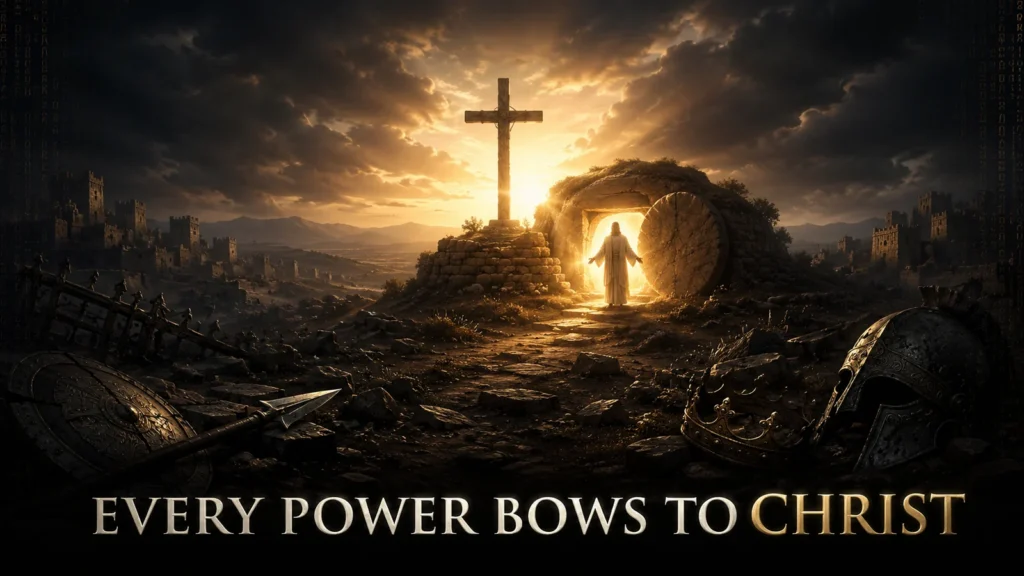
The Giants Did Not Escape God’s Rule
The survival question can make the post-Flood appearance of giant power sound like a victory over judgment. Scripture tells the opposite story. Sin also continued after the Flood, but its continuation did not mean God’s covenant purpose had failed. In the same way, the reappearance of intimidating clans did not place them beyond his reach.
The giant trail is also a trail of limits. The Anakim are driven from the hill country. Og falls east of the Jordan. Goliath collapses before the shepherd whom God has chosen. The Rapha-associated warriors from Gath are struck down in later battles. Their strength is real enough to terrify, but created power never becomes ultimate power.
Second Peter 2:4-9 draws hope from the same pattern of judgment and rescue: God knows how to judge rebellious angels and preserve the righteous. Ancient renown cannot overrule his verdict. Survival, recurrence, and remembered power are not the same as victory.
The mystery is how giant power appeared again. The certainty is that it never escaped God’s authority. That certainty reaches its fullness in Jesus Christ. Colossians 1:15-20 and 2:13-15 declare that every throne, dominion, ruler, and authority was created through the Son and for him. At the cross, he disarmed hostile powers and triumphed over them.
Christ does not answer corrupted might by becoming a greater version of the giants. He defeats sin and death through faithful obedience, sacrificial love, and resurrection. Philippians 2:9-11 and Hebrews 2:14-15 place the name above every name upon the crucified and exalted Lord, who shared our humanity to destroy the one who held the power of death and to free those enslaved by fear.
The Christian hope is therefore not the preservation of corrupted strength, a hidden bloodline, or an escape from creaturely limits. It is resurrection in Christ. Whatever combination of lineage, memory, recurrence, or classification stands behind the post-Flood giant tradition, none of it can threaten the kingdom of the risen Son. The giants did not escape God’s rule, and every power that still trades in fear will finally bow before Jesus Christ.