
GUIDED ARTICLE EXPERIENCE
Who Were the Nephilim? Giants and Men of Renown in Genesis 6
Read along as the narration moves through the article.
Private device narration · No hosted audio or tracking
CONTINUE GUIDED TOUR
Continue where you left off.
GUIDED TOUR COMPLETE
You have reached the end of this study.
Study record saved on this device.
GUIDED TOUR
Who Were the Nephilim? Giants and Men of Renown in Genesis 6
Narrator: Paranoid Prophet Recommended Voice Native device narration
Prepare to follow the article as it is narrated.
VOICE & TOUR OPTIONS
Voice & Listening
NARRATOR
Finding a narrator…
Checking the best narrator available on this device.
Restores the best curated narrator available on this device.
Narrator choices are curated for clear, long-form listening on this device.
Screen-awake support will be checked when narration starts.
CHOOSE A NARRATOR
Curated for this device
Choose a verified narrator for this browser, or use System Narrator. Automatic mode uses the best reliable route exposed by this device; your chosen narrator is preserved even if this device needs a temporary fallback.
Preparing the guided article experience…
RESUME GUIDED TOUR?
Continue where you left off.
GUIDED TOUR COMPLETE
You have reached the end of this study.
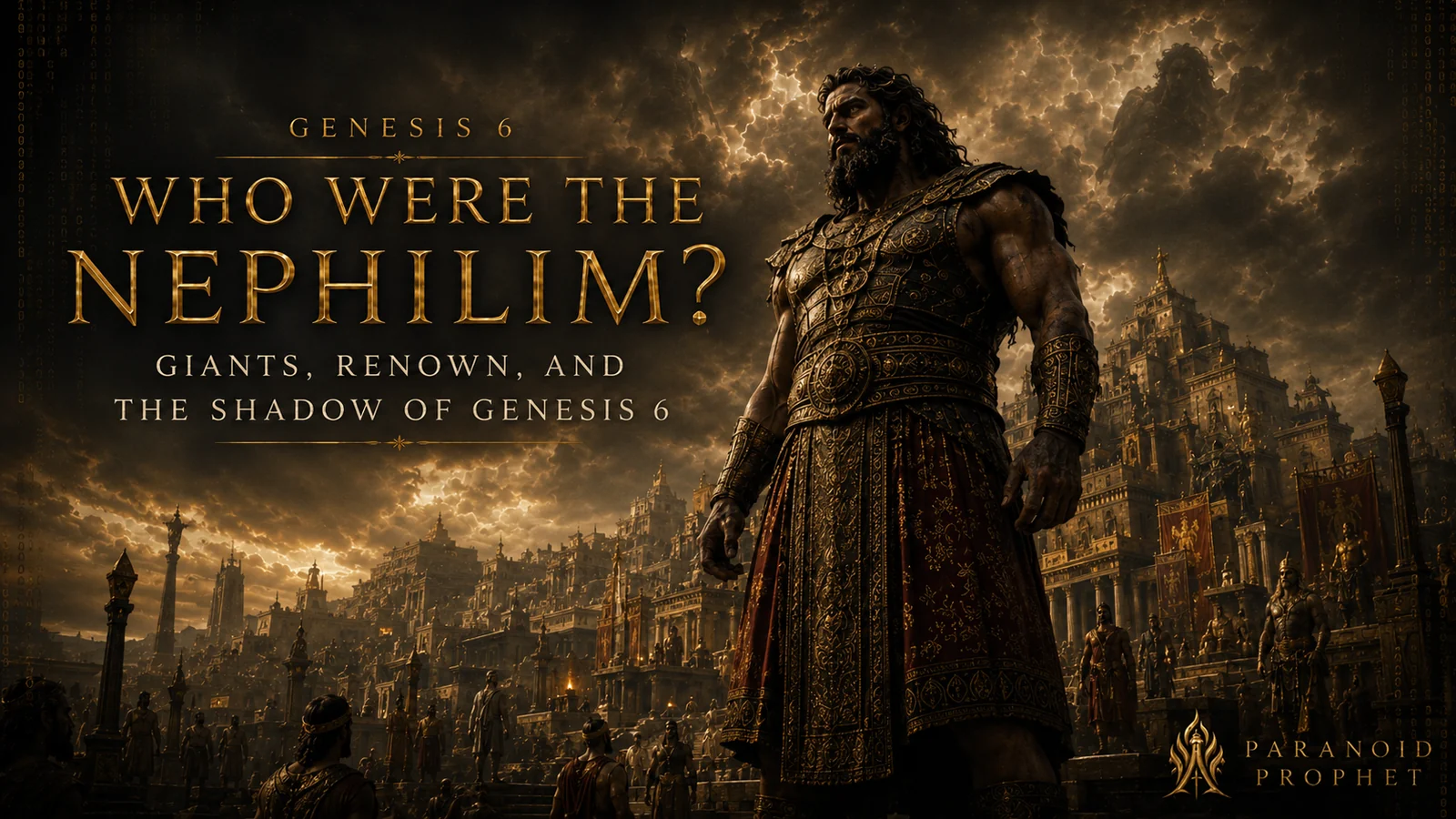
Who were the Nephilim? In Genesis 6:1–4, they are mysterious figures placed in the same compressed scene as the sons of God taking human women and children being born. The strongest reading understands the Nephilim as the offspring or earthly result of that forbidden union. Genesis associates them with the gibborim, the mighty men of old, and with men whose names had become famous.
That answer needs one immediate qualification. The Bible does not give a physical reconstruction, a biological explanation, or a complete family tree. It does not simply define Nephilim as “giants.” Yet the giant association is not a later fantasy pasted onto the text. The ancient Greek translation of Genesis used gigantes, Numbers 13 connects Nephilim language with the formidable sons of Anak, and later biblical books remember the Anakim, Rephaim, Og of Bashan, and giant warriors from Gath.
The Nephilim are not the starting point of Genesis 6. They belong to the aftermath of rebellion. The chapter begins with a boundary crossing and quickly moves toward human wickedness, a world filled with violence, divine judgment, and Noah finding favor before God. The Nephilim belong inside that moral and theological movement, not outside it as a detached monster story.
This article therefore focuses on identity: what Genesis 6:4 says, what the name may mean, why the offspring reading is strongest, and how later giant traditions relate without becoming identical categories. The words “and also afterward” create a real post-Flood continuity question, but Scripture does not state how that continuity worked. A dedicated study will compare those competing explanations. Here the goal is narrower: to understand the Nephilim without allowing speculation to outrun the text.
The result should be neither timid nor sensational. Genesis permits a firm conclusion about the Nephilim’s close connection to the forbidden union while requiring humility about etymology, physical details, and later continuity. At every stage, the evidence must determine the strength of the claim: Scripture first, ancient interpretation as context, and modern theory only after both.
For the whole chapter, begin with Genesis 6 Explained. For the identity of the heavenly boundary-crossers, see Sons of God and Daughters of Men. Those studies establish the setting. This one follows the figures born into its shadow.
Article Guide11 sections
The Nephilim in Genesis 6
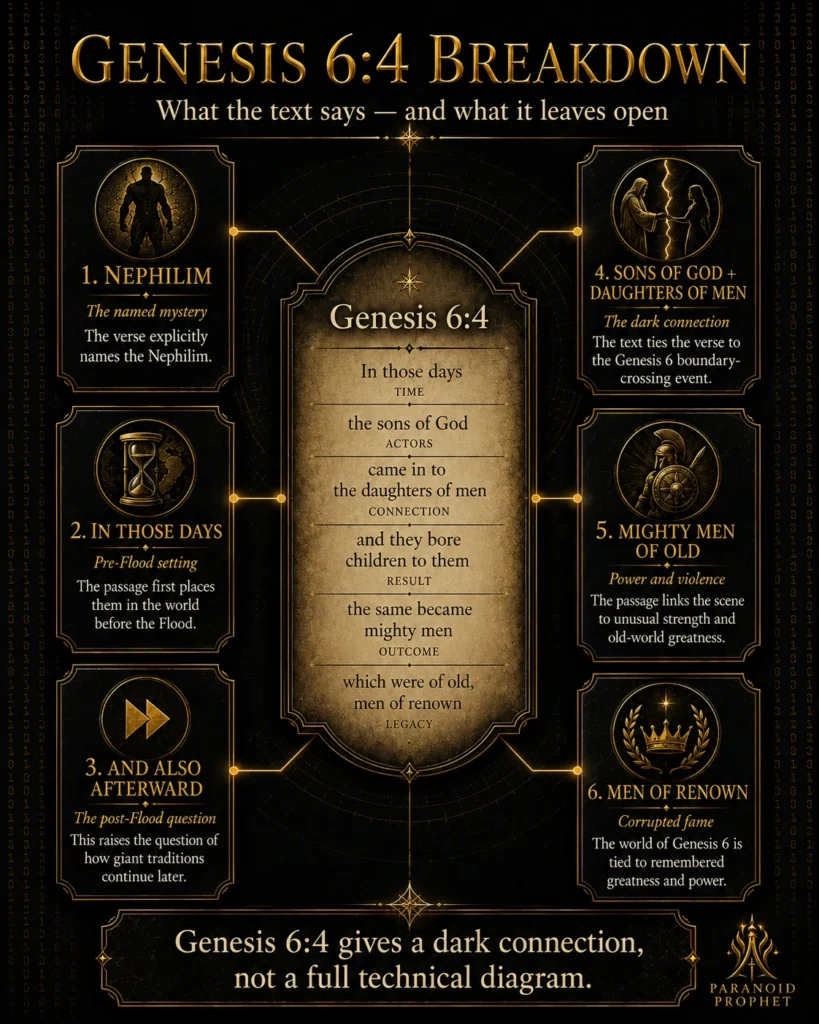
Genesis 6:4 is the primary canonical text. It says, in one dense sentence, that the Nephilim were on the earth “in those days” and “also afterward”; that the sons of God went in to the daughters of humanity; that the women bore children to them; and that “these” were the mighty men of old, the men of renown.
The sentence is compressed, but its pieces are not random. It places four elements beside one another:
- The Nephilim: named figures present in the world of Genesis 6.
- The time: “in those days, and also afterward.”
- The boundary crossing: the sons of God take human women, and children are born.
- The reputation: the resulting figures are remembered as mighty men and men of renown.
The exact antecedent of “these” has generated debate. The verse does not pause to say in modern analytical language, “the children were the Nephilim.” Even so, it places the Nephilim, the births, and the mighty men inside one tightly connected notice. The most natural narrative reading takes the children born from the union as the Nephilim and identifies them with, or includes them among, the mighty men of ancient fame.
The Hebrew wording helps explain both the confidence and the caution. The clause joining the sons of God to the women can be rendered “when” or “whenever” they went in to them, and the final emphatic pronoun can point readers back toward the figures produced within the scene. Syntax alone cannot turn the verse into a labeled family tree, but it does make a close relationship difficult to avoid. The verse is economical because its first readers were expected to recognize the kind of ancient figures being evoked.
Genesis also places this notice between two widening descriptions of disorder. Verses 1–2 describe the taking of women; verses 5–13 describe evil, corruption, and violence spreading through the earth. The Nephilim notice does not replace the chapter’s indictment of humanity, and it should not be made the sole cause of the Flood. It functions as one concentrated sign that the created order has become disordered at multiple levels.
“In those days” locates them in the pre-Flood world. That location matters because the next verses describe human evil as pervasive and the earth as corrupt and filled with violence. Genesis does not explicitly blame every feature of that corruption on the Nephilim, but neither does it present them in a morally neutral heroic age. Their renown rises inside a world moving toward judgment.
“And also afterward” is more difficult. The phrase may look beyond the unions within the pre-Flood period, or it may prepare readers for the later reappearance of Nephilim language in Numbers 13. Either way, Genesis raises the continuity question without naming a mechanism. It does not mention ark survival, a second incursion, inherited traits, or any other proposed solution.
The biblical text creates a continuity problem but does not explain the mechanism. The planned article Did the Nephilim Survive the Flood? will compare the major interpretations without pretending Scripture says more than it does.
What Does the Name Nephilim Mean?
Nephilim is the Hebrew plural form used in Genesis 6:4 and twice in Numbers 13:33. English translations often preserve the Hebrew word because its derivation is uncertain. That caution is wise. A familiar translation can sound more settled than the underlying evidence allows.
A connection with the Hebrew root n-p-l, “to fall,” is commonly proposed. From that connection come suggestions such as “fallen ones” or, less directly, those who make others fall. Some interpreters have also understood the name through the reputation of ancient warriors who brought terror and death. These proposals are possible, but the text does not provide its own etymology, and Hebrew names do not always yield their meaning through a simple root equation.
Calling the Nephilim “fallen ones” can also create a category problem. It may sound as though the word names the heavenly beings who fell, even though Genesis distinguishes the sons of God from the figures associated with the births. An uncertain etymology should not be used to erase the narrative’s actors.
The ancient Greek Septuagint made an influential interpretive choice. It rendered Nephilim with gigantes, the source behind the traditional English “giants.” In Genesis 6:4 the Greek translation also uses gigantes for the mighty men later in the sentence. That choice tightly connects Nephilim and heroic giant imagery in the earliest major translation tradition.
This double use is significant. The translators did not merely substitute a familiar Greek word for an obscure Hebrew name and move on. They read the opening Nephilim and the closing mighty men through the same conceptual lens. Their translation suggests that the verse’s ancient warriors belonged to the giant world as they understood it, a world marked by extraordinary origin, scale, and reputation.
In the Greek world, gigantes could evoke more than unusual height. The term carried associations with primordial figures, extraordinary power, and conflict involving the divine realm. The Septuagint therefore does not function like a modern height chart. It places the Nephilim within a recognizable ancient category of fearsome, superhuman, or heroic-age beings.
Numbers strengthens that association from inside the biblical canon. The scouts do not use Nephilim as a generic word for every tall person in Canaan. They invoke the name while describing the sons of Anak as an overwhelming, almost legendary threat. Translation history and later narrative memory converge around size and terror, even though neither settles the Hebrew word’s original derivation.
The name’s exact derivation remains debated, but the textual tradition firmly associates the Nephilim with extraordinary power, fearsome reputation, and giant traditions. “Giants” is a strong traditional association. It is not a complete, uncontested dictionary definition.
Were the Nephilim the Offspring of the Union?
Why the Offspring Reading Is Strongest
The narrative sequence makes the main case. The sons of God see and take the daughters of humanity. Children are born to them. The Nephilim are mentioned in that same sentence, and the notice culminates with mighty men whose fame reaches back into the ancient past. The births are not a side detail; they are the stated result of the union.
If the Nephilim were unrelated figures who merely happened to live at the same time, the verse would become strangely disjointed. The offspring reading gives each clause a role: heavenly beings cross a boundary, human women bear children, and the resulting figures become remembered for unusual might and renown. Genesis remains terse, but its narrative movement remains coherent.
This reading also has deep ancient roots. First Enoch interprets the giants as offspring of rebellious Watchers and women, then expands their violence and judgment. That does not make Enoch equal to Genesis, and it does not prove every detail of Enoch’s story. It does show that the offspring interpretation is ancient rather than a modern invention.
First Enoch’s expanded story also shows what ancient readers believed Genesis left compressed. It names the heavenly rebels, dramatizes their oath, describes giant offspring, and links the resulting violence with the world’s cry for judgment. Those details belong to the later interpretation, not to the wording of Genesis. Yet the expansion makes sense only because its readers already perceived births as the hinge between the heavenly transgression and the mighty figures on earth.
For the heavenly rebels in that tradition, see The Watchers Explained. For the tradition’s catalog of corrupting instruction, see What Did the Watchers Teach? Those subjects help explain the ancient reception of Genesis 6, but the identity question here rests first on the canonical verse itself.
What the Grammar Leaves Open
The Hebrew sentence is compact enough to permit another reading. Some interpreters take the opening statement, “the Nephilim were on the earth,” as describing figures already present whenever the sons of God entered human unions. On that reading, the children may become mighty men without being strictly identical to the Nephilim.
That view takes the first clause seriously and deserves to be represented honestly. It is also one reason the article should not claim that every grammatical detail is beyond dispute. Still, it must explain why Genesis binds the Nephilim, the union, the births, and the mighty men together in one short notice. The offspring interpretation accounts for that relationship more directly.
The best conclusion is clear without becoming mechanical: the Nephilim were most likely the offspring or earthly result of the forbidden union, even though Genesis does not describe how such offspring were generated. The text gives a theological relationship, not a scientific account. Questions about DNA, reproductive technology, or dimensional biology import categories Genesis never uses.
Mighty Men and Men of Renown
Genesis calls the figures in view gibborim, the plural of gibbor. The word can describe mighty warriors, champions, heroes, or people of exceptional strength and influence. Elsewhere it can be used for respected warriors, including David’s mighty men, so the term itself does not automatically condemn everyone it describes. Context determines what kind of might is being remembered.
Genesis 6 supplies a dark context. Immediately after its notice about the mighty men, the chapter describes the greatness of human wickedness. It later says the earth had become corrupt before God and filled with violence (Genesis 6:5–13). The verse does not explicitly say that the Nephilim alone caused that violence, but their fame belongs to an age whose power had become morally disordered.
The phrase translated “men of renown” is more literally “men of the name.” It speaks of reputation, remembered identity, and public stature. These were not anonymous figures at the edges of their world. Their names carried weight. They may have been celebrated as heroes, rulers, champions, or founders whose strength shaped the imagination of later generations.
Renown is not inherently sinful. Scripture can honor a good name and faithful deeds. The warning in Genesis is subtler: fame does not certify holiness. A violent culture can praise domination as greatness, remember terror as heroism, and treat the ability to take as proof of the right to rule. Genesis refuses to let reputation deliver the final moral verdict.
That distinction matters in an ancient heroic setting. Kings and warriors commonly secured memory through conquest, monuments, dynasties, and stories of battlefield prowess. Genesis acknowledges that such men became renowned, but it narrates their fame from outside the values that created it. God sees the whole earth, including the victims, the violence, and the corruption that heroic memory can hide. A celebrated name may preserve what a culture admired while concealing what heaven judged.
The Nephilim are not merely a size question. They are a glory question. What kind of power does a fallen world admire? Which names does it preserve? What does it call heroic when God sees corruption? Those questions are closer to the theological force of Genesis 6 than an attempt to calculate an ancient warrior’s height.
The chapter places another kind of distinction beside human renown: “Noah found favor in the eyes of the Lord.” The mighty men possess a name before people; Noah receives grace before God. One form of distinction is built from visible power and remembered fame. The other is given by God and expressed in faithful obedience.
Noah’s favor does not mean he saves himself by being more impressive than the mighty men. Favor is received. His obedience follows grace, and his life becomes an instrument through which God preserves a future. The contrast therefore reaches deeper than famous people versus obscure people. Genesis contrasts greatness that magnifies the creature with grace that restores a creature to faithful dependence on God.
That contrast reaches forward to Babel, where humanity seeks to “make a name” through a city and tower (Genesis 11:1–9). The stories are not identical, but they expose a recurring temptation: creatures pursue greatness that can be seen, feared, and remembered while resisting life under God’s rule. Genesis answers that ambition with judgment, then preserves its promise through people who depend on grace.
Nephilim, Giants, and Related Clans
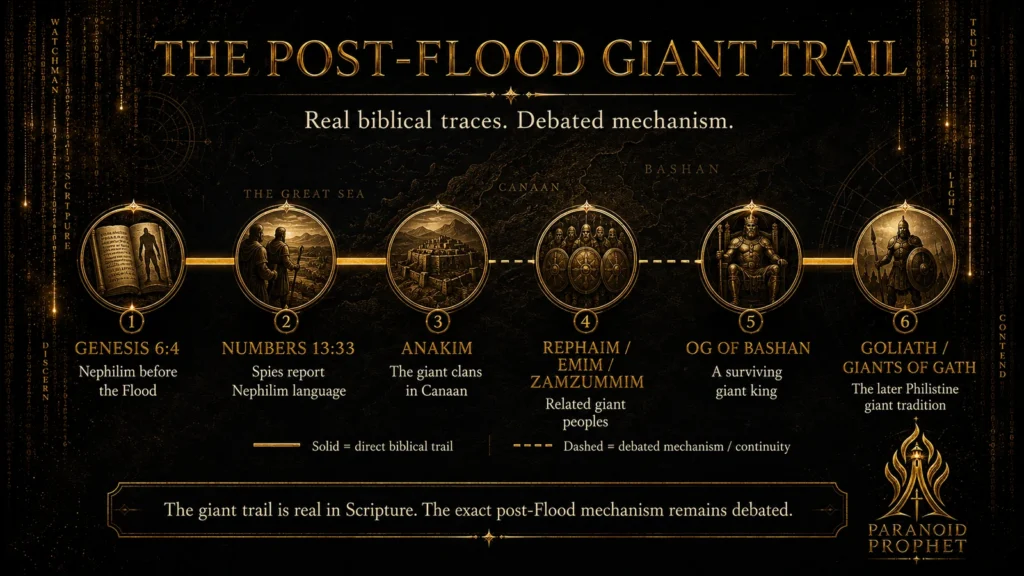
Were the Nephilim giants? The biblical answer is stronger than “we have no idea” and more careful than “Nephilim simply means giants.” Genesis provides no height. The Septuagint’s gigantes translation supplies an ancient giant association, and Numbers 13 explicitly connects Nephilim language with the Anakim, a people remembered elsewhere as tall and formidable.
The later books then preserve a landscape of giant traditions: Anakim in Canaan, Rephaim and related peoples east of the Jordan, Og of Bashan, and giant warriors associated with Gath. These texts belong together as a biblical trail of extraordinary and intimidating power. They do not establish a single, documented genealogy from Genesis 6 to every later figure.
Physical scale remains part of that trail. Deuteronomy explicitly compares peoples by height, Og’s enormous object is measured, and Goliath’s stature and equipment are narrated in detail. But the texts are never satisfied with anatomy. They combine size with antiquity, military force, fortified territory, reputation, and fear. “Giant” in the biblical imagination is therefore both a bodily description and a narrative role: a form of power that makes ordinary faithfulness look hopeless.
Numbers 13 and the Anakim
The most direct later connection appears in Numbers 13:25–33 and 14:1–10. Twelve scouts return from Canaan agreeing that the land is fruitful and its cities are fortified. Caleb urges Israel to go up in faith. The other scouts insist the inhabitants are stronger, describe the land as devouring its people, identify the sons of Anak with Nephilim language, and compare themselves to grasshoppers.
The report is evidence, but it is also rhetoric. The narrator calls the scouts’ speech a bad report, and the language escalates after Caleb challenges their conclusion. Their purpose is no longer merely to describe Canaan; it is to persuade Israel that obedience is impossible. Fear selects facts, enlarges threats, and suppresses the promise of God.
That does not make the Anakim imaginary. Earlier in the report the scouts locate descendants of Anak near Hebron, before the rhetoric reaches its peak. Deuteronomy remembers the Anakim as great and tall, and Joshua 11:21–23 says Joshua cut them off from the hill country while some remained in Gaza, Gath, and Ashdod. Caleb and Joshua dispute Israel’s unbelieving conclusion, not the existence of formidable inhabitants.
Numbers 13 therefore preserves a real textual connection between Anakim and Nephilim language, but it comes through fearful scouts trying to discourage Israel. It should neither be discarded nor treated as a neutral anthropological report. The passage deliberately makes the reader feel Israel’s fear, then asks whether fear or God’s promise will govern the people’s judgment.
Rephaim, Emim, and Zamzummim
Deuteronomy 2 remembers several ancient peoples associated with great stature and fearsome reputation. The Emim are described as numerous and tall like the Anakim; they were counted as Rephaim, though the Moabites called them Emim. The Zamzummim are described similarly and were known to the Ammonites by that regional name.
This language shows both overlap and distinction. Rephaim can function as a broad ancient classification in these passages, while Emim and Zamzummim identify particular peoples. The Anakim serve as a point of comparison. The text does not simply rename all of them Nephilim.
The safest description is “related giant traditions.” The peoples share memories of height, antiquity, military power, and terror, but the Bible preserves different names, regions, and histories. Related does not mean identical.
Og of Bashan
Deuteronomy 3 identifies Og king of Bashan as the remaining remnant of the Rephaim. It preserves the extraordinary dimensions of his iron bedstead, couch, or possibly funerary bier: nine cubits long and four cubits wide. The object functions as material testimony to a king remembered on an intimidating scale.
Yet the story does not stop at the dimensions. Og is defeated, his fortified cities are taken, and his land is given to Israel. Later legends imagined how he or other giants might have survived the Flood, but Deuteronomy does not provide that story. It uses Og to magnify the Lord’s victory, not to settle a continuity mechanism.
Goliath and the Giants of Gath
First Samuel 17 introduces Goliath as a towering, heavily armed champion from Gath who paralyzes Israel’s army with fear. Ancient textual witnesses differ over his exact height, but every form of the story presents him as physically imposing, militarily experienced, and confident that visible strength has already decided the battle.
David refuses Goliath’s interpretation of reality. The giant speaks in the language of weapons, size, and contempt; David answers in the name of the Lord. His victory is theological before it is heroic. Israel is shown that the battle belongs to God and that intimidating power does not possess final authority.
Second Samuel 21 and 1 Chronicles 20 remember other unusually formidable warriors associated with Gath and descended from Rapha. Joshua’s earlier note that Anakim remained in Gath gives the location added significance. Even so, Goliath is never directly called a Nephilim. The Gath narratives continue a giant tradition; they do not provide a simple biological label for every warrior.
Across these passages, the Bible acknowledges real sources of fear without surrendering to them. Anakim occupy fortified country. Og rules an old kingdom. Goliath has reach, armor, and reputation. Each looks decisive when measured only by human capacity. None remains invincible when God acts.
What the Nephilim Were Not
Mystery invites category collapse. One strange word begins absorbing every giant, demon, fallen angel, ancient hero, and modern nonhuman claim. A responsible reading keeps related ideas connected without pretending they are interchangeable.
Not the Sons of God or the Watchers
In the strongest reading of Genesis 6, the sons of God are the heavenly beings who cross the boundary. “Watchers” is the later Enochic name used for those rebellious beings. The Nephilim are distinct figures connected to the union, most likely its offspring or earthly result. The rebels and the offspring occupy different places in the story.
Not Automatically Every Biblical Giant
Numbers connects Nephilim language with the sons of Anak, and the wider Old Testament preserves several related giant traditions. It still uses different terms for different peoples and individuals. Height alone does not make someone a Nephilim, and association with a giant tradition does not prove direct descent from Genesis 6.
Not Demons
First Enoch 15–16 later presents the spirits of the dead giants as evil spirits active on the earth. That became an influential ancient explanation for the origin of demons. Genesis does not say it, however, and the Gospels confront demons without identifying every unclean spirit as a deceased Nephilim spirit. The theory deserves serious historical attention without being promoted to explicit biblical doctrine. The full question belongs in Where Are Demons and Fallen Angels Now?
Not Aliens or NHI
“Alien” and “nonhuman intelligence” are modern interpretive labels. Genesis uses biblical categories: sons of God, human women, Nephilim, mighty men, corruption, violence, and judgment. Modern narratives about nonhuman contact, hybridization, altered humanity, or superior revelation may echo parts of this older pattern, but thematic similarity does not make “alien” a biblical definition of Nephilim or prove that modern claims describe the same beings.
That comparison belongs later in The Pre-Flood Origin Theory. Here it is enough to keep the direction of interpretation clear: Scripture defines the ancient category; a modern theory cannot reach backward and redefine it.
Why the Nephilim Matter
The Nephilim matter because Scripture places them where power, reputation, and rebellion meet. They belong to a world in which boundaries are crossed, mighty names are remembered, violence fills the earth, and God judges what human culture may have celebrated. Their mystery serves a moral revelation.
They also expose the limits of visible power. Israel hears about Anakim and forgets the God who defeated Egypt. Og’s old kingdom looks immovable until it falls. Goliath’s body, armor, and reputation dominate the battlefield until David names the Lord whom Goliath has defied. The biblical giant tradition repeatedly tests whether God’s people will interpret reality by fear or by faith.
This does not mean every powerful person or famous leader should be called Nephilim. It means Genesis trains readers to distrust the assumption that strength, scale, age, or fame confers moral legitimacy. Created power can be impressive and corrupt at the same time. A name can be celebrated on earth while its works stand condemned before heaven.
Nor should the giant stories be flattened into motivational metaphors, as though Og and Goliath mattered only because everyone has “giants” to face. The texts speak first about concrete peoples, rulers, battles, and covenant promises. Their enduring spiritual force grows from that history: God proved faithful against enemies whose power was not imaginary. Application should arise from the text rather than replacing it.
Noah supplies the counterimage. He is not introduced as a mighty man of public renown. He finds favor before the Lord, walks with God, and obeys when the surrounding world has lost its way. Genesis gives more lasting weight to received grace and faithful obedience than to the fame of the ancient heroes.
The Nephilim therefore should produce neither embarrassment nor obsession. They should make readers sober about boundary violation, corrupted greatness, and the power of fear. They should also prepare readers for the Bible’s larger announcement that every created ruler and authority remains answerable to God.
That posture leaves room for disciplined curiosity. Christians do not need to deny difficult words, ancient supernatural categories, or the strangeness of Genesis 6. They also do not need to make uncertainty exciting by filling it with unsupported mechanisms. Faithful interpretation can hold a strong conclusion and an unresolved question at the same time.
Frequently Asked Questions About the Nephilim
Who were the Nephilim?
The Nephilim were mysterious figures named in Genesis 6:4. The strongest reading understands them as the offspring or earthly result of the forbidden union between the sons of God and human women. Genesis associates them with mighty men of old and men of renown.
Were the Nephilim giants?
The Nephilim are strongly associated with giants, especially through the Septuagint’s gigantes translation and Numbers 13:33’s link to the Anakim. “Giants” is an important biblical and ancient association, but it is not a complete definition based only on physical height.
Were the Nephilim the children of fallen angels?
If the sons of God are correctly understood as heavenly beings, then the offspring reading makes the Nephilim children of rebellious heavenly beings and human women. Genesis does not call those beings “fallen angels” or explain the biological mechanism, but that interpretation best fits the verse’s narrative flow.
What does Nephilim mean?
The etymology is disputed. A connection with the Hebrew root meaning “to fall” is often proposed, producing suggestions such as “fallen ones,” but no single derivation is certain. The Septuagint translated the word as gigantes, which strongly influenced the tradition of calling them giants.
Were the Nephilim the same as the Watchers?
No. In Enochic tradition, the Watchers are the rebellious heavenly beings who take human women. The Nephilim or giants are the offspring connected to that union. The actors are related, but they are not the same category.
Were the Anakim and Rephaim Nephilim?
Numbers 13 directly associates the sons of Anak with Nephilim language. Deuteronomy connects the Anakim, Rephaim, Emim, and Zamzummim within a broader giant tradition. Scripture does not explicitly identify every member of every group as a Nephilim or provide a proven genealogy linking all the names.
How were there giants after the Flood?
Genesis says “and also afterward,” Numbers 13 uses Nephilim language, and later books preserve giant-associated peoples. Scripture creates a genuine continuity problem but does not explain the mechanism. The planned Did the Nephilim Survive the Flood? article will compare the major interpretations.
Were the Nephilim demons?
No. Genesis presents the Nephilim as figures associated with births, might, and renown, not as disembodied spirits. First Enoch later connects the spirits of dead giants with evil spirits, but that ancient demon-origin theory is not stated directly in Genesis or the Gospels.
Were the Nephilim aliens?
The Bible never calls the Nephilim extraterrestrials or aliens. Modern stories may share themes of nonhuman contact or hybridization, but similarities do not establish identity. Biblical terms should be interpreted from Scripture and ancient context rather than modern UFO categories.
Selected Sources and Further Reading
- Scripture: Genesis 6; Numbers 13; Deuteronomy 2–3; Joshua 11; 1 Samuel 17; 2 Samuel 21; 1 Chronicles 20; Colossians 1–2; Philippians 2; Hebrews 2.
- Language and translation: Ludwig Koehler, Walter Baumgartner, and Johann Jakob Stamm, The Hebrew and Aramaic Lexicon of the Old Testament; and Robert J. V. Hiebert, A New English Translation of the Septuagint: Genesis.
- George W. E. Nickelsburg and James C. VanderKam, 1 Enoch: The Hermeneia Translation, Book of the Watchers excerpt — a responsible translation of the primary ancient offspring tradition.
- Ronald S. Hendel, “Of Demigods and the Deluge: Toward an Interpretation of Genesis 6:1–4” — a major study of the passage’s grammar, literary role, and ancient setting.
- Archie T. Wright, The Origin of Evil Spirits: The Reception of Genesis 6:1–4 in Early Jewish Literature — Nephilim identity and the development of the giant-spirit tradition.
- Brian R. Doak, The Last of the Rephaim: Conquest and Cataclysm in the Heroic Ages of Ancient Israel — a focused scholarly treatment of biblical giants, heroic memory, and divine victory.
- Sarah Schwartz, “From Rhetoric to Demagoguery: A New Reading of the Spies’ Report (Num 13:26–33)” — literary analysis of the report’s escalation, persuasion, and relationship to Caleb’s response.
Read Next
The principal next step is the planned article Did the Nephilim Survive the Flood? It will examine “and also afterward,” Numbers 13, the later giant clans, and the major continuity models without turning one disputed possibility into biblical fact.
- Return to Genesis 6 Explained for the complete chapter, including corruption, violence, judgment, and Noah’s grace.
- Read Sons of God and Daughters of Men for the full case identifying the heavenly boundary-crossers.
- Continue later to The Pre-Flood Origin Theory for the modern synthesis, after the biblical and ancient foundations are in place.
The Giants Fall, but Christ Reigns
The Bible’s giant traditions never grant intimidating power the final word. The scouts magnify the Anakim until Israel feels like insects, but Joshua and Caleb remember the Lord. Og’s bed preserves the scale of his reputation, but his kingdom falls. Goliath fills the valley with threats, but one faithful servant confronts him in the name of God.
These victories are not invitations to trust human heroes instead. They expose the creaturely limits of every power that demands fear. Renown does not outlast God’s judgment. Strength does not place a ruler beyond accountability. The most imposing enemy still lives on borrowed breath.
The New Testament brings that theme to its fullness in Jesus Christ. Colossians 1:15–20 and 2:13–15 place every throne, dominion, ruler, and authority beneath the Son through whom all things were made. At the cross, Christ does not defeat hostile powers by becoming a larger version of them. He disarms them through self-giving obedience, bears the judgment of sin, and triumphs over them.
Philippians 2:5–11 and Hebrews 2:14–15 show the same kingdom. The exalted name belongs to the One who humbled himself, and the power of death is broken by the One who shared our humanity and suffered for us. Christ’s glory is not corrupted renown. It is holy majesty revealed through love, sacrifice, resurrection, and rightful rule.
Christians are therefore called to faith, not fascination. We can investigate the Nephilim, weigh ancient interpretations, and admit unresolved questions without giving the mystery control of our imagination. No giant, rebel power, famous name, or hostile authority stands outside the rule of the crucified and risen King.
The Bible does not invite believers to admire giants. It shows that the powers which terrify human beings are still creatures beneath God’s authority. The final answer to corrupt renown is not a stronger giant, but Jesus Christ, whose name is above every name and whose kingdom will not pass away.
CONTINUE THE INVESTIGATION
Theory review
Pre-Flood Origin Theory: Aliens, Watchers & Nephilim
Test how modern pre-flood origin theories combine biblical language, ancient tradition, and speculative explanations.