
GUIDED ARTICLE EXPERIENCE
The Pre-Flood Origin Theory: Were the “Ancient Aliens” Really Heavenly Rebels?
Read along as the narration moves through the article.
Private device narration · No hosted audio or tracking
CONTINUE GUIDED TOUR
Continue where you left off.
GUIDED TOUR COMPLETE
You have reached the end of this study.
Study record saved on this device.
GUIDED TOUR
The Pre-Flood Origin Theory: Were the “Ancient Aliens” Really Heavenly Rebels?
Narrator: Paranoid Prophet Recommended Voice Native device narration
Prepare to follow the article as it is narrated.
VOICE & TOUR OPTIONS
Voice & Listening
NARRATOR
Finding a narrator…
Checking the best narrator available on this device.
Restores the best curated narrator available on this device.
Narrator choices are curated for clear, long-form listening on this device.
Screen-awake support will be checked when narration starts.
CHOOSE A NARRATOR
Curated for this device
Choose a verified narrator for this browser, or use System Narrator. Automatic mode uses the best reliable route exposed by this device; your chosen narrator is preserved even if this device needs a temporary fallback.
Preparing the guided article experience…
RESUME GUIDED TOUR?
Continue where you left off.
GUIDED TOUR COMPLETE
You have reached the end of this study.
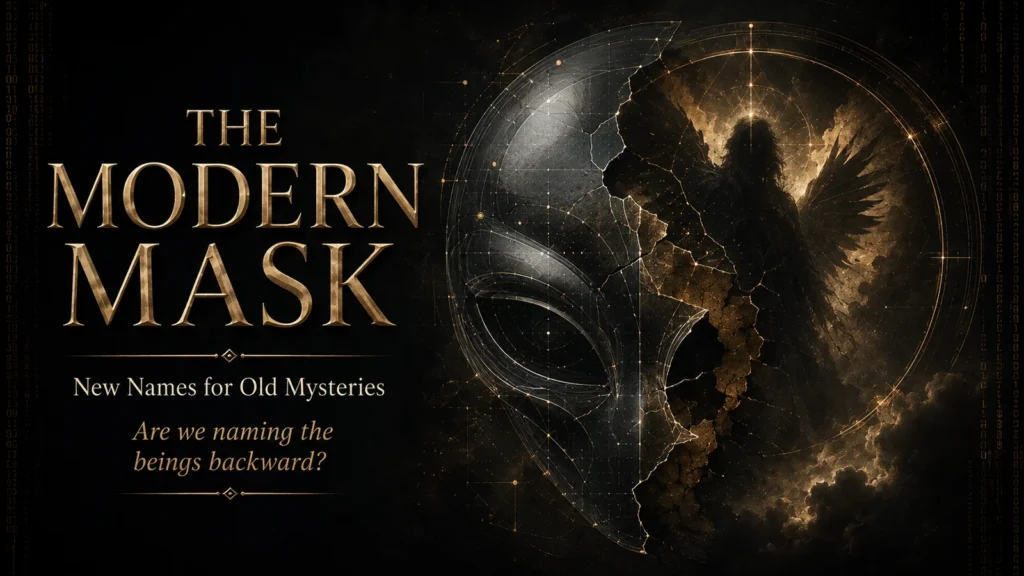
Modern culture has a ready-made word for almost every strange intelligence it cannot explain: alien.
The label arrives before the investigation is finished. An unusual object is reported in the sky. A witness describes a presence that did not seem human. A contact story offers hidden knowledge, a new account of human origins, or a promise of future transformation. The explanation quickly shifts from unidentified to extraterrestrial, as though naming a mystery had settled its identity.
But what if the label decides the answer before the evidence does? Christians are not required to accept the newest label before testing the oldest categories. Scripture gives us a created heavenly realm, loyal and rebellious spiritual beings, angels who sinned, hostile rulers and authorities, counterfeit revelation, deceptive signs, and a pre-Flood episode in which heavenly rebellion crosses into human history. Those are biblical categories before they are UFO categories.
The Pre-Flood Origin Theory proposes that some modern alien, non-human intelligence (NHI), contact, and UAP narratives may be misidentifying, remembering, imitating, exploiting, or recreating an older pattern of heavenly rebellion. Ancient-astronaut theory says ancient people mistook advanced aliens for gods or angels. The Pre-Flood Origin Theory reverses the question: what if modern humanity is mistaking angels and rebel powers for aliens?
This is not the claim that every UFO is demonic, every witness is deceived, or every unresolved report has one spiritual cause. Many reports will have ordinary, psychological, atmospheric, technological, or human explanations. Some will remain unresolved because the data are poor. The theory also does not deny that God could have created biological life elsewhere. Possible life beyond Earth and alleged intervention in human history are different questions.
The theory begins instead with the moral and theological shape of certain claims. Genesis 6 and the Enochic Watcher tradition do not present rebellious heavenly teachers as humanity’s liberators. They present unauthorized contact, forbidden mediation, corrupted knowledge, altered boundaries, violence, and judgment. Modern alien mythology often retells those same features with the moral verdict reversed: the rebels become benefactors, forbidden knowledge becomes uplift, and salvation arrives through superior beings, hybridization, technology, or awakening.
That parallel deserves attention, but a parallel is not a proof. The strongest continuity may be a recurring rebellion pattern; more specific proposals include ongoing spiritual influence, cultural transmission, biological continuity, material remnants, human recreation, reverse engineering, or direct modern manifestation. Those explanations do not carry equal weight. This article ranks them instead of blending them into one dramatic claim.
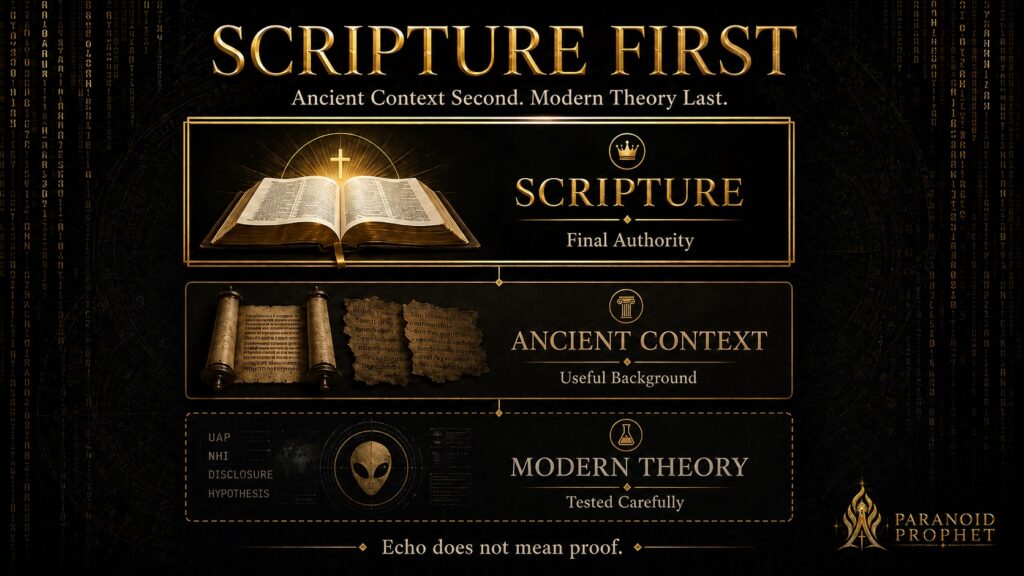
The governing order is simple: Scripture defines the ontology, ancient context may expand the interpretation, modern evidence documents reports and religious patterns, and synthesis comes last. The Pre-Flood Origin Theory is therefore a Christian model, not a new doctrine. Its purpose is to test whether an old rebellion can wear a modern mask without surrendering either intellectual honesty or biblical authority.
The investigation finally leads beyond Watchers, Nephilim, UAP, and alleged disclosure. Every created intelligence, visible or invisible, remains beneath Jesus Christ. If a message rewrites creation, minimizes sin, displaces the cross, or promises ascension without the King, its religious meaning can be tested even while its physical cause remains unresolved.
Article Guide12 sections
The Alien Assumption: Are We Naming the Beings Backward?
The word alien sounds observational, but it is usually interpretive. A witness may observe a light, object, movement, figure, voice, impression, or event. The conclusion that its source is biological life from another planet adds an origin story the observation itself may not establish.
UAP, NHI, and alien are not interchangeable
UAP names an unresolved observation: an unidentified anomalous phenomenon. It does not identify the cause. NHI names a claimed kind of agency: non-human intelligence. It does not identify that intelligence’s nature, origin, morality, or message. Alien usually supplies a particular interpretation: an extraterrestrial organism or civilization.
Keeping those terms separate prevents a common leap. An unresolved object is not automatically intelligently controlled. Apparent intelligence is not automatically non-human. A non-human agency, if one were established, would not automatically be extraterrestrial. And an extraordinary performance claim would not establish the identity claimed by a messenger.
This distinction does not close the investigation. It keeps the investigation open. Christians can examine sensor data, testimony, material evidence, natural explanations, classified technology, and psychological factors without allowing a cultural label to outrun the facts.
The Heavenly Identity Reversal
Scripture introduces intelligent non-human beings without placing them on distant planets. Angels serve God. Other heavenly beings rebel. Some powers deceive nations, oppose God’s purposes, or present false worship. Their existence does not make every unusual event spiritual, but it means extraterrestrial biology is not the only category available to a Christian worldview.
This produces the theory’s first signature contribution, the Heavenly Identity Reversal:
Ancient-astronaut theory says humanity mistook aliens for angels. The Pre-Flood Origin Theory asks whether modern humanity is mistaking angels and rebel powers for aliens.
The reversal does not prove that a particular report involved a heavenly being. It changes the order of questions. Before asking which star system a claimed intelligence comes from, Christians ask what evidence establishes intelligence, what the being claims to be, what message it brings, what response it demands, and whether its account of God and humanity agrees with revelation.
Possible extraterrestrial life is a separate question
Nothing in this theory requires Christians to declare that God created no life elsewhere. Scripture does not give a census of every living creature in the physical universe. The existence of extraterrestrial microbes or even intelligent embodied creatures, if ever demonstrated, would not by itself confirm ancient-astronaut claims, validate contact religions, or identify every UAP.
The important distinction is between possible life elsewhere and claims that superior beings intervened in human origins, religion, biology, or salvation. The second claim enters biblical territory because it concerns creation, authority, worship, and the meaning of humanity. It must be tested rather than granted immunity by the word alien.
Genesis 6: Heavenly Intervention, Not Extraterrestrial Visitation
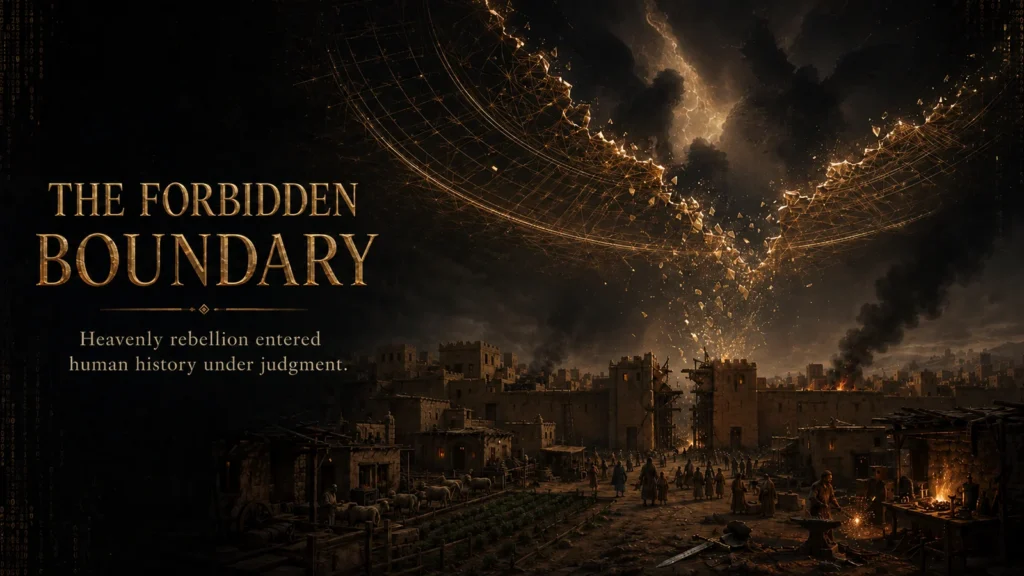
The theory’s biblical foundation is not Roswell, a leaked memo, or a contact testimony. It is the pattern surrounding Genesis 6: heavenly beings cross a forbidden boundary, the Nephilim appear, human wickedness intensifies, violence fills the earth, God announces judgment, and Noah finds favor.
Genesis does not describe visitors from another planet. It names the actors with the text’s own categories and places the event within creation’s rebellion against God. Genesis 6 gives a category for heavenly contact entering human history under judgment.
The sons of God and the forbidden boundary
Genesis 6:1-4 says that the “sons of God” saw the daughters of humanity, took wives, and were associated with the appearance of the Nephilim and the mighty men of old. Three main interpretations have been offered: the sons of God as Sethite men, as royal or tyrannical rulers, or as heavenly beings. This article works from the heavenly-being interpretation because it best fits the phrase’s use in Job 1:6; 2:1; 38:7, the boundary-crossing character of the episode, its ancient reception, and its relationship to later texts about angels who sinned.
That reading is strong, but it is not beyond debate. Sons of God and Daughters of Men owns the full interpretation question. Genesis 6 Explained follows the chapter’s complete movement into corruption, violence, judgment, and Noah’s grace.
The text emphasizes transgression more than mechanics. It does not explain the biology of the union or provide a technical account of how heavenly beings interacted with human women. Modern curiosity asks for a laboratory diagram. Genesis gives a moral verdict: a created boundary has been violated, and the event belongs to the crisis preceding the Flood.
The Nephilim are an aftermath, not an alien species label
The Nephilim are present “in those days, and also afterward,” when the sons of God went in to the daughters of humanity. The grammar and identity questions are difficult, but the passage ties these formidable figures to the boundary crisis. It does not call them extraterrestrials, pilots, or a spacefaring species.
Nor should Nephilim become a sensational label for every giant tradition, anomalous skeleton claim, unusual person, demon, alien, or UAP entity. The term has a defined biblical location. Who Were the Nephilim? examines their identity, while Did the Nephilim Survive the Flood? evaluates the difficult post-Flood continuity question.
For the present theory, their importance is narrower. Genesis 6 portrays heavenly rebellion as having consequences within the human world. The account is not about neutral visitors offering harmless progress. It belongs to a sequence ending in pervasive evil and divine judgment.
Jude and Peter preserve the rebellion-and-judgment pattern
Jude 5-7 and 2 Peter 2:4-10 speak of angels who sinned, restraint or custody for judgment, sexual transgression in the surrounding examples, the ancient world, and the Flood. Interpreters differ over the exact relationships among these details, but both passages reinforce a canonical pattern: angelic rebellion is real, God judges it, and rebellion from the heavenly realm does not become righteous because it offers power or crosses into human experience.
First Enoch develops that pattern by naming the rebels Watchers, narrating their descent, and cataloging corrupting instruction. It is valuable ancient evidence for how Genesis 6 was read, but it is not Christian Scripture. The Watchers Explained treats the rebel Watcher tradition, and The Book of Enoch Explained establishes its authority limits.
That source order matters. Genesis supplies the inspired text. Jude and Peter confirm the reality and judgment of angelic sin. Enoch offers ancient interpretive expansion. Modern theories must remain downstream from all three and must never import planets, spacecraft, genetic laboratories, or alien evolution into passages that do not name them.
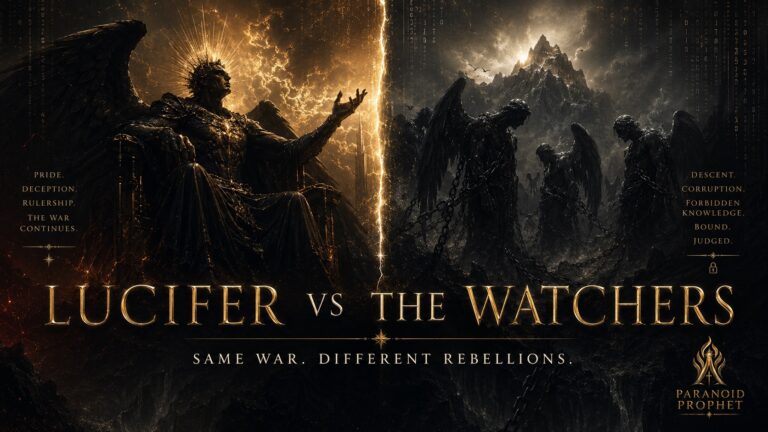
The same discipline applies to identity and present status. Rebel Watchers are not simply another name for Satan, and restrained angels are not automatically the active demons encountered in the Gospels. Lucifer vs. the Watchers separates two rebellion patterns without denying their place within a wider kingdom of darkness. Where Are Demons and Fallen Angels Now? distinguishes bound angels, active unclean spirits, rulers and authorities, and the Enochic spirits-of-giants theory. A modern manifestation hypothesis cannot be credible if it erases the categories Scripture and ancient sources actually give.
Human Civilization, Heavenly Corruption
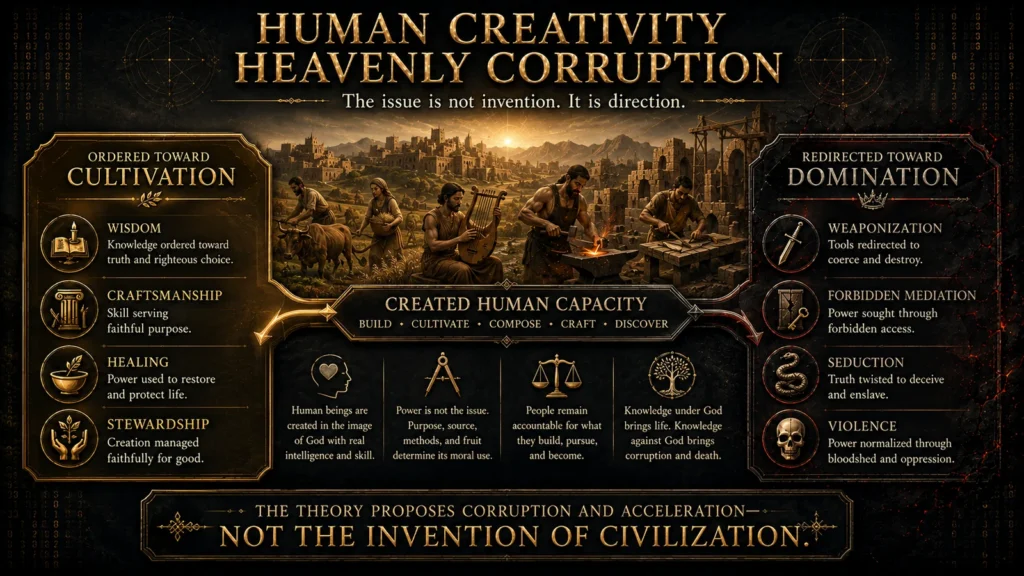
A careless version of the theory would credit heavenly rebels with inventing civilization. Genesis will not allow that. Human beings are already creating, organizing, building, cultivating, composing, and working metal before the sons of God episode appears.
Genesis 4 already shows human culture
Genesis 4:17-22 describes a city, livestock culture, music, and metalworking. These developments arise within Cain’s line before Genesis 6:1-4. The text neither denies human ingenuity nor requires outside beings to explain ordinary cultural development.
Human creativity follows from creation in God’s image. It can be used in worship or rebellion, for cultivation or domination, but it is genuinely human. The Bible does not treat every difficult invention, mathematical achievement, monument, medical advance, or ancient engineering accomplishment as evidence of non-human tutoring.
This is an important correction to both ancient-alien enthusiasm and anti-technology fear. Neither Scripture nor archaeology needs a “gods did it” shortcut wherever ancient people demonstrate skill. The builders of the ancient world were intelligent humans, not props waiting for alien instructors.
The theory proposes corruption and acceleration, not invention
The stronger proposal is that rebel heavenly intervention may have accelerated, redirected, weaponized, or corrupted aspects of existing human knowledge. In the Enochic tradition, the problem is not that humans were incapable of discovering anything. It is that unauthorized teachers disclose knowledge within rebellion and turn it toward violence, seduction, domination, occult mediation, and disorder.
This model respects both human agency and spiritual influence. People remain responsible for what they desire, build, and do. Rebel powers do not have to invent a sword in order to intensify a culture of bloodshed. They do not have to create curiosity in order to redirect it toward forbidden access. Corruption often takes created capacities and detaches them from their proper end under God.
Scripture provides no technical inventory of angelic knowledge, and First Enoch is not an engineering manual. The theory must therefore resist claims that a specific modern technology came from a specific Watcher unless independent evidence establishes that history. The Enochic catalog supplies a moral pattern, not a patent archive.
Knowledge under God is not forbidden knowledge
The Bible honors skill, wisdom, craftsmanship, observation, and learning when ordered toward truth and faithful vocation. In Exodus 31:1-11, Bezalel is filled by the Spirit of God with wisdom, understanding, knowledge, and craftsmanship for the tabernacle. Technical ability is not inherently unholy. Its source, purpose, means, and moral use matter.
Medicine is not rebellion because it is powerful. Astronomy is not occult because it studies the heavens. Metallurgy is not evil because weapons can be made from metal. Engineering and computation are not sinful because pride can misuse them. A Christian critique of forbidden knowledge concerns knowledge pursued through forbidden mediation, used against God’s order, or turned into a rival path to mastery and salvation.
What Did the Watchers Teach? develops this distinction in detail. The Pre-Flood Origin Theory needs the guardrail because it is easy to confuse moral discernment with fear of discovery. The issue is not whether knowledge advances. The issue is whether power remains accountable to the Creator and ordered toward love of God and neighbor.
Ancient Culture-Bringers, or Heavenly Rebels?
The theory’s intellectual center is not a claim about a particular craft. It is a conflict between two moral readings of the same broad pattern: superior beings descend, transmit special knowledge, alter human conditions, and become associated with the world before a great flood. Are they humanity’s benefactors, or are they unauthorized mediators whose gifts conceal rebellion?
Antediluvian sages and the apkallu tradition
Mesopotamian traditions remembered the apkallu, primeval sages associated with wisdom, kingship, culture, and the antediluvian past. Their traditions are complex rather than uniformly positive. Some texts honor wise culture-bringers; other strands associate sages or their descendants with dangerous power and post-Flood disorder.
Assyriologist Amar Annus has argued that the Enochic Watcher story should be read in comparison with these Mesopotamian traditions. His 2010 study, “On the Origin of Watchers”, proposes that Jewish writers inverted important apkallu themes, turning prestigious antediluvian sages into condemned transgressors. His later open-access study, “The Story of the Watchers as a Counter Narrative”, develops the Watcher story as an Enochic response to the authority claimed for Mesopotamian sages.
This scholarship establishes literary and cultural relationships; it does not prove that supernatural events occurred. It also warns against a simplistic contrast in which every apkallu tradition is benevolent and every Jewish response is wholly new. The ancient evidence already contains mixed and dangerous strands. The comparison is valuable because it shows a contest over who has the right to mediate wisdom and how humanity should judge the gifts of antediluvian teachers.
The Watcher tradition reverses the moral verdict
In First Enoch, the descending teachers are not saviors of an ignorant species. They are rebels. Their instruction is unauthorized, their unions violate boundaries, their offspring become violent, and their knowledge magnifies corruption. The narrative strips the culture-bringer story of its heroic glow.
The key issue is not that knowledge exists, but that revelation has been detached from God’s authority. The Watchers mediate power while violating the order of the One who made both heaven and earth. Their apparent gifts cannot be judged apart from their rebellion, methods, fruits, and end.
This is why the Watcher tradition offers more than a list of strange beings. It supplies a theology of corrupt mediation. A being may know more than a human and still lie. It may perform wonders and still rebel. It may offer a gift and still seek allegiance. Intelligence, antiquity, and power do not establish moral authority.
Ancient aliens restore the benefactor story
Modern ancient-alien narratives often move in the opposite direction. Gods, angels, sages, and Watchers are recoded as advanced extraterrestrials. Their knowledge becomes technological uplift. Boundary crossing becomes genetic intervention. Hybrid offspring become evidence of a breeding program. Divine judgment becomes the suppression or misunderstanding of liberating visitors.
Giuseppe M. Cuscito’s 2024 study, “From Angels to Aliens”, documents this modern reinterpretation of First Enoch, including Watchers treated as aliens, giants as hybrids, and forbidden instruction as science or technology. The study documents the move; it does not confirm the ancient-alien explanation.
The Pre-Flood Origin Theory calls this reversal the Rebel Benefactor Inversion. What modern culture calls ancient astronauts, the Watcher tradition may remember as unauthorized heavenly teachers. Put as an explicitly interpretive thesis: The modern alien story may not be revealing the true identity of the ancient gods. It may be repeating their alibi.
The Rebel Benefactor Inversion
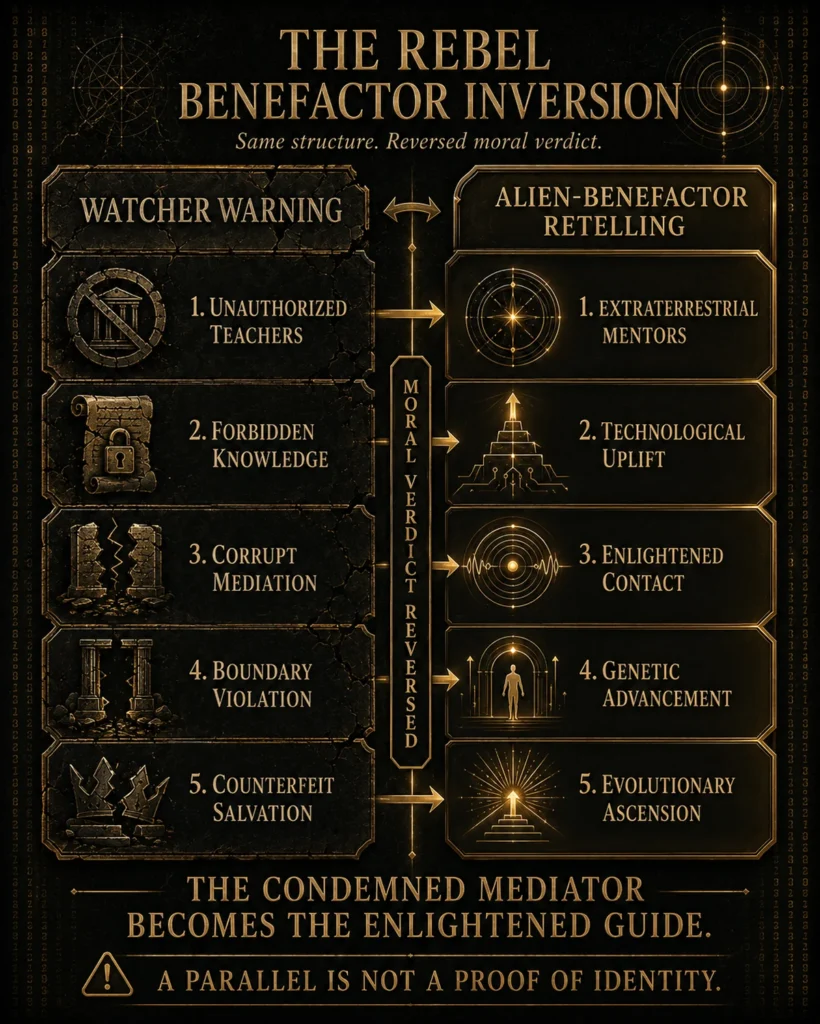
| Watcher warning | Alien-benefactor retelling |
|---|---|
| Unauthorized teachers | Extraterrestrial mentors |
| Forbidden knowledge | Technological uplift |
| Corrupt mediation | Enlightened contact |
| Boundary violation | Genetic advancement |
| Altered offspring | Hybrid program |
| Rebellion | Liberation from restrictive religion |
| Divine judgment | Suppression of humanity’s benefactors |
| Counterfeit salvation | Evolutionary or technological ascension |
The table identifies a narrative inversion, not a one-to-one proof. Similar stories can arise through borrowing, cultural memory, recurring human desire, spiritual deception, or some combination. The point is that modern retellings often preserve the structure while changing the moral evaluation. The condemned mediator becomes the enlightened guide.
The Pre-Flood Origin Theory is Paranoid Prophet’s original synthesis of several older lines of research: scholarly work on Watchers and apkallu, alternative-UFO comparisons between modern reports and older encounter traditions, religious-studies research on alien revelation, and Christian frameworks for spiritual discernment. Its distinct proposal joins heavenly intervention, alien rebranding, post-Flood persistence, modern human recreation, and gospel testing. It does not claim that every component is novel or that the synthesis has been proven.
“And Also Afterward”: The Pre-Flood Persistence Ladder
Genesis 6:4 places the Nephilim in the pre-Flood world and adds the difficult phrase “and also afterward.” Later biblical books describe the Anakim, Rephaim, Og of Bashan, and formidable warriors associated with Gath. That evidence establishes post-Flood giant traditions, but it does not by itself explain how those traditions relate to the pre-Flood Nephilim.
Proposals include a second incursion, survival through a family line, the recurrence of giant clans without direct biological continuity, or the reuse of Nephilim language as a comparison of terror and stature. Did the Nephilim Survive the Flood? weighs those options. The present article asks a wider question: in what senses could a pre-Flood rebellion leave later traces?
The answer needs levels. A recurring moral pattern is easier to defend than an unbroken bloodline. Cultural memory requires less evidence than a recovered artifact. A claim that humans imitate an old rebellion is less specific than a claim that a government reverse-engineered a non-human vehicle. Treating every level as equally certain would make the whole theory weaker.
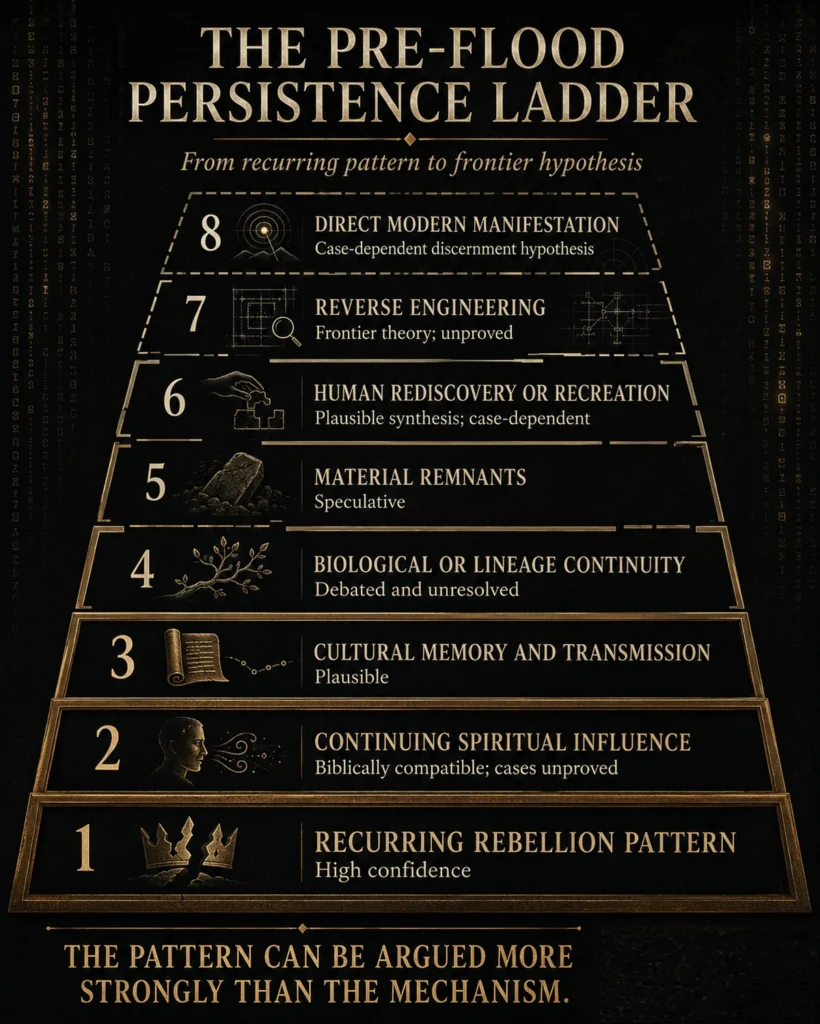
| Level | Persistence proposal | Confidence |
|---|---|---|
| 1 | Recurring rebellion pattern | High |
| 2 | Continuing spiritual influence | Biblically compatible; cases unproved |
| 3 | Cultural memory and transmission | Plausible |
| 4 | Biological or lineage continuity | Debated and unresolved |
| 5 | Material remnants | Speculative |
| 6 | Human rediscovery or recreation | Plausible synthesis; case-dependent |
| 7 | Reverse engineering | Frontier theory; unproved |
| 8 | Direct modern manifestation | Discernment hypothesis; case-dependent |
Levels 1-2: recurring pattern and spiritual influence
Level 1, recurring rebellion pattern. The proposal is that the basic pattern recurs: created beings or human powers seek knowledge, rule, identity, or transformation outside obedience to God. It explains why different periods produce similar stories of forbidden ascent, corrupt mediation, counterfeit revelation, and promised autonomy. Its source basis is broad and biblical, from Eden and Genesis 6 to Babel, idolatry, false prophecy, and rival gospels. The main objection is that resemblance does not establish a shared hidden actor or historical chain. Confidence: high for the pattern, without assigning every recurrence to the same mechanism.
Level 2, continuing spiritual influence. The proposal is that hostile spiritual powers continue to deceive, tempt, inspire false worship, or exploit human systems. It explains why ancient rebellion themes can reappear as living religious claims rather than only as old literature. Its source basis includes biblical teaching about deceptive spirits, rulers and authorities, idolatrous powers, false signs, and spiritual conflict. The primary objection is evidential: biblical compatibility does not identify the cause of a particular sighting, dream, contact report, technology, or movement. Confidence: biblically compatible; individual cases unproved.
Levels 3-4: cultural memory and lineage continuity
Level 3, cultural memory and transmission. The proposal is that stories, symbols, rituals, genealogies, and warnings carry memories of the pre-Flood crisis into later cultures. It explains recurring flood traditions, antediluvian sages, giant memories, divine-human boundary stories, and the later reinterpretation of Watchers as aliens. Its source basis is comparative literature and the demonstrated ability of cultures to preserve and transform traditions. The primary objection is that direct transmission chains are often difficult to prove, and similar motifs can arise independently. Confidence: plausible, with each historical connection requiring its own evidence.
Level 4, biological or lineage continuity. The proposal is that some bodily line, second incursion, or related condition connects pre-Flood Nephilim with later giant clans. It explains one possible reading of “and also afterward” and the presence of Anakim, Rephaim, Og, and Gath traditions. Its source basis is the disputed relationship among Genesis 6, Numbers 13, Deuteronomy, Joshua, and Samuel. The primary objection is substantial: the Flood narrative presents catastrophic judgment, Scripture gives no explicit survival mechanism, and later giant terms do not form a simple genealogy. Confidence: debated and unresolved.
Levels 5-6: material remnants and human recreation
Level 5, material remnants. The proposal is that objects, sites, techniques, or physical traces from the pre-Flood rebellion survived judgment or were preserved afterward. It could explain claims of anomalous artifacts or inherited technologies. Its source basis is mainly theoretical; neither Genesis nor Enoch identifies a recoverable machine, and no publicly verified object has been shown to be pre-Flood angelic technology. The primary objection is the absence of secure provenance, reproducible testing, and an evidential chain from artifact to claimed source. Confidence: speculative.
Level 6, human rediscovery or recreation. The proposal is that human beings independently rediscover powerful techniques or deliberately recreate the moral pattern of forbidden boundary crossing, perhaps through weaponization, occult practice, genetic manipulation, human-machine integration, or salvation claims attached to technology. It explains continuity without requiring a surviving object or bloodline. Its source basis is human creativity, recurring rebellion, and the observable ability of societies to turn good capacities toward domination. The primary objection is that thematic resemblance may be stretched too far and can become an anti-technology reflex. Confidence: plausible synthesis; specific cases require evidence.
Levels 7-8: reverse engineering and direct manifestation
Level 7, reverse engineering. The proposal is that humans possess and attempt to reproduce technology of genuinely non-human origin, possibly connected to an older rebel intelligence. It would explain some claims of abrupt technological transfer, secret retrieval programs, or unusual materials. Its source basis currently consists of allegations, testimony, disputed documents, and unresolved reports rather than a publicly verified artifact with transparent chain of custody and independent testing. Whistleblower status may justify investigation, but it does not convert a claim into evidence of origin. Confidence: frontier theory, unproved.
Level 8, direct modern manifestation. The proposal is that a hostile spiritual intelligence directly presents itself through a modern alien or NHI identity, whether by apparition, deception, manipulation of perception, physical manifestation, or some interaction not yet understood. It could explain cases in which anomalous performance and religious messaging appear together. Its source basis is the biblical reality of deceptive powers and the historical recurrence of encounter claims. The primary objection is that identity is difficult to establish from experience, and the rebellious angels linked by Jude and Peter to ancient judgment may be restrained rather than roaming. A modern deceiver would not automatically be one of the Genesis 6 Watchers. Confidence: a case-dependent discernment hypothesis.
Continuity is more evident than one continuity mechanism. The higher the ladder rises, the more specific the proposal becomes and the more evidence it needs. The pattern can be argued more strongly than the mechanism. That distinction lets the theory remain bold where the sources are strong and modest where evidence is incomplete.
UAP as Remnant, Recreation, Manifestation, or Mask
A modern UAP report does not arrive with its cause attached. The same surface description could be produced by different realities, and different reports may have no relationship to one another. The Pre-Flood Origin Theory is therefore not a single-cause machine. It is a set of ranked possibilities applied only after ordinary investigation.
Ordinary, natural, psychological, and human explanations
Aircraft, balloons, drones, satellites, astronomical objects, atmospheric effects, sensor artifacts, hoaxes, memory errors, expectation, classified systems, and adversarial deception can account for many reports. A Christian framework gains nothing by calling an airplane an angel or a camera artifact a portal. Careful identification is part of truthfulness.
Official uncertainty should also remain uncertainty. NASA’s current UAP FAQ, last updated May 8, 2026, says NASA has not found credible evidence of extraterrestrial life or evidence that UAP are extraterrestrial, and emphasizes the lack of high-quality observations. AARO’s September 2025 declassification information paper likewise says it has found no evidence of extraterrestrial beings or technology to date while noting that a small percentage of reports may remain potentially anomalous. Neither statement proves a spiritual theory. Both restrain extraterrestrial certainty.
The material-remnant model
This model asks whether a physical object or technique could persist from an earlier rebellion. It is the most archaeological form of the theory and one of the easiest to overstate. A genuinely anomalous object would still need secure provenance, documented custody, material analysis, reproducible results, and a justified path from unusual composition to non-human origin. Even then, “non-human” would not automatically mean Watcher, Nephilim, or pre-Flood.
The human-recreation model
This model does not require ancient machinery. Humans may recreate the old pattern whenever they pursue mastery through forbidden mediation, remove moral limits from powerful knowledge, alter humanity while denying creaturely identity, or promise salvation through elite access. A laboratory, military program, spiritual movement, or technology company could echo the Watcher pattern without possessing a single pre-Flood artifact.
The model is strongest as moral analysis and weakest when it is used to accuse a specific project without evidence. Genetic medicine can heal; artificial intelligence can serve; space research can enlarge knowledge. The biblical warning concerns means, ends, worship, justice, and the attempt to become more than creatures apart from God.
The reverse-engineering model
Retrieval and reverse-engineering allegations deserve normal standards of inquiry: named evidence, lawful access where possible, corroboration, chain of custody, independent analysis, and protection against disinformation. Testimony can identify questions worth investigating. It cannot establish the age, origin, builders, or spiritual identity of an unseen object.
The theory therefore keeps reverse engineering on the frontier rather than at its foundation. If public evidence becomes stronger, the level can be reassessed. Until then, Genesis 6 should not be made to authenticate a classified-program story it never describes.
The direct-manifestation or modern-mask model
This model asks whether some alleged intelligences adapt their appearance and vocabulary to the expectations of an age. Folklore comparisons associated with Jacques Vallee’s work have long challenged a simple spacecraft-only reading by comparing modern encounters with older reports of strange beings and altered experience. Vallee is adjacent evidence for continuity of encounter motifs, not an endorser of a Christian Watcher explanation.
Jeffrey Kripal’s Authors of the Impossible likewise explores phenomena that unsettle familiar boundaries among the material, cultural, sacred, and conscious. His categories can help readers see that the field is not exhausted by hardware, but his metaphysics are not Christian doctrine.
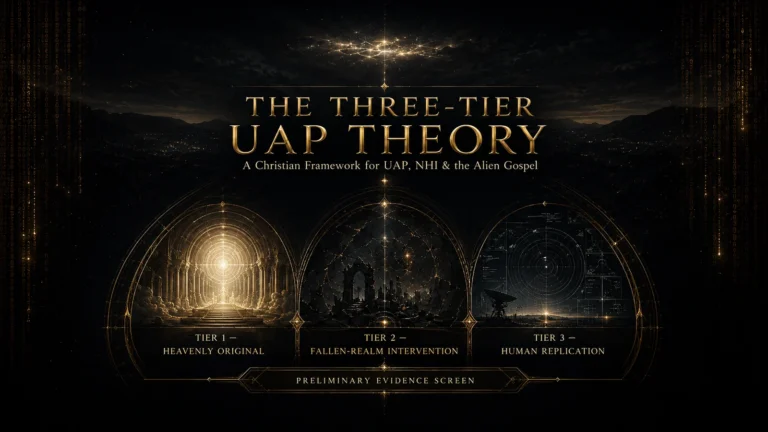
A mask model remains a hypothesis, not a universal answer. One report might be a drone, another a sincere misperception, another a manipulative religious performance, and another genuinely unexplained. The detailed sorting process belongs in Christian View of UFOs: The Three-Tier UAP Theory. This article supplies the older pattern that makes its spiritual tier intelligible.
The Alien Alibi: When Contact Becomes Another Gospel
The most important modern parallel may not be a shape in the sky. It may be a story about who made us, what is wrong with us, who can save us, and what we are becoming. When an alleged intelligence answers those questions, the claim has entered religion even if it speaks through laboratories, star maps, consciousness language, or disclosure culture.
New creators: humanity seeded or engineered
Some narratives replace creation by God with seeding, experimentation, or genetic manufacture by superior beings. Humanity’s dignity then depends on alien ancestry or engineered potential rather than being made in God’s image. The claim may sound scientific, but it performs the religious work of an origin story and assigns creator-like authority to creatures.
New revelation: elite contact and hidden history
Contact movements often center on select receivers who disclose humanity’s suppressed past, coming crisis, or evolutionary destiny. Religious-studies scholars document this structure without endorsing its truth. Diana Walsh Pasulka’s American Cosmic examines the interaction of UFO belief, religion, and technology. Christopher Partridge’s UFO Religions surveys revelation, worship, abduction spiritualities, and apocalyptic expectations in UFO movements. They document religious patterns; they do not establish the spiritual cause proposed here.
The Christian question is not merely whether a contact experience felt profound. It is whether the claimed revelation tells the truth about God, Christ, sin, humanity, worship, and salvation. Private access does not outrank public revelation, and secrecy does not make a message sacred.
New salvation: awakening, upgrade, and technological immortality
Alien and NHI narratives can present humanity’s problem as ignorance, low vibration, undeveloped consciousness, biological limitation, or technological immaturity. The solution becomes awakening, hybridization, merger, genetic upgrade, evacuation, or technological escape from death. Such promises offer transformation without repentance and immortality without resurrection.
The New Testament announces something different. Humanity is alienated from God by sin, not merely limited information. Reconciliation comes through the incarnate Son’s death and resurrection, not initiation by superior creatures. Eternal life is received by grace in Christ, not achieved by an elite who obtain restricted technology or consciousness.
The gospel test
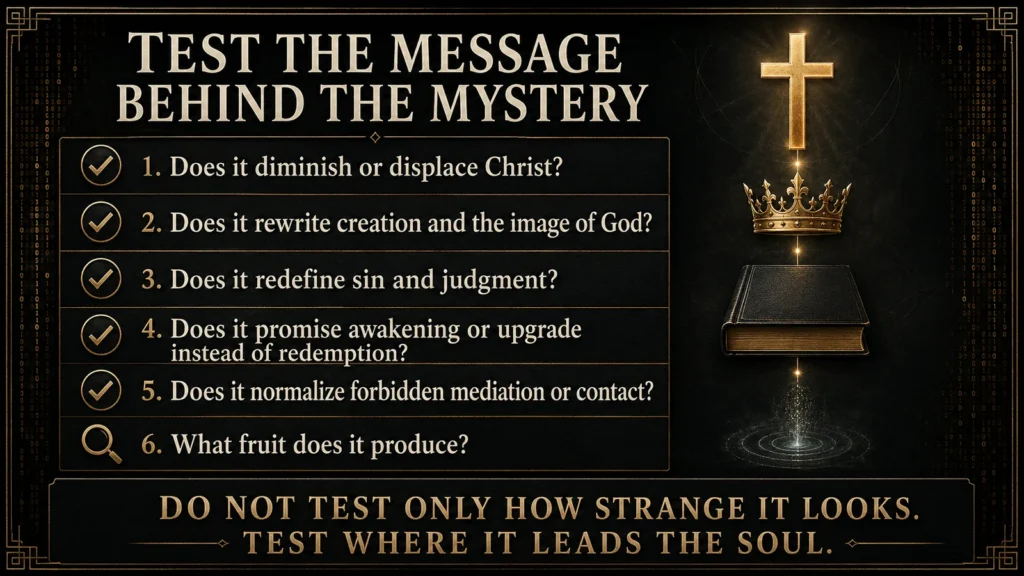
First John 4, Galatians 1, and 2 Corinthians 11 command Christians to test spirits, reject another gospel even when associated with an angelic messenger, and recognize that deception may present itself as light. The test is theological and moral, not merely spectacular.
| Biblical gospel | Counterfeit contact gospel | Question to test |
|---|---|---|
| God creates humanity in his image | Superior beings seed or manufacture humanity | Who receives Creator authority? |
| Sin is rebellion against God | The problem is ignorance or arrested evolution | Is repentance still necessary? |
| Christ redeems by grace through the cross | Contact, knowledge, or upgrade saves | Is Christ displaced? |
| Resurrection defeats death | Technology or consciousness grants immortality | What hope is being offered? |
| Revelation is tested by apostolic truth | Elite receivers reveal a suppressed message | What authority governs the claim? |
| Worship belongs to God | Advanced beings demand trust, allegiance, or awe | Where does the message lead worship? |
Discernment should separate at least six questions: What was physically observed? What performance is claimed? What interpretation has been placed on it? What identity does the intelligence claim? What religious message does it bring? How does that message stand under Scripture? The craft may remain unidentified. The gospel it carries may not.
Colossians 1-2 gives the controlling answer. All things, visible and invisible, including thrones, dominions, rulers, and authorities, were created through Christ and for Christ. Fullness dwells in him. Through the cross he reconciles and disarms hostile powers. No intelligence can become humanity’s true creator, mediator, or savior because those places already belong to the Son.
What the Theory Does, and Does Not, Claim
A useful theory should survive its strongest objections. These challenges do not all carry the same force, but each identifies a place where the synthesis could become careless.
“Genesis 4 shows civilization before the Watcher episode”
Correct. That fact defeats the claim that heavenly teachers invented civilization or supplied every major human art. The theory does not need that claim. It proposes possible corruption, acceleration, redirection, or weaponization within a civilization humans were already building. Human beings remain image bearers with real creativity and real responsibility.
“The Watcher story may derive from Mesopotamian literature”
Comparative scholarship gives strong reasons to read Enochic Watcher traditions alongside apkallu materials. Literary dependence, adaptation, or counter-narrative can explain features of First Enoch without proving a historical Watcher event. Yet this does not erase Genesis 6, Jude, or 2 Peter, and it does not make the moral inversion meaningless. It clarifies how Jewish writers contested claims about antediluvian sages. The theory uses that contest as ancient context, not as proof of its modern mechanism.
“Modern alien stories may simply borrow ancient myths”
Yes, direct borrowing is often the simplest explanation. Popular books, films, esoteric movements, internet communities, and ancient-astronaut media openly recycle biblical and Enochic material. That establishes cultural transmission, not direct contact. The theory includes this as Level 3 rather than treating every parallel as independent confirmation. Borrowing can also become a vehicle for a live religious message, so the resulting claim still requires gospel testing.
“Most UAP reports may be ordinary or human”
Agreed. The theory is not a statistical claim that most reports are rebel powers. It addresses the narrower subset in which unresolved phenomena become joined to claims of non-human agency, hidden origin, contact, revelation, hybridization, or salvation. Ordinary explanations should be pursued first, and unresolved should remain unresolved when evidence does not justify more.
“Extraterrestrial life is possible, and First Enoch is not Scripture”
Both statements are true guardrails. Possible biological life elsewhere does not threaten Christian doctrine, although any actual discovery would need careful theological reflection. First Enoch remains a non-canonical ancient Jewish work for most Christian traditions. Its value is historical and interpretive. It may illuminate how early readers developed Genesis 6 themes, but it cannot establish doctrine or authenticate a modern contact claim on its own.
“There is no publicly verified pre-Flood or non-human artifact”
That is the strongest objection to the material-remnant and reverse-engineering levels. At present, no publicly available object has demonstrated pre-Flood angelic origin through transparent provenance, independent testing, and reproducible analysis. Claims may deserve investigation, but they cannot carry the article’s foundation.
The evidence hierarchy therefore remains fixed: explicit Scripture carries the most authority for Christian ontology; ancient texts establish reception and context; documented modern reports establish that people report phenomena or form movements; independently tested physical evidence can establish physical properties; synthesis proposes relationships among those layers. A source may be valuable at its own level without proving the level above it.
This hierarchy also allows several judgments to coexist. A witness may report sincerely without interpreting correctly. A movement may have measurable religious effects without its claimed beings being real. A radar return may establish that something was detected without identifying its maker. An ancient text may preserve a genuine warning while also reflecting literary development. A biblical passage may establish the reality of heavenly rebellion without supplying the mechanism behind a modern event. Intellectual honesty does not demand that every layer rise or fall together.
The theory claims neither certainty nor irrelevance. It claims that biblical categories deserve priority, the benefactor retelling deserves suspicion, persistence mechanisms deserve ranking, and every revelation claim deserves testing under the gospel. That is enough to make the theory useful without making it infallible.
FAQ: The Pre-Flood Origin Theory, Watchers, Aliens, and UAP
What is the Pre-Flood Origin Theory?
It is a Christian synthesis proposing that some modern alien, NHI, contact, and UAP narratives may misidentify, remember, imitate, exploit, or recreate older heavenly-rebellion patterns associated with Genesis 6 and the Watcher tradition. Scripture defines the beings and moral categories; ancient sources supply context; modern evidence and religious narratives are evaluated afterward.
Does the theory say all aliens are demons?
No. Alien, demon, Watcher, Nephilim, angel, and NHI are not interchangeable categories. The theory does not identify every strange being or report. It asks whether some alien interpretations could mask heavenly or spiritual realities, while allowing ordinary, human, psychological, natural, and unresolved explanations.
Were the Watchers extraterrestrials?
Not in the biblical or Enochic categories. The Genesis 6 heavenly-being reading and the Watcher tradition describe members of the heavenly realm in rebellion, not biological visitors evolved on another planet. Recasting them as extraterrestrials is a modern interpretation added to the ancient texts.
What is the Heavenly Identity Reversal?
It reverses ancient-astronaut theory’s starting assumption. Instead of claiming ancient people mistook aliens for angels, it asks whether modern people may mistake angels or rebel powers for aliens. The reversal is a question and discernment framework, not proof about a specific case.
What is the Rebel Benefactor Inversion?
It is the modern reversal of the Watcher tradition’s moral verdict. Enochic Watchers are unauthorized teachers whose transgression contributes to corruption and judgment. Ancient-alien retellings often turn similar figures into enlightened mentors who uplift humanity through technology, genetics, or hidden wisdom.
Does “and also afterward” prove the Nephilim survived the Flood?
No. Genesis 6:4 and later giant traditions create a genuine continuity question, but they do not reveal one uncontested mechanism. A second incursion, family-line survival, recurring giant clans, and rhetorical comparison have all been proposed. Biological continuity remains debated.
Does the theory oppose science or technology?
No. Genesis already presents human culture and craftsmanship, and Scripture honors knowledge used faithfully. The concern is power detached from obedience, truth, justice, and love of neighbor. A technology must be evaluated by evidence, purpose, means, effects, and the religious claims attached to it.
Could most UAP reports have ordinary explanations?
Yes. Many reports are resolved as aircraft, balloons, satellites, sensor effects, atmospheric phenomena, or other ordinary causes. Others may involve classified or adversarial technology, hoaxes, or misperception. The theory concerns a narrower class of reports and narratives, especially those joined to claimed intelligence, revelation, identity, worship, or salvation.
How is this different from ancient-astronaut theory?
Ancient-astronaut theory typically treats gods and angels as misunderstood extraterrestrial visitors who advanced human civilization. The Pre-Flood Origin Theory treats the biblical heavenly identity as primary and asks whether modern extraterrestrial language rehabilitates condemned rebels as humanity’s benefactors. It also protects human civilization from the claim that ancient people needed alien inventors.
How should Christians evaluate an alleged NHI message?
Separate the observation from the interpretation and the messenger’s claimed identity. Then test the message: Does it confess the biblical Christ? Does it preserve creation, sin, repentance, the cross, grace, resurrection, and worship of God? Does it demand forbidden mediation or elite allegiance? What fruit does it produce? No display of power outranks the gospel.
Selected Sources
Scripture
- Genesis 4:17-22; 6:1-13: human civilization, sons of God, Nephilim, corruption, violence, and judgment.
- Numbers 13; Deuteronomy 2-3; Joshua 11; 1 Samuel 17: post-Flood giant and warrior traditions.
- Jude 5-7; 2 Peter 2:4-10: angelic sin, the ancient world, restraint, and judgment.
- 1 John 4; Galatians 1; 2 Corinthians 11; Colossians 1-2: testing spirits, rejecting rival gospels, deceptive light, and Christ’s supremacy.
Ancient context and Watcher scholarship
- George W. E. Nickelsburg and James C. VanderKam, 1 Enoch: The Hermeneia Translation, for a modern scholarly translation of the Book of the Watchers.
- Amar Annus, “On the Origin of Watchers”, and “The Story of the Watchers as a Counter Narrative”, for apkallu and Enochic comparisons.
- Annette Yoshiko Reed, Fallen Angels and the History of Judaism and Christianity, for the reception and transformation of fallen-angel traditions.
- Loren T. Stuckenbruck, The Myth of Rebellious Angels, for Jewish and early Christian developments of rebellious-angel traditions.
Modern reinterpretation, religion, and UAP boundaries
- Giuseppe M. Cuscito, “From Angels to Aliens”, for the modern ancient-alien reinterpretation of the Watchers.
- Tim Lomas and Brendan Case, “From Angels to Aliens”, for how cultural frameworks shape interpretations of celestial unknowns.
- Diana Walsh Pasulka, American Cosmic; Christopher Partridge, UFO Religions; and Jeffrey J. Kripal, Authors of the Impossible, for documented religious and interpretive dimensions of the modern field.
- NASA UAP Frequently Asked Questions and AARO’s 2025 declassification information paper, for current official evidential boundaries.
Read Next
- Christian View of UFOs: The Three-Tier UAP Theory applies the framework to modern reports, claimed entities, disclosure narratives, and rival gospels.
- Did the Nephilim Survive the Flood? examines the biological and giant-continuity questions without assuming one mechanism.
- What Did the Watchers Teach? distinguishes the Enochic forbidden-knowledge catalog from human creativity and biblical wisdom.
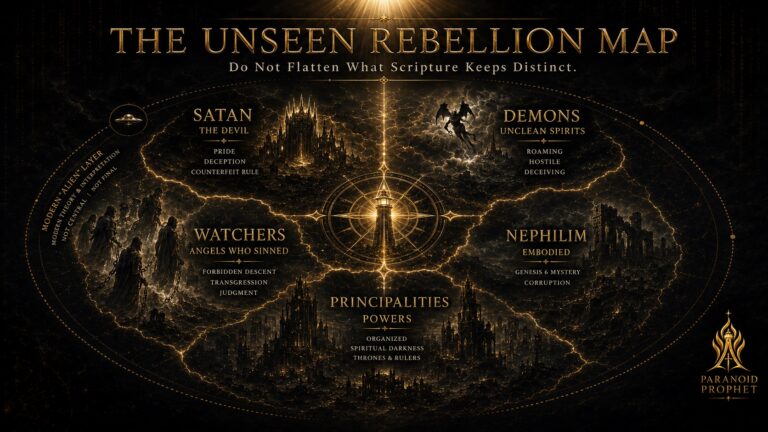
- The Unseen Rebellion Map keeps Watchers, Nephilim, demons, Satan, rulers, powers, and modern labels in their proper categories.
Christ Before the Flood, Christ After the Flood, Christ Above Every Intelligence
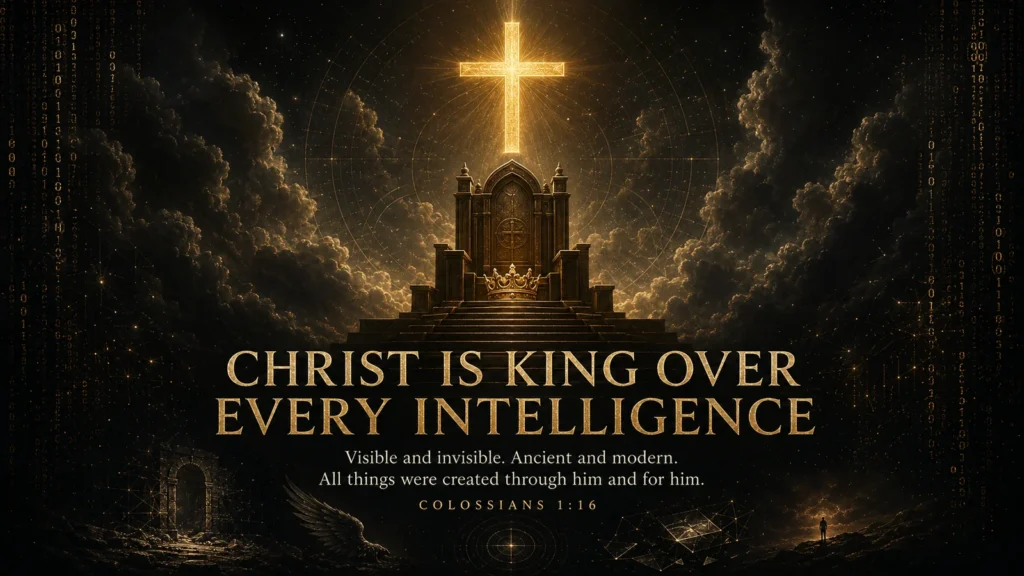
The pre-Flood world was not beyond God’s authority. The post-Flood world is not abandoned to hidden powers. Modern humanity is not waiting for a superior species to reveal its purpose. Before any throne, dominion, ruler, authority, angel, rebel, nation, or machine existed, the Son was. All things were created through him and for him.
That truth removes both fascination and fear from the throne. Rebel beings may deceive, cultures may retell their rebellion as liberation, and powerful people may imitate the old desire for mastery. None becomes a rival creator. None can rewrite the image of God in humanity. None can offer a greater incarnation than the Word made flesh, a deeper sacrifice than the cross, or a stronger victory than the resurrection.
Christians therefore do not need to mock every witness, believe every disclosure claim, or force every mystery into one answer. We can investigate evidence, preserve categories, admit uncertainty, test messages, refuse forbidden mediation, and love people drawn into fear or cosmic hope. Discernment is neither panic nor credulity. It is patient loyalty to the truth.
The final question is not whether an intelligence appears older, smarter, stranger, or more technologically capable than humanity. The question is whether it stands under the Lord Jesus Christ and tells the truth about him. The gospel does not wait for disclosure to become complete. Christ has already exposed the false promise behind every rebel benefactor: life is not found by escaping creaturehood, receiving secret knowledge, or ascending without God. Life is found in the crucified and risen King, who made the visible and invisible, disarmed hostile powers, reconciles his people by grace, and will bring every mystery into the light.
CONTINUE THE INVESTIGATION
Map the categories
The Unseen Rebellion Map: Satan, Watchers, Demons, Nephilim, and Principalities
Place competing pre-flood theories inside a broader category map of Satan, Watchers, demons, Nephilim, and principalities.