
GUIDED ARTICLE EXPERIENCE
Sons of God and Daughters of Men: What Genesis 6 Really Means
Read along as the narration moves through the article.
Private device narration · No hosted audio or tracking
CONTINUE GUIDED TOUR
Continue where you left off.
GUIDED TOUR COMPLETE
You have reached the end of this study.
Study record saved on this device.
GUIDED TOUR
Sons of God and Daughters of Men: What Genesis 6 Really Means
Narrator: Paranoid Prophet Recommended Voice Native device narration
Prepare to follow the article as it is narrated.
VOICE & TOUR OPTIONS
Voice & Listening
NARRATOR
Finding a narrator…
Checking the best narrator available on this device.
Restores the best curated narrator available on this device.
Narrator choices are curated for clear, long-form listening on this device.
Screen-awake support will be checked when narration starts.
CHOOSE A NARRATOR
Curated for this device
Choose a verified narrator for this browser, or use System Narrator. Automatic mode uses the best reliable route exposed by this device; your chosen narrator is preserved even if this device needs a temporary fallback.
Preparing the guided article experience…
RESUME GUIDED TOUR?
Continue where you left off.
GUIDED TOUR COMPLETE
You have reached the end of this study.
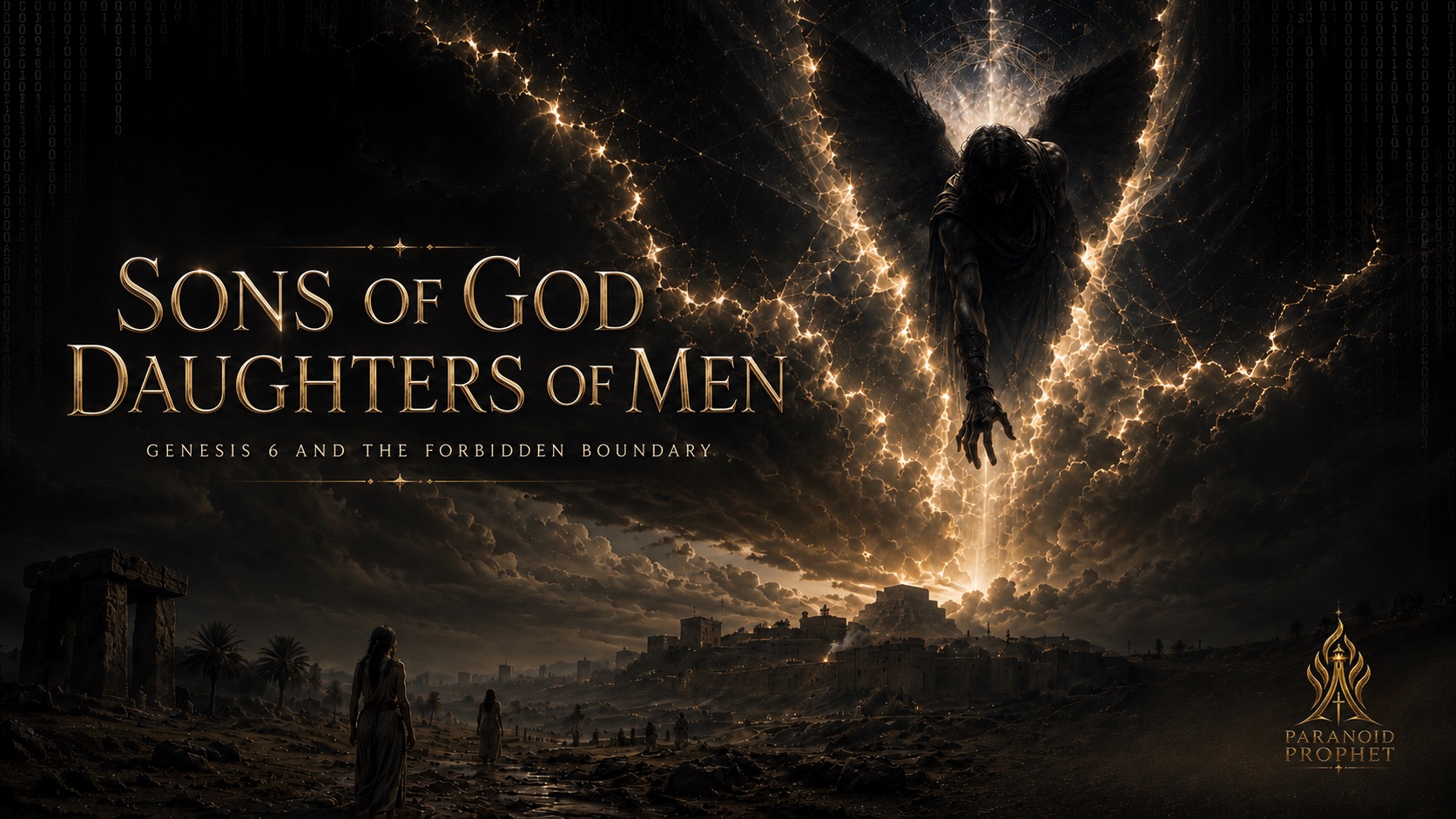
Genesis 6 does not give us a monster story. It gives us a warning with half the lights turned off. In four compressed verses, heavenly figures called the “sons of God” see the daughters of men, take wives for themselves, and cross a boundary the text presents as part of the disorder preceding the Flood.
Who were the sons of God and daughters of men? The strongest reading is that the sons of God were heavenly beings who rebelled against their appointed order, while the daughters of men were human women. The women are not presented as the principal instigators, and the sons of God are not the Nephilim.
That conclusion does not rest on one dramatic phrase. It comes from the wording of Genesis 6:1–4, the Old Testament use of “sons of God,” the contrast between heavenly sons and human daughters, the extraordinary setting, the Nephilim notice, the judgment traditions echoed in Jude and 2 Peter, and the antiquity of the heavenly interpretation.
This article follows the chapter-wide foundation established in Genesis 6 Explained. Here the question is narrower: what does Genesis mean by the two groups at the center of its opening scene, and which interpretation best explains all the evidence?
Article Guide8 sections
What Genesis 6:1–4 Actually Says
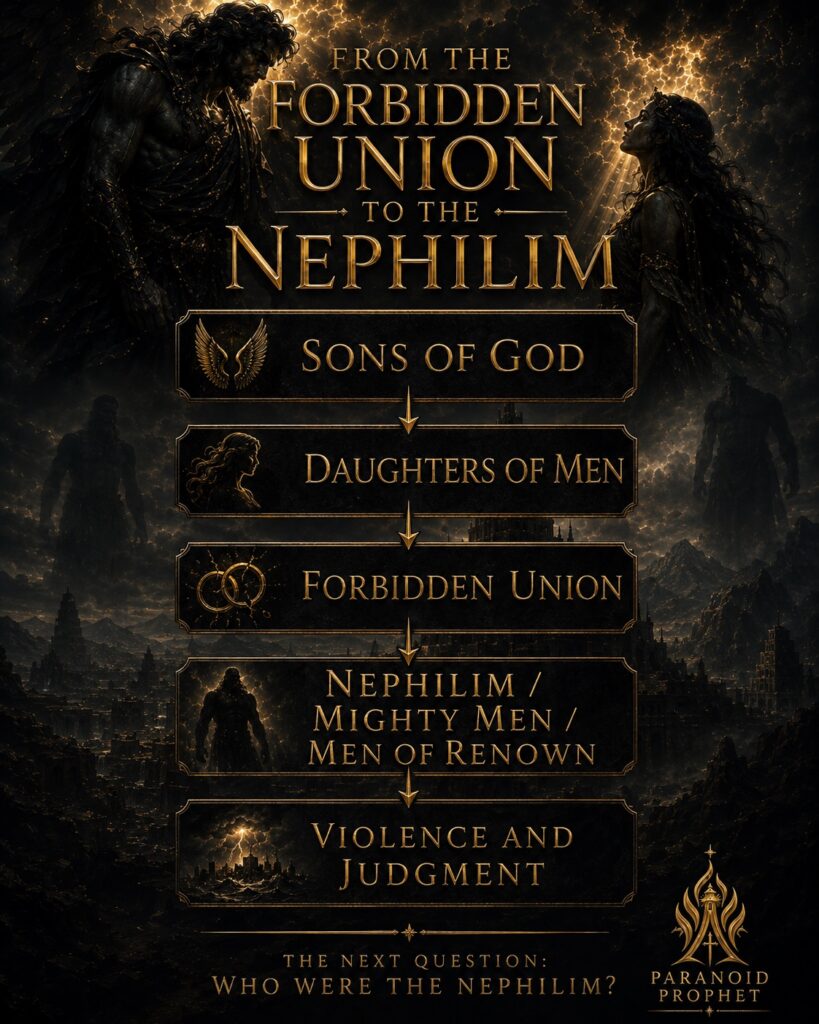
The passage begins with ordinary human growth. People multiply on the earth, and daughters are born to them. Then the camera turns toward a different group: the sons of God see that the daughters of men are attractive and take as wives any they choose. God announces a limit, and the text mentions the Nephilim, the mighty men of old, and men of renown.
The scene is brief, but its contrast is deliberate. On one side are the sons of God. On the other are the daughters of humankind, born as humanity multiplies. The natural force of the wording is not two human family trees meeting at a wedding. It is two different orders coming together in a way that contributes to the chapter’s mounting crisis.
They Saw, Chose, and Took
Genesis places the initiating verbs on the sons of God: they saw, they chose, and they took. The pattern recalls earlier biblical scenes in which desire moves toward seizure rather than submission to God’s order. The wording “any they chose” also carries an atmosphere of unchecked power.
We should not make the text say more than it does. Genesis does not provide dialogue, individual motives, or enough information to reconstruct every question of agency and consent. It does, however, direct responsibility toward the sons of God. They are the actors who cross the boundary. The daughters are human participants in the episode, not the passage’s central villains.
The mystery is real, but mystery is not permission to invent doctrine. The responsible task is to follow the clues Genesis gives, compare its language with the rest of Scripture, and stop where the evidence stops.
What Does “Sons of God” Mean?
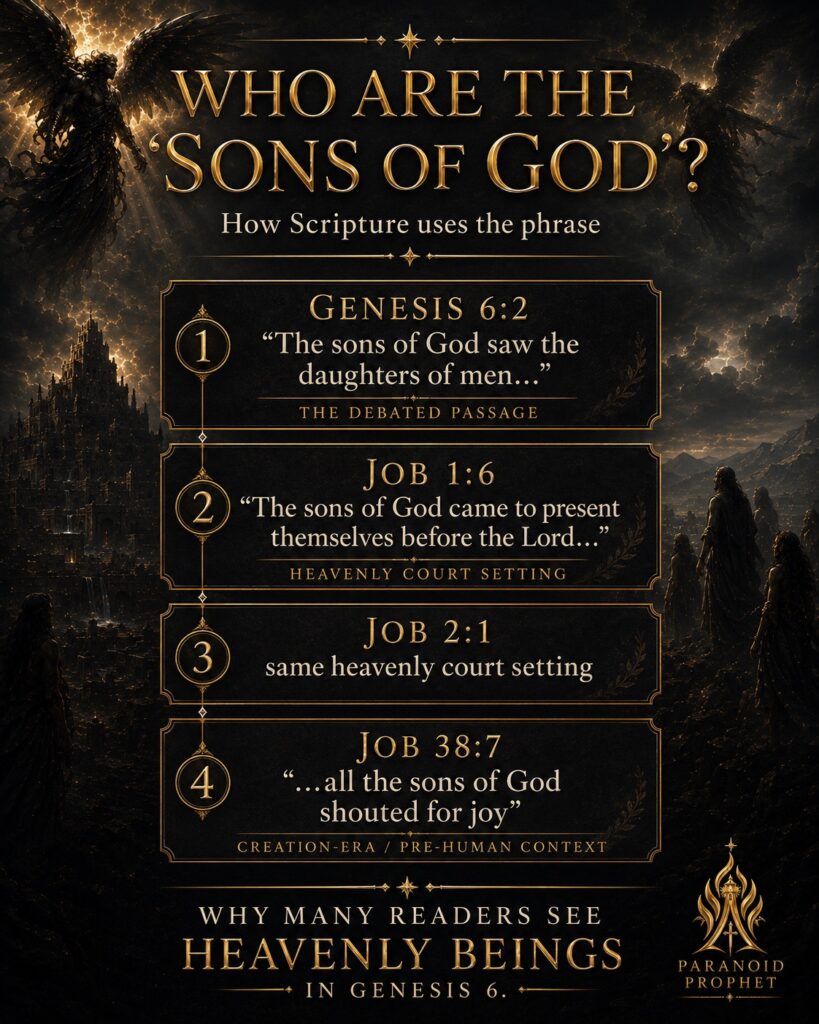
The Hebrew phrase commonly transliterated bene ha’elohim is usually translated “sons of God.” The phrase describes belonging to the heavenly realm or membership in God’s heavenly court. It does not mean these beings share God’s nature, possess divine equality, or are literal offspring of God in a pagan sense. They are created beings under his authority.
The closest biblical parallels appear in Job. In Job 1:6 and Job 2:1, the sons of God present themselves before the Lord. In Job 38:4–7, they shout for joy when God lays the earth’s foundations. Human beings are not yet present in that creation scene. The referents are heavenly beings.
These passages do not settle Genesis 6 by vocabulary alone. Words and phrases must be read in context. But when the same uncommon expression appears elsewhere in the Old Testament with a clear heavenly meaning, that usage deserves substantial weight. An interpretation that changes the phrase into “male descendants of Seth” or “human kings” carries the burden of showing why Genesis uses heavenly-court language without explaining the shift.
A Title of Realm and Accountability
Calling them sons of God identifies their realm; it does not excuse their conduct. Scripture regularly presents heavenly beings as powerful yet accountable creatures. Some serve faithfully. Others rebel and face judgment. Genesis 6 is disturbing precisely because beings associated with the heavenly order act against the order of their Creator.
The phrase therefore points upward without making the beings divine. They come from the unseen realm, but they remain under the rule of the God who made heaven and earth.
Who Were the Daughters of Men?
The daughters of men were human women. Genesis introduces them as daughters born while humankind multiplies. The expression is broad, not tribal: it does not name Cain’s line, a royal class, or a spiritually corrupt female population. They are the human counterpart to the heavenly sons.
This matters because one popular interpretation depends on turning “daughters of men” into “daughters of Cain.” Genesis never makes that identification. The preceding genealogies distinguish lines associated with Cain and Seth, but the opening of Genesis 6 speaks about humanity multiplying and daughters being born to them. The wording widens the frame rather than narrowing it to one clan.
What the Text Does and Does Not Tell Us
Genesis does not invite readers to blame the women for attracting forbidden attention. Nor does it describe them as seducers, teachers of evil, or the source of the transgression. Its narrative grammar focuses on the choice of the sons of God.
At the same time, a compressed ancient account cannot answer every modern question we might ask. The verb “took” can be used for ordinary marriage, though “any they chose” suggests an asymmetry of choice and power. We can say the sons of God initiate the union and violate a boundary. We cannot confidently narrate the inner will or circumstances of every woman involved.
That restraint is not evasive. It keeps moral emphasis where Genesis places it and protects the women from becoming either invented villains or props in an imagined scene.
The Three Major Interpretations
Jewish and Christian readers have offered several explanations of the passage, but three have dominated the discussion. Each notices something real in the text or its setting. The question is not which view feels safest to modern readers. The question is which view best accounts for the text.
The Sethite Interpretation
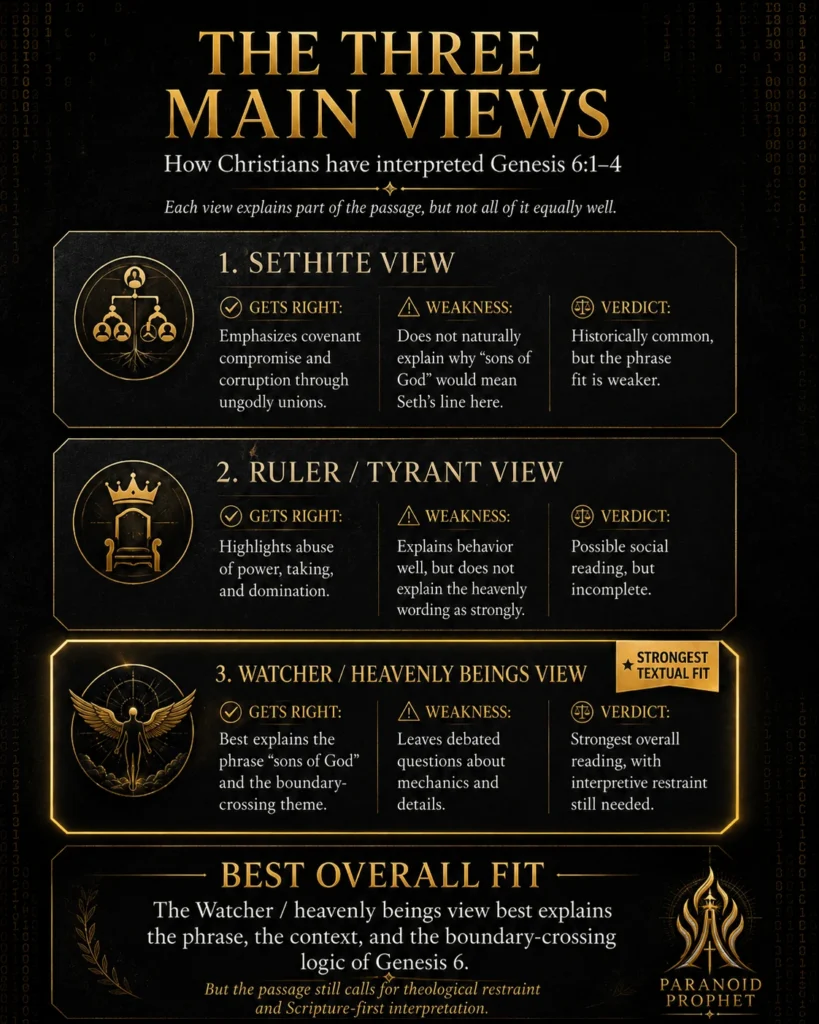
The Sethite view identifies the sons of God with the supposedly godly male descendants of Seth and the daughters of men with women from Cain’s line. The sin is covenant compromise: faithful men abandon separation from a corrupt line and marry according to appearance.
This interpretation has a serious Christian history and fits a genuine biblical theme. Genesis 4 and 5 do contrast two family lines, and Scripture repeatedly warns God’s people against marriages that lead them into idolatry. The view also avoids questions about how heavenly beings could enter physical unions.
Its weaknesses are textual. Genesis never calls Seth’s descendants “sons of God” here, never calls the women daughters of Cain, and never says the entire Sethite line was godly. By Genesis 6, human wickedness is widespread. Ordinary intermarriage also does not naturally explain why the episode is framed as extraordinary or why the Nephilim appear in the same notice.
The Royal or Tyrant Interpretation
The royal view understands the sons of God as kings, nobles, or warrior-rulers who claimed divine status. They gathered women into their households “whomever they chose,” displaying the same predatory power that later fills the earth with violence.
This reading takes the verbs of seeing and taking seriously. Ancient rulers could present themselves as sons or representatives of a deity, and the Bible often exposes kings who use power to seize people and property. The view also connects naturally with the later description of mighty men and renown.
Yet Genesis gives no title such as king, prince, judge, or ruler. The interpretation also moves away from the phrase’s closest Old Testament parallels, which are heavenly, and it leaves the later traditions about angels who sinned before the Flood only loosely connected to the passage.
The Heavenly-Being Interpretation
The heavenly-being view identifies the sons of God as members of the unseen realm who abandoned their proper order and took human women. The transgression is not merely a bad marriage alliance. It is a forbidden crossing between heavenly and human domains.
This view has the clearest lexical support from Job, preserves the contrast between heavenly sons and human daughters, explains the passage’s strange atmosphere, accounts for the Nephilim notice more naturally, and aligns with the oldest surviving Jewish interpretations of Genesis 6. Jude and 2 Peter also speak about sinning angels in ways that fit this interpretive world.
Its difficulty is obvious: the event is extraordinary, and Genesis does not explain its mechanism. But strangeness is not a reason to replace the passage’s categories with more familiar ones. The Bible contains heavenly beings, embodied appearances, rebellion in the unseen realm, and divine judgment against spiritual powers. The interpretation should be tested by the evidence, not dismissed because the event lies outside ordinary experience.
Why the Heavenly-Being Interpretation Is Strongest
No single clue needs to carry the whole case. The heavenly-being interpretation is strongest because multiple lines of evidence converge.
- The phrase: The closest Old Testament uses of “sons of God” refer to heavenly beings.
- The contrast: Heavenly sons are set against daughters born to humankind.
- The action: The sons initiate a union portrayed within an escalating crisis of violated order.
- The Nephilim notice: An unusual group appears in the same compressed episode, making an ordinary intermarriage reading less persuasive.
- The New Testament echoes: Jude and 2 Peter remember angels who sinned, abandoned proper order, and were held for judgment.
- The ancient reception: The heavenly interpretation is not a modern invention. It is prominent in Jewish literature from before the time of Christ.
The Nephilim Are Connected, but Not Identical
Genesis 6:4 places the Nephilim on the earth “in those days, and also afterward,” when the sons of God went to the daughters of men and children were born to them. The most natural reading connects the Nephilim with the union, and early Jewish interpreters understood them as its giant offspring.
Still, Genesis is grammatically compressed. It does not pause to explain the exact relationship, physical process, or meaning of every label. What can be said firmly is that the sons of God are the boundary-crossers, the daughters of men are human women, and the Nephilim belong to the same narrative event. The sons of God and the Nephilim are not the same group.
The identity of the Nephilim, the meaning of “men of renown,” and the difficult phrase “and also afterward” deserve their own investigation. Those questions continue in Who Were the Nephilim?.
Explanatory Power Matters
The Sethite view explains spiritual compromise. The royal view explains abusive power. Both themes fit the wider Bible, and both may illuminate the moral atmosphere of Genesis 6. But neither explains the particular wording and full cluster of evidence as well as the heavenly-being view.
A good interpretation should account for the details readers might otherwise have to explain away. The heavenly reading does that. It keeps the phrase’s biblical meaning, preserves the heaven-and-earth contrast, takes the extraordinary setting seriously, and makes sense of why ancient Jewish and New Testament writers could associate the pre-Flood world with angelic rebellion.
Jude, 2 Peter, and the Matthew 22 Objection
Angels Who Sinned
Jude 6–7 recalls angels who did not remain within their own position of authority but left their proper dwelling. God keeps them in bonds for judgment. Jude then places Sodom and Gomorrah beside them as another example of transgressive sexual pursuit and coming judgment.
Interpreters debate exactly how the comparison works and whether Jude is directly expounding Genesis 6. Even so, his language of angels abandoning their appointed domain fits the boundary violation described by the heavenly reading. It also reflects a world of interpretation familiar with the Book of the Watchers.
Second Peter 2:4–5 makes the chronological connection even more visible. Peter moves from angels who sinned and were committed to gloomy confinement to the ancient world and the Flood. The passage does not name Genesis 6, but sinning angels immediately before Noah form a striking sequence.
These New Testament texts should not be forced to provide details they do not state. They do, however, show that angelic rebellion and pre-Flood judgment belong together in early Christian thought. That supports the heavenly interpretation even though Genesis remains the primary text.
Does Jesus Say Angels Cannot Marry?
The most common objection comes from Matthew 22:23–33. Answering a Sadducee challenge about resurrection, Jesus says that those raised from the dead neither marry nor are given in marriage but are like angels in heaven.
Jesus is explaining resurrection life, not interpreting Genesis 6. His statement describes the ordered condition of “angels in heaven.” It establishes that marriage is not part of that heavenly order. The heavenly-being interpretation of Genesis 6 claims that rebellious beings violated their proper order; it does not claim that angelic marriage is normal or approved.
Matthew 22 therefore does not prove how the Genesis event occurred, and it should not be used to speculate about angelic biology. It simply does not rule out the interpretation. A statement about faithful heavenly order cannot by itself establish what rebellious beings are incapable of attempting when they abandon that order.
Other Major Objections
“Genesis blames human wickedness, not angels.” The chapter certainly condemns humanity. Genesis 6:5 turns directly to the evil of the human heart, and the Flood judges the violent world humans have filled. The presence of a heavenly rebellion in verses 1–4 does not remove human guilt. The chapter presents more than one dimension of created rebellion.
“Angels are spirits, so physical interaction is impossible.” Scripture calls angels spirits, yet it also portrays heavenly messengers appearing in embodied, tangible ways: they are seen, speak, eat, grasp hands, and are mistaken for ordinary men. Those appearances do not explain Genesis 6’s mechanism, but they caution against assuming that spiritual beings can never interact materially.
“The heavenly view depends on 1 Enoch.” It does not. The case begins with Genesis and the Old Testament use of the phrase. Enoch is evidence that ancient readers understood the passage this way and developed it into a larger narrative. Ancient reception strengthens the historical case; it does not create the doctrine.
From the Sons of God to the Watcher Tradition
Genesis calls the beings “sons of God.” It does not call them Watchers. That name comes from later ancient Jewish interpretation, especially the section of 1 Enoch commonly called the Book of the Watchers.
In the Book of Enoch, the brief Genesis episode becomes a much longer account. Watchers descend, bind themselves to a common plan, take human wives, produce giant offspring, transmit forbidden teachings, and await judgment. Other Second Temple texts also preserve versions of angelic descent and punishment.
This material matters for two reasons. First, it demonstrates that the heavenly interpretation is ancient, not a recent attempt to make Genesis sensational. Second, its language and themes help explain the interpretive environment behind Jude and 2 Peter.
But 1 Enoch is not Genesis with missing pages restored. It is an ancient interpretive development, and most Christian traditions do not receive it as Scripture. It may preserve early interpretation and old traditions, but it also adds names, speeches, locations, judgments, and story details beyond the biblical text. Those additions must be identified as Enochic tradition rather than quietly imported into Genesis.
Why “Watchers” Becomes the Next Question
Once the sons of God are identified as heavenly boundary-crossers, the next question is historical: why did ancient readers call them Watchers, and how did that tradition expand the four verses of Genesis?
That is the lane of The Watchers Explained, the principal next article in this series. The more specific question of their forbidden instruction belongs in What Did the Watchers Teach?. Keeping those topics in their own articles allows Genesis 6 to speak in its own voice before later tradition fills out the scene.
Why the Boundary Crossing Matters
Genesis 6:1–4 is not a license for endless speculation. It is a theological account of creatures refusing the limits of their Creator. Heavenly beings see what they desire, take what lies beyond their appointed order, and become part of a world moving toward corruption and judgment.
The passage is short, but the atmosphere is heavy. Something has gone wrong at the boundary between heaven and earth. Yet Genesis does not teach that evil has escaped God’s control. The Lord sets a limit, judges rebellion, preserves Noah, and continues the covenant story through which redemption will come.
Frequently Asked Questions
Who were the sons of God in Genesis 6?
The strongest interpretation identifies them as heavenly beings who crossed a forbidden boundary with human women. This reading best explains the phrase’s Old Testament parallels, the contrast with the daughters of men, the extraordinary context, the Nephilim notice, and the later angelic-judgment traditions.
Were the sons of God fallen angels?
They can reasonably be called rebellious or fallen heavenly beings because their conduct violates God’s order. Genesis itself calls them sons of God, not “fallen angels.” That later label describes their rebellion without replacing the wording of the passage.
Who were the daughters of men?
They were human women born as humanity multiplied. Genesis does not identify them specifically as Cainites or present them as the principal instigators. The sons of God perform the initiating actions, while the text leaves many questions about the women’s individual agency unstated.
Were the sons of God the Nephilim?
No. The sons of God are the heavenly beings who take the daughters of men. The Nephilim are a distinct group mentioned in connection with the episode and commonly understood as offspring associated with the union.
Does Matthew 22 disprove the heavenly-being view?
No. Jesus describes resurrection life and the ordered state of angels in heaven, where marriage does not occur. Genesis 6 describes rebellion against proper order. Matthew 22 does not explain the mechanism of Genesis 6, but it does not rule out rebellious heavenly beings violating the order Jesus described.
Does Genesis call these beings Watchers?
No. Genesis calls them sons of God. “Watchers” is a later ancient label used in 1 Enoch and related interpretive traditions. The distinction helps readers separate the biblical text from its ancient expansion.
Does Genesis 6 describe aliens or UAP?
No. Genesis uses biblical categories: God, heavenly beings, human women, the Nephilim, rebellion, and judgment. Translating those categories into extraterrestrials, non-human intelligence, or technology imports a modern theory the passage never states.
Sources and Further Reading
- Genesis 6:1–4; Job 1:6; 2:1; 38:4–7; Matthew 22:23–33; Jude 6–7; 2 Peter 2:4–5.
- Gordon J. Wenham, Genesis 1–15, Word Biblical Commentary.
- Victor P. Hamilton, The Book of Genesis, Chapters 1–17, New International Commentary on the Old Testament.
- Richard J. Bauckham, Jude, 2 Peter, Word Biblical Commentary.
- George W. E. Nickelsburg and James C. VanderKam, 1 Enoch: The Hermeneia Translation.
- Annette Yoshiko Reed, Fallen Angels and the History of Judaism and Christianity.
- Loren T. Stuckenbruck, The Myth of Rebellious Angels.
Read Next
- Principal next step: The Watchers Explained follows the heavenly interpretation into its ancient Jewish development.
- Who Were the Nephilim? examines the other mysterious group in Genesis 6:4.
- The Book of Enoch Explained separates the ancient text, its influence, and its authority from modern claims about it.
Christ Is Greater Than the Sons of God
The sons of God are not rival deities, and their rebellion never places history outside God’s command. They are creatures. Their power is limited, their disobedience is judged, and their story unfolds beneath the authority of the one true God.
The New Testament directs our attention beyond every rebellious power to Jesus Christ. Colossians 1:15–20 and 2:13–15 declares that all things in heaven and on earth, visible and invisible, were created through Christ and for Christ. At the cross, he disarmed the rulers and authorities and triumphed over them.
Christians do not need secret knowledge to stand secure. We need faithful Scripture, sober discernment, and allegiance to the risen Lord. If our study of the sons of God makes us more obsessed with hidden beings than with the Son of God, we have read the passage poorly. Faithful interpretation begins with the text and ends in submission to Christ.
CONTINUE THE INVESTIGATION
Next discernment study
The Watchers Explained: Fallen Angels, Enoch, Genesis 6, and Forbidden Knowledge
Compare the Genesis 6 sons-of-God question with the Watchers interpretation developed in later Jewish literature.