
GUIDED ARTICLE EXPERIENCE
Was Jesus a Madman? Why the Gospel Portrait Does Not Fit Delusion
Read along as the narration moves through the article.
Private device narration · No hosted audio or tracking
CONTINUE GUIDED TOUR
Continue where you left off.
GUIDED TOUR COMPLETE
You have reached the end of this study.
Study record saved on this device.
GUIDED TOUR
Was Jesus a Madman? Why the Gospel Portrait Does Not Fit Delusion
Narrator: Paranoid Prophet Recommended Voice Native device narration
Prepare to follow the article as it is narrated.
VOICE & TOUR OPTIONS
Voice & Listening
NARRATOR
Finding a narrator…
Checking the best narrator available on this device.
Restores the best curated narrator available on this device.
Narrator choices are curated for clear, long-form listening on this device.
Screen-awake support will be checked when narration starts.
CHOOSE A NARRATOR
Curated for this device
Choose a verified narrator for this browser, or use System Narrator. Automatic mode uses the best reliable route exposed by this device; your chosen narrator is preserved even if this device needs a temporary fallback.
Preparing the guided article experience…
RESUME GUIDED TOUR?
Continue where you left off.
GUIDED TOUR COMPLETE
You have reached the end of this study.
The question sounds offensive at first: was Jesus a madman?
It would be unnecessary if Jesus had presented Himself as one wise teacher among many. A teacher can offer useful advice, misunderstand part of his subject, or leave behind a few sayings worth remembering. But Jesus did not ask to be placed beside other religious guides and admired from a safe distance.
He forgave sins. He claimed authority over the Sabbath. He called people to follow Him above every earthly loyalty. He spoke of judgment, eternal life, and the kingdom of God. He identified Himself with the Son of Man who receives everlasting dominion. He taught that the way to the Father runs through Him. After the resurrection, Thomas confessed Him as “My Lord and my God.”
Claims that high cannot be treated as harmless religious advice.
That is why the old liar, lunatic, or Lord question continues to matter, even though the word lunatic should be handled with care. Mental illness is not an insult, and human suffering should never become apologetic ammunition. The serious question is whether Jesus could have been sincere but deeply mistaken about Himself. Was He self-deceived? Had He lost touch with reality? Or do the Gospels present extraordinary claims joined to holiness, truth, obedience, and self-giving authority?
This article belongs within the larger case explored in Was Jesus a Liar, Lunatic, Legend, or Lord?. That article considers several explanations of Jesus. This one examines a narrower objection: perhaps Jesus meant what He said but was tragically wrong about who He was.
The controlling question is not whether Jesus seemed unusual. Anyone who confronted religious hypocrisy, announced God’s kingdom, and challenged the powerful would have appeared disruptive. The issue is whether self-deception explains the whole Gospel witness: His claims, moral vision, emotional honesty, conduct under pressure, willing death, and the proclamation that God raised Him from the dead.
The argument begins with sanity, but it will not end there. If the accusation fails, Jesus does not return to the category of respectable moral teacher. His identity still demands an answer.
Article Guide8 sections
What We Can and Cannot Prove
We cannot perform a modern clinical evaluation of Jesus. We do not possess a medical history, private interview, psychological examination, or controlled observation. Any claim that Jesus can be medically “proven sane” from ancient documents promises more than historical evidence can deliver.
That limitation does not make the question meaningless. The claim that Jesus was delusional is itself an attempted explanation of the evidence. Like every explanation, it can be tested for scope and coherence. Does it account for only a few isolated sayings, or does it explain the complete narrative? Does it illuminate Jesus’ character, or must it ignore much of what the Gospels preserve?
The responsible question is not, “Can we diagnose Jesus across two thousand years?” We cannot. The better question is, “Does the sincerely mistaken explanation account for the Jesus presented in the Gospel witness?”

That theory must reckon with more than His highest claims. It must also account for His command of Scripture, insight into human motives, compassion toward sinners, severity toward hypocrisy, anguish in Gethsemane, composure before Pilate, and refusal to use authority for comfort or escape.
Jesus must also be read in His own historical and biblical world. He was a first-century Jewish man speaking within Israel’s Scriptures, covenant promises, temple worship, resurrection hope, expectation of judgment, and longing for God’s kingdom. Modern readers may find parts of that world unfamiliar. Unfamiliarity, however, is not evidence of irrationality.
Some older attempts to portray Jesus as paranoid, delusional, or consumed by grandiosity failed at this point. They measured His words against modern assumptions while neglecting the Jewish and scriptural setting in which He spoke. A Christian response should not repeat the same error in reverse. We should not answer reckless diagnosis with reckless counter-diagnosis.
This article will take a more disciplined path. Scripture provides the final authority for who Jesus is. Historical context and scholarship can clarify difficult questions, expose anachronisms, and help us read disputed passages more carefully. They cannot replace the biblical verdict. For more on that distinction, see Sources and Verification.
Did People Say Jesus Was “Out of His Mind”?
The Gospel of Mark does not hide the accusation.
In Mark 3:20–35, Jesus enters a house and a crowd gathers so tightly that He and His disciples cannot even eat. Mark then reports that those close to Jesus went out to restrain Him, “for they were saying, ‘He is out of his mind.’”
The Greek wording has generated debate over who “those from Him” were, who was making the statement, and how the expression translated “He is out of His mind” should be understood. Some interpreters attribute the words directly to Jesus’ family. Others allow that Mark may be reporting what was being said about Him more broadly. Either way, Mark preserves the accusation rather than concealing it.
But an accusation is not the same thing as an explanation.
Mark does not present a calm medical assessment. He presents a scene of conflict, crowd pressure, and competing attempts to explain Jesus’ authority. Immediately afterward, scribes from Jerusalem offer another interpretation. They claim that Jesus casts out demons through the ruler of demons.
Some respond with alarm. The scribes respond with hostility. The crowds press toward Jesus because of what they have heard and seen. Each group is trying to account for a ministry that refuses to fit ordinary categories.
Jesus answers the scribes with controlled reasoning. If Satan is casting out Satan, then his kingdom is divided and cannot stand. Jesus then explains His authority through the image of entering a strong man’s house and binding him before plundering his goods. Whatever one concludes about His identity, Mark does not portray Him as unable to follow an argument or distinguish reality from fantasy.
The larger scene reinforces that point. Jesus speaks about kingdom, spiritual conflict, blasphemy, obedience, and the family of God. When His mother and brothers arrive, He uses the moment to teach that whoever does the will of God belongs to His true family.
Mark 3 therefore matters greatly, but not because it settles the case against Jesus. It shows that He was misunderstood, even by people close to Him, and that His ministry created alarm and controversy. It does not show His mind collapsing under examination.
Jesus could be misunderstood and opposed—even by those nearest to Him—without their concern becoming proof that He was delusional. The real question is whether the accusation explains what follows. Mark records the charge; the rest of the Gospel allows readers to test it.
Why the Question Matters
The question matters because Jesus cannot be reduced to safe moral advice.
If He had taught only kindness, generosity, and forgiveness, readers could separate the teaching from the teacher and preserve whichever sayings they preferred. But Jesus placed Himself at the center of forgiveness, discipleship, judgment, revelation, and God’s kingdom. His identity is woven into His message.
A merely human teacher who falsely believes that He possesses authority to forgive sins or reveal the Father is not mistaken about a peripheral detail. He is mistaken about the center of His mission. That is why the sincerely mistaken explanation must be examined rather than brushed aside.
Yet the theory must explain the whole Jesus: compassion without sentimentality, holiness without self-righteousness, authority without exploitation, grief without despair, courage without violence, and obedience when obedience leads to death.
The New Testament does not present Jesus as merely ordinary, and this article will not defend Him by pretending that it does. Scripture presents Him as the Son who reveals the Father, the servant who gives His life, the King whose dominion will not pass away, and the risen Lord who calls the world to repent and believe.
Before examining His character under pressure, we must first face the claims that made neutrality impossible.
What Claims Made the Question Unavoidable?
The Gospels do not separate Jesus’ message from His identity. He places His own authority at the center of forgiveness, sacred law, truth, life, judgment, and God’s kingdom. His call to discipleship demands more than agreement with His teaching. It demands allegiance to Him.
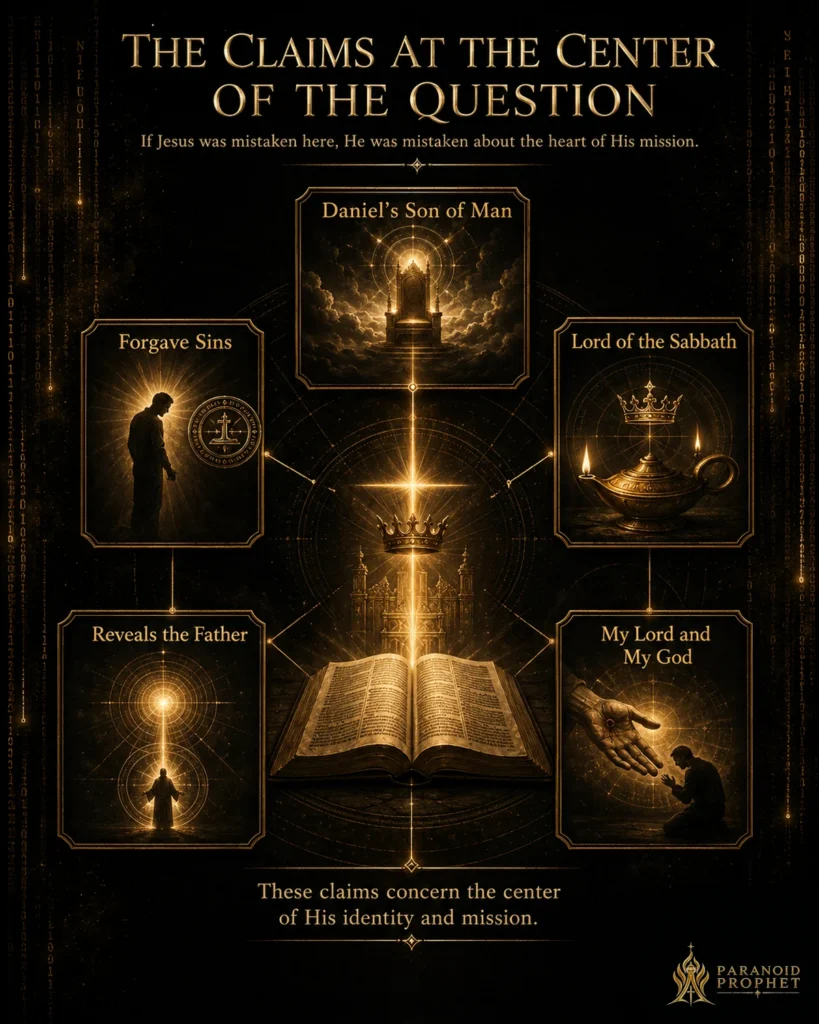
That is why the sincerely mistaken explanation must address specific claims rather than dismissing Jesus as merely intense or unconventional. Jesus forgives sins, claims lordship over the Sabbath, identifies Himself with Daniel’s Son of Man, speaks as the Son who reveals the Father, and receives Thomas’s confession after rising from the dead.
These claims do not settle every question by themselves. They establish what is at stake—and form part of the wider biblical case that Jesus is the Son of God.
Jesus Forgave Sins
In Mark 2:1–12, several men bring a paralyzed friend to Jesus. Unable to reach Him through the crowded doorway, they open the roof and lower the man into the house.
The visible need is obvious. The man cannot walk. Yet Jesus first addresses something no one in the room can see. He tells him, “Son, your sins are forgiven.”
The scribes immediately recognize the seriousness of those words. They reason that Jesus is blaspheming because God alone can forgive sins. Their objection shows how they understood the moment. Jesus is not merely encouraging the man to trust that God may show mercy. He speaks forgiveness over him with direct authority.
Jesus then makes the claim public. He asks whether it is easier to declare forgiveness or command the paralytic to rise. The first claim concerns an invisible reality and cannot be immediately tested by those watching. The second can. Jesus heals the man so that the witnesses may know that “the Son of Man has authority on earth to forgive sins.”
The miracle does more than display compassion. Within the narrative, it confirms the authority Jesus has just claimed.
Jesus therefore joins forgiveness to His own authority as the Son of Man. A mistake here would not concern a minor point of interpretation. It would reach the center of His identity and mission. Mark presents the scene differently: the One who commands the paralyzed man to rise also possesses authority to forgive sins.
Jesus Claimed Authority Over the Sabbath
The Sabbath was not an optional custom on the edge of Israel’s religious life. It was rooted in creation, commanded in the covenant, and woven into Israel’s worship and identity.
Teachers could debate how Sabbath obedience should be practiced. Prophets could condemn people who honored sacred days outwardly while their hearts remained corrupt. Jesus goes further.
When His disciples are criticized for plucking grain on the Sabbath, Jesus answers from Scripture. He recalls how David entered the house of God and ate the bread of the Presence when he and his companions were in need. He then explains that the Sabbath was made for man, not man for the Sabbath.
The argument reaches its height in Mark 2:28: “The Son of Man is lord even of the Sabbath.”
A teacher can explain the Sabbath. Jesus claims lordship over it.
He is not discarding God’s command or replacing holiness with convenience. He speaks with authority concerning the Sabbath’s purpose and proper use. The institution does not stand above Him as though He were one more interpreter trying to locate its boundaries. He identifies Himself as its Lord.
That claim cannot be reduced to a general lesson about rest or compassion. Jesus places His authority within one of the most sacred features of Israel’s covenant life. The dispute concerns more than rabbinic interpretation; it raises the question of divine prerogative.
Jesus Identified Himself with Daniel’s Son of Man
“Son of Man” can sound like the least exalted title Jesus used. It may appear to be a simple way of emphasizing His humanity.
But the title sounds low until Daniel 7 opens behind it.
Daniel sees one like a son of man coming with the clouds of heaven and approaching the Ancient of Days. He receives dominion, glory, and a kingdom. Peoples, nations, and languages serve Him. His dominion is everlasting, and His kingdom will never be destroyed.
That vision gives the title a horizon far larger than a modest reference to humanity. The Son of Man is human in appearance, yet He comes with the clouds and receives universal, everlasting rule from God.
Jesus repeatedly joins this title to His authority and mission. The Son of Man forgives sins. He is Lord of the Sabbath. He must suffer, be rejected, die, and rise. Later, when questioned by the high priest, Jesus brings together Daniel’s cloud-coming figure and the one seated at the right hand of Power in Mark 14:61–64.
The title holds humiliation and exaltation together. The One who receives Daniel’s kingdom first walks the road of suffering. His authority does not prevent the cross; it gives the cross its place within His mission.
Jesus does more than explain Israel’s hope. He places Himself within its fulfillment.
Jesus Spoke as the Son Who Reveals the Father
The Gospel of John expresses with concentrated clarity what the larger Gospel witness has already begun to show: Jesus does not simply tell people truths about God. He presents Himself as the Son through whom the Father is known.
In John 14:6–9, Thomas asks how the disciples can know the way. Jesus does not answer by offering a technique, a hidden ritual, or an impersonal spiritual principle. He points to Himself: “I am the way, and the truth, and the life.” No one comes to the Father except through Him.
When Philip asks Jesus to show them the Father, Jesus answers, “Whoever has seen me has seen the Father.”
Jesus is not claiming to be the same person as the Father. The discourse distinguishes the Father and the Son. Yet it also presents a unique union and revelation: the Son perfectly makes the Father known, speaks the Father’s words, and performs the Father’s works.
That theological precision matters. Jesus is not one religious messenger standing at a distance from God and offering partial information. He claims an exclusive role in bringing people to the Father because He uniquely reveals the Father.
He does not simply say that He knows the way. He is the way. He does not claim only to teach truth. He is the truth. He does not point toward life as a gift available independently of Him. He is the life.
A mistake here would concern Jesus’ relationship to God and His place in human salvation, not a secondary point of interpretation. John presents these words as revelation: the Son making the Father known.
Thomas Confessed Jesus as “My Lord and My God”
The question reaches its sharpest point after the resurrection.
Thomas was absent when the risen Jesus first appeared to the other disciples. He refused to accept their testimony without seeing the wounds for himself. His response is not presented as easy credulity. He wants direct evidence that the One standing before them is the same Jesus who was crucified.
Eight days later, Jesus appears again. He invites Thomas to examine His hands and side and calls him to stop disbelieving and believe.
Thomas responds directly to Jesus in John 20:28: “My Lord and my God.”
Jesus does not reject the confession, correct Thomas, or redirect the words toward the Father. He answers Thomas by speaking about his belief and then blesses those who will believe without having seen.
That moment does not carry the entire case for Jesus’ deity or resurrection by itself. It does show where John’s Gospel leads. The wounded and risen Jesus is addressed as Lord and God, and the confession is received within the narrative as faith.
Jesus’ identity has not diminished after the cross. His wounds remain visible, but defeat does not have the final word. Thomas stands before the crucified and risen Christ and confesses who He is.
Why These Claims Cannot Be Treated as Harmless
The issue is now unavoidable. Jesus’ claims concern forgiveness, sacred law, everlasting dominion, access to the Father, and divine identity. They are too central to be detached from His moral teaching as though His ethics can be preserved while His self-understanding is ignored.
A merely sincere Jesus would not solve the problem. Sincerity can explain why someone continues to speak; it cannot make a false claim true. If He was only human and wrong about these claims, then He was mistaken about the heart of His mission.
Yet extraordinary claims should not be rejected simply because they are extraordinary. They require examination. Do they stand alone as grand assertions, or do they belong to a life marked by moral clarity, emotional honesty, obedience, courage, and self-giving love?
The claims force the question. The character of the One who made them will test the accusation.
Does the Gospel Portrait Fit Delusion?
Jesus’ words belong to a sustained pattern of teaching, relationships, choices, prayer, suffering, and obedience. Across controversy, grief, arrest, and trial, the Gospels preserve a coherent portrait. Any explanation of Jesus must account for that whole witness, not only for the sayings that sound most startling to modern ears.
The sincerely mistaken theory therefore faces a difficult combination. Jesus speaks with immense authority, yet the same narratives portray searching moral insight, emotional honesty, disciplined obedience, and concern for others rather than self-protection. Character does not settle every historical or theological question by itself. It does test whether self-deception adequately explains the evidence.

Jesus Saw the Human Heart with Moral Clarity
Jesus’ teaching does not remain on the surface of religious conduct. He repeatedly moves beneath outward behavior to expose the desires, loyalties, and motives that shape it.
In the Sermon on the Mount, anger is treated as morally serious before it reaches murder. Lust reveals corruption before it becomes adultery. Giving, prayer, and fasting can appear righteous while being driven by the desire for public approval. Wealth can become a rival master. Judgment becomes hypocritical when people condemn faults in others while refusing to confront their own sin.
Jesus does not make morality easier by reducing it to good intentions. He deepens it. His commands reach speech, desire, secrecy, money, enemies, anxiety, mercy, and worship. He sees how respectable religion can conceal pride and how outward obedience can coexist with an unchanged heart.
That is not moral fog. That is moral precision.
His severity is joined to compassion. Jesus welcomes sinners without redefining sin as harmless. He shows mercy to the shamed and excluded while confronting those who use religion to exalt themselves. He blesses the meek, the merciful, the pure in heart, and those who hunger for righteousness. He commands love for enemies because the children of the Father are called to reflect the Father’s generosity.
Yet His moral vision never bends toward convenience. Jesus does not excuse the powerful, flatter the crowd, or reshape holiness around His own comfort. His teaching exposes self-deception while directing people toward truth, repentance, mercy, and faithfulness before God.
None of this medically proves that Jesus was sane, nor does profound moral teaching by itself establish deity. The narrower conclusion still matters: the Gospel narratives do not preserve scattered flashes of wisdom buried inside ethical confusion. They present a moral vision of unusual depth and consistency.
Jesus Was Emotionally Honest Without Losing Obedience
A careless defense of Jesus might portray Him as untouched by grief, sorrow, anger, or anguish. Scripture does not defend Him that way.
Jesus weeps. He has compassion on suffering people. He grieves over unbelief and death. Hardened hearts provoke His anger. The approach of the cross brings real distress. The New Testament does not present holiness as emotional numbness.
Gethsemane brings this into sharp focus. Jesus tells His disciples that His soul is deeply sorrowful, even to death. He falls before the Father and asks whether the cup may pass from Him. The scene never pretends that crucifixion is light or painless.
Yet His prayer does not end in flight from the Father’s will. Jesus submits Himself: “Not as I will, but as you will.” He returns to prayer and continues toward the arrest He knows is coming.
It is agony governed by obedience.
That distinction protects the full biblical portrait of Christ. The eternal Son truly entered human weakness, sorrow, and suffering without sin. His distress is not theatrical, and His obedience is not mechanical. Gethsemane reveals the cost of the mission precisely because His anguish is real.
The scene also shows that Jesus understands what is happening. He recognizes the danger, names His sorrow, seeks the Father in prayer, and asks His disciples to remain with Him. He does not mistake torture and death for worldly success.
Jesus faces the horror ahead without allowing that horror to overturn His trust in the Father. His emotions disclose the weight of obedience; they do not erase it.
Pressure Revealed Coherence, Not Collapse
The final hours before the crucifixion place Jesus’ identity and mission under maximum pressure. He is betrayed, arrested, abandoned, accused, and handed to Roman authority. The passion narratives are where any dependence on admiration, safety, or control would be exposed.
Instead, the evangelists portray continuity between what Jesus taught publicly and how He acts when the cost becomes unavoidable.
In John 18:33–38, Pilate asks whether Jesus is the King of the Jews. Jesus answers without flattery or retreat. He explains that His kingdom is not from this world and that He came to bear witness to the truth.
His words do not make God’s kingdom irrelevant to the world. They identify its source and character. Jesus’ rule is not produced by Roman permission or advanced through worldly domination. Had His kingdom been of that order, His servants would have fought to prevent His arrest.
Standing before the governor who possesses earthly authority to release or condemn Him, Jesus remains faithful to the mission He has already declared. He clarifies His kingship, bears witness to truth, and refuses to turn His followers into instruments of retaliation.
Pressure did not expose incoherence in Jesus. It revealed obedience.
This composure should not be confused with emotional detachment. The sorrowful Son in Gethsemane is the same truthful King before Pilate. His anguish and resolve belong to one mission. Suffering is near, yet He does not invent a new message when the old one becomes costly.
The narrative shows no retreat into violence, denial, or opportunistic revision. Jesus remains truthful when truth provides no earthly advantage and obedient when obedience leads toward death.
His Authority Was Self-Giving, Not Self-Serving
Jesus’ use of authority creates another difficulty for the theory that His claims arose from self-exalting fantasy. The Gospels repeatedly show His authority moving toward the needs of others.
He receives people who interrupt Him, touches those regarded as unclean, welcomes children, eats with sinners, restores the excluded, and confronts those secure in religious status. His ministry is not organized around luxury, spectacle, political control, or insulation from suffering.
His instruction to the disciples makes the pattern explicit. When they argue about status, Jesus overturns their assumptions about greatness.
In Mark 10:42–45, Jesus contrasts Gentile rulers who “lord it over” others with leadership in His kingdom. Whoever would be great must become a servant. He then interprets His own mission: “For even the Son of Man came not to be served but to serve, and to give his life as a ransom for many.”
False glory protects the self. Jesus’ glory gives Himself away.
The Danielic Son of Man possesses everlasting dominion, yet Jesus describes His path through service and ransom. Majesty and humility are not competing identities in the Gospel narratives. The King serves. The Shepherd lays down His life. The Son obeys the Father. Divine authority is revealed through holy, self-giving love.
Jesus speaks openly about His identity and glory. The striking feature is how that glory is expressed. He does not use others as sacrifices for His comfort. He gives Himself for others.
The self-deception explanation must therefore account for more than exalted language. It must explain why Jesus’ authority remains joined to mercy, courage, truth, and sacrifice when another path might have preserved His safety.
Character has tested the accusation. One stronger alternative remains: perhaps Jesus was an apocalyptic prophet whose expectations overtook Him. That theory must finally be tested where His mission reaches its darkest hour—the cross.
The Strongest Alternative Explanation
The strongest remaining explanation is not that Jesus was crudely irrational, but that He was a sincere Jewish prophet whose kingdom expectations became centered on Himself and outran reality.
This theory deserves more attention than a careless label. It places Jesus within the religious world of first-century Judaism and recognizes that His message included judgment, restoration, resurrection, fulfillment, and the reign of God. Those features belong to the heart of His preaching.
The issue is whether that historical category explains Jesus or merely describes part of His setting.
Was Jesus an Apocalyptic Prophet Who Got Carried Away?
Jesus announced the kingdom of God, called people to repent, warned of judgment, and spoke of resurrection, the coming Son of Man, and the fulfillment of Israel’s Scriptures.
A faithful Christian answer should admit all of this plainly. Jesus was not a modern teacher offering detached principles for personal improvement. He proclaimed that God’s reign was breaking into history and demanded a response.
Yet the kingdom message never appears as an expectation gradually escaping His control. From the beginning, it is joined to holiness, mercy, discipleship, conflict, suffering, and redemption. Jesus tells His followers to take up the cross, lose their lives for His sake, serve rather than dominate, and remain faithful under opposition.
His own path follows the same pattern. In Mark 8:31, Jesus teaches that the Son of Man must suffer, be rejected, be killed, and rise after three days. As He approaches Jerusalem, He speaks with increasing directness about betrayal, condemnation, mockery, death, and resurrection.
Those predictions do not independently prove every Christian claim. They show how the evangelists understand Jesus’ mission. His suffering is not introduced as an emergency correction to a failed kingdom program. It belongs to the path He teaches His disciples to expect.
The apocalyptic-prophet category can illuminate Jesus’ Jewish setting, but it cannot exhaust His identity. Jesus speaks as the Son of Man through whom forgiveness, judgment, suffering, kingdom, and final vindication converge.
His expectation of God’s reign also intensifies present obedience. Jesus remains alert to hypocrisy, exploitation, pride, mercy, prayer, money, violence, and faithfulness. The coming kingdom does not make this life morally irrelevant. It calls people to live before God in truth.
If false expectations overtook Jesus, the cross should expose the failure. If suffering belonged to the mission He knowingly embraced, the cross must be read differently.
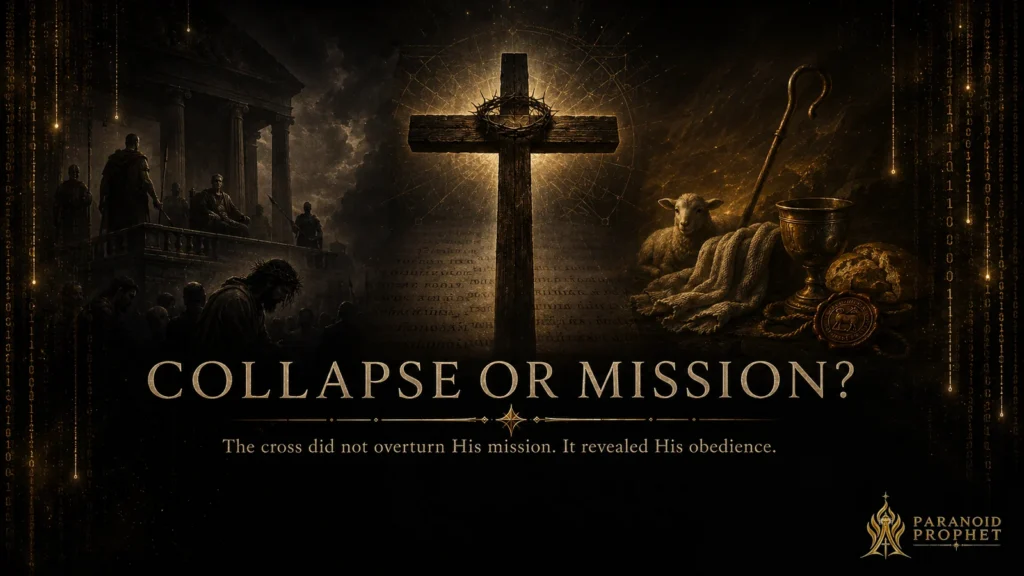
Does the Cross Look Like Collapse or Mission?
Crucifixion appears, at first glance, to destroy Jesus’ claims. Rome executes Him. His disciples scatter. His enemies mock His kingship. The One who announced God’s kingdom hangs beneath a Roman charge identifying Him as King of the Jews.
For a mission built on earthly success, admiration, or political control, the cross would be catastrophic. That is not how Jesus interprets His death.
He had already taught that the Son of Man came to serve and give His life as a ransom for many. In Mark 14:22–25, He connects His blood with the covenant. In John 10:11–18, He identifies Himself as the Good Shepherd who lays down His life for the sheep.
The cross is not where Jesus’ identity falls apart. It is where His obedience is displayed.
That does not make crucifixion less brutal. Jesus is betrayed, abandoned, mocked, beaten, and executed under Roman authority. Christianity begins with the public death of Jesus, not with an uplifting metaphor detached from history.
For the broader historical context, see Historical Evidence for Jesus: Why Jesus Was Not a Myth or Legend. The narrower issue here is how the Gospel narratives interpret His death.
Jesus continues toward the mission He has described. He refuses to establish His kingdom through the sword, remains obedient to the Father, and gives His life within the pattern of service, covenant, sacrifice, and Scripture.
After the resurrection, Luke presents Jesus explaining that the Christ had to suffer before entering His glory. In Luke 24:25–27, He interprets that pattern through Moses and the Prophets. Within the biblical story, messianic suffering and glory belong together.
Sincerity alone would not make Jesus’ claims true. People can die for beliefs that are false. The Christian case rests on more than His willingness to suffer. The decisive question is whether death had the final word.
The Resurrection Changes the Verdict
If Jesus remained in the grave, the sincerely mistaken explanation would remain possible.
He might still be remembered as courageous, morally profound, tragically misunderstood, or sincerely convinced of a mission that ended at the cross. His followers could preserve His teaching and honor His sacrifice. His highest claims, however, would remain beneath the shadow of death.
The New Testament proclaims a different ending.

In 1 Corinthians 15:3–8, Paul reminds the Corinthians of what he had received and delivered as of first importance: Christ died for sins according to the Scriptures, was buried, was raised on the third day, and appeared to witnesses. He names Cephas, the Twelve, more than five hundred believers, James, all the apostles, and finally himself.
Resurrection is not a decorative ending attached to Jesus’ ethical teaching. Death, burial, resurrection, and appearances stand at the center of the gospel Paul proclaims.
Care is still required. History can investigate how early the resurrection proclamation appeared, what the sources report, whom they name, and how proposed alternatives account for the evidence. Historical inquiry cannot place the risen Christ in a laboratory or define His identity independently of revelation.
Scripture gives the event its meaning. The resurrection is not a clinical test of Jesus’ mental state. It is God’s vindication of the Son.
Paul expresses this in Romans 1:3–4. The gospel concerns God’s Son, descended from David according to the flesh and declared to be the Son of God in power through His resurrection from the dead. Resurrection does not transform a merely human Jesus into the Son. Paul has already called Him the Son. God reveals and vindicates Him in power.
The Man condemned by earthly authorities is raised by God. The One mocked as king is proclaimed as Lord. His wounds remain part of His identity, but the tomb does not define His end.
If the New Testament witness is true, the sincerely mistaken theory cannot survive the resurrection. A mistaken teacher may inspire followers. A failed prophet may leave behind a movement. Neither explanation accounts for God raising and vindicating the crucified Son.
The argument has moved beyond the original accusation. The question began with whether Jesus had lost touch with reality. The New Testament answers by proclaiming that the crucified Jesus was raised from the dead and revealed as the Son of God in power—Jesus Christ our Lord.
Sources and Further Reading
Scripture is the final authority for who Jesus is. Historical study and scholarship can clarify language, context, early proclamation, and competing explanations. They cannot replace the biblical verdict that Jesus is the holy Son of God, crucified Savior, risen Lord, and coming King.
Primary Scripture Passages
- Mark 3:20–35 — the “out of His mind” accusation, competing explanations, and Jesus’ response.
- Mark 2:1–12 — Jesus declares forgiveness and demonstrates the Son of Man’s authority.
- Mark 2:23–28 — the Son of Man is Lord of the Sabbath.
- Daniel 7:13–14 — the Son of Man receives everlasting dominion.
- John 14:6–9 — the Son reveals the Father and is the way, truth, and life.
- John 20:24–29 — Thomas confesses the risen Jesus as Lord and God.
- Matthew 5–7 — Jesus’ teaching about the heart, holiness, mercy, and life before God.
- Matthew 26:36–46 — real anguish joined to obedience in Gethsemane.
- Mark 10:42–45 — greatness through service and the Son of Man’s life given as a ransom.
- 1 Corinthians 15:3–8 — the received proclamation of death, burial, resurrection, and appearances.
- Romans 1:3–4 — the Son vindicated in power through resurrection.
Related Paranoid Prophet Articles
- Was Jesus a Liar, Lunatic, Legend, or Lord? — the wider identity argument and parent article for this study.
- Is Jesus the Son of God? — the central hub connecting history, prophecy, crucifixion, resurrection, and Scripture.
- Was Jesus a Liar? — a focused examination of deliberate deception as an explanation of Jesus.
- Historical Evidence for Jesus — evidence that Jesus was a real historical person rather than a myth or late invention.
- Martyrdom of Jesus’s Disciples — the apostles’ resurrection witness, persecution, and traditions about their deaths.
- Sources and Verification — how Paranoid Prophet weighs Scripture, history, scholarship, disputed claims, and corrections.
Historical and Scholarly Context
These sources provide context and further study. They do not outrank Scripture or settle Jesus’ identity by themselves.
- Larry Hurtado, “Jesus’ Mental Health: Schweitzer’s Classic Work” — historical caution concerning attempts to diagnose Jesus through modern psychiatric assumptions.
- Henry Wansbrough, “Mark III. 21—Was Jesus Out of His Mind?” — discussion of the difficult wording and interpretation of Mark 3:21.
- Drew S. Holland, “The Meaning of Ἐξέστη in Mark 3:21” — examination of the Greek expression often translated “He is out of His mind.”
- C. S. Lewis, Mere Christianity — classic background for the liar, lunatic, or Lord formulation.
- N. T. Wright, The Resurrection of the Son of God — a major study of Jewish resurrection belief and early Christian proclamation.
- Dale C. Allison Jr., The Resurrection of Jesus: Apologetics, Polemics, History — a careful discussion of resurrection evidence, method, and competing explanations.
Frequently Asked Questions
Was Jesus a madman?
No. This is not a modern clinical diagnosis. It is the conclusion that the accusation fails to account for the New Testament presentation of Jesus. His extraordinary claims are joined to moral clarity, emotional honesty, obedience, self-giving authority, and a deliberate movement toward the cross.
Was Jesus delusional?
The Gospels portray Jesus understanding opposition, recognizing suffering, naming His anguish, answering His accusers, and remaining coherent when His mission becomes costly. Character alone does not establish deity, but this sustained portrait creates serious difficulties for the self-deception theory.
Did Jesus’ family think He was out of His mind?
Mark 3:21 records the accusation and says that those close to Jesus went out to restrain Him. The Greek wording has generated debate over who was speaking and how the expression should be understood. Mark preserves the charge, but the surrounding narrative presents competing explanations and records Jesus’ reasoned response.
Was Jesus only an apocalyptic prophet?
Jesus was a Jewish teacher and prophet who proclaimed God’s kingdom, repentance, judgment, fulfillment, and resurrection. Yet that category does not exhaust the Gospel presentation. Jesus places Himself at the center of forgiveness, the Sabbath, the Son of Man’s kingdom, access to the Father, suffering, and final vindication.
Does the resurrection prove Jesus was not delusional?
The resurrection is not a clinical test of sanity. Scripture presents it as God’s vindication of the Son. Historical inquiry can study the early proclamation, sources, named individuals, reported groups, and proposed alternatives. Scripture gives the event its full meaning: the crucified Jesus is the risen Lord.
Can we clinically prove Jesus was sane?
No. The available evidence cannot support a modern psychological evaluation. What can be tested is the accusation’s explanatory power. Any alternative must account for the whole New Testament presentation rather than isolating a few extraordinary sayings from Jesus’ character, mission, death, and resurrection proclamation.
Where should I study next?
Begin with Was Jesus a Liar, Lunatic, Legend, or Lord? for the wider identity argument. Then continue to Is Jesus the Son of God?, the central hub connecting the historical reality of Jesus with prophecy, crucifixion, resurrection, divine identity, and Scripture’s final verdict.

The Final Verdict: Jesus Is Lord
The question began with an accusation: perhaps Jesus was sincere but tragically wrong about Himself. That explanation has now been tested against His claims, treatment of Scripture, moral vision, anguish in Gethsemane, composure under pressure, self-giving authority, willing path to the cross, and the proclamation that God raised Him from the dead.
The Gospel narratives do not present a confused teacher disappearing inside His own claims. They present the holy Son who reveals the Father, confronts sin without cruelty, gives mercy without denying truth, serves without surrendering His authority, and obeys even when obedience leads to death.
Scripture’s verdict is higher than sanity. Jesus is Lord: the Word made flesh, the promised Son of Man, the servant who gives His life as a ransom, the Lamb who bears sin, the risen Christ, and the King whose dominion will never pass away.
He is not a psychological curiosity to be examined from a safe distance. He is the crucified and risen Savior who calls sinners to repent, believe, worship, and follow Him.
CONTINUE THE INVESTIGATION
Return to the central case
Was Jesus a Liar, Lunatic, Legend, or Lord? The Identity of Christ
Return from the focused delusion objection to the broader identity synthesis.