
GUIDED ARTICLE EXPERIENCE
Prophecies of Jesus’ Betrayal and Rejection | Fulfilled Verses
Read along as the narration moves through the article.
Private device narration · No hosted audio or tracking
CONTINUE GUIDED TOUR
Continue where you left off.
GUIDED TOUR COMPLETE
You have reached the end of this study.
Study record saved on this device.
GUIDED TOUR
Prophecies of Jesus’ Betrayal and Rejection | Fulfilled Verses
Narrator: Paranoid Prophet Recommended Voice Native device narration
Prepare to follow the article as it is narrated.
VOICE & TOUR OPTIONS
Voice & Listening
NARRATOR
Finding a narrator…
Checking the best narrator available on this device.
Restores the best curated narrator available on this device.
Narrator choices are curated for clear, long-form listening on this device.
Screen-awake support will be checked when narration starts.
CHOOSE A NARRATOR
Curated for this device
Choose a verified narrator for this browser, or use System Narrator. Automatic mode uses the best reliable route exposed by this device; your chosen narrator is preserved even if this device needs a temporary fallback.
Preparing the guided article experience…
RESUME GUIDED TOUR?
Continue where you left off.
GUIDED TOUR COMPLETE
You have reached the end of this study.
Christians believe that Jesus’ betrayal and rejection did not stand outside the story of Scripture. The New Testament presents His suffering and death as taking place within the redemptive purpose God had already revealed through Israel’s Scriptures.
But a careful Christian case does not need to claim that every Old Testament text functions in exactly the same way. Some passages are directly quoted and applied to Jesus by the New Testament. Others establish the larger biblical pattern through which the Gospels tell His story.
Together, these texts reveal a consistent portrait: the Messiah is betrayed, rejected, struck, and finally vindicated by God. The purpose is not to build a detached chart of fulfilled details. It is to see more clearly who Jesus is and why the cross stands at the center of the biblical story.
For the wider framework, see Prophecies of Jesus Fulfilled in Scripture.
Article Guide13 sections
Did Scripture Foretell Jesus’ Betrayal and Rejection?
In brief: Christians believe Scripture prepares readers for Jesus’ betrayal and rejection most clearly through Psalm 41, Zechariah’s rejected-shepherd imagery, Isaiah’s suffering Servant, the struck Shepherd of Zechariah 13, and the rejected Stone of Psalm 118.
These texts do not all function in the same way.
Psalm 41 is explicitly applied by Jesus to betrayal at the table. Zechariah 11 supplies rejected-shepherd, thirty-silver, temple, and potter imagery that Matthew brings into Judas’s story. Isaiah 53 gives the central biblical portrait of the despised and suffering Servant. Other passages establish the wider scriptural pattern: the Messiah rejected by men is nevertheless established and vindicated by God.
The stronger Christian claim is not that every Old Testament line is a simple one-to-one forecast. It is that Jesus and the apostles understood His betrayal, rejection, death, and vindication as the fulfillment of Scripture’s united witness.
How Should Christians Read These Prophecies?
Source discipline matters: A strong Christian argument begins by asking what each passage says in its own setting before asking how the New Testament applies it to Jesus.
- What the Old Testament says in context: Many of these passages arise from real historical suffering, covenant failure, rejected leadership, or Davidic lament. They were not written as detached riddles waiting for a future answer.
- What Jesus and the New Testament explicitly apply to Him: In several places, the Gospels and apostles quote Scripture and identify Jesus’ betrayal, rejection, or vindication with it.
- What Christians see in the wider biblical pattern: Some connections are typological or canonical. They show how patterns established in Israel’s Scriptures reach their fullest meaning in Christ.
- What Christians should not overstate: Not every text is an identical one-to-one prediction. Difficult citations should not be treated as though they have no interpretive complexity. And Scripture’s anticipation of betrayal does not remove Judas’s guilt.
The Bible presents both truths at once: Jesus went to the cross according to God’s redemptive purpose, and those who betrayed and rejected Him remained morally responsible.
A necessary caution: The Gospels describe the actions of Judas, particular leaders, crowds, fearful disciples, and Roman authority. Jesus, His disciples, and the first Christian witnesses were themselves Jewish. Christians should never turn the Passion narratives into blame against Jewish people as a whole.
Psalm 41:9: Betrayed by One Who Shared His Bread
Fulfillment category: Explicit New Testament application
Psalm 41 is a psalm of David. It opens with a prayer from a man surrounded by enemies, weakened by suffering, and wounded by hostility. Near its close, David names one of the most painful forms of treachery: betrayal by someone close enough to share his bread.
“Even my close friend in whom I trusted, who ate my bread, has lifted his heel against me.”
The immediate setting is David’s own lament. Psalm 41 should not be treated as though David were merely writing a coded prediction about Judas centuries later. David’s suffering, betrayal, and prayer are real within the life of Israel’s king.
Yet Jesus Himself applies this Scripture to His betrayal.
During the Last Supper, Jesus tells His disciples that one among them will betray Him. In John 13:18, He quotes Psalm 41:9 and says that Scripture is being fulfilled. Jesus presents His betrayal as the climactic fulfillment of the righteous-sufferer pattern already present in David’s lament.
The wound was not only political or public. Jesus was opposed by authorities, abandoned by fearful disciples, and betrayed by one who sat at His table.
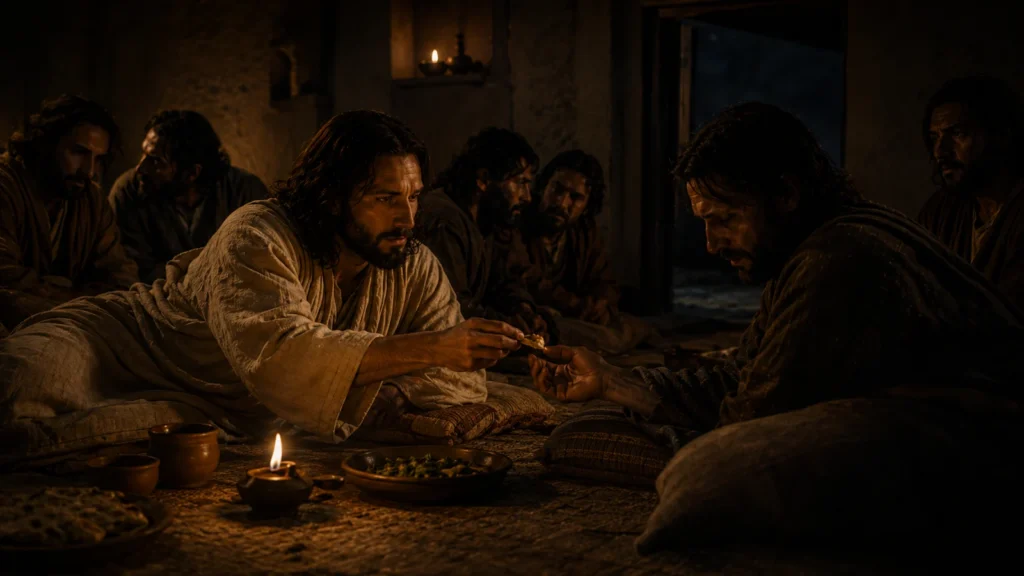
All four Gospels place Jesus’ warning about betrayal in the setting of the final meal. Matthew and Mark speak of one who shared the meal with Jesus. Luke places the betrayer’s hand at the table. John records Jesus giving bread to Judas. The betrayal comes from within the visible circle of disciples, not from a distant enemy outside it.
Read together, the Gospel accounts of the final meal deepen the force of Psalm 41’s language of broken fellowship.
What Psalm 41 Establishes
Psalm 41 does not make David’s own suffering unimportant or unreal. Rather, David’s righteous-sufferer experience becomes part of the scriptural pattern through which Jesus understands His own suffering.
- Psalm 41 is first a Davidic lament.
- Jesus explicitly applies it to betrayal from within His own circle.
- Judas’s treachery fulfills the righteous-sufferer pattern in its climactic form.
- The betrayal at the table reveals the personal cost of Jesus’ path toward the cross.
The point is not merely that Jesus knew a betrayal was coming. The point is that He knew Scripture’s story was converging upon Him—and that He went forward willingly.
Zechariah 11: The Rejected Shepherd and Thirty Pieces of Silver
Fulfillment category: Scriptural fulfillment pattern with explicit Gospel correspondence
Zechariah 11 is one of the most important passages in this article, but it must be read carefully.
The chapter presents an enacted prophetic shepherd drama shaped by failed leadership, judgment, and covenant unfaithfulness. Zechariah acts in the role of a shepherd among a people marked by rebellion and corrupt leadership. The shepherd eventually asks for his wages. He receives thirty pieces of silver, and the Lord tells him to throw the money in the house of the Lord.
The scene is not presented as an ordinary financial transaction. The amount carries a deliberately contemptuous valuation of the shepherd. Exodus 21:32 assigns thirty shekels as legal compensation in a specific case involving the death of a slave, giving Zechariah’s “wages” an unmistakably demeaning force.
Matthew’s Gospel places Judas’s betrayal in a strikingly similar scriptural world.
Judas agrees to hand Jesus over for thirty pieces of silver. After Jesus is condemned, Judas returns the money to the chief priests and elders. He throws it into the temple, and the leaders use it to purchase the potter’s field as a burial place for strangers.
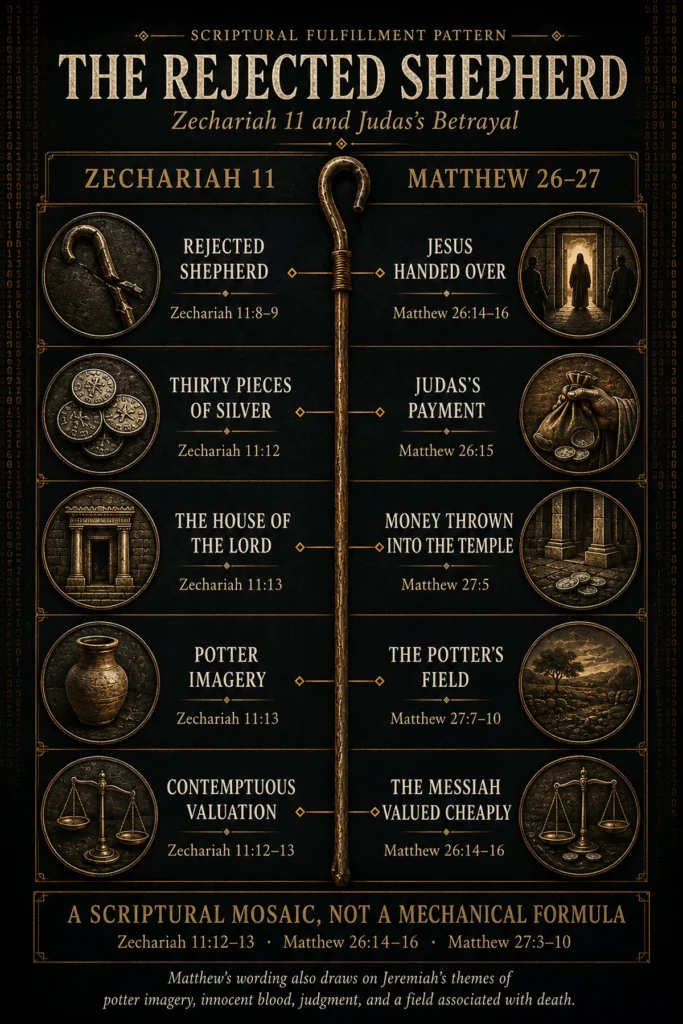
Read Zechariah 11:12–13 alongside Matthew 26:14–16 and Matthew 27:3–10, and the major correspondences are clear:
- A rejected shepherd: Jesus is rejected and handed over.
- Thirty pieces of silver: Judas receives thirty pieces of silver.
- The house of the Lord: Judas throws the money into the temple.
- Potter imagery: The money is used to purchase the potter’s field.
- A contemptuous valuation: Jesus is valued cheaply and betrayed for silver.
Matthew is not merely reporting coincidence. He is deliberately telling Judas’s story within the scriptural world of Israel’s rejected shepherd.
Yet the best Christian reading does not claim that Matthew simply copies one Old Testament prediction line by line. Zechariah supplies the rejected-shepherd theme, thirty pieces of silver, temple setting, and potter imagery. Matthew’s account then brings those images into the particular tragedy of Judas, blood money, and the potter’s field.
Translation note: Zechariah 11:13 is rendered “to the potter” in many English translations, while some translations render the destination “to the treasury.” That variation should make Christians cautious about claiming a mechanical one-to-one formula. It does not erase the larger correspondence: Matthew deliberately frames Judas’s silver, the temple, and the potter’s field with Zechariah’s imagery in view.
Why Does Matthew Name Jeremiah?
Matthew 27:9–10 is one of the places where careful Christian interpretation matters most.
The Gospel names Jeremiah, while the most obvious verbal echoes come from Zechariah 11. The responsible response is not to deny the difficulty. Matthew’s wording is not a verbatim quotation from one isolated Old Testament passage, and the exact reason he names Jeremiah remains debated.
The clearest Jeremiah background is Jeremiah 19, where potter imagery, innocent blood, divine judgment, and a coming burial setting converge. Jeremiah 32 may provide a secondary field resonance, but it should not carry the main explanatory weight.
Many interpreters therefore understand Matthew as presenting a scriptural mosaic. Zechariah contributes the rejected shepherd and thirty pieces of silver. Jeremiah contributes a wider prophetic setting of the potter, bloodshed, judgment, and a field associated with death.
A scriptural mosaic, not a mechanical formula: Christians can see a profound fulfillment pattern here without pretending that every detail is a simple verbatim forecast from one isolated Old Testament sentence. Matthew presents Judas’s betrayal through the language of Israel’s Scriptures because he sees Jesus as the true Shepherd rejected and valued cheaply by His own people.
The tragedy is not merely that Judas was paid a particular amount. In Zechariah’s shepherd drama, thirty pieces of silver represent a contemptuous valuation. In Matthew’s account, Judas agrees to betray Jesus for the same amount. The Gospel presents Jesus, the true Shepherd, as being valued cheaply by those who reject Him.
Divine Purpose Does Not Remove Judas’s Guilt
The Bible does not present Judas as a morally innocent man who simply played an assigned role.
Jesus speaks of His path as taking place according to what is written. But in the same setting, He pronounces judgment on the betrayer. Scripture’s anticipation of betrayal does not make betrayal good. Divine purpose does not erase human responsibility.
In Matthew 26:24, Jesus holds both truths together: the Son of Man goes as it is written, yet woe remains upon the one who betrays Him.
God’s redemptive plan was not threatened by Judas’s betrayal. Jesus was not caught unaware, and the cross was not an accident in the Christian story.
But Judas’s betrayal remained betrayal.
The New Testament gives no permission to treat evil as morally harmless simply because God is able to bring redemption through it. Instead, it shows the holiness of Christ, the seriousness of sin, and the sovereign purpose of God meeting at the cross.
Betrayal belongs in the Christian understanding of prophecy because it reveals the Messiah as the rejected Shepherd who knowingly went toward the cross. That wider pattern reaches its theological center in Isaiah’s suffering Servant and its historical climax in the crucifixion of Jesus.
For a fuller study of Isaiah 53, Psalm 22, sacrifice, and the cross, continue with Jesus’ Crucifixion Prophecies: Isaiah 53, Psalm 22, and the Cross.
Isaiah 53: The Rejected and Silent Servant
Fulfillment category: Central Christian canonical fulfillment
Isaiah 53 gives the deepest Old Testament portrait of the Messiah’s rejection and suffering. It is not merely one more entry in a prophecy list. For Christians, this passage stands near the center of how Jesus’ betrayal, trial, death, and vindication are understood within the whole story of Scripture.
“He was despised and rejected by men; a man of sorrows and acquainted with grief.”
Isaiah’s Servant is not rejected because He is faithless or defeated. He is despised, misunderstood, afflicted, and wounded; yet the chapter also moves beyond suffering to vindication. The Servant bears grief, is numbered with transgressors, and finally sees the purpose of God accomplished.
That pattern became foundational for the New Testament’s proclamation of Jesus. The earliest Christians did not merely say that Jesus suffered and later find isolated verses that seemed to fit. They repeatedly read His suffering, death, and resurrection through Isaiah’s portrait of the Servant.
Isaiah 53 also describes the Servant as oppressed and afflicted, yet silent before those who condemn Him.
“Like a sheep that before its shearers is silent, so he opened not his mouth.”
The Gospels portray Jesus answering false accusation with restraint before Pilate. Christians have long understood that scene in light of Isaiah’s Servant. His silence does not mean that falsehood became true, that injustice became just, or that Jesus lacked authority to answer. It reveals His willing movement toward the Father’s saving purpose.
Matthew records that Jesus gave no answer to many accusations before Pilate. Peter later describes Christ as the One who did not retaliate when reviled but continued entrusting Himself to the God who judges justly. Read together, Isaiah 53, Matthew 27, and 1 Peter 2 present Jesus’ suffering as neither helplessness nor moral compromise. He knowingly entrusted Himself to the righteous judgment of God.
Jewish and Christian readers have differed substantially over the identity of Isaiah’s Servant. Christians argue that Jesus’ rejection, innocent suffering, death, and vindication—and the New Testament’s repeated use of Isaiah 53—identify Him as the Servant’s climactic fulfillment.
That claim should be made with conviction and care. Isaiah 53 does not invite Christians to caricature Jewish interpretation or to treat the passage as a detached riddle. It calls readers to consider whether the Servant’s rejection, innocence, suffering, and vindication find their fullest fulfillment in Jesus Christ.
This article does not attempt to duplicate the full case for Isaiah 53, sacrifice, Psalm 22, and the cross. For that focused study, see Jesus’ Crucifixion Prophecies: Isaiah 53, Psalm 22, and the Cross.
Zechariah 13:7: The Shepherd Struck and the Sheep Scattered
Fulfillment category: Explicit New Testament application
Zechariah 13:7 contains one of the clearest Old Testament passages Jesus directly applies to the events surrounding His arrest.
“Strike the shepherd, and the sheep will be scattered.”
On the night before His crucifixion, Jesus tells His disciples that they will all fall away because of Him. He then cites Zechariah’s words about the Shepherd being struck and the sheep scattering.
Jesus was not merely finding a familiar verse that resembled a difficult moment. He understood His arrest, the disciples’ fear, and their coming failure within the scriptural pattern of the struck Shepherd.
The Gospels preserve both sides of the event. God’s redemptive purpose was not defeated by Jesus’ arrest, but the disciples’ fear and failure were still real. Peter would deny Jesus. The others would flee. Scripture’s anticipation of their scattering did not turn their fear into faithfulness or erase their responsibility.
Yet Jesus did not quote Zechariah 13 only to predict abandonment. He immediately gave His disciples a resurrection promise: after He was raised, He would go before them to Galilee.
That promise changes the shape of the scene. The Shepherd would be struck, and the sheep would scatter. Yet the Shepherd would rise, regather His people, and lead them forward.
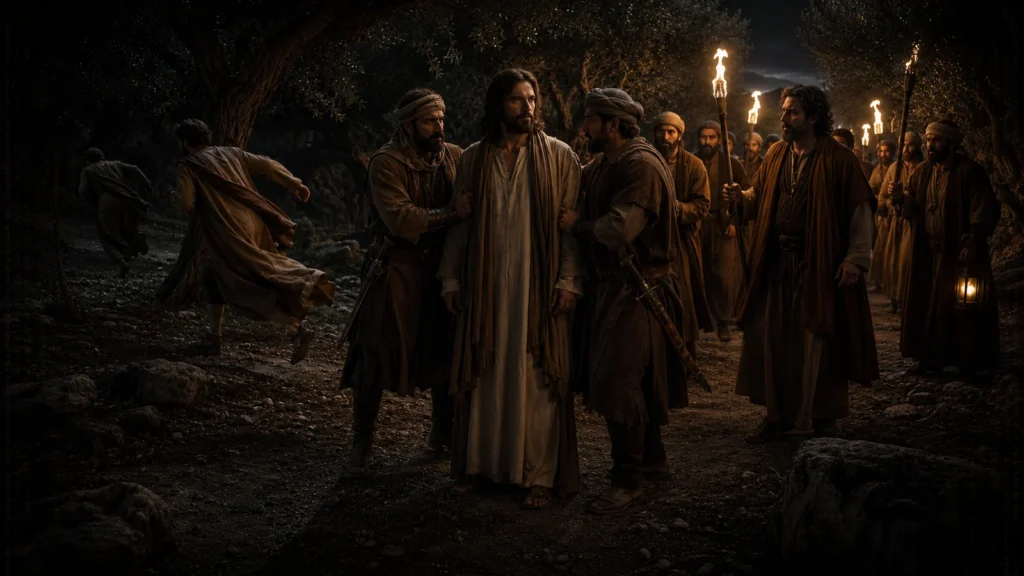
Matthew 26:31–32 and Mark 14:27–28 therefore connect betrayal and rejection directly to resurrection hope. The disciples’ scattering is not the final word. Jesus’ restoration of His followers is.
Psalm 118:22: The Rejected Stone Becomes the Cornerstone
Fulfillment category: Explicit Jesus and apostolic application
“The stone that the builders rejected has become the cornerstone.”
Psalm 118 announces one of Scripture’s great reversals: what human builders reject, God establishes. The original psalm celebrates the Lord’s saving deliverance and His reversal of an apparently defeated servant’s position. Jesus applies this text to Himself after telling the parable of the tenants, placing His rejection within that pattern of divine vindication.
The New Testament then carries the same theme forward. Peter publicly identifies Jesus as the rejected Stone whom God has made foundational. In 1 Peter, Christ becomes the living Stone around whom God is building His people.
- Psalm 118:22–23: God reverses the verdict of the builders.
- Matthew 21:42: Jesus applies the rejected-Stone passage to Himself.
- Acts 4:11–12: Peter identifies Jesus as the rejected Stone and connects Him to salvation.
- 1 Peter 2:4–8: Christ is the living Stone, chosen and precious before God.
Read together, these passages show that betrayal and rejection are not the final verdict on Jesus. The One rejected by human builders is established by God as the foundation of salvation.
This theme also opens into the wider biblical case for Jesus’ authority and identity. The rejected Stone is not merely restored to honor; He becomes the foundation of God’s saving work. Explore that connection in Does the Old Testament Point to Jesus’ Divine Identity?.
Supporting Echoes of Rejection and Unjust Hatred
Fulfillment category: Supporting rejection echo
Jesus’ rejection was not limited to Judas’s betrayal or the disciples’ scattering. The Gospels also present Him as the righteous One opposed without just cause.
In John 15, Jesus tells His disciples that the world’s hatred of Him fulfills the written word: “They hated me without a cause.” The wording echoes the righteous-sufferer language found in Psalms 35 and 69. Psalm 69:4 is a particularly strong parallel, but Christians should not treat it as the only possible background to John’s wording.
These Psalms alongside John 15:18–25 do not function as separate predictions about Judas. They strengthen the wider biblical pattern: the righteous one is hated without cause, yet God does not abandon His purpose.
These supporting echoes do not carry the article’s central argument by themselves. Psalm 41, Zechariah 11, Isaiah 53, Zechariah 13, and Psalm 118 remain the central pillars. But the righteous-sufferer Psalms help readers see that Jesus’ rejection belongs within a recurring scriptural story: opposition without just cause does not overturn God’s purpose or prevent His vindication of the Messiah.
Betrayal, rejection, scattering, and unjust hatred therefore form a unified movement in the Passion story. But Scripture does not leave Jesus beneath the verdict of those who reject Him. The rejected Stone becomes the cornerstone. The struck Shepherd rises and regathers His people. The suffering Servant is vindicated by God.
What These Scriptures Establish—and What They Do Not
The strongest Christian case does not treat every Old Te by Jesus Himself or by the apostles. Others establish a larger scriptural pattern that reaches its climactic fulfillment in Him.
That distinction does not weaken the case. It makes the case more credible. Scripture’s witness is not a collection of detached predictions competing for attention. It is a unified story in which the betrayed companion, the rejected Shepherd, the suffering Servant, the scattered sheep, and the rejected Stone converge in Jesus Christ.
Evidence Matrix: Betrayal and Rejection
| Old Testament text | Fulfillment category | New Testament connection | Read carefully |
|---|---|---|---|
| Psalm 41:9 | Explicit New Testament application | John 13:18 | David’s lament is explicitly applied by Jesus to betrayal from within His own circle. |
| Zechariah 11:12–13 | Scriptural fulfillment pattern with Gospel correspondence | Matthew 26:14–16; 27:3–10 | Matthew’s use of Zechariah and Jeremiah is a scriptural mosaic, not a simple one-text quotation formula. |
| Isaiah 53:3, 7 | Central Christian canonical fulfillment | Matthew 27:11–14; 1 Peter 2:21–24 | Jewish and Christian readers differ over the Servant’s identity; Christians see Jesus as the climactic fulfillment. |
| Zechariah 13:7 | Explicit New Testament application | Matthew 26:31–32; Mark 14:27–28 | The disciples’ scattering is real, but Jesus immediately joins it to His promise of resurrection and restoration. |
| Psalm 118:22–23 | Explicit Jesus and apostolic application | Matthew 21:42; Acts 4:11–12; 1 Peter 2:4–8 | Human rejection is reversed by God’s vindication of Christ. |
| Psalms 35:19; 69:4 | Supporting rejection echo | John 15:25 | These Psalms strengthen the righteous-sufferer pattern; they are not specific predictions about Judas. |
What Christians Can Say Confidently
- Jesus explicitly applies Psalm 41 to betrayal from within His own circle.
- Jesus explicitly applies Zechariah 13 to His arrest and the scattering of His disciples.
- Jesus and the apostles repeatedly apply Psalm 118’s rejected-Stone language to Jesus’ rejection and God’s vindication of Him.
- Matthew deliberately frames Judas’s betrayal through the scriptural world of Zechariah’s rejected shepherd, thirty pieces of silver, temple imagery, and the potter’s field.
- The New Testament presents Jesus’ betrayal and rejection as part of Scripture’s united witness, not as isolated events outside God’s redemptive purpose.
What Christians Should Not Claim
- Christians should not claim that every Old Testament betrayal or rejection text is an identical one-to-one forecast of Judas.
- Christians should not claim that Matthew’s use of Zechariah and Jeremiah has no interpretive complexity.
- Christians should not claim that Scripture’s anticipation of betrayal excuses Judas, fearful disciples, particular leaders, or Roman authorities from moral responsibility.
- Christians should not turn the Passion narratives into blame against Jewish people as a whole.
- Christians should not make a prophecy chart more important than the Christ to whom Scripture points.
The purpose of these passages is not to create a collection of detached proof texts. Scripture leads readers to Jesus: the rejected Messiah, the suffering Servant, the struck Shepherd, and the Stone whom God has established.
How Betrayal and Rejection Fit the Larger Case for Jesus
Prophecy explains the cross within the story of Scripture. History asks whether Jesus was truly crucified. The Gospel explains why His death matters. The resurrection case asks what happened after the rejected Messiah was killed.
Betrayal and rejection do not prove Christianity by themselves. They belong within the larger Christian case: Scripture anticipates a rejected Messiah; the Gospels proclaim His death; the resurrection declares that rejection was not God’s final verdict; and the apostles publicly bear witness that Jesus is risen and Lord.
The pattern is consistent from beginning to end. Jesus is betrayed by one who shares His bread. He is rejected by human builders. He is struck, and His disciples scatter. Yet He is not abandoned to defeat. The rejected Stone becomes the foundation. The struck Shepherd rises and regathers His people.
Continue the Evidence
- Explore the Prophecy Map: Prophecies of Jesus Fulfilled in Scripture
- Study the Cross in Scripture: Jesus’ Crucifixion Prophecies
- Examine the Historical Foundation: Was Jesus Crucified?
- Understand the Meaning of the Cross: Why Did Jesus Die?
- Follow the Resurrection Case: How Early Is the Resurrection Claim?
Frequently Asked Questions About Jesus’ Betrayal and Rejection Prophecies
Did the Old Testament predict Judas by name?
No. The Old Testament does not name Judas. Christians argue that Psalm 41, Zechariah 11, and related passages establish scriptural patterns that the New Testament applies to Jesus’ betrayal.
Why does Matthew mention Jeremiah when Zechariah contains the thirty-silver imagery?
Matthew 27 visibly echoes Zechariah 11, yet Matthew names Jeremiah. Many interpreters understand the Gospel as gathering Zechariah’s rejected-shepherd and thirty-silver imagery together with Jeremiah-related themes of potter imagery, innocent blood, judgment, and a field associated with death. The exact explanation remains debated.
Does prophecy mean Judas was not responsible for betraying Jesus?
No. Jesus says the Son of Man goes as Scripture foretold while also pronouncing woe on the betrayer. God’s redemptive purpose does not turn evil into innocence or erase moral responsibility.
Are all betrayal and rejection passages direct predictions?
No. Some passages are explicitly applied by Jesus or the apostles. Others are broader canonical patterns or supporting scriptural echoes. A strong Christian case explains the category of fulfillment rather than treating every connection as identical.
Do betrayal and rejection prophecies alone prove Christianity?
No. They belong within a cumulative Christian case centered on Scripture, Jesus’ historical crucifixion, the meaning of the cross, and the early proclamation that God raised Him from the dead.
Sources and Further Reading
- Primary biblical texts: Psalm 35; Psalm 41; Psalm 69; Psalm 118; Isaiah 52:13–53:12; Zechariah 11 and 13; Matthew 21 and 26–27; John 13 and 15; Acts 4; 1 Peter 2.
- R. T. France, The Gospel of Matthew. A substantial commentary useful for Matthew’s Passion narrative and its use of Israel’s Scriptures.
- G. K. Beale and D. A. Carson, eds., Commentary on the New Testament Use of the Old Testament. A major reference work on Old Testament quotations, allusions, and echoes throughout the New Testament.
- Richard B. Hays, Echoes of Scripture in the Gospels. Especially helpful for distinguishing direct quotation from broader scriptural resonance.
- Raymond E. Brown, The Death of the Messiah, From Gethsemane to the Grave. A detailed study of the Passion narratives and their interpretive questions.
Unless otherwise indicated, Scripture quotations are from the ESV® Bible.
Jesus Was Rejected, but Not Defeated
Jesus was betrayed by one who shared His bread. He was valued cheaply, rejected, struck, and abandoned by fearful followers.
Yet Scripture does not leave the Messiah in rejection.
The rejected Stone becomes the foundation. The struck Shepherd rises and regathers His people. The suffering Servant is vindicated. The cross becomes not the collapse of God’s purpose, but the place where God’s mercy, justice, and redemption meet.
The final aim is not amazement at a chart. It is faith in Jesus Christ: the rejected Messiah, the crucified Savior, the risen Lord, and the foundation God has established.
Scripture’s witness to betrayal and rejection leads beyond Judas, silver, and scattering. It leads to Jesus—the Messiah who knowingly went toward the cross, was vindicated by God, and now calls people to trust Him.
CONTINUE THE INVESTIGATION
Recommended continuation
Jesus’ Crucifixion Prophecies Fulfilled in Scripture
Continue from betrayal and rejection into the prophetic texts Christians understand as pointing to the Messiah’s suffering and crucifixion.