
GUIDED ARTICLE EXPERIENCE
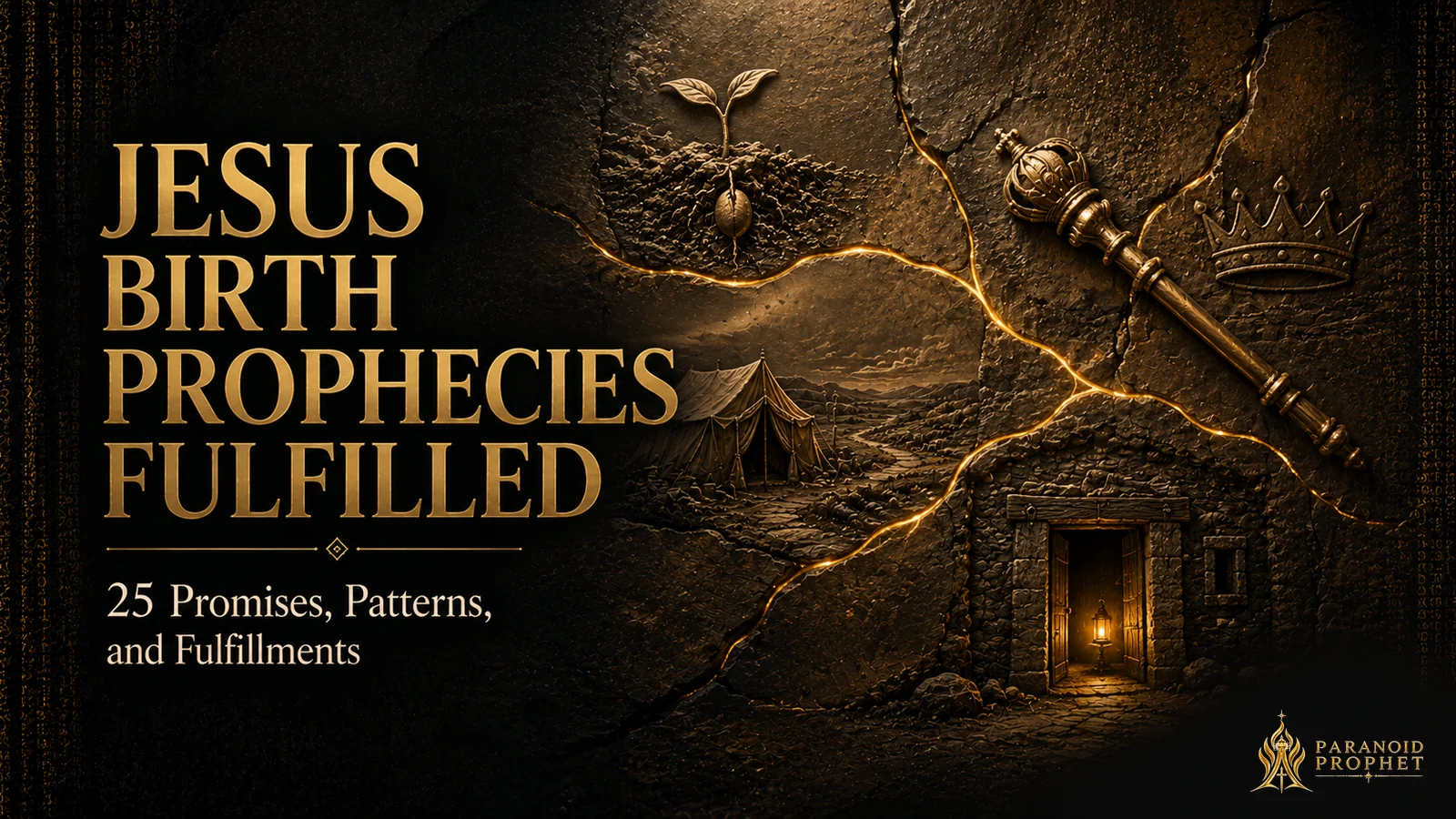
Jesus Birth Prophecies: 25 Promises, Patterns, and Fulfillments
Read along as the narration moves through the article.
Private device narration · No hosted audio or tracking
CONTINUE GUIDED TOUR
Continue where you left off.
GUIDED TOUR COMPLETE
You have reached the end of this study.
Study record saved on this device.
GUIDED TOUR
Jesus Birth Prophecies: 25 Promises, Patterns, and Fulfillments
Narrator: Paranoid Prophet Recommended Voice Native device narration
Prepare to follow the article as it is narrated.
VOICE & TOUR OPTIONS
Voice & Listening
NARRATOR
Finding a narrator…
Checking the best narrator available on this device.
Restores the best curated narrator available on this device.
Narrator choices are curated for clear, long-form listening on this device.
Screen-awake support will be checked when narration starts.
CHOOSE A NARRATOR
Curated for this device
Choose a verified narrator for this browser, or use System Narrator. Automatic mode uses the best reliable route exposed by this device; your chosen narrator is preserved even if this device needs a temporary fallback.
Preparing the guided article experience…
RESUME GUIDED TOUR?
Continue where you left off.
GUIDED TOUR COMPLETE
You have reached the end of this study.
The birth of Jesus was not a sentimental accident placed at the beginning of the New Testament. It was the arrival of the promised Son, the Davidic King, the true Israel, the light to the nations, and the Savior whose coming had been prepared across the Law, the Prophets, and the Writings.
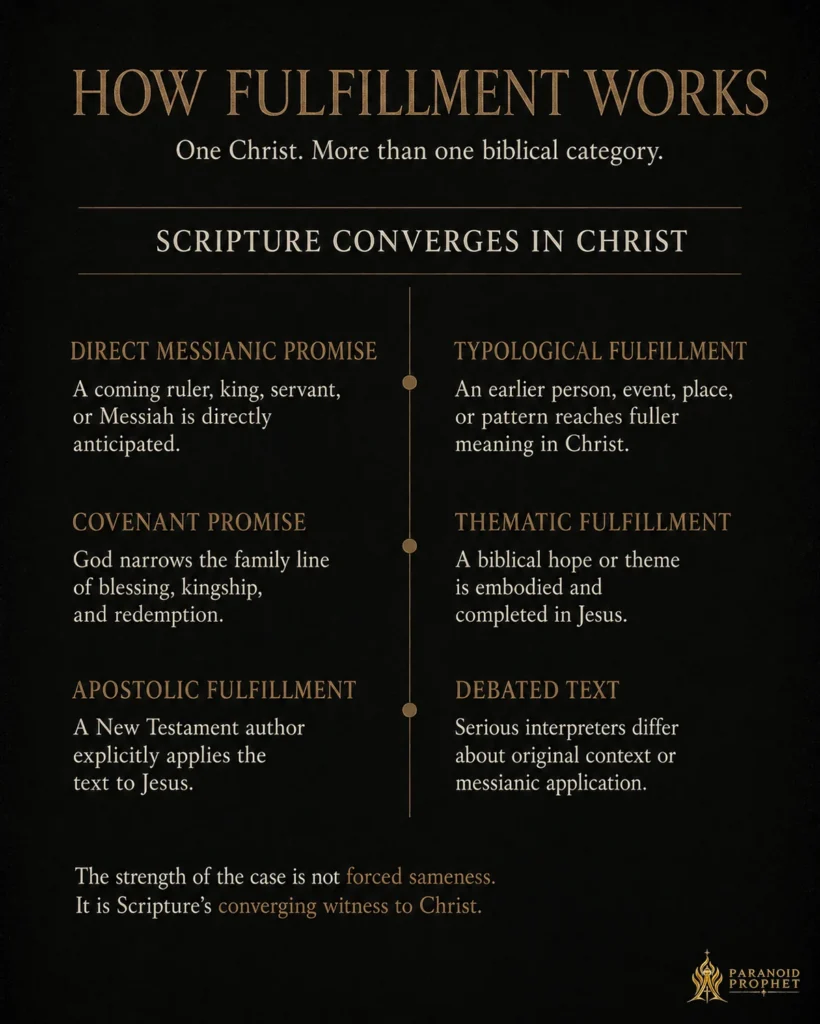
That does not mean every Old Testament passage connected to Jesus’ birth works the same way. Some texts are direct messianic promises. Some are covenant promises that narrow the family line. Some are typological fulfillments, where Jesus fills up the meaning of Israel’s earlier story. Some are themes that the New Testament shows reaching their goal in Christ. Some are debated and need careful handling.
A stronger Christian case does not need to flatten those categories. Scripture is strong enough to be read honestly.
Core claim: The birth of Jesus fulfills the Old Testament not as a random collection of isolated predictions, but as the arrival of the promised seed, son of Abraham, son of David, ruler from Bethlehem, Immanuel, true Israel, light to the nations, and divine Son who reveals the Father.
Source discipline: This article distinguishes direct messianic prediction, covenant promise, apostolic fulfillment, typology, thematic fulfillment, and debated interpretation. Scripture is the final authority. Historical and scholarly sources can clarify context, but they do not replace the biblical witness. Evidence does not sit above Scripture; it serves the case that Scripture tells the truth about Jesus. The goal is not to win a counting contest. The goal is to see how the Scriptures point to Christ. For the wider site standard, see Sources and Verification.
Article Guide12 sections
Why This Article Belongs in the Jesus Evidence Web
This article is not mainly a Christmas devotional, a trivia list, or an attempt to make prophecy sound impressive by inflating a number. It is one node in the larger Jesus Evidence Web.
The question is bigger than whether a few Old Testament lines can be matched to the manger. The question is whether the Bible tells one true story that reaches its goal in Jesus Christ. Birth prophecy helps build that case because it shows that Jesus did not appear from nowhere. He came inside the promise-shaped world of Scripture: creation, fall, covenant, kingship, exile, hope, temple, redemption, and the coming kingdom.
That matters for the central claim of this site. If Jesus is the promised Son, the Davidic King, Immanuel, the true Israel, the light to the nations, and the one whose birth already points toward the cross and resurrection, then the birth narratives are not decorative background. They are evidence that Scripture is coherent, that God keeps His word, and that Jesus is who He said He is. This is why the birth-prophecy trail belongs beside the wider case for Jesus as Lord rather than liar, lunatic, or legend.
How This Article Handles Birth Prophecy
Many articles about Jesus birth prophecies present a list and call every item a direct prediction. That may sound impressive, but it creates problems. Genesis 3:15, Micah 5:2, Isaiah 7:14, Hosea 11:1, Jeremiah 31:15, and Matthew 2:23 are not the same kind of text. They should not be handled as if they were.
The New Testament teaches Christians to read the Old Testament in light of Christ. Jesus Himself taught that the Scriptures bear witness to Him. But Christ-centered reading is not permission to make every verse mean the same thing. Fulfillment can mean direct prediction coming to pass, but it can also mean a promise reaching its appointed goal, a pattern being filled up, or Israel’s story being embodied by the Messiah.
| Fulfillment Type | Meaning | Examples in This Article |
|---|---|---|
| Direct messianic promise | A text that naturally looks forward to a coming ruler, king, servant, or Messiah. | Micah 5:2; Isaiah 9:6-7 |
| Covenant promise | A promise that narrows the family line through which blessing, kingship, and redemption will come. | Genesis 12:1-3; Genesis 49:10; 2 Samuel 7:12-16 |
| Apostolic fulfillment | A passage explicitly applied to Jesus by a New Testament author. | Isaiah 7:14 in Matthew 1; Hosea 11:1 in Matthew 2 |
| Typological fulfillment | An earlier person, event, place, or pattern reaches fuller meaning in Christ. | Egypt, Ramah, Israel as God’s son |
| Thematic fulfillment | A biblical theme is embodied in Jesus even when the text is not a narrow prediction. | Light to the nations; Gentile worship; hiddenness and rejection |
| Debated text | A passage where serious interpreters disagree about the original context or messianic application. | Isaiah 7:14; Matthew 2:23; some Magi/gift connections |
The Case at a Glance
Here is the 25-part map. The strength of the case is not that every entry is a direct standalone prediction. The strength is that the whole pattern converges: family line, royal promise, birthplace, divine identity, Gentile hope, suffering, exile, opposition, and redemption all move toward Jesus Christ.
| # | Old Testament Anchor | New Testament Anchor | Category | Strength |
|---|---|---|---|---|
| 1 | Seed of the woman | Galatians 4:4; Luke 1:35 | Foundational promise | Broad but important |
| 2 | Offspring of Abraham | Matthew 1:1; Galatians 3:16 | Covenant promise | Strong |
| 3 | Line of Isaac | Matthew 1:2 | Covenant narrowing | Strong |
| 4 | Line of Jacob / Israel | Matthew 1:2; Luke 3:34 | Covenant narrowing | Strong |
| 5 | Tribe of Judah | Matthew 1:2-3; Luke 3:33 | Royal promise | Strong |
| 6 | Son of David | Matthew 1:1; Luke 1:32-33 | Davidic covenant | Very strong |
| 7 | Root / branch of Jesse | Matthew 1; Luke 3; Romans 15:12 | Messianic lineage | Strong |
| 8 | Ruler from Bethlehem | Matthew 2:1-6; Luke 2:1-7 | Direct messianic promise | Very strong |
| 9 | Immanuel sign | Matthew 1:22-23 | Apostolic fulfillment | Strong but debated |
| 10 | Child called Mighty God and Prince of Peace | Luke 1:32-35; John 1:14 | Royal / divine identity | Strong |
| 11 | Son of God / royal Son | Luke 1:35; Matthew 3:17 | Messianic sonship | Strong |
| 12 | The Lord comes to His temple | Luke 2:22-38 | Temple fulfillment pattern | Moderate to strong |
| 13 | Forerunner prepares the way | Luke 1:13-17; Luke 3:2-6 | Direct prophetic preparation | Strong |
| 14 | Star and scepter from Jacob | Matthew 2:1-2 | Royal oracle / thematic fulfillment | Moderate |
| 15 | Light for the nations | Luke 2:30-32 | Servant / nations theme | Strong |
| 16 | Nations come to the light | Matthew 2:1-12 | Kingdom pattern | Moderate |
| 17 | Gold and frankincense from the nations | Matthew 2:11 | Kingdom imagery | Moderate |
| 18 | Kings bring tribute | Matthew 2:11 | Royal typology | Moderate |
| 19 | Out of Egypt I called my son | Matthew 2:13-15 | Typological fulfillment | Strong as Matthew’s reading |
| 20 | Rachel weeping in Ramah | Matthew 2:16-18 | Typological fulfillment | Strong as Matthew’s reading |
| 21 | He shall be called a Nazarene | Matthew 2:23 | Summary / debated fulfillment | Debated |
| 22 | Sign opposed by many | Luke 2:34-35 | Infancy prophecy / Israel’s division | Strong within Luke |
| 23 | Humble root from dry ground | Luke 2:7; Matthew 13:55-57 | Thematic fulfillment | Moderate |
| 24 | Consolation and redemption for Israel | Luke 2:25-38 | Prophetic hope embodied | Strong theme |
| 25 | Glory revealed in the coming of the Lord | Luke 2:8-14; John 1:14 | Glory / incarnation theme | Strong theme |
Lineage and Covenant Promises
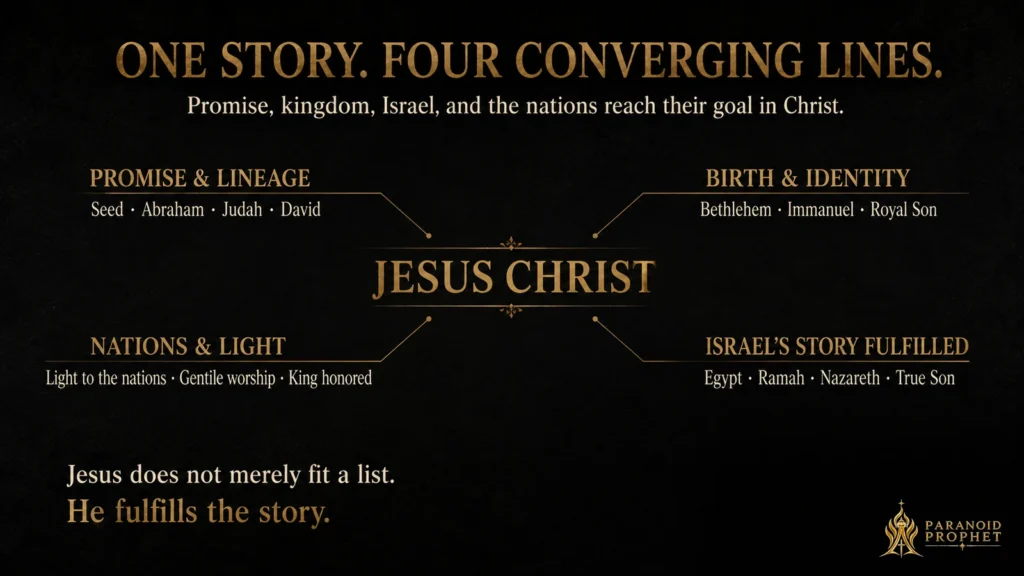
The birth of Jesus begins with genealogy because the gospel does not float above history. Matthew opens with Jesus as son of David and son of Abraham. Luke places Jesus within the larger human family. The point is not bare ancestry trivia. The point is covenant fulfillment.
1. The Seed of the Woman
Old Testament anchor: Genesis 3:15
New Testament anchor: Galatians 4:4-5; Luke 1:35
Category: Foundational promise
Genesis 3:15 is not a detailed nativity prediction. It does not name Mary, Bethlehem, or the manger. It is the first great promise that the conflict introduced by sin will not have the final word. A coming offspring of the woman will crush the serpent, though suffering is involved.
The birth of Jesus stands within that promise. Paul says the Son came “born of woman” and “born under the law” to redeem those under the law. Luke presents Jesus’ conception as the work of God, not the result of ordinary human initiative. The promise begins broadly in Genesis, then the rest of Scripture narrows the line until the promised Son arrives.
2. The Offspring of Abraham
Old Testament anchor: Genesis 12:1-3; 22:18
New Testament anchor: Matthew 1:1; Galatians 3:16
Category: Covenant promise
God promised Abraham that blessing would come to all nations through his offspring. Matthew’s first sentence deliberately identifies Jesus as the son of Abraham. This matters because the Messiah is not an isolated wonder-worker. He is the heir of the promise through whom the nations are blessed.
Paul later reads the Abrahamic promise in a concentrated Christ-centered way. The blessing promised to Abraham reaches the nations through Christ. The birth narratives already point in that direction: Israel’s Messiah is born for Israel, but He is never only for Israel.
3. The Line of Isaac
Old Testament anchor: Genesis 17:19; 21:12
New Testament anchor: Matthew 1:2
Category: Covenant narrowing
The promise to Abraham narrows through Isaac. This is not a dramatic birth prophecy by itself, but it is part of the covenant line. Scripture does not present the Messiah as coming from any branch at random. The promise moves through a particular family story.
Matthew includes Isaac because the genealogy is doing theological work. Jesus is placed inside the promise-bearing family. The promised blessing to the nations comes through Israel’s covenant line, not around it.
4. The Line of Jacob and Israel
Old Testament anchor: Genesis 28:13-15
New Testament anchor: Matthew 1:2; Luke 3:34
Category: Covenant narrowing
The promise narrows again through Jacob, whose name becomes Israel. The Messiah is not detached from Israel’s story. He is born into it, fulfills it, and carries it to its appointed goal.
This helps explain why Matthew later presents Jesus as the true Son called out of Egypt. Jesus does not merely belong to Israel by ancestry. He embodies Israel’s vocation in perfect obedience.
5. The Tribe of Judah
Old Testament anchor: Genesis 49:8-10
New Testament anchor: Matthew 1:2-3; Revelation 5:5
Category: Royal promise
Jacob’s blessing over Judah points toward rule, kingship, and the obedience of the peoples. Christians have long seen this as part of the messianic trajectory that leads to Christ.
Matthew’s genealogy places Jesus in Judah’s line, and Revelation later calls Him the Lion of the tribe of Judah. The birth of Jesus is therefore royal from the beginning, even when it appears humble. The child in Bethlehem is not a private religious symbol. He is the King promised through Judah.
6. The Son of David
Old Testament anchor: 2 Samuel 7:12-16; Psalm 132:11-12
New Testament anchor: Matthew 1:1; Luke 1:32-33
Category: Davidic covenant
This is one of the strongest birth-related prophecy lines. God promised David a throne, a kingdom, and a royal son whose reign would endure. The angel’s announcement to Mary deliberately uses Davidic language: her Son will receive David’s throne and reign over Jacob’s house.
Matthew opens by naming Jesus as son of David before son of Abraham. That order is not accidental. It places the royal promise at the front of the Gospel. The baby born to Mary is the promised King, though His kingship will move through rejection, cross, resurrection, and exaltation.
7. The Root and Branch of Jesse
Old Testament anchor: Isaiah 11:1-10
New Testament anchor: Romans 15:12; Matthew 1; Luke 3
Category: Messianic lineage and kingdom hope
Isaiah speaks of a shoot from Jesse and a root who will rule with righteousness. Jesse was David’s father, so the image reaches back to David’s family while also looking ahead to a coming ruler greater than David.
The birth of Jesus fits this expectation because He comes from David’s line, yet His kingdom is larger than David’s political reign. Isaiah’s vision moves beyond ancestry into Spirit-filled rule, justice, peace, and the hope of the nations. Jesus’ birth is the beginning of that fulfillment, not the whole visible consummation of it.
Birthplace, Identity, and Infancy Fulfillment
The birth narratives do more than establish family line. They identify the child as ruler, Son, Immanuel, and the one in whom Israel’s temple and prophetic hope begin to find their answer.
8. The Ruler Born in Bethlehem
Old Testament anchor: Micah 5:2-5
New Testament anchor: Matthew 2:1-6; Luke 2:1-7
Category: Direct messianic promise
Micah 5 is one of the clearest birth-related messianic texts. The ruler is connected to Bethlehem, David’s town, and His significance reaches beyond ordinary local leadership. Matthew explicitly applies the passage when Herod asks where the Christ was to be born.
Luke gives the providential historical route by which Joseph and Mary arrive in Bethlehem. The Messiah is associated with Nazareth in ordinary life, but He is born in David’s city. The humility of Bethlehem does not weaken the royal claim. It intensifies it. God brings the promised ruler in a way that exposes how easily human power misses Him.
9. The Immanuel Sign and the Virgin Birth
Old Testament anchor: Isaiah 7:14
New Testament anchor: Matthew 1:18-25
Category: Apostolic fulfillment; debated original context
Isaiah 7:14 must be handled carefully. In its original setting, the sign is given during a crisis in Judah. Interpreters debate the immediate reference, the meaning of the Hebrew term, and how the text should be read in relation to later messianic fulfillment.
Matthew is not careless with the text. He sees the birth of Jesus as the fullness of the Immanuel sign: God with us. The virginal conception is not presented as a decorative miracle. It reveals that Jesus’ origin is from God, that salvation is God’s initiative, and that the child born to Mary is more than a merely human successor to David.
A careful Christian argument should admit that Isaiah 7:14 is debated. But it should also recognize that Matthew’s inspired reading places Jesus at the climactic end of the Immanuel theme. In Him, God is not merely giving a sign of deliverance. God is drawing near to save.
10. The Child Called Mighty God and Prince of Peace
Old Testament anchor: Isaiah 9:1-7
New Testament anchor: Luke 1:32-35; John 1:14
Category: Royal and divine identity
Isaiah 9 joins the birth of a child to royal rule, David’s throne, peace, justice, and names that press beyond ordinary kingship. Christians read this passage in light of Jesus because He is the Davidic Son whose kingdom is righteous, enduring, and finally universal.
The angel’s announcement to Mary echoes this royal expectation. Jesus will reign, and His kingdom will not end. John later reveals the deeper reality: the Word became flesh. The child is not only a promised king. He is the divine Son come among us. For the fuller doctrine of God’s self-revelation in Christ, see Who Is God? The Biblical Answer Revealed in Jesus Christ.
11. The Royal Son of God
Old Testament anchor: Psalm 2:7-12; 2 Samuel 7:14
New Testament anchor: Luke 1:35; Matthew 3:17; Romans 1:3-4
Category: Messianic sonship
In the Old Testament, “son” language can carry royal, covenantal, and messianic meaning. Israel is called God’s son. The Davidic king is called God’s son. Psalm 2 speaks of the Lord’s anointed Son receiving the nations.
Luke goes further when he records the angelic explanation of Jesus’ conception: the child will be called holy, the Son of God. This does not erase the Old Testament background. It fulfills it at a higher level. Jesus is Israel’s Messiah and David’s Son, but He is also the divine Son who reveals the Father. This connects directly to the larger biblical doctrine of the one God revealed as Father, Son, and Holy Spirit, explored further in What Is the Trinity?.
12. The Lord Comes to His Temple
Old Testament anchor: Malachi 3:1
New Testament anchor: Luke 2:22-38
Category: Temple fulfillment pattern
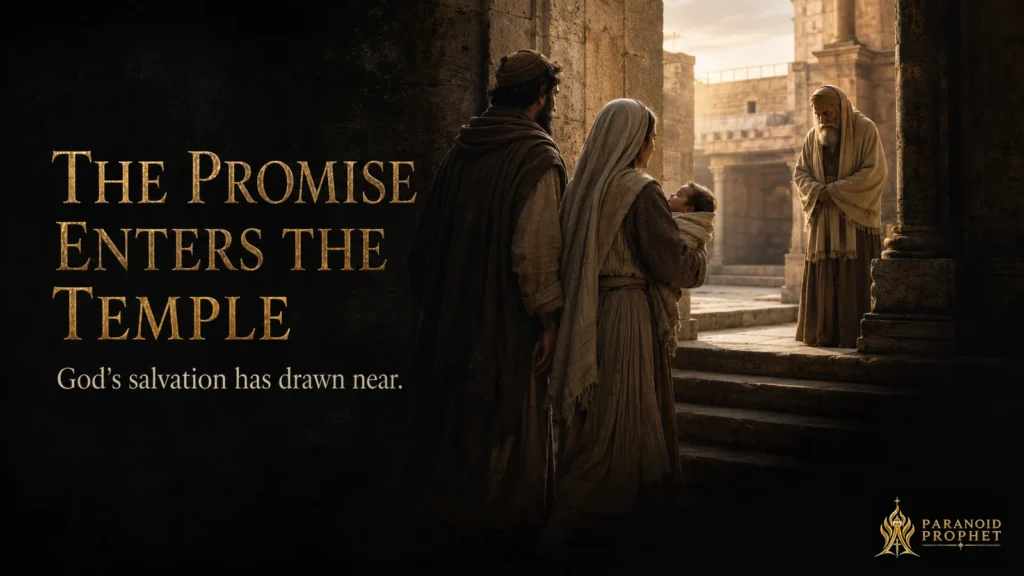
Malachi speaks of the Lord coming to His temple and of a messenger preparing the way. Luke’s infancy narrative shows Jesus being brought to the temple, where Simeon and Anna recognize that God’s salvation has arrived.
This is not a simple “baby will be presented at the temple” prediction. It is richer than that. The temple was the place of God’s presence, sacrifice, priesthood, and hope. When Jesus enters the temple as an infant, the scene quietly announces that the One greater than the temple has come in humility.
13. The Forerunner Prepares the Way
Old Testament anchor: Isaiah 40:3-5; Malachi 3:1; 4:5-6
New Testament anchor: Luke 1:13-17; 3:2-6
Category: Direct prophetic preparation
John the Baptist’s birth is not the main event, but it belongs to the birth narrative because his mission prepares for Jesus. Luke presents John in the language of Elijah-like preparation. The messenger comes before the Lord.
This strengthens the case for Jesus’ birth because the story does not begin with Jesus appearing in isolation. The forerunner arrives first. The prophetic road is prepared. Then the Christ appears.
Nations, Gentile Worship, and Royal Homage
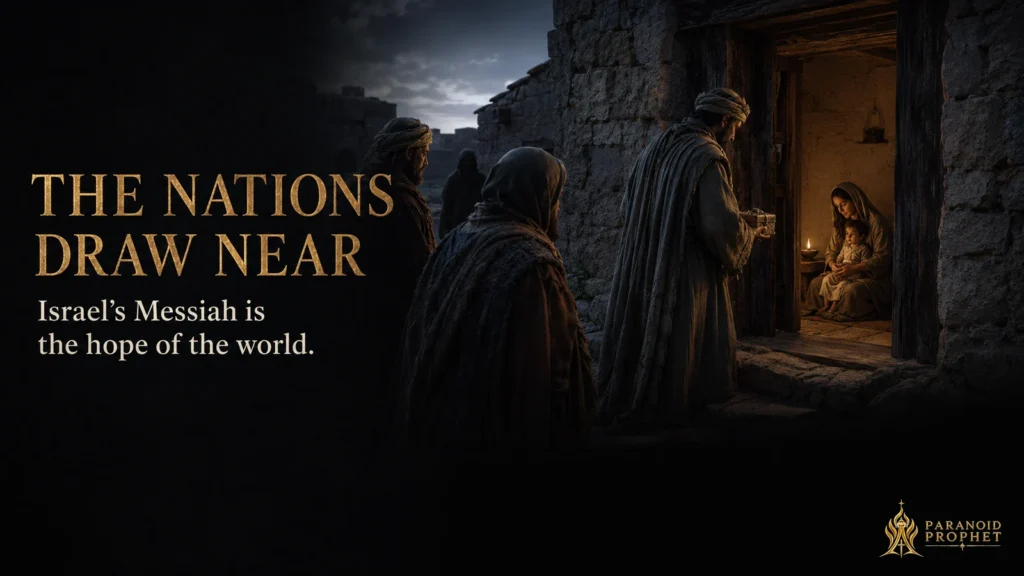
The birth of Jesus is Jewish to the core, but it is never tribal in the narrow sense. From the beginning, the nations are in view. The Magi, Simeon’s words, and the royal imagery surrounding the child all show that the Messiah of Israel is also the hope of the world.
14. A Star and Scepter from Jacob
Old Testament anchor: Numbers 24:17
New Testament anchor: Matthew 2:1-12
Category: Royal oracle and thematic fulfillment
Numbers 24 speaks of a star and a scepter arising from Jacob. The passage is royal and victorious, and Christians have often connected it to the Magi’s star in Matthew 2.
This connection should be made carefully. Numbers 24 is not a technical astronomy prediction that explains exactly what the Magi saw. It is a royal oracle. Matthew presents Gentile wise men responding to a heavenly sign and seeking the king of the Jews. The thematic fit is strong: a royal sign draws the nations toward Israel’s Messiah.
15. A Light for the Nations
Old Testament anchor: Isaiah 42:6; 49:6
New Testament anchor: Luke 2:25-32
Category: Servant and nations theme
When Simeon holds the infant Jesus, he declares that God’s salvation has been prepared in the sight of the peoples: light for revelation to the Gentiles and glory for Israel. That language belongs to Isaiah’s vision of God’s servant and salvation reaching the nations.
This is a strong theme, even though it is not only about the birth event. Jesus’ infancy already reveals the scope of His mission. He is Israel’s glory and the nations’ light.
16. Nations Coming to the Light
Old Testament anchor: Isaiah 60:1-3
New Testament anchor: Matthew 2:1-12
Category: Kingdom pattern
Isaiah 60 pictures nations and kings coming to Zion’s light. Matthew does not quote Isaiah 60 in the Magi story, so we should not claim that Matthew directly identifies it as the fulfillment text. But the pattern is hard to miss: Gentiles come from the east to honor the king connected to Israel’s hope.
The Magi are not proof that every detail in Isaiah 60 has been exhausted. They are a firstfruits sign. The nations are beginning to come to the light because the King has been born.
17. Gold and Frankincense from the Nations
Old Testament anchor: Isaiah 60:6
New Testament anchor: Matthew 2:11
Category: Kingdom imagery
Isaiah 60 includes gifts such as gold and frankincense in a vision of nations honoring the glory of the Lord. Matthew records the Magi bringing gifts of gold, frankincense, and myrrh to Jesus.
The connection should be stated modestly. Matthew does not say, “This happened to fulfill Isaiah 60.” Still, the symbolism fits the larger biblical pattern: the nations bring tribute, and the child receives honor that points beyond ordinary kingship.
18. Kings Bringing Tribute
Old Testament anchor: Psalm 72:10-17
New Testament anchor: Matthew 2:1-12
Category: Royal typology
Psalm 72 prays for the king’s righteous reign and pictures distant rulers bringing tribute. The Magi are not called kings in Matthew, and the text should not be forced to say that they were. Still, their journey and gifts fit the royal pattern: distant Gentiles honor the king connected to Israel’s hope.
This is the right way to use Psalm 72. It is not a narrow prediction that three kings would visit a manger. It is a royal vision that finds a beginning fulfillment as Gentile worshipers bow before the child.
Egypt, Ramah, Nazareth, Opposition, and Hiddenness
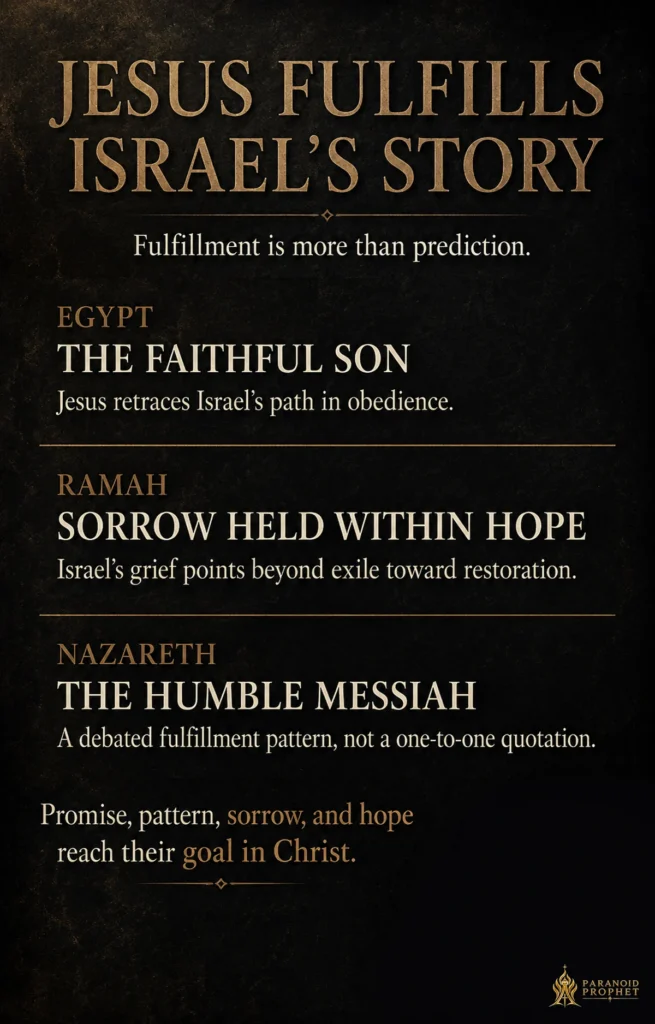
Matthew’s early-life fulfillment texts are some of the most important and most misunderstood. They show how Jesus fills up Israel’s story. They are not always direct predictions in the modern sense. They are inspired readings of Scripture’s patterns, griefs, hopes, and promises reaching their goal in Christ.
19. Out of Egypt I Called My Son
Old Testament anchor: Hosea 11:1
New Testament anchor: Matthew 2:13-15
Category: Typological fulfillment
Hosea 11:1 originally looks backward to the exodus: God called Israel, His son, out of Egypt. Matthew applies this text to Jesus after Joseph takes the child to Egypt and later returns.
This is not Matthew ripping a verse from context. It is typology. Israel was God’s son, called out of Egypt, yet Israel failed repeatedly. Jesus is the true Son who retraces Israel’s path in obedience. He goes down into Egypt and comes out again, not as a copy of Israel’s failure, but as the faithful Son who fulfills Israel’s calling.
20. Rachel Weeping in Ramah
Old Testament anchor: Jeremiah 31:15-17
New Testament anchor: Matthew 2:16-18
Category: Typological fulfillment of lament and hope
Jeremiah pictures Rachel weeping for her children in the context of exile and grief. Matthew applies this lament to Herod’s massacre in Bethlehem.
Again, the fulfillment is not a simple direct prediction. It is the filling up of Israel’s sorrow. The birth of the Messiah does not mean evil vanishes immediately. Herod’s violence shows that the King’s arrival exposes and provokes the powers of this age. But Jeremiah 31 is not only grief. It also contains hope, return, restoration, and the promise of a new covenant. Matthew places Bethlehem’s sorrow inside that larger hope.
21. He Shall Be Called a Nazarene
Old Testament anchor: Matthew refers broadly to “the prophets”; possible connections include branch imagery and despised lowliness
New Testament anchor: Matthew 2:19-23
Category: Summary fulfillment; debated
Matthew 2:23 is one of the most debated fulfillment statements in the birth narratives because there is no Old Testament verse that simply says, “He shall be called a Nazarene.” Matthew also says this was spoken by the prophets, plural, which may suggest a broader prophetic theme rather than a single quotation.
Several explanations have been proposed. Some connect “Nazarene” with branch imagery. Others connect Nazareth with obscurity and lowliness. Others see Matthew summarizing the prophetic expectation that the Messiah would be despised and unimpressive in the eyes of many.
The right approach is humility. This is a real fulfillment statement, but it should not be presented as a straightforward one-to-one quote. Matthew is showing that Jesus’ hidden, humble, Nazareth-associated life fits the prophetic pattern of the Messiah who comes without worldly prestige.
22. A Sign Opposed by Many
Old Testament background: Isaiah’s sign and stone imagery; Israel divided over God’s work
New Testament anchor: Luke 2:34-35
Category: Infancy prophecy within the Gospel narrative
Simeon tells Mary that Jesus is appointed for the fall and rising of many in Israel and for a sign that will be opposed. This is not an Old Testament proof-text in the same way Micah 5:2 is. It is prophetic interpretation inside the infancy narrative itself.
That matters because the birth of Jesus is not presented as harmless inspiration. From the beginning, the child divides. Some worship. Some fear losing power. Some are pierced with sorrow. Some oppose. The cradle already points toward the cross.
23. The Humble Root from Dry Ground
Old Testament anchor: Isaiah 53:2-3
New Testament anchor: Luke 2:7; Matthew 13:55-57; John 1:46
Category: Thematic fulfillment
Isaiah 53 should not be reduced to a manger prophecy. The passage is about the suffering servant, rejection, sin-bearing, and vindication. Still, the description of unimpressive appearance and despised lowliness fits the larger pattern of Jesus’ humble coming.
The Son of David is not born in visible palace power. He is laid in a feeding trough, raised in Nazareth, and later dismissed by many as ordinary. This does not prove Isaiah 53 by itself. It shows the coherence between the Messiah’s humble arrival and the servant pattern that reaches its deepest fulfillment at the cross.
24. Consolation and Redemption for Israel
Old Testament background: Isaiah’s comfort and redemption promises; hope for Jerusalem
New Testament anchor: Luke 2:25-38
Category: Prophetic hope embodied
Luke describes Simeon as waiting for the consolation of Israel and Anna as speaking to those waiting for Jerusalem’s redemption. These phrases are loaded with Old Testament hope. They recall promises of comfort, restoration, forgiveness, and the Lord’s saving return to His people.
The birth of Jesus answers that hope. Not all at once in visible political triumph, but truly. The child is salvation prepared by God. He will redeem His people more deeply than many expected: not merely from political pressure, but from sin, death, and alienation from God.
25. The Glory of the Lord Revealed
Old Testament anchor: Isaiah 40:5
New Testament anchor: Luke 2:8-14; John 1:14
Category: Glory and incarnation theme
Isaiah 40 looks ahead to the revelation of the Lord’s glory and the comfort of God’s people. Luke records the glory of the Lord shining around the shepherds as the birth of the Savior is announced. John later gives the theological center: the Word became flesh, and His glory was seen.
This is not only atmosphere. Glory language belongs to God’s presence and saving action. At Jesus’ birth, glory appears not over a throne room but over a field of shepherds. The Lord’s glory is being revealed in the humility of the incarnate Son.
Objections and Cautions About Jesus Birth Prophecies
A strong Christian case should answer objections directly. The goal is not to protect a list from criticism. The goal is to handle Scripture faithfully.
Are all 25 entries direct predictions?
No. They should not be presented that way. Micah 5:2 is much closer to a direct messianic birthplace promise. Hosea 11:1 is typology. Jeremiah 31:15 is fulfilled lament. Matthew 2:23 is a debated summary fulfillment. Isaiah 60 and Psalm 72 are royal and kingdom patterns that fit the Magi story without being direct quotations in Matthew.
This does not weaken the case. It makes it stronger. Readers can trust an argument that admits the difference between a direct prediction and a typological pattern.
Are Christians reading Jesus back into the Old Testament?
Christians do read the Old Testament in light of Jesus because the New Testament teaches us to do that. But Christian interpretation should not treat the Old Testament as a pile of disconnected hints waiting for clever decoding. The claim is deeper: the Old Testament already contains promise, covenant, kingship, sacrifice, exile, return, temple, servant, wisdom, sonship, and kingdom hope. Jesus fulfills that whole story.
Why do many Jewish readers reject these messianic claims?
Many Jewish readers do not accept the New Testament’s claims about Jesus and read key passages differently. Isaiah 7:14, Isaiah 53, Micah 5:2, Daniel 7, Psalm 110, and other messianic texts are often interpreted in different ways. Some objections focus on original context. Others focus on translation. Others focus on the expectation that the Messiah should bring visible peace, justice, restoration, and worldwide recognition of God.
The Christian answer is not to pretend these objections do not exist. The Christian answer is that Jesus fulfills the messianic mission in two movements: suffering and redemption in His first coming, visible consummation and final judgment at His return. The birth prophecies begin that story. They do not exhaust it.
Does fulfilled birth prophecy prove Christianity by itself?
No. Birth prophecy is one strand in a larger case. The full Christian claim includes Jesus’ life, teaching, authority, miracles, crucifixion, resurrection, apostolic witness, divine identity, and saving work. Birth prophecy shows that Jesus stands in continuity with Israel’s Scriptures, but the case does not stop at Bethlehem.
How the Birth Prophecies Fit the Jesus Evidence Web
The birth of Jesus is the opening movement of the larger evidence case. It answers one kind of question: did Jesus arrive within the promise-shaped story of Scripture? The answer is yes. He comes as son of Abraham, son of David, ruler from Bethlehem, Immanuel, true Israel, light to the nations, and the child whose life will divide hearts.
But the birth narratives also point forward. Bethlehem points to kingship. Immanuel points to divine presence. Egypt points to Jesus as true Israel. Ramah points to suffering and restoration. Simeon’s words point to opposition and the piercing grief that will reach Mary at the cross. The Magi point to the nations. The temple scene points to the Lord drawing near to His people.
That is why the birth of Jesus cannot be separated from the rest of His mission. The child is born to fulfill Scripture, but He fulfills Scripture by living, teaching, suffering, dying, rising, reigning, and coming again. Prophecy is one evidence lane. History, crucifixion, resurrection, apostolic witness, divine identity, redemption, and glory complete the web.
- For the full evidence path, start with Is Jesus the Son of God?
- For the larger prophecy map, see Prophecies of Jesus Fulfilled in Scripture
- For Jesus’ public historicity, see Historical Evidence for Jesus
- For the identity question, see Was Jesus a Liar, Lunatic, Legend, or Lord?
- For the witness of the apostles, see Martyrdom of Jesus’ Disciples
- For the cross, see Jesus’ Crucifixion Prophecies
- For resurrection hope, see Prophecies of Jesus’ Resurrection
- For Jesus’ divine identity, see Prophecies About Jesus’ Divine Identity
- For redemption, see Messianic Prophecies of Jesus the Redeemer
- For the risen Christ in glory, see Jesus in Revelation 1
Frequently Asked Questions About Jesus Birth Prophecies
What is the clearest prophecy about Jesus’ birthplace?
Micah 5:2 is the clearest birth-related text about the Messiah’s birthplace. Matthew explicitly connects it to Bethlehem when Herod asks where the Christ was to be born. Luke then narrates how Joseph and Mary came to Bethlehem before Jesus was born.
Is Isaiah 7:14 really about the virgin birth?
Isaiah 7:14 has an original historical setting that should be taken seriously, and interpreters debate details of the passage. Matthew applies it to Jesus’ birth and presents the virginal conception as the climactic fulfillment of the Immanuel sign. A careful Christian reading should acknowledge the debate while also receiving Matthew’s inspired interpretation.
Why does Matthew apply Hosea 11:1 to Jesus?
Hosea 11:1 originally refers to Israel’s exodus from Egypt. Matthew applies it typologically. Jesus is the true Son who embodies Israel’s story and succeeds where Israel failed. His return from Egypt fills up the earlier pattern rather than functioning as a simple one-line prediction.
Does the Old Testament directly say the Messiah would be called a Nazarene?
No single Old Testament verse says that exact phrase. Matthew says the prophets spoke this, which likely points to a broader prophetic theme rather than one direct quotation. The best explanations connect Nazareth with humble, despised, or branch-related messianic themes. Because the text is debated, it should be used carefully.
Were the Magi the fulfillment of prophecies about kings bringing gifts?
Matthew does not call the Magi kings, and he does not quote Psalm 72 or Isaiah 60 directly. The connection is best understood as royal and kingdom imagery. Gentiles from the east bring gifts and honor the king of the Jews, which fits the Old Testament hope that the nations would come to the Lord’s light.
Why does it matter that Jesus is son of Abraham and son of David?
Those titles place Jesus inside the covenant promises. As son of Abraham, He brings blessing to the nations. As son of David, He is the promised King whose kingdom will not finally fail. The genealogy is not filler. It is part of the gospel’s claim that God kept His promises in Christ.
Do the birth prophecies prove Jesus is the Son of God?
They contribute to the case, but they do not stand alone. Birth prophecy shows continuity between Jesus and the Old Testament promises. Scripture reveals His divine identity more fully through His words, works, resurrection, worship, and the apostolic witness. The birth narratives are the opening of the case, not the whole case.
Sources and Further Reading
These sources are not all used in the same way. Scripture is the foundation. Ancient context and careful scholarship help readers understand genre, fulfillment, typology, and disputed interpretations. They do not replace Scripture’s authority.
Primary Biblical Texts
- Genesis 3:15; 12:1-3; 17:19; 21:12; 28:13-15; 49:8-10
- Numbers 24:17
- 2 Samuel 7:12-16; Psalm 2; Psalm 72; Psalm 132
- Isaiah 7:14; 9:1-7; 11:1-10; 40:3-5; 42:6; 49:6; 52:7-10; 53:2-3; 60:1-6
- Jeremiah 31:15-17; Hosea 11:1; Micah 5:2-5; Malachi 3:1; 4:5-6
- Matthew 1-2; Luke 1-2; John 1:1-18; Galatians 3-4; Romans 1:3-4; Romans 15:12
Study Helps on Messianic Fulfillment and Typology
- BibleProject: Messiah – helpful overview of the Messiah theme across Scripture.
- BibleProject: How Does the Bible’s Story Lead to Jesus? – useful for seeing biblical themes converge in Christ.
- G. K. Beale, Handbook on the New Testament Use of the Old Testament – useful for categories such as quotation, allusion, typology, and fulfillment.
- Commentary on the New Testament Use of the Old Testament – detailed reference work on how New Testament authors use Old Testament texts.
Paranoid Prophet Related Studies
- Is Jesus the Son of God? Evidence from History, Prophecy, Resurrection, and Scripture
- Evidence of Jesus Archive
- Prophecies of Jesus Fulfilled in Scripture
- Historical Evidence for Jesus
- Was Jesus a Liar, Lunatic, Legend, or Lord?
- Martyrdom of Jesus’ Disciples
- Prophecies About Jesus’ Divine Identity
- Messianic Prophecies of Jesus the Redeemer
- Jesus in Revelation 1
- Sources and Verification
The Birth Prophecies Lead to Christ
The final point of Jesus birth prophecies is not the number 25. It is Jesus Christ.
The Old Testament does not merely give scattered clues. It gives a promise-shaped story: the seed of the woman, the blessing of Abraham, the line of Judah, the throne of David, the ruler from Bethlehem, the hope of Immanuel, the light to the nations, the true Son called out of Egypt, and the consolation of Israel.
Jesus does not merely fit a list. He fulfills the story. He is the promised Son, the Davidic King, the true Israel, the light for the Gentiles, the glory of His people, and the Savior born to redeem sinners.
That is why Bethlehem matters. The child born there is not only part of a Christmas scene. He is the Christ promised in Scripture, revealed in history, crucified for sinners, raised from the dead, and worthy of worship.
This is where the evidence should lead: Scripture is true, God keeps His word, and Jesus Christ is the Son of God, the Lord, the Savior, and the King who will come again.
CONTINUE THE INVESTIGATION
Recommended continuation
Prophecies About Jesus’s Ministry | 22 Fulfilled Verses
Continue chronologically from Jesus’ birth and lineage into the prophetic themes associated with His public ministry.