
GUIDED ARTICLE EXPERIENCE
Was Jesus a Liar? Why the Gospel Portrait Does Not Fit Deliberate Deception
Read along as the narration moves through the article.
Private device narration · No hosted audio or tracking
CONTINUE GUIDED TOUR
Continue where you left off.
GUIDED TOUR COMPLETE
You have reached the end of this study.
Study record saved on this device.
GUIDED TOUR
Was Jesus a Liar? Why the Gospel Portrait Does Not Fit Deliberate Deception
Narrator: Paranoid Prophet Recommended Voice Native device narration
Prepare to follow the article as it is narrated.
VOICE & TOUR OPTIONS
Voice & Listening
NARRATOR
Finding a narrator…
Checking the best narrator available on this device.
Restores the best curated narrator available on this device.
Narrator choices are curated for clear, long-form listening on this device.
Screen-awake support will be checked when narration starts.
CHOOSE A NARRATOR
Curated for this device
Choose a verified narrator for this browser, or use System Narrator. Automatic mode uses the best reliable route exposed by this device; your chosen narrator is preserved even if this device needs a temporary fallback.
Preparing the guided article experience…
RESUME GUIDED TOUR?
Continue where you left off.
GUIDED TOUR COMPLETE
You have reached the end of this study.
Calling Jesus a liar is not simply another way of saying that Christianity is mistaken. It is a claim about Jesus Himself.
If Jesus knew His central claims were false, then He did not merely make a religious error. He built hope, obedience, sacrifice, and salvation around something He knew was untrue. He presented authority He did not believe He possessed and invited others to entrust their lives to a deliberate deception.
That charge deserves more than a slogan in response. Jesus made claims that cannot be reduced to ordinary moral instruction. He spoke and acted with authority to forgive sins, placed the Sabbath under the authority of the Son of Man, identified Himself with Daniel’s exalted ruler, and—especially in John’s Gospel—presented Himself as the unique way to the Father and the embodiment of truth.
Conscious fraud, however, is a demanding theory. It requires more than extraordinary claims or hostile accusations. It requires evidence that Jesus believed those claims were false, intended others to accept them, and had a motive and method for sustaining the deception as opposition grew.
In brief: The Gospel portrait does not fit conscious fraud well. Jesus’ claims, conduct, use of authority, response to opposition, path to the cross, and the earliest resurrection proclamation form a pattern that deliberate deception does not explain naturally. No one feature proves His identity by itself. Scripture’s verdict is greater: Jesus is the Truth, the crucified Savior, and the risen Lord.
Source discipline: This article distinguishes what Scripture teaches from what historical method can establish. Gospel accusations are not treated as independent non-Christian proof that Jesus deceived anyone. Sincerity is not treated as proof of truth. Suffering is not treated as proof of deity. The question here is narrower: does intentional deception plausibly explain the whole portrait?
Article Guide10 sections
The Hard Question: Was Jesus a Liar?
The larger liar, lunatic, legend, or Lord question contains several different possibilities. Jesus could have been knowingly deceptive. He could have been sincere but mistaken. His disciples could have misunderstood Him. Later followers could have expanded His claims. Symbolic or prophetic speech could have been interpreted too literally.
Those theories cannot be treated as interchangeable. This article isolates one accusation: Did Jesus knowingly mislead people about His identity, authority, mission, death, or expected vindication?
What Counts as a Lie?
A lie is not simply a statement that turns out to be false. Someone can speak falsely while sincerely believing the statement to be true. That may reveal error, confusion, poor judgment, or delusion, but it is not the same as purposeful deceit.
For the liar theory to apply to Jesus, three elements must be present:
- Jesus made or encouraged a claim.
- He believed that claim was false.
- He intended others to accept it as true.
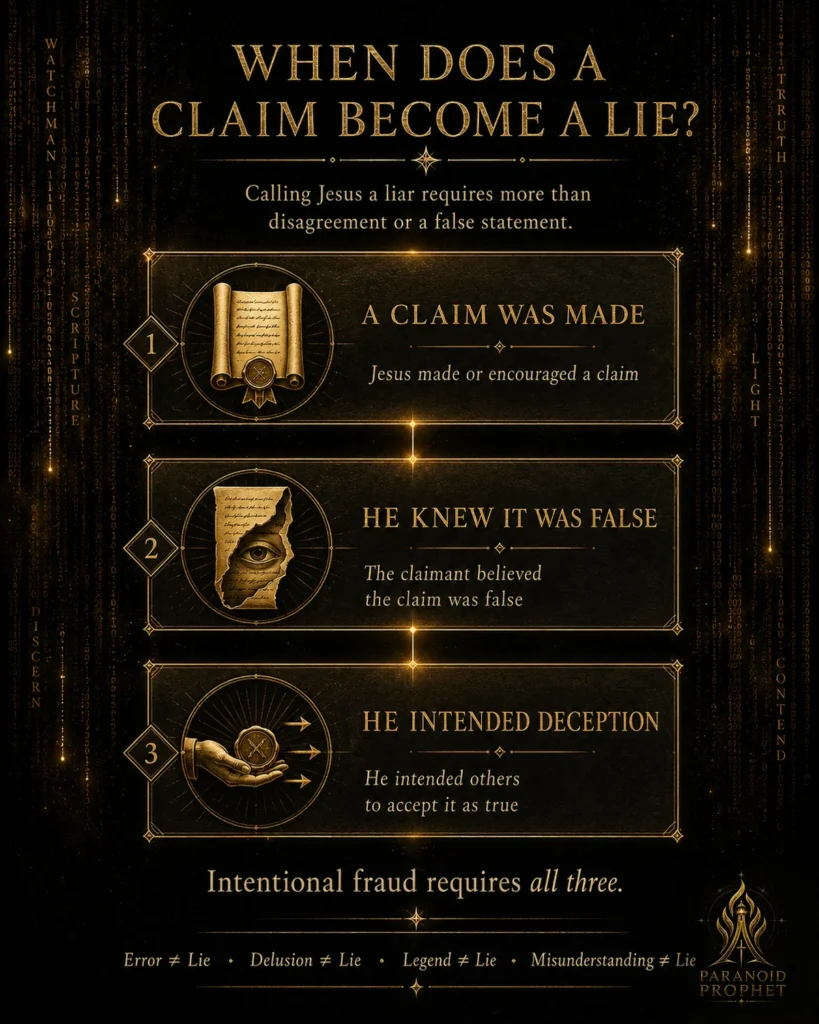
The second and third elements are decisive. A sincerely mistaken claimant belongs to the separate question of whether Jesus could have been deluded or mentally unstable. A claim created by later followers belongs to the legend theory. A metaphor misunderstood as literal belongs to interpretation. Intentional fraud requires knowledge and intent.
Jesus Was Accused of Deceiving People
The canonical Gospels do not hide the accusation that Jesus misled people. They preserve it openly.
In John 7:12, the crowds are divided. Some call Jesus a good man, while others answer, “No, he is leading the people astray.” The Greek verb planaō can mean to lead astray, deceive, or cause someone to wander from the correct path.
Later, when temple officers fail to arrest Him, the Pharisees ask in John 7:47, “Have you also been deceived?” After His death, the chief priests and Pharisees refer to Him in Matthew 27:63–64 as “that impostor” or “that deceiver.” The related noun planos describes someone regarded as leading others astray.
These passages show that the accusation is not a modern invention. It belongs to the conflict remembered within the Gospel narratives. Yet the limitation must remain clear: these are Christian writings reporting hostile speech. They establish that the accusation was preserved, not that independent non-Christian witnesses verified it.
What History Can and Cannot Establish
Historical inquiry can examine what the earliest sources claim Jesus said and did. It can compare traditions, study their dates and literary purposes, evaluate public settings, and ask whether the movement displays recognizable patterns of exploitation, concealment, or manipulation. It cannot directly enter Jesus’ consciousness. No surviving source gives us a private confession in which He admits constructing a scheme.
“Jesus knowingly lied” is therefore an explanatory judgment. The claim that He was sincere is also explanatory. Each must be tested by how well it accounts for the whole pattern.
This is why individual sayings require care. The Synoptic Gospels and John present Jesus through distinct literary and theological emphases. John presents Him in a distinctive theological and literary voice. Christian readers receive that testimony as Scripture, while historical-critical scholarship continues to debate how its extended discourses relate to the precise wording of Jesus’ public ministry.
It is also significant that conscious fraud is not the dominant explanation even among scholars who reject traditional Christian conclusions. Critical reconstructions more often portray Jesus as a sincere apocalyptic prophet, a Jewish restoration preacher, a charismatic healer, a mistaken claimant, or a figure whose memory was later developed by followers. Scholarly popularity does not settle the question, but it shows that the most serious alternatives usually lie elsewhere.
Sincerity alone is still not enough. People can hold false beliefs with complete conviction. Religious leaders can suffer for ideas that are mistaken. Moral integrity does not transform error into truth. Showing that Jesus does not fit conscious fraud clears one obstacle; it does not complete the case for His identity. The resurrection question later asks whether sincerity alone is enough to explain Him.
What Claims Would Have to Be Deliberate Lies?
The scale of the accusation becomes clearer when we examine the authority the Gospels attribute to Jesus. The alleged deception would not concern a minor prediction or an incidental detail at the edge of His ministry. It would reach into the center of who He claimed to be.

Authority to Forgive Sins and Rule the Sabbath
In Mark 2:1–12, friends lower a paralyzed man through a roof and place him before Jesus. Jesus first tells the man that his sins are forgiven. The scribes immediately recognize the theological weight of the declaration: “Who can forgive sins but God alone?” Jesus does not correct them by saying He merely means God may forgive the man later. Mark’s narrative connects the healing with Jesus’ declaration that “the Son of Man has authority on earth to forgive sins.”
A similar authority appears in Mark 2:23–28. When His disciples are criticized for plucking grain on the Sabbath, Jesus appeals to David and declares, “The Sabbath was made for man, not man for the Sabbath. So the Son of Man is lord even of the Sabbath.” This is more than an argument over one permitted action. Jesus places the purpose and interpretation of the Sabbath under the authority of the Son of Man.
These passages do not, by themselves, prove every miracle to a modern historian. They establish the kind of authority the Gospel attributes to Him. A fraud hypothesis must ask whether Jesus knowingly claimed prerogatives He believed He did not possess.
Daniel’s Son of Man
The title “Son of Man” has a range of uses in the Gospels, and scholars debate the authenticity and meaning of individual sayings. Not every use of the phrase should be treated as though it carries exactly the same force.
Its significance becomes especially clear in the trial scene. When the high priest asks whether Jesus is the Christ, the Son of the Blessed, Jesus answers in Mark 14:61–64 with language drawn from Daniel 7:13–14 and Psalm 110:1. He speaks of the Son of Man seated at the right hand of Power and coming with the clouds of heaven.
Daniel’s figure receives dominion, glory, and an everlasting kingdom. Psalm 110 places the Lord’s chosen ruler beside Him in authority. Mark’s narrative presents the high priest and assembled council as hearing Jesus’ response not as harmless poetry, but as a claim serious enough to provoke a charge of blasphemy. A conscious-fabrication theory must therefore explain whether Jesus knowingly adopted that scriptural role while believing it did not belong to Him.
The Way, the Truth, and the Life
John’s Gospel makes the claim even more personal. In John 14:6–9, Jesus does not merely say that He teaches a true path. He says, “I am the way, and the truth, and the life. No one comes to the Father except through me.” He then connects knowing Him with knowing the Father.
John is presenting a theological portrait of enormous depth. Christian readers receive that testimony as Scripture. Historical-critical scholarship still debates the relationship between John’s distinctive presentation and the precise form of Jesus’ spoken words. Even with that distinction, the claim cannot be reduced to generic ethical wisdom. John presents Jesus as personally decisive for access to God. If knowingly false, this would not be a small religious exaggeration. It would be a foundational deception about salvation and the Father.
What Would Jesus Have Gained—and How Would the Fraud Work?
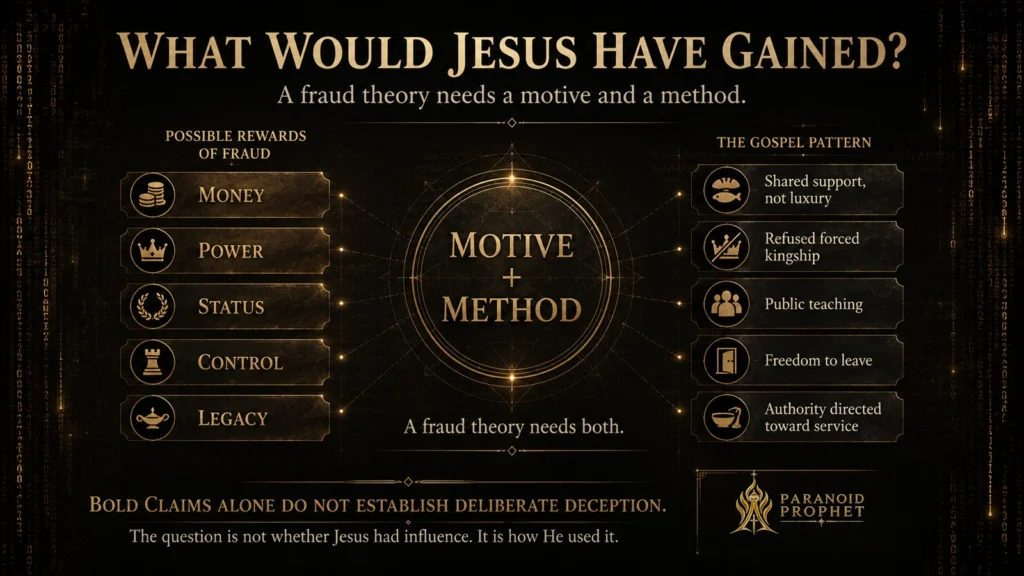
Bold claims do not explain themselves. If Jesus knowingly built His mission on falsehood, what reward made the risk worthwhile, and how would He have sustained the deception?
The obvious possibilities are money, political power, religious status, admiration, control over followers, social influence, or a legacy that would survive His death. None should be dismissed before it is tested. Deception is not always driven by luxury. Some people manipulate others for prestige, ideological success, or the satisfaction of being obeyed.
The question, then, is not whether Jesus possessed influence. He plainly did. The question is how He used it and whether the Gospel narratives show Him pursuing the ordinary rewards and protective mechanisms of religious fraud.
Money and Material Support
A weak defense of Jesus would claim that no money passed through His ministry. The Gospels say otherwise.
Luke 8:1–3 names Mary Magdalene, Joanna, Susanna, and other women who supported Jesus and the Twelve “out of their means.” John also refers to a common moneybag. In John 12:4–6, Judas is identified as the one who kept it. In John 13:27–29, some disciples assume Jesus has told Judas to purchase what the group needs for the feast or to give something to the poor.
Those details should not be minimized. Jesus received support, traveled with a group, and participated in a movement with shared resources. The relevant question is what He did with them.
The canonical narratives do not portray Him accumulating property, building a private estate, securing comfort for relatives, or converting gifts into a luxurious lifestyle. There is no Gospel scene in which Jesus pressures followers to enrich Him while insulating Himself from hardship. Instead, Matthew 8:18–20 presents Him warning a would-be follower that “the Son of Man has nowhere to lay his head.”
That statement is not proof of absolute destitution. Jesus ate in homes, accepted hospitality, and traveled with supporters. An austere lifestyle can itself create moral authority and attract devotion. Still, money moved through the ministry, and the story does not center on Jesus turning it into personal wealth, luxury, sexual access, dynastic privilege, or protected comfort. Judas—not Jesus—is the figure John associates with stealing from the common fund.
Political Power, Glory, and Legacy
Jesus preached the kingdom of God and was eventually executed under a royal accusation. His message was not merely private advice about becoming kinder. Yet the narratives repeatedly distinguish His kingdom from ordinary seizure of power.
After the feeding of the multitude, the crowd identifies Jesus as the expected prophet. John 6:14–15 says that Jesus recognized they were about to take Him by force and make Him king. He withdrew to the mountain alone. If conventional political rule were His goal, this was an extraordinary opportunity. A large, excited crowd was prepared to elevate Him, yet He did not organize an armed following, seize territory, or consolidate a popular throne.
That does not mean Jesus rejected kingship altogether. The Gospels present Him as Messiah and King. The narrower point is that He refused kingship through uncontrolled popular force, coercion, or military mobilization.
Religious status is another possible reward. A person may desire to be revered as a prophet, obeyed as a teacher, or remembered as the founder of a movement. John’s Gospel addresses this motive directly. In John 7:14–18, Jesus contrasts the person who speaks on his own authority and seeks his own glory with the one who seeks the glory of the Sender.
A skeptic may reasonably answer that deceptive leaders often speak in the language of humility. Claiming to serve God can become an effective means of elevating oneself. The harder question is whether the remembered pattern supports self-advancement. Jesus does not flatter the religious establishment to secure acceptance. He does not soften His criticism when status is at risk. He receives public acclaim at moments, but He also withdraws, confronts crowds, and permits His reputation to collapse among former followers.
Legacy remains possible. A person may accept suffering if he believes history will remember him. Yet a legacy theory must explain why Jesus attached His mission to claims that appeared to end in public disgrace. Roman crucifixion did not preserve the dignity of defeated claimants. It displayed them as warnings.
Public Teaching and the Freedom to Leave
If Jesus were maintaining a fabricated identity, method would matter as much as motive. A fraud theory centered on manipulation would naturally look for controlled access to information, protected inner-circle privilege, retention at almost any cost, or authority directed toward the leader’s security.
During His questioning before the high priest, Jesus answers in John 18:19–23, “I have spoken openly to the world. I have always taught in synagogues and in the temple, where all Jews come together. I have said nothing in secret.” Jesus plainly did teach His disciples privately; the Gospels record private explanations, warnings, and intimate conversations. His point concerns the core of His public mission. John remembers Jesus appealing to teaching given in open settings where opponents could hear Him.
That public exposure is uncomfortable for a theory built mainly on hidden doctrine or inaccessible revelation. Public teaching does not guarantee truth, but it weakens a model that depends on Jesus hiding the substance of His mission from scrutiny.
John 6 presents another test. After a difficult teaching, many disciples complain that the saying is hard. John 6:60–71 says that many turned back and no longer walked with Jesus. The narrative does not show Him immediately replacing the disputed teaching with something easier. He turns to the Twelve and asks, “Do you want to go away as well?”
A leader dependent on numbers might be expected to manage the crisis by lowering the cost, flattering the remaining group, or portraying departure as impossible. John instead presents a moment in which continued discipleship is chosen in the face of a hard saying. The scene fits poorly with a retention strategy that depends on making every message acceptable whenever the crowd begins to shrink.
Authority Directed Toward Service
Jesus is not presented as merely gentle, agreeable, or passive. He commands, judges, rebukes, forgives, calls people to repentance, and speaks with sovereign authority. Any portrait that removes those features weakens the biblical witness.
Yet the direction of His authority matters. When Peter rejects the prediction of suffering, Jesus rebukes him sharply in Mark 8:31–33. When the disciples argue over who is greatest, Mark 9:33–37 presents Jesus placing a child among them and redefining reception of the lowly as reception of Himself. When James and John seek honored seats, Mark 10:35–45 shows Jesus rejecting the status model behind the request and contrasting His way with rulers who “lord it over” others.
A manipulator can certainly rebuke followers. Harsh correction can create fear and deepen dependence. The issue is the direction of Jesus’ correction. He confronts the desire for rank, the pursuit of protected privilege, the rejection of suffering, the dismissal of the weak, and the temptation to imitate dominating rulers. He does not promise the Twelve an easy ruling class while demanding sacrifice only from everyone else.
The same pattern reaches its clearest symbolic expression in John 13:1–17. Jesus rises from the meal, lays aside His outer garments, takes a towel, and washes the disciples’ feet. The act does not deny His status. John says that He knew the Father had given all things into His hands, that He had come from God, and that He was returning to God. The One who knows His authority uses it to kneel before His disciples.
The pattern fits awkwardly with a man using divine claims mainly to secure ordinary dominance, privilege, or comfort. Ordinary self-interest fits poorly. A stronger possibility remains: Jesus may have deceived for a cause rather than for comfort.
The Strongest Alternative: Could Jesus Have Used a Noble Lie?
The strongest version of the liar theory does not imagine Jesus as a greedy confidence man. It imagines a reformer who deceived for a cause.

Perhaps Jesus believed Israel needed moral renewal so urgently that strategic exaggeration seemed justified. Perhaps He saw Himself as a genuine prophet or reformer but allowed His followers to attribute more authority to Him than He privately believed He possessed. Perhaps He used symbolic claims, messianic expectation, or reported signs to force a national decision. On this theory, the deception served repentance, justice, restoration, or the kingdom of God rather than personal luxury.
That form of the objection deserves careful treatment because it can explain why Jesus accepted hardship. A reformer may suffer willingly for a movement he has partly constructed. He may believe the cause is true even while using methods he knows are not.
What Would a Noble Lie Mean?
A noble-lie theory does not require Jesus to believe that everything He taught was false. He may have sincerely believed that God had called Him to confront corruption, announce judgment, gather Israel, and awaken hope. The alleged falsehood would lie in the gap between that sincere mission and the higher identity, authority, or expected vindication He encouraged others to accept.
That theory could take several forms. Jesus may have knowingly allowed others to treat Him as more than a prophet. He may have used messianic language strategically while privately doubting that the role belonged to Him. He may have allowed reported signs, symbolic actions, or expectations of divine vindication to authorize a reform movement whose central claims exceeded what He Himself believed.
This differs from delusion, in which a claimant fully believes what he says. It differs from legend, in which followers develop higher claims later. It also differs from sincere failed expectation, in which Jesus truly expected God to act but was mistaken. The noble-lie theory requires both sincerity and deception: sincerity about the cause, deception about some central part of the claim.
Reform, Hypocrisy, and Messianic Ambiguity
The Gospels unmistakably present Jesus as a reformer. He calls for repentance, mercy, justice, faithfulness, reconciliation, and wholehearted love for God. He confronts religious leaders who preserve outward respectability while neglecting the weightier demands of righteousness.
In Matthew 23:13–36, Jesus condemns leaders who appear righteous outwardly while concealing corruption within. Sacred authority is being used to hide moral contradiction and burden others. In Matthew 5:33–37, He rejects verbal mechanisms used to manage truthfulness and calls for plain speech: let “Yes” mean yes and “No” mean no.
None of this logically establishes that Jesus never lied. Deceivers can condemn deception. A manipulator might use uncompromising moral language precisely to make scrutiny seem unnecessary. But explanatory fit matters. The theory requires Jesus’ reform against concealed religious corruption to rest on the same hidden corruption. His strongest moral accusations would be aimed at others while He privately maintained a contradiction at the heart of His own authority.
The objection may answer that Jesus did not need to state everything directly. He taught in parables, used symbolic actions, spoke of the Son of Man in layered ways, and frequently left hearers divided. His disciples misunderstood Him repeatedly. Crowds interpreted His signs politically. Even His closest followers struggled to understand His predictions of rejection and death.
Those features are real. Jesus’ language is not equally explicit in every tradition. The title “Son of Man” has several possible shades of meaning. Parables reveal and conceal. Messianic expectation could intensify the movement around Him.
Yet the same narratives also present Jesus correcting the misunderstandings that would have strengthened an ordinary power movement. He withdraws when a crowd attempts to force kingship upon Him. He rebukes Peter for rejecting the path of suffering. He refuses the disciples’ model of ruling greatness. He predicts rejection rather than uncomplicated national triumph. Strategic ambiguity might explain why some people misunderstood Him; it leaves unresolved why He repeatedly disrupted the very misunderstandings that would have helped the strategy.
Could Signs Have Been Manipulated?
A critic might focus less on words and more on signs. Some healings could be interpreted as psychosomatic. Exorcisms took place within ancient expectations. Symbolic acts may have grown in the retelling. A stronger version argues that Jesus knowingly used claims of sacred power to authenticate His mission.
The pagan critic Celsus later pressed a related accusation. His work survives through Origen’s Against Celsus, Book I. Celsus alleged that Jesus accomplished His wonders through sorcery. He wrote too late to provide eyewitness evidence that Jesus staged healings or practiced magic. His value is narrower: he shows that a pagan opponent could reclassify Christian wonder claims rather than simply deny them.
Morton Smith developed a prominent modern version of the magician interpretation in his 1978 study, Jesus the Magician: Charlatan or Son of God?. Smith attempted to interpret Jesus through ancient categories of healing, exorcism, and magic, though his reconstruction did not become the dominant scholarly portrait.
Reclassifying the signs may alter one category of evidence. It does not explain Jesus’ teaching, authority, treatment of followers, refusal of coercive power, and conduct under pressure.
Why the Noble-Lie Theory Still Struggles
The noble-lie theory is stronger than the claim that Jesus simply wanted money or comfort. It can explain why a reformer might accept poverty, risk, opposition, symbolic speech, and even an expectation that God would eventually vindicate the cause. But its strength creates new burdens.
It must explain why a reform against hypocrisy would be built on concealed hypocrisy, why Jesus would correct political misunderstandings if those misunderstandings helped the strategy, why He would disclose rejection and suffering instead of uncomplicated triumph, and why He would continue when the plan moved toward public disgrace. The theory becomes most plausible if Jesus expected Jerusalem to produce divine intervention. That possibility moves the investigation toward its hardest point: what happened when opposition became arrest, and expectation gave way to the apparent finality of the cross?
The Trial and Cross Test the Liar Theory
Trials do not automatically reveal truth, and suffering does not sanctify every claimant. Yet pressure can expose the structure of a deception. When safety, reputation, influence, and control disappear, a fabricated mission may produce confession, revision, escape, or blame. The passion narratives instead preserve continuity between Jesus’ public mission and His conduct as death approaches.

What Does Mark Say His Accusers Exposed?
Mark 14:55–65 presents the chief priests and council seeking testimony against Jesus. Many speak, but their accounts do not agree. A charge concerning the temple appears, yet the testimony remains inconsistent. The high priest finally turns from disputed witness statements to Jesus Himself: “Are you the Christ, the Son of the Blessed?” The climactic conflict concerns His identity.
Mark’s narrative does not read like investigators uncovering stolen funds, staged healings, secret indulgence, or a private confession of manipulation. It presents a conflict over authority, the temple, Messiahship, and Jesus’ place in God’s rule. That does not establish that the proceedings were fair or that every historical detail can be recovered with modern precision. It means Mark does not narrate the passion as the exposure of a conventional religious scam.
Gethsemane Shows Genuine Anguish and Obedience
The Gospels do not portray Jesus moving toward death with theatrical ease. In Matthew 26:36–46, He enters Gethsemane and tells Peter, James, and John that His soul is deeply sorrowful. He falls before the Father and asks whether the cup may pass from Him.
This is not emotional numbness. Jesus understands the terror before Him. The scene allows no shallow argument that a truthful man would feel no fear or that divine obedience removes human anguish. A critic might read the prayer as evidence that the plan had failed. Perhaps Jesus expected rescue and now recognized that events had moved beyond His control. Perhaps the fear belonged to a reformer discovering too late that symbolic confrontation had become fatal.
Anguish alone settles none of those possibilities. Fear of death is compatible with innocence, error, deception, courage, and weakness.
The more important feature is what governs the anguish. Jesus does not confess that His claims were fabricated. He does not tell the disciples that the mission was an exaggeration. He does not abandon the Father, order an escape, or shift responsibility onto His followers. He prays, “Not as I will, but as you will.” The cup is not embraced because suffering is pleasant. It is accepted through obedience.
Matthew and Mark therefore present Jesus facing the consequences of His mission with full emotional seriousness while remaining committed to the Father’s will. That does not independently establish His deity. It weighs against the picture of a man scrambling to protect a deception once the danger becomes real.
Kingship and Truth Before Pilate
John’s passion narrative continues the same themes established earlier in the Gospel. In John 18:33–38, Pilate asks Jesus whether He is the King of the Jews. Jesus does not simply deny kingship. He distinguishes His kingdom from a rule advanced through ordinary armed defense. If His kingdom operated from the same source as worldly regimes, His servants would fight to prevent His arrest.
Jesus then describes His mission as bearing witness to the truth. John presents this exchange in his distinctive theological voice, not as a modern stenographic transcript. Within the narrative, however, Jesus interprets His kingship consistently with the pattern already established. He claims authority without mobilizing His followers to preserve Him through force. He speaks of truth when truthfulness can no longer secure popularity, comfort, or release.
The Cross Does Not Prove Honesty—but It Pressures the Fraud Theory
Liars can die. Ideological deceivers can remain committed to a cause. Failed leaders may refuse to confess because of pride, shame, loyalty, self-deception, or hope for a posthumous legacy. Execution does not transform a false claim into truth.
Jesus’ crucifixion, by itself, cannot prove that every saying attributed to Him is authentic. It cannot prove His divine identity. It cannot establish the resurrection. Its apologetic force in this article is more limited: it tests whether the conscious-fraud theory fits the direction and outcome of His mission.
Roman crucifixion was designed to destroy more than the body. It humiliated the condemned, displayed imperial power, and warned others against following the same path. For Jesus, the cross meant apparent disconfirmation. The proclaimed kingdom did not arrive through visible political triumph. The crowd did not enthrone Him. His disciples scattered. His public reputation was subjected to mockery. He lost ordinary control over the movement and received no visible earthly reward.
A fraud theory can survive this outcome, but it must add further explanations. Perhaps Jesus expected rescue and miscalculated. Perhaps He intended His death to become a symbol that followers would later use. Perhaps He believed public suffering would catalyze reform. Perhaps He lost control of a movement that had grown beyond His original plan. Perhaps He expected a legacy even if He did not expect resurrection.
None of those possibilities is logically impossible. But the more the theory depends on unrecorded motives, last-minute expectations, and posthumous strategy, the less securely it rests on the sources themselves. The passion narratives preserve something simpler and more coherent: Jesus anticipates rejection, confronts religious authority, refuses coercive kingship, experiences real anguish, submits to the Father, maintains His identity, and goes to the cross.
The crucifixion does not establish that He told the truth. It does mean that the alleged deception carried Him toward public shame, loss of control, and death without the ordinary rewards such a scheme was expected to produce.
What Costly Witness Can—and Cannot—Prove
After Jesus’ death, His followers did not preserve only His ethical teaching or remember Him merely as a courageous reformer. They proclaimed that God had raised Him from the dead. Some of those proclaimers endured imprisonment, violence, exclusion, and death. That evidence matters, but it must be used carefully.
Suffering Supports Sincerity More Directly Than Truth
The slogan “no one dies for a lie” is too broad. People may die for false claims they sincerely believe. They may also remain loyal because of shame, group pressure, hope, pride, or fear of admitting error. Costly endurance supports a more limited conclusion: when someone close to the origin of a claim persists through serious loss while continuing to proclaim it, that persistence weighs against the idea that he regarded the message as a disposable invention created for easy advantage.
Even then, the evidence must be weighed by source quality. How close was the person to the origin of the claim? Did he claim firsthand knowledge or inherit the belief? What kind of suffering is securely documented? Was the suffering connected to the movement’s proclamation? Do the sources preserve an opportunity to recant? The evidence is not equal for every apostle, and later martyrdom traditions should not be treated as though they all carry the same historical weight.
The Strongest Early Anchors
Paul is the strongest starting point because his suffering is described in his own letters rather than only in later accounts about him. In 2 Corinthians 11:23–28, Paul reports imprisonments, beatings, stoning, danger, sleeplessness, hunger, exposure, and continuing pressure from concern for the churches. In 1 Corinthians 15:30–32, he connects his willingness to face danger with resurrection hope.
Acts gives another early biblical anchor. Acts 12:1–2 reports that Herod killed James, the brother of John, with the sword. Acts does not preserve James’s final speech, describe an offer of release, or give his last words. It does show that lethal opposition reached a leading apostle early in the movement.
An early Christian source, 1 Clement 5, places Peter and Paul among examples from the writer’s own recent generation. Peter is remembered as enduring repeated labors and bearing his testimony. Paul is remembered for bonds, exile, stoning, public testimony, and patient endurance before departing from the world. First Clement does not say that Peter was crucified upside down or that Paul was beheaded; those details depend on later traditions.
James, the brother of Jesus, provides another important anchor. Paul names an appearance to James in 1 Corinthians 15:7, identifies him as “the Lord’s brother” in Galatians 1:18–19, and later includes him among recognized Jerusalem leaders in Galatians 2:1–10. Josephus reports in Antiquities 20.200 that Ananus brought forward “the brother of Jesus who was called Christ, whose name was James,” accused him and others as lawbreakers, and delivered them to be stoned. Josephus anchors James’s identity and violent death, but he does not connect that death explicitly to a refusal to deny a resurrection appearance.
The Broader Martyrdom Evidence Is Uneven
Later traditions describe the missions and deaths of Andrew, Thomas, Bartholomew, Matthew, Simon, Jude, Matthias, and others. Some may preserve authentic ancient memory. Others appear late, conflict with competing traditions, or cannot be traced to independent early testimony. It is therefore historically careless to claim that every apostle certainly died as a martyr after being offered release for denying a personally witnessed resurrection appearance.
The strongest evidence supports a more disciplined conclusion: Paul’s letters document serious suffering; Acts reports the execution of James son of Zebedee; First Clement remembers Peter and Paul enduring witness through death; and Josephus independently records the stoning of James, Jesus’ brother. The wider traditions contribute to a cumulative picture, but they do not all deserve equal confidence. The detailed evidence tiers are examined separately in the evidence for the apostles’ deaths and costly witness.
Their suffering belonged to a movement whose central proclamation was not merely that Jesus had taught noble ethics, but that the crucified Jesus had been raised. Cost can test sincerity. It cannot raise the dead.
The Resurrection Changes the Verdict
If Jesus remained dead, the liar theory might still fit poorly. The sources could continue to portray Him as morally serious, resistant to ordinary exploitation, consistent under pressure, and willing to suffer for His mission. But a sincere man can still be wrong. The New Testament does not end with admiration for a dead teacher. It proclaims that God raised Him.
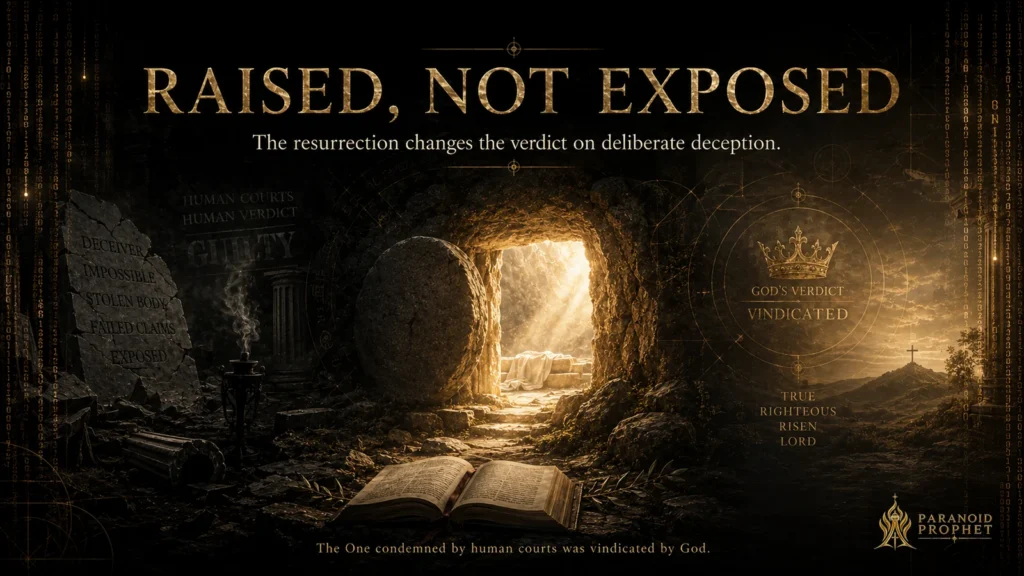
The Earliest Christian Proclamation Centered on Death and Resurrection
In 1 Corinthians 15:3–8, Paul reminds the Corinthians of what he had received and delivered as of first importance: Christ died for sins according to the Scriptures, was buried, was raised on the third day according to the Scriptures, and appeared to named individuals and groups.
The language of receiving and delivering is important. Paul does not present the core message as a private theory he created in Corinth. He describes himself as handing on a proclamation he had received. The formulaic structure has led many scholars to recognize at least the central lines concerning Jesus’ death, burial, resurrection, and appearance to Cephas as tradition predating the letter. The exact date, place, and extent of each pre-Pauline line remain debated, but the secure conclusion is substantial: Paul was not inventing the resurrection proclamation from nothing when he wrote to Corinth.
Paul, Cephas, James, and the Named Appearances
Paul’s resurrection message was not isolated from Jerusalem leaders associated with Jesus’ first followers. In Galatians 1:18–19, Paul says that after three years he went to Jerusalem to visit Cephas and stayed with him for fifteen days. He also met James, the Lord’s brother. Later, in Galatians 2:1–10, Paul describes another meeting involving James, Cephas, and John, whom he calls recognized pillars.
Those contacts do not mean that Paul and the Jerusalem leaders agreed on every practical or theological question. Galatians itself preserves serious conflict. Nor does Paul describe a modern forensic interview in which every appearance detail was independently verified. The letters nevertheless place him in direct contact with Cephas and James, weakening the theory that Paul independently created a resurrection religion disconnected from the earliest Jerusalem movement.
The named appearances require careful weighting. Paul’s own claimed experience is central because it appears in his letters and is tied to the redirection of his life. Cephas and James are especially significant because Paul names them in the appearance tradition and also reports personal contact with them. The reference to more than five hundred believers is biblically important because Paul includes it, but historically harder to evaluate. Paul supplies no location, list of names, or additional narrative, and no surviving independent source describes the same group event in comparable detail. The claim shows that Paul knew a broad group-appearance tradition; it should not be presented as though historians possess five hundred separately documented interviews.
Paul and James do not independently establish resurrection. They do anchor the appearance proclamation within the first generation and connect it to figures personally known within the earliest movement.
History Establishes Earliness; Scripture Declares Vindication
Historical study can ask when the resurrection proclamation appeared, which sources preserve it, whom they name, and how closely key leaders were connected to the movement’s origin. On those questions, the evidence is strong. Paul’s letters are early. He preserves received resurrection tradition, claims his own experience, and reports direct contact with Cephas and James. Resurrection belief belongs to Christianity’s first generation, not to a medieval legend that gradually replaced an earlier message about a merely dead teacher.
The historical task becomes more contested when it moves from the existence of the belief to its ultimate cause. Historians can establish that early Christians believed Jesus appeared to them. Evaluating whether God raised Him also involves assumptions about whether divine action is possible. History can identify an early, named, costly resurrection proclamation. Scripture declares what that proclamation means.
The resurrection is not presented as a final promotion that turned a merely human teacher into the Son of God. Paul already identifies Jesus as God’s Son. In Romans 1:3–4, the gospel concerns God’s Son, descended from David according to the flesh and declared to be the Son of God in power according to the Spirit of holiness by His resurrection from the dead.
The resurrection reveals and vindicates Jesus in power. The One condemned by human courts is raised by God. The One mocked as king is shown to be Lord. The crucifixion is not erased; its meaning is unveiled through God’s victory over death.
Paul makes Christianity’s dependence on this event explicit in 1 Corinthians 15:12–19. Without resurrection, apostolic preaching is empty, faith is futile, the witnesses misrepresent God, and believers remain in their sins. Christianity does not ask readers to admire Jesus while treating Easter as optional symbolism. Resurrection stands at the center of the claim that Jesus truly is who He said He is.
At the level of historical argument, the conclusion can be stated conditionally: if the resurrection proclamation corresponds to what God actually did, then deliberate deception is no longer a viable explanation of Jesus. The New Testament does not remain at the level of condition. It proclaims that God raised Him.
Frequently Asked Questions
Was Jesus accused of being a deceiver during His lifetime?
Yes. The Gospel narratives preserve accusations that Jesus was misleading people. In John 7:12, some in the crowd say that He was leading people astray. The Pharisees raise a similar charge in John 7:47, and Matthew records Jesus’ opponents calling Him a deceiver after His death in Matthew 27:63–64. These are Christian texts preserving hostile speech, not independent proof that Jesus deceived anyone.
Could Jesus have lied for a good cause rather than personal gain?
That is the strongest version of the liar theory. It imagines Jesus sincerely wanting Israel’s renewal while knowingly exaggerating His identity, authority, signs, or expected vindication because He believed the larger cause justified the method. This explains why a deceiver might reject wealth and accept suffering. But it creates a serious tension: Jesus’ reform repeatedly condemns concealed religious corruption. The theory depends on a hidden contradiction at the center of His own mission.
Does Jesus’ willingness to die prove He was truthful?
No. Liars can die, and sincere people can suffer for false beliefs. Crucifixion does not automatically prove Jesus’ deity, establish the resurrection, or authenticate every saying attributed to Him. Its narrower significance is that Jesus’ mission ended in humiliation, apparent disconfirmation, loss of control, and death rather than the ordinary rewards expected from a successful fraud. The cross weighs against easy self-interest, but the Christian case ultimately depends on God raising Jesus from the dead.
Did all the apostles die rather than deny the resurrection?
The evidence is uneven. Paul personally reports severe suffering. Acts records the execution of James, the brother of John. 1 Clement remembers Peter and Paul as enduring witness through persecution and death. Josephus independently reports the stoning of James, the brother of Jesus. Later apostolic death traditions vary in date, detail, and reliability. The evidence does not justify claiming that every apostle received a documented opportunity to recant. See the evidence for the apostles’ deaths and costly witness.
Could Jesus have been sincere but mistaken?
Yes. That is a different theory from deliberate deception. A liar knows a central claim is false and intends others to believe it. A sincerely mistaken person believes the claim himself. Evidence of Jesus’ moral seriousness, suffering, and consistency under pressure may weigh against conscious fraud without proving He could not have been mistaken. That separate question is examined in Was Jesus a Madman? The resurrection is the decisive divide because Christianity claims God publicly vindicated Jesus.
What is the strongest evidence against the liar theory?
No single slogan settles the question. The force lies in the whole pattern: Jesus does not fit a stable profile of personal enrichment, political seizure, protected inner-circle privilege, or retreat from scrutiny. He taught publicly, allowed followers to leave, corrected ambition, directed authority toward service, confronted hypocrisy, and maintained His mission as earthly rewards vanished. Early leaders preserved a resurrection proclamation through serious cost. The decisive Christian claim is greater than character: God raised Jesus from the dead.
Continue the case: This article addresses one specialist objection: whether Jesus knowingly deceived His followers. The larger identity question is examined in Was Jesus a Liar, Lunatic, Legend, or Lord? The separate question of sincere delusion belongs in Was Jesus a Madman? For broader context, continue with the historical evidence for Jesus, apostolic costly witness, and the cumulative case that Jesus is the Son of God.
Sources and Further Reading
This article begins with Scripture as the final authority for who Jesus is. Ancient sources and modern scholarship are used to clarify historical context, competing explanations, and evidential limits. A link identifies the source being discussed; it does not imply agreement with every conclusion reached by that author.
Primary Biblical Texts
- Jesus’ authority and identity claims: Mark 2; Mark 14:55–65; John 14:6–9; John 18:33–38.
- Accusations, motive, and public conduct: John 6–7; Luke 8:1–3; Mark 10:35–45.
- Truthfulness, hypocrisy, obedience, and the cross: Matthew 5:33–37; Matthew 23:13–36; Matthew 26:36–46; Mark 15.
- Costly witness and resurrection proclamation: 1 Corinthians 15; 2 Corinthians 11; Galatians 1–2; Romans 1:3–4.
Primary Ancient Sources
- Josephus, Jewish Antiquities 20.200: identifies James as the brother of Jesus who was called Christ and reports his stoning.
- 1 Clement 5: remembers Peter and Paul as examples of endurance, testimony, persecution, and death.
- Origen, Against Celsus, Book I: preserves and answers Celsus’s later accusation that Jesus’ reported wonders should be classified as sorcery.
Focused Scholarly Works
- Dale C. Allison Jr., The Resurrection of Jesus: Apologetics, Polemics, History: a careful study of resurrection evidence, historical method, and competing explanations.
- E. P. Sanders, The Historical Figure of Jesus: a major historical-Jesus study placing Jesus within first-century Judaism.
- Paula Fredriksen, When Christians Were Jews: The First Generation: a study of the earliest Jerusalem movement and first-generation Christian proclamation.
- Bart D. Ehrman, How Jesus Became God: a major critical conversation partner on early Christian claims about Jesus.
- N. T. Wright, The Resurrection of the Son of God: a large historical and theological argument concerning ancient resurrection belief and Christian origins.
- Morton Smith, Jesus the Magician: Charlatan or Son of God?: a prominent attempt to interpret Jesus through ancient categories of magic, healing, and exorcism.
The Final Verdict: Jesus Is the Truth and the Lord
The Gospel portrait does not fit deliberate deception.
The liar theory explains why Jesus’ opponents might accuse Him of misleading people and why extraordinary claims invite suspicion. Its strongest form can even explain how a reformer might reject wealth, accept hardship, and use symbolic language while privately believing that strategic falsehood served a greater cause. The theory should not be dismissed merely because Jesus suffered or taught against hypocrisy.
Yet the central pattern remains difficult for that theory. The canonical narratives acknowledge that Jesus received support and exercised extraordinary influence, but they do not present Him converting those things into personal luxury, political seizure, sexual exploitation, dynastic privilege, or safety for an insulated inner circle. He refused forced kingship, corrected status ambition, taught publicly, permitted followers to leave, and directed authority toward service rather than ordinary domination.
The noble-lie version faces a deeper tension. It requires the central opponent of concealed religious corruption to establish His own reform through a hidden division between public claim and private belief. It also asks us to suppose that Jesus corrected useful political misunderstandings, predicted suffering that weakened easy triumphalism, and maintained His identity as arrest and execution removed the visible rewards of the alleged strategy.
These observations do not turn moral character into proof of deity. History cannot inspect Jesus’ private consciousness. Crucifixion does not prove honesty. Suffering does not make a belief true. Early resurrection belief does not become a demonstrated miracle merely because it appeared early. The measured conclusion is that conscious fraud fits the available pattern poorly.
To sustain it as the best explanation, one must add a private ideological motive, strategic exaggeration, carefully managed ambiguity, manipulated signs, an expectation of rescue, and perhaps a posthumous legacy plan. Each proposal can be imagined. Together they create a reconstruction increasingly dependent on intentions and mechanisms the surviving sources never clearly reveal.
Everything turns on the resurrection. If Jesus remained dead, the case might show that He was not an ordinary religious fraud while still leaving room for sincere error. If God raised Him, the verdict changes completely. God would be reversing the judgment of earthly courts and publicly vindicating the identity and mission for which Jesus was condemned. Deliberate deception could no longer account for Him.
The New Testament does not stop at the conditional. It proclaims that Jesus Christ was raised from the dead.
Jesus is not merely a teacher whose private honesty survived historical scrutiny. He is the eternal Son who came from the Father, spoke the words of the Father, and gave Himself for sinners. Human courts condemned Him, Roman power crucified Him, and His followers scattered—but God raised Him from the dead. The One who washed His disciples’ feet now reigns as Lord. The One who said He came to bear witness to the truth calls every reader to believe Him, follow Him, and submit to His kingdom. Jesus is not a failed deceiver preserved by devoted followers. He speaks the truth because He is the Truth.
CONTINUE THE INVESTIGATION
Return to the central case
Was Jesus a Liar, Lunatic, Legend, or Lord? The Identity of Christ
Return from the focused deception objection to the broader comparison of the major explanations.