
GUIDED ARTICLE EXPERIENCE
Prophecies About Jesus’ Ministry: The Messiah’s Mission, Kingdom, and Signs
Read along as the narration moves through the article.
Private device narration · No hosted audio or tracking
CONTINUE GUIDED TOUR
Continue where you left off.
GUIDED TOUR COMPLETE
You have reached the end of this study.
Study record saved on this device.
GUIDED TOUR
Prophecies About Jesus’ Ministry: The Messiah’s Mission, Kingdom, and Signs
Narrator: Paranoid Prophet Recommended Voice Native device narration
Prepare to follow the article as it is narrated.
VOICE & TOUR OPTIONS
Voice & Listening
NARRATOR
Finding a narrator…
Checking the best narrator available on this device.
Restores the best curated narrator available on this device.
Narrator choices are curated for clear, long-form listening on this device.
Screen-awake support will be checked when narration starts.
CHOOSE A NARRATOR
Curated for this device
Choose a verified narrator for this browser, or use System Narrator. Automatic mode uses the best reliable route exposed by this device; your chosen narrator is preserved even if this device needs a temporary fallback.
Preparing the guided article experience…
RESUME GUIDED TOUR?
Continue where you left off.
GUIDED TOUR COMPLETE
You have reached the end of this study.
Prophecies about Jesus’ ministry do not present a detached checklist of isolated predictions. They prepare readers for a Messiah whose public mission brings good news to the poor, release to the burdened, restoration to the broken, light in places of darkness, justice marked by mercy, and salvation that reaches beyond Israel to the nations.
The Gospels present Jesus’ ministry as the fulfillment and climax of that scriptural mission. His works are not merely impressive displays of power. They are signs that God’s promised kingdom has drawn near in the Messiah’s person and work.
Some Old Testament passages are directly applied to Jesus by the Gospel writers or apostles. Others establish the larger scriptural patterns through which the New Testament explains His preaching, healing, teaching, and kingdom mission. Christians do not need to make every passage function in exactly the same way to see that Israel’s Scriptures converge meaningfully in Jesus.
For the wider framework of promise, fulfillment, typology, and debated texts, see Prophecies of Jesus Fulfilled in Scripture.
Article Guide13 sections
What Do Prophecies About Jesus’ Ministry Say?
The Old Testament prepares readers for more than a ruler who arrives with political force. It anticipates God’s restoring work among His people: good news proclaimed to the poor, captives released, the afflicted comforted, the blind and lame restored, justice brought to the nations, and light dawning in places long marked by distress.
Jesus’ ministry takes shape within that world of expectation. He preaches the kingdom of God, heals the sick, restores those pushed to the margins, confronts evil, teaches with authority, and calls people to repentance and faith. The Gospels interpret those acts through Scripture because they believe God’s promised restoration has begun in Him.
This article focuses on that public ministry. It does not attempt to repeat the full case for Jesus’ divine identity, His crucifixion, or His resurrection. Those questions belong in their own specialist pages. Here, the question is narrower: how do the Scriptures frame the Messiah’s mission, and how do the Gospels present Jesus as fulfilling it?
The answer begins with Jesus’ own public reading of Scripture in Nazareth. In Luke 4, He does not merely select a comforting passage for a synagogue sermon. He identifies the mission announced by Isaiah with the mission He has come to fulfill.
How This Article Uses “Fulfillment”
A careful reading begins with the Old Testament text in its own setting before asking how the New Testament applies it to Jesus. That matters especially here, because a ministry article can easily turn every healing or act of compassion into a separate prediction claim.
- Explicit New Testament application: A Gospel writer or apostle directly applies an Old Testament passage to Jesus.
- Kingdom-sign convergence: Jesus’ works correspond to a wider prophetic vision of restoration without functioning as a one-miracle-per-verse prediction chart.
- Servant-mission pattern: The Messiah’s gentleness, justice, and mission to the nations are understood through Isaiah’s Servant language.
- Prophetic-authority pattern: Jesus is identified with a promised role, such as the Prophet like Moses, that clarifies His mission and summons hearers to listen to Him.
- Text requiring care: A serious Christian reading may remain persuasive while questions of citation form, original context, or fulfillment language still require humility.
These categories do not diminish confidence in Christ. They help readers see what the Gospels are actually doing. Luke 4 does not reproduce Isaiah 61 as a mechanical, word-for-word quotation. Jesus’ answer to John the Baptist draws on a cluster of Isaianic restoration signs. Matthew’s use of Isaiah 42 joins compassion and justice rather than reducing Jesus’ ministry to a collection of sentimental scenes.
The stronger Christian claim is that Scripture provides the categories and hope; Jesus’ public ministry brings those categories into focus. He announces the kingdom, embodies its mercy, displays its restoring power, and calls people to receive God’s salvation.

Isaiah 61: Jesus Announces the Messiah’s Mission
Fulfillment category: Explicit Gospel application through an Isaiah-shaped scriptural composition
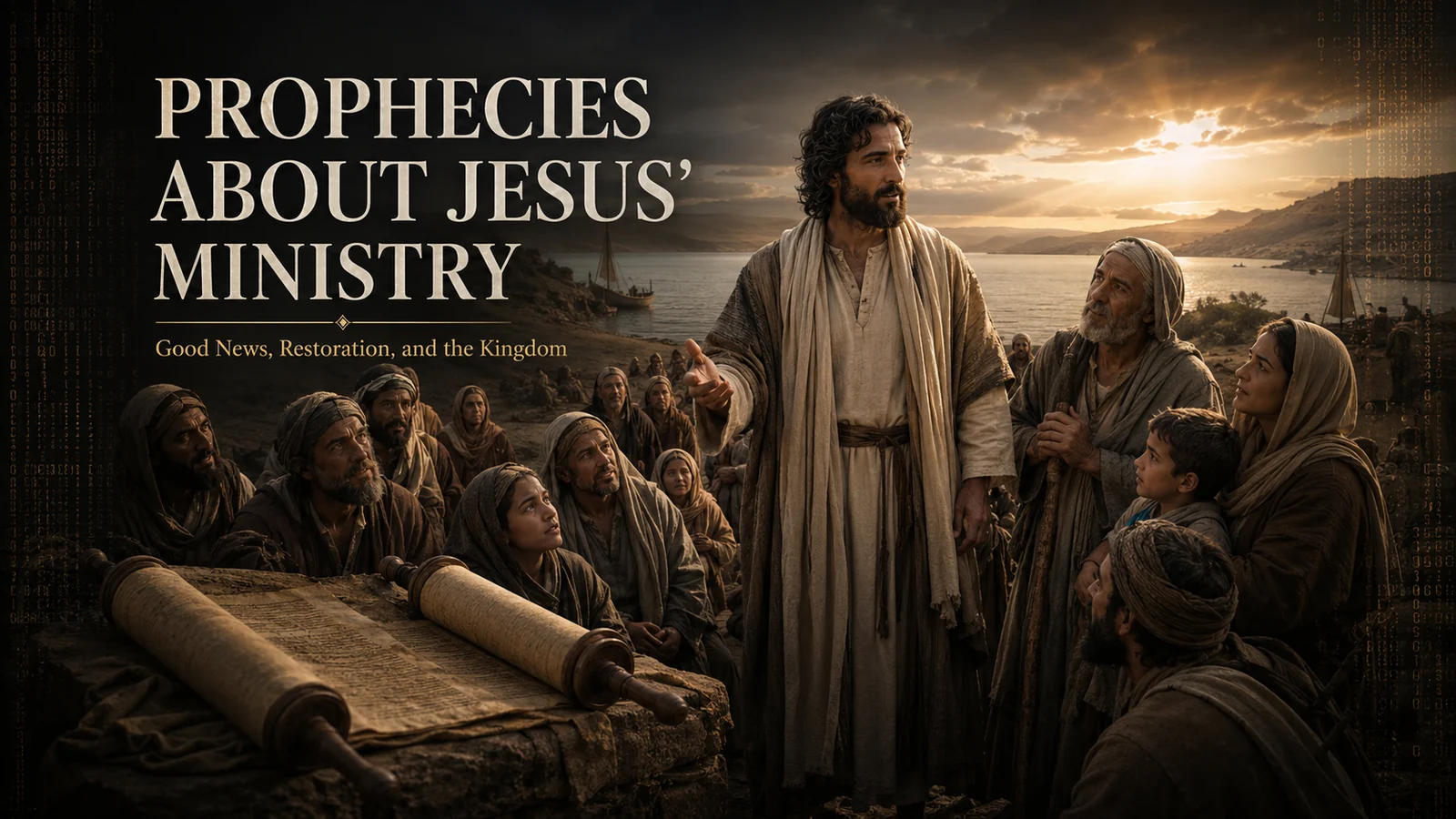
Luke 4 records one of the clearest moments in which Jesus publicly explains His mission through Scripture. In the synagogue at Nazareth, He reads from Isaiah and then tells those present, “Today this Scripture has been fulfilled in your hearing.” Luke 4:16–21
“The Spirit of the Lord is upon me, because he has anointed me to proclaim good news to the poor.”
Isaiah 61 belongs within a larger promise of restoration after devastation. It speaks of good news for the poor, binding up the brokenhearted, liberty for captives, comfort for mourners, and the rebuilding of what has been ruined. The passage is not merely about private encouragement. It announces God’s saving restoration for a people who have known loss, oppression, exile, and grief.
Luke presents Jesus’ reading as Isaiah-shaped rather than as a flat quotation of Isaiah 61 alone. The language of setting the oppressed free also echoes Isaiah 58:6. That does not weaken the scene. It shows Luke’s care in presenting Jesus’ mission through the wider restoration hope found in Isaiah.
Jesus ends the reading with “the year of the Lord’s favor” and does not continue into Isaiah’s next phrase, “the day of vengeance of our God.” Christians should not force that stopping point into a rigid timetable theory. Luke’s emphasis is clear enough: Jesus’ public ministry announces that God’s promised favor, restoration, and saving reign are arriving in Him.
This does not mean that Luke denies judgment, ignores sin, or teaches that every form of suffering disappears immediately wherever Jesus is present. Jesus Himself speaks of accountability, judgment, repentance, and the coming completion of God’s kingdom. But Luke 4 establishes the opening emphasis of His ministry: good news, release, restoration, and the Lord’s favor proclaimed to those in need.
The poor in Luke’s Gospel are not merely an abstract spiritual category, nor are they only a political category. Jesus’ ministry reaches people who are materially burdened, socially overlooked, physically afflicted, spiritually oppressed, and conscious of their need before God. His kingdom confronts the whole ruin of sin and suffering without reducing salvation to only one dimension of human need.
Jesus therefore does not present Himself simply as another teacher commenting on Isaiah. He publicly identifies His Spirit-anointed mission with Isaiah’s promise of restoration. The Gospels then show what that mission looks like: the kingdom is proclaimed, the afflicted are met with mercy, sin is confronted, and people are summoned to receive the grace of God.

Isaiah 35: Kingdom Signs of Restoration
Fulfillment category: Kingdom-sign convergence
Isaiah 35 offers a sweeping vision of restoration. The wilderness rejoices, weakness receives strength, fear gives way to courage, and God’s saving presence brings healing, joy, and a holy return for His people.
“Then the eyes of the blind shall be opened, and the ears of the deaf unstopped; then shall the lame man leap like a deer, and the tongue of the mute sing for joy.”
The passage is larger than a list of individual healings. Isaiah describes the restoration of God’s people and creation itself: the desert blossoms, sorrow gives way to joy, and a way of holiness leads the redeemed home. Christians should not shrink that vision into a set of detached miracle predictions.
Yet Jesus Himself points to this Isaianic world when John the Baptist sends disciples to ask whether He is “the one who is to come.” Rather than offering a slogan, Jesus directs them to what is happening before their eyes: the blind receive sight, the lame walk, lepers are cleansed, the deaf hear, the dead are raised, and the poor receive good news. Matthew 11:2–6 and Luke 7:18–23
Jesus’ answer is best understood as a cluster of Isaianic kingdom signs, especially resonating with Isaiah 35 and Isaiah 61. He does not quote one verse and say that every line has been exhausted. He points to a public pattern of restoration that signals the promised age of God’s saving action has begun.
The signs matter because they reveal the character of the kingdom Jesus announces. Blindness, lameness, disease, death, poverty, and oppression are not treated as trivial inconveniences. They belong to the fractured condition of a world in need of God’s renewal. Jesus’ works show His authority over that ruin and His compassion toward those living beneath it.
At the same time, the Gospels do not claim that Isaiah 35 has reached its final completion in every respect during Jesus’ earthly ministry. The world still groans. Death remains an enemy. God’s people still await the full renewal of creation. Jesus’ healings are signs: real acts of mercy that reveal the kingdom’s presence and anticipate its final fullness.
This protects readers from two opposite errors. One error treats Jesus’ miracles as mere illustrations with no larger theological meaning. The other treats them as a guarantee that every faithful believer will experience complete physical healing in the present age. The Gospels present something both more concrete and more hopeful: the Messiah has begun the work of restoration, and His kingdom will finally complete what His signs reveal.
Isaiah 61 announces the mission. Isaiah 35 shows the kind of restoration that accompanies it. The next question is what sort of Messiah carries that mission forward. Matthew answers through Isaiah 42: Jesus is the Spirit-anointed Servant whose gentleness toward the weak and commitment to justice belong together.
Isaiah 42: The Gentle Servant Who Brings Justice
Fulfillment category: Explicit New Testament application
Isaiah 42 introduces God’s Servant as the one upon whom God places His Spirit, the one who will bring justice to the nations. The passage holds together qualities that readers often separate: gentleness toward the weak, faithfulness in mission, and the eventual establishment of God’s justice throughout the earth.
“A bruised reed he will not break, and a faintly burning wick he will not quench; he will faithfully bring forth justice.”
Matthew explicitly applies this Servant passage to Jesus. After describing Jesus’ withdrawal, His healing of many, and His command that they not make Him known, Matthew cites Isaiah 42 and identifies Jesus with the Spirit-anointed Servant. Matthew 12:15–21
That application matters because Matthew does not present Jesus’ compassion as a series of disconnected moments. He sees Jesus’ ministry as the fulfillment of Isaiah’s Servant mission. Jesus is gentle with people who are bruised, weary, sinful, sick, overlooked, and burdened. He does not treat weakness as a reason to discard someone. He comes near, heals, teaches, restores, and calls people to faith.
But Isaiah 42 is not merely a portrait of private tenderness. The Servant brings justice. He does not grow faint or become discouraged until justice is established in the earth. The nations wait for His instruction. Jesus’ ministry therefore combines mercy and moral seriousness. He receives the broken without affirming sin, confronts evil without crushing the weak, and announces a kingdom in which God’s justice will finally prevail.
This helps readers understand the tone of Jesus’ public ministry. His gentleness is not passivity. His compassion is not indifference to truth. His healing does not mean that suffering is unimportant; it reveals God’s opposition to the ruin sin has brought into the world. The Servant’s mercy and justice belong together because both arise from God’s holy purpose to restore what human rebellion has damaged.
Matthew’s use of Isaiah 42 also widens the horizon beyond Israel alone. The quotation ends by declaring that the nations will hope in the Servant’s name. Jesus’ ministry begins among Israel, yet the hope announced through Him is never meant to remain confined to one region, class, or people.
Isaiah 42 therefore gives the article an essential balance. Jesus brings good news and restoration, but He does so as God’s Servant: Spirit-anointed, gentle toward the vulnerable, committed to justice, and carrying hope outward to the nations.

Isaiah 9: Light Dawns in Galilee
Fulfillment category: Explicit New Testament application
Matthew places the beginning of Jesus’ public ministry in Galilee and explains that this location matters. After John the Baptist is arrested, Jesus withdraws into Galilee, makes His home in Capernaum near the sea, and begins to proclaim, “Repent, for the kingdom of heaven is at hand.” Matthew then connects this ministry with Isaiah’s promise of light dawning in darkness.
“The people dwelling in darkness have seen a great light, and for those dwelling in the region and shadow of death, on them a light has dawned.”
Isaiah’s promise speaks into a setting of distress, invasion, darkness, and fear. Zebulun and Naphtali had known the weight of foreign domination and national humiliation. Matthew does not use the prophecy merely to show that Jesus happened to live in the correct place on a map. He presents Galilee as the place where the Messiah’s public proclamation begins to shine into a region associated with darkness and affliction.
Matthew 4:12–17 makes the connection explicit. Jesus’ move into Galilee fulfills Isaiah’s language of light, and His first recorded proclamation there announces the nearness of God’s kingdom.
The light is therefore not a vague symbol of optimism. In Matthew’s Gospel, it is the light of God’s saving rule breaking into a world marked by sin, fear, confusion, and death. Jesus teaches, heals, calls disciples, confronts unclean spirits, forgives sins, and summons people to repentance because the kingdom He announces is real.
This section should remain focused on Jesus’ ministry in Galilee. Isaiah 9 also contains royal themes that are important for Christian reflection on the Messiah, but the article on Jesus’ Divine Identity in Prophecy examines those themes in their proper setting. Here, Matthew’s emphasis is the beginning of Jesus’ public mission: light has dawned where darkness has long prevailed.
Jesus’ ministry does not simply bring people information. It brings them before a decision. Light exposes what darkness hides. The kingdom calls for repentance, faith, and allegiance to the King. Matthew’s use of Isaiah therefore frames the Galilean ministry as both announcement and summons: God’s promised light has arrived, and people must respond to the One through whom it shines.
Deuteronomy 18: The Prophet Like Moses
Fulfillment category: Explicit apostolic application and prophetic-authority pattern
Deuteronomy 18 addresses Israel’s need for trustworthy guidance from God. Israel was not to seek hidden knowledge through pagan divination, sorcery, or forbidden spiritual practices. Instead, God promised to raise up a prophet like Moses from among the people—one through whom God’s word would be heard.
“I will raise up for them a prophet like you from among their brothers. And I will put my words in his mouth, and he shall speak to them all that I command him.”
The promise first establishes a prophetic pattern. Moses was the mediator through whom God delivered His law and led His people. The prophet like Moses would carry God’s authoritative word, and Israel would be accountable for how it responded.
The apostles explicitly identify Jesus with this promise. Peter cites Deuteronomy 18 in Acts 3 and applies it to Christ, calling his hearers to listen to Him. Stephen also refers to the same promise in Acts 7. Acts 3:19–26 and Acts 7:35–37
This is an important part of Jesus’ ministry, but it must be described accurately. Deuteronomy 18 does not, by itself, prove that Jesus is God. It identifies Him as the promised Prophet like Moses: the authoritative revealer of God’s word whom God’s people must hear.
That role is visible throughout the Gospels. Jesus teaches with authority, interprets Scripture, announces the kingdom, commands repentance, exposes false religion, and speaks of God’s will with an authority that demands a response. His Sermon on the Mount repeatedly moves beyond mere citation of earlier teachers: “You have heard that it was said … but I say to you.” His words are not optional religious advice. They carry the weight of the Messiah’s summons from God.
Jesus also fulfills the Prophet-like-Moses pattern without being reduced to merely another prophet. Moses points forward; Jesus stands at the center of the Gospel proclamation. Moses led Israel through the wilderness, while Jesus announces the kingdom of God. Moses gave the law, while Jesus reveals its intended fulfillment and calls people to obey God from the heart. Moses interceded for the people; Jesus’ ministry ultimately moves toward the saving work explored in Jesus’ Crucifixion Prophecies: Isaiah 53, Psalm 22, and the Cross.
The point of Deuteronomy 18 is therefore not to diminish Jesus into one more voice among many. It is to show that God’s promised revelatory mission reaches a decisive fulfillment in Him. The apostles’ application makes the response unavoidable: those who hear Jesus are called not merely to admire His teaching, but to listen, repent, trust, and obey.
Jesus announces restoration through Isaiah, brings light to Galilee, and speaks with the authority of the Prophet like Moses. The next section will show how Matthew understands His teaching itself: Jesus reveals the kingdom through parables, drawing on Scripture’s own pattern of teaching God’s purposes through remembered history and hidden wisdom.
Psalm 78: Jesus Teaches the Kingdom in Parables
Fulfillment category: Explicit New Testament application
Jesus’ teaching ministry was not limited to public commands or formal debates. He regularly taught through parables: memorable stories and images that disclosed the character of God’s kingdom, exposed hardened responses, and called listeners to hear with faith.
Matthew connects that practice with Psalm 78:
“I will open my mouth in parables; I will utter what has been hidden since the foundation of the world.”
Psalm 78 is first a historical teaching psalm. Its opening summons Israel to remember God’s works, learn from the failures of earlier generations, and pass the truth of God’s covenant faithfulness to those who come after them. Psalm 78:1–4 does not function as a detached prediction that the Messiah would one day use illustrative stories.
Matthew’s application is therefore richer than a prediction-and-fulfillment formula. Jesus reveals the kingdom in continuity with Scripture’s own pattern of teaching God’s purposes through remembered history, wisdom, parabolic speech, and hidden realities brought into the light. His parables explain why the kingdom can be truly present in His ministry while still being resisted, misunderstood, and awaiting its final public completion.
That is why parables in the Gospels do more than make difficult ideas easier to understand. They test the hearer. The same story can comfort the humble, confront the self-assured, expose false expectations, or reveal whether someone is willing to receive the kingdom on Jesus’ terms.
Jesus therefore teaches with the authority of the promised Messiah and with the wisdom Scripture associates with God’s own covenant instruction. His parables announce that the kingdom is not a passing religious movement. It is God’s reign drawing near and demanding a response.

Light to the Nations: The Servant’s Wider Mission
Fulfillment category: Servant-mission pattern extending through the apostolic witness
Jesus’ public ministry begins among Israel, exactly where God’s covenant promises are rooted. Yet Isaiah’s Servant songs also look outward. The Servant is given as “a light for the nations,” so that God’s salvation may reach “to the end of the earth.” Isaiah 42:6 and 49:6
Luke’s Gospel places that horizon around Jesus from the beginning. Simeon praises God for the child Jesus as “a light for revelation to the Gentiles” and “for glory to your people Israel.” Luke 2:29–32 holds Israel and the nations together rather than treating one as a disposable replacement for the other.
Acts then shows the mission extending outward through the apostles’ witness in Jesus’ name. When Paul and Barnabas explain their turn toward Gentile audiences, they invoke Isaiah 49:6: “I have made you a light for the Gentiles, that you may bring salvation to the ends of the earth.” Acts 13:46–48
This development should be stated carefully. Isaiah’s Servant language is complex, and Acts applies the Servant’s mission to the apostolic witness as they carry the message of Christ outward. Christians do not need to say that every Gentile encounter in the Gospels is an isolated fulfillment citation. The larger claim is stronger: in Jesus, God’s promised salvation begins its public advance from Israel toward the nations, and the risen Christ sends witnesses to carry that good news outward.
The mission to the nations does not mean that Israel is discarded from God’s purposes. Jesus is Israel’s Messiah. His ministry fulfills Israel’s Scriptures. The widening of salvation reveals the scope of God’s covenant mercy: through the Messiah, the blessing promised through Israel reaches the world.
What These Scriptures Establish—and What They Do Not
The texts in this article do not all function at the same level. Luke directly presents Jesus’ synagogue reading through Isaiah. Matthew directly applies Isaiah 42, Isaiah 9, and Psalm 78. The apostles explicitly identify Jesus with the Prophet like Moses. Isaiah 35 and Isaiah 61 converge in the kingdom signs Jesus points to when John asks whether He is the coming one.
Together, they form a coherent biblical portrait: Jesus announces God’s restoring reign, performs signs of its arrival, brings gentle justice to the vulnerable, calls people to hear and obey God’s word, and carries salvation toward the nations.
Evidence Matrix: Scripture and Jesus’ Ministry
| Old Testament text | Fulfillment category | New Testament hinge | What Christians can responsibly claim |
|---|---|---|---|
| Isaiah 61:1–2; Isaiah 58:6 | Explicit Gospel application through an Isaiah-shaped composition | Luke 4:16–21 | Jesus publicly identifies His mission with good news, release, restoration, and the Lord’s favor. |
| Isaiah 35:5–6; Isaiah 61:1 | Kingdom-sign convergence | Matthew 11:2–6; Luke 7:18–23 | Jesus’ works show that God’s promised restoration has begun in the Messiah’s ministry. |
| Isaiah 42:1–4 | Explicit New Testament application | Matthew 12:15–21 | Jesus is the Spirit-anointed Servant who brings gentle justice and hope for the nations. |
| Isaiah 9:1–2 | Explicit New Testament application | Matthew 4:13–16 | Jesus’ Galilean ministry is framed as light dawning in a region marked by darkness and distress. |
| Deuteronomy 18:15–19 | Explicit apostolic application | Acts 3:22–23; Acts 7:37 | Jesus is identified as the Prophet like Moses whom God’s people must hear. |
| Psalm 78:2 | Explicit New Testament application | Matthew 13:34–35 | Jesus’ parables are presented within Scripture’s pattern of revealing God’s purposes through parabolic instruction. |
| Isaiah 42:6; Isaiah 49:6 | Servant-mission pattern | Luke 2:29–32; Acts 13:46–47 | God’s salvation reaches the nations through Christ and the witness carried in His name. |
What Christians Can Say Confidently
- Jesus publicly identifies His mission with Isaiah’s promise of good news, restoration, and the Lord’s favor.
- Jesus’ works answer John the Baptist through a recognizable cluster of Isaianic kingdom signs.
- Matthew explicitly presents Jesus as Isaiah’s gentle, Spirit-anointed Servant who brings justice and hope to the nations.
- Matthew frames Jesus’ Galilean ministry as light dawning in darkness.
- The apostles identify Jesus as the Prophet like Moses, whose words God’s people must hear.
- The mission announced in Jesus extends to the nations through the apostolic witness in His name.
What Christians Should Not Claim
- Christians should not claim that Luke 4 is a word-for-word quotation of Isaiah 61 alone.
- Christians should not turn Jesus’ stopping point before Isaiah 61’s judgment language into a rigid end-times timetable.
- Christians should not treat Isaiah 35 as a one-miracle-per-verse forecast or promise complete physical healing now for every believer.
- Christians should not reduce Isaiah 42 to sentimental kindness or detach its gentleness from its justice.
- Christians should not use Deuteronomy 18 as an isolated proof of Jesus’ deity.
- Christians should not say that the Servant’s mission to the nations means Israel is discarded from God’s purposes.
These boundaries do not weaken the case. They keep the article close to Scripture’s own shape: God’s promised restoration arrives in Jesus’ ministry, yet the kingdom’s final fullness still lies ahead.
How Jesus’ Ministry Fits the Larger Case for Christ
Jesus’ ministry does not stand apart from His identity, His death, or His resurrection. The same Messiah who announces the kingdom is the one Christians confess as Lord. The same Servant who heals and restores is the one who gives Himself for sinners. The same light that dawns in Galilee is proclaimed by the earliest witnesses as the risen Christ.
This article has focused on the public mission of Jesus. For the Old Testament and New Testament case concerning His divine identity, see Jesus’ Divine Identity in Prophecy. For the scriptural pattern of His suffering and death, see Jesus’ Crucifixion Prophecies: Isaiah 53, Psalm 22, and the Cross. For the historical groundwork of Jesus’ life and execution, see Historical Evidence for Jesus.
Prophecy does not replace historical inquiry. It gives readers the scriptural framework in which the Gospel events are understood. The ministry of Jesus therefore belongs within the larger Christian proclamation: the Messiah announced the kingdom, carried out His saving mission, was crucified, rose from the dead, and now sends His good news to the nations.
Continue the Evidence
- Explore the Prophecy Hub: Prophecies of Jesus Fulfilled in Scripture
- Continue in the Prophecy Lane: Prophecies of Jesus’ Resurrection Fulfilled
- Examine the Earliest Resurrection Proclamation
- See the Wider Case: Is Jesus the Son of God?
Frequently Asked Questions About Jesus’ Ministry Prophecies
Did Jesus quote Isaiah 61 word for word in Luke 4?
No. Luke’s presentation draws primarily from Isaiah 61:1–2 while also using release language associated with Isaiah 58:6. Jesus’ reading is best understood as an Isaiah-shaped scriptural composition that announces His Spirit-anointed mission of good news, release, restoration, and the Lord’s favor.
Why did Jesus stop before “the day of vengeance of our God”?
Luke emphasizes the announcement of the Lord’s favor at the beginning of Jesus’ public ministry. That does not mean Jesus denies judgment; the Gospels include His calls to repentance and His teaching about accountability. The passage should not be turned into a rigid timetable theory beyond what the text itself says.
Did Isaiah 35 predict every miracle Jesus performed?
No. Isaiah 35 describes God’s wide restoration of His people and creation. Jesus’ healings correspond to that vision as kingdom signs, showing that the promised restoration has begun, while the final renewal of all things still awaits completion.
Does Deuteronomy 18 prove Jesus is God?
No. Deuteronomy 18 identifies the coming Prophet like Moses, and Acts applies that promise to Jesus. The passage establishes His authoritative revelatory mission and calls God’s people to hear Him; the fuller case for His divine identity belongs in Jesus’ Divine Identity in Prophecy.
What does Psalm 78 have to do with Jesus teaching in parables?
Psalm 78 teaches God’s purposes through Israel’s remembered history and parabolic instruction. Matthew presents Jesus’ parables as fulfillment of that scriptural pattern: Jesus reveals the kingdom through stories that both disclose truth and call hearers to respond.
How does Jesus’ ministry reach the nations?
Isaiah presents the Servant as a light to the nations. Luke-Acts shows that promise beginning in Jesus and extending through the apostolic witness in His name. This does not discard Israel from God’s purposes; it shows the worldwide reach of God’s salvation through Israel’s Messiah.
Sources and Further Reading
- Primary biblical texts: Deuteronomy 18:15–19; Psalm 78:1–4; Isaiah 9:1–2; Isaiah 35:1–10; Isaiah 42:1–9; Isaiah 49:1–6; Isaiah 58:6; Isaiah 61:1–3; Matthew 4, 11–13; Luke 2, 4, and 7; Acts 3, 7, and 13.
- Joel B. Green, The Gospel of Luke.
- R. T. France, The Gospel of Matthew.
- Richard Beaton, Isaiah’s Christ in Matthew’s Gospel.
- G. K. Beale and D. A. Carson, eds., Commentary on the New Testament Use of the Old Testament.
- Craig S. Keener, Acts: An Exegetical Commentary.
- John N. Oswalt, The Book of Isaiah, Chapters 1–39; and The Book of Isaiah, Chapters 40–66.
These works represent relevant scholarly resources for the texts discussed. Their inclusion does not imply agreement with every conclusion in this article.
Unless otherwise indicated, Scripture quotations are from the ESV® Bible.
Jesus the Messiah Who Brings Good News
The ministry of Jesus is not a collection of impressive moments detached from the story of Scripture. He announces the Lord’s favor, brings mercy to the afflicted, reveals the first signs of God’s restoration, teaches the kingdom with authority, and carries hope beyond the boundaries people expect.
In Him, the light dawns in darkness. The bruised are not cast aside. The poor hear good news. The nations are summoned into the blessing promised through Israel’s Messiah.
Jesus Christ is the Spirit-anointed Servant and King whose kingdom has drawn near. He calls the weary, the sinful, the forgotten, and the far off to repent, believe the good news, and receive the life only He can give.

CONTINUE THE INVESTIGATION
Recommended continuation
Prophecies About Jesus’ Divine Identity | Fulfilled in the Bible
Move from the signs and setting of Jesus’ ministry to the prophetic texts used to examine His identity and authority.