
GUIDED ARTICLE EXPERIENCE
Prophecies of Jesus’ Return: His Reign, Judgment, and the New Creation
Read along as the narration moves through the article.
Private device narration · No hosted audio or tracking
CONTINUE GUIDED TOUR
Continue where you left off.
GUIDED TOUR COMPLETE
You have reached the end of this study.
Study record saved on this device.
GUIDED TOUR
Prophecies of Jesus’ Return: His Reign, Judgment, and the New Creation
Narrator: Paranoid Prophet Recommended Voice Native device narration
Prepare to follow the article as it is narrated.
VOICE & TOUR OPTIONS
Voice & Listening
NARRATOR
Finding a narrator…
Checking the best narrator available on this device.
Restores the best curated narrator available on this device.
Narrator choices are curated for clear, long-form listening on this device.
Screen-awake support will be checked when narration starts.
CHOOSE A NARRATOR
Curated for this device
Choose a verified narrator for this browser, or use System Narrator. Automatic mode uses the best reliable route exposed by this device; your chosen narrator is preserved even if this device needs a temporary fallback.
Preparing the guided article experience…
RESUME GUIDED TOUR?
Continue where you left off.
GUIDED TOUR COMPLETE
You have reached the end of this study.
Prophecies of Jesus’ return are not an invitation to master a secret schedule of world events. They direct Christian hope toward a person: the crucified, risen, and ascended Jesus Christ, who will return in glory to judge with righteousness, raise His people, defeat death and evil, and bring creation to its promised renewal.
That future hope belongs to the center of the Christian message. Jesus announced God’s kingdom in His public ministry, gave Himself for sinners, rose from the dead, and ascended as Lord. The New Testament does not present His ascension as the end of His work. It presents it as the setting for the church’s confidence that the same Jesus will come again.
Christians have long differed over the sequence and imagery of several end-times passages. They disagree about the relationship between the tribulation, the millennium, the gathering of believers, the final judgment, and some of Revelation’s visions. Those disagreements matter, and Scripture should not be made to say more than it says. But they do not remove the central Christian confession: Jesus Christ will return, His reign will be publicly revealed, and God’s purposes for judgment, resurrection, and renewal will reach their appointed completion.
For the wider framework of direct fulfillment, covenant promise, typology, and future hope across Scripture, see Prophecies of Jesus Fulfilled in Scripture.
Article Guide12 sections
What Do Prophecies of Jesus’ Return Say?
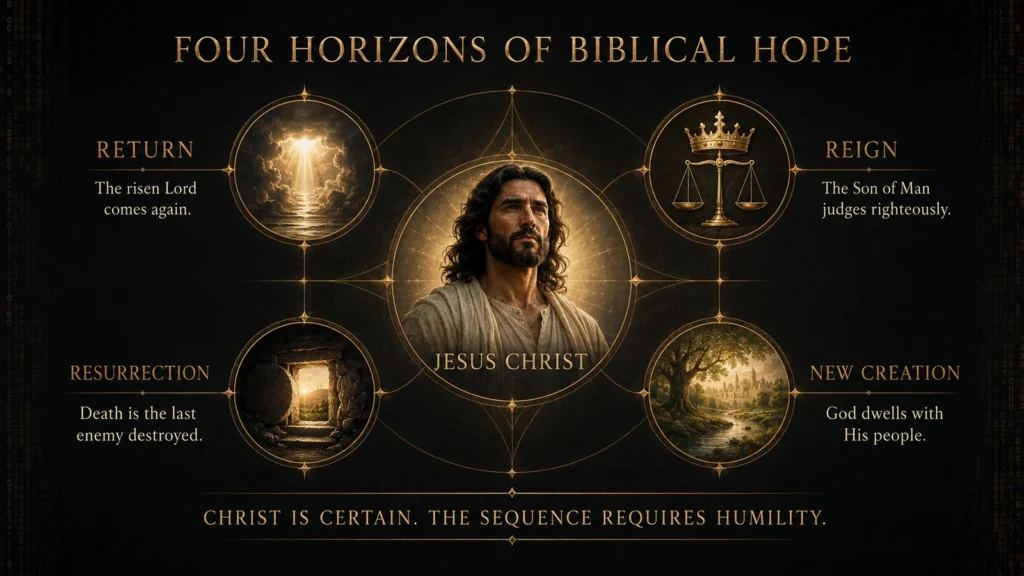
Scripture’s future hope is larger than a prediction about a single future moment. The prophets, the Gospels, Paul’s letters, and Revelation speak of God’s coming reign, righteous judgment, the defeat of death, the restoration of His people, and the renewal of creation. The New Testament gathers these promises around Jesus Christ, the risen Messiah whose kingdom will not fail.
That does not mean every biblical image of the end belongs to one simple timeline. Daniel, the prophets, the Gospels, Paul, and Revelation use different literary forms and address different moments within God’s redemptive purpose. Some passages are poetic prophecy. Some are apocalyptic visions. Some are direct teachings of Jesus. Some are pastoral letters written to churches facing grief, pressure, confusion, or suffering.
Christian hope therefore does not rest on decoding every symbol or arranging every passage into a complete sequence. It rests on the promise that Jesus Christ will return, judge with righteousness, raise the dead, and make all things new.
This article will distinguish between what Scripture teaches clearly and what Christians should hold with humility. It will not build a date-setting system, identify current headlines as a fixed prophecy code, or treat Revelation as a scene-by-scene screenplay of modern events. Its focus is the biblical center: the future belongs to the risen and reigning Christ.
How This Article Uses Future Fulfillment and Apocalyptic Imagery
Future fulfillment requires a different kind of care than passages whose New Testament fulfillment is presented as completed in Jesus’ earthly ministry. The promise of Christ’s return, final judgment, resurrection, and new creation is real and central. Yet the timing, sequence, symbolism, and exact relationship between several passages remain debated among faithful Christians.
- Direct New Testament promise: Some texts plainly promise that the ascended Jesus will return and that His people will be gathered to Him.
- Kingdom and judgment vision: Daniel and the Gospels present the Son of Man with everlasting authority and the right to judge, while leaving important chronological questions open.
- Resurrection and renewal hope: Paul and the prophets proclaim that death will be defeated and creation will be renewed under God’s reign.
- Apocalyptic consummation: Revelation portrays Christ’s final victory, righteous judgment, the removal of curse and death, and God dwelling with His people through symbolic visions that should not be flattened into a simple event chart.
This framework allows Christians to confess future hope with conviction while refusing claims the texts do not require. The return of Christ is not uncertain because the timing is unknown. The final defeat of death is not less certain because Christians debate the millennium. The promise of new creation is not weakened because prophetic and apocalyptic language carries imagery that demands careful reading.
Jesus Himself directs His followers away from timetable control and toward faithfulness. After His resurrection, the disciples ask whether He will restore the kingdom to Israel at that time. He does not give them a calendar. He tells them that the timing belongs to the Father and commissions them to bear witness through the power of the Holy Spirit. Acts 1:6–8
The future hope of Scripture is therefore active rather than passive. It calls Christians to witness, holiness, courage, endurance, and confidence in the One whose kingdom will finally be seen for what it is.
Jesus Will Return: The Promise of the Risen Lord
Fulfillment category: Direct New Testament promise with future consummation
Acts begins its account of the church’s mission with the ascension of Jesus. After speaking with His disciples about the kingdom of God and promising the Holy Spirit, Jesus is taken from their sight. The disciples stand looking upward, and two angelic messengers address them with a promise that has shaped Christian hope ever since.
“This Jesus, who was taken up from you into heaven, will come in the same way as you saw him go into heaven.”
The wording matters. The promise concerns this Jesus: the same Lord whom the disciples knew, who was crucified, raised, and visibly ascended. Christian hope is not fixed on an impersonal force, a vague spiritual awakening, or a replacement figure. The New Testament directs believers toward the return of the risen Christ Himself.
Acts also makes clear what the disciples are not given. They are not handed a full prophetic itinerary. Jesus does not explain the duration of every future trial, the order of every judgment scene, the meaning of each image in Revelation, or the exact moment when His kingdom will be publicly consummated. The church receives a promise, a mission, and the Spirit’s power for witness.
That focus provides an important correction to end-times speculation. Scripture does not call believers to build their confidence on a detailed chart that could be revised whenever events change. It calls them to live as witnesses of the risen Lord, trusting that the One who ascended will return in the Father’s appointed time.
Revelation opens with the same public seriousness. John praises Jesus Christ as the faithful witness, the firstborn from the dead, and the ruler of the kings of the earth before announcing that He is coming with the clouds. Revelation 1:5–7 presents Christ’s coming as an event of universal significance: the world will not remain morally indifferent to its true King.
The language of clouds reaches back into the Old Testament’s imagery of divine presence, kingship, and judgment. In Revelation, it is not a technical timeline label. It reinforces the certainty and public weight of Christ’s return. The ruler of the kings of the earth will not remain hidden forever.
Some Christians connect Acts 1 with Zechariah 14, especially because the ascension occurs near the Mount of Olives and Zechariah’s Day-of-the-Lord vision includes the Mount of Olives. That connection has a long history in Christian interpretation. Yet Acts 1 itself does not explicitly state that Jesus’ feet will stand at an exact geographical location described in Zechariah.
For that reason, the article will not make a precise Mount of Olives return location a test of biblical faithfulness. The clear claim is greater than the debated detail: the ascended Jesus will return. The church is called to trust His promise, continue His witness, and wait with hopeful readiness.
That promise also guards against the idea that Christian faith is only about private inward comfort. The return of Jesus is public, personal, and decisive. It means that history is moving toward the reign of the One who gave Himself for sinners and rose in victory over death.
The Son of Man Will Reign and Judge Righteously
Fulfillment category: Kingdom vision with Christological use and future judgment
Daniel 7 gives one of Scripture’s most important visions of God’s final kingdom. After a sequence of beastly powers that oppress and devour, Daniel sees the Ancient of Days take His seat in judgment. Then “one like a son of man” comes with the clouds of heaven and receives dominion, glory, and a kingdom that will not pass away.
“And to him was given dominion and glory and a kingdom, that all peoples, nations, and languages should serve him; his dominion is an everlasting dominion, which shall not pass away.”
Daniel’s vision gives the article a kingdom horizon. Human empires rise and fall. Their power can look permanent, violent, and untouchable. Yet Daniel’s vision insists that their rule is not ultimate. God judges arrogant powers, gives lasting dominion to the Son of Man, and secures a kingdom that will not be destroyed.
Jesus repeatedly uses “Son of Man” language in the Gospels, and He directly evokes Daniel 7 during His trial. When asked whether He is the Messiah, Jesus speaks of the Son of Man seated at the right hand of Power and coming with the clouds of heaven. Matthew 26:57–68
That connection is central to the Christian reading of Jesus’ identity and authority. Daniel 7 supplies the biblical vision behind the New Testament confession that Jesus possesses an everlasting kingdom and exercises the authority of the Son of Man. For the fuller Old Testament and New Testament case concerning that divine-identity horizon, see Jesus’ Divine Identity in Prophecy.
Daniel 7 should not, however, be reduced to a simple picture of Jesus descending from heaven to earth at one future moment. Within Daniel’s vision, the Son of Man comes toward the Ancient of Days and receives dominion. Christian interpreters have connected this imagery to Jesus’ vindication, ascension, enthronement, judgment, and future return in different ways. The passage establishes enduring authority more directly than it supplies a complete end-times sequence.
Matthew 24 requires similar care. Jesus speaks of tribulation, cosmic imagery, the Son of Man coming on the clouds, and the gathering of His elect. Matthew 24:29–31 is deeply connected to Daniel-shaped language, but it also stands within Jesus’ teaching about the temple’s coming destruction and the end of the age. Faithful interpreters differ over how its near and future elements relate.
The article therefore will not use Matthew 24 as a master chart for every future event. Its enduring message is clear enough: Jesus speaks with divine authority, warns against deception, calls His disciples to endurance, and directs them toward readiness rather than prediction-driven control.
Matthew 25 gives a more direct portrayal of final accountability. Jesus describes the Son of Man coming in glory, seated on His glorious throne, gathering the nations, and judging with perfect righteousness. Matthew 25:31–46
That judgment is not presented as arbitrary. The King’s verdict reveals the moral seriousness of human life before God. Mercy, allegiance, faithfulness, and the treatment of those in need matter because Christ’s reign is righteous. Final judgment means history is not morally empty. Violence, oppression, deception, contempt, and unrepentant evil will not finally escape the justice of God.
At the same time, the Christian hope of judgment is not a celebration of destruction. The Judge is Jesus Christ—the One who wept over Jerusalem, welcomed sinners, called the weary to Himself, gave His life for the world, and rose again. His return brings both the exposure of evil and the public vindication of God’s mercy, truth, and righteousness.
The promise of Christ’s return and judgment therefore calls for neither fear-driven obsession nor careless indifference. It calls people to turn to the King, live faithfully under His authority, care for their neighbor, and wait in hope for the day when His righteous reign will be fully revealed.
The Last Enemy Will Be Destroyed: Death and Evil
Fulfillment category: Prophetic salvation horizon and apostolic resurrection theology
The future return of Christ is not presented in Scripture as a display of power detached from human suffering. It brings God’s answer to the deepest enemies of His creation: sin, evil, corruption, and death itself.
Isaiah gives one of the Old Testament’s clearest visions of that hope. In a passage that looks toward God’s saving reign, the prophet describes a future feast for the nations, the removal of shame, tears wiped away, and death swallowed up forever.
“He will swallow up death forever; and the Lord God will wipe away tears from all faces.”
Isaiah’s vision is larger than private comfort. It speaks of God’s public victory over the powers that wound His people and obscure His glory. Death, grief, reproach, and fear do not have the final word because the Lord Himself acts to save.
The New Testament takes up that hope in the proclamation of Christ’s resurrection. Paul calls Jesus the “firstfruits” of those who have died. His resurrection is not merely an isolated miracle or a symbol of personal renewal. It is the beginning and guarantee of the future resurrection of His people.
Paul explains that Christ must reign until every enemy is placed beneath His feet, and he names death as the final enemy to be destroyed. 1 Corinthians 15:20–28 gives the return of Christ its deeper purpose: the risen Lord’s kingdom will finally overcome all that opposes God’s life-giving reign.
This is why the Christian hope is not simply that believers will endure difficult events before the end. It is that Christ’s victory reaches all the way to death itself. The enemy that appears most permanent—the power that touches every family, humbles every achievement, and closes every earthly life—will not remain unconquered.
Paul returns to Isaiah’s language near the close of the chapter. When the perishable puts on the imperishable and the mortal puts on immortality, then the Scripture will be fulfilled: “Death is swallowed up in victory.” 1 Corinthians 15:50–58
The connection does not turn Isaiah 25 into a technical map of every later apocalyptic scene. Isaiah speaks in prophetic imagery of God’s saving victory; Paul announces that the resurrection of Christ and the future resurrection of His people bring that hope toward its appointed fulfillment. The shared center is clear: God’s final salvation reaches as deeply as death.
Scripture also speaks of evil’s final defeat. Revelation portrays the judgment of the powers that corrupt, deceive, accuse, and destroy. Yet the article should not reduce that vision to a newspaper-code system or treat every image as a separate item in a rigid sequence. Revelation’s central testimony is that Christ’s victory will be complete. Evil will be judged. The curse will not endure. God’s righteous reign will not be challenged forever.
That promise gives Christian hope moral weight. Final victory is not escapism from the suffering of the present world. It means injustice matters because God will judge it. Faithfulness matters because Christ’s kingdom is real. Mercy matters because the coming Judge is righteous. And grief is not meaningless because the One who conquered death will finally remove its power.
Resurrection Hope: The Future of Christ’s People
Fulfillment category: Direct apostolic return-and-resurrection hope
Christian hope is bodily hope. The future promised in Scripture is not merely the survival of an invisible soul after death. It includes the resurrection of the dead, the transformation of those who belong to Christ, and everlasting life in the presence of the Lord.
Paul writes about this hope to the Thessalonian church because believers there were grieving fellow Christians who had died. They feared that those who died before Christ’s return might somehow miss the fulfillment of His promise. Paul responds not with a detailed end-times schedule, but with consolation rooted in Jesus’ death and resurrection.
“And the dead in Christ will rise first. Then we who are alive, who are left, will be caught up together with them . . . and so we will always be with the Lord.”
The immediate purpose of this passage is pastoral. Paul wants grieving Christians to know that those who die in Christ will not be left behind when the Lord returns. The dead will be raised. Christ’s people will be gathered to Him. And the final assurance is not a location or a chronology, but communion: “we will always be with the Lord.”
Christians have placed this passage within different rapture and tribulation systems. Those debates should not be hidden, but neither should they eclipse Paul’s actual pastoral purpose. First Thessalonians 4 does not pause to explain the entire sequence of Revelation 19–20, settle the timing of every future trial, or give a chart for the millennium. It gives comfort to the grieving and confidence to the church.
The resurrection hope of 1 Thessalonians stands in full harmony with 1 Corinthians 15. Jesus’ resurrection is the firstfruits. Those who belong to Him will share in the resurrection life He has already inaugurated. The future of Christ’s people is therefore not abandonment to decay, but transformation by the life of the risen Lord.
Romans 8 broadens that hope even further. Paul describes creation itself as groaning under corruption while believers wait eagerly for “the redemption of our bodies.” Romans 8:18–25 joins personal resurrection to creation-wide renewal. The Christian future is not escape from God’s material world, but the liberation of creation from bondage under God’s final reign.
This matters because the resurrection of the body affirms the goodness of God’s creation even in its present brokenness. God does not treat human embodiment as disposable. The risen Jesus remains the pattern and guarantee of His people’s future. Christian hope is not that death makes the body irrelevant, but that Christ will redeem what death has wounded.
That promise gives believers a different way to face suffering and loss. It does not deny grief. Paul explicitly tells Christians not to grieve “as others do who have no hope,” not not to grieve at all. The death of those we love remains painful. The future promise does not make sorrow shallow. It tells grieving people that sorrow will not finally win.
For the focused biblical case that Christ’s resurrection fulfills Scripture and anchors Christian hope, see Prophecies of Jesus’ Resurrection Fulfilled. For the historical question of how early the resurrection proclamation appears, see How Early Is the Resurrection Claim?.
The New Creation: God Makes All Things New
Fulfillment category: Prophetic new-creation horizon and apocalyptic consummation vision
The final Christian hope is not only that individual believers will be rescued from death. Scripture promises that God will renew creation itself. The God who made the world will not abandon His purpose for it. He will bring His work to its righteous and life-giving completion.
Isaiah gives this hope one of its clearest Old Testament expressions:
“For behold, I create new heavens and a new earth, and the former things shall not be remembered or come into mind.”
Isaiah’s vision is full of prophetic pictures of joy, peace, secure life, restored worship, and creation freed from violence. It gives Scripture’s future horizon: God’s final purpose is not permanent ruin, but renewal under His righteous reign.
That does not mean Isaiah 65 functions as a technical blueprint for every later passage about the end. Its imagery should not be forced into exact correspondence with every line of Revelation 21. Christians have debated how Isaiah’s language of long life, peace, and ongoing human activity relates to the final consummation described in the New Testament. The faithful conclusion is not that the passages conflict, but that they contribute to the same broad biblical hope of creation renewed by God.
Second Peter brings judgment and renewal together. The Day of the Lord is serious; it exposes human rebellion and calls for holy living. But Peter does not leave the church with destruction as the final horizon. He directs believers toward “new heavens and a new earth in which righteousness dwells.” 2 Peter 3:8–13
Christians differ over how the passage’s fire imagery should be understood: as destruction, purification, transformation, or apocalyptic judgment language. This article does not need to settle every part of that discussion. Peter’s enduring pastoral point is plain. The promised future calls believers to patient faithfulness, holy conduct, and confidence that God’s righteous world will come.
Revelation brings the new-creation hope to its climactic vision. John sees a new heaven and a new earth, the holy city coming down from God, and God dwelling with His people. Death, mourning, crying, pain, and curse are removed. Revelation 21–22
The heart of the vision is not a speculative architectural diagram of heaven. It is God’s presence: “Behold, the dwelling place of God is with man.” The final future of redemption is communion. The God who made His dwelling among Israel, who came near in Jesus Christ, and who gives His Spirit to His people will dwell with the redeemed in a world where death and curse no longer remain.
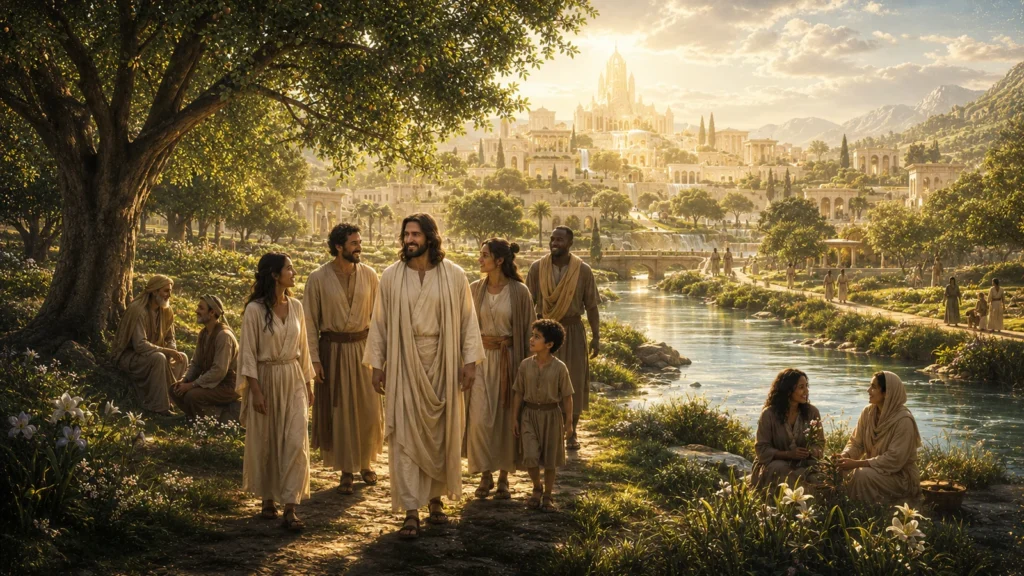
Revelation’s imagery is symbolic and apocalyptic, but that does not make its promise unreal. Symbolic language is often the fitting way to speak of realities too great for ordinary description. The New Jerusalem, the river of life, the tree of life, and the removal of the curse proclaim that God’s future is abundant, holy, healed, and secure in His presence.
Christians should therefore resist two opposite errors. One is to turn Revelation into a literal scene-by-scene schedule that settles every disputed question about the future. The other is to treat its images as empty metaphors with no real promise behind them. Revelation proclaims a real future victory of Christ, real judgment, real resurrection hope, and real renewal under the reign of God.
Jesus’ return brings this hope to completion. The King who will judge with righteousness is also the Savior who gave Himself for sinners. The risen Lord who will raise His people is also the Creator and Redeemer whose purpose is to make all things new. Scripture’s final vision is not escape from God’s world, but God’s world restored beneath the unveiled reign of Jesus Christ.
What Christians Agree On—and What They Debate
Christian hope is strongest when it distinguishes the truths Scripture teaches clearly from the details believers have interpreted differently. The return of Jesus Christ is not a minor doctrine or an optional appendix to the Gospel. Neither are the resurrection of the dead, final judgment, the defeat of death, and the renewal of creation. These are central elements of the New Testament’s hope.
At the same time, Scripture does not give Christians a single, uncontested timeline that resolves every question about the tribulation, the millennium, the relationship between Matthew 24 and the destruction of Jerusalem, the gathering of believers, Zechariah 14, or the sequence of Revelation 19–20. Faithful Christians have reached differing conclusions because several of these texts use prophetic and apocalyptic imagery that requires careful interpretation.
That does not make the future hope uncertain. It means Christians should place their confidence where Scripture places it: in the returning Christ Himself. Jesus will return. He will judge with righteousness. The dead in Christ will be raised. Death and evil will not have the final word. God will dwell with His people in renewed creation.
Evidence Matrix: Scripture and the Return of Christ
| Scripture | Category | New Testament hinge | What Christians can responsibly claim |
|---|---|---|---|
| Acts 1:6–11 | Direct New Testament promise | Acts 1:11 | The ascended Jesus will return. The passage does not provide a complete prophetic itinerary. |
| Revelation 1:5–7 | Apostolic-apocalyptic return confession | Revelation 1:7 | Christ’s coming is certain and universally significant; the text does not settle every end-times sequence. |
| Daniel 7:13–14 | Kingdom vision with Christological use | Matthew 26:64; Matthew 25:31–46 | Jesus is the Son of Man with everlasting dominion who will judge righteously. Daniel supplies kingdom-and-authority imagery, not a complete return timeline. |
| Matthew 25:31–46 | Direct teaching of Jesus | Matthew 25:31–46 | Christ will judge with righteousness, and final accountability before God is real. |
| Isaiah 25:6–9 | Prophetic salvation horizon | 1 Corinthians 15:54 | God’s final salvation reaches to the defeat of death itself. |
| 1 Corinthians 15 | Apostolic resurrection theology | 1 Corinthians 15:20–28, 50–58 | Christ’s resurrection is the firstfruits, and death is the last enemy to be destroyed. |
| 1 Thessalonians 4:13–18 | Apostolic return-and-resurrection hope | 1 Thessalonians 4:16–18 | The dead in Christ will be raised, and Christ’s people will be with Him forever. |
| Romans 8:18–25 | Creation-wide resurrection hope | Romans 8:21–25 | Creation and believers alike await liberation, bodily redemption, and future glory. |
| Isaiah 65:17–25; Revelation 21–22 | New-creation horizon and consummation vision | Revelation 21:1–5 | God’s future includes renewed creation, His dwelling with His people, and the final removal of death and curse. |
What Christians Can Say Confidently
- Jesus Christ will return.
- Christ will judge with righteousness.
- The dead in Christ will be raised.
- Death is not ultimate; it is the last enemy to be destroyed.
- Evil, corruption, and curse will not have the final word.
- God will dwell with His redeemed people.
- Creation will be renewed under God’s righteous reign.
- Christians are called to hopeful, holy, watchful faithfulness rather than date-setting.
What Christians Should Hold with Humility
- The exact relationship between Daniel 7, Matthew 24, Jerusalem’s destruction, and Christ’s final return.
- The relationship between Zechariah 14 and Acts 1.
- The precise order of resurrection, tribulation, millennium, judgment, and new creation.
- The interpretation of the millennium in Revelation 20.
- The precise continuity and discontinuity between the present creation and the new creation.
- The full symbolic mechanics of Revelation’s visions.
These limits are not a retreat from Christian conviction. They protect the central hope from being buried beneath arguments Scripture does not require every believer to settle in the same way. The church does not wait for a chart to be completed. It waits for Jesus Christ.
How Christ’s Return Completes the Larger Case for Jesus
The promise of Christ’s return completes the story Scripture tells about Jesus. His public ministry announced the kingdom of God. His death secured redemption and forgiveness. His resurrection proclaimed victory over death. His future return brings His righteous reign into public and final view.
The same Jesus who preached good news to the poor, welcomed the broken, confronted evil, and called people to repentance will return as the righteous King. The same Jesus who gave Himself for sinners will judge with perfect justice. The same Jesus who rose from the dead will raise His people and bring creation into the renewal God has promised.
For the public mission that announces this kingdom hope, see Prophecies About Jesus’ Ministry: The Messiah’s Mission, Kingdom, and Signs. For the redemptive work through which sinners are reconciled to God, see Prophecies of Jesus the Redeemer: Covenant, Sacrifice, and Forgiveness in Christ. For the scriptural case concerning His suffering and death, see Jesus’ Crucifixion Prophecies: Isaiah 53, Psalm 22, and the Cross.
Christ’s return also depends on the historical and theological reality of His resurrection. The church is not waiting for an unknown future savior. It is waiting for the crucified and risen Jesus proclaimed from the earliest days of the Christian movement. For that historical foundation, see Historical Evidence for Jesus. For the larger Scriptural and historical case, see Is Jesus the Son of God?.
The Christian claim is not merely that history has an ending. It is that history has a King. Jesus Christ will bring truth into the light, judge evil with righteousness, wipe away the tears of His people, and make all things new. The future hope of Scripture is therefore not escape from the world, but the completion of God’s purpose for His world through His Son.
Frequently Asked Questions About Jesus’ Return
Does Acts 1 say Jesus will return to the Mount of Olives?
Acts 1 clearly promises that the ascended Jesus will return in the same manner the disciples saw Him go. The ascension occurs near the Mount of Olives, and some Christians connect this setting with Zechariah 14. Yet Acts 1 does not explicitly say that Jesus’ feet will stand at the exact location described in Zechariah. The return of Christ is certain; the precise geographical connection should be held with humility.
Does Matthew 24 give a complete end-times timeline?
No. Matthew 24 includes serious interpretive questions involving the destruction of Jerusalem, the Son of Man imagery, “this generation,” the gathering of the elect, and the end of the age. Its clearest enduring message is Christ’s authority, the certainty of His words, the danger of deception, and the call to faithful readiness.
Does 1 Thessalonians 4 prove one rapture system?
No. Paul’s immediate purpose is to comfort Christians who grieve believers who have died. The passage teaches that the dead in Christ will be raised and that Christ’s people will be with Him forever. Christians differ about the larger timeline, but the text’s pastoral hope remains clear.
What do “new heavens and a new earth” mean?
Scripture promises God’s future renewal of creation, where death, mourning, evil, and curse no longer have the final word. Christians differ over several questions about imagery, continuity, and sequence, but the biblical hope is not the abandonment of God’s world. It is God’s righteous renewal of His creation under the reign of Christ.
Is Revelation a literal timeline of future events?
Revelation is apocalyptic Scripture. It presents Christ’s final victory, righteous judgment, the end of death and curse, and God dwelling with His people through powerful visions. Its promises are real, but it should not be treated as a simple scene-by-scene schedule that ends all interpretive disagreement.
Why has Jesus not returned yet?
The New Testament rejects date-setting and calls believers to patient, holy faithfulness. Second Peter answers the apparent delay not by giving a new schedule, but by pointing to God’s patience and His promised day of judgment and renewal. 2 Peter 3:8–13 directs the church toward holy living and hope rather than speculation.
Can current events tell us exactly when Jesus will return?
Christians should watch the world with sobriety, prayer, and moral clarity, but Scripture does not authorize date-setting or treating every headline as a definitive fulfillment code. Jesus directs His people toward readiness, witness, endurance, and faithfulness. The future is not given so that believers can predict every event; it is given so that they can live faithfully before the returning King.
Continue the Evidence
- Explore the Prophecy Hub: Prophecies of Jesus Fulfilled in Scripture
- Explore Jesus’ Divine Identity in Prophecy
- Continue in the Prophecy Lane: Prophecies of Jesus’ Resurrection Fulfilled
- Examine the Earliest Resurrection Proclamation
- See the Wider Case: Is Jesus the Son of God?
Sources and Further Reading
- Primary biblical texts: Isaiah 11:1–10; Isaiah 25:6–9; Isaiah 65:17–25; Daniel 7:9–14; Matthew 24–25; Acts 1:6–11; Romans 8:18–25; 1 Corinthians 15; 1 Thessalonians 4:13–18; 2 Peter 3:8–13; Revelation 1:5–7 and 19–22.
- G. K. Beale, The Book of Revelation: A Commentary on the Greek Text.
- Richard Bauckham, The Theology of the Book of Revelation.
- John J. Collins, Daniel: A Commentary on the Book of Daniel.
- John J. Collins, The Apocalyptic Imagination: An Introduction to Jewish Apocalyptic Literature.
- Craig S. Keener, Acts: An Exegetical Commentary.
- R. T. France, The Gospel of Matthew.
- Gordon D. Fee, The First Epistle to the Corinthians.
These works represent relevant scholarly resources for the texts discussed. Their inclusion does not imply agreement with every conclusion in this article.
Unless otherwise indicated, Scripture quotations are from the ESV® Bible.
Jesus Christ, the Coming King Who Makes All Things New
Jesus Christ is not merely a figure from the past, a teacher whose influence survives in memory, or a symbol of hope in difficult times. Scripture presents Him as the risen and reigning Lord who will return to bring God’s purpose for judgment, resurrection, and renewal to completion.
The King who announced good news will return in glory. The Savior who gave Himself for sinners will judge with righteousness. The risen Lord who defeated death will raise His people. The Creator and Redeemer will remove the curse and dwell with His people in a renewed creation.
That is the Christian hope: not confidence in a chart, not fear of a headline, and not escape from God’s world, but trust in Jesus Christ. He will return. He will make all things new. Until that day, He calls His people to faith, holiness, mercy, courage, witness, and hope.