
GUIDED ARTICLE EXPERIENCE
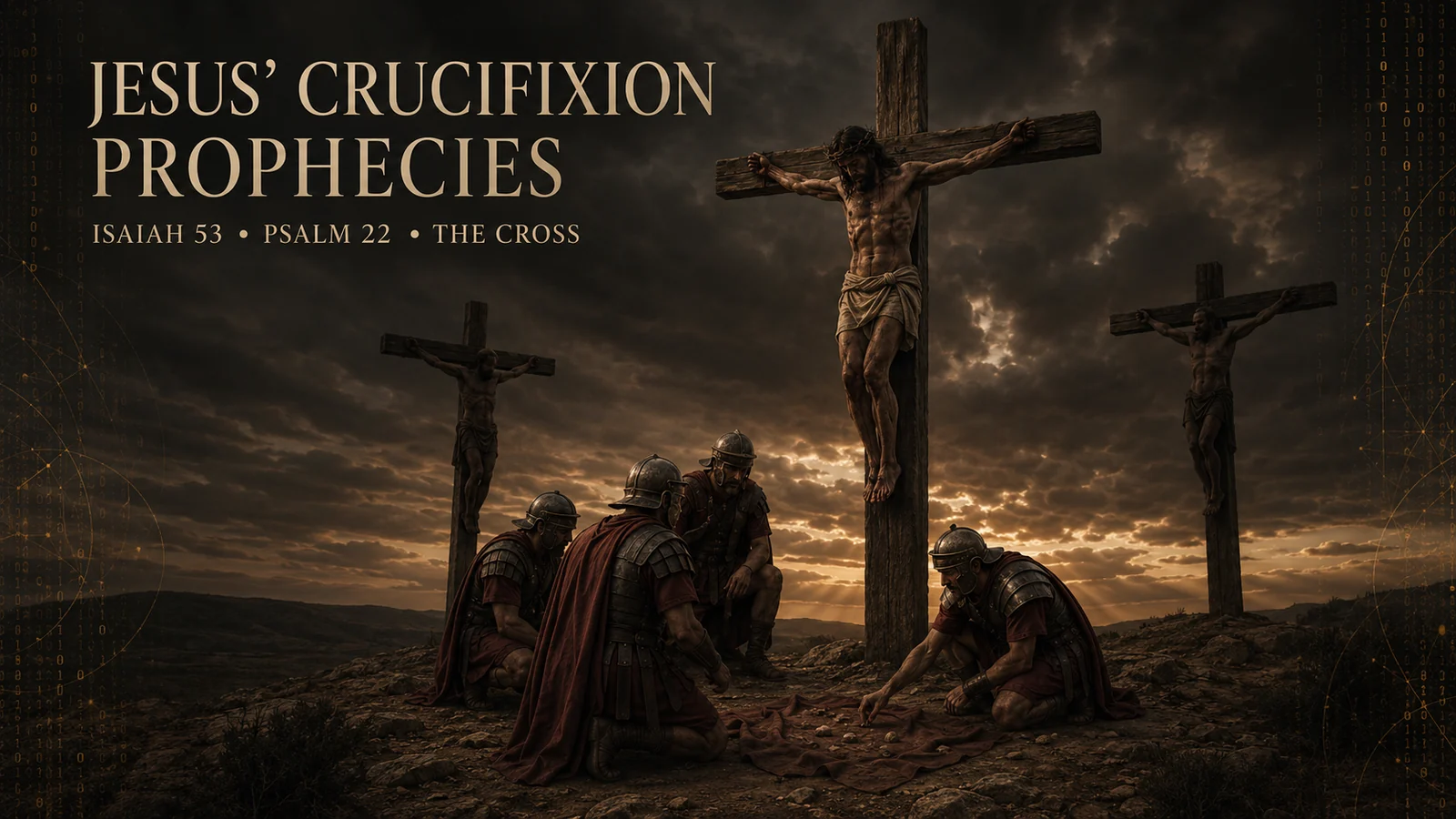
Jesus’ Crucifixion Prophecies: Isaiah 53, Psalm 22, and the Cross
Read along as the narration moves through the article.
Private device narration · No hosted audio or tracking
CONTINUE GUIDED TOUR
Continue where you left off.
GUIDED TOUR COMPLETE
You have reached the end of this study.
Study record saved on this device.
GUIDED TOUR
Jesus’ Crucifixion Prophecies: Isaiah 53, Psalm 22, and the Cross
Narrator: Paranoid Prophet Recommended Voice Native device narration
Prepare to follow the article as it is narrated.
VOICE & TOUR OPTIONS
Voice & Listening
NARRATOR
Finding a narrator…
Checking the best narrator available on this device.
Restores the best curated narrator available on this device.
Narrator choices are curated for clear, long-form listening on this device.
Screen-awake support will be checked when narration starts.
CHOOSE A NARRATOR
Curated for this device
Choose a verified narrator for this browser, or use System Narrator. Automatic mode uses the best reliable route exposed by this device; your chosen narrator is preserved even if this device needs a temporary fallback.
Preparing the guided article experience…
RESUME GUIDED TOUR?
Continue where you left off.
GUIDED TOUR COMPLETE
You have reached the end of this study.
Jesus’ crucifixion prophecies are not best understood as a stack of isolated lines that predict a Roman execution in the modern sense. The stronger Christian case is biblical and cumulative: Scripture presents a faithful Servant who is rejected, suffers without guilt, bears the sins of others, dies, and is finally vindicated by God. The New Testament repeatedly identifies Jesus with that Servant and reads His death through the wider scriptural patterns of suffering, sacrifice, rejection, and restoration.
Some Old Testament passages are directly quoted and applied to Jesus by the New Testament. Others establish the larger scriptural world through which the Gospels tell the Passion story. Christians do not need to claim that every connection works in exactly the same way to see that the Scriptures converge with remarkable force upon Christ and His cross.
This article focuses on that scriptural case. For the wider framework of direct prophecy, fulfillment, typology, and debated texts, see Prophecies of Jesus Fulfilled in Scripture.
Article Guide12 sections
What Do Crucifixion Prophecies Say About Jesus?
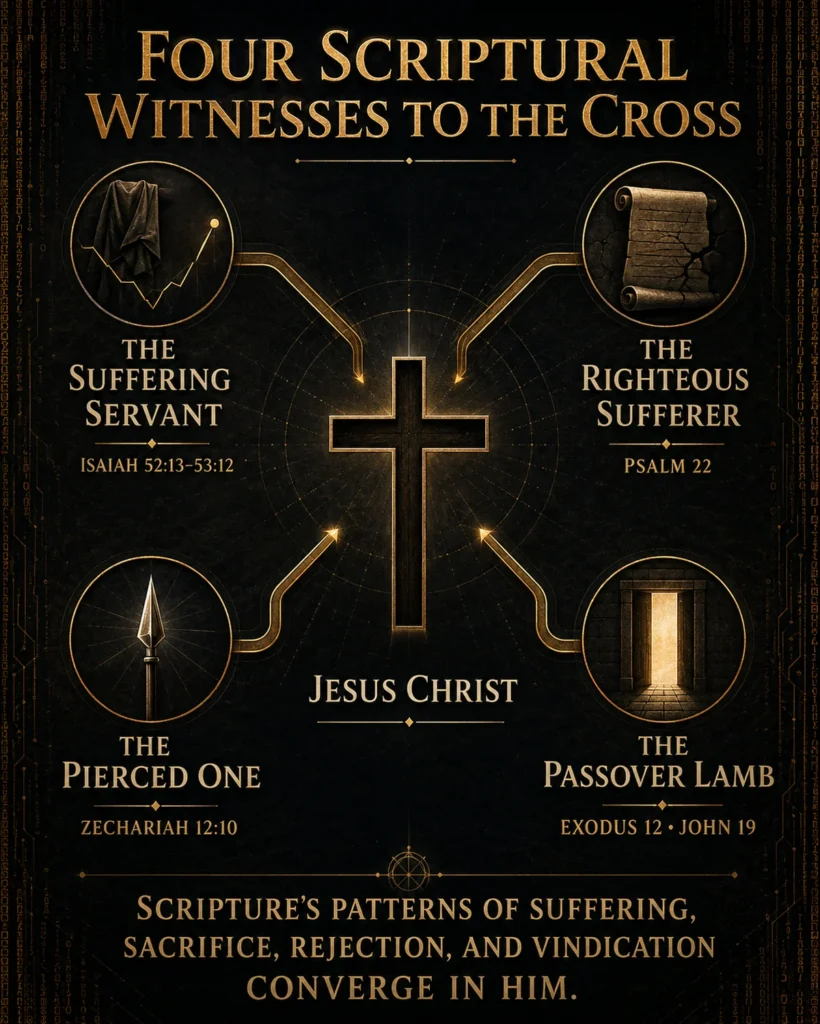
In brief: Christians believe the Old Testament prepares readers for Jesus’ death most clearly through Isaiah’s suffering Servant, Psalm 22’s righteous sufferer, Zechariah’s pierced one, and the Passover pattern fulfilled in Christ. These texts do not all function as identical one-to-one forecasts. But together they form the scriptural pattern through which the New Testament explains why Jesus was rejected, why He suffered, and why His death was not the collapse of God’s purpose.
The heart of the case is not that the Bible contains a collection of disconnected clues which happen to resemble events in the Gospels. It is that the New Testament’s earliest witnesses repeatedly interpreted Jesus’ death through Israel’s Scriptures. They saw in Him the Servant who suffers, the righteous one mocked by enemies, the sacrifice through whom deliverance comes, and the Messiah whom God vindicates after rejection and death.
That does not mean prophecy replaces history. The historical question remains whether Jesus was truly crucified under Roman authority; that evidence belongs in Was Jesus Crucified? Historical Evidence for the Cross. This article asks a different question: how do the Scriptures themselves frame the meaning and pattern of Jesus’ death?
Nor does this article attempt to explain every dimension of what the cross accomplished. The New Testament speaks of sacrifice, reconciliation, redemption, victory, covenant, and forgiveness. For that focused theological question, see Why Did Jesus Die? What Scripture Says the Cross Accomplished.
Here, the focus is narrower: the Scriptures Jesus and His followers believed were coming to fulfillment in His suffering and death.
How This Article Uses the Word “Fulfillment”
A careful Christian reading begins by asking what an Old Testament passage says in its own setting before asking how the New Testament applies it to Jesus. That discipline matters especially in an article about the cross, where familiar verses can easily be turned into slogans.
- Explicit New Testament application: The Gospel writers or apostles directly quote or apply an Old Testament text to Jesus.
- Central Christian canonical fulfillment: An Old Testament passage becomes foundational for understanding Jesus’ person and saving work across the New Testament.
- Passion echo or righteous-sufferer pattern: The Gospels narrate Jesus’ suffering with language that resonates with Israel’s Scriptures, even where the text is not a simple prediction-and-fulfillment formula.
- Typology or sacrificial pattern: A real person, institution, event, or practice in Israel’s history reaches its fullest meaning in Christ.
- Debated text requiring care: A Christian reading may be serious and defensible, while questions of translation, textual history, original context, or chronology still require humility.
These categories do not weaken Christian confidence. They make the argument more truthful. Scripture is not less powerful because Psalm 22 is first a Davidic lament, because Passover laws first govern Israel’s worship, or because Isaiah’s Servant has been interpreted differently by Jewish and Christian readers. The question is whether the New Testament’s reading of those texts finds their fullest coherence in Jesus Christ.
That is why this article will not claim that every Old Testament line is a detached prediction of a Roman crucifixion scene. It will show instead how the New Testament reads Jesus’ Passion as the climax of Scripture’s united witness: the righteous sufferer is mocked, the Servant bears sin, the sacrifice brings deliverance, and God vindicates the One whom human beings reject.
The path toward the cross also includes betrayal, abandonment, and the striking of the Shepherd. Those texts are considered in detail in Jesus’ Betrayal and Rejection in Prophecy. This article begins with the passage that stands near the center of the New Testament’s understanding of Jesus’ suffering: Isaiah 52:13–53:12.
Isaiah 52:13–53:12: The Suffering Servant at the Center
Fulfillment category: Central Christian canonical fulfillment
Isaiah 52:13–53:12 is not merely one more entry in a list of messianic texts. For Christians, it is one of Scripture’s clearest and deepest portraits of the meaning of Jesus’ suffering and death.
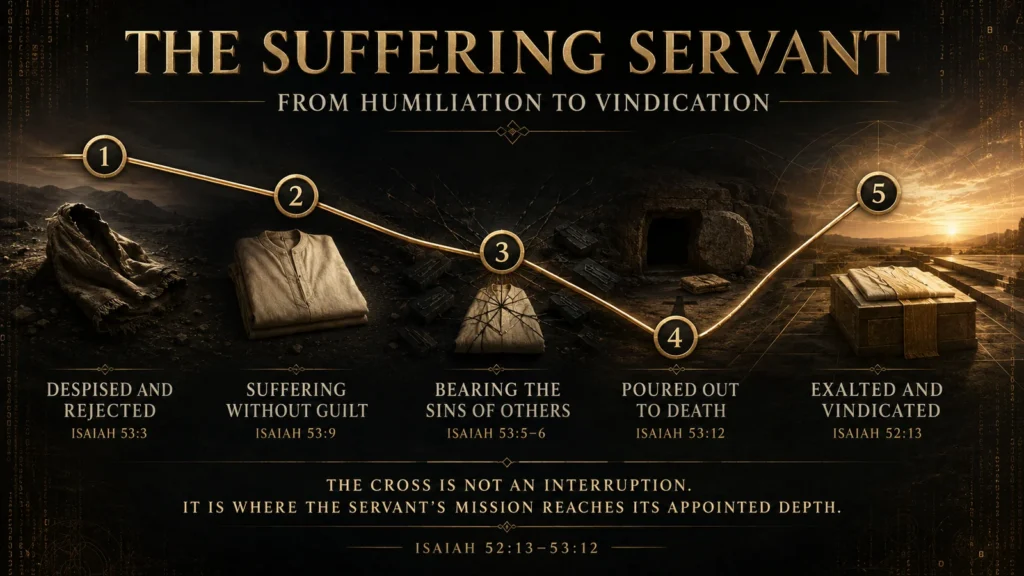
The poem begins with a startling tension. God declares that His Servant will ultimately be exalted, lifted up, and highly raised. Yet the same Servant is first disfigured, despised, rejected, and treated as though He were under God’s judgment. The movement of the passage is not from glory to escape from suffering. It is from humiliation through suffering toward vindication.
“He was despised and rejected by men; a man of sorrows and acquainted with grief.”
Isaiah does not portray the Servant as suffering because He is morally corrupt or abandoned by God in the sense of personal failure. The poem repeatedly stresses His innocence. He suffers unjustly, yet His suffering is described as bearing grief, carrying sorrows, being wounded for transgressions, and making many righteous through His work.
That is why Isaiah 53 has remained central to Christian reflection on the cross. The passage does not merely say that a righteous person suffers. It speaks of a Servant whose suffering has a representative and redemptive dimension. He is wounded in relation to the sins of others. He bears their iniquities. He gives Himself unto death. And, after that suffering, the purpose of the Lord prospers in His hand.
The poem also includes the Servant’s silence under oppression, His death, His burial, and His final vindication. These elements belong together. Christians should not isolate one phrase and turn it into a slogan. Isaiah presents a unified portrait: the Servant is rejected, innocent, afflicted, silent before oppression, numbered among the transgressors, and then vindicated by God after accomplishing the purpose for which He was sent.
Jewish and Christian readers have differed substantially over the identity of Isaiah’s Servant. In some parts of Isaiah, Israel is explicitly called God’s servant. That broader context must be acknowledged. Yet Isaiah 49 also describes a Servant whose mission includes bringing Jacob back and restoring Israel, which Christians understand as showing that the Servant’s role cannot be reduced simply to the nation as a whole.
Christians therefore argue that Jesus fulfills Israel’s calling in the fullest sense: faithful where Israel failed, obedient where humanity rebels, suffering without guilt, bearing sin, and bringing God’s light and salvation outward to the nations. This is not an argument that dismisses Jewish interpretation. It is the Christian claim that the New Testament’s witness identifies Jesus as the Servant in whom Isaiah’s portrait reaches its climactic fulfillment.
Isaiah 53 does not invite readers to admire suffering for its own sake. It reveals the holiness of the Servant, the seriousness of sin, and the purpose of God to save through the One who willingly gives Himself. The cross, in this light, is not an interruption in Jesus’ mission. It is the place where His mission reaches its appointed depth.
How the New Testament Applies Isaiah 53 to Jesus
The New Testament does not leave Isaiah 53 as a vague background theme. It repeatedly brings the Servant passage into direct relation with Jesus.
Matthew applies Isaiah 53:4 to Jesus’ ministry of healing and deliverance, showing that the Servant’s burden-bearing work was already understood as part of Christ’s mission before the crucifixion. Matthew 8:16–17 does not reduce Isaiah’s Servant to physical healing, but it shows that Jesus’ compassionate ministry and His saving suffering belong to the same messianic calling.
John also cites Isaiah 53 after describing the widespread refusal to believe in Jesus despite His signs. John 12:37–38 reads unbelief and rejection through the Servant’s question: “Who has believed what he has heard from us?” In John’s Gospel, Jesus’ rejection is not evidence that His mission failed. It is part of the scriptural pattern through which His glory is revealed.
Acts 8 provides one of the clearest examples. The Ethiopian official is reading Isaiah 53 and asks whom the prophet is speaking about. Luke then says that Philip, “beginning with this Scripture,” told him the good news about Jesus. Acts 8:32–35 does not present Isaiah 53 as a side note or an optional illustration. It presents the Servant passage as a starting point for proclaiming Christ.
First Peter applies the passage with particular force. Peter describes Jesus as sinless, reviled without retaliation, and entrusting Himself to the God who judges justly. He then draws directly from Isaiah 53: “He himself bore our sins in his body on the tree” and “by his wounds you have been healed.” 1 Peter 2:21–25 presents Christ’s suffering as both an example of faithful endurance and the saving work through which wandering people are brought back to the Shepherd and Overseer of their souls.
These New Testament uses establish the article’s central point. Christians do not identify Jesus with Isaiah’s Servant merely because later readers noticed a few verbal similarities. The New Testament repeatedly interprets Jesus’ ministry, rejection, suffering, and saving death through Isaiah’s Servant poem.
Isaiah 53 therefore gives the theological center of the biblical case for Jesus’ crucifixion prophecies. Psalm 22 will add the language of the righteous sufferer whose anguish, mockery, and eventual vindication are taken up in the Passion narratives. Together, these texts help explain why the Gospels portray the cross not as an unforeseen defeat, but as the suffering through which God’s saving purpose is brought to its appointed climax.
Psalm 22: Jesus’ Passion and the Righteous Sufferer
Fulfillment category: Passion echo with explicit New Testament application
Psalm 22 is one of the most important Old Testament texts in the Passion narratives. But it must first be read for what it is: a Davidic lament from a righteous sufferer surrounded by mockery, danger, public shame, and apparent abandonment.
The psalm does not begin as a detached prediction chart. It begins as prayer.
“My God, my God, why have you forsaken me?”
David speaks from deep anguish. He feels exposed before enemies, mocked by those around him, and brought near death. Yet Psalm 22 does not end in despair. Its movement is from suffering toward confidence, praise, and the public declaration that God has acted.
Christians should not treat the psalm as though David were merely recording a first-person medical description of Roman crucifixion centuries in advance. Psalm 22 is a real lament arising from Israel’s Scriptures. Its original voice matters.
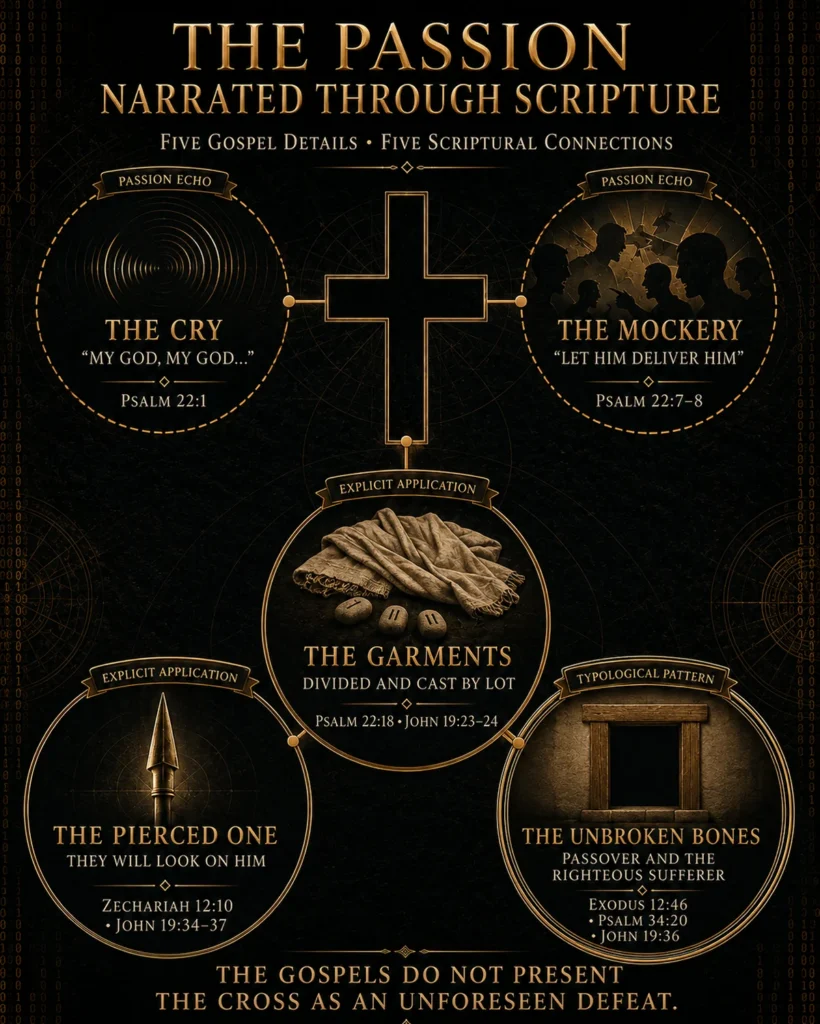
Yet the Gospels repeatedly narrate Jesus’ suffering in language that resonates with Psalm 22. Jesus’ cry from the cross unmistakably invokes the psalm’s opening words. Matthew and Mark record Him crying, “My God, my God, why have you forsaken me?” as He dies. Matthew 27:45–46 and Mark 15:33–34 therefore place Jesus’ final suffering within the scriptural language of the righteous sufferer.
That cry should not be reduced to a slogan or used to flatten the mystery of the cross. Jesus is not quoting Psalm 22 simply to announce a verse reference. The Gospel writers present His suffering as taking place in the scriptural world the psalm describes: rejection, mockery, humiliation, anguish, and trust in God amid suffering.
The public mockery surrounding Jesus also echoes Psalm 22.
“All who see me mock me; they make mouths at me; they wag their heads; ‘He trusts in the Lord; let him deliver him.’”
Matthew describes those passing by Jesus at the cross wagging their heads, mocking Him, and challenging God to rescue Him. Matthew 27:39–43 does not require readers to conclude that every sentence was mechanically dictated by the psalm. But the correspondence is clear: the Passion narrative is telling Jesus’ suffering through the scriptural pattern of the righteous one publicly scorned by those who assume that suffering proves God has abandoned him.
The strongest explicit connection comes in John’s account of the soldiers dividing Jesus’ garments and casting lots for His clothing.
“They divide my garments among them, and for my clothing they cast lots.”
John does not merely leave readers to notice a similarity. He explicitly says that the soldiers’ actions occurred “to fulfill the Scripture.” John 19:23–24 is therefore one of the clearest examples in this article of direct New Testament application.
Psalm 22 matters because the Gospels do not present Jesus as a victim whose suffering fell outside God’s purposes. They present Him as the righteous sufferer whose rejection and humiliation take place within the scriptural pattern already given to Israel. The psalm’s eventual movement toward praise and God’s public vindication also prepares readers for the Christian claim that the cross is not the final verdict on Jesus.
Psalm 22:16: A Necessary Textual Note
Psalm 22:16 is often cited in Christian discussions of Jesus’ crucifixion because some translations render it, “They have pierced my hands and feet.” But this line has a real textual and translation question that should not be hidden.
Some Hebrew traditions are rendered “like a lion,” while ancient translation traditions and some manuscript evidence support a verbal reading rendered “they pierced” or “they dug through.” Christians may reasonably present “pierced” as a defensible reading, but they should not make the whole case for Jesus’ crucifixion depend on that one disputed line.
The Christian case for Psalm 22 does not stand or fall with verse 16. The Gospel connections to Psalm 22:1, the mockery language in verses 6–8, and John’s explicit use of verse 18 are already substantial. Psalm 22:16 may remain part of the discussion, but it should be handled with humility rather than used as a rhetorical shortcut.
The point is not to avoid difficult questions. It is to let each text bear the weight it can responsibly carry. Psalm 22 remains deeply significant because the Passion narratives repeatedly draw readers into its world of anguish, scorn, trust, and eventual vindication.
Zechariah 12:10: The Pierced One
Fulfillment category: Explicit New Testament application
Zechariah 12 belongs to a larger prophetic vision of Jerusalem’s crisis, mourning, repentance, cleansing, and restoration. It should not be reduced to one phrase detached from its setting. The chapter looks toward a time when God acts decisively for His people and when deep mourning follows the recognition of the one who has been pierced.
“They will look on me, on him whom they have pierced, and they shall mourn for him.”
The verse contains genuine interpretive difficulty. Its wording moves between “me” and “him,” and scholars continue to discuss how the pronouns relate within Zechariah’s prophetic vision. Christians should acknowledge that complexity rather than pretending the Hebrew text has no questions.
But John’s Gospel explicitly brings Zechariah’s pierced-one language into the account of Jesus’ death.
After Jesus has died, John records that a soldier pierces His side with a spear. John then explains that these events took place in accordance with Scripture and cites the words, “They will look on him whom they have pierced.” John 19:34–37 makes the Christian connection explicit: John sees Jesus’ piercing as the fulfillment of Zechariah’s prophetic language.
The article’s claim should remain as careful as John’s own method. Christians do not need to say that Zechariah 12 is only about the Roman soldier at the cross, or that the verse by itself settles every question about Jesus’ divine identity. Zechariah’s wider context includes mourning, repentance, cleansing, and restoration. John reads Jesus’ death as the decisive event through which that larger prophetic horizon begins to come into focus.
That matters because Jesus’ death is not presented merely as an act of violence inflicted upon Him. In John’s Gospel, the pierced Christ becomes the one upon whom people must look with grief, faith, repentance, and hope. The cross exposes the depth of human sin, but it also opens the way toward cleansing and restoration.
Psalm 22 and Zechariah 12 therefore work together without functioning in identical ways. Psalm 22 gives the Passion narrative the language of the righteous sufferer mocked and humiliated before God’s vindication. Zechariah 12 gives John the language of the pierced one whose death leads to mourning and restoration. Both texts converge in the New Testament’s proclamation of Jesus crucified.
John’s Passion narrative continues beyond garments and piercing. It also frames Jesus’ death through Passover imagery, Scripture’s language of unbroken bones, and the sacrificial pattern fulfilled in Christ. That is the next part of the case.
Passover, Sacrifice, and “Not One of His Bones Will Be Broken”
Fulfillment category: Passover typology and converging scriptural fulfillment
John’s Passion narrative does not present Jesus’ death as a bare execution scene. It repeatedly places the cross within the scriptural world of sacrifice, deliverance, and Passover.
After recording Jesus’ death, John explains that the soldiers did not break His legs because they found that He was already dead. He then says, “For these things took place that the Scripture might be fulfilled: ‘Not one of his bones will be broken.’” John 19:31–36
Christians have long read this statement in light of the Passover instructions. The Passover lamb was not to have its bones broken. Exodus 12:46 and Numbers 9:12 establish that practice within Israel’s worship. Psalm 34:20 also speaks of the righteous sufferer whom the Lord preserves: “He keeps all his bones; not one of them is broken.”
The safest Christian claim is not that Exodus contains a detached prediction that the Messiah would be executed by Rome without broken bones. Exodus gives Israel the Passover pattern. Psalm 34 adds righteous-sufferer language. John then presents Jesus’ death as the place where these scriptural patterns converge.
That is typology. A real event in Israel’s history—the Passover deliverance from judgment and slavery—reaches its fullest meaning in Christ. John’s Gospel has already introduced Jesus as “the Lamb of God, who takes away the sin of the world,” and Paul later writes, “Christ, our Passover lamb, has been sacrificed.” John 1:29 and 1 Corinthians 5:7
The point is not that Jesus merely resembles a Passover lamb in one physical detail. The New Testament presents His death as the climactic sacrifice through which God brings deliverance. The lamb’s blood marked households for rescue in Exodus; Christ gives Himself so that judgment, bondage, and death do not have the final word over those who belong to Him.
This article does not attempt to exhaust the Bible’s teaching about atonement. Scripture speaks of sacrifice, substitution, reconciliation, redemption, covenant, victory, forgiveness, and new creation. Those themes belong in greater detail in Why Did Jesus Die? What Scripture Says the Cross Accomplished. Here, the central point is narrower: John reads Jesus’ death through the scriptural pattern of Passover deliverance and the righteous sufferer preserved by God.
Supporting Passion Echoes: Psalms 69 and 31
John’s account also records that Jesus said, “I thirst,” and explains that He did so “to fulfill the Scripture.” He was then given sour wine. John 19:28–29
Psalm 69:21 provides the strongest scriptural parallel: “for my thirst they gave me sour wine to drink.” Psalm 69:21 is another lament of a rejected righteous sufferer. Christians should not treat it as an isolated proof that settles the entire case for Jesus. Its force comes from the way John places Jesus’ thirst, suffering, and final surrender within the wider scriptural pattern of the righteous one rejected by enemies yet heard by God.
Luke’s Gospel gives another restrained but important echo. Jesus’ final words include, “Father, into your hands I commit my spirit,” drawing directly from Psalm 31:5. Luke 23:46 and Psalm 31:5 portray Jesus’ death not as despairing surrender to meaninglessness, but as faithful trust in the Father even at the point of death.
These supporting echoes should remain supporting echoes. Psalm 69 and Psalm 31 deepen the scriptural atmosphere of the Passion; they do not need to be inflated into separate “proofs” competing with Isaiah 53, Psalm 22, Zechariah 12, and John 19.
What These Scriptures Establish—and What They Do Not
The biblical case for Jesus’ crucifixion prophecies is strongest when each text is allowed to bear the weight it can responsibly carry. The Old Testament passages considered here do not all function in the same way. Some are explicitly applied by the New Testament. Others provide the canonical patterns through which the Gospels understand Jesus’ suffering and death.
Evidence Matrix: Scripture and the Cross
| Old Testament text | Fulfillment category | New Testament connection | What Christians can responsibly claim |
|---|---|---|---|
| Isaiah 52:13–53:12 | Central Christian canonical fulfillment | Matthew 8:17; John 12:38; Acts 8:32–35; 1 Peter 2:21–25 | The New Testament repeatedly understands Jesus’ rejection, innocent suffering, sin-bearing, death, and vindication through Isaiah’s Servant. |
| Psalm 22:1, 6–8 | Passion echo / righteous-sufferer pattern | Matthew 27:39–46; Mark 15:34 | The Passion narratives tell Jesus’ suffering in language that strongly resonates with Psalm 22. |
| Psalm 22:18 | Explicit New Testament application | John 19:23–24 | John explicitly applies the divided-garments text to Jesus. |
| Psalm 22:16 | Debated text requiring care | Christian Passion interpretation | “Pierced” is a defensible reading in some textual traditions, but the Hebrew wording is disputed and should not carry the argument. |
| Zechariah 12:10 | Explicit New Testament application | John 19:34–37 | John applies pierced-one language to Jesus while Zechariah’s larger mourning-and-restoration context remains important. |
| Exodus 12:46; Numbers 9:12; Psalm 34:20 | Passover typology and righteous-sufferer resonance | John 19:31–36; 1 Corinthians 5:7 | Jesus’ death is framed within converging Passover and righteous-sufferer categories, not as a simplistic one-line forecast. |
| Psalm 69:21; Psalm 31:5 | Supporting Passion echoes | John 19:28–29; Luke 23:46 | The Gospels present Jesus’ thirst and final surrender within Scripture’s language of suffering and trust. |
What Christians Can Say Confidently
- The New Testament repeatedly interprets Jesus’ suffering and death through Israel’s Scriptures rather than as an unforeseen collapse of His mission.
- Isaiah 53 stands near the center of the New Testament’s understanding of Jesus as the rejected, innocent, suffering Servant who bears sin and is vindicated by God.
- The Gospels deliberately narrate Jesus’ Passion in the scriptural language of Psalm 22, including Jesus’ cry, public mockery, and the division of His garments.
- John explicitly applies Psalm 22:18 and Zechariah 12:10 to events surrounding Jesus’ death.
- John also frames Jesus’ death in Passover categories, joined with righteous-sufferer language, when he explains why Jesus’ bones were not broken.
- Scripture’s patterns of suffering, sacrifice, rejection, and vindication converge in the crucified and risen Christ.
What Christians Should Not Claim
- Christians should not claim that every Old Testament connection is the same kind of direct prediction.
- Christians should not claim that Psalm 22 is a medical report of Roman crucifixion or that Psalm 22:16 has no textual difficulty.
- Christians should not claim that Passover regulations were a stand-alone forecast of Roman execution.
- Christians should not claim that Zechariah 12:10 has no contextual or interpretive complexity.
- Christians should not claim that Isaiah 53 has never been interpreted differently by Jewish readers.
- Christians should not claim that prophecy alone proves Christianity apart from the historical claims concerning Jesus’ death and resurrection.
Daniel 9:26 deserves one final word of restraint. Many Christians connect its reference to an anointed one being “cut off” with Jesus’ death before Jerusalem’s destruction. That interpretation has a long Christian history, but the chronology, historical setting, and precise identification of the figures remain debated. Daniel 9 should not carry the main burden of the case for Jesus’ crucifixion.
How Prophecy, the Historical Cross, and Resurrection Fit Together
Prophecy does not replace history. The Christian claim that Jesus was crucified under Roman authority must be considered historically, using the Gospel accounts, Paul’s letters, early Christian testimony, and relevant non-Christian evidence. That case is developed in Was Jesus Crucified? Historical Evidence for the Cross.
Yet history and Scripture are not competing explanations. The historical cross establishes that Jesus died publicly under Roman authority. Scripture explains why His earliest followers believed that death was not random, accidental, or the final defeat of their Messiah.
Isaiah’s Servant is rejected and later vindicated. Psalm 22 moves from anguish to praise. Zechariah’s pierced one becomes the focus of mourning, cleansing, and restoration. Passover points from deliverance through sacrifice toward the Lamb of God. These texts create the scriptural world in which the New Testament proclaims Jesus crucified.
The resurrection is therefore not an optional postscript. It is the Christian claim that God publicly vindicated the One who was rejected and killed. Paul summarizes the earliest proclamation in terms of Christ’s death, burial, resurrection, and appearances, saying that Christ died “for our sins in accordance with the Scriptures.” 1 Corinthians 15:1–8
The historical and evidential questions surrounding that proclamation deserve focused treatment. Continue with How Early Is the Resurrection Claim?, then examine What Did the First Witnesses Claim About the Risen Jesus?.
Continue the Evidence
- Explore the Prophecy Hub: Prophecies of Jesus Fulfilled in Scripture
- Study the Wider Passion Pattern: Jesus’ Betrayal and Rejection in Prophecy
- Continue in the Prophecy Lane: Prophecies of Jesus’ Resurrection Fulfilled
- Return to the Larger Case: Is Jesus the Son of God?
Frequently Asked Questions About Jesus’ Crucifixion Prophecies
Does Psalm 22:16 really say “they pierced my hands and feet”?
Psalm 22:16 has a real textual and translation dispute. Some Hebrew traditions are rendered “like a lion,” while ancient translation traditions and some manuscript evidence support a verbal reading such as “they pierced” or “they dug through.” Christians may regard “pierced” as a defensible reading, but the case for Jesus should not rest on that one line.
Is Isaiah 53 about Jesus or Israel?
Jewish and Christian readers have differed substantially over the Servant’s identity. Israel is called God’s servant elsewhere in Isaiah, but Isaiah also describes a Servant whose mission includes restoring Israel. Christians believe Jesus fulfills the Servant’s calling in its fullest sense, and the New Testament repeatedly applies Isaiah 53 to His ministry, suffering, death, and saving work.
Did the Old Testament directly predict Roman crucifixion?
The strongest Christian case does not depend on claiming that every text predicted the mechanics of Roman execution. Scripture presents the suffering Servant, the righteous sufferer, the pierced one, the Passover sacrifice, rejection, and vindication. The New Testament identifies those scriptural patterns as fulfilled in Jesus’ death.
Why were Jesus’ bones not broken?
John says this occurred so that Scripture would be fulfilled. Christians read the scene through the Passover command not to break the lamb’s bones, together with Psalm 34’s righteous-sufferer language. The point is typological fulfillment: Jesus’ death is presented as the climactic sacrifice through whom God brings deliverance.
What does Zechariah 12:10 mean for Jesus’ death?
John explicitly applies the pierced-one language of Zechariah 12:10 to Jesus after the soldier pierces His side. Zechariah’s larger setting includes mourning, repentance, cleansing, and restoration, which Christians see as deepening the significance of Jesus’ death rather than reducing it to one physical detail.
Does Daniel 9:26 prove that Jesus was crucified?
Many Christians connect Daniel 9:26’s reference to an anointed one being “cut off” with Jesus’ death. That reading has a long history, but the passage’s chronology and detailed interpretation remain debated. It may be considered as a supporting discussion, but it should not bear the central burden of the case.
Sources and Further Reading
- Primary biblical texts: Isaiah 52:13–53:12; Psalm 22; Psalm 31:5; Psalm 34:20; Psalm 69:21; Zechariah 12:10; Exodus 12:46; Numbers 9:12; Matthew 27; Mark 15; Luke 23; John 19; Acts 8:32–35; 1 Peter 2:21–25; 1 Corinthians 5:7; 1 Corinthians 15:1–8.
- Richard B. Hays, Echoes of Scripture in the Gospels (Baylor University Press, 2016).
- G. K. Beale and D. A. Carson, eds., Commentary on the New Testament Use of the Old Testament (Baker Academic, 2007).
- Joseph Blenkinsopp, Isaiah 40–55: A New Translation with Introduction and Commentary, Anchor Yale Bible 19A (Yale University Press, 2002).
- John Goldingay, Psalms, Volume 1: Psalms 1–41, Baker Commentary on the Old Testament Wisdom and Psalms (Baker Academic, 2006).
- Mark J. Boda, The Book of Zechariah, New International Commentary on the Old Testament (Eerdmans, 2016).
- Raymond E. Brown, The Death of the Messiah: From Gethsemane to the Grave, 2 vols.
These works represent a range of scholarly approaches. Their inclusion identifies resources relevant to the biblical texts discussed; it does not imply agreement with every conclusion in this article.
Unless otherwise indicated, Scripture quotations are from the ESV® Bible.
Jesus’ Cross Was Not an Accident
The Old Testament does not give Christians a shortcut around careful reading. It gives them a unified scriptural witness: a Servant who suffers without guilt, a righteous one mocked by enemies, a pierced one mourned in repentance, and a Passover sacrifice through whom deliverance comes.
The New Testament identifies Jesus with that witness. He is betrayed, rejected, mocked, pierced, and crucified. Yet His death is not the final verdict upon Him. God vindicates the Servant. The righteous sufferer is heard. The rejected Messiah rises.
The final purpose of these Scriptures is not admiration for a chart of correspondences. They call readers to behold Jesus Christ: the holy Servant who bore sin, the true Passover Lamb, the crucified Savior, and the risen Lord who now calls men and women to trust Him.
CONTINUE THE INVESTIGATION
Recommended continuation
Why Did Jesus Die? What Scripture Says the Cross Accomplished
Move from the prophetic pattern of suffering to Scripture’s explanation of why the cross matters.