
GUIDED ARTICLE EXPERIENCE
What Did the Watchers Teach? Forbidden Knowledge Before the Flood
Read along as the narration moves through the article.
Private device narration · No hosted audio or tracking
CONTINUE GUIDED TOUR
Continue where you left off.
GUIDED TOUR COMPLETE
You have reached the end of this study.
Study record saved on this device.
GUIDED TOUR
What Did the Watchers Teach? Forbidden Knowledge Before the Flood
Narrator: Paranoid Prophet Recommended Voice Native device narration
Prepare to follow the article as it is narrated.
VOICE & TOUR OPTIONS
Voice & Listening
NARRATOR
Finding a narrator…
Checking the best narrator available on this device.
Restores the best curated narrator available on this device.
Narrator choices are curated for clear, long-form listening on this device.
Screen-awake support will be checked when narration starts.
CHOOSE A NARRATOR
Curated for this device
Choose a verified narrator for this browser, or use System Narrator. Automatic mode uses the best reliable route exposed by this device; your chosen narrator is preserved even if this device needs a temporary fallback.
Preparing the guided article experience…
RESUME GUIDED TOUR?
Continue where you left off.
GUIDED TOUR COMPLETE
You have reached the end of this study.
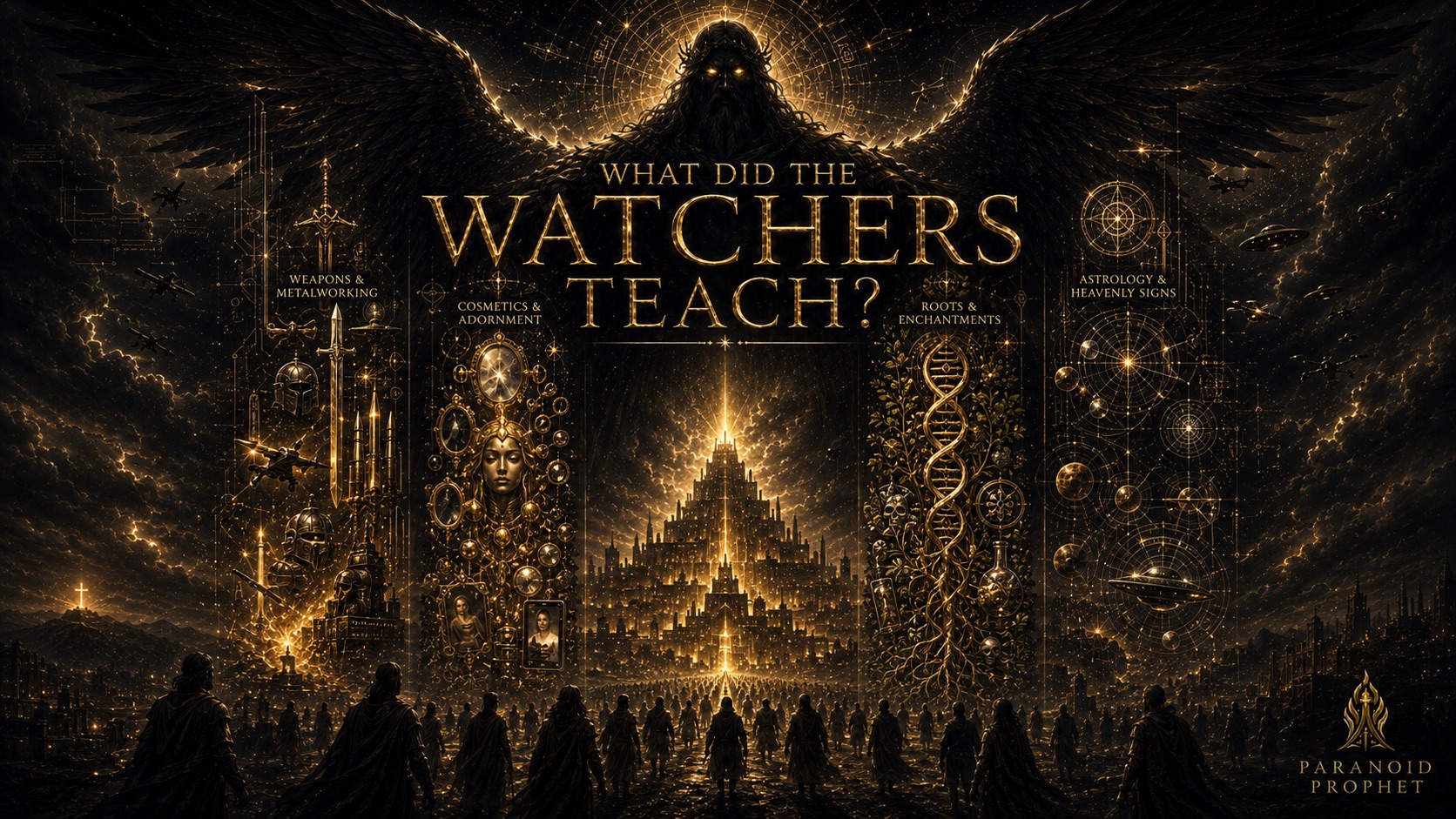
What did the Watchers teach humanity? Genesis does not provide a curriculum of forbidden arts. The detailed list comes from 1 Enoch 8, where rebellious heavenly beings are said to reveal weapons and metalworking, ornaments and beautification, spells and root-cutting, and several forms of celestial sign-lore. The chapter assigns different teachings to named Watchers, then places those revelations inside a story of godlessness, bloodshed, corruption, and judgment.
That source distinction controls everything that follows. Genesis 6 gives the canonical setting: the sons of God cross a boundary, the Nephilim appear, human wickedness becomes great, violence fills the earth, and God announces judgment while Noah finds favor. First Enoch is an ancient Jewish interpretation that expands this compressed biblical world. For most Christians, it is significant context rather than Scripture equal to Genesis.
The ancient warning is easy to distort. The text does not require Christians to condemn metal, medicine, beauty, craftsmanship, astronomy, or technical skill. Scripture celebrates Spirit-given artisans, wisdom, healing, and the created order. Violence also existed before the Watcher teaching catalog: Cain murdered Abel, and Lamech boasted of vengeance. In the Enochic story, the newly revealed arts intensify and organize corruption already active in the human heart.
The central issue is therefore not whether a form of knowledge seems advanced, hidden, natural, or powerful. Christians must ask where it comes from, how it is obtained, what moral order governs it, and what fruit it produces. Capability is not wisdom. Information is not holiness. Power can protect life or dominate it, heal a neighbor or exploit one, direct attention toward the Creator or become a substitute for him.
This also means the teaching list cannot prove the hidden origin of a modern invention. Similarity between an ancient category and a present technology may raise an ethical question, but it cannot establish a historical chain of transmission. The Enochic text gives readers an ancient theology of corrupt revelation, not an intelligence report about contemporary laboratories, weapons programs, medical systems, or aerospace claims.
This article examines the teaching list in its ancient setting, distinguishes the text from later interpretation, and develops a Christian framework for testing claims of hidden or nonhuman revelation. Modern parallels appear only after the ancient evidence is clear. The danger is not knowledge under God. The danger is knowledge against God.
Article Guide9 sections
What Did the Watchers Teach?
In the scholarly translation by George W. E. Nickelsburg and James C. VanderKam, 1 Enoch 8 attributes these broad categories of instruction to the Watchers:
- Weapons and armor: swords, other weapons, shields, breastplates, and instruments of war.
- Metals and workmanship: metals from the earth, the working of gold and silver, bracelets, ornaments, precious stones, and dyes.
- Beautification: antimony, eye paint, and practices connected with ornamenting the body.
- Magical arts: spells, sorcery, the loosening of spells, and the cutting of roots.
- Celestial and earthly signs: signs associated with lightning, stars, shooting stars, the earth, the sun, and the moon.
The exact names, spellings, and assignments differ among Aramaic fragments, Greek witnesses, Ethiopic manuscripts, and English translations. Older versions often summarize parts of the final category as astrology, constellations, cloud signs, or courses of heavenly bodies. Those differences do not erase the central pattern, but they warn against presenting one modern spelling or wording as unquestionably original.
Asael receives the longest individual description. Shemihazah and Hermani are associated with magical practices, while six additional names are attached to signs in the heavens or earth. The chapter closes the catalog by saying the Watchers disclosed mysteries to their wives and children as human beings perished. In other words, the list is framed as illicit revelation passing from rebellious teachers into families and society, not as neutral discoveries emerging through ordinary human study.
The list also operates on more than one level. First Enoch directly names the arts. Its surrounding narrative connects their revelation with transgression, godlessness, bloodshed, and a world moving toward judgment. The further claim that these arts form a map of violence, desire, status, manipulation, and control is a theological interpretation of the narrative, not a word-for-word translation of chapter 8.
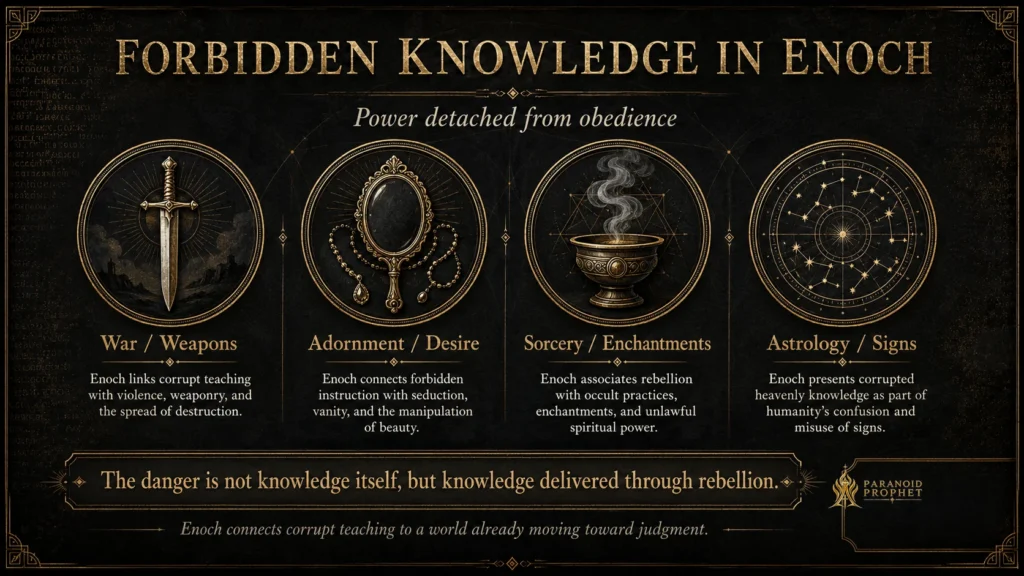
The Watchers are remembered as corrupt teachers because their rebellion becomes cultural. They do more than break a boundary themselves. They train human beings to wield power inside an already fallen moral order. The problem was not that humanity became informed. It was that humanity was discipled by rebellion.
Where the Teaching List Comes From
Genesis supplies the foundation, but 1 Enoch supplies the catalog. Confusing those sources either inflates Genesis or empties the ancient tradition of its historical value.
Genesis Establishes the Moral World
The biblical story already knows murder, pride, technical skill, and escalating vengeance before Genesis 6. Cain kills Abel in Genesis 4:1–16. Later in the chapter, Tubal-cain is described as a forger of bronze and iron tools, while Lamech boasts that his retaliation exceeds Cain’s. Genesis places craftsmanship and violence near one another without declaring craftsmanship itself sinful.
Genesis 6 then describes a wider crisis. The sons of God and daughters of humanity stand at the chapter’s opening, but the inspired text moves quickly to the human heart, the corruption of all flesh, and an earth filled with violence. The Flood answers a total moral collapse, not one isolated invention. Genesis 6 Explained traces that complete movement without allowing verses 1–4 to consume the chapter.
First Enoch Develops the Ancient Interpretation
The Book of the Watchers expands the boundary-crossing beings into named rebels who descend, take wives, produce giant offspring, disclose mysteries, and come under judgment. Chapter 8 contains the concentrated teaching list. Chapters 9–10 describe the heavenly response: the archangels see bloodshed and godlessness, human cries rise to heaven, and God commands judgment against the rebels and their violent offspring.
Two Teaching Strands Woven Together
Scholars often observe that 1 Enoch 6–11 combines traditions centered on Shemihazah and Asael. The Shemihazah material emphasizes the collective descent, marriages, giant offspring, and magical teaching. The Asael material gives special attention to metallurgy, weapons, adornment, and the corruption those arts produce. In the final literary form, the strands reinforce one another: forbidden union and forbidden revelation belong to the same expanding crisis.
This helps explain why leadership can seem to shift. Shemihazah is chief of the descending Watchers, yet Asael receives singular blame in the judgment material for teaching unrighteousness and making the earth desolate. The text is not offering a tidy organizational chart. It preserves layered traditions that have been woven into a common account of heavenly rebellion and earthly ruin.
This sequence gives the catalog its moral force. It is not an antiquarian inventory of who invented which craft. It belongs to an accusation: heavenly beings revealed mysteries outside God’s order, human beings used what they received, and devastation followed. The arts are interpreted through the story’s fruit.
For the source’s composition, manuscripts, canon history, and proper Christian use, see The Book of Enoch Explained. For the identity and rebellion of the Watchers themselves, see The Watchers Explained. This article owns the narrower question of what the tradition says they taught and why the teachings were condemned.
Azazel or Asael: Weapons, Metals, and Adornment
The figure popularly called Azazel in many discussions appears as Asael in the Nickelsburg–VanderKam translation of 1 Enoch 8. Textual forms and scholarly discussions vary, so this article uses Asael when following that translation while acknowledging the familiar Azazel form.
Weapons and the Acceleration of Violence
Asael is credited with teaching human beings to make iron swords, weapons, shields, breastplates, and instruments of war. The text does not say he created violence in an innocent world. Genesis has already shown Cain’s murder and Lamech’s vengeful boast. The Enochic contribution is the systematization and amplification of violence through specialized equipment.
That distinction matters. A tool does not generate hatred from nothing, but it can extend hatred’s reach. Armor can protect, a blade can serve lawful purposes, and metallurgy can benefit ordinary life. In the narrative, however, war-making instruction enters a world whose powerful figures consume, kill, and shed blood. The surrounding story interprets the technology by the destruction it serves.
The theological warning is not that every improvement in capability is rebellion. It is that capability can outrun character. When violence already rules the heart, stronger instruments make violence more efficient. Power can grow faster than character, and a civilization that mistakes increased capacity for increased wisdom may become more dangerous as it becomes more skilled.
Metalworking, Ornaments, and Beautification
The same passage associates Asael with metals from the earth, worked gold and silver, bracelets, ornaments, antimony, eye paint, precious stones, and colored dyes. Weapons and adornment may appear unrelated to modern readers. Within the literary unit, both concern the transformation of created materials into social power: one through force, the other through display and desire.
Antimony was a mineral substance used in preparations around the eyes, and the passage places it beside eye paint, stones, dyes, and jewelry. That historical detail does not justify reading a complete modern beauty industry back into the verse. It shows that the author associated specialized material knowledge with practices of presentation and attraction that, in this narrative, participated in transgression.
First Enoch directly lists these arts and says that transgression and godlessness followed. The text does not provide a modern psychology of cosmetics, nor does it condemn every act of grooming or decoration. Applications involving vanity, seduction, status, exploitation, or manipulation arise from reading the list within its moral narrative; they should not be passed off as literal definitions of antimony or jewelry.
Scripture protects the goodness of skilled work. In Exodus 31:1–11, God fills Bezalel with the Spirit, wisdom, knowledge, and craftsmanship for work in gold, silver, bronze, stone, wood, fabric, and sacred design. Materials and skill can serve worship. Beauty can express gratitude, dignity, celebration, and holiness.
The contrast is not craft versus faith. It is craft ordered by obedience versus craft recruited by rebellion. Asael’s instruction appears in a story where creation’s gifts are bent toward war, transgression, and self-exaltation. The moral burden falls on the source, purpose, use, and fruit of the capability.
Shemihazah and the Other Watcher Teachings
Shemihazah, often written Semjaza or Semyaza in English, leads the collective descent in the Watcher narrative. In 1 Enoch 8, however, the teaching list extends beyond its two best-known figures. It moves from magic and roots to signs read across the created order.
Spells and Root-Cutting
The Hermeneia translation says Shemihazah taught spells and the cutting of roots. Hermani taught sorcery associated with loosening spells, magic, and skill. The precise range of “root-cutting” is debated, but it most likely concerns plant or root lore within a magical, medicinal, or esoteric setting rather than a clean modern category.
Ancient healing, botany, ritual, and magic often overlapped in ways that do not map neatly onto contemporary institutions. Mirela Chrysovergi’s detailed study of the textual evidence argues that root-cutting and herbal knowledge could involve botanical or medicinal practice while their association with spell-casting places the rejected activity within magico-medical use. That is more precise than calling all plant knowledge sorcery or all medicine a Watcher inheritance.
Scripture never condemns plants, responsible treatment, care for the suffering, or the study of created properties. The concern here is mediation and method: creation used through enchantment, coercive ritual, forbidden spiritual access, or a promise of control detached from trust in God. The root itself is not the moral agent.
Healing can be an act of mercy, and careful medical knowledge can express love of neighbor. A treatment may involve roots or chemicals without making a spiritual claim at all. Conversely, a ritual may use an ordinary plant while seeking power from a forbidden source. The material object cannot settle the discernment question by itself. The practice must be considered as a whole.
This protects readers from two mistakes. Medicine should not be slandered as occult because an ancient apocalypse mentions roots. At the same time, a practice does not become spiritually harmless merely because it uses a natural substance. Source, ritual context, intention, and fruit remain relevant.
Lightning, Stars, Earth, Sun, and Moon
Nickelsburg and VanderKam render the remaining assignments with unusual specificity: Baraqel teaches signs of lightning flashes; Kokabel, signs of the stars; Ziqel, signs of shooting stars; Arteqoph, signs of the earth; Shamsiel, signs of the sun; and Sahriel, signs of the moon. Other textual witnesses and translations compress or vary the list, sometimes using terms such as astrology, sign-lore, observation of stars, clouds, or lunar courses.
The safest conclusion is that the passage concerns interpretive arts directed toward natural and celestial phenomena. It should not be reduced to one modern discipline. Some ancient observation supported calendars, agriculture, navigation, and an appreciation of cosmic order. First Enoch itself contains extensive astronomical material that is not treated as equivalent to the Watchers’ rebellion.
This internal contrast is important. The Astronomical Book portrays Enoch receiving ordered knowledge of the luminaries within a revelatory framework the text approves. The Book of the Watchers condemns mysteries disclosed by rebels. Even within 1 Enoch, the bare subject matter “heavenly bodies” does not determine whether knowledge is faithful or corrupt. Authority, mediation, and purpose shape the judgment.
The moral boundary appears when creation is approached as an autonomous oracle: a source of fate, secret guidance, spiritual leverage, or authority that displaces the Creator. Psalm 19:1–6 presents the heavens as witnesses to God’s glory. Deuteronomy 18:9–14 forbids divination and sorcery. Studying a star is not the same act as asking a star to govern identity or disclose destiny.
Why the Names and Assignments Vary
First Enoch survives through a complex manuscript history. Aramaic fragments, Greek witnesses, and the complete Ethiopic tradition preserve overlapping but not identical forms. Names pass through several languages and alphabets, and some ancient copies abbreviate or rearrange material. Azazel and Asael, Semjaza and Shemihazah, Barakijal and Baraqel, and Kokabel and Kokabiel are familiar examples of English variation.
Simplified four-name charts should therefore be read with caution. Their “astrology” and “constellations” assignments may represent one translation tradition, while the modern Hermeneia rendering is more detailed. The reliable claim is the broad pattern of war-making, adornment, magic and roots, and interpreted signs, not one infallible English chart.
What Makes Knowledge Forbidden?
Knowledge is not condemned merely because it is advanced, hidden, technical, unfamiliar, or powerful. The Bible does not present ignorance as holiness. It praises wisdom, skill, truthful speech, careful observation, craftsmanship, and the instruction of the faithful. The decisive questions are moral and theological.
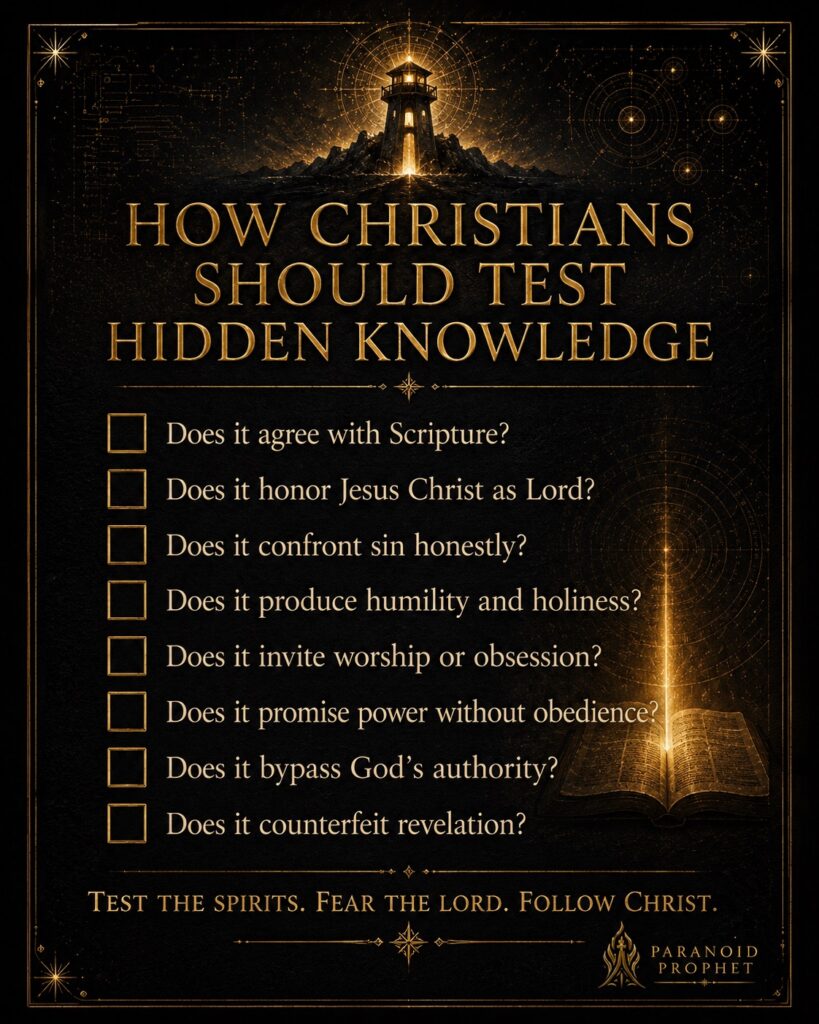
- What is the source? Does the teaching arise through truthful study and faithful stewardship, or through a messenger and method opposed to God?
- What is the purpose? Does it heal, protect, cultivate, and serve, or does it promise domination, seduction, revenge, and control?
- What moral order governs it? Are there boundaries, accountability, and love of neighbor, or is capability treated as its own permission?
- How is it obtained? Through honest learning and responsible practice, or through divination, coercion, initiation, deceptive spirits, or forbidden mediation?
- What fruit does it produce? Humility, peace, mercy, and justice, or pride, obsession, impurity, violence, and dependence?
- What does it ask us to worship? Does knowledge deepen gratitude to God, or present itself, its messenger, or human potential as the new savior?
Knowledge, Capability, Wisdom, and Holiness
These words should not be treated as synonyms. Knowledge recognizes or understands something. Capability turns understanding into power to act. Wisdom judges what should be done, when, why, and for whose good. Holiness orders the person toward God’s character and purposes. Obedience accepts that not every possible action is faithful.
The Watcher tradition depicts an explosion of capability without the formation of holy character. Weapons improve while violence expands. Secret arts promise leverage while truth and worship collapse. The teaching is powerful, but its source and fruit expose it as corrupt.
Proverbs 9:10 places the beginning of wisdom in the fear of the Lord. James 3:13–18 tests wisdom by its manner and fruit: purity, peace, gentleness, reasonableness, mercy, sincerity, and righteousness stand against envy, selfish ambition, disorder, and vile practice. Biblical wisdom is more than impressive information. It is truth embodied under God.
This framework keeps Christian discernment intellectually serious. A new discovery is not holy because it is new, and it is not evil because it is unfamiliar. The right response is neither panic nor worship. It is patient testing under Scripture, moral accountability, and love of God and neighbor.
Godly Knowledge Has a Moral Shape
Bezalel’s craftsmanship in Exodus 31 provides more than a defensive exception. It offers a positive vision. God gives skill for a holy purpose, within a covenant community, under revealed instructions, for work that serves worship. The craftsman’s ability is not autonomous. Gift, character, task, and accountability remain joined.
Biblical wisdom likewise forms a person rather than merely increasing options. Proverbs teaches prudence, justice, discipline, truthful speech, and the fear of the Lord. James asks whether supposed wisdom produces a life consistent with heaven’s character. Knowledge that makes a person more capable while making that person less truthful, less merciful, and less accountable has failed the biblical test of wisdom.
Modern cultures often separate invention from formation. The engineer asks whether something can be built, the institution asks whether it can be scaled, and the market asks whether it can be sold. Christian wisdom adds questions that capability alone cannot answer: Should it be done? Who bears the risk? Who receives the benefit? What kind of person and society will this practice form?
The Watcher narrative dramatizes the cost of skipping those questions. Its teachers deliver arts of power without covenant, accountability, or love. Their students inherit techniques but not holiness. The result is not mature stewardship; it is greater capacity inside a world already enslaved to appetite and violence.
Eden, the Watchers, and Babel
Eden, the Watcher tradition, and Babel are distinct accounts. They involve different actors, settings, and judgments. Reading them together does not mean collapsing them into one event. It reveals a recurring temptation: creatures seek wisdom, power, security, or elevation apart from faithful dependence on God.
Eden: Wisdom Seized Without Trust
In Genesis 3:1–7, the serpent reframes God’s boundary as deprivation. The fruit is desirable for gaining wisdom, and the promise is elevation: humanity can become like God while distrusting God. The temptation does not praise ignorance. It offers wisdom through disobedience.
The Watchers: Revelation Through Rebellion
In 1 Enoch, heavenly mediation itself becomes corrupt. Beings who should remain within God’s order cross a boundary and disclose mysteries in a way that deepens godlessness and violence. Knowledge comes “from above,” but origin outside ordinary humanity is not proof of goodness. The character and allegiance of the messenger matter.
Babel: Collective Power for Self-Exaltation
In Genesis 11:1–9, human beings organize, build, and seek to make a name for themselves. Architecture, cities, engineering, and cooperation are not inherently condemned. The narrative targets collective ambition ordered toward self-secured greatness and resistance to God’s commission.
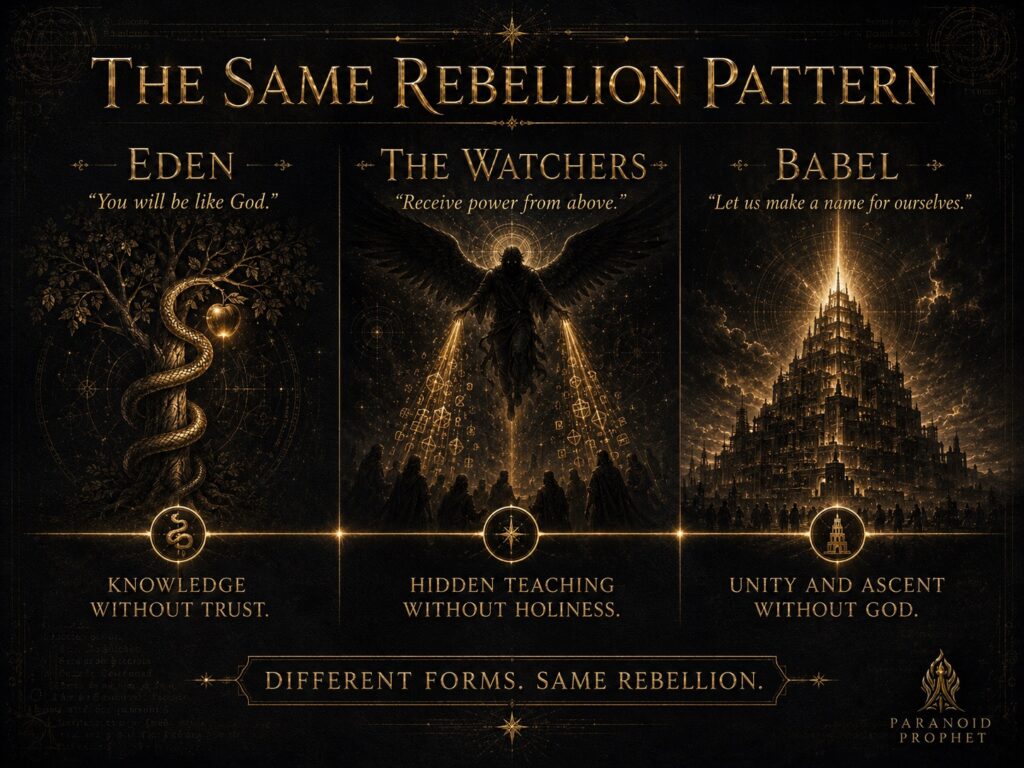
The repeated problem is not fruit, teaching, or bricks by themselves. It is a posture toward God. A good creation is approached as raw material for autonomy. A boundary becomes an enemy. Capability becomes a claim to moral authority. The creature’s desire to rise replaces the call to receive life as a gift.
The three accounts also keep one another from being misused. Eden prevents readers from reducing rebellion to technology. The Watcher tradition prevents them from assuming every messenger from a higher realm is holy. Babel prevents them from imagining that corrupt elevation always requires nonhuman instruction. Human beings can organize their own pride with remarkable skill.
How Christians Test Claims of Hidden Knowledge
Christians do not need to prove that every unusual claim comes from a Watcher before exercising discernment. Scripture gives a more durable method: test the source, test the fruit, and test the gospel.
Test the Source
First John 4:1–3 tells believers not to accept every spirit but to test them. A claimed messenger does not become trustworthy by appearing radiant, ancient, technologically superior, nonhuman, or secret. Ask whether the message submits to God’s revealed truth and confesses Jesus Christ faithfully. Notice whether it demands fascination, fear, initiation, secrecy, or allegiance to the messenger.
Test the Fruit
Jesus teaches that false prophets are known by their fruit in Matthew 7:15–20. James 3 adds a moral profile of wisdom. Does the teaching cultivate holiness, peace, humility, mercy, truth, and self-control? Or does it produce pride, domination, fear, obsession, impurity, confusion, violence, and dependence on hidden intermediaries?
Test the Gospel
Galatians 1:6–9 rejects another gospel even if an angel delivers it. Be wary when a revelation offers salvation through secret knowledge, transformation without repentance, immortality without resurrection, enlightenment without Christ, or human redesign as redemption. No superior intelligence has authority to revise the gospel.
Modern Claims and the Ancient Pattern
Some modern narratives resemble the Watcher pattern when a claimed nonhuman intelligence offers superior revelation, portrays God’s boundaries as limitations to overcome, treats humanity as material to redesign, or promises transformation apart from repentance. Technological power can also become a counterfeit salvation when increased capability is asked to cure the moral condition of the human heart.
Thematic resemblance is not identity. The pattern does not prove that a modern report involves Watchers. Not every technology shares one spiritual origin, not every scientific advance is rebellion, and not every UAP report is spiritual. First Enoch does not explain modern aerospace programs, artificial intelligence, medicine, or genetics.
Modern application begins with the message rather than speculation about the mechanism. Does the claim offer contact as a new revelation, disclosure as a new apocalypse, or a higher intelligence as humanity’s guide and redeemer? Does it bypass sin, the cross, resurrection, and the lordship of Christ? Test the message more than chase the phenomenon.
The full synthesis belongs in The Pre-Flood Origin Theory and Christian View of UFOs: The Three-Tier UAP Theory. Here the ancient pattern serves as a guardrail, not a universal explanation.
Discernment Without Paranoia
Biblical testing is not a command to suspect every expert, institution, discovery, or unfamiliar experience. Fear can become its own form of bondage, making dramatic claims feel more credible simply because they are dark. Discernment requires evidence, patience, truthful categories, and a willingness to leave some questions unresolved.
It also resists fascination. A person can denounce hidden knowledge while allowing it to dominate attention, imagination, and identity. Christian vigilance should produce greater faithfulness to Christ, not an endless appetite for darker mysteries. The goal is sober obedience: neither naive acceptance nor compulsive suspicion.
Frequently Asked Questions About What the Watchers Taught
What did the Watchers teach humanity?
First Enoch 8 attributes weapons, armor, metalworking, ornaments, beautification, spells, root-cutting, sorcery, and interpretations of earthly and celestial signs to named Watchers. The surrounding narrative connects those revelations with corruption, bloodshed, and judgment.
Where is the Watcher teaching list found?
The main catalog appears in 1 Enoch 8, within the Book of the Watchers. Genesis 6 supplies the canonical setting but does not enumerate these teachings.
What did Azazel teach?
The figure often called Azazel appears as Asael in the Nickelsburg–VanderKam translation. He teaches weapons and armor, metalworking, gold and silver ornaments, antimony, eye paint, precious stones, and dyes.
What did Semjaza teach?
Semjaza, written Shemihazah in the scholarly translation used here, teaches spells and root-cutting. The expression belongs to an ancient setting where plant knowledge, healing, and magic could overlap.
What are root-cuttings in 1 Enoch?
Root-cutting probably refers to plant or root lore practiced in a magical, medicinal, or esoteric context. Its exact scope is debated. It should not be equated automatically with modern medicine, pharmacology, or herbal healing as a whole.
Did the Watchers teach astrology?
Some translations use “astrology” and related terms. The Hermeneia translation lists signs of lightning, stars, shooting stars, earth, sun, and moon. The passage concerns revealed sign-lore, but ordinary observation, calendars, navigation, and astronomy should not be collapsed into divination.
Is technology itself forbidden?
No. Scripture presents craftsmanship and knowledge as gifts that can serve worship and neighbor. Technology becomes morally corrupt when its source, method, purpose, or fruit opposes God’s order and treats capability as permission.
Does the Watcher tradition explain modern UAP claims?
It supplies an ancient discernment pattern, not a universal identification. Similar themes may justify testing a message, but they do not prove that a UAP report involves Watchers or even a spiritual cause.
Christ Is the Wisdom of God
The Watcher tradition describes power and revelation descending through rebellion and producing corruption. The gospel announces the Son descending in holiness, revealing the Father, bearing sin, defeating hostile powers, and making his people new. One descent offers capability without reconciliation. The other brings reconciliation through the cross.
First Corinthians 1:18–31 identifies Christ as the wisdom and power of God while overturning human boasting. Colossians 1:15–20 and 2:2–3, 13–15 place every throne, ruler, authority, and treasure of wisdom beneath Christ, who reconciles through his blood and disarms hostile powers.
The gospel requires no secret angelic supplement. Salvation does not come through initiation, technique, contact, hidden teaching, or superior intelligence. It comes through the crucified and risen Lord. True knowledge finds its order in worship, love, and obedience to him.
This is why Christian discernment can remain hopeful. The church is not waiting for an elite disclosure to complete Christ’s work. No archive of forbidden mysteries can overturn his resurrection, and no created power can rise outside his authority. The wisdom of God is not hidden from believers behind initiation into darkness; it is proclaimed in the crucified Messiah.
The Son Descended in Holiness
Counterfeit revelation flatters humanity with the promise of elevation while leaving sin enthroned. Christ confronts sin, bears its judgment, and gives a new life that human technique cannot manufacture. He does not make disciples dependent on secret intermediaries. He brings them to the Father.
This frees Christians to study difficult traditions without fear and to examine new claims without fascination. Curiosity belongs beneath discipleship. Skill belongs beneath wisdom. Power belongs beneath holiness. Every created intelligence belongs beneath the Lord who made it.
The Watcher teaching list warns what happens when revelation becomes rebellion and power outruns character. The Christian answer is not suspicion of learning or retreat from the created world. It is knowledge ordered by truth, capability governed by love, and wisdom formed under the lordship of Jesus Christ.
Selected Sources and Further Reading
- Scripture: Genesis 3–6 and 11; Exodus 31; Deuteronomy 18; Psalm 19; Proverbs 9; Matthew 7; Galatians 1; James 3; 1 John 4; 1 Corinthians 1; Colossians 1–2.
- George W. E. Nickelsburg and James C. VanderKam, 1 Enoch: The Hermeneia Translation, Book of the Watchers excerpt — the primary modern translation used for the 1 Enoch 8 assignments.
- Annette Yoshiko Reed, Fallen Angels and the History of Judaism and Christianity — Watcher traditions and their Jewish and Christian reception.
- Loren T. Stuckenbruck, The Myth of Rebellious Angels — studies of rebellious angels in Second Temple Judaism and New Testament texts.
- Mirela Chrysovergi, Attitudes Towards the Use of Medicine in Jewish Literature from the Third and Second Centuries BCE — detailed textual study of root-cutting, herbs, magic, and medicine in 1 Enoch.
Read Next
The principal next article is Who Were the Nephilim? It asks what resulted from the forbidden union, how giants relate to the biblical text, and what “and also afterward” does and does not establish. For the source behind this teaching catalog, return to The Book of Enoch Explained. For the later synthesis, continue to The Pre-Flood Origin Theory.
CONTINUE THE INVESTIGATION
Next discernment study
Who Were the Nephilim? Giants, Watchers, and Genesis 6
Continue from forbidden-knowledge traditions into the biblical and interpretive question of the Nephilim.