
Someone tells you they are Wiccan. Before you answer, what do you think you have learned?
If your mind jumps straight to Satan worship, movie villains, or someone who simply likes crystals, you may already be talking past the person. Wicca is a real religious identity. It deserves an accurate explanation, even when the Christian response is disagreement.
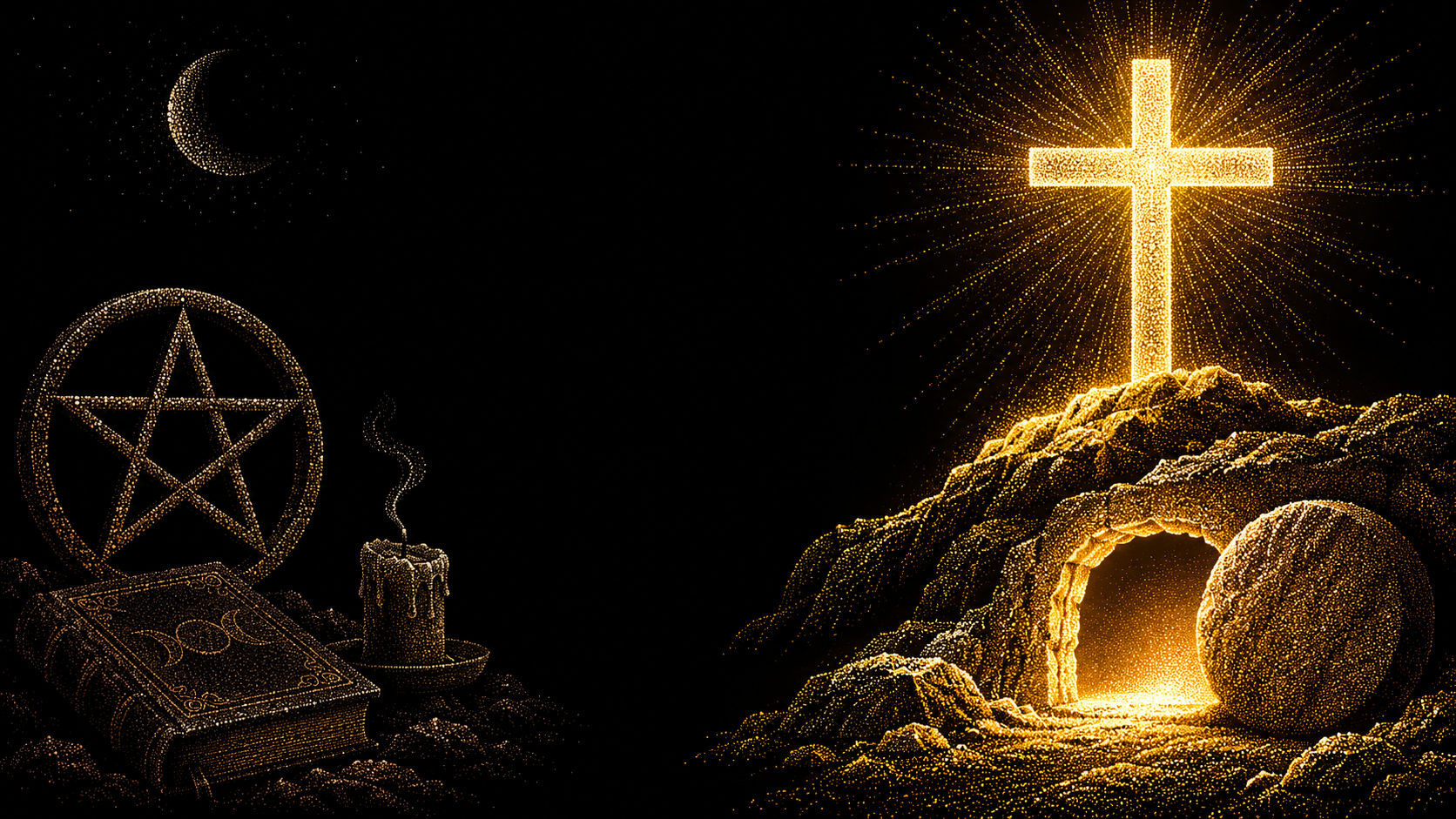
Wicca and Christianity differ most deeply over the identity of God, the authority behind spiritual practice, and what people ultimately need. This guide first explains Wicca on its own terms, then evaluates those differences from a Christian perspective. Respecting a person does not require treating every belief as equally true.
GUIDED ARTICLE EXPERIENCE
Wicca and Christianity: Nature, Spiritual Practice, and the Question of Christ
Read along as the narration moves through the article.
Browser narration · No stored audio or site tracking
CONTINUE GUIDED TOUR
Continue where you left off.
GUIDED TOUR COMPLETE
You have reached the end of this study.
Study record saved on this device.
GUIDED TOUR
Wicca and Christianity: Nature, Spiritual Practice, and the Question of Christ
Narrator: Paranoid Prophet Recommended Voice Native device narration
Prepare to follow the article as it is narrated.
VOICE & TOUR OPTIONS
Voice & Listening
NARRATOR
Finding a narrator…
Checking the best narrator available on this device.
Restores the site recommendations available in this browser.
Our listening picks lead when available; other voices are ranked for narration. Known novelty voices are hidden. Browser-provided voices may use an online voice service.
Screen-awake support will be checked when narration starts.
Optional: improve your device voices
Listening works with the voices already available here. Your device may offer additional free voices through its own settings.
iPhone or iPad: Settings → Accessibility → Read & Speak (or Spoken Content) → Voices → English. Look for Premium or Enhanced choices, then return here.
If offered, preview Ava or Zoe for U.S. English, or Serena or Jamie for British English. An explicit Premium or Enhanced version can improve on its compact version.
Mac: System Settings → Accessibility → Read & Speak → System voice. Open the voice list to preview or download additional choices.
Windows: Settings → Accessibility → Narrator → Add natural voices. Browser availability varies; a Narrator voice may not appear on websites. Edge may also expose online Natural voices without a model download.
Android: Open Accessibility → Text-to-speech output (the location varies by device). In the preferred engine settings, look for voice data and English choices.
Download sizes vary; some enhanced voices exceed 100 MB. This website cannot install system voices, and an installed voice appears here only if your browser exposes it.
Apple voice guide · Windows voice guide · Android voice guide
CHOOSE A NARRATOR
Recommended on this device
Our listening picks: Aaron, Martha, then Daniel, when available here. Otherwise, automatic uses the highest-ranked suitable voice. Preview alternatives or save your own choice.
Preparing the guided article experience…
RESUME GUIDED TOUR?
Continue where you left off.
GUIDED TOUR COMPLETE
You have reached the end of this study.
This guide belongs to our World Religions library. For the approach behind these comparisons, begin with how to compare religions fairly.
Article Guide8 sections
Start with four words that do not mean the same thing
Paganism is a broad category. Contemporary Pagan communities include Wiccans, Druids, Heathens, and other distinct traditions. Wicca is one religion within that landscape. Witchcraft can describe a practice or identity, including forms outside Wicca. Those words overlap, but they are not interchangeable. Harvard’s Pluralism Project explicitly distinguishes Wicca from other Pagan paths and non-Wiccan religious witchcraft. What Do Pagans Do?
Satanism is another category, not a substitute name for Wicca. Calling someone a Satanist because they identify as Wiccan skips the most basic task: finding out what they actually believe. A Christian may judge a spiritual practice incompatible with Scripture without falsely assigning its practitioner a religious identity they reject.
There is a practical lesson here. Ask, “What does Wiccan mean in your life?” before explaining what you think it means. The answer may reveal a particular lineage, a solitary practice, or an eclectic approach. Your conversation should address that answer, not a composite assembled from television and social media.
Contemporary Paganism
An umbrella for diverse contemporary religions.
Wicca
A modern Pagan religion with multiple traditions.
Witchcraft
A practice or identity with meanings beyond Wicca.
Satanism
A separate category, not a synonym for Wicca.
Identities can overlap without becoming synonyms. This is not a diagram placing all witchcraft within Wicca or Paganism. Sources: Harvard and Circle Sanctuary, linked in the article.
Is Wicca an ancient religion or a modern one?
Modern Wicca became publicly prominent in twentieth-century Britain, especially through Gerald Gardner. Gardner said he had encountered an older witchcraft tradition. The existence of older religious materials and the claim of an uninterrupted ancient Wiccan institution, however, are different historical questions. Harvard’s account identifies Gardner’s influence and notes debate over how much he inherited and how much he constructed. Gardnerian Tradition
Historian Ronald Hutton’s The Triumph of the Moon studies modern Pagan witchcraft within a wider British history of folklore, literature, magic, and changing attitudes to ancient religion. That framework is more useful than either extreme: “nothing here has older roots” or “today’s Wicca is an unchanged religion secretly preserved from antiquity.” Oxford University Press overview
A religion’s age does not by itself prove or disprove its truth. Christians should not use “modern” as a shortcut for “therefore false.” The historical point is narrower: inherited symbols, reconstructed practices, and a continuous institutional lineage require different kinds of evidence.
What do Wiccans believe?
There is no single Wiccan authority whose statements settle every question for every practitioner. Selena Fox of Circle Sanctuary describes a decentralized religious landscape with numerous paths, both group-based and solitary, and differing approaches to initiation. That diversity matters whenever an introduction uses the phrase “Wiccans believe.” Circle Sanctuary introduction
Several themes recur, though their meaning varies.
Nature has spiritual significance
Seasonal rhythms, the land, and relationships within the natural world are important in many Wiccan paths. Circle Sanctuary’s statement of spiritual philosophy connects attention to nature with worship and describes the divine as both present within existence and beyond ordinary human limits. It also emphasizes responsibility, compassion, honesty, and service. This is one practitioner account, not a universal creed. Overview of Wiccan Spiritual Philosophy
That means a Christian conversation should go deeper than “You care about nature; I care about God.” Christians also have reasons to care for creation. The significant question is what nature is, how it relates to God, and whether it is itself an object of religious devotion.
Goddess and God language is important in many traditions
The Pagan Federation’s description of traditional Wicca presents Goddess-and-God polarity alongside small-group autonomy and nature-centered practice. It also describes Wicca as both religion and a craft directed toward practical spiritual ends. Its account strongly emphasizes initiation, so it should not be used to erase the broader solitary and eclectic landscape described by other practitioners. Witchcraft & Wicca
The right follow-up is specific: Does this person understand divine figures as distinct personal beings, symbolic forms, expressions of a deeper unity, or something else? Those answers lead to different conversations. Repeating “all Wiccans worship the same two gods” would conceal the diversity that needs explaining.
Ritual is more than decoration
In the wider Pagan landscape, ritual can mark seasons, honor deities, celebrate life transitions, and express spiritual intentions. Some practitioners use the spelling magick to distinguish religious practice from stage performance. Harvard describes such practices as seeking change in people and the world. That describes practitioners’ purposes; it does not establish supernatural efficacy. Pagan ritual and practice
Christians should neither dismiss every practice as a costume nor claim every reported experience proves the practitioner’s explanation. An experience can be meaningful while its interpretation remains open to examination. The same intellectual discipline should apply to Christian testimonies.
Ethics: freedom carries responsibility
In Circle Sanctuary’s introduction, Selena Fox explains the Wiccan Rede as an ethical principle connecting freedom of action with avoiding harm. That is a more accurate starting point than imagining that Wiccan practice necessarily means doing anything one wants without moral concern. The description belongs to this practitioner source; it should not be imposed as an identical rulebook for every Wiccan. Circle Sanctuary on the Rede
A useful conversation asks how harm is understood, how competing needs are weighed, and what someone does when good intentions produce damage. Christians can recognize the seriousness of those ethical questions while asking their own further question: how do responsibility, forgiveness, and reconciliation with God fit together?
Are there Wiccan denominations?
“Traditions,” “paths,” and “lineages” usually communicate the landscape more precisely than imagining a single church divided into denominations.
Gardnerian Wicca traces its identity to Gardner. Alexandrian Wicca is associated with Alex and Maxine Sanders and developed in relation to Gardnerian practice. Initiatory lineage matters in those accounts. Harvard’s historical summary
The Pagan Federation also discusses Dianic approaches with feminist emphases. Circle Sanctuary describes additional paths and practitioners who work outside regularly meeting groups. These introductions are useful maps, but they do not make every self-description identical or resolve every boundary dispute. Pagan Federation, Circle Sanctuary
For a fair comparison, ask three questions: Which tradition? Which teacher or community? Which actual beliefs and practices? “My friend is Wiccan” is the beginning of understanding, not the completed profile.
Where Christianity draws a different line
The following comparison expresses historic Christian convictions. It does not pretend that Wiccan practitioners accept the Bible as their authority.
Divine identity
Wiccan diversity
Goddess-and-God language in many traditions; understandings of the divine differ.
Historic Christian framework
Creator distinct from creation.
Religious authority
Wiccan diversity
Traditions and personal experience differ.
Historic Christian framework
Scripture and Christ.
Spiritual practice
Wiccan diversity
Ritual and magic in many paths.
Historic Christian framework
Prayer and obedience to God.
Ultimate hope
Wiccan diversity
No single universal formulation.
Historic Christian framework
Forgiveness and resurrection through Christ.
Wiccan entries describe diversity, not a universal creed. Christian entries summarize the framework used in this article. Read the supporting practitioner sources and biblical passages alongside these summaries.
1. Creation is good, but creation is not God
Genesis presents the world as God’s creation. Acts 17:24–25 identifies God as the maker and sustainer of the world, rather than a being dependent on what human beings provide. Christians can receive forests, bodies, seasons, and beauty as gifts while distinguishing those gifts from their giver.
This distinction does not excuse environmental indifference. If the world belongs to God, treating it carelessly is hardly faithful stewardship. The disagreement concerns worship and divine identity, not whether a tree or a river deserves care. Acts 17:24–31
2. Spiritual intention is not the only test
A person may sincerely intend healing, protection, or personal transformation. Christianity still asks whether the means of seeking those goods agree with God’s commands. Deuteronomy 18:9–14 rejects practices including divination and consulting the dead. Christians should explain that objection plainly rather than treating good intentions as the only question.
At the same time, this ancient passage is not a description of modern Wicca’s organizational history. Nor does it authorize mistreating Wiccans. Applying its religious warning is different from claiming its original audience was encountering a twentieth-century religion. Deuteronomy 18:9–14
Christian prayer also cannot be reduced to a technique for controlling outcomes. Jesus’ prayer in Gethsemane models submission to the Father’s will. If a Christian treats particular words, objects, or performances as guaranteed leverage over God, that practice needs correction too. Matthew 26:36–46
3. The Christian answer centers on Christ’s work
Christianity’s central offer is reconciliation with God through Jesus Christ. Ephesians 2:8–10 places salvation in God’s grace, received through faith, and then describes good works as the life that follows. It does not present spiritual achievement as the price of admission.
This should not be turned into an invented Wiccan doctrine of “earning salvation.” Wicca is not simply Christianity with a different answer to the same theological vocabulary. The Christian claim is that humanity needs forgiveness and reconciliation, whether or not another tradition diagnoses the human problem in those terms. Ephesians 2:8–10
4. Jesus is more than an interchangeable spiritual symbol
The apostolic proclamation concerns Jesus’ death, burial, resurrection, and appearances. Paul ties Christian hope to that resurrection in 1 Corinthians 15. Christianity therefore asks readers to consider a claim about God’s action in history, not merely whether Christian imagery feels personally useful.
That is why this site’s answer is Christ. If Jesus truly rose, his identity and authority cannot be settled by selecting whichever spiritual symbols appeal to us. His resurrection claim deserves investigation. Christians also owe readers an argument rather than an assumption that saying “Jesus” ends the discussion. 1 Corinthians 15:3–19
For a closer look at the historical claim, read what the first witnesses claimed about the risen Jesus.
How to talk with a Wiccan without caricature
A productive conversation might begin like this: “I know there are different Wiccan paths. What drew you to yours, and what do you believe the divine is like?” Then listen long enough for the answer to change your understanding.
You can ask how they evaluate spiritual experiences, how their community thinks about ethical obligations, and what they make of Jesus. In return, be ready to explain how you evaluate Christian claims and why you trust the resurrection testimony. Do not demand evidence from a neighbor while exempting your own beliefs from scrutiny.
If someone describes mistreatment by Christians, defend neither cruelty nor hypocrisy. Acknowledging wrongdoing does not require abandoning Christian convictions. It means refusing to confuse loyalty to Jesus with protecting every action performed under a Christian label.
A few boundaries help:
- Do not diagnose a stranger’s motives or private spiritual experiences.
- Do not treat every candle, herb, or moon image as proof of Wiccan religious practice.
- Do not use fear, humiliation, or sensational accusations as evangelism.
- Do explain disagreement clearly, including why worship and spiritual authority matter.
The goal is a truthful encounter between people, not a victory over an imaginary opponent.
Questions readers often ask
Is Wicca the same as New Age spirituality?
No. Labels and practices can overlap, but Wicca has identifiable traditions and histories that should not disappear into a catch-all description of alternative spirituality. Learn which identity a person actually uses before drawing comparisons.
Can someone combine Wicca and Christianity?
Some people use blended identities. Their existence does not settle theological compatibility. From the Christian framework used here, worship of other deities and practices rejected by Scripture conflict with Christian allegiance. Respect for the person and evaluation of the combination are separate responsibilities.
Does disagreeing with Wicca require hostility toward Wiccans?
No. Christian truth claims do not cancel the obligation to love one’s neighbor. Accuracy, religious liberty, ordinary kindness, and honest disagreement can belong together.
The question worth keeping
The deepest question is not whether a spiritual practice feels ancient, beautiful, empowering, or unfamiliar. It is whether its account of reality is true, and whether it brings us into a right relationship with God.
For Christians, Jesus Christ is central to that answer: the crucified and risen Lord who offers forgiveness and calls people to follow him. We can make that case without pretending Wicca is something its practitioners would not recognize.
Start with accurate understanding. Then examine the claims. A Christian witness loses nothing by telling the truth about the neighbor it hopes to reach.