

GUIDED ARTICLE EXPERIENCE
How to Compare Religions Fairly Without Pretending They Are All True
Read along as the narration moves through the article.
Private device narration · No hosted audio or tracking
CONTINUE GUIDED TOUR
Continue where you left off.
GUIDED TOUR COMPLETE
You have reached the end of this study.
Study record saved on this device.
GUIDED TOUR
How to Compare Religions Fairly Without Pretending They Are All True
Narrator: Paranoid Prophet Recommended Voice Native device narration
Prepare to follow the article as it is narrated.
VOICE & TOUR OPTIONS
Voice & Listening
NARRATOR
Finding a narrator…
Checking the best narrator available on this device.
Restores the best curated narrator available on this device.
Narrator choices are curated for clear, long-form listening on this device.
Screen-awake support will be checked when narration starts.
CHOOSE A NARRATOR
Curated for this device
Choose a verified narrator for this browser, or use System Narrator. Automatic mode uses the best reliable route exposed by this device; your chosen narrator is preserved even if this device needs a temporary fallback.
Preparing the guided article experience…
RESUME GUIDED TOUR?
Continue where you left off.
GUIDED TOUR COMPLETE
You have reached the end of this study.
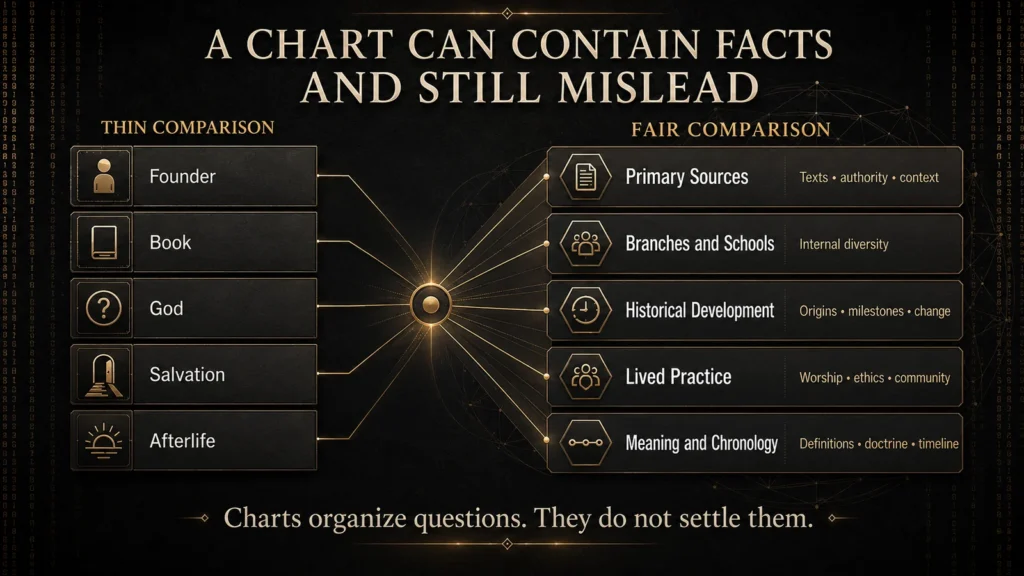
The easiest religious comparison is usually the least fair. A chart can make Buddhism, Islam, Hinduism, Judaism, and Christianity look simple enough to sort in a few rows: founder, book, God, salvation, afterlife. It may even contain facts. But if it flattens branches, ignores lived practice, treats one hostile example as representative, or assumes that shared words mean shared doctrines, it teaches readers to feel informed while leaving them unprepared.
Some comparisons fail by caricature. Others fail by politeness. They gather every religion under a vague theme like peace, love, or spirituality, then avoid the claims that actually divide them. Neither approach is honest. People deserve to have their beliefs described accurately before those beliefs are evaluated. At the same time, contradictory claims about God, humanity, sin, enlightenment, resurrection, judgment, and salvation cannot all be affirmed in the same sense.
This guide explains the method Paranoid Prophet will use throughout the World Religions library. The goal is accurate understanding, fair comparison, careful testing, and open Christian evaluation. A serious comparison must begin by asking what fairness actually requires.
Article Guide11 sections
Short Answer: Can Religions Be Compared Fairly?
Yes. Religions can be compared fairly when the comparison states its question, uses layered sources, respects internal diversity, compares equivalent categories, tracks source history, and tells the reader where evaluation begins. Fairness does not require pretending that every claim is equally true. Fair description and equal truth-status are different questions.
A Christian can compare religions fairly, but only by refusing shortcuts. Central doctrinal claims should be grounded first in the religion’s relevant primary or authoritative sources. Informed insiders should help test whether a description is recognizable, while historical and comparative scholarship can clarify chronology, diversity, and development. Lived practice also matters, because religious belief is expressed through culture, ritual, family, law, and community.
Paranoid Prophet is not religiously neutral. Scripture is our final authority for Christian doctrine, and our evangelistic purpose is openly disclosed through Paranoid Prophet’s Christian mission. That conviction does not excuse distortion. It increases the need for disciplined sources, honest wording, and clear separation between description and Christian evaluation.
Using the same method throughout this library allows readers to judge every comparison by a consistent standard rather than by whichever example happens to favor the writer. A study of Islam, Buddhism, Hindu traditions, Judaism, or another religion should be accountable to the same rules. Readers should know those rules in advance, and adherents should know the work is accountable to more than a quick apologetic instinct.
Why Comparing Religions Is Harder Than Making a Chart
Charts are useful servants and poor masters. They can help readers notice patterns, but they often hide the very things that matter most. A single column labeled “God” may compress the triune God confessed by Christians, the one God described in Islamic theology, Brahman, diverse Hindu theisms and nondual philosophies, Buddhist non-theistic paths, and Jewish monotheism into one small heading. A column labeled “salvation” may compress forgiveness, liberation, enlightenment, covenant faithfulness, paradise, resurrection, and union with God into one misleading category. The problem is not comparison itself. The problem is thin comparison.
Religions are internally diverse
Major religions contain branches, schools, and lived variations that can materially change an answer. Islam includes Sunni and Shia traditions, legal schools, devotional movements, and modern reform currents. Buddhism includes Theravada, Mahayana, Vajrayana, and local forms of practice. Hindu traditions are not one uniform system, but include many streams of devotion, philosophy, ritual, and regional expression. Judaism is not frozen as an Old Testament religion; it includes ancient, rabbinic, medieval, and modern forms. Christianity itself includes Catholic, Orthodox, Protestant, and other traditions with important doctrinal and liturgical differences.
Internal diversity does not mean a religion has no identifiable teachings. It means broad statements must be sized correctly. The smallest accurate generalization is usually better than the sweeping one. Harvard Divinity School’s Religion and Public Life core principles and the American Academy of Religion’s religious literacy guidelines both stress that religions are diverse, historical, and socially embedded. Paranoid Prophet uses that insight as a guardrail for fair description, not as a substitute for Christian theology.
Religions develop through history
Religious traditions develop through interpretation, institutions, reform, and changing cultural settings. A fair article distinguishes a founder from later commentary, an early text from a modern popular summary, an official doctrine from a local custom, and an ancient claim from a recent adaptation. Chronology matters because a late interpretation may be important to living adherents while still being later than the events or teachings it explains.
This is especially important when a religion speaks about another tradition’s figure, text, or doctrine. It is not enough to say that two religions mention Jesus, resurrection, law, or grace. The comparison must ask when the relevant source appears, what it claims to know, and whether it accepts, rejects, or reinterprets earlier testimony.
Religions are practiced as well as believed
Texts matter deeply, but religions are also enacted. People pray, fast, gather, marry, mourn, sing, eat, abstain, give, argue, celebrate, teach children, and bury the dead within communities shaped by inherited meanings. Marianne Moyaert’s work on ritual comparison helps press this point: attention to texts and attention to ritual practice should complement rather than cancel each other. A careful comparison asks both what a religion teaches and what its adherents commonly do, while avoiding the mistake of treating every practice as official doctrine.
Fairness Does Not Require Pretending to Have No Viewpoint
Neutrality and honesty are not the same thing
One of the strongest objections to a Christian comparison project is simple: if the site wants readers to follow Jesus, will it select evidence that favors Christianity and make other religions look weak? That concern is legitimate. Evangelistic writing becomes manipulative when it hides its goal, loads the comparison, or uses the other person’s beliefs merely as a prop.
The answer is not to pretend that no viewpoint exists. Everyone compares from somewhere. Academic religious studies, insider devotion, secular skepticism, interfaith theology, and Christian apologetics all ask different questions and use different standards. The honest move is to disclose the standpoint and then use controls that make the description accountable: primary texts, informed insiders, scholarship, lived practice, source chronology, claim-confidence limits, and correction of substantive errors. For more on our broader editorial controls, see our source and verification standards.
Paranoid Prophet’s Christian standpoint
Paranoid Prophet believes Scripture is final authority, that Jesus Christ is the eternal Son of God, that He was crucified for sinners, that He rose from the dead, and that salvation is found in Him. Christianity makes claims about God, history, Jesus, salvation, and judgment, not merely private spiritual preference. Lesslie Newbigin’s work on the gospel in a pluralist society is useful here because it refuses to reduce the Christian message to a private opinion outside public truth. Harold A. Netland’s Encountering Religious Pluralism is also useful for defining pluralism and Christian engagement without pretending that conviction disappears.
Our agenda is not hidden: understand the belief, compare it honestly, test its claims, and point the reader to Jesus Christ.
That sentence is not a license for careless apologetics. Open Christian conviction does not excuse distortion; it increases the need for disciplined sources and honest representation. Francis X. Clooney’s comparative theology demonstrates, in a different theological framework, that careful interreligious study can be conducted from within a declared faith tradition. Paranoid Prophet does not adopt every conclusion of comparative theology, but it welcomes the methodological lesson: conviction should make the work more accountable, not less.
The recognizability test
An informed adherent should be able to recognize the description, even if that person rejects the Christian evaluation. Recognition does not mean total agreement. It means the guide has used the right texts, named the relevant authorities, represented main beliefs accurately, acknowledged important branches, avoided lazy generalizations, and included qualifications where they matter.
This test protects the reader from two errors. The first is hostile distortion, where another religion is described through slurs, terrorism, abuse, or its weakest popular expression. The second is sentimental distortion, where differences disappear because the writer wants all religions to sound the same. Both are unfair. One weaponizes misunderstanding; the other baptizes confusion as kindness.
The correction protocol should be simple. If a serious adherent or qualified scholar can show that a description misstates a source, ignores a major branch, confuses official teaching with abuse, or treats a fringe view as central, the article should be corrected. A Christian site should not fear correction. Christianity gains nothing from false witness against a neighbor.
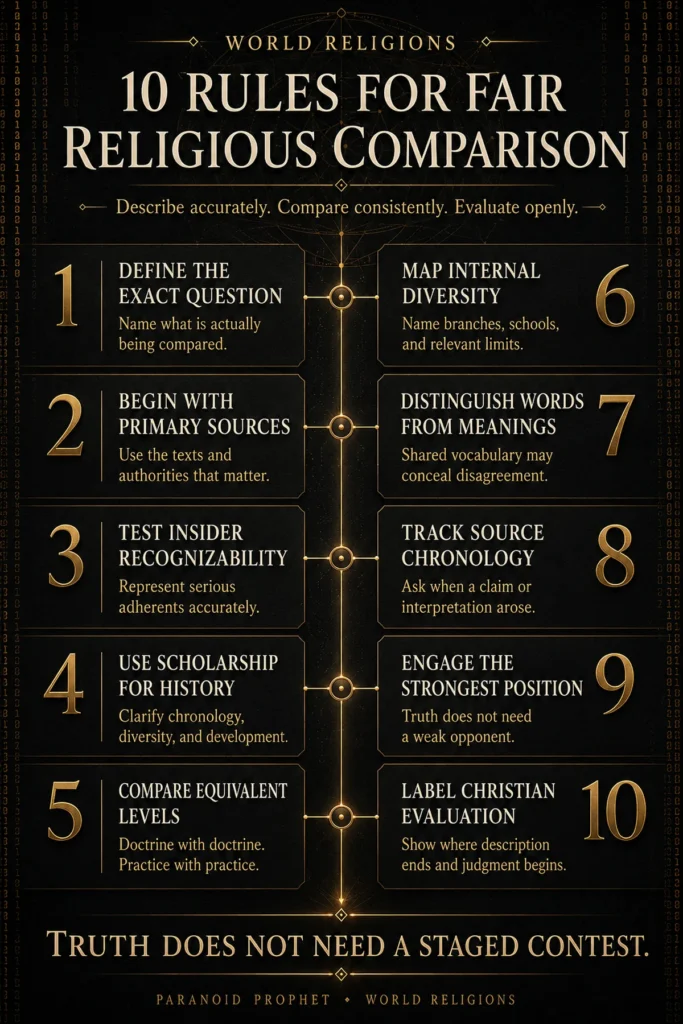
Ten Rules for Comparing Religions Fairly
1. Define the exact comparison
A comparison should state what is being compared and why. “Christianity and Buddhism” is too broad. “How do Christianity and Buddhism describe the human problem?” is better. “How do Christian resurrection hope and Buddhist liberation differ?” is better still, though that belongs in a focused article of its own. Jonathan Z. Smith’s work on comparison is useful because it reminds readers that comparison is constructed around a stated question and involves both similarity and difference. A fair method names the category before drawing conclusions.
2. Let primary sources establish central teachings
Central doctrinal claims should be grounded first in the religion’s relevant primary or authoritative sources. For Christianity, that means Scripture governs Christian doctrine. For another religion, the reader should be shown the texts, authorities, and interpretive traditions that actually matter there. A viral quote, an angry ex-member, a hostile meme page, or a loose summary cannot establish what a religion teaches. Nor can one official promotional page exhaust a living tradition.
3. Use informed insiders to test recognizability
Informed insiders help test whether a description is recognizable, but no single adherent represents an entire tradition. An imam, rabbi, monk, priest, scholar, lay teacher, or practitioner may clarify a real feature of a community while still speaking from a particular branch, region, school, or level of observance. The insider test asks, “Would serious adherents recognize the texts, beliefs, distinctions, and qualifications in this description?” It does not require them to accept the Christian conclusion.
4. Use scholarship to clarify history and diversity
Historical and comparative scholarship can clarify chronology, diversity, and development without being treated as infallible. Scholars are not magically neutral, and believers are not automatically unreliable. Each source has strengths and limits. Academic work can help identify when texts appeared, how traditions changed, which branches disagree, and where popular assumptions are too simple. Christian evaluation must not pretend that scholarship has settled questions it has only framed.
5. Compare equivalent levels
Do not compare Christianity’s best doctrine with another religion’s worst adherents. Do not compare another religion’s poetic ideal with Christianity’s ugliest failures. Doctrine should be compared with doctrine, practice with practice, official teaching with official teaching, popular devotion with popular devotion, and abuse with abuse. When the level changes, the article should say so. This rule alone would prevent many cheap comparisons.
6. Map internal diversity
Before making a broad statement, identify the branch and the limit. Is the claim about all Muslims, a Sunni legal tradition, a Shia theological claim, a Sufi devotional expression, or a modern political movement? Is it about all Buddhists, or about Theravada monastic discipline, Pure Land devotion, Tibetan practice, or a Western mindfulness adaptation? The same caution applies to Judaism, Hindu traditions, and Christianity. Diversity requires disciplined qualification rather than silence.
7. Distinguish shared words from shared meanings
Religions may use the same word while assigning it substantially different meanings. “God,” “salvation,” “Messiah,” “Word,” “resurrection,” and “grace” can carry different doctrinal weight in different systems. Sometimes the overlap is real and should be acknowledged. Sometimes the resemblance is partial. Sometimes the word is familiar but the meaning has moved. A fair article does not score quick points by treating vocabulary as identity.
8. Track chronology
Chronology is not a trick; it is part of responsible evidence. A later source may be the authoritative source for a living religion, and it deserves accurate description on those terms. But if it makes a claim about earlier events, earlier figures, or earlier texts, the comparison should notice the time gap and ask what kind of knowledge is being claimed. This does not automatically disprove the later claim. It does keep the evidential question visible.
9. Engage the strongest credible position
The weakest version of a religion is usually the easiest to defeat and the least useful to understand. A responsible comparison engages serious arguments, careful representatives, and the strongest credible form of a claim. That does not mean every extreme reading receives equal weight. It means the article should not win by choosing a poor target. Truth does not need a staged contest.
10. Label Christian evaluation clearly
Description and Christian evaluation must be distinguishable. The reader should know when the article is saying, “This tradition teaches…” and when it is saying, “From a biblical Christian standpoint, this claim conflicts with…” That labeling serves both Christian witness and the reader’s trust. It also keeps apologetics from smuggling its conclusion into the description.
Similarities Matter, but Similar Words Can Mislead
Genuine common ground should be acknowledged
Religions do sometimes overlap in meaningful ways. Many traditions commend prayer, generosity, moral restraint, reverence, discipline, compassion, family responsibility, and concern for the poor. Some share historical contact, inherited stories, or philosophical questions. Christians should not be afraid to notice common ground. Paul in Athens paid attention to his audience’s worship, poetry, and public reasoning before calling them to repentance in light of resurrection and judgment in Acts 17:16-34.
Shared vocabulary may conceal incompatible doctrines
The danger comes when similarity is stretched past its meaning. “God” may refer to the triune Creator, strict unitarian monotheism, an ultimate reality described in nonpersonal terms, or one deity among many. “Salvation” may mean forgiveness and reconciliation with God, liberation from rebirth, paradise, enlightenment, covenant restoration, or moral purification. “Messiah” can carry Jewish, Christian, Islamic, political, or symbolic meanings. “Resurrection” may mean the bodily raising of Jesus, a future resurrection of the dead, spiritual renewal, or a metaphor for hope.
Similarity does not prove identity
None of that means similarities are fake. It means they must be interpreted. Two religions may ask similar human questions while giving incompatible answers. They may value mercy while disagreeing about sin. They may honor Jesus while denying what the New Testament presents as central to His identity. They may use the language of surrender while disagreeing about the one to whom surrender is owed. Comparison should neither erase overlap nor force agreement where the claims divide.
How Christians Should Speak About Other Religions
Gentleness is not timidity
The New Testament does not tell Christians to choose between conviction and gentleness. 1 Peter 3:15-16 calls believers to give reasons for hope with gentleness, respect, and a good conscience. 2 Timothy 2:24-26 rejects quarrelsome correction and calls the Lord’s servant to patience. Gentleness is not a retreat from truth. It is truth spoken under the authority of Christ rather than under the pressure of ego.
Gracious speech does not erase disagreement
Colossians 4:5-6 tells Christians to walk wisely toward outsiders and let speech be gracious. Gracious speech does not require doctrinal vagueness. It does forbid contempt. Responsible Christian engagement rejects mockery, slurs, ethnic contempt, collective blame, humiliation, and guilt by association. If a religious community has produced violence or oppression, that can be discussed with sources and context. It must not become a way to blame every adherent or avoid the harder work of understanding.
Evangelism should listen before it answers
In 1 Corinthians 9:19-23, Paul describes a missionary flexibility that seeks to understand people without changing the gospel. In Acts 17, he knows enough about Athenian religious life to speak into it, yet he still proclaims the risen Christ and coming judgment. That is the pattern: listen carefully, represent accurately, identify points of contact, expose real disagreement, and invite the hearer to Christ. Evangelism becomes manipulative when it hides its purpose or damages the evidence. Transparent persuasion states its aim and preserves the facts.
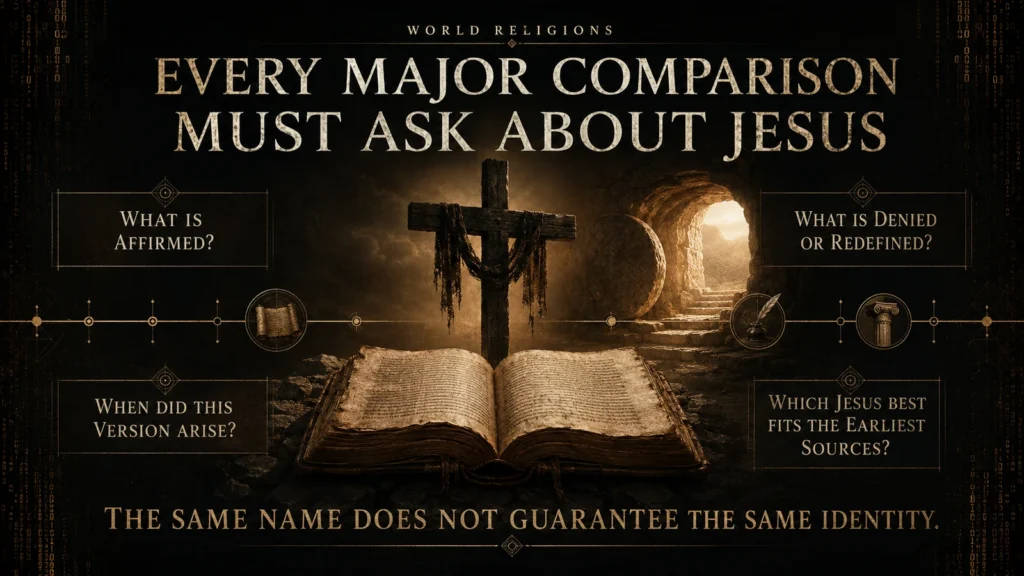
Why Every Major Comparison Must Ask About Jesus
The World Religions cluster will not compare religions only as ethical systems, cultures, or spiritual techniques. It must ask what each religion does with Jesus. Many religions and worldviews affirm Him in some way. Some call Him a prophet, Messiah, teacher, miracle worker, holy person, enlightened figure, or moral example. Those affirmations matter and should be described accurately. But using the name “Jesus” does not guarantee the same identity.
What does the religion affirm?
The first question is charitable and descriptive: what is affirmed? Does the religion honor Jesus? Does it use a title such as Messiah, Word, prophet, teacher, avatar, or sage? Does it appeal to His ethics, miracles, compassion, suffering, or return? The answer should come from the relevant sources, not from Christian assumption. A fair comparison lets the religion speak before evaluating the claim.
What does it deny or redefine?
The next question asks what is denied or redefined. The New Testament presents Jesus as the unique Son who reveals the Father, the crucified Savior, the risen Lord, and the one mediator between God and humanity. See John 14:6, Acts 4:12, and 1 Timothy 2:5-6. If another religion honors Jesus while denying His deity, incarnation, atoning death, bodily resurrection, unique saving authority, or final judgment, that difference should be named without sneer or fog.
When did this version of Jesus arise?
Chronology belongs inside the Jesus question. A later account of Jesus may be authoritative within a later religion, but if it makes claims about first-century events, the article should ask how that account relates to the earliest Christian sources. When did the interpretation arise? Does it claim revelation, historical transmission, philosophical reinterpretation, or devotional insight? What earlier testimony does it accept, revise, or deny?
Which Jesus best fits the earliest sources?
A fair comparison does not begin by forcing Jesus into Christian conclusions. It begins by identifying the competing claims, their sources, and their chronology. Then it asks which account best explains Jesus’ Jewish setting, public ministry, crucifixion, earliest followers, resurrection proclamation, and divine claims. Readers who want to pursue that evidence can begin with the earliest historical evidence for Jesus, the historical evidence for Jesus’ crucifixion, what the earliest witnesses claimed, and the larger evidence concerning Jesus’ identity.
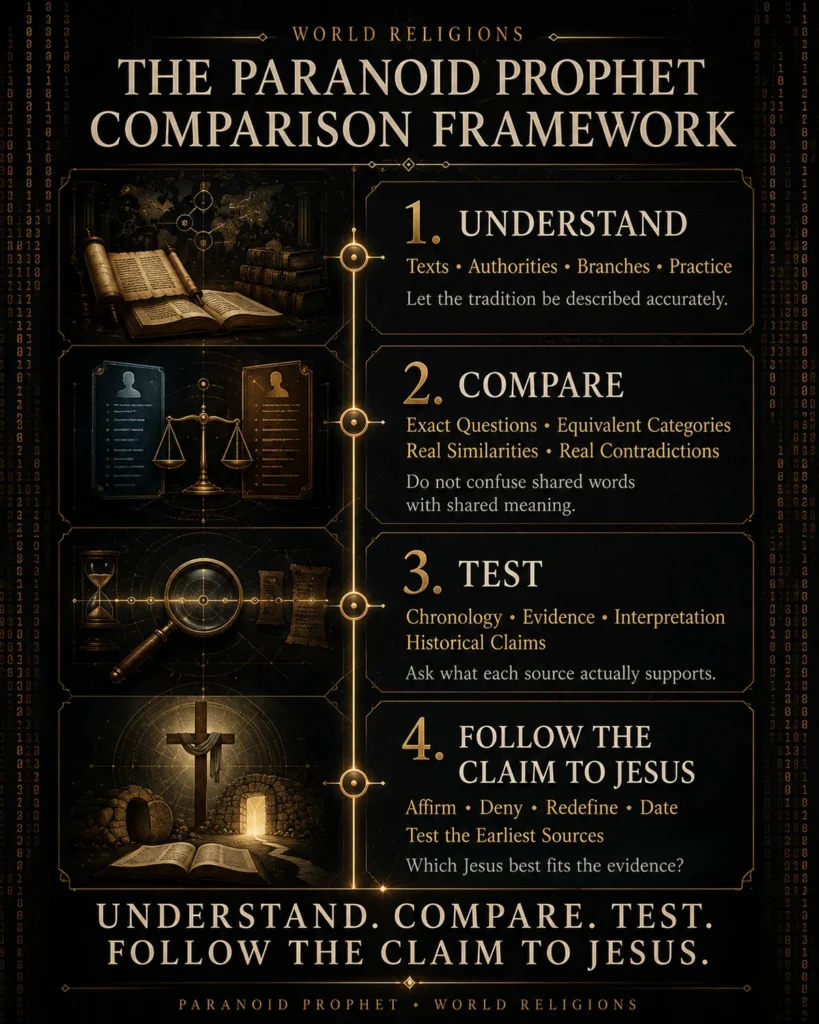
The Paranoid Prophet Comparison Framework
Understand, compare, test, and follow the claim to Jesus
The framework for this cluster has four stages: Understand, Compare, Test, and Follow the Claim to Jesus.
Understand. What does the religion call itself? What texts and authorities shape it? What branches or schools matter for this question? How is the religion practiced in worship, family, ritual, ethics, and community? What common assumptions should be corrected before evaluation begins?
Compare. What exact question is being compared? Are equivalent categories being placed side by side? Are shared words being used in the same sense? Which similarities are substantial, which are partial, and where do the claims contradict?
Test. How old are the sources? What does each source explicitly support? What is later interpretation? What is historically testable? What rests on revelation, philosophy, tradition, or experience? What kind of evidence could count against the claim?
Follow the Claim to Jesus. What does the religion affirm about Jesus? What does it deny? What does it redefine? When did that interpretation arise? Which Jesus best fits the earliest evidence?
The working belief map will ask twelve recurring questions: What is ultimate reality? How is revelation known? What is a human being? What is the human problem? What path is offered? How do grace, works, discipline, karma, law, or enlightenment function? What practices shape adherents? What is taught about Jesus? What is taught about the cross? What happens after death? What evidence is offered? What final hope is promised?
How the method works in practice
Suppose someone says, “Christianity and another religion both teach salvation.” The method does not answer by nodding quickly or rejecting the sentence instantly. It first asks what each tradition means. In some settings, “salvation” may be the right term. In others it may be only an approximate English label for liberation, enlightenment, purification, moksha, nirvana, paradise, restoration, or another goal.
Then the comparison asks what problem the path is meant to answer. Is the central problem guilt before God, sin, ignorance, craving, karma, impurity, separation, failure to submit, or something else? Different diagnoses lead to different paths, and different paths reveal different views of God, humanity, authority, and final hope.
The test stage asks which primary texts define the path, which branch interprets them, whether the claim is early or later, and whether it is historically testable, philosophically argued, institutionally defined, or received as revelation. Finally, the Jesus question asks whether Jesus is the Savior who accomplishes redemption, a prophet who delivers instruction, one teacher within a path, a manifestation or enlightened figure, or absent from the system. A shared English word does not settle the comparison. It tells the reader where careful comparison must begin.
What the method can and cannot establish
Fair comparison can clarify what a religion teaches, correct stereotypes, expose real contradictions, test certain historical claims, and improve Christian witness. It can show that two traditions are not saying the same thing. It can also reveal where Christians have been careless, where an opponent has been misquoted, or where a familiar talking point needs to be retired.
It cannot force belief. It cannot eliminate every assumption from the person doing the comparing. It cannot resolve every question about pluralism, salvation, history, authority, and divine revelation in one article. It cannot guarantee that all readers will agree on the standard of evidence. What it can do is make the disagreement clearer and more honest.
That clarity is not a small thing. People sometimes reject Christianity after hearing a weak version of it, just as Christians may dismiss another religion after hearing a cartoon version of its beliefs. Neither response honors truth. Careful comparison gives the reader a better question: not “Which group can I dismiss fastest?” but “Which claim is actually true?”
Frequently Asked Questions
Is it biased to compare religions from Christianity?
Every comparison is written from a standpoint. A Christian standpoint becomes unfair only when it distorts sources, applies double standards, ignores meaningful qualifications, or hides where evaluation begins. The proper test is not whether the writer has convictions, but whether the religion has been represented accurately and the Christian conclusion has been labeled honestly.
Do all religions teach basically the same morality?
Many religions share moral concerns such as compassion, restraint, generosity, honesty, and care for others. But similar moral teachings do not mean identical views of God, humanity, sin, salvation, authority, or final hope. The full question of whether all religions lead to God belongs in a separate article.
Can a Christian learn from another religion?
Yes, a Christian can learn about human longing, discipline, devotion, moral seriousness, cultural wisdom, and the questions people carry. Learning from another religion does not require surrendering Scripture as final authority or treating incompatible doctrines as equally true.
Should Christians read other sacred texts?
Not every Christian needs to study another religion’s sacred texts. Pastors, teachers, students, apologists, and Christians seeking to understand a neighbor may have good reason to do so. They should read with a clear purpose, sufficient biblical grounding, reliable context, prayer, and discernment. Reading another text to understand its claims is not the same as receiving it as divine authority.
Who decides what a religion really teaches?
No single voice decides everything. Primary texts, authoritative traditions, major branches, informed adherents, and historical scholarship all contribute. When insiders disagree, the article should identify the disagreement rather than pretend one person speaks for all.
Can religions be compared when they use different concepts?
Yes, but the comparison must slow down. Sometimes the right move is not to force one religion’s category onto another, but to ask parallel questions: What problem is being addressed? What authority defines the answer? What practice follows? What hope is promised?
Is saying Jesus is the only way disrespectful?
It can be said disrespectfully, but the claim itself is part of New Testament Christianity. Respect requires honesty about what Christianity teaches and honesty about why others disagree. The New Testament presents Jesus not as one teacher among many but as the unique way to the Father.
Sources and Further Reading
This article uses Scripture as final authority for Christian doctrine and academic methodology to help describe religious traditions accurately.
Comparative-religion methodology
- Harvard Religion and Public Life, “Core Principles”
- American Academy of Religion, “Religious Literacy Guidelines”
- Jonathan Z. Smith, Relating Religion: Essays in the Study of Religion
- Marianne Moyaert, “Towards a Ritual Turn in Comparative Theology”
- Francis X. Clooney, Comparative Theology: Deep Learning Across Religious Borders
Christian theology and mission
- Lesslie Newbigin, The Gospel in a Pluralist Society
- Harold A. Netland, Encountering Religious Pluralism
Primary biblical texts
Acts 17:16-34; 1 Corinthians 9:19-23; Colossians 4:5-6; 1 Peter 3:15-16; 2 Timothy 2:24-26; John 14:6; Acts 4:12; 1 Timothy 2:5-6.
Truth Does Not Need a Caricature
The easiest comparison is still waiting for us: flatten the chart, quote the weakest opponent, make all similarities sound identical, make all differences sound foolish, and declare victory. But Christianity gains nothing from distortion. If Jesus is Lord, Christians do not need false witness to defend Him. If the gospel is true, truth can afford patience, accuracy, and courage.
Other people are not illustrations for our arguments. They are neighbors made in the image of God. Their beliefs deserve careful treatment, even when those beliefs conflict with Scripture. Accurate understanding is not the destination, though. Contradictory claims still require a verdict. The question is not whether comparison can make everyone comfortable. The question is whether the claims are true.
That is why this method finally moves toward Jesus. Do not reduce Him to a symbol of religious tolerance, a generic teacher, or a name that can be filled with any meaning. Investigate Jesus. Read the Gospels. Examine His identity, His cross, and His resurrection. Ask whether the crucified and risen Christ is who the New Testament says He is: the Son who reveals the Father, the Savior who gave Himself for sinners, and the Lord who calls every people to follow Him.