
GUIDED ARTICLE EXPERIENCE
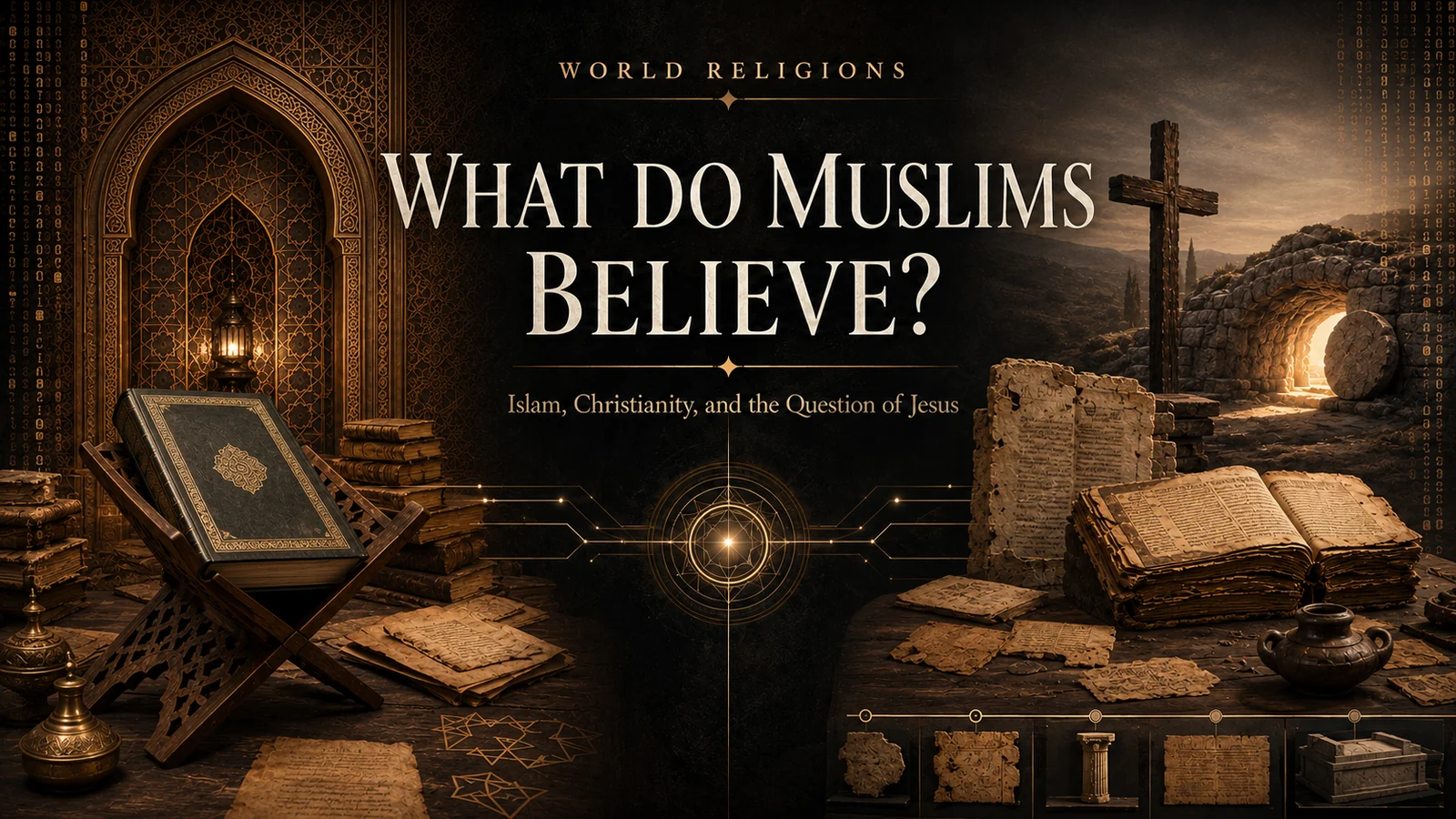
What Do Muslims Believe? Islam and Christianity Compared
Read along as the narration moves through the article.
Private device narration · No hosted audio or tracking
CONTINUE GUIDED TOUR
Continue where you left off.
GUIDED TOUR COMPLETE
You have reached the end of this study.
Study record saved on this device.
GUIDED TOUR
What Do Muslims Believe? Islam and Christianity Compared
Narrator: Paranoid Prophet Recommended Voice Native device narration
Prepare to follow the article as it is narrated.
VOICE & TOUR OPTIONS
Voice & Listening
NARRATOR
Finding a narrator…
Checking the best narrator available on this device.
Restores the best curated narrator available on this device.
Narrator choices are curated for clear, long-form listening on this device.
Screen-awake support will be checked when narration starts.
CHOOSE A NARRATOR
Curated for this device
Choose a verified narrator for this browser, or use System Narrator. Automatic mode uses the best reliable route exposed by this device; your chosen narrator is preserved even if this device needs a temporary fallback.
Preparing the guided article experience…
RESUME GUIDED TOUR?
Continue where you left off.
GUIDED TOUR COMPLETE
You have reached the end of this study.
Islam is often discussed before it is understood. News, political conflict, and arguments on social media can make a worldwide religious tradition look like a single attitude or culture. That is no basis for a serious comparison. Muslims are not all Arab, do not all practice alike, and should not be defined by extremists. They worship God, not Muhammad, and many order daily life around prayer, repentance, generosity, family, and hope in divine mercy.
Accuracy does not require pretending that Islam and Christianity say the same thing. They use some of the same names and speak of creation, revelation, prophets, judgment, mercy, and Jesus. Yet shared words can carry different meanings. The deepest disagreements concern who God is, what humanity needs, how God saves, and whether Jesus is merely a revered messenger or the eternal Son who died and rose.
This article follows a fair-comparison method: understand a belief in its strongest recognizable form before evaluating it. The aim is neither suspicion nor artificial agreement. It is to hear Islam through its own major sources, state the Christian confession openly, and bring both accounts to the question neither can avoid: Who is Jesus?
Article Guide14 sections
Short Answer: What Do Muslims Believe?
Muslims believe in one sovereign Creator, the Quran as God’s final revelation, Muhammad as the final prophet, angels, earlier revelations and messengers, resurrection, judgment, disciplined worship, repentance, righteous deeds, and hope in divine mercy. Islam honors Jesus as Messiah and prophet but denies that He is the eternal Son and, in its mainstream interpretation, denies that He was crucified, died for sins, and rose bodily from the dead.
The word Islam is associated with submission to God. Its foundational confession is that there is no deity but God and Muhammad is God’s messenger. Muslims receive the Quran as revelation given to Muhammad, while reports about his words and example help shape belief and practice. The familiar Five Pillars summarize testimony, ritual prayer, required almsgiving, fasting during Ramadan, and pilgrimage to Mecca for those able to go. They are central practices, not a complete definition of the religion.
Islam also teaches moral accountability. Human beings are created to worship God, can repent, and will be raised for judgment. Faith, worship, obedience, good deeds, and mercy belong together; Islam is not accurately described as a mechanical points system. Sunni and Shia traditions share this broad world while differing over authority and leadership after Muhammad.
The sharpest divide from Christianity is Jesus. The Quran calls Him Messiah, son of Mary, and messenger, and associates Him with miracles by God’s permission. Mainstream Islam nevertheless denies that He is God the Son or that He was crucified. The New Testament proclaims the opposite: the eternal Son became human, freely died for sins, was bodily raised, and is Lord. The comparison therefore turns on which account best explains Jesus and the earliest evidence about Him.
What Is Islam, and Where Does Its Authority Come From?
Islam presents itself as the restoration and completion of the religion preached by earlier messengers. Adam, Noah, Abraham, Moses, David, and Jesus belong to a long prophetic history that culminates in Muhammad. In this account, the prophets called people to worship the one God, reject idolatry, live righteously, and prepare for judgment. Islam is therefore not understood by Muslims as a new devotion to a new deity. It claims continuity with Abrahamic monotheism and correction of later departures from it.
Muhammad and the Quran
Islam regards Muhammad as God’s messenger and the final prophet. Quran 33:40 calls him the messenger of God and the seal of the prophets. Muslims revere him as prophet and model; they do not worship him as God. Evaluating every episode in Muhammad’s life or the entire claim to prophethood would require a separate investigation. For this profile, the essential point is his place in Islamic authority: revelation was recited to him, and his example became a major guide for the community.
Muslims receive the Quran as God’s final revelation to Muhammad. It is recited in Arabic in worship, memorized, interpreted, and treated as the controlling criterion for prior religious claims. Translations communicate its meaning but are commonly distinguished from the Arabic Quran itself. The text addresses doctrine, worship, ethics, law, narrative, warning, consolation, and the final judgment. A fair introduction begins here rather than asking a hostile Christian source to define Islam.
Quran, Sunnah, hadith, and tafsir
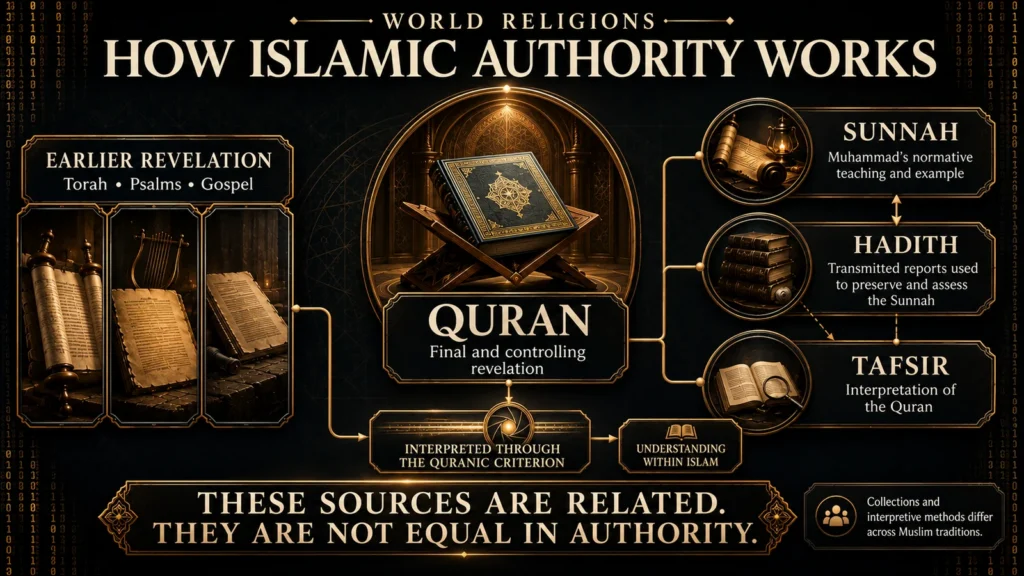
These terms name different layers and should not be blended. The Quran is the highest shared textual authority across Sunni and Shia Islam. The Sunnah is Muhammad’s normative teaching and example. A hadith is an individual transmitted report about his sayings, actions, approvals, or circumstances; collections classify reports and Muslim schools do not all assess or use them identically. The Hadith of Gabriel, preserved in Sahih Muslim 8a, famously distinguishes outward submission, faith, and excellence in worship.
Tafsir is Quranic interpretation. A commentator may explain a difficult phrase with grammar, other Quranic passages, hadith, earlier reports, or theological reasoning. Tafsir can be influential without becoming another Quran verse. This distinction matters acutely when discussing the crucifixion: later substitution stories belong to interpretation and tradition, not to the wording of Quran 4:157 itself.
Earlier revelation and the final criterion
The Quran commands belief in revelation given to earlier messengers, including the Torah and Gospel, while also presenting itself as confirming and overseeing previous Scripture. Muslims explain the relation in different ways. Some emphasize textual alteration, others interpretive distortion or concealment, and others the loss of original revelation alongside surviving truth. The common result is that the Quran functions as the final criterion when a biblical claim conflicts with it.
The disagreement is precise: can a seventh-century revelation rightly correct apostolic testimony that Christians receive as earlier and authoritative?
60-Second Belief Map
- God: one sovereign Creator without partner or divine offspring
- Revelation: the Quran as final, controlling revelation
- Prophet: Muhammad as God’s final messenger
- Human problem: unbelief, disobedience, misguidance, injustice, and shirk
- Path: faith, submission, worship, repentance, righteous deeds, and mercy
- Judgment: bodily resurrection, Paradise, and punishment
- Jesus: Messiah and prophet, not the divine Son
- Cross: denied in the historically dominant interpretation
Is Islam One Unified Tradition?
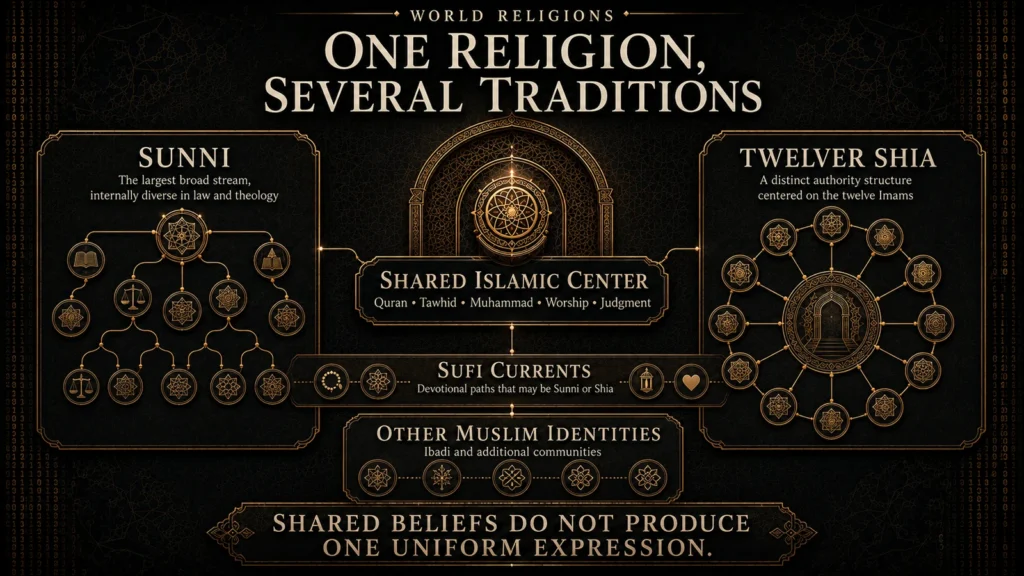
Islam has a shared center but not a single human expression. Muslims broadly share the Quran, confession of one God, Muhammad’s prophethood, worship, moral accountability, resurrection, and judgment. They also inhabit many cultures, languages, legal traditions, theological schools, political settings, and levels of observance. Neither one Muslim neighbor nor one government can stand for the whole religion.
Sunni Islam
Sunni Muslims form the largest broad stream. Sunni tradition recognizes the first caliphs after Muhammad and developed multiple schools of law and theology. Its major hadith collections, juristic methods, and scholarly institutions shape much of what outsiders commonly encounter as Islam. Yet Sunni is an umbrella, not a guarantee of uniform conclusions. A Hanafi and a Hanbali, or an Ashari and an Athari, may share identity while reasoning differently about law or theology.
Twelver Shia Islam
Sunni and Twelver Shia Muslims share Quranic monotheism, prophecy, worship, and judgment while differing significantly over authority and imamate. Twelver Shia teaching gives explicit prominence to divine justice and to a line of twelve Imams from the family of Muhammad, beginning with Ali. The disagreement is therefore theological and authoritative, not merely a modern political rivalry. A Twelver Shia doctrinal overview also shows the tradition’s own hadith inheritance and scholarly structure.
Sufism and other Muslim identities
Sufism is often a devotional current within broader Sunni or Shia identity rather than a simple third sect. Sufi paths may emphasize remembrance of God, spiritual discipline, love, moral purification, and guidance under a teacher. Muslims debate particular Sufi beliefs and practices, just as they debate reformist, traditionalist, philosophical, and revivalist movements. Other identities, including Ibadi and smaller Shia communities, further resist a two-box map.
One Religion, Several Traditions
- Sunni: the majority stream, internally diverse in law, theology, and practice
- Twelver Shia: shares the Quranic center while emphasizing divine justice and the authority of the twelve Imams
- Sufi currents: devotional and mystical paths that may be Sunni or Shia
- Other Muslim identities: communities and movements that do not fit neatly into these three descriptions
What Do Muslims Believe About God?
God stands at the center of Islam. The Arabic word Allah means God and is also used by Arabic-speaking Christians. The word itself is not evidence for a moon-god theory, and that claim should be discarded. The real comparison concerns the identity and character attributed to God.
Tawhid: God is one
Tawhid names the confession and affirmation of divine oneness. Quran 112 declares God one, self-sufficient, without offspring, and incomparable. Islam teaches that God is one, without equal, partner, or divine offspring. Nothing in creation shares His deity. To associate a partner with God is shirk, the most serious theological violation.
This conviction shapes Muslim resistance to Christian language about Father, Son, and Holy Spirit. From an Islamic standpoint, calling Jesus divine appears to compromise God’s uniqueness, and the idea of divine Sonship may sound like assigning offspring to God. Quran 4:171 warns against saying “Three,” while Quran 5:72-75 rejects identifying the Messiah with God and stresses that Jesus and Mary ate food. Islam places Jesus among dependent creatures and honored messengers, not within God’s eternal identity.
God’s mercy, sovereignty, and judgment
Islamic speech about God is not exhausted by negation. The Quran repeatedly names God merciful and compassionate. He creates, sustains, guides, commands, forgives, judges, and rules without rival. Quran 39:53-54 tells those who have transgressed not to despair of God’s mercy and summons them to turn back in submission. Divine mercy is therefore not an embarrassed exception to an otherwise mathematical system; it belongs to the religion’s own proclamation.
Mercy does not eliminate judgment. God knows every act, raises the dead, and decides the final destiny of His creatures. Schools debate divine decree and human responsibility, but people remain accountable to believe, repent, and obey.
Why Islam rejects the Trinity
Muslim objections often target three gods, biological procreation, or the elevation of a human prophet into deity. Christians should answer by correcting those pictures, not by pretending that the disagreement disappears. Christianity does not teach that God physically fathered Jesus. It does not teach that Father, Son, and Spirit are three competing beings. It does not teach that a mere man gradually became divine.
The Trinity is Christian monotheism, not belief in three gods. The church confesses one God eternally as Father, Son, and Holy Spirit. The persons are distinct without dividing deity. Physical analogies distort this confession; a full defense belongs elsewhere.
How Christian monotheism differs
The New Testament does not abandon Israel’s confession that God is one. 1 Corinthians 8:4-6 reaffirms one God while naming the Father and the one Lord Jesus Christ within creation and salvation. John 1 identifies the Word as with God and as God, then says the Word became flesh. Matthew 28 joins Father, Son, and Holy Spirit in one baptismal name.
Christians therefore agree with Muslims that God is incomparable and reject all physical accounts of Sonship. They differ over whether God’s oneness excludes eternal personal distinction. Christianity says the Son did not begin with Mary. He shares the Father’s glory, became truly human without ceasing to be divine, and makes the unseen Father known. That is not a minor variation inside an agreed doctrine of God. It is a different answer to who the one God has revealed Himself to be.
Same Words, Different Meanings
- God / Allah: the same ordinary referential word can carry importantly different doctrines of God’s identity.
- Son of God: Islam rejects divine offspring; Christianity confesses an eternal relation, not physical procreation.
- Messiah: both apply the title to Jesus, but Islam does not give it the full apostolic meaning of crucified redeemer and risen King.
- Word: Islamic use of “Word” does not ordinarily confess Jesus as the eternal divine Logos.
- Mercy: central in both traditions, but explained through different accounts of sin, judgment, and reconciliation.
- Salvation: both can use the term while describing a different human problem, means of rescue, and final relationship with God.
What Do Muslims Believe About Humanity, Sin, and Salvation?
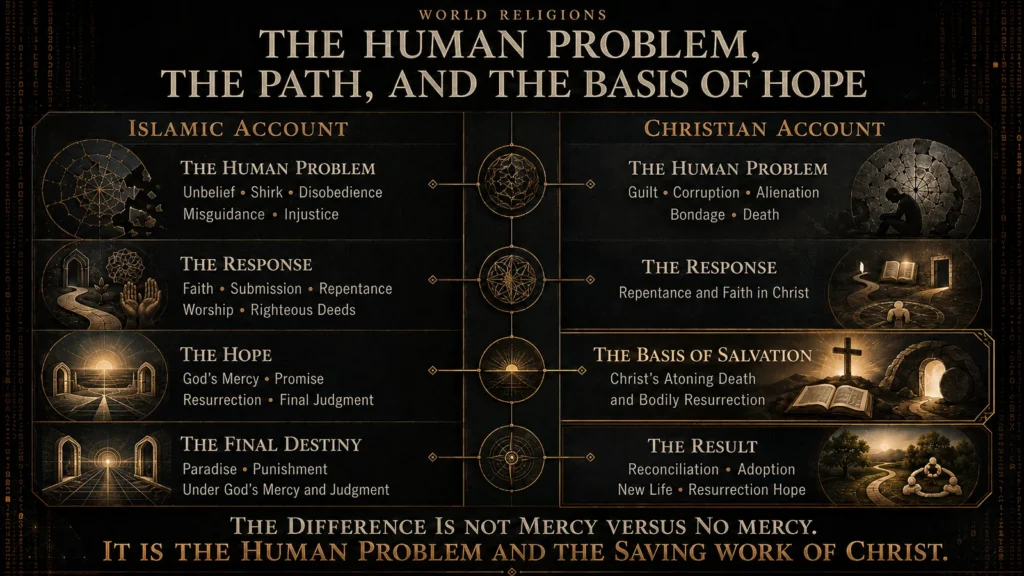
Comparisons often fail here by forcing Islam into a slogan: Christianity is grace; Islam is works. That contrast notices something real about the Christian reliance on Christ’s completed work, but its crude form misrepresents Muslim teaching. Islam joins faith, repentance, worship, deeds, judgment, and hope in divine mercy. The deeper difference is not mercy versus no mercy. It is the diagnosis of the human condition and the place, or absence, of Christ’s atoning work.
Human nature, fitrah, and personal responsibility
Islam teaches that human beings are created by God, honored with responsibility, and accountable for their own choices. Quran 6:164 says no bearer of burdens bears another’s burden. Quran 30:30 is commonly connected to fitrah, the created disposition toward the worship of God. Human beings are not commonly described as inheriting Adam’s guilt in the Christian sense. Adam sins, repents, and is forgiven; his descendants enter life responsible for their own response to God.
Muslim traditions still speak realistically about weakness, forgetfulness, temptation, pride, and disobedience. They do not claim that everyone naturally lives in perfect submission. Yet the primary Islamic frame is not a humanity corporately condemned in Adam and needing union with a second Adam.
Sin, unbelief, shirk, and misguidance
There is no single Islamic term that maps neatly onto every Christian use of sin. The human problem includes unbelief, associating partners with God, rejecting guidance, hypocrisy, injustice, ingratitude, moral transgression, and persistent disobedience. Shirk is uniquely grave because it violates tawhid. Yet moral conduct toward other people also carries eschatological weight. Quran 2:177 refuses to reduce righteousness to ritual direction and joins belief with generosity, prayer, covenant faithfulness, and patience.
People can commit major and minor sins, repent, receive forgiveness, and seek to repair wrongs. Islamic schools differ on questions such as whether serious sin removes a person from faith, how divine decree relates to choice, and how particular judgments should be understood. A profile should not pretend those debates are trivial, but neither should it bury the shared summons: worship God alone, turn from evil, do justice, and prepare to answer to the Creator.
Repentance, righteous deeds, and mercy
Repentance, or tawba, involves turning back to God with remorse and a changed direction. Quran 39 calls sinners away from despair and toward submission. Righteous deeds matter: prayer, generosity, truthfulness, fidelity, patience, and care for others are not optional decorations. The Quran speaks of scales at judgment and of even small deeds being brought to light. Muslim discussions may emphasize different relations among faith, deeds, intercession, divine promise, and mercy, but deeds have real moral and final significance.
That does not make Paradise a wage that God is forced to pay. In Sahih Muslim 2818a, a prominent Sunni hadith says that no one’s deeds alone will secure salvation, not even Muhammad’s, unless God covers him with mercy. The same teaching appears in Sahih al-Bukhari 6464. Muslim theologians explain this alongside Quranic promises concerning faith and righteous action. The responsible summary is that obedience matters and mercy remains indispensable.
Muslim experience of assurance varies: some emphasize confidence in God’s compassion; others stress fear, hope, perseverance, or uncertainty. No doctrinal chart establishes a universal Muslim psychology.
How Christian grace differs
Christianity joins personal responsibility with a fallen human condition marked by sin and death. Romans 5 presents Adam as the head of a humanity under condemnation and Christ as the obedient representative who brings justification and life. Ephesians 2 describes people not merely as underinformed but dead in trespasses. Every person also commits actual sin and stands guilty; inherited ruin does not erase individual responsibility.
The gospel’s answer is not that moral action becomes irrelevant. It is that sinners cannot reconcile themselves to God by assembling an acceptable record. In Romans 3:21-26, God acts to justify through the redemption in Christ Jesus. Second Corinthians 5 says God was in Christ reconciling the world to Himself and made the sinless One to be sin for us. Ephesians 2 calls salvation God’s gift and then describes believers as created in Christ for good works. Works are the fruit of grace, not a substitute for the Savior.
Muslims may object that God can forgive directly and that requiring a death limits mercy. The Christian claim is not that an external law forces a reluctant God to punish someone else. The Father does not punish an unwilling stranger; the Son freely gives Himself in God’s work of reconciliation. Father, Son, and Spirit act in one saving purpose. The cross reveals both God’s holy judgment against sin and His self-giving love for sinners.
Islam directs the repentant worshiper to God’s mercy, judgment, and promise without an incarnate mediator who bears sin. Christianity says mercy has taken historical form in the mission of the Son: He assumes our humanity, obeys, dies, rises, and brings His people to the Father. A fuller explanation of what Christians believe Jesus accomplished on the cross belongs to the atonement study, but the profile cannot omit that center.
How Do Muslims Worship and Practice Their Faith?
Islam, iman, and ihsan
The Hadith of Gabriel offers a compact architecture. Islam is described through confession and embodied obligations; iman, or faith, through belief in God, angels, books, messengers, the Last Day, and divine decree; ihsan, or excellence, through worshiping God with the awareness that He sees the worshiper. These categories show why Islam cannot be reduced either to private belief or to outward rules. Doctrine, practice, intention, and spiritual character belong together.
The Five Pillars
The Five Pillars summarize central Islamic practices. The shahada bears witness that there is no deity but God and Muhammad is His messenger. Formal prayer structures the day around worship. Zakat requires almsgiving. Fasting during Ramadan disciplines desire and intensifies worship and generosity. The hajj gathers able pilgrims in Mecca. Each practice has legal detail, communal form, and spiritual meaning beyond what a short list can capture.
Muslim worship also includes Quran recitation, personal supplication, remembrance of God, ethical conduct, family duties, festival observance, learning, and service. Practices differ across legal schools and communities, and Sunni and Shia ritual forms have visible distinctions. None of this implies that Muslims worship Muhammad. His name appears in the confession because of his prophetic role, not because he is treated as divine.
Lived Islam
A religion on paper is not identical to every believer’s life. Some Muslims observe every prescribed prayer; others identify culturally, struggle with practice, or interpret commitment differently. A Muslim in Indonesia, Iran, Senegal, Turkey, Saudi Arabia, Britain, or the United States may inhabit a very different social world. Gender, age, family, education, migration, and local institutions all affect lived religion. Description should therefore distinguish what sources teach, how traditions interpret, and how particular people practice.
What Do Muslims Believe About Jesus?
Muslims do believe in Jesus. Any Christian account that says otherwise fails before the comparison begins. The Quran gives Jesus extraordinary honor while placing Him within the prophetic order rather than confessing Him as the eternal Son. Understanding both parts is essential.
What Islam genuinely affirms
In Quran 3:45-55, angels announce to Mary a child called the Messiah, Jesus son of Mary, honored in this world and the next. He speaks to people, performs signs by God’s permission, confirms the Torah, and calls Israel to worship God. Quran 19 narrates the announcement and miraculous conception with substantial attention to Mary. Quran 5:110 recalls Jesus forming a bird from clay, healing the blind and leper, and raising the dead, always by divine permission.
The Quran calls Jesus Messiah and presents Him as a messenger. It calls Him a word from God and, in Quran 4:171, a spirit from Him. It presents His birth as a sign and denies accusations against Mary. God raises Jesus to Himself in Quran 4:158. Major Muslim traditions also expect His future return. These affirmations make hostility toward Jesus an unintelligible description of normative Islamic belief. A Sunni study of Jesus as a basis for dialogue develops this reverence from within Islam.
These affirmations create real conversational ground. Muslims and Christians can read passages about Mary, miracles, Messiahship, judgment, and devotion to God. But honor is not yet agreement. Each title must be interpreted inside the larger account that gives it meaning.
Similar titles, different meanings
In the New Testament, “Messiah” is joined to Jesus’ Davidic kingship, suffering, death for sins, resurrection, universal rule, and return. In Islam, the title remains genuine but does not by itself include that apostolic pattern. Likewise, Islamic use of “Word” does not ordinarily confess Jesus as the eternal divine Logos. A Twelver Shia treatment of Jesus as Kalimat Allah illustrates how Muslim interpreters connect the title to God’s creative command. John 1 makes a different claim: the Word already was in the beginning, was with God, was God, made all things, and became flesh.
Calling Jesus “son of Mary” honors His miraculous birth and identifies Him, but also consistently places Him as a human messenger. Christian “Son of God” language is not a claim that God took Mary as a consort or physically produced a child. The Son eternally relates to the Father and took human nature from Mary in time. To reject biological divine offspring is compatible with Christianity. To reject the eternal Son is not.
What Islam denies or redefines
Islam denies the Trinity as it understands the claim, rejects worship of Jesus, and refuses divine Sonship. Quran 5 presents Jesus denying that he told people to take him and his mother as deities besides God. Quran 4 warns the People of the Book not to exceed proper bounds concerning Him. Although the passages do not function as a full technical account of later Nicene doctrine, the Islamic conclusion is unambiguous: Jesus is not God the Son.
The historically dominant Islamic reading also denies that Jesus was crucified. That removes the atoning death and bodily resurrection after death that define the apostolic gospel. God raises and vindicates Jesus in the Quranic account, but not through the New Testament sequence of public execution, burial, and resurrection on the third day.
The Christian confession is that one God is Father, Son, and Holy Spirit; the eternal Son became truly human; He obeyed, suffered, and freely gave Himself for sinners; God raised Him bodily; and He reigns as Lord and the one mediator. The biblical and historical case for Jesus as the Son of God does not depend on biological imagery or a fourth-century invention. It begins with Scripture’s first-generation witness.
Does Islam expect Jesus to return?
Major Sunni and Twelver Shia traditions expect Jesus to return near the end of history, though details and emphases come substantially from hadith and later interpretation rather than one simple Quranic timeline. In common Sunni accounts, Jesus returns as a servant and messenger of God, defeats the false messiah, establishes justice, and confirms Islam. Shia narrations may place His return in relation to the Mahdi. These traditions heighten Jesus’ importance without making Him divine.
A Christian should not use the return motif as though it secretly proves the New Testament view. The meaning differs. Christianity says the One who returns is the same crucified and risen Lord who will judge the living and the dead. Islam generally presents the returning Jesus as a vindicated prophet who corrects Christian claims about Him and serves God’s final purposes.
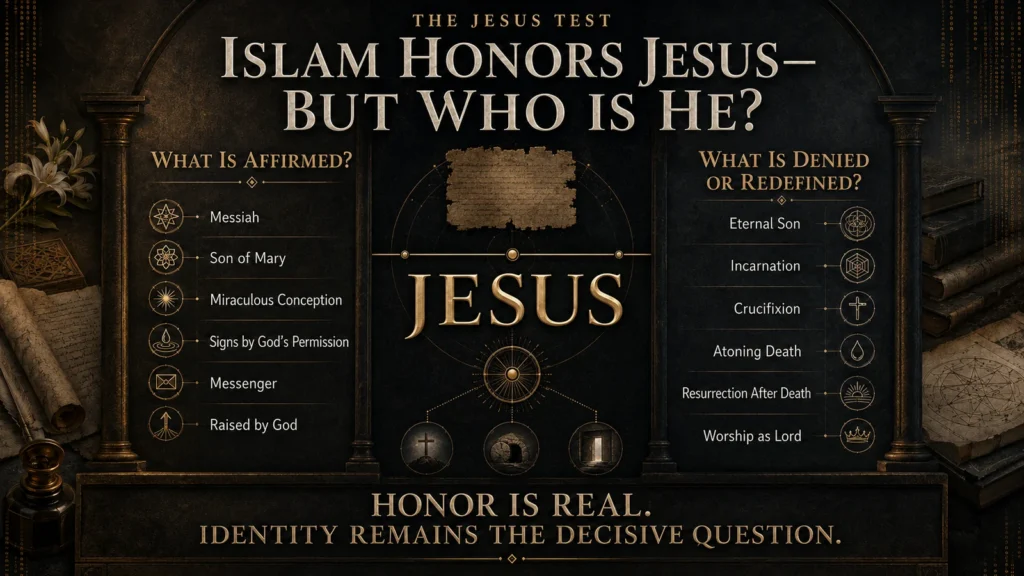
The Jesus Test
- What does Islam affirm? Messiah, son of Mary, miraculous conception, messenger, signs, honor, and raising by God.
- What does it deny? Eternal divine Sonship, incarnation in the Christian sense, crucifixion in the dominant reading, atoning death, and resurrection after death.
- What does it redefine? Titles such as Messiah, Word, and Spirit are placed inside Islamic monotheism and prophethood.
- When did the account arise? The Quranic correction belongs to the seventh century; the New Testament witness belongs to the first.
- Which account best fits the earliest sources? The answer must explain the cross, resurrection proclamation, and worship of Jesus before Nicaea.
Was Jesus Crucified? The Central Historical Conflict
Here the two religions make incompatible claims about a public event. Christianity says Jesus was crucified under Pontius Pilate, died, was buried, and was raised. The dominant Islamic account says He was not crucified but was raised by God. Because the cross is central to the gospel, the conflict requires explanation.
What Quran 4:157-158 says
Quran 4:157-158 rejects the boast, “We killed the Messiah, Jesus son of Mary, the messenger of God.” It then says they did not kill or crucify Him, that it was made to appear so to them, and that God raised Him to Himself. The precise grammar and referents have produced interpretation, but the denial language is strong.
Later substitution stories exist, but the Quran itself does not identify a substitute. It does not name Judas, Simon of Cyrene, or any other person as the one placed on the cross. Repeating one later story as though the Quran states it would confuse tafsir with revelation.
Mainstream and minority Islamic interpretations
The historically dominant Islamic reading is that Jesus was not crucified. Many interpreters have understood another person to have been made to resemble Him, while others have left the mechanism less defined. Sunni and Shia sources broadly share the denial even when their reports differ. Minority and modern reinterpretations exist but have not displaced the dominant denial. Some reconsider whether the passage denies Roman action, Jewish responsibility, Jesus’ death, or only the enemies’ claim of mastery.
Those qualifications preserve accuracy without erasing the conflict with the passion narratives and Paul’s gospel summary.
What the earliest historical evidence supports
Jesus’ crucifixion is among the strongest historical conclusions concerning His life. The four Gospels place His execution under Pilate within first-century Judea. Paul’s undisputed letters make the crucified Christ central, and they predate the final written form of the Gospels. In 1 Corinthians 15, Paul passes on what he had received: Christ died for sins, was buried, was raised, and appeared. Galatians connects Paul with Cephas and James, leaders tied to the earliest Jerusalem community.
Non-Christian evidence is narrower but consistent. Early Christian sources consistently place Jesus’ execution under Pontius Pilate, and Tacitus provides a later hostile Roman attestation to that execution. One Roman report does not prove Christian theology, but it converges with early Christian sources on the execution. No surviving first-century source known to us presents an alternative account in which Jesus was publicly rescued from crucifixion. The fuller case for the historical evidence that Jesus was crucified examines sources and objections in their proper depth.
History should be calibrated. It can strongly establish an execution and very early resurrection belief. It cannot, by ordinary historical method alone, force a confession that God raised Jesus. That conclusion interprets the evidence within the apostolic witness and God’s revelation.
Why the cross changes everything
For Paul, the cross is not an unfortunate misunderstanding later converted into symbolism. It is the saving act he had already received and preached. Jesus gives Himself for sins, reconciles enemies, bears the curse, and inaugurates the new covenant. His resurrection vindicates Him and declares that death has been defeated.
The Quran’s later date does not disprove its account automatically. It does mean its correction of Jesus’ first-century history must be weighed against sources and traditions much closer to the events. A later revelation could logically correct earlier testimony. A rescue account must also explain why no trace of that alternative appears in the earliest surviving Christian proclamation, despite Paul’s documented contact with Cephas and James.
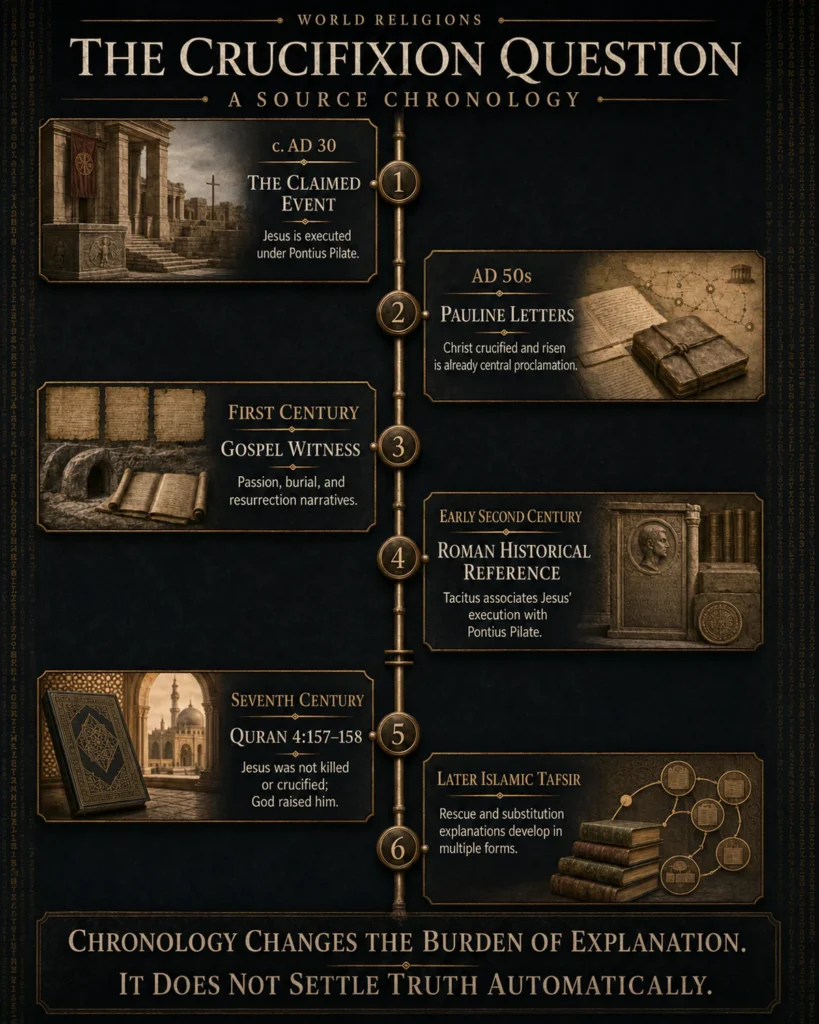
Evidence and Limits: A Crucifixion Chronology
- Jesus under Pilate: early Christian sources place His execution under Pontius Pilate, with later hostile Roman attestation.
- Pauline proclamation: Paul’s letters proclaim a crucified and risen Messiah and preserve material he had received.
- Early worship: Jesus is invoked as Lord and placed within divine saving and creative work.
- Quranic correction claim: the seventh-century Quran denies that Jesus was killed or crucified.
- Later interpretation: tafsir and transmitted traditions develop different substitution and rescue accounts.
Chronology changes the burden of explanation; it does not settle truth automatically.
Do Muslims Believe the Bible Was Corrupted?
Original revelation and the Quran as criterion
Muslims affirm that God gave revelation to Moses and Jesus. The Quran speaks of the Torah and Gospel, confirms prior revelation, and also accuses some among earlier communities of distortion, concealment, misreading, or forgetting. Because the Quran is received as the final protected revelation, it becomes the criterion when present biblical texts conflict with Islamic teaching.
That creates an important nuance: a Muslim may affirm the original Gospel given to Jesus while denying that the New Testament’s four Gospels simply are that revelation. The Islamic category can mean a divine message entrusted to Jesus rather than a collection of apostolic narratives about Him.
Tahrif is not one simple theory
Tahrif, often translated corruption or distortion, has not been explained in only one way. Muslim explanations differ over textual alteration, interpretive distortion, concealment, and loss. Some argue that the wording of earlier Scriptures was changed extensively. Others emphasize false interpretation or selective handling while allowing that substantial truth remains. Popular debates may combine several claims without distinguishing them.
Fairness requires asking a Muslim what is meant rather than assigning the most extreme view. It also requires Christians to admit that biblical manuscripts contain textual variants. The existence of variants is public evidence, not a secret. The real questions are whether the wording can be responsibly recovered, when disputed readings arose, and whether central claims about Jesus depend on late, isolated alterations.
The Christian response
The New Testament textual tradition is abundant and geographically distributed. Variants require careful evaluation, but the crucifixion, resurrection proclamation, and high view of Jesus do not rest on one fragile verse. They appear across Paul, the Gospels, and other first-century writings. Even passages frequently discussed in textual criticism do not create those doctrines from nothing.
The historical question also precedes a general theory of corruption. Paul’s letters already proclaim Christ crucified and risen. First Corinthians 15 preserves received tradition, and Galatians places Paul in contact with Cephas and James. A corruption proposal must explain how the central message became established across the earliest recoverable evidence, not merely point out that scribes sometimes differed.
This profile cannot settle every manuscript or canon question. Christians should neither deny variants nor surrender the stable early witness; Islam’s correction must account for evidence that is centuries earlier and more proximate to Jesus.
Islam and Christianity Compared at a Glance
A compact comparison can orient the reader, but each line summarizes a tradition with internal discussions. It should send readers back into the fuller sections rather than replace them.
- God: Islam confesses one incomparable Creator without partner or offspring. Christianity confesses one God as Father, Son, and Holy Spirit.
- Revelation: Islam receives the Quran as final revelation and criterion. Christianity receives the prophetic and apostolic Scriptures culminating in the incarnate Son.
- Muhammad: Islam regards him as God’s messenger and final prophet. Christianity does not receive his correction of the apostolic gospel.
- Humanity: Islam emphasizes created disposition and personal accountability. Christianity joins personal guilt to a fallen condition under sin and death.
- Human problem: Islam names unbelief, shirk, disobedience, injustice, and misguidance. Christianity names guilt, corruption, alienation, bondage, and death.
- Mercy and deeds: Islam calls for faith, repentance, worship, righteousness, and hope in God’s mercy. Christianity says good works flow from grace received through Christ.
- Jesus: Islam honors the Messiah and prophet, miraculously born to Mary. Christianity worships the eternal Son made flesh.
- Cross: dominant Islamic interpretation denies Jesus was crucified. Christianity places His willing death for sins at the gospel’s center.
- Resurrection: both teach a future resurrection of humanity. Christianity proclaims that Jesus Himself died and bodily rose as the beginning and guarantee of the final resurrection.
- Final hope: Islam looks to Paradise under God’s mercy and judgment. Christianity looks to reconciliation, adoption, and resurrection life with God through Christ.
These are not two routes saying the same thing in different accents. The overlap is serious, and so is the contradiction. The identity of Jesus concentrates the difference because it joins doctrine of God, revelation, sin, salvation, history, and final judgment in one person.
Which Account of Jesus Best Fits the Earliest Evidence?
A fair comparison reaches evaluation eventually. Islam claims to restore Jesus’ original monotheistic message after Christians elevated Him and distorted revelation. Christianity claims that the apostolic witness already preserves His true identity and saving work. Which account better explains the evidence nearest to Jesus?
The cross belongs to Christianity’s earliest proclamation
Paul’s letters do not reveal a primitive prophet-only movement waiting for later Christians to add a cross. They proclaim Christ crucified. Paul says he received this message, met Cephas and James, and delivered the same gospel to churches before the Gospels reached their final written forms. The cross is therefore not a late ornament attached after eyewitness generations disappeared.
Resurrection proclamation is first-generation
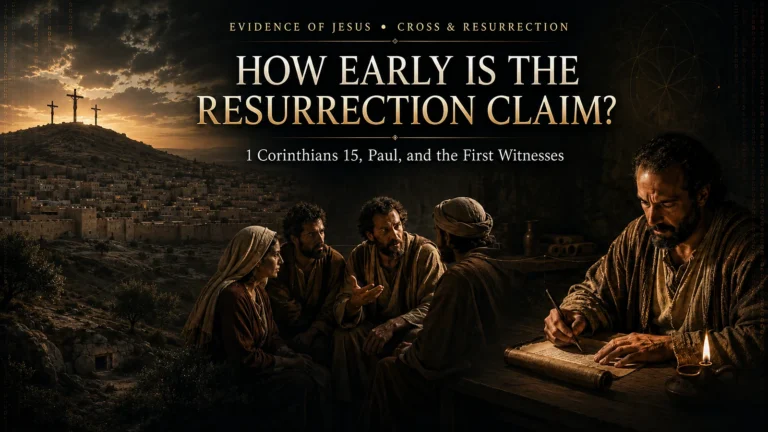
First Corinthians 15:1-8 names death, burial, resurrection, and appearances to Cephas, the Twelve, James, the apostles, and Paul. It does not give a modern transcript of every experience, and assigning every line an exact date can outrun the text. It does show that Paul received a resurrection tradition already known within the first Christian generation. See the focused study of how early the resurrection proclamation appeared.
Jesus was honored as Lord before Nicaea
The Council of Nicaea in AD 325 did not take a merely human Jesus and vote Him into divinity. Its technical language addressed how the Son relates to the Father. Scholars differ over how best to describe the development and conceptual shape of earliest Christology, but Paul’s letters already place Jesus within prayer, confession, divine saving action, and creation. Philippians 2 presents the humbled and exalted Christ receiving universal homage; 1 Corinthians 8 names one God, the Father, and one Lord, Jesus Christ, through whom all things exist. Larry W. Hurtado’s Lord Jesus Christ examines devotion to Jesus in earliest Christianity in depth.
John states the confession with unmistakable clarity but does not create devotion to Jesus from a historical vacuum. Later vocabulary can clarify earlier belief without inventing its subject.
The cumulative question
The Quran’s account remains logically possible if one first accepts its divine authority. Historically, however, its correction must explain a difficult cluster: Jesus’ Jewish and Roman setting, His execution under Pilate, Paul’s early letters, contact with Cephas and James, received resurrection tradition, and worship of Jesus as Lord among monotheistic Jews. Lateness is not automatic refutation, but a later correction of earlier testimony must explain the earlier and more proximate evidence it overturns.
From a Christian apologetic standpoint, this account explains the cluster without removing the cross and resurrection from the earliest proclamation. The eternal Son became human; He entered public history; He freely died for sins; God raised Him; His first followers proclaimed what they believed they had received and witnessed; and the church confessed Him as Lord. Historical analysis cannot produce faith by itself, but it can show that the apostolic Jesus is not a fourth-century invention. Readers can pursue what the first witnesses claimed about the risen Jesus and weigh whether Islam’s later correction or the earlier testimony better explains the whole.
Frequently Asked Questions
Do Muslims and Christians believe in the same God?
Both intend to speak of the one Creator of Abraham and reject idols and rival deities. Arabic-speaking Christians use the word Allah, so vocabulary alone cannot settle the question. The doctrines differ decisively: Islam says divine oneness excludes Son and Trinity, while Christianity confesses one God eternally as Father, Son, and Holy Spirit. The broad referential question and the theological identity question should be distinguished rather than compressed into a slogan. Shared reference does not erase contradictory descriptions of who God is.
Do Muslims believe in Jesus?
Yes. The Quran calls Jesus Messiah and messenger, presents His miraculous conception by Mary, attributes miracles to Him by God’s permission, and says God raised Him. Islam does not, however, confess Him as the eternal Son, incarnate Lord, crucified Savior, or risen mediator. Muslim reverence is real and does not equal the New Testament confession.
Do Muslims believe Jesus was crucified?
The historically dominant Islamic reading of Quran 4:157-158 says Jesus was not crucified. Later substitution stories exist, but the Quran itself does not identify a substitute. Minority and modern reinterpretations have questioned exactly what the passage denies, yet they have not displaced the mainstream view.
Do Muslims believe in the resurrection?
Islam strongly teaches a future bodily resurrection and final judgment for humanity. It does not ordinarily teach the Christian sequence in which Jesus was crucified, died, was buried, and bodily rose on the third day. God raises Jesus in the Quranic account, but dominant interpretation denies the death from which the New Testament says He rose.
Does Islam teach salvation by works?
That wording is too simple if it implies a crude points system or denies mercy. Islam joins faith, submission, repentance, worship, righteous deeds, judgment, and hope in divine compassion. Prominent Sunni hadith deny that deeds alone entitle anyone to Paradise. Christianity differs by locating reconciliation specifically in Christ’s completed death and resurrection, with good works following God’s saving gift.
Do Muslims believe the Bible was corrupted?
Many do, but Muslim explanations differ over textual alteration, interpretive distortion, concealment, and loss. Muslims can affirm original revelation to Moses and Jesus while treating the Quran as the final criterion over present biblical texts. Christians acknowledge textual variants while arguing that the wording is recoverable and that the central apostolic claims are early, widespread, and not dependent on one disputed passage.
Do Muslims worship Muhammad?
No. Muslims revere Muhammad as prophet, messenger, and model; they do not worship him as God. His name in the confession of faith identifies his prophetic role. Islamic worship is directed to God alone.
Are all Muslims Sunni?
No. Sunni Muslims are the largest broad stream, but Twelver Shia, other Shia communities, Ibadis, and additional identities are part of the Muslim world. Sufism is often a devotional current within Sunni or Shia identity rather than a mutually exclusive third sect. Every broad label contains further diversity in law, theology, devotion, and lived practice across time and place.
Sources and Further Reading
This profile begins with Islamic primary texts, then uses Sunni and Twelver Shia sources to check recognizability. Academic works supply historical and interpretive context rather than defining belief for Muslims. Scripture governs the Christian confession, while the linked evidence studies develop arguments this broad profile summarizes.
Primary Islamic texts
- Quran 112; Quran 4:157-171; Quran 3:45-55; Quran 39:53-54
- Hadith of Gabriel, Sahih Muslim 8a; deeds and mercy, Sahih Muslim 2818a; Sahih al-Bukhari 6464
Sunni and Shia perspectives
- Yaqeen Institute, “Basics of Islam”; “Repentance, Redemption, and Salvation: An Islamic Framework”; and “Jesus: A Foundation for Dialogue Between Muslims and Christians”
- Mohammad Ali Shomali, Discovering Shia Islam, doctrinal chapter; Muhammad Legenhausen, “Jesus as Kalimat Allah, the Word of God”
Academic and historical sources
- The Oxford Handbook of Islamic Theology and The Oxford Handbook of Qur’anic Studies
- Gabriel Said Reynolds, The Qur’an and the Bible; Sidney H. Griffith, The Bible in Arabic
- Gabriel Said Reynolds, “The Muslim Jesus: Dead or Alive?”
- Tacitus, Annals 15.44; Larry W. Hurtado, Lord Jesus Christ: Devotion to Jesus in Earliest Christianity
Christian Scripture and linked evidence
- John 1:1-18; Romans 3:21-26; 1 Corinthians 8:4-6; 1 Corinthians 15:1-8; Philippians 2:5-11; Hebrews 1
- Paranoid Prophet: the case for Jesus as the Son of God; historical evidence for Jesus; crucifixion evidence; and the meaning of the cross
- Paranoid Prophet: the early resurrection proclamation; the first witnesses’ claims; and the World Religions library
Every listed passage with a stable online text is linked for direct reading. Hadith are identified by collection and number, and interpretive claims are not presented as though they were Quranic wording.
Islam Honors Jesus—But Who Is He?
Islam deserves to be understood accurately. It confesses one Creator, receives the Quran as final revelation, honors Muhammad as messenger, calls people to worship and repentance, takes judgment seriously, and places real hope in divine mercy. It also honors Jesus as Messiah, son of Mary, miracle-working messenger, and a sign from God. Christians should never erase those beliefs to make an argument easier.
Yet honor is not the same as trust. The New Testament does not ask readers merely to reserve a high place for Jesus among the prophets. It reveals the eternal Son who became human, bore our guilt willingly, died under Pilate, was buried, and was raised bodily by God. He does not only point toward a path of salvation. He is the one mediator who reconciles sinners to the Father.
Read the Gospel of John and ask whether its Jesus can be reduced to a later misunderstanding. Read 1 Corinthians 15 and ask how early the cross and resurrection shaped Christian faith. Examine the historical evidence, including the earliest historical evidence for Jesus. Pray honestly that God would expose caricature, correct pride, and reveal the truth.
For the Christian, the invitation is not merely to adopt a label or admire an argument. It is to repent, receive the mercy God has given in Christ, and follow the living Jesus in faith and worship.
The final question is not whether Jesus deserves a place among the prophets. It is whether the crucified and risen Son is Lord.