


GUIDED ARTICLE EXPERIENCE
What Did the First Witnesses Claim About the Risen Jesus?
Read along as the narration moves through the article.
Private device narration · No hosted audio or tracking
CONTINUE GUIDED TOUR
Continue where you left off.
GUIDED TOUR COMPLETE
You have reached the end of this study.
Study record saved on this device.
GUIDED TOUR
What Did the First Witnesses Claim About the Risen Jesus?
Narrator: Paranoid Prophet Recommended Voice Native device narration
Prepare to follow the article as it is narrated.
VOICE & TOUR OPTIONS
Voice & Listening
NARRATOR
Finding a narrator…
Checking the best narrator available on this device.
Restores the best curated narrator available on this device.
Narrator choices are curated for clear, long-form listening on this device.
Screen-awake support will be checked when narration starts.
CHOOSE A NARRATOR
Curated for this device
Choose a verified narrator for this browser, or use System Narrator. Automatic mode uses the best reliable route exposed by this device; your chosen narrator is preserved even if this device needs a temporary fallback.
Preparing the guided article experience…
RESUME GUIDED TOUR?
Continue where you left off.
GUIDED TOUR COMPLETE
You have reached the end of this study.
What did the first witnesses claim about the risen Jesus? They did not merely say that Jesus’ teachings survived, that His memory inspired them, or that His soul had gone to heaven. The earliest Christian sources proclaim something far more concrete: the crucified Jesus had been raised by God and had appeared to named people.
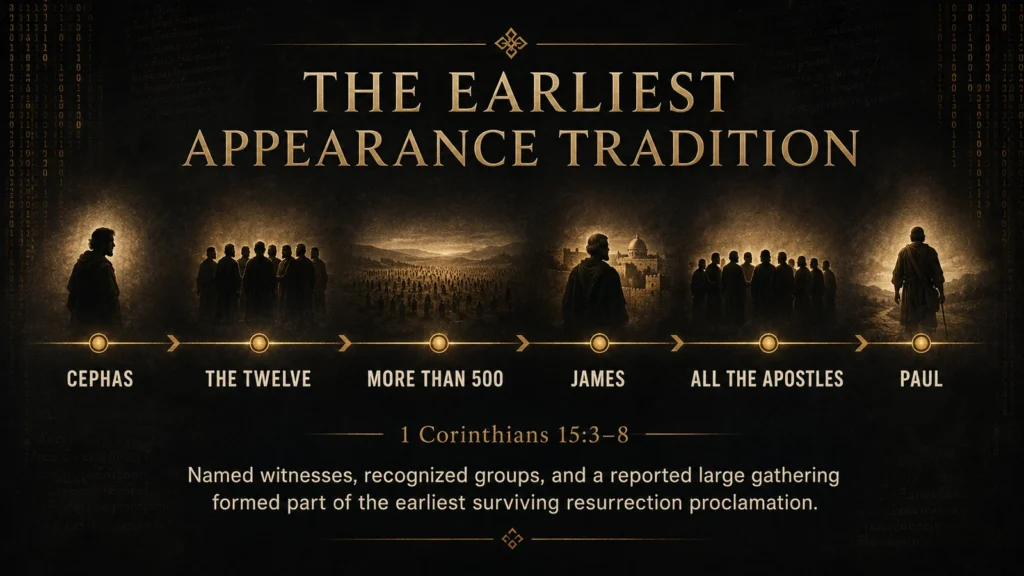
The strongest early source is 1 Corinthians 15:1–11. Paul says that Christ appeared to Cephas, then to the Twelve, then to more than five hundred people at once, then to James, then to all the apostles, and finally to Paul himself.
That does not mean historians can reconstruct every encounter with complete certainty. The sources differ in detail, the Gospel accounts are later than Paul, and several questions remain debated. But the central historical claim is difficult to avoid: very early Christians publicly maintained that Jesus had died, had been raised, and had appeared to specific people.
Article Guide11 sections
Who Were the First Witnesses of the Resurrection?
The first witnesses of the resurrection named in the earliest surviving Christian source include Cephas, the Twelve, James, all the apostles, and Paul. The Gospel accounts also place women at the empty tomb and among the first recipients of resurrection news.
These witnesses do not all carry the same evidential weight. Paul is our earliest written source. His own letters establish that he knew Cephas and James. The Gospel narratives give fuller accounts, but they are later and shaped by distinct theological interests. A careful historical case begins with the earliest named claims and then adds the later narrative witnesses without pretending every source answers every question equally.
Source discipline: Scripture teaches that Jesus truly rose and appeared to His followers. History investigates what the sources claim, how early they are, how they connect to known first-generation figures, and what rival explanations can account for. This article distinguishes the historical fact of early resurrection claims from the theological conclusion that God raised Jesus.
Before examining each witness, we need to understand what these people were actually claiming. Their message was not simply that Jesus remained spiritually meaningful. It was a Gospel centered on His death for sins, His resurrection, His appearances, and His lordship.
What the First Witnesses Actually Proclaimed
More Than “Jesus Lives in Our Hearts”
Modern readers sometimes imagine that the earliest Christians believed only that Jesus’ influence continued, that His spirit remained near them, or that His message outlived His death. That picture does not fit the sources.
Paul’s summary in 1 Corinthians 15 does not begin with an unexplained vision. It begins with the Gospel: Christ died for our sins according to the Scriptures, was buried, was raised, and appeared. The witness list belongs inside that message, not outside it. The earliest Christians were not merely reporting that something unusual happened after Jesus’ death. They were proclaiming that God had acted through the crucified Messiah to save, fulfill His promises, and defeat death.
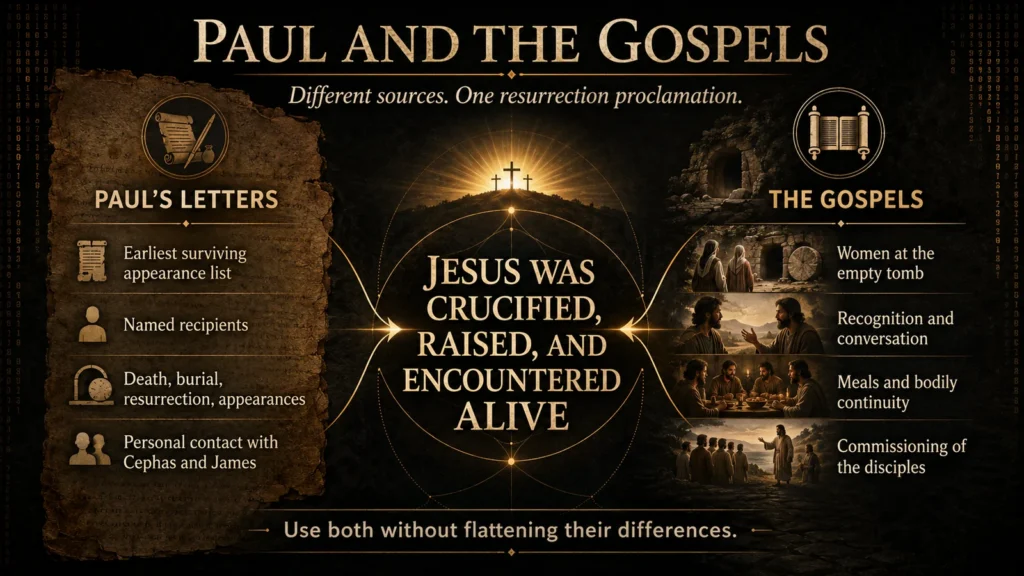
The Gospel accounts make the same basic claim in fuller narrative form. They present an empty tomb, women receiving the first message, appearances to disciples, recognition, commissioning, meals, conversation, fear turning to joy, and the risen Jesus sending His followers into the world.
The narratives differ in scene selection, sequence, emphasis, and detail. That should not be hidden. But their shared proclamation is clear: Jesus was not merely remembered. He was proclaimed as risen.
The Witnesses Proclaimed One Shared Gospel
Paul did not present the resurrection as a private revelation that began with him. He tells the Corinthians that he had received the central Gospel tradition and then passed it on to them. Before naming his own encounter, he identifies appearances to Cephas, the Twelve, more than five hundred people, James, and all the apostles.
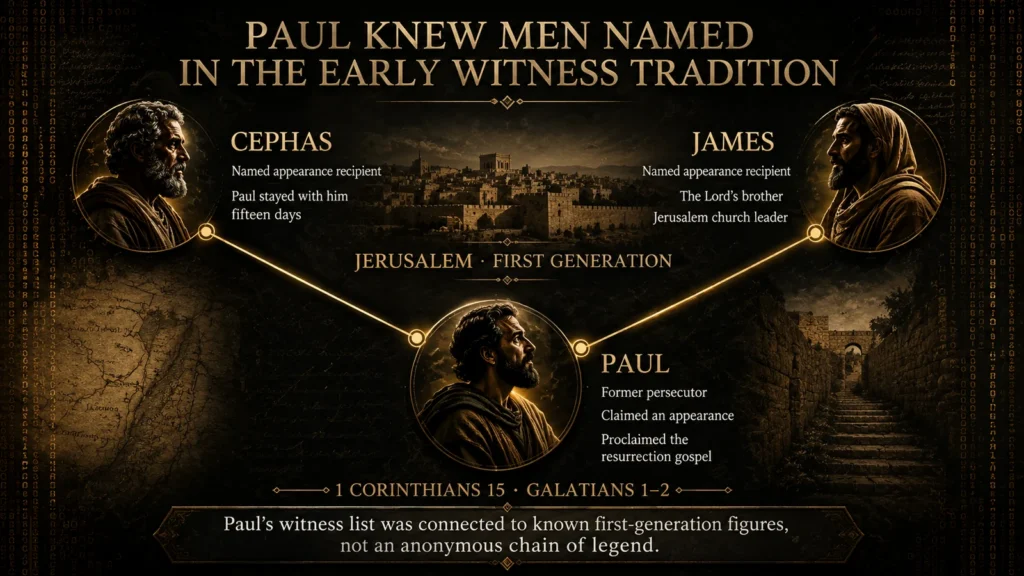
The sequence places Paul inside a proclamation that already existed. His later contact with Cephas and James strengthens that connection. In Galatians 1:18–20, Paul says that he stayed with Cephas in Jerusalem and also saw James, the Lord’s brother. He was not writing about distant names from an unreachable legendary age. He personally knew two of the most important people included in the appearance tradition.
Paul closes the witness list by saying that whether the preaching came from him or from the earlier apostles, this was what they preached and what the Corinthians believed. He does not claim that every apostle described every encounter in identical words or agreed about every later theological question. His point is narrower and historically important. The resurrection of Jesus belonged to a shared apostolic Gospel. Paul represented himself as proclaiming the same central message that the earlier witnesses proclaimed.
This does not independently prove that the proclamation was true. It does make one common explanation much harder to sustain: Paul did not invent the resurrection decades after Jesus. He received an earlier message, knew leading figures connected to it, and publicly located his own ministry within that shared witness. For the dating and transmission of this tradition, see How Early Is the Resurrection Claim? 1 Corinthians 15 and the First Witnesses.
The Named Witnesses in Paul’s Earliest Appearance Tradition
Paul’s list is historically valuable because it combines identifiable individuals, recognized groups, and his own first-person claim. It is not a collection of equal pieces of evidence. Some entries connect directly to people Paul knew. Others are preserved only as brief reports without names or narrative detail.
The strongest approach is therefore not to count witnesses as though every name or group supplied an independent written deposition. It is to examine what each part of the tradition supports, what remains unknown, and how the different claims fit within the earliest Christian proclamation.
Cephas: The First Named Witness in Paul’s List
In 1 Corinthians 15, Paul says that Jesus “appeared to Cephas.” Cephas is the Aramaic name commonly associated with Peter. Paul’s wording does not describe the location, duration, visual detail, or exact circumstances of the appearance. It gives us something more limited but historically important: Cephas was already named as a resurrection witness within the tradition Paul had received.
Cephas matters because Paul personally knew him. In Galatians 1:18–20, Paul says that he later visited Cephas in Jerusalem and stayed with him for fifteen days. This does not prove that Paul recorded every conversation or received every line of 1 Corinthians 15 directly from Peter. Paul does not say that.
It does show that Paul’s witness list was not a detached catalog of anonymous religious figures. He had direct contact with Cephas, one of the men named in the received resurrection proclamation.
The Gospels portray Peter as prominent in Jesus’ ministry, fractured by fear during the Passion, and restored by the risen Christ. Luke 24:33–35 refers to the Lord appearing to Simon, while John 21 gives a later narrative of Peter’s restoration and commission.
Historically, the safest conclusion is that Peter was recognized very early as a named recipient of an appearance of the risen Jesus and later became a central leader in the movement that preached Jesus’ resurrection. We cannot reconstruct every moment of the encounter from Paul’s brief reference.
The Twelve and the Apostolic Witness
After Cephas, Paul says that Jesus appeared “to the Twelve.” The phrase functions as a recognized designation for the apostolic circle. It should not be turned into a technical claim that every member was necessarily present at every moment or that we possess individual testimony from each apostle.
What it does show is that the resurrection proclamation was not framed only around one isolated individual. Paul’s received tradition includes a collective apostolic witness.
The Gospel accounts provide different scenes involving disciples gathered after Easter. Matthew 28:16–20 presents the risen Jesus commissioning the Eleven in Galilee. Luke 24:36–49 emphasizes continuity between the crucified Jesus and the risen Lord. John 20:19–29 centers on Jesus’ appearance to the disciples and Thomas’s confession.
These accounts should not be forced into a single artificial timeline. Their narrative forms differ. Yet they agree that the disciples were not simply given a philosophical idea. They were presented as encountering the risen Jesus and being commissioned to bear witness.
That collective claim is historically significant. It does not prove that every apostle later died in a particular way, and it does not make every later martyrdom tradition equally secure. It does establish that the earliest movement publicly located its message in testimony: “we are witnesses.”
What happened when that testimony became public belongs to the next stage of the investigation. Evidence that early Christians endured hostility and suffering can support the sincerity of their conviction, but suffering alone cannot prove that the resurrection occurred. For that separate question, see Did First Christians Suffer for the Resurrection? What the Evidence Actually Shows.
James: Jesus’ Brother and a Named Appearance Recipient
Paul next says that Jesus appeared to James. This James is widely identified with James the Lord’s brother, whom Paul later presents as one of the leading figures in Jerusalem.
In Galatians 1:18–20, Paul says he saw James, the Lord’s brother. In Galatians 2:7–10, James appears among the recognized pillars of the Jerusalem church.
James matters because he joins several important lines of evidence. Paul explicitly names him as an appearance recipient. Paul also explicitly identifies him as the Lord’s brother and knows him as a Jerusalem leader. The Jewish historian Josephus later refers to James as “the brother of Jesus who was called Christ,” independently placing him in the historical setting of first-century Jerusalem.
The Gospel of John says that Jesus’ brothers did not initially believe in Him. That is a meaningful part of the Christian narrative, but it should be handled cautiously in historical argument. John is later than Paul and does not describe James’s personal response in detail.
The strongest historical statement is therefore straightforward: Paul names James as a recipient of an appearance, identifies him as the Lord’s brother, and knows him as a leading figure in the Jerusalem movement. That makes James an important witness in the earliest resurrection proclamation.
For a focused study of James’s identity and later witness, see Did Mary Have Other Children? James and the Brothers of Jesus Explained and How Did James the Brother of Jesus Die?.
Paul: A Former Opponent Who Claimed to See the Risen Jesus
Paul’s own testimony is among the strongest first-generation data in the discussion. He says that he once persecuted the church and later proclaimed the Gospel he had opposed.
In Galatians 1:11–17, Paul describes the Gospel as coming through a revelation of Jesus Christ. In 1 Corinthians 15:8–11, he places his own experience in continuity with the appearance tradition, saying that Christ appeared to him last.
Paul’s claim is not confined to the appearance list. While defending his apostolic ministry in 1 Corinthians 9:1, he asks, “Have I not seen Jesus our Lord?” That statement does not independently establish that Paul interpreted his experience correctly. It does show that seeing the risen Jesus was a repeated and public part of Paul’s explanation of his calling, authority, and change of allegiance.
Paul’s letters do not give the full narrative detail later found in Acts. For historical work, Paul’s own testimony should come first. He claimed that he encountered the risen Jesus, that this encounter transformed his allegiance, and that he thereafter proclaimed the same resurrection-centered Gospel he had previously opposed.
That does not force one to accept Paul’s interpretation. A critic may argue that Paul had a visionary or revelatory experience. But even that objection grants an important point: Paul did not invent resurrection belief long after the events. He became a first-generation proclaimer because he was convinced that the risen Jesus had appeared to him.
For a deeper study of Paul’s suffering, proclamation, and the evidence for his death, see How Did Paul Die?.
The Five Hundred: A Meaningful Claim With Clear Limits
Paul reports that Jesus appeared to more than five hundred people at one time, adding that most of them were still alive when he wrote, though some had died. The claim is significant because it shows that Paul knew of a broad appearance tradition extending beyond the individually named witnesses.
His statement that most were still living also places the reported event within living memory. Paul did not locate it in a remote sacred age populated only by anonymous people who could no longer be connected to an existing community. He presented it as an event involving many of his contemporaries.
That observation must still be handled carefully. Paul does not explicitly tell the Corinthians to travel through the empire and interview the participants. We do not possess their names, the location, a date, a separate narrative account, or hundreds of independently preserved testimonies. The event is not described elsewhere in the New Testament.
It is therefore fair to say that Paul reports a living-memory tradition of a large-group appearance. It is not fair to speak as though historians possess five hundred signed depositions or individually cross-examinable accounts. The claim has positive historical significance, but it remains less securely anchored than Cephas, James, and Paul, who are named figures connected directly to the earliest proclamation.
What the Gospels Add to the Witness Picture
Paul gives us the earliest compact list of appearances. The Gospels provide fuller narratives. They add women at the tomb, disciples running to investigate, appearances in Jerusalem and Galilee, meals, commission scenes, and the repeated insistence that the risen Jesus is not merely a disembodied idea.
All four Gospels place women among the first discoverers of the empty tomb. That detail is historically interesting, especially because women’s testimony did not hold equal status in every ancient legal setting. Yet it should not be oversold as an automatic proof of authenticity. Ancient sources are more complicated than one slogan about embarrassment can carry.
The more responsible conclusion is that the women-at-the-tomb tradition is early within the Gospel stream and consistent across the canonical accounts, even though Paul does not explicitly narrate it and the Gospel details differ.
Luke and John especially stress bodily continuity: the risen Jesus speaks, is recognized, eats, and bears continuity with the crucified Jesus. Matthew emphasizes worship and mission. Mark’s likely earliest ending reaches the women’s discovery of the empty tomb and the announcement that Jesus has been raised, though it does not narrate an appearance scene before ending.
Later narrative detail does not by itself prove invention. At the same time, those later details should not be projected backward into Paul as though he described every scene the Gospels later narrate. Paul remains the earliest source for the named appearance tradition. A balanced case uses both without flattening their differences or treating one source as if it does all the work.
What Did “Resurrection” Mean in Their Jewish World?
The earliest Christians did not invent the word “resurrection.” They used it within a Jewish world where many expected God to defeat death and raise the righteous at the end of the age.
Jewish belief was not uniform, and first-century debates about resurrection were real. The Sadducees, for example, denied the resurrection. But for groups that affirmed it, resurrection was more than a poetic way of saying someone’s legacy survives. It referred to God’s victory over death.
That helps explain why the earliest Christian claim was so striking. They proclaimed that God had raised one crucified Messiah in the middle of history, ahead of the final resurrection they still expected. The claim was both continuous with Jewish hope and radically specific. God’s final victory over death was said to have begun in one person, Jesus the Messiah, before the general resurrection expected at the end of the age.
The first witnesses were therefore not simply saying, “Jesus is still meaningful to us.” They were claiming that God had acted decisively in and through the crucified Jesus.
Could Visions, Grief, and Group Reinforcement Explain the Claims?
Visions, bereavement experiences, and intense religious experiences are serious considerations. Human beings can have vivid experiences after loss, and a fair Christian case should never answer that objection by pretending such experiences do not occur.
A stronger skeptical explanation does not need to depend on one cause alone. One or more followers could have experienced visions after Jesus’ death. Shared expectation and group reinforcement could have spread conviction through the community. Israel’s Scriptures could have provided categories through which those experiences were interpreted. As the tradition developed, later Gospel narratives could have expressed the resurrection claim with fuller scenes, conversations, meals, and physical detail.
That combined model is stronger than simply saying, “The disciples hallucinated.” It can explain parts of the evidence. It may help account for why an individual became convinced that Jesus was alive, why conviction spread through a religious community, and why later accounts became more narratively developed.
The remaining issue is whether it explains the total pattern as well as the resurrection does. The model must still account for the extremely early death-burial-resurrection-appearance tradition, the specific inclusion of Cephas, James, and Paul, Paul’s personal contact with Jerusalem leaders, and his insistence that he proclaimed the same central Gospel as the earlier apostles. It must explain why the message took the specifically Jewish form of resurrection rather than merely saying that Jesus’ soul had entered heaven or that His influence continued.
Paul presents an additional challenge to a grief-centered theory. He was not a bereaved member of Jesus’ inner circle longing for his teacher’s return. By his own testimony, he had opposed the church. Any explanation must account for why an opponent became convinced that the crucified Jesus had appeared to him and then joined the movement he had resisted.
Naturalistic explanations should not be dismissed as though they explain nothing. They describe possible psychological and social mechanisms through which conviction could arise and spread. Christians argue, however, that they leave important historical residue: the earliness, specificity, shared proclamation, named recipients, Jewish resurrection meaning, and transformed allegiance still require a fuller explanation.
The historical conclusion of this article remains limited but important. The earliest witnesses were not merely preserving a moral memory of Jesus. They claimed encounters that convinced them God had raised the crucified Messiah. The apologetic question is whether that conviction arose only through visionary and interpretive processes, or whether the witnesses were convinced because Jesus truly rose.
What Historians Can and Cannot Conclude
- History can strongly establish: resurrection proclamation emerged very early; Paul preserves a list of named appearance recipients; Paul personally knew Cephas and James; Paul claimed an appearance of the risen Jesus; and the earliest movement centered its public message on Jesus’ resurrection.
- History can support with more caution: the women-at-the-tomb tradition, the empty tomb, collective appearance scenes, and the fuller details narrated in the Gospels.
- History cannot reconstruct with certainty: the exact visual, physical, chronological, and conversational details of every appearance encounter.
- Scripture teaches: Jesus truly rose, appeared to His followers, commissioned them, and now reigns as Lord.
- Apologetic inference argues: the total pattern of early proclamation, named recipients, Paul’s contact with Jerusalem leaders, transformed allegiance, Jewish resurrection language, and a shared apostolic Gospel is better explained by the risen Christ than by legend, deliberate deception, or a combined visionary-and-interpretive model.
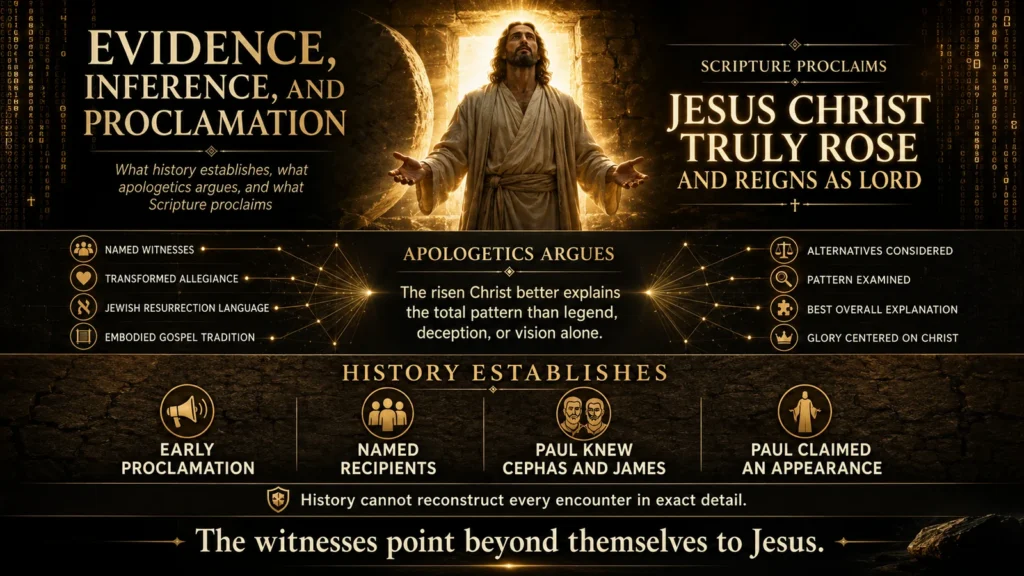
Admitting historical limits does not weaken the Christian case. It identifies where the evidence is strongest and prevents weaker claims from carrying more weight than they can bear. The case does not depend on reconstructing every location, conversation, meal, or appearance sequence with complete certainty.
What remains historically difficult to dismiss is that resurrection conviction emerged very early, attached itself to identifiable first-generation figures, and stood at the center of the movement’s shared proclamation. History establishes that this claim requires explanation. Christian apologetics argues that the risen Jesus explains it better than the alternatives.
What the Witness Claims Said About Jesus
The witnesses matter because their proclamation was ultimately not about themselves. It was a claim about Jesus and about God’s verdict concerning Him.
Jesus had been rejected, condemned, and executed under Roman authority. Crucifixion publicly marked Him as defeated, disgraced, and powerless. To many observers, His death would have appeared to end His messianic claim. The movement should have dissolved around the memory of another failed claimant.
The resurrection proclamation reversed that apparent verdict. The witnesses claimed that God had raised the very Jesus whom human authorities had condemned. In the New Testament’s interpretation, the resurrection did not merely mean that Jesus continued to exist after death. It meant that God vindicated Him.
This is why resurrection testimony cannot be separated from the identity of Christ. If God raised Jesus, then the cross was not evidence that He had been exposed as a false Messiah. It became the place where the Messiah gave Himself for sinners before being raised in victory. The rejected Jesus was proclaimed as the promised Messiah, the risen Lord, and the living center of God’s saving action.
History can establish that this interpretation appeared very early and stood at the center of Christian proclamation. Scripture goes further and declares what the resurrection means: God vindicated His Son, made the crucified Jesus known as Lord and Messiah, and appointed Him as the One through whom salvation and judgment come. See Acts 2:22–36 and Romans 1:3–4.
That is why the witness question leads naturally into the larger case for Christ. For the historical foundation beneath the resurrection claim, see Was Jesus Crucified? Historical Evidence for the Cross. For what His death accomplished, see Why Did Jesus Die? What the Cross Accomplished. For the wider question of His identity, see Is Jesus the Son of God? Evidence from History, Prophecy, Resurrection, and Scripture.
If God raised Jesus, then His enemies’ verdict was not the final verdict. The crucified One is the vindicated Messiah. The witnesses therefore force the discussion beyond their own sincerity, courage, or psychology and toward the identity of the One they proclaimed.
Frequently Asked Questions
Who were the first witnesses of the resurrection?
The earliest named witnesses in 1 Corinthians 15 include Cephas, the Twelve, James, all the apostles, and Paul. The Gospels also identify women as the first discoverers of the empty tomb and recipients of the resurrection announcement.
Did Paul know Peter and James?
Yes. In Galatians 1, Paul says he visited Cephas in Jerusalem and stayed with him for fifteen days. He also says he saw James, the Lord’s brother. This does not prove the details of every Easter conversation, but it shows Paul was directly connected to two men named in the early resurrection tradition.
Did Paul mention the women at the tomb?
No. In 1 Corinthians 15, Paul gives a list of appearance recipients but does not narrate the women discovering the empty tomb. The women-at-the-tomb tradition comes from the Gospel accounts and should be considered an important but separately argued part of the cumulative resurrection case.
What does Paul’s appearance to the five hundred prove?
It shows that Paul knew of a broad appearance tradition involving more than the individually named witnesses. His statement that most were still alive places the reported event within living memory and connects it to an existing community. But we do not have their names, location, date, or a separate narrative account. The claim has historical significance, but it should not be presented as though historians possess five hundred independently documented testimonies.
Did the first witnesses claim a physical resurrection?
Paul’s earliest summary says Jesus died, was buried, was raised, and appeared. The Gospels later add scenes that emphasize bodily continuity, recognition, speech, and meals. Scholars debate the exact character of the appearances, but the earliest Christian claim was far stronger than mere inspiration or memory survival.
Can historians prove that Jesus rose from the dead?
Historians can assess the sources, their dates, their claims, their connections to first-generation figures, and the rise of resurrection belief. They can establish that the proclamation emerged very early and that people such as Peter, James, and Paul became convinced that Jesus had appeared to them. Historians disagree about whether divine action can function as an ordinary historical explanation. Christians argue that the resurrection best explains the cumulative evidence, while critics propose combined visionary, psychological, social, and interpretive alternatives.
Sources and Further Reading
Primary Biblical and Ancient Sources
- 1 Corinthians 15:1–11
- 1 Corinthians 9:1
- Galatians 1:11–24 and Galatians 2:1–10
- Mark 16:1–8; Matthew 28; Luke 24; John 20–21
- Acts 2:22–36 and Romans 1:3–4
- Josephus, Antiquities of the Jews, Book 20, especially section 200, for James as the brother of Jesus called Christ.
Historical and Resurrection Scholarship
- Dale C. Allison Jr., The Resurrection of Jesus: Apologetics, Polemics, History, T&T Clark.
- N. T. Wright, The Resurrection of the Son of God, SPCK.
- Michael R. Licona, The Resurrection of Jesus: A New Historiographical Approach, IVP Academic.
- Paula Fredriksen, When Christians Were Jews: The First Generation, Yale University Press.
- Bart D. Ehrman, How Jesus Became God, for a skeptical historical account emphasizing visions and the development of belief about Jesus.
- Gary R. Habermas, On the Resurrection, Volume 1: Evidences, B&H Academic, including the minimal-facts approach.
Related Paranoid Prophet Investigations
- How Early Is the Resurrection Claim?
- Was Jesus Crucified?
- Did First Christians Suffer for the Resurrection?
- Is Jesus the Son of God?
- Explore the Cross and Resurrection evidence path
The Witnesses Point Beyond Themselves
The first witnesses do not stand at the center of Christianity. Jesus does.
Cephas, James, Paul, the apostles, and the women at the tomb matter because their testimony points beyond their own courage, confusion, grief, and transformation. They proclaimed that the crucified Jesus was alive because God had raised Him.
History can show that this proclamation emerged early, named real first-generation figures, and shaped the movement from the beginning. Faith then faces the deeper question: if the witnesses were right, what does it mean that Jesus Christ is alive?
The witness claim finally confronts the reader not merely with an unresolved event, but with Jesus Christ Himself: the crucified Savior whom God raised, the living Lord who reigns, and the One before whom every human verdict must finally give way.
CONTINUE THE INVESTIGATION
Recommended continuation
Did First Christians Suffer for the Resurrection?
After identifying the earliest proclamation, examine whether that witness was public, costly, and sustained under pressure.