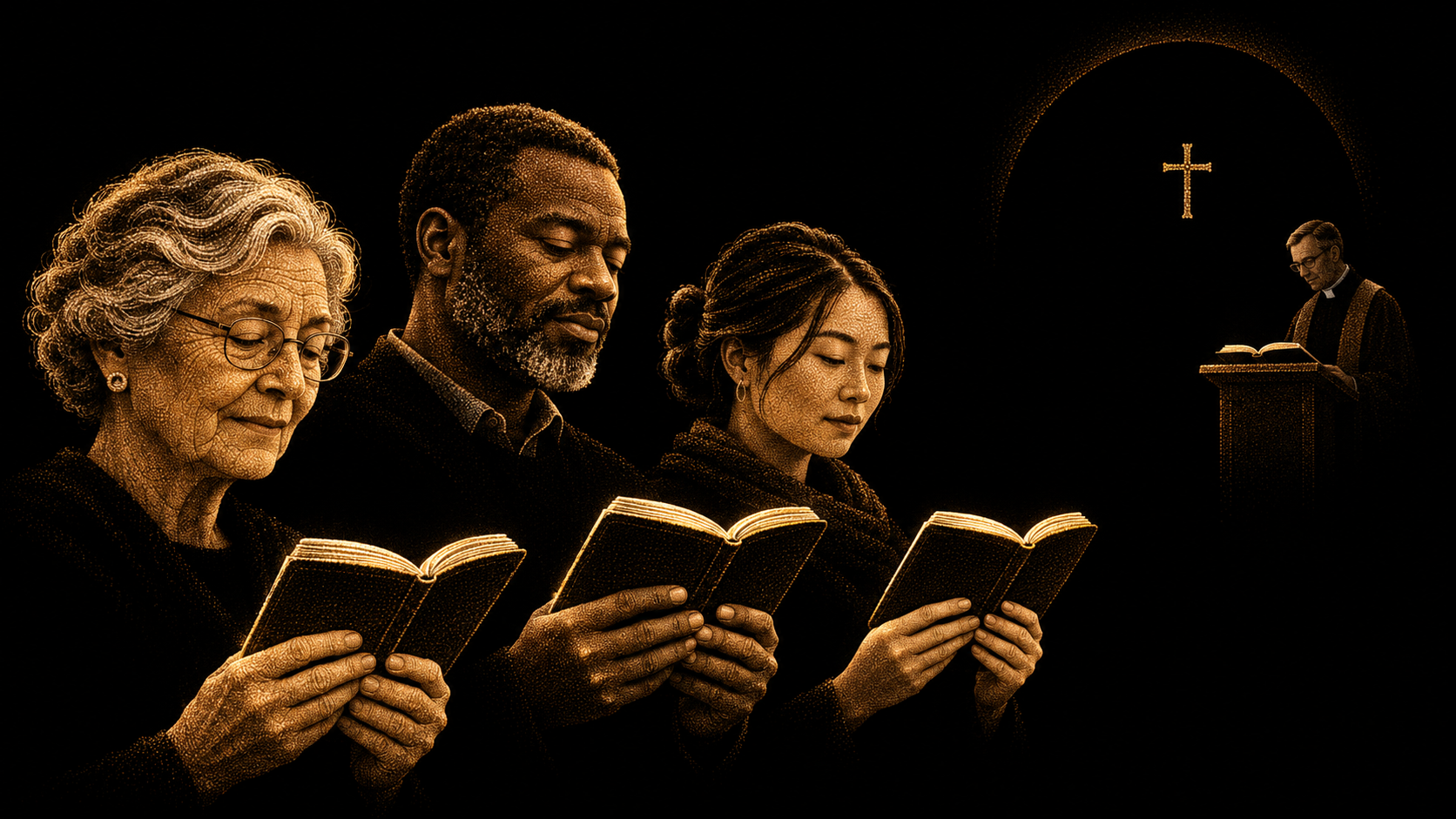

Walk into two Anglican churches and you may wonder whether they belong to the same tradition. One congregation might sing with a choir and receive Communion at an altar. Another might put a long Bible sermon at the center of a simpler service. Both may use a prayer book and belong to churches with bishops.
Anglicanism is a Christian tradition shaped by the English Reformation, historic creeds, Scripture, common prayer, and sacramental worship. Its churches share a recognizable inheritance, but their teaching and practice are not identical. Understanding Anglican beliefs requires asking which province, which doctrinal standards, and which congregation you mean.
This guide approaches Anglicanism as a Christian family, not a separate world religion. Our purpose is to understand its claims fairly, recognize its confession of Christ, and identify the questions worth examining before choosing a church.
GUIDED ARTICLE EXPERIENCE
Anglican Beliefs Explained: Scripture, Sacraments, and a Global Christian Family
Read along as the narration moves through the article.
Browser narration · No stored audio or site tracking
CONTINUE GUIDED TOUR
Continue where you left off.
GUIDED TOUR COMPLETE
You have reached the end of this study.
Study record saved on this device.
GUIDED TOUR
Anglican Beliefs Explained: Scripture, Sacraments, and a Global Christian Family
Narrator: Paranoid Prophet Recommended Voice Native device narration
Prepare to follow the article as it is narrated.
VOICE & TOUR OPTIONS
Voice & Listening
NARRATOR
Finding a narrator…
Checking the best narrator available on this device.
Restores the site recommendations available in this browser.
Our listening picks lead when available; other voices are ranked for narration. Known novelty voices are hidden. Browser-provided voices may use an online voice service.
Screen-awake support will be checked when narration starts.
Optional: improve your device voices
Listening works with the voices already available here. Your device may offer additional free voices through its own settings.
iPhone or iPad: Settings → Accessibility → Read & Speak (or Spoken Content) → Voices → English. Look for Premium or Enhanced choices, then return here.
If offered, preview Ava or Zoe for U.S. English, or Serena or Jamie for British English. An explicit Premium or Enhanced version can improve on its compact version.
Mac: System Settings → Accessibility → Read & Speak → System voice. Open the voice list to preview or download additional choices.
Windows: Settings → Accessibility → Narrator → Add natural voices. Browser availability varies; a Narrator voice may not appear on websites. Edge may also expose online Natural voices without a model download.
Android: Open Accessibility → Text-to-speech output (the location varies by device). In the preferred engine settings, look for voice data and English choices.
Download sizes vary; some enhanced voices exceed 100 MB. This website cannot install system voices, and an installed voice appears here only if your browser exposes it.
Apple voice guide · Windows voice guide · Android voice guide
CHOOSE A NARRATOR
Recommended on this device
Our listening picks: Aaron, Martha, then Daniel, when available here. Otherwise, automatic uses the highest-ranked suitable voice. Preview alternatives or save your own choice.
Preparing the guided article experience…
RESUME GUIDED TOUR?
Continue where you left off.
GUIDED TOUR COMPLETE
You have reached the end of this study.
Article Guide12 sections
Start with the Christian center
Historic Anglican faith confesses the Trinity: Father, Son, and Holy Spirit. Jesus Christ is truly divine and truly human. His incarnation, crucifixion, resurrection, and coming judgment belong to the substance of the faith, rather than optional religious imagery.
The Apostles’ and Nicene Creeds provide recurring public summaries of that confession. The Anglican Communion also recognizes the Athanasian Creed, although its use in ordinary worship is less common. These are inherited Christian statements, shared across denominational boundaries in different ways. They were not invented to distinguish Anglicanism from everybody else. See the Communion’s account of the historic creeds.
That starting point changes the conversation. A fair Christian comparison should not begin by treating Anglican neighbors as people who have never heard that Jesus saves. It should ask whether a church faithfully teaches and lives the gospel it confesses. The same examination belongs in Baptist, Presbyterian, Catholic, Orthodox, and independent congregations.
Our guide to Catholic, Orthodox, and Protestant differences supplies the broader family context.
A history larger than Henry VIII
Christianity existed in Britain long before the Tudor monarchy. The English Reformation broke England’s institutional relationship with Rome during Henry VIII’s reign, but Anglican doctrine and worship developed through further religious conflict and reform. Thomas Cranmer’s prayer books and the Elizabethan settlement were important parts of that development.
Later expansion involved missionary work, imperial power, local Christian leadership, and eventually self-governing churches. Colonial entanglements should not be hidden. Neither should African, Asian, American, or Pacific Christians be reduced to passive recipients of English religion. The Communion’s own historical overview recognizes both that complicated legacy and the importance of indigenous leadership.
The familiar claim that Anglicanism exists only because a king wanted a different marriage is therefore inadequate. Political motives matter to the story. They do not explain the whole theological tradition or settle whether its present teaching is true.
For readers investigating any denomination, origins provide necessary context. They are not a substitute for reading what the church actually teaches.
Scripture, tradition, and reason: three equal authorities?
You may hear Anglican theology described as a three-legged stool: Scripture, tradition, and reason. The image becomes misleading if it suggests that personal reasoning can simply outvote the Bible.
The Anglican Communion’s explanation of its theological method identifies Scripture as foundational and the ultimate standard of faith. Tradition supplies the church’s accumulated interpretation and witness. Reason helps people understand, evaluate, and apply what they read. These are related activities, not three unrelated sources offering competing revelations.
This still leaves real interpretive disagreements. People can agree that Scripture has authority while disagreeing about what a passage means, how an ancient instruction applies today, or what the church may change.
A useful question for a prospective congregation is: “When a current belief conflicts with the apparent meaning of a biblical text, how do you work through it?” Ask for an example. A thoughtful answer should engage the passage, its context, and the reasons for the interpretation. Simply invoking either “tradition” or “modern understanding” does not resolve the question.
What are the Thirty-nine Articles?
The Thirty-nine Articles are Reformation-era statements covering Christian doctrine, church authority, salvation, and worship. Their status and interpretation should be checked in the church under discussion rather than assumed identical across Anglican bodies.
For the Church of England specifically, Canon A5 locates its doctrine in Scripture and in ancient teaching consistent with Scripture, with particular reference to the Articles, the Book of Common Prayer, and the Ordinal. The Ordinal concerns the ordering of bishops, priests, and deacons. These texts are often called its historic formularies.
Three articles help dispel common misunderstandings. Article XI grounds justification in Christ’s merit received through faith, rather than human deserving. Article XII describes good works as the fruit of living faith. Article XX also limits church authority: the church cannot legitimately establish teaching contrary to Scripture. Read the Articles of Religion rather than relying on a slogan about Anglican identity.
For a reader who associates liturgical churches with earning salvation through ceremonies, this is important evidence. Ceremonial appearance alone cannot tell you what a tradition teaches about grace.
Why the prayer book matters
A prayer book is more than a program telling people when to stand. It gives a congregation words for confession, praise, intercession, Scripture reading, and sacramental worship. Repeated worship can teach theology through participation as well as explanation.
There is no single modern prayer-book edition used identically by every Anglican church. The Church of England’s Book of Common Prayer preserves the historic 1662 collection, while Anglican provinces also have their own authorized resources. The Communion describes this relationship between worship and formation in its liturgy overview.
The practical question is what repetition produces. Does the congregation understand the confession it says? Does hearing Scripture lead to repentance and trust? Does participation deepen love of God and neighbor?
Reading a written prayer does not automatically make it empty. Speaking spontaneously does not automatically make prayer sincere. Either practice can become attentive or careless. When visiting, listen to the meaning before judging the form.
Baptism and the Eucharist
Anglican teaching gives a central place to Baptism and the Eucharist, also called Holy Communion or the Lord’s Supper. The Communion identifies them as the two great sacraments of the gospel and describes them as means through which God communicates grace. It also discusses other sacramental rites without placing them in precisely the same category. See its sacramental explanation.
Anglican churches baptize infants as well as converts who have not been baptized. The historic prayer book contains services for both. Eucharistic theology has different emphases within Anglicanism, so neither “all Anglicans teach Roman Catholic transubstantiation” nor “all Anglicans see Communion as only a reminder” is a safe summary. Article XXVIII rejects transubstantiation while speaking of faithful participation in Christ.
Questions worth asking include: What does baptism signify and accomplish? How does the church teach children to own the faith into which they were baptized? What does it mean to receive Christ in Communion? Who is invited to receive, and why?
A visitor should ask about the congregation’s Communion practice rather than assume that every church has the same admission rules.
Four reference points, not an exhaustive rulebook
The Chicago-Lambeth Quadrilateral names four reference points for Christian unity:
Scripture
The Holy Scriptures of the Old and New Testaments.
Creeds
The Apostles’ and Nicene Creeds.
Sacraments
Baptism and the Eucharist.
Historic episcopate
The historic ministry of bishops.
The Chicago–Lambeth Quadrilateral is an ecumenical framework, not an exhaustive summary of Anglican doctrine.
“Episcopate” means the ministry and order of bishops. The statement helps explain why Anglicans combine biblical and creedal commitments with sacramental worship and episcopal organization.
It is an ecumenical framework, not a complete answer to every doctrinal or ethical question. Using those four headings as the whole of Anglican theology would leave out much of what readers need to know about an actual church.
Evangelical, Anglo-Catholic, and other emphases
Anglican life includes different theological and devotional currents. The terms describe overlapping tendencies rather than three neat denominations.
Evangelical Anglicanism emphasizes biblical preaching, conversion, and the Reformation’s account of salvation. Anglo-Catholicism emphasizes continuity with the historic catholic church, sacramental life, and often more elaborate liturgy. Broad Church has historically described a more comprehensive approach that makes room for a wider range of theological positions. The Episcopal Church’s glossary provides definitions of these historical terms.
Do not turn worship style into a reliable political or doctrinal test. Incense does not tell you how a priest interprets every biblical text. Contemporary music does not establish a congregation’s position on church authority.
Instead, separate three questions: What does this church officially confess? How does its clergy explain that confession? What do its regular teaching and pastoral practices demonstrate?
Anglican is global; Episcopal needs context
The Anglican Communion describes itself as a family of autonomous churches. England is part of that family, not the administrative headquarters of every Anglican congregation. The member-church directory includes churches across Africa, Asia, the Americas, Europe, and the Pacific.
In the United States, “Episcopal” commonly refers to The Episcopal Church. Its statement of belief identifies Scripture, Christ’s incarnation and resurrection, and baptism among its foundations. But “episcopal” also describes governance by bishops; the word is not exclusively an American denominational brand.
There are also churches identifying as Anglican outside the Communion’s listed member churches. Consequently, an Anglican sign does not by itself establish institutional affiliation. Consult the particular church and the relevant directory.
This matters especially when discussing disputed questions. Teaching on ordination, marriage, and other issues cannot be inferred from one country’s headlines and applied to every Anglican worldwide. In 2026 the Anglican Consultative Council itself acknowledged strained communion relationships and disagreement. Institutional relationships deserve careful, current description rather than a simple claim that everybody agrees.
A Christ-centered way to evaluate a congregation
Our Christian evaluation begins with the person and work of Jesus. In 1 Corinthians 15:1–8, Paul connects the gospel he preached to Christ’s death, burial, resurrection, and witnesses. In Ephesians 2:8–10, salvation is God’s gift, and good works belong to the life God creates in those he saves. Those passages give substance to discernment beyond denominational branding.
Ask whether the church clearly teaches who Jesus is and what he has done. Ask whether forgiveness rests on his saving work. Look for a summons to repentance, faith, holiness, and love, rather than mere cultural belonging.
Then examine disputed teachings honestly. Read relevant biblical passages in context. Listen to the strongest explanation from the people who hold the view. Distinguish a disagreement over application from denial of a central Christian confession. Our guide to comparing religions fairly describes habits that also improve conversations between Christians.
Finally, examine accountability. Who receives a complaint about clergy? How are children and vulnerable people protected? Can leaders admit error? Beautiful worship and a sound statement of faith do not excuse abusive conduct.
Province and diocese
Which province and diocese does this church belong to?
Doctrinal standards
Which doctrinal standards does this community uphold?
Local practice
How does this congregation worship and put its teaching into practice?
These are suggested questions for visitors, not an official Anglican checklist. Anglican churches have shared inheritances and important differences. Do not infer every belief or practice from an architectural style or church label.
Questions people commonly ask
Are Anglicans Protestant or Catholic?
Anglicanism emerged through the Protestant Reformation while retaining historic Christian creeds, bishops, and sacramental worship. Many Anglicans describe this inheritance as catholic and reformed. Lowercase “catholic” here means universal; it does not automatically mean membership in the Roman Catholic Church.
Is the Archbishop of Canterbury an Anglican pope?
No. The Communion’s churches govern themselves. Canterbury has an important historic and relational role, but that should not be confused with universal jurisdiction over every province.
Do all Anglicans believe the same things?
They share historical reference points, but interpretations, provincial rules, and local teaching differ. Identify the particular church before attributing a disputed position to it.
Is a traditional service enough to identify a faithful church?
No. Neither old wording nor modern presentation proves faithfulness. Examine the teaching about Christ, the handling of Scripture, the practice of discipleship, and the conduct of leaders.
The question beneath the label
Anglicanism offers a substantial inheritance of Scripture reading, common prayer, creedal confession, and sacramental life. Understanding it means taking those commitments seriously while recognizing genuine diversity and disagreement.
For a Christian, the final hope is Christ himself. The church’s work is to proclaim him faithfully and help people follow him. That is the standard worth carrying into any congregation, including our own.
Continue exploring the World Religions and Christian Traditions hub or compare Baptist beliefs, particularly the differences over baptism and church governance.