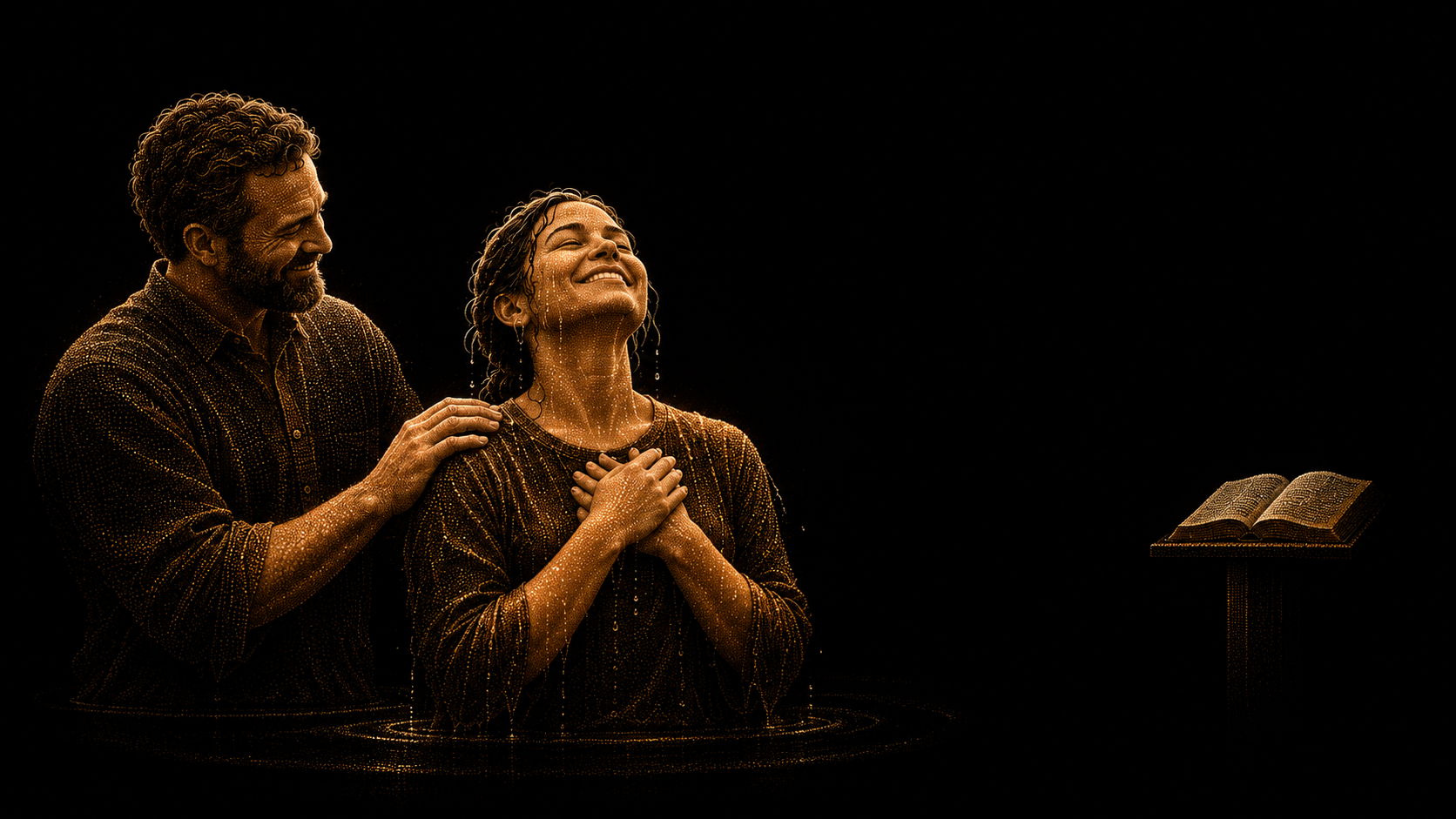

Baptists are Christians within the Protestant family, not a separate religion competing with Christianity. Their most recognizable conviction is that baptism should follow a person’s own profession of faith in Jesus Christ. But understanding Baptist beliefs requires more than knowing how someone enters the water.
The deeper questions concern what a church is, how Christians recognize authority, and why faith must not be coerced. There is also no single Baptist headquarters that speaks for every congregation. A Southern Baptist church, an American Baptist church, and a Free Will Baptist church share important commitments without agreeing on every doctrine or practice.
This guide explains that common ground, identifies real differences, and offers practical questions for evaluating a church without reducing Christianity to a denominational label.
GUIDED ARTICLE EXPERIENCE
Baptist Beliefs Explained: Baptism, the Bible, and the Local Church
Read along as the narration moves through the article.
Browser narration · No stored audio or site tracking
CONTINUE GUIDED TOUR
Continue where you left off.
GUIDED TOUR COMPLETE
You have reached the end of this study.
Study record saved on this device.
GUIDED TOUR
Baptist Beliefs Explained: Baptism, the Bible, and the Local Church
Narrator: Paranoid Prophet Recommended Voice Native device narration
Prepare to follow the article as it is narrated.
VOICE & TOUR OPTIONS
Voice & Listening
NARRATOR
Finding a narrator…
Checking the best narrator available on this device.
Restores the site recommendations available in this browser.
Our listening picks lead when available; other voices are ranked for narration. Known novelty voices are hidden. Browser-provided voices may use an online voice service.
Screen-awake support will be checked when narration starts.
Optional: improve your device voices
Listening works with the voices already available here. Your device may offer additional free voices through its own settings.
iPhone or iPad: Settings → Accessibility → Read & Speak (or Spoken Content) → Voices → English. Look for Premium or Enhanced choices, then return here.
If offered, preview Ava or Zoe for U.S. English, or Serena or Jamie for British English. An explicit Premium or Enhanced version can improve on its compact version.
Mac: System Settings → Accessibility → Read & Speak → System voice. Open the voice list to preview or download additional choices.
Windows: Settings → Accessibility → Narrator → Add natural voices. Browser availability varies; a Narrator voice may not appear on websites. Edge may also expose online Natural voices without a model download.
Android: Open Accessibility → Text-to-speech output (the location varies by device). In the preferred engine settings, look for voice data and English choices.
Download sizes vary; some enhanced voices exceed 100 MB. This website cannot install system voices, and an installed voice appears here only if your browser exposes it.
Apple voice guide · Windows voice guide · Android voice guide
CHOOSE A NARRATOR
Recommended on this device
Our listening picks: Aaron, Martha, then Daniel, when available here. Otherwise, automatic uses the highest-ranked suitable voice. Preview alternatives or save your own choice.
Preparing the guided article experience…
RESUME GUIDED TOUR?
Continue where you left off.
GUIDED TOUR COMPLETE
You have reached the end of this study.
Article Guide10 sections
The short answer: what do Baptists believe?
At the center of historic Baptist Christianity are the triune God, Jesus Christ as fully divine and fully human, His saving death and bodily resurrection, and the authority of Scripture. These are Christian convictions, not Baptist inventions. The Baptist World Alliance explicitly places its confession within that shared Christian faith. Baptist World Alliance beliefs
Shared Christian center
The Trinity, Jesus’ death and resurrection, and salvation through Christ.
Baptist distinctives
Believer’s baptism, congregational church life, and conscience and religious liberty.
These are an orientation, not a statement that every Baptist body explains each topic identically. Baptist distinctives belong within a wider Christian confession, not a replacement for it. These emphases do not imply that other Christians lack conscience or local community.
American Baptist Churches USA describes these themes as part of a tradition reaching back to the early seventeenth century. Its account is a useful representative introduction, not a rulebook binding every Baptist group. Ten facts about American Baptists
The most useful distinction: Baptist identity describes a family of convictions about Christian discipleship and church life. It does not mean that every Baptist congregation is doctrinally identical, spiritually healthy, or interchangeable.
Christian first: why the center matters
Before comparing baptism or church government, ask what a congregation teaches about Jesus.
The Christian gospel is not that joining the right organization earns reconciliation with God. Its center is Christ: who He is, what He accomplished, and the call to repent and trust Him. In 1 Corinthians 15:1–8, Paul connects the gospel to Christ’s death, burial, resurrection, and appearances. Ephesians 2:8–10 connects salvation by grace with a life of good works, rather than treating good works as its purchase price.
That distinction should shape a fair denominational comparison. Christians can disagree seriously about baptism while still recognizing that the dispute is not whether Jesus rose from the dead. Conversely, a familiar denominational name should never excuse vague teaching about Christ or a church culture that contradicts His commands.
This site’s Christian conviction is that Christ, not a religious brand, is the answer to sin and separation from God. If you are investigating that foundational claim, begin with our guide to the evidence for Jesus. For the larger denominational map, see Catholic, Orthodox, and Protestant differences.
Why do Baptists baptize believers?
Baptists understand baptism as a public response to faith rather than a substitute for it. The person’s own profession matters. This is why “believer’s baptism” is more precise than “adult baptism”: the issue is professed faith, not simply reaching a particular birthday.
Immersion is characteristic of Baptist practice. American Baptist Churches USA explains it through the image of resurrection into new life and describes the Lord’s Supper as a remembrance of Christ’s self-giving love. American Baptist explanation of the ordinances
To understand the biblical reasoning, read Acts 2:41 and Acts 8:12 alongside Romans 6:3–4. Baptists emphasize the connection between receiving the message, believing, and baptism. The burial-and-resurrection imagery helps explain why immersion carries such weight.
Christians who baptize infants do not necessarily believe personal faith is irrelevant. Their arguments involve how God’s covenant, the church, children, and baptism fit together. A serious comparison should examine those arguments instead of dismissing them as people ignoring the Bible.
A helpful question for a Baptist pastor is: “If I was baptized as an infant, what would this congregation ask of me, and why?” Ask for the biblical argument and the actual membership policy. Do not assume that an internet summary tells you every local requirement.
Scripture, interpretation, and the believer’s responsibility
Baptists emphasize the Bible’s authority, but that does not remove the work of interpretation. Two people can agree that Scripture is authoritative while disagreeing about what a passage requires.
American Baptist Churches USA affirms Christ as Redeemer and Lord while acknowledging theological variety among its members and other Christians. Its explanation also joins biblical learning with practical compassion. American Baptists on Scripture and faith
For a church visitor, the important test is not merely whether a sermon contains Bible verses. Ask how the passage is being handled:
- Is the speaker explaining the passage in context?
- Are conclusions distinguished from assumptions?
- Can members ask honest questions without being shamed?
- Does the church apply Scripture to its own leaders as well as its members?
These are editorial evaluation questions, not a claim that every Baptist church meets them. The goal is to move beyond a slogan toward accountable teaching.
This emphasis is often called the priesthood of all believers: ministry and responsibility before God belong to the whole Christian community, not only an ordained class. The Baptist World Alliance describes believers as priests to one another who read Scripture together. That is not a claim that pastors have no responsibilities or need no accountability. BWA beliefs on Christian community
Personal responsibility also should not become spiritual isolation. Reading Scripture seriously involves listening, learning, testing interpretations, and admitting when correction is needed. A Christian community should help that process, not replace it with unquestioning loyalty to a personality.
What does local church autonomy mean?
Local autonomy means that a Baptist congregation governs its own life rather than functioning as a branch office of a single worldwide Baptist authority. Cooperation with other churches does not automatically erase that independence.
The National Association of Free Will Baptists, for example, describes local churches as self-governing while explaining their voluntary participation in wider associations for shared ministry. Free Will Baptist beliefs
This arrangement raises a practical issue: independence is not the same thing as accountability. A church needs meaningful ways to address misconduct, financial questions, conflicts of interest, and complaints involving leaders. “We are autonomous” is not a sufficient answer to “Who can investigate a serious concern?”
Before joining, ask to see the church’s membership expectations and decision-making process. Who selects leaders? Who can remove them? How are concerns handled when the person receiving the complaint is also the person being accused? How does the church protect vulnerable people?
Those questions matter in every Christian tradition. They are especially useful when a congregation’s own structures carry much of the responsibility for oversight.
Religious liberty: freedom for more than our own church
A principled defense of religious liberty protects people with whom we disagree, not just people who share our doctrine. The Baptist World Alliance’s religious-liberty resolution includes freedom to examine religious claims and change beliefs. BWA resolution on religious liberty
That principle allows a Christian to make a confident case for Christ without treating coercion as evangelism. Explaining why a belief is true is different from demanding that the state enforce conversion. Disagreement is different from denying another person’s freedom of conscience.
For this series, that is an important boundary. We can compare religions honestly and explain the Christian claim about salvation while representing our neighbors accurately. Conviction does not require contempt. Respect does not require pretending that contradictory beliefs all mean the same thing.
Where Baptists disagree
The Baptist name alone cannot answer every theological question. Here are three differences worth checking rather than assuming.
Salvation and perseverance
How does this church explain assurance, repentance and perseverance in faith?
Pastoral ministry
What does this church teach about women serving in pastoral ministry?
Communion practice
Who may participate, and how does this congregation explain the Lord’s Supper?
Ask the local church. A Baptist label alone does not settle these questions; consult the congregation’s own confession and practice.
Perseverance and salvation
The Southern Baptist Faith and Message teaches that true believers persevere. Free Will Baptists affirm salvation by grace while allowing for the possibility of abandoning faith and being lost. These are substantially different accounts of perseverance, not merely different worship styles. Southern Baptist confession, article V · Free Will Baptist beliefs
Neither position should be reduced to a slogan suggesting that obedience does not matter or that salvation is earned by performing enough good works. Ask how a church explains assurance, repentance, and the warning passages of Scripture together.
Women in pastoral ministry
The Southern Baptist confession restricts the office of pastor/elder/overseer to qualified men. American Baptist Churches USA affirms women and men in ordained ministry. A statement about one Baptist body’s position should not be presented as the position of all Baptists. Southern Baptist confession, article VI · American Baptist support for women in ministry
A useful conversation asks what each position understands the relevant biblical passages to teach, not whether one side has ever read them.
Ordinances and local practice
Many Baptist churches speak of two ordinances, baptism and the Lord’s Supper. Free Will Baptists also recognize washing the saints’ feet as an ordinance expressing humility. Free Will Baptist doctrine of the church
Even when churches share a broad description, practical questions remain: Who may receive communion? How is membership connected to baptism? How often is communion celebrated? Ask the congregation rather than supplying an answer from its sign outside.
Six questions to ask before choosing a Baptist church
- What is the gospel you teach? Listen for a clear explanation of Christ, grace, repentance, and faith.
- What does your statement of faith commit members to? Distinguish required beliefs from questions on which members may disagree.
- How do baptism and membership work here? Ask what happens if your previous baptism was in another tradition.
- How are leaders accountable? Look for a real process, not only assurances that the pastor is trustworthy.
- What does discipleship look like after someone joins? Ask about teaching, prayer, service, care, and opportunities to grow.
- How do you treat people who disagree or leave? A gracious answer can reveal as much as a polished presentation.
These questions are not a scoring system for finding a flawless church. They are a way of looking for substance. Attractive music, friendly greetings, and a strong website can help someone feel welcome, but they do not settle questions of doctrine or character.
Common questions about Baptist beliefs
Are Baptists Christian or Protestant?
Historically, Baptists belong within Protestant Christianity. Their distinctive church practices should be understood within that wider context, not as evidence that they worship a different Christ. An individual congregation’s teaching still deserves examination.
Are all Baptists Southern Baptist?
No. The sources in this guide include American Baptists and Free Will Baptists as well as Southern Baptists and an international Baptist fellowship. One organization’s confession cannot stand in for the whole family.
Do Baptists believe baptism saves a person?
In the representative Baptist teaching described here, the act of baptism does not itself regenerate or save a person. Baptism expresses obedience and faith in Christ; it does not produce the new birth. The Southern Baptist confession calls baptism symbolic and describes regeneration as the Holy Spirit’s work. This is a substantive difference from sacramental understandings of baptism, not merely a different ceremony. Baptist Faith and Message, articles IV and VII
Does a Baptist label guarantee a good church?
No. Evaluate what the congregation teaches, how it treats people, and whether its structures support truthfulness and accountability. Christian identity is not a substitute for Christian faithfulness.
The bottom line: follow Christ, understand the differences
Baptist distinctives deserve a better explanation than “they baptize adults.” They concern the relationship between faith and baptism, the responsibilities of a congregation, the authority of Scripture, and freedom of conscience.
Those convictions can be discussed seriously without making Baptists the only Christians or pretending denominational differences do not matter. Start with Christ. Read the biblical passages. Examine the church’s actual teaching. Ask honest questions about its life.
Continue exploring the World Religions and Christian Traditions collection with that same combination of conviction, accuracy, and respect.