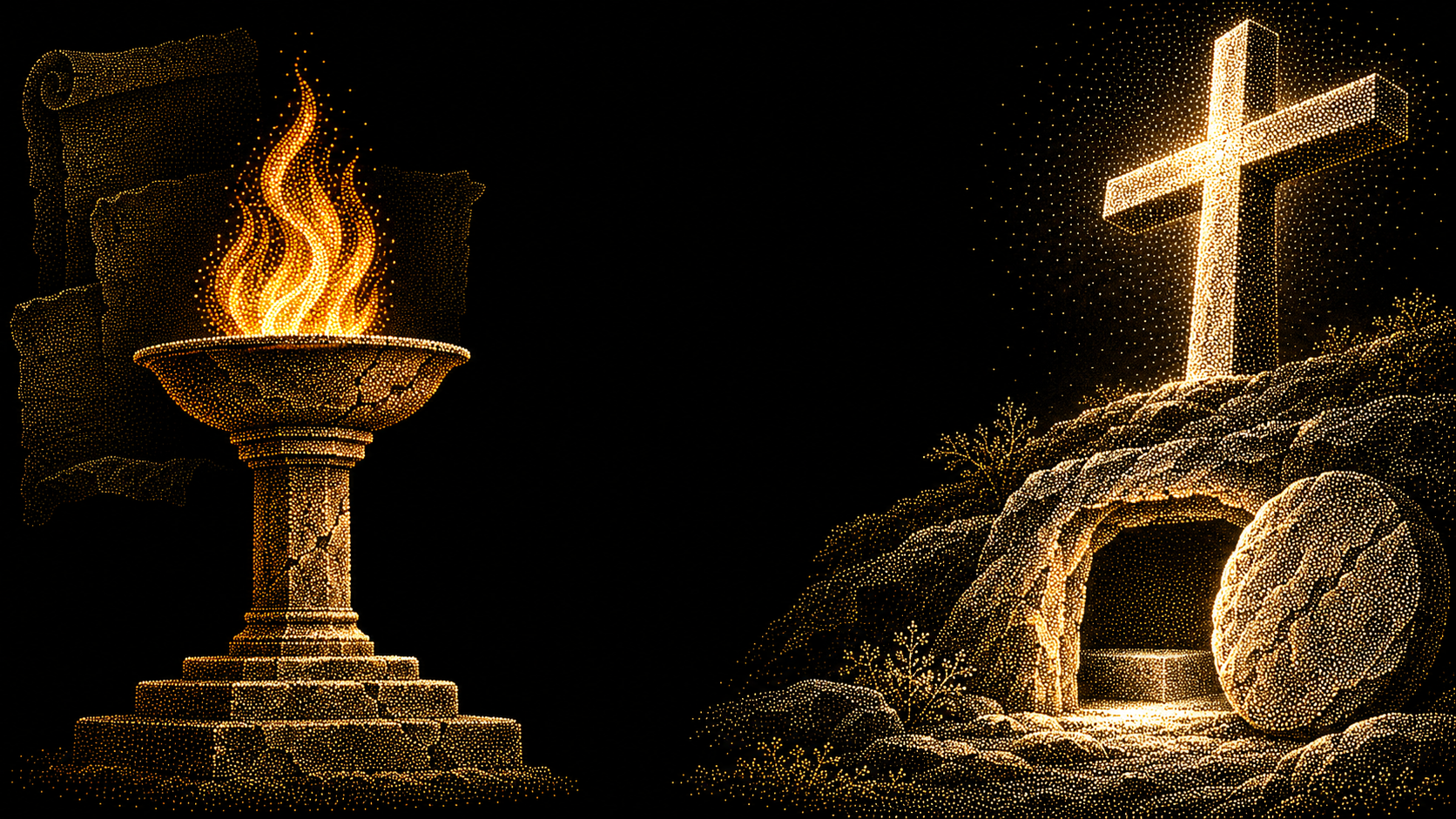

Zoroastrianism is an ancient Iranian religion associated with the prophet Zarathushtra, also called Zoroaster. Its central concerns include worship of Ahura Mazda, the struggle against evil, responsible moral choice, and the renewal of creation. It is a living faith, not merely a footnote to Persian history. Zoroastrian overview
For Christians, the most useful comparison is not “Which religion mentions good and evil?” Both do. The deeper questions are what evil is, how people become right with God, and where the hope of a restored world rests.
This guide explains Zoroastrian beliefs before offering an explicitly Christian response. Recognizing moral insight in another tradition does not require treating its theology as identical to Christianity. Neither does disagreement justify caricature. Our guide to comparing religions fairly explains that approach.
GUIDED ARTICLE EXPERIENCE
What Do Zoroastrians Believe? Zoroastrianism and Christianity Compared
Read along as the narration moves through the article.
Browser narration · No stored audio or site tracking
CONTINUE GUIDED TOUR
Continue where you left off.
GUIDED TOUR COMPLETE
You have reached the end of this study.
Study record saved on this device.
GUIDED TOUR
What Do Zoroastrians Believe? Zoroastrianism and Christianity Compared
Narrator: Paranoid Prophet Recommended Voice Native device narration
Prepare to follow the article as it is narrated.
VOICE & TOUR OPTIONS
Voice & Listening
NARRATOR
Finding a narrator…
Checking the best narrator available on this device.
Restores the site recommendations available in this browser.
Our listening picks lead when available; other voices are ranked for narration. Known novelty voices are hidden. Browser-provided voices may use an online voice service.
Screen-awake support will be checked when narration starts.
Optional: improve your device voices
Listening works with the voices already available here. Your device may offer additional free voices through its own settings.
iPhone or iPad: Settings → Accessibility → Read & Speak (or Spoken Content) → Voices → English. Look for Premium or Enhanced choices, then return here.
If offered, preview Ava or Zoe for U.S. English, or Serena or Jamie for British English. An explicit Premium or Enhanced version can improve on its compact version.
Mac: System Settings → Accessibility → Read & Speak → System voice. Open the voice list to preview or download additional choices.
Windows: Settings → Accessibility → Narrator → Add natural voices. Browser availability varies; a Narrator voice may not appear on websites. Edge may also expose online Natural voices without a model download.
Android: Open Accessibility → Text-to-speech output (the location varies by device). In the preferred engine settings, look for voice data and English choices.
Download sizes vary; some enhanced voices exceed 100 MB. This website cannot install system voices, and an installed voice appears here only if your browser exposes it.
Apple voice guide · Windows voice guide · Android voice guide
CHOOSE A NARRATOR
Recommended on this device
Our listening picks: Aaron, Martha, then Daniel, when available here. Otherwise, automatic uses the highest-ranked suitable voice. Preview alternatives or save your own choice.
Preparing the guided article experience…
RESUME GUIDED TOUR?
Continue where you left off.
GUIDED TOUR COMPLETE
You have reached the end of this study.
Article Guide12 sections
Start with the people, not the stereotype
Zoroastrian history connects ancient Iran, the Parsi communities of India, and a wider diaspora. Parsis descend from Zoroastrians who migrated from Iran to India; “Parsi” is therefore a community identity, not a synonym for every Zoroastrian. Communities also remain in Iran and elsewhere. Almut Hintze, British Academy
A person may encounter this faith through a family, a community association, a prayer ceremony, or a conversation about ethical responsibility. Starting with “You worship fire, right?” is unlikely to help.
A better opening is: “What does practicing your faith look like in your everyday life?” That lets a person describe their own beliefs rather than defend an outsider’s slogan.
How old is Zoroastrianism, and what are its scriptures?
Zarathushtra’s precise dates remain disputed. Giving a confident birthday or a single uncontested founding year creates certainty the evidence does not support. The Gathas, hymns attributed to Zarathushtra, belong within the Avesta, the religion’s central sacred collection. Later Middle Persian, or Pahlavi, literature preserves further interpretation and traditions. Avesta archive: dating and scriptures
Gathas within the Avesta
The Gathas belong within the Avestan scriptural tradition.
Wider Avestan tradition
Read each text with attention to its language, form and setting.
Later Middle Persian texts
Later writings preserve further interpretations and developments; older traditions can survive in later manuscripts.
This is a guide to reading sources, not an exact timeline of the founder’s life. The date of a surviving manuscript is not automatically the date of every tradition it preserves.
A late surviving text can preserve an old tradition. But we cannot automatically assign every detail in that text to the earliest period. Conversely, the absence of an early surviving manuscript does not prove nobody held the idea before.
That distinction protects readers from two opposite mistakes: dismissing the tradition as late invention, or placing every later doctrine in Zarathushtra’s own mouth.
Ahura Mazda, truth, and the struggle against evil
Ahura Mazda is commonly rendered “Wise Lord” or “Lord of Wisdom.” FEZANA’s religious education materials introduce Ahura Mazda as God and emphasize freedom of choice, responsibility, and care for the environment. FEZANA Religious Education
Asha is a key term associated with truth, righteousness, and right order. Its opposite is often expressed through the language of falsehood and disorder. In the Zoroastrian Association of North Texas’s account, good thought, honest speech, and beneficial action are ways of participating responsibly in the world’s moral life. ZANT: the Zoroastrian ethic
What about “two gods”? That shorthand is unreliable. Zoroastrian sources contain a strong opposition between good and evil, with Angra Mainyu, also known as Ahriman, opposing Ahura Mazda. Mary Boyce’s historical account describes an uncreated adversary in the tradition, while identifying Ahura Mazda as the good creator. This is a substantial theological difference from Christianity, not simply a different name for the Christian devil. Encyclopaedia Iranica: Ahura Mazda
At the same time, ZANT describes its faith as monotheistic. Rather than erase that self-description, readers should distinguish a contemporary community’s explanation from the full range of historical formulations. A useful follow-up is: “When you speak of evil, do you mean a personal spiritual power, destructive choices, or both?”
The Christian claim is that all created things depend on God; evil is not an equally ultimate creator. Colossians presents Christ as the one through whom creation exists, not one contestant within a universe shared by independent divine rivals. Colossians 1:15–20
Good thoughts, good words, good deeds
The familiar threefold ethical formula is a helpful doorway into Zoroastrian life. ZANT connects it to honest work, generosity, reflection, and active service. It is not merely an instruction to hold correct opinions. Conduct matters. ZANT: ethics and responsibility
Christians can recognize something admirable here without pretending the theological systems agree at every point. Telling the truth, caring for neighbors, and refusing cruelty are not made worthless because a person belongs to another religion.
The sharper Christian question is what happens when we fail to do the good we recognize. Can remorse repair every injury? Can future obedience erase past wrongdoing? What does reconciliation require?
These questions should be asked of Christians too. A Christian comparison loses credibility when it scrutinizes everyone else’s moral failures while ignoring its own.
Prayer, initiation, and why fire matters
Zoroastrian religion includes embodied practices, not just ethical principles. Jivanji Jamshedji Modi’s historical account of the Parsi initiation ceremony describes investiture with the sudre, a sacred shirt, and kusti, a sacred cord. The ceremony is known as Navjote among Parsis and Sudre-Pooshi among Iranian Zoroastrians. This source describes a tradition of practice; it should not be used to dictate every contemporary family’s observance. Modi’s account of initiation
Fire has a central ritual place. Calling Zoroastrians simply “fire-worshippers” confuses their worship of Ahura Mazda with the visible focus of a ceremony. Yet calling fire “only a symbol” can also understate its religious significance. Scholar Almut Hintze explains how the ritual fire relates to divine presence within Zoroastrian worship. British Academy: worship and ritual fire
The fair approach is to describe a practice as its practitioners and specialist sources understand it before evaluating it from Christian convictions.
Does Zoroastrianism have denominations?
Not in a way that maps neatly onto “Catholic, Orthodox, and Protestant.” Iranian and Parsi identities concern historical communities, not a ready-made Christian-style denominational chart. FEZANA’s educational site provides distinct Iranian and Parsi teaching resources within its wider educational work. FEZANA teaching resources
For a beginner, it is more helpful to ask which community, teacher, and period a claim represents than to force every difference into the word denomination.
This also prevents the phrase “Zoroastrians believe” from becoming an excuse to ignore variation. An introductory article can describe a shared framework without claiming every person explains every doctrine identically.
Judgment and the renewal of the world
Zoroastrian traditions address both individual accountability after death and the eventual defeat of evil. Traditional accounts associate individual judgment with the Chinvat bridge, described as broad for the righteous and perilous for the wicked. Later developed accounts include resurrection and frashokereti, the world’s final renovation. These are not interchangeable with every Christian description of judgment and new creation. Their place within the larger theological story matters. Encyclopaedia Iranica: eschatology
A comparison should therefore distinguish three questions:
- What happens to an individual after death?
- What happens to humanity and creation at the end?
- What makes the promised outcome possible?
Two religions can share language about renewal while giving different answers to the third question. That is where a comparison becomes more informative than a checklist of similar words.
Did Christianity borrow from Zoroastrianism?
Persian influence on Jewish and Christian ideas is a serious historical question. It should not be dismissed simply because Christians find it uncomfortable. Shaul Shaked’s Iranica survey argues for significant influence while also explaining scholarly disagreement and an important difficulty: fully developed Zoroastrian accounts often survive in Pahlavi texts later than early Jewish texts containing comparable ideas. Shaked on influence and its evidential limits
The responsible conclusion is narrower than either popular slogan:
- “Christianity copied everything” outruns the evidence.
- “No influence could have occurred” also outruns the evidence.
Similarity invites investigation; it does not, by itself, establish dependence. An argument needs a sufficiently specific parallel, a plausible route of transmission, and a defensible chronology. It must also account for differences rather than quietly dropping them.
This methodological point does not settle whether Christianity is true. Even demonstrated borrowing of a word or concept would not, by itself, establish whether Jesus rose from the dead. Nor would proving an idea original automatically make it true. Historical origins and truth claims are related questions, but they are not identical questions.
Good and evil
Ask how each tradition understands their origin, conflict and ultimate resolution.
Moral responsibility
Ask what human choices accomplish and how wrongdoing is addressed.
Final renewal
Ask what the hoped-for restoration means within each tradition’s own framework.
Christianity centers its answer on the incarnation, cross and resurrection of Jesus. Do not replace a Zoroastrian account with Christian terms simply because some questions overlap. This is an editorial comparison framework, not a shared creed.
Why Christians place their hope in Christ
From a Christian perspective, the answer to evil is not merely better information about right conduct. It is reconciliation with God and the defeat of sin and death through Jesus Christ.
1. God acts within the world he made
John presents Jesus as the eternal Word who became human. Christianity’s central claim is not simply that a teacher explained divine wisdom particularly well. It is that God has made himself known in the incarnate Son. John 1:1–18
This is the positive center of the comparison. Christians do not need to reduce Zarathushtra to a cartoon villain in order to explain why they trust Christ.
2. Grace does not make good works irrelevant
Ephesians describes salvation as God’s gift rather than a basis for boasting, then immediately speaks of the good works believers are created to do. In that passage, obedience is the result and purpose of God’s saving work, not a purchase price offered to him. Ephesians 2:8–10
That is more precise than “Zoroastrians do works; Christians do nothing.” It also avoids reducing a whole living tradition to a crude calculation of merits. The real Christian invitation is to receive God’s mercy and live a transformed life, not to stop caring about truth or justice.
3. Resurrection is anchored in a claim about Jesus
Paul connects Christian hope to Jesus’ death, burial, resurrection, and appearances. He also says that if Christ has not risen, Christian faith fails at its foundation. Christianity therefore puts a historical claim on the table, not just a preferred picture of the future. 1 Corinthians 15:1–22
A reader weighing Christianity should investigate that claim rather than accept it because an article says it with confidence. Our Evidence Web provides routes into the historical and resurrection questions. A reader challenging Christianity should address it rather than assume a list of religious parallels has already disproved it.
Questions worth taking into a conversation
Instead of treating a Zoroastrian neighbor as a debate target, ask questions that allow both people to be understood:
- What does Asha mean to you in practice?
- How does your faith address guilt, repentance, and repairing harm?
- What do you believe the final defeat of evil will involve?
- What would you want a Christian to understand before making a comparison?
- Would you be willing to read a Gospel together and discuss its account of Jesus?
These are invitations, not traps. A serious Christian witness can state a real disagreement without disguising an argument as curiosity.
Frequently asked questions
Are Zoroastrians and Parsis the same?
Parsis are a historic Zoroastrian community associated with India. Not all Zoroastrians are Parsis. The distinction matters because a religion’s worldwide membership is not identical to one ethnic or historical community.
Is Zoroastrianism just belief in good and evil?
No. That description leaves out worship, sacred texts, ritual, community, and ultimate hope. The ethical dimension is important, but it is not a complete account of the religion.
Is Zoroastrianism older than Christianity?
Its roots precede Christianity. That does not settle the exact dates of Zarathushtra or the age of every doctrine found in later writings. Nor does age alone establish a religion’s truth.
Can Christians appreciate Zoroastrian ethics while disagreeing?
Yes. Respecting a person’s moral seriousness is compatible with disagreeing about God, Christ, salvation, and evil. Fairness is not the same as theological equivalence.
The central difference
The strongest Christian response is neither contempt nor a claim that all religions say the same thing. It is an invitation to examine Jesus.
Zoroastrianism deserves to be understood as a living tradition with its own language and history. Christianity deserves to be assessed by its central claim: that in Jesus Christ, God has acted to reconcile sinners and overcome death. The question is not merely whether people should pursue the good. It is whether the crucified and risen Christ is the one in whom our deepest need for forgiveness and renewal is answered.
Continue exploring with the World Religions library.