
GUIDED ARTICLE EXPERIENCE
Books of the Bible Explained: Groups, Purpose, and How to Read Them
Read along as the narration moves through the article.
Private device narration · No hosted audio or tracking
CONTINUE GUIDED TOUR
Continue where you left off.
GUIDED TOUR COMPLETE
You have reached the end of this study.
Study record saved on this device.
GUIDED TOUR
Books of the Bible Explained: Groups, Purpose, and How to Read Them
Narrator: Paranoid Prophet Recommended Voice Native device narration
Prepare to follow the article as it is narrated.
VOICE & TOUR OPTIONS
Voice & Listening
NARRATOR
Finding a narrator…
Checking the best narrator available on this device.
Restores the best curated narrator available on this device.
Narrator choices are curated for clear, long-form listening on this device.
Screen-awake support will be checked when narration starts.
CHOOSE A NARRATOR
Curated for this device
Choose a verified narrator for this browser, or use System Narrator. Automatic mode uses the best reliable route exposed by this device; your chosen narrator is preserved even if this device needs a temporary fallback.
Preparing the guided article experience…
RESUME GUIDED TOUR?
Continue where you left off.
GUIDED TOUR COMPLETE
You have reached the end of this study.
A Bible fits in one hand, but it is not one long book written in one voice or one literary style. Open near the beginning and you may find covenant law. Turn farther and you enter royal history, worship poetry, prophetic warnings, a Gospel, a personal letter, or a symbolic vision. The binding holds these writings together, but it does not make them all work the same way.
That variety can make Scripture feel harder than it is. Many readers begin in Genesis, reach detailed laws in Leviticus, and assume they have failed when their momentum disappears. They have not failed. They need a map. This guide offers the books of the Bible explained as a library: how the books are grouped, what each contributes, how genre shapes meaning, where a beginner can start, and how the whole story reaches its fulfillment in Jesus Christ.
You do not need to memorize sixty-six summaries before Scripture becomes meaningful. A map simply reduces avoidable confusion. It helps you recognize when a book is advancing the main narrative, pausing for worship and wisdom, addressing a covenant crisis, presenting Jesus, or applying the gospel to a church. Once you know what kind of room you have entered, you can pay better attention to what is happening inside it.
Article Guide12 sections
Short Answer: How Is the Bible Organized?
The Bible in One Map
The Protestant Bible contains sixty-six books divided into two Testaments. The thirty-nine books of the Old Testament tell the story of creation, human rebellion, covenant, Israel, worship, wisdom, judgment, exile, and promised restoration. The twenty-seven books of the New Testament present Jesus Christ, the mission of His apostles, the formation and instruction of the church, and the promised completion of God’s redemptive work.
“Testament” is closely related to covenant. The names Old and New Testament do not mean that the first part is false, useless, or replaced like an outdated manual. The New Testament depends on the Old Testament’s account of God, creation, sin, promise, sacrifice, kingdom, and hope. The Old Testament, in Christian reading, moves toward the new covenant established through Christ. Each Testament becomes harder to understand when detached from the other.
The familiar order is organized mainly by traditional groupings, not by the date every book was written or by the sequence in which every event happened. In the Old Testament, the common Protestant map is Law, History, Poetry and Wisdom, Major Prophets, and Minor Prophets. In the New Testament, it is Gospels, Acts, Paul’s Letters, General Letters, and Revelation. These labels are useful navigation tools, but the Bible never declares that these later table-of-contents categories are inspired divisions.
Protestant Bibles contain thirty-nine Old Testament books and twenty-seven New Testament books. Catholic Bibles include additional Old Testament books and sections, as the USCCB canonical list shows. Orthodox Bibles also receive a wider Old Testament collection, as this Orthodox Church in America explanation describes. Catholic and Orthodox Christians do not lack Holy Scripture; they receive a wider Old Testament collection. This article follows the sixty-six-book arrangement normally used by Paranoid Prophet. The history behind those differences belongs in the separate guide to how we got the Bible.
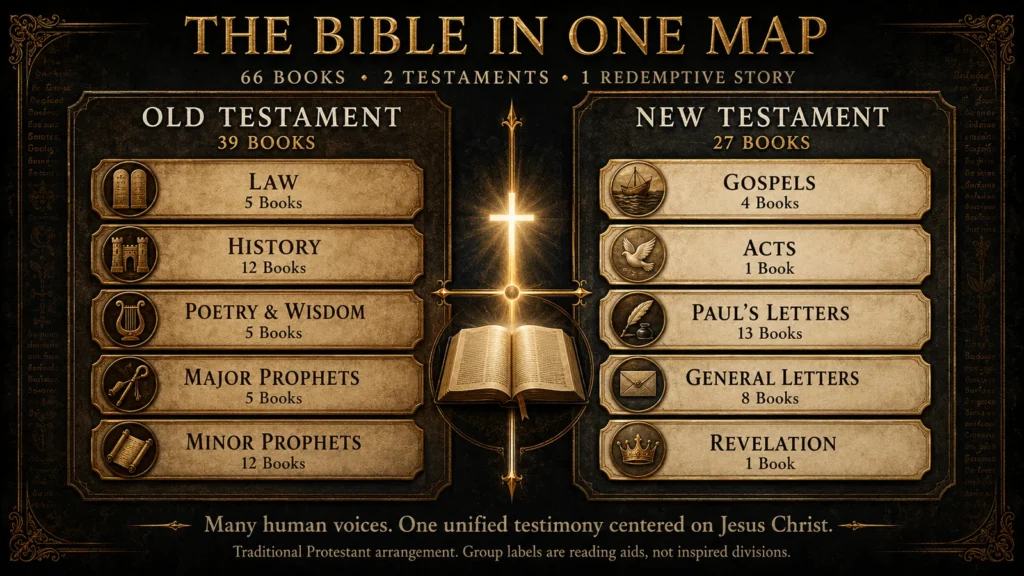
Within that map, every book has its own setting, purpose, and literary shape. Genesis is not Psalms, Proverbs is not Jeremiah, and Luke is not Romans. Yet the books do not form a random shelf.
The Bible has one unified message, many human voices, sixty-six distinct books, and one redemptive story centered on Jesus Christ.
One Redemptive Story Told Through Many Voices
The Bible’s unity is not sameness. Its authors wrote across many centuries, in different circumstances, and for real communities facing worship, war, exile, injustice, persecution, false teaching, moral failure, and hope. They used narrative, genealogy, law, lament, proverb, prophecy, Gospel testimony, pastoral instruction, and apocalyptic vision. Their voices remain recognizably human.
Across those voices, a coherent movement emerges. God creates a good world. Humanity rebels and brings sin, alienation, and death into human life. God judges evil but also promises rescue. He calls Abraham and promises blessing for the nations. He delivers Israel, establishes covenant, gives His law, dwells among His people, and raises kings and prophets. Israel repeatedly fails, the kingdom divides, exile follows, and the prophets announce both judgment and restoration.
Unity does not require every author to repeat the whole storyline. Ruth concentrates on one family during the period of the judges. Proverbs gathers wise instruction rather than narrating Israel’s history. Philemon addresses one fractured relationship. Their narrower purposes still belong within the world created by covenant, sin, grace, worship, and God’s saving purpose. The Bible’s unity becomes clearer as readers notice how later books remember, develop, and answer earlier ones. That unity does not require forcing every page into the same outline.
The Old Testament leaves several hopes open at once: final cleansing and forgiveness, a faithful covenant people, a righteous Davidic king, God’s Spirit poured out, restored creation, and God’s presence dwelling securely with humanity. The New Testament announces that these lines converge in Jesus without claiming that every Old Testament sentence is a direct prediction. The Gospels present His life, death, and bodily resurrection. Acts traces His mission through the Spirit-empowered church. The letters explain the gospel’s meaning for faith and life. Revelation unveils the Lamb’s victory and the renewal of all things.
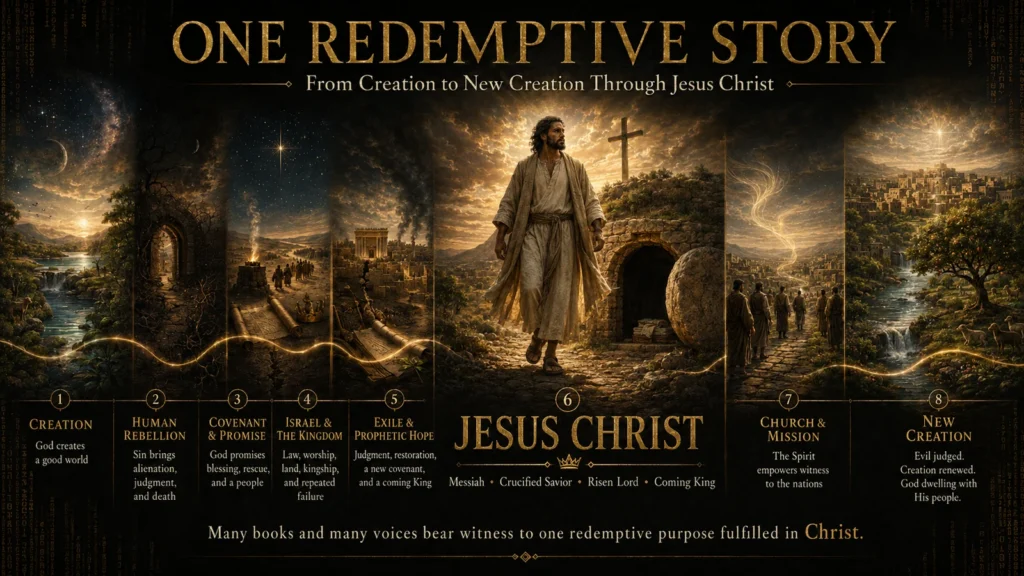
Jesus teaches His followers to read Israel’s Scriptures within this larger movement. In Luke 24:27 and 44-47, He places the Law, Prophets, and Psalms within the story of the Messiah’s suffering, resurrection, forgiveness, and mission to the nations. That Christ-centered reading respects original settings while asking how covenant, sacrifice, kingship, exile, wisdom, promise, and hope reach their goal in Him.
The Five Main Groups of the Old Testament
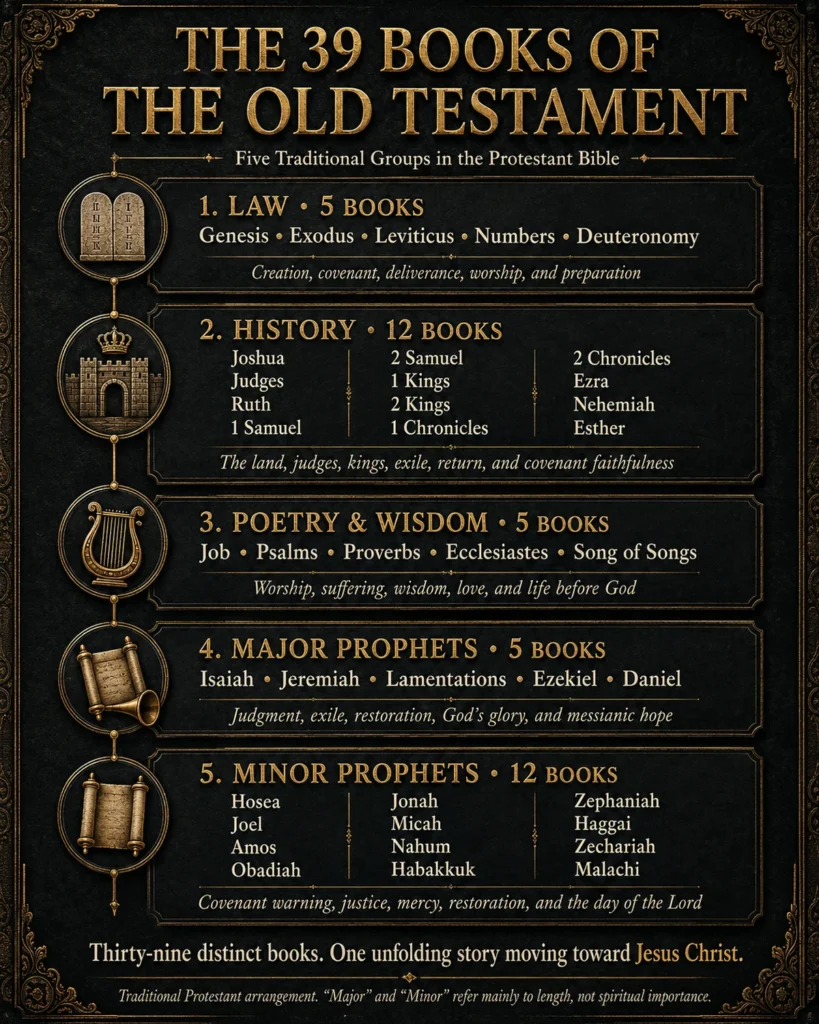
The Old Testament begins the biblical story and supplies the language the New Testament assumes. Its traditional Protestant groupings help readers see broad functions, even though several books contain more than one genre.
Jewish Bibles arrange and count the same shared core differently, grouping the Torah, Prophets, and Writings. The Protestant order places historical books together, then Poetry and Wisdom, then Prophets. That difference in arrangement can highlight different relationships without changing the words inside the shared books. For this guide, the familiar Protestant sequence provides the working shelf labels.
1. Law or Torah
Genesis through Deuteronomy, five books. These books establish creation, the patriarchs, Israel’s exodus, covenant, law, worship, wilderness testing, and preparation to enter the land. Jewish tradition calls this collection the Torah. Christians often call it the Pentateuch.
2. History
Joshua through Esther, twelve books. These writings follow Israel in the land, the period of the judges, the monarchy, the divided kingdoms, exile, and life after return. “History” does not mean bare chronology. The narratives interpret rulers and events through covenant faithfulness, worship, justice, and God’s purposes.
3. Poetry and Wisdom
Job through Song of Songs, five books. These books teach readers to pray, worship, lament, pursue wisdom, face suffering, reckon with life’s brevity, and receive covenantal love as a gift. Their poetry, dialogue, proverbs, and reflection require different reading habits from historical narrative.
4. Major Prophets
Isaiah through Daniel, five books in the familiar Protestant arrangement. “Major” refers mainly to length, not spiritual importance. These books address judgment, exile, restoration, God’s glory, the coming king and servant, new covenant hope, and God’s rule over empires. Lamentations is poetry, while Daniel includes court narrative and apocalypse.
5. Minor Prophets
Hosea through Malachi, twelve books. “Minor” also refers to length. These concentrated prophetic books confront idolatry, injustice, corrupt worship, pride, and covenant betrayal while announcing the day of the Lord, mercy, restoration, the Spirit, and coming royal hope.
This arrangement is a reading map, not a claim that every book fits only one category. Genesis contains poetry and genealogy. Daniel combines narrative and symbolic visions. The prophets often write poetry. Classification helps readers enter the library, but genre and context still control interpretation.
The Five Main Groups of the New Testament
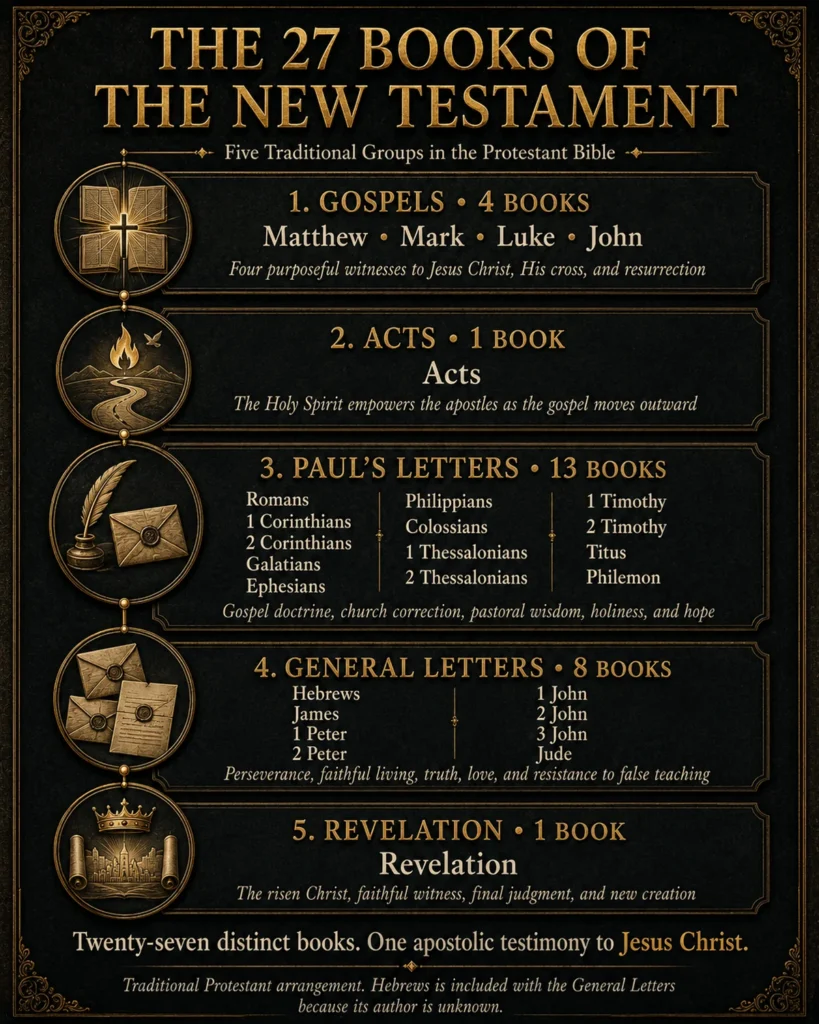
The New Testament centers on Jesus Christ and the apostolic witness to Him. Its five traditional groups move from His ministry to the church’s mission, instruction, and final hope.
These groups also explain why reading straight through feels different after Acts. The reader moves from sustained narrative into letters written to distinct churches and coworkers. Each letter assumes the same gospel but addresses different needs. Revelation then changes style again, gathering imagery from the entire biblical story into a final call to endurance and worship.
1. Gospels
Matthew, Mark, Luke, and John. The four Gospels are complementary theological and historical witnesses to Jesus’ ministry, teaching, signs, death, and resurrection. Each selects and arranges material to emphasize particular dimensions of His identity and mission.
2. Acts
One book. Acts continues Luke’s narrative and traces the Holy Spirit empowering the apostles as the gospel moves from Jerusalem into the wider Roman world. It connects the Gospels with the letters and explains the mission setting of the early church.
3. Paul’s Letters
Romans through Philemon, thirteen letters. These writings address churches and coworkers with gospel doctrine, correction, pastoral counsel, worship guidance, ethical instruction, and hope. They are arranged largely by recipients and approximate length, not by the order in which Paul wrote them.
4. General Letters
Hebrews through Jude, eight books. These writings address wider audiences or do not fit neatly into the Pauline collection. Hebrews appears here because its author is unknown; it should not be presented as certainly written by Paul.
5. Revelation
One book. Revelation is a letter to seven churches, a prophecy, and an apocalypse. Through symbolic visions it reveals the risen Christ, exposes the pretensions of evil and empire, calls believers to faithful witness, and promises final judgment and new creation.
What Each Old Testament Book Is About
The following summaries give each book’s broad purpose, not a verdict on every authorship, date, or interpretive debate. Read them as doorways into the books themselves.
The Law or Torah
- Genesis: Introduces creation, human rebellion, judgment, covenant promise, and Abraham’s family, through whom God begins His plan to bless the nations. Its purpose is larger than any single modern debate about science or origins.
- Exodus: Records God rescuing Israel from slavery, establishing His covenant, giving His law, and dwelling among His people through the tabernacle. Deliverance leads to worship, obedience, communal identity, and the presence of God.
- Leviticus: Teaches how a holy God could dwell among a sinful covenant people through sacrifice, priesthood, cleansing, worship, and holiness. Christians read its commands within Israel’s covenant and through their fulfillment in Christ.
- Numbers: Follows Israel through censuses, wilderness rebellion, divine discipline, and renewed preparation for the land. Its lists serve a covenant community story in which human unfaithfulness repeatedly meets God’s commitment to preserve His promises.
- Deuteronomy: Records Moses renewing the covenant with a new generation and calling Israel to love, remember, obey, and choose life with the Lord. It is covenant instruction and appeal, not merely a duplicate law code.
History
- Joshua: Describes Israel entering the promised land, receiving its inheritance, and being summoned to covenant loyalty. The warfare belongs to the book’s setting of judgment and promise and should not be sanitized or casually transferred to modern conflicts.
- Judges: Traces repeated cycles of rebellion, oppression, deliverance, and worsening moral collapse. The increasingly compromised judges and the refrain about everyone doing what seemed right reveal Israel’s need for faithful, God-given leadership.
- Ruth: Portrays covenant loyalty, providence, family redemption, and the preservation of the line leading to David. Its romance matters, but land, kinship responsibility, faithful love, and its place in Israel’s royal story matter too.
- 1 Samuel: Follows Israel’s transition from judges to monarchy through Samuel, Saul, and David. It explores the dangers of human kingship, the character God seeks in a leader, and the cost of rejecting God’s word.
- 2 Samuel: Presents David’s reign, God’s covenant promise to his house, and David’s grave moral failures. The book refuses to idealize its king while sustaining hope for a righteous ruler from David’s line.
- 1 Kings: Records Solomon’s wisdom and failure, the building of the temple, the kingdom’s division, and the conflict among idolatry, covenant faithfulness, kings, and prophets. Its political history carries a sustained theological evaluation.
- 2 Kings: Describes the decline and exile of Israel and Judah after persistent rebellion despite prophetic warnings. Judgment dominates, yet the final notice about Jehoiachin preserves a small sign that the Davidic story is not finished.
- 1 Chronicles: Retells Israel’s story with emphasis on genealogies, David, worship, priestly service, the temple, and covenant hope. Its family records reconnect a community rebuilding after exile to its identity, calling, and promises rather than merely repeating Samuel.
- 2 Chronicles: Follows Solomon and Judah’s kings with sustained attention to temple worship, reform, rebellion, exile, and possible restoration. Its covenant promises should not be lifted directly into guarantees for a modern nation.
- Ezra: Records return from exile, rebuilding the temple, restoring worship, and renewing commitment to God’s law. Its difficult marriage crisis concerns the restored community’s covenant identity and cannot be reduced to race or a universal policy.
- Nehemiah: Describes rebuilding Jerusalem’s walls alongside reform of injustice, worship, Sabbath practice, and covenant life. The public reading and explanation of Scripture in Nehemiah 8:8 reveals the deeper renewal the community needed.
- Esther: Recounts the preservation of the Jewish people in Persia through courage, hidden providence, and dramatic reversal. God is never directly named, so providence is a theological inference invited by the narrative rather than an explicit statement.
Poetry and Wisdom
- Job: Examines undeserved suffering, faithful lament, inadequate explanations, and the limits of human understanding before God’s wisdom. The friends speak many confident words, but the book itself warns readers not to treat their speeches as reliable doctrine.
- Psalms: Gives God’s people inspired language for praise, grief, repentance, thanksgiving, trust, justice, kingship, and hope. Its many poetic forms should not all be read as literal autobiography or direct messianic prediction.
- Proverbs: Teaches practical wisdom for speech, work, money, discipline, relationships, leadership, and character rooted in the fear of the Lord. Its concise sayings normally describe wise patterns, not automatic guarantees for every circumstance.
- Ecclesiastes: Confronts life’s brevity, frustration, and apparent repetition under the sun, exposing the limits of pleasure, achievement, and human control. Its observations voiced along the way must be read through the work’s tensions and final call to fear God.
- Song of Songs: Celebrates romantic love, desire, beauty, exclusivity, commitment, and delight through richly poetic courtship and wedding imagery. Spiritual applications may follow, but they should not erase the book’s plain literary subject of human love.
Major Prophets
- Isaiah: Announces judgment and salvation through the Holy One of Israel, promising comfort, the servant, a messianic king, and final restoration. Readers must distinguish original settings, near fulfillments, developing promises, and ultimate hope.
- Jeremiah: Warns Judah of coming judgment, exposes covenant unfaithfulness, voices the prophet’s anguish, and promises a new covenant. Familiar encouragement verses belong inside a book dominated by national rebellion, grief, and costly prophetic witness.
- Lamentations: Gives poetic voice to grief after Jerusalem’s destruction while holding confession, judgment, mercy, and hope together. Its hopeful lines gain their weight from the surrounding communal sorrow rather than offering an escape from it.
- Ezekiel: Proclaims God’s glory and judgment among the exiles while promising cleansing, a new heart, renewed life, restored worship, and God’s presence. Its symbolic visions invite careful contextual reading, not technological speculation.
- Daniel: Encourages faithfulness under pagan empires and reveals that earthly kingdoms remain under God’s sovereign rule. Because it combines court narrative and apocalypse, its symbols should not be forced into one confident current-events timetable.
Minor Prophets
- Hosea: Uses the anguish of an unfaithful marriage to portray Israel’s covenant betrayal and God’s persistent, disciplining love. Its imagery must be handled without romanticizing abuse, betrayal, or the human suffering within the sign.
- Joel: Interprets devastating judgment as a call to repentance and looks toward the day of the Lord, restoration, and the outpouring of God’s Spirit. Its debated date need not control a beginner’s reading.
- Amos: Condemns oppression, religious hypocrisy, complacency, and injustice while announcing judgment and eventual restoration. The prophet refuses to separate public righteousness from covenant faithfulness, truthful worship, and accountability before God.
- Obadiah: Declares judgment on Edom for pride and violence against Judah and affirms that the kingdom belongs to the Lord. Its concise message remains clear even though scholars debate the precise historical date.
- Jonah: Reveals God’s compassion toward hostile nations and confronts a prophet who resents mercy for his enemies. The great fish is memorable, but the unresolved conflict between Jonah’s heart and God’s compassion is the sharper point.
- Micah: Exposes corrupt rulers, exploitation, and false worship while calling for justice, mercy, humility, and hope in a coming ruler and restored people. Its famous ethical summary belongs within covenant judgment and grace.
- Nahum: Announces Nineveh’s fall and assures oppressed people that God’s patience does not mean cruelty will be ignored forever. Its violent imagery should be heard against the brutality of the empire it condemns.
- Habakkuk: Records a prophet questioning evil, violence, and divine justice before learning to live by faith and rejoice amid loss. God answers, but the book does not pretend every philosophical difficulty has disappeared.
- Zephaniah: Warns of the day of the Lord while promising purification, restoration, and God’s joyful presence among a humble remnant. Severe judgment and tender renewal belong together in its prophetic vision.
- Haggai: Calls returned exiles to rebuild the temple, reorder neglected priorities, and trust God’s promise of future glory. “Consider your ways” addresses covenant worship and should not become a formula for personal prosperity.
- Zechariah: Uses visions and prophetic messages to encourage repentance, restoration, and temple rebuilding while developing hope in a coming king, priest, and shepherd. Its symbols begin in the period after the return from exile and reach beyond it.
- Malachi: Confronts corrupt worship, faithless leadership, broken covenant relationships, and spiritual cynicism while promising a coming messenger and the day of the Lord. Tithing is one concern, not the book’s entire message.
What Each New Testament Book Is About
The New Testament books arise from the apostolic witness to Jesus and the needs of the first Christian communities. Their summaries distinguish each book while keeping Christ’s death, resurrection, reign, and mission at the center.
The Gospels
- Matthew: Presents Jesus as the promised Messiah and King who fulfills Scripture, announces God’s kingdom, teaches with authority, forms disciples, and sends them to the nations. Its fulfillment language often involves patterns and promises, not only simple predictions.
- Mark: Portrays Jesus as the authoritative Son of God, suffering Messiah, and servant who gives His life for others. His road to victory runs through rejection, sacrifice, the cross, and the vindication of resurrection.
- Luke: Offers an orderly account emphasizing Jesus’ saving mission, the Holy Spirit, prayer, outsiders, the poor, women, and salvation reaching all nations. Those concerns serve Luke’s larger testimony to Christ, fulfillment, and redemption.
- John: Selects signs and teachings so readers may believe Jesus is the Messiah and Son of God and receive life in His name, an explicit purpose stated in John 20:30-31.
Acts
- Acts: Records the Holy Spirit empowering the apostles as the gospel moves from Jerusalem through the Roman world and forms a multiethnic church. Its unique transition events should not all be turned into universal procedures.
Paul’s Letters
- Romans: Explains the gospel of God’s righteousness, humanity’s sin, justification by faith, new life in Christ, Israel’s place in God’s purposes, and transformed Christian living. Its argument extends beyond any one Reformation slogan.
- 1 Corinthians: Corrects division, sexual immorality, lawsuits, disorderly worship, spiritual pride, and confusion about resurrection in a troubled church. Each answer belongs within Paul’s gospel-centered effort to reform a specific community.
- 2 Corinthians: Defends authentic apostolic ministry as marked by suffering, weakness, integrity, reconciliation, generosity, and God’s power. The letter resists both triumphal ministry and any reduction of Christian giving to prosperity.
- Galatians: Defends justification by faith in Christ rather than works of the law and calls believers to freedom expressed through love and life in the Spirit. Scholarly debate about “works of the law” remains broader than this orientation.
- Ephesians: Celebrates God’s plan to unite all things in Christ and create one reconciled, holy people from Jews and Gentiles. It joins salvation by grace with the church’s unity, maturity, worship, conduct, and spiritual resistance.
- Philippians: Calls Christians to joy, unity, humility, perseverance, and Christlike faithfulness amid suffering. Paul’s famous declaration about doing all things concerns contentment through changing circumstances, not unlimited personal achievement.
- Colossians: Proclaims the supremacy and sufficiency of Christ against teachings that would diminish His identity or add rival spiritual requirements. The precise false teaching is debated, so the book’s clear Christological answer should control the summary.
- 1 Thessalonians: Encourages a young church in faith, holiness, love, perseverance, grief shaped by hope, and expectation of Christ’s return. One passage should not be made to carry an entire end-times system.
- 2 Thessalonians: Strengthens persecuted believers, corrects confusion about the day of the Lord, and confronts irresponsible idleness. The timing and identity of the man of lawlessness remain debated.
- 1 Timothy: Gives pastoral instruction about sound teaching, public worship, leadership, care within the church, and godly conduct. Questions of authorship and modern church-office application should not eclipse those stated concerns.
- 2 Timothy: Calls Timothy to guard the gospel, endure suffering, rely upon Scripture, and complete his ministry faithfully. Its teaching on inspiration belongs within the letter’s urgent concern for perseverance and trustworthy proclamation.
- Titus: Directs Titus to appoint qualified leaders and teach sound doctrine that produces self-control, good works, and faithful public conduct. In this letter, doctrinal health becomes visible in transformed communal life.
- Philemon: Appeals for Onesimus to be welcomed as a beloved brother, showing how the gospel transforms status, forgiveness, responsibility, and relationships. The slavery setting must be acknowledged without claiming the letter explicitly abolishes the institution.
General Letters
- Hebrews: Proclaims the supremacy of Christ, His perfect priesthood and sacrifice, the new covenant, and the necessity of persevering faith. Its author is unknown and should not be identified as certainly Paul.
- James: Teaches that genuine faith becomes visible through endurance, obedience, impartiality, controlled speech, mercy, prayer, and practical righteousness. James and Paul address different errors; they should not be turned into opponents.
- 1 Peter: Encourages suffering Christians to live with holiness, hope, courage, and faithful witness as God’s people in a hostile world. Its submission language must never be used to excuse abuse or injustice.
- 2 Peter: Calls believers to spiritual growth, warns against destructive teachers, and affirms Christ’s return and final judgment. Authorship and date are heavily debated, but the concise orientation need not resolve those questions.
- 1 John: Gives assurance through truth about Jesus, obedience, love, holiness, and fellowship with God. Its tests expose empty claims while directing believers toward confidence, not sinless perfectionism.
- 2 John: Joins truth and love while warning Christians not to support teachers who deny the true identity of Christ. Whether the “elect lady” is a person or congregation need not control a first reading.
- 3 John: Commends faithful hospitality and partnership in the gospel while confronting prideful, controlling church leadership. Its personal setting shows large questions about truth and authority appearing within ordinary Christian relationships.
- Jude: Urges believers to contend for the apostolic faith against corrupt teachers while remaining in God’s love and mercy. Its use of Jewish traditions does not make every echoed source canonical; see the separate Book of Enoch guide.
Revelation
- Revelation: Encourages faithful witness by unveiling the risen Christ, the Lamb’s victory, the judgment of evil, and the coming new creation. It must be read together as letter, prophecy, and apocalypse rather than a code for modern headlines.
Why the Bible Is Not Arranged Chronologically
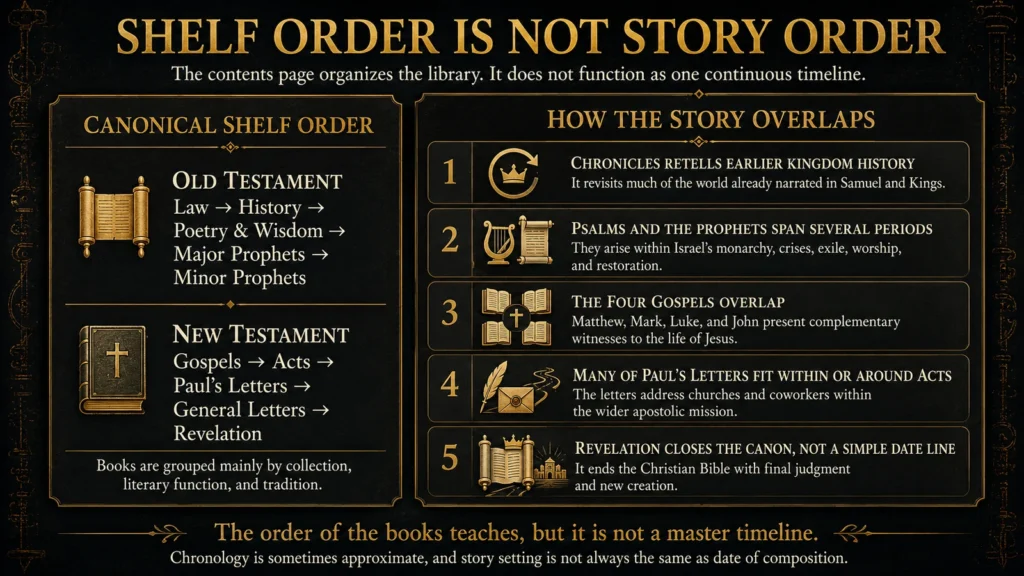
The books of the Bible appear in a meaningful order, but that order is not a master timeline. Genesis through Kings largely advances a narrative from creation to exile, yet poetry and prophecy are grouped separately even when their authors and events belong inside the historical periods already narrated. Psalms includes songs connected with David and many other settings. Isaiah, Jeremiah, and the Twelve spoke into different moments before, during, and after exile.
This means a reader can finish 2 Kings, enter 1 Chronicles, and encounter substantial retelling rather than the next event. Ezra and Nehemiah describe return from exile, while Esther takes place among Jews living in Persia. Job is placed with Wisdom Literature even though proposals for its date vary. The location of a book in the contents page does not settle when it was written.
The New Testament works similarly. The four Gospels cover overlapping periods in Jesus’ life from complementary perspectives. Acts continues the story into the apostolic mission. Paul’s letters are grouped together and ordered largely by recipients and approximate length, not by composition date. Several fit within settings narrated in Acts, while others may come later. The General Letters form another collection, and Revelation closes the Christian Bible with final judgment and new creation rather than functioning as the next dated event after Jude.
A chronological reading plan can help readers place prophets beside kings or letters beside parts of Acts. It remains a study aid, not a correction of a defective Bible. The order of the books also teaches. It lets readers move from Torah through Israel’s story, worship, wisdom, and prophetic hope, then from Christ’s arrival through apostolic mission and instruction to the renewal of all things.
Chronology is sometimes approximate because proposed dates are debated. Readers can confidently place Amos within the world of Israel’s divided monarchy or Haggai after the return from exile without pretending every oracle can be assigned to a precise day. The same caution applies to letters whose dates or authorship remain disputed. A useful timeline distinguishes what the text states, what history strongly supports, and what remains a scholarly reconstruction.
How to Read Different Biblical Genres
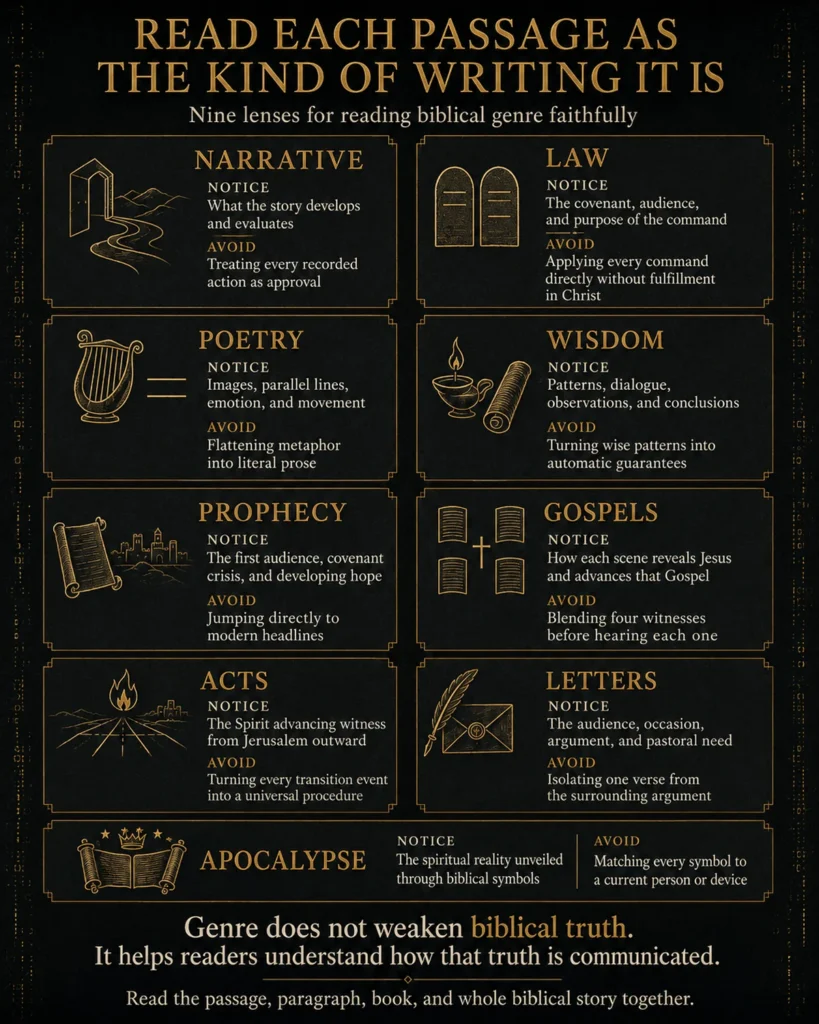
Genre is not a decorative label. It tells readers what kind of communication they have encountered and what the author is doing with it. The American Bible Society’s overview of biblical literature offers a useful introduction, but the essential habits can be learned directly from the books.
Group and genre are related but not identical. The Law contains narrative, genealogy, covenant speeches, songs, and legal collections. Historical books include prayers and poetry. Prophets use lawsuits, laments, visions, sermons, and symbolic actions. Revelation is simultaneously letter, prophecy, and apocalypse. Readers should identify the form of the immediate passage while remembering the purpose of the whole book.
Narrative: Notice what the story approves
Biblical narrative teaches through characters, settings, conflict, development, and the narrator’s evaluation. Ask what changes, what drives the scene, and how it advances the larger book. A recorded action is not automatically a model. Judges describes betrayal, violence, and moral collapse precisely to expose them. David’s place in God’s purposes does not make David’s adultery and abuse righteous.
Law: Begin with covenant and fulfillment
The laws of Exodus through Deuteronomy ordered Israel’s worship, sacrifice, priesthood, justice, holiness, and national life under the covenant. Ask who received a command, what it reveals about God and neighbor love, and how the New Testament treats it in Christ. Do not apply every ritual or civil command directly to a modern church or nation, and do not dismiss the law as spiritually useless.
Poetry: Let images be images
Psalms, Lamentations, prophetic oracles, and other poems communicate through imagery, parallel lines, repetition, compression, contrast, and emotional intensity. A metaphor can be true without being literal prose. Ask whether a poem is lament, praise, thanksgiving, confession, royal song, wisdom, or protest. Its emotional setting and movement often carry as much interpretive weight as one isolated line.
Wisdom: Distinguish patterns from guarantees
Proverbs presents general patterns for wise life. Job and Ecclesiastes challenge simplistic formulas by exploring innocent suffering, frustration, and the limits of human understanding. Song of Songs celebrates covenantal love. Before applying a statement, ask whether it is a proverb, a speaker’s claim, an observation voiced along the way, a dialogue, or the book’s final conclusion. Wisdom trains judgment rather than eliminating every exception.
Prophecy: Hear the first audience before the latest headline
The prophets addressed real covenant communities facing idolatry, injustice, corrupt worship, foreign invasion, exile, and hope. Start with that historical crisis. Then distinguish what a prophecy meant in its first setting, how its promise develops across Scripture, its fulfillment in the Messiah, and its final hope. The New Testament may reveal a fuller horizon, but responsible reading does not transform every detail into a coded forecast of current politics.
Gospels: Read four purposeful witnesses
Matthew, Mark, Luke, and John proclaim the same Jesus through different selection, order, wording, and emphasis. They are neither modern audio transcripts nor detached spiritual fables. Ask what each scene contributes to that Gospel’s plot and portrait of Christ. Comparison can deepen understanding, but a reader should first let each Gospel speak as a complete work.
Acts: Follow the mission without copying every event
Acts 1:8 supplies the book’s geographical and theological movement from Jerusalem outward by the Spirit’s power. Acts records unique transition events as Jews, Samaritans, Gentiles, and others receive the gospel. Notice repeated patterns of witness, opposition, prayer, and church formation, while using the letters to interpret Christian doctrine and practice.
Letters: Follow the argument beyond one verse
New Testament letters address real audiences, crises, relationships, and pastoral needs. Identify sender, recipients, occasion, and purpose. Read complete paragraphs and trace words such as “therefore,” “for,” and “but.” A sentence shared as an inspirational image may mean something richer, narrower, or more demanding inside the argument that surrounds it.
Apocalypse: See the world from heaven’s perspective
Apocalyptic literature uses symbolic creatures, numbers, cosmic conflict, worship, judgment, and earlier biblical images to unveil spiritual reality. Daniel and Revelation call God’s people to faithfulness under pressure. Ask what the symbols communicated to their first audiences and how they reveal God’s sovereignty. A vision’s purpose is lost when every beast becomes a current politician or every mark becomes a new device.
Before applying any passage, ask: What book am I reading? What genre is this? Who is speaking, to whom, and why? What comes before and after? How does this paragraph serve the book’s purpose? How does it fit the wider biblical story and the revelation of Christ? Reading with explanation and understanding follows the pattern of Nehemiah 8 rather than treating context as an obstacle to spiritual devotion.
Where Should a New Bible Reader Begin?
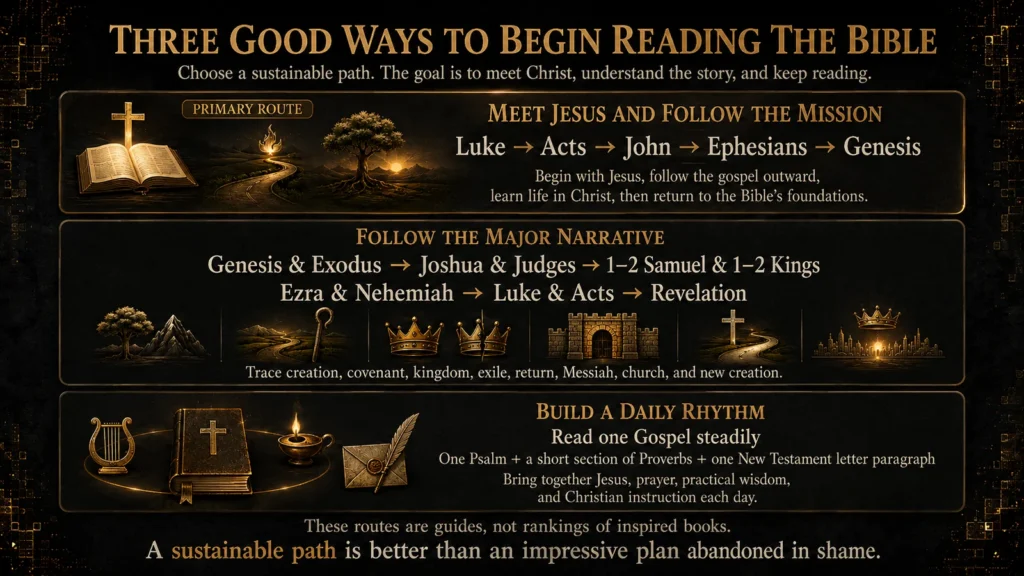
There is no inspired rule requiring every reader to begin on page one and proceed without interruption. Genesis is foundational, but a beginner may understand it better after meeting Jesus and seeing where the story leads. A sustainable path is better than an impressive plan abandoned in shame.
Primary route: Meet Jesus and follow the mission
- Luke: Meet Jesus through an orderly account of His ministry, teaching, death, and resurrection.
- Acts: Continue with Luke as the gospel moves outward through the Spirit-empowered church.
- John: Return to Jesus through a deeper focus on His identity as Messiah, Son of God, and giver of life.
- Ephesians: Learn how salvation in Christ creates a reconciled people and reshapes Christian life.
- Genesis: Return to creation, rebellion, covenant, promise, and the beginning of the long story fulfilled in Christ.
This route is a recommendation, not a ranking of inspired books. Luke is not spiritually superior to Matthew, Mark, or John.
Route two: Follow the major narrative
Read Genesis, Exodus, Joshua, Judges, 1 and 2 Samuel, 1 and 2 Kings, Ezra, Nehemiah, Luke, Acts, and Revelation. This selective route follows creation, covenant, Israel, kingdom, exile, return, Messiah, church, and new creation. The books omitted from the route are not less inspired; they can be added once the central narrative is familiar.
Route three: Worship, wisdom, and Jesus
Read one Gospel steadily while adding one Psalm, a short section of Proverbs, and a paragraph from a New Testament letter each day. This gives a reader the life of Jesus, prayer, practical wisdom, and Christian instruction together. Remember that Psalms includes grief and judgment as well as comfort, and Proverbs gives wise patterns rather than automatic outcomes.
If Leviticus has stalled you, you have not failed. Move to Luke or Mark, keep a bookmark in the Old Testament, and return after learning the larger framework of covenant, sacrifice, priesthood, holiness, and Christ’s fulfillment. A responsible study aid can help, provided its notes remain commentary rather than Scripture.
Whatever route you choose, read complete paragraphs, notice repeated words, and keep questions in a notebook. Use one faithful translation consistently, compare another when wording is difficult, and pray for understanding while still doing contextual work. The aim is not merely to finish a plan. It is to hear, understand, trust, and obey God.
A simple weekly rhythm can make this concrete. Read the chosen book steadily on most days, then use one day to review what has repeated: names for God, commands, promises, conflicts, turning points, and questions. Write a one-sentence summary of each chapter, then revise it after finishing the book. That habit trains you to hear the author’s full message instead of collecting unrelated favorite lines.
Common Mistakes When Reading the Bible
Assuming the contents page is a timeline
The table of contents often places books by group or function. When Chronicles retells history or a prophet returns to an earlier crisis, the Bible has not become confused. Learn the broad historical movement, then let each book’s location and purpose do their own work.
Isolating a verse from its paragraph
Verse numbers are useful reference tools added long after the books were written. They can tempt readers to treat one sentence as a complete message. Read before and after it. In a letter, trace the argument. In poetry, follow the whole stanza. In narrative, watch the scene develop.
Treating description as approval
Scripture truthfully records lies, violence, cowardice, exploitation, foolish vows, and compromised leaders. A biblical character’s action is not automatically a command. Look for the narrator’s evaluation, consequences, explicit divine instruction, and the wider moral teaching of Scripture.
Flattening every genre into literal prose
“Literal” reading should mean reading according to literary intent, not stripping away metaphor. Poetry uses images. Proverbs generalize. Parables create stories. Apocalypse symbolizes. A reader honors truth by receiving the form in which God gave it.
Ignoring the original audience
Application begins with what a passage communicated in its own covenant, historical, and literary setting. A promise to exiled Israel, an instruction to Corinth, and a vision sent to seven churches may still address Christians, but not by bypassing their first purpose.
Forcing Christ into every detail or missing Him entirely
Some readings turn every tent peg, number, and character into a secret prediction of Jesus. Others read the Old Testament as though Christ never taught His followers to see Him as its fulfillment. The better path honors each text’s own meaning and then traces its place within the larger biblical story that culminates in Christ.
Confusing study notes with Scripture
Headings, maps, cross-references, commentary, timelines, and theological systems can be valuable. They remain human aids. Read the biblical text first, compare responsible interpreters, and test every claim. A study Bible’s footnote does not gain divine authority by sharing the page.
Quitting because some passages are difficult
The Bible contains ancient customs, difficult judgments, unfamiliar genres, textual questions, and teachings that confront every culture. Difficulty is not failure. Mark the problem, consult reliable help, and keep reading. Clear passages provide orientation while harder ones invite patience, humility, and study.
Reading only what feels immediately useful
Readers can remain inside a small circle of comforting Psalms, familiar Gospel scenes, and favorite promises. Those texts are gifts, but Scripture also confronts injustice, pride, false worship, sexual sin, greed, suffering, judgment, and costly discipleship. Reading whole books allows God to set the agenda. It brings neglected truths into view and protects personal preference from becoming a private canon.
How Every Section Leads to Christ
A Christ-centered Bible is not a Bible in which every sentence becomes a direct prediction. It is a Bible whose many covenants, institutions, promises, failures, patterns, and hopes reach their intended goal in the incarnate Son.
That movement includes direct promise, but it is larger than prediction. Adam, Israel, David, the temple, sacrifice, priesthood, exodus, exile, wisdom, and prophetic hope create patterns and questions that the New Testament rereads around Jesus. Christians should let the apostolic writers teach those connections rather than inventing correspondences from verbal resemblance alone.
The Law establishes creation, sin, covenant, sacrifice, priesthood, holiness, and God’s dwelling with His people. Jesus fulfills rather than trivializes that story. Israel’s histories reveal deliverance and repeated rebellion, the limits of judges and kings, the cost of exile, and the need for a faithful Davidic ruler. Poetry and Wisdom teach worship, lament, righteous kingship, suffering, love, and the search for life under God.
The Prophets confront actual covenant sin while announcing judgment, return, the Spirit, a new covenant, a servant, a shepherd, a king, and final restoration. Christian interpretation should preserve those original settings and promises before tracing how the apostolic writings proclaim their fulfillment. The separate prophecies of Jesus guide explores that movement in greater depth.
The Gospels do not merely add Jesus to an existing moral system. They announce His arrival as Messiah, Son, servant, Savior, and Lord. Their claims are rooted in public places, rulers, witnesses, crucifixion, and resurrection, which is why the historical evidence for Jesus matters. Acts shows His reign advancing through the Spirit and apostolic witness. The letters explain union with Christ, justification, reconciliation, holiness, church life, suffering, mission, and resurrection hope.
Revelation completes the library’s movement with the Lamb enthroned, evil judged, creation renewed, and God dwelling with His people. The question whether Jesus is the Son of God therefore stands near the center of how Christians understand the whole Bible. If He is who the apostolic witnesses proclaim, the unity of Scripture is not an editorial trick. It is the unfolding testimony to God’s redemptive purpose in Him.
Jesus Himself warned that people can search the Scriptures and still refuse to come to the One they testify about. John 5:39-40 keeps biblical literacy from becoming an end in itself. Knowing the groups, dates, genres, and themes is valuable only when it helps readers hear the Word, recognize the Son, and live faithfully before God.
The Bible Is a Library That Leads to the Living Christ
The Bible’s variety is not a problem to overcome. It is part of the gift. Law teaches covenant holiness. History exposes faithfulness and failure. Poetry gives language to worship and pain. Wisdom forms judgment. Prophecy confronts sin and sustains hope. The Gospels present Jesus. Acts follows His mission. The letters form His people. Revelation unveils His victory.
Learning this library takes time. Readers will revise assumptions, revisit difficult books, and discover that familiar verses carry more weight inside their full arguments. They do not need to master every debate before beginning. They need humility, patience, prayer, sound help, and the willingness to read whole books as the kinds of writing they are.
Jesus Christ is the eternal Son, the Word made flesh, Israel’s promised Messiah, the crucified Savior, the risen Lord, and the coming King. Scripture leads beyond organization to communion and obedience: to know Him, trust Him, follow Him, worship Him, and wait for His return. The final aim of reading the Bible is not merely to understand a library, but to hear and answer the living Christ to whom the whole library bears witness.