
GUIDED ARTICLE EXPERIENCE
How Early Is the Resurrection Claim? 1 Corinthians 15 and the First Witnesses
Read along as the narration moves through the article.
Private device narration · No hosted audio or tracking
CONTINUE GUIDED TOUR
Continue where you left off.
GUIDED TOUR COMPLETE
You have reached the end of this study.
Study record saved on this device.
GUIDED TOUR
How Early Is the Resurrection Claim? 1 Corinthians 15 and the First Witnesses
Narrator: Paranoid Prophet Recommended Voice Native device narration
Prepare to follow the article as it is narrated.
VOICE & TOUR OPTIONS
Voice & Listening
NARRATOR
Finding a narrator…
Checking the best narrator available on this device.
Restores the best curated narrator available on this device.
Narrator choices are curated for clear, long-form listening on this device.
Screen-awake support will be checked when narration starts.
CHOOSE A NARRATOR
Curated for this device
Choose a verified narrator for this browser, or use System Narrator. Automatic mode uses the best reliable route exposed by this device; your chosen narrator is preserved even if this device needs a temporary fallback.
Preparing the guided article experience…
RESUME GUIDED TOUR?
Continue where you left off.
GUIDED TOUR COMPLETE
You have reached the end of this study.
How early is the resurrection claim? It was already established teaching before Paul wrote 1 Corinthians around AD 53–55, roughly twenty to twenty-five years after Jesus’ crucifixion. In 1 Corinthians 15:1–11, Paul reminds readers of the message he had received and preached: Christ died for sins, was buried, was raised on the third day, and appeared to named witnesses.
Paul’s letter gives us a dated witness to an older message. To assess the evidence, we need to distinguish when the letter was written from when the proclamation began, and ask how Paul was connected to Cephas and James. The precise date of the inherited tradition remains debated; its existence before the letter is the starting point for this investigation.
That does not prove by itself that Jesus rose from the dead. Early claims can still be mistaken. But it rules out one common shortcut: the idea that the resurrection was a late myth slowly attached to Jesus after the first Christian generation had passed from the scene.
Source discipline: Scripture teaches that God raised Jesus from the dead. History can investigate how early the claim appears, whether Paul preserves earlier tradition, and whether he had contact with named Jerusalem leaders. This article argues that the resurrection proclamation is early and historically serious. It does not pretend that earliness alone proves the resurrection or settles every disputed Easter detail.
Article Guide9 sections
Why the Date of the Resurrection Claim Matters
Some objections to Christianity depend heavily on time. The basic proposal is that Jesus may have been a real teacher who died, but later followers gradually transformed Him into a risen Lord through grief, memory, devotion, reinterpretation, and legendary embellishment.
Stories can develop over time. The canonical Gospels are fuller than Paul’s compressed summary. They provide scenes, dialogue, settings, meals, an empty tomb, and theological emphasis that Paul does not narrate in detail. A responsible Christian case should acknowledge that difference rather than pretend every source says everything at the same moment.
Fuller later narratives, however, are not the same as a late invention of the central proclamation. The crucial historical question is whether the core message, that Jesus died, was buried, was raised, and appeared, arrived only after the movement had become distant from its beginnings.
Paul’s letters make that simple explanation difficult. Before the Gospel narratives were written, resurrection was already central to the message Paul had received, preached, and passed to Christian communities. The first surviving resurrection sequence is not separated from Jesus by centuries of anonymous development. It stands within the first Christian generation.
A stronger skeptical explanation does not need to place the origin of resurrection belief centuries after Jesus. It may propose that one or more followers had visionary or bereavement experiences very early, interpreted those experiences through Israel’s Scriptures, reinforced the conviction within the community, and expressed the belief with increasing narrative detail. It may then portray Paul as a later convert who joined, developed, and spread an existing resurrection movement.
That combined model is more serious than saying a legend simply appeared in a distant age. It also concedes the central chronological point this article can establish: resurrection belief was early. The model must now explain why the proclamation took the specific form of Christ’s death for sins, burial, resurrection, and appearances; why Paul says he received it; why he presents it as shared apostolic preaching; and why a former opponent became one of its leading proclaimers. Those questions require the rest of the resurrection evidence cluster, but they cannot be answered by a slow late-legend theory alone.
To see how early the claim is, we must distinguish Paul’s surviving letter from the proclamation he says he had already received.
Paul Preserves an Earlier Resurrection Tradition
Paul’s Letters and the Earliest Written Evidence
Many readers begin an Easter investigation with the empty-tomb narratives in the Gospels. Those accounts matter greatly, but they are not the earliest surviving Christian writings. Paul’s undisputed letters come first.
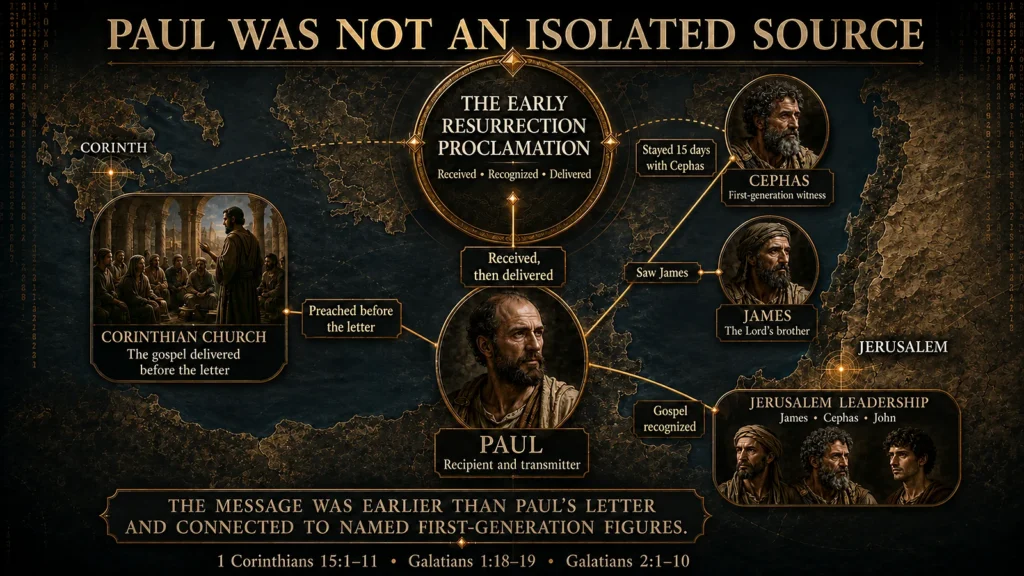
In 1 Corinthians 15:1–11, Paul reminds the Corinthian church of the Gospel he had already preached to them. He does not present it as a private insight invented for that letter. He says he passed on what he had also received.
Paul was a major theologian whose letters explain the Gospel with extraordinary depth. Yet he did not claim to have created the basic resurrection proclamation. He identifies himself as one who received it, preached it, and later preserved it in writing.
The summary contains a compact sequence:
- Christ died for our sins according to the Scriptures.
- He was buried.
- He was raised on the third day according to the Scriptures.
- He appeared to Cephas and then to the Twelve.
- He appeared to more than five hundred people, then to James and all the apostles.
- Finally, Paul says Christ appeared to him.
The language is brief, but it is not vague. It centers Jesus, His death for sins, His burial, His resurrection, and appearance claims connected to identifiable people and groups. The earliest written Christian proclamation was not merely that Jesus’ moral influence survived. It was that God had raised the crucified Christ.
Resurrection proclamation is not confined to this chapter. 1 Thessalonians 1:9–10 speaks of God raising Jesus from the dead. Romans 1:3–4 opens with a compressed proclamation concerning Jesus, His Davidic identity, and resurrection. In 1 Corinthians 9:1, Paul publicly associates his apostleship with having seen Jesus the Lord. These passages should not all be labeled formal creeds, but together they show that resurrection was woven throughout Paul’s proclamation rather than appearing in one isolated paragraph.
What “Received and Delivered” Means
Paul’s wording matters. In 1 Corinthians 15, he says that he received the central Gospel proclamation and then passed it on to the Corinthians. He presents himself as a recipient and transmitter, not as the person who first created the message.
Paul uses similar language in 1 Corinthians 11:23–26 when recounting the tradition concerning the Lord’s Supper. That comparison does not prove that both traditions came from the same person, place, or moment. It does show that receiving and delivering were natural ways for Paul to describe teaching he understood himself to be transmitting.
Scholars commonly discuss 1 Corinthians 15:3–5 as a pre-Pauline formula, meaning a compact confession Paul inherited. The terms tradition, formula, confession, and creed overlap. They do not mean historians possess a separate written document that can be independently dated. The inherited proclamation survives because Paul incorporated it into his letter.
Scholars continue to debate how much of the passage Paul received in an established form. Some concentrate on verses 3–5. Others argue that inherited material extends into later appearance statements. Paul may also have shaped the wording as he placed the tradition inside his argument to Corinth.
Those questions matter for reconstructing the formula’s precise boundaries. They do not erase Paul’s explicit claim. Before he delivered the message to the Corinthians, he had received a Gospel centered on Christ’s death for sins, burial, resurrection, and appearances. The exact wording may be debated, but the central proclamation did not begin when Paul wrote the letter.
A Shared Apostolic Proclamation
Paul does more than say that he received the Gospel. At the end of the appearance sequence, he places his preaching alongside that of the earlier apostles. In 1 Corinthians 15:9–11, he concludes that whether the message came through him or through them, this was what they preached and what the Corinthians believed.
Paul does not claim that every apostle agreed about every later theological, practical, or missionary dispute. His letters preserve real disagreements within the earliest movement. His statement is narrower and historically significant: the death and resurrection of Christ belonged to their shared proclamation.
This makes it difficult to explain resurrection belief as Paul’s private innovation. He distinguishes himself from apostles who came before him, yet he places his ministry inside the same resurrection Gospel. The earliest surviving Christian writer does not portray himself as replacing the Jerusalem message. He presents himself as preaching the risen Christ already proclaimed by others.
The identities and claims of Cephas, James, Paul, and the other appearance recipients deserve their own investigation. For that evidence, see What Did the First Witnesses Claim About the Risen Jesus?.
How Early Was the Resurrection Tradition?
The Four Historical Dating Layers
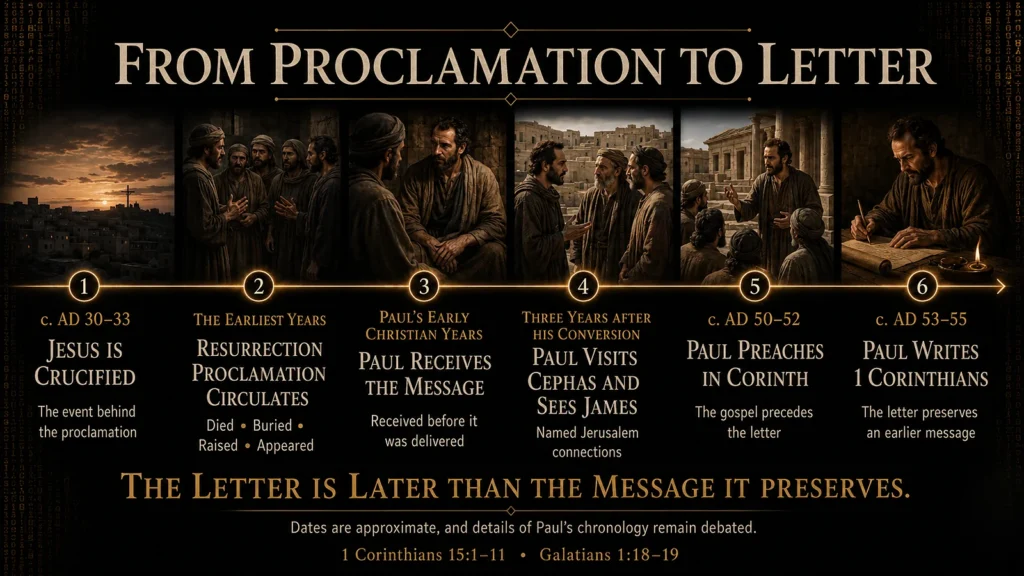
The date of Paul’s letter is not the same as the date of the resurrection proclamation. A clear investigation must distinguish four related historical layers.
First is the event layer. Jesus was crucified under Roman authority, commonly dated around AD 30 or AD 33. His followers claimed that appearances of the risen Jesus followed His death.
Second is the proclamation layer. The earliest Christian movement began preaching that God had raised Jesus. No surviving document records the exact day on which the first complete formula was spoken, but Paul’s letters show that the proclamation existed before he wrote them.
Third is the reception layer. Paul says that he received the Gospel before passing it to the Corinthians. He does not identify the exact conversation in which he received every part of the tradition. His own chronology also places him in direct contact with Cephas and James during the early period of his Christian ministry.
Fourth is the preservation layer. Paul wrote 1 Corinthians around the middle of the first century, commonly dated to approximately AD 53–55. In that letter, he preserved the earliest surviving written sequence joining Christ’s death, burial, resurrection, and appearances.
The essential point is simple: the letter’s date is not the tradition’s date. The proclamation must be earlier than the letter because Paul says he had already received it, preached it in Corinth, and seen the Corinthians believe it before writing to remind them of it.
What We Can Date Confidently
Several chronological conclusions remain firm even when exact dates are disputed:
- Paul wrote 1 Corinthians within the first Christian generation.
- He had founded and taught the Corinthian church before writing the letter.
- He says that he had already received the resurrection proclamation.
- He had already delivered that proclamation to the Corinthians.
- The inherited tradition therefore predates the surviving letter.
- Paul’s own account connects him directly with Cephas and James, recognized leaders in the Jerusalem movement.
This evidence does not allow historians to assign every line of 1 Corinthians 15:3–7 to a precise day, month, or year. It establishes something more defensible: the central proclamation was functioning as received Christian teaching before the middle of the first century.
That is early by ancient historical standards. The resurrection claim does not first appear after the first generation had disappeared. It stands inside the earliest surviving Christian correspondence and is presented there as an established message that Paul himself had inherited.
Where Scholars Still Disagree
Scholars debate how much of 1 Corinthians 15:3–7 reflects inherited wording, where Paul’s own phrasing begins, whether the references to the five hundred and James belonged to the earliest form, and when and where Paul received the material. They also disagree about what the burial-and-resurrection language implies about the tomb, how the appearances should be interpreted historically, and how closely the wording reflects the earliest Jerusalem church.
These are real questions, but they should be kept in proportion. They concern the formula’s precise extent, wording, transmission, and interpretation. They do not remove Paul’s own testimony that he received and delivered an earlier Gospel centered on the crucified and risen Christ.
The responsible conclusion is neither skepticism nor false certainty. We cannot date every phrase with mathematical precision. We can say with confidence that resurrection proclamation predates 1 Corinthians, belongs to the first Christian generation, and was connected to recognized leaders before Paul preserved it in writing.
Paul’s Contact With Cephas and James
First Corinthians tells us that Paul received and transmitted resurrection tradition. Galatians shows that Paul was not isolated from the earliest Jerusalem leaders.
In Galatians 1:11–24, Paul describes his former opposition to the church, his calling through the revelation of Jesus Christ, and his later journey to Jerusalem. He says that after three years he visited Cephas and stayed with him for fifteen days. He also says that he saw James, the Lord’s brother.
Later, in Galatians 2:1–10, Paul describes another Jerusalem meeting involving James, Cephas, and John. He portrays these recognized leaders as acknowledging the grace given to him and his mission among the Gentiles. Galatians also preserves real tensions within the early movement, so this recognition should not be turned into a claim that every disagreement disappeared.
These passages do not give us a transcript of every conversation. Paul does not say, “I received the complete 1 Corinthians 15 formula during my fifteen days with Cephas.” We should not place words in the text that Paul does not write.
The larger historical significance remains powerful. Paul knew Cephas. Paul knew James. Paul had direct contact with the Jerusalem movement. His resurrection proclamation was not the detached theology of a solitary latecomer with no connection to the people he names.
The significance of Cephas, James, Paul, and the other named recipients is examined in the dedicated witness article. Here their importance is chronological: Paul’s resurrection proclamation was connected to recognized first-generation Jerusalem figures.
Did Paul Invent the Resurrection Message?
No. Paul was central to the spread and theological explanation of Christianity, but the evidence does not support the claim that he invented the basic resurrection message.
First, Paul explicitly says he received and delivered the proclamation. Second, Galatians places him in contact with Cephas and James, key first-generation figures connected to the Jerusalem church. Third, Paul presents resurrection as the shared Gospel proclaimed by himself and earlier apostles, not as a private innovation belonging to him alone.
Paul did write with a distinctive voice. He expounded the cross, resurrection, union with Christ, justification, the Spirit, the church, and the hope of glory with extraordinary depth. Theological explanation and development, however, are not the same as historical invention.
A critic may still argue that Paul reshaped the meaning of Jesus, intensified claims about Him, or developed resurrection theology in new directions. Those are separate historical and theological questions. They do not establish that Paul created the basic proclamation that Christ died, was buried, was raised, and appeared.
The theory that Paul invented Christianity must therefore account for why Paul describes the resurrection message as inherited, why he recognizes apostles before him, why he had contact with Jerusalem leaders, and why he says that they preached the same central resurrection Gospel.
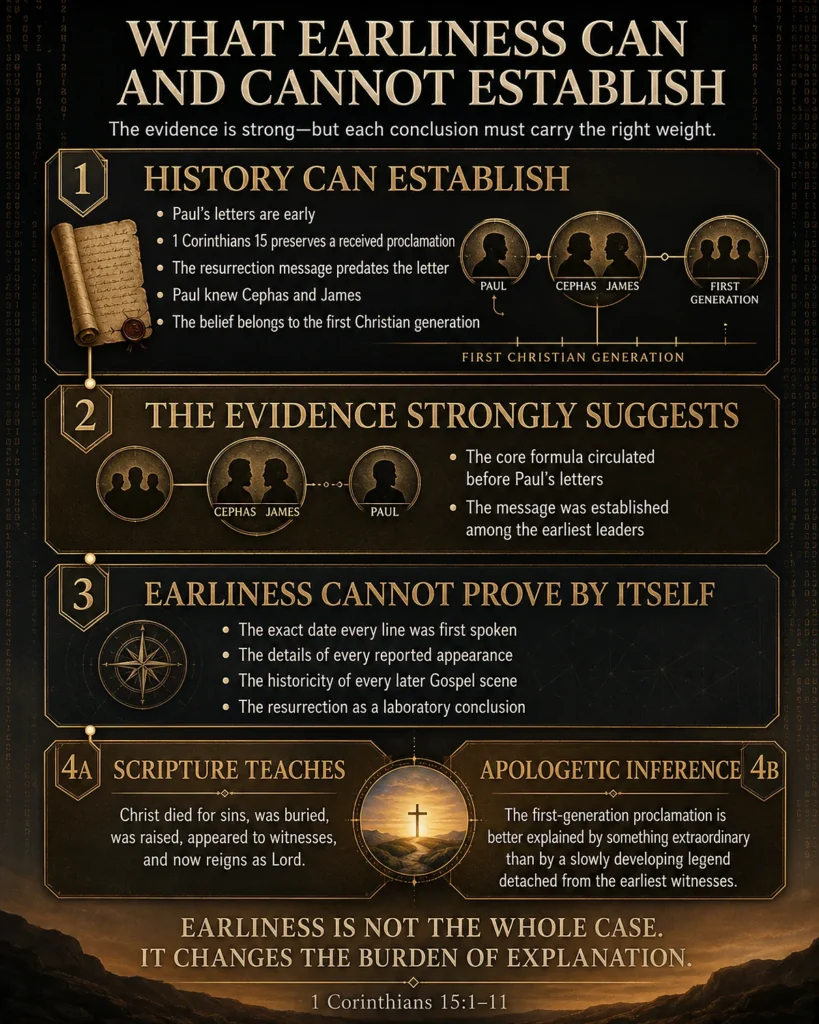
What Earliness Proves and Does Not Prove
A claim can be early and still be false. People can misunderstand events, interpret experiences through existing beliefs, or become sincerely convinced of something that did not happen as they understood it. The early date of resurrection proclamation does not by itself prove that God raised Jesus from the dead.
That admission does not make the evidence insignificant. It clarifies what the dating argument actually accomplishes.
What Earliness Strongly Supports
- The resurrection proclamation belongs to the first Christian generation.
- Paul preserves teaching that he says he received before writing 1 Corinthians.
- The core message existed before the canonical Gospel narratives were written.
- Paul did not invent the central claim that Jesus died, was buried, was raised, and appeared.
- A theory depending on slow development over many generations cannot explain the evidence by itself.
- Any adequate explanation must begin close to the originating movement rather than centuries later.
What Earliness Does Not Establish by Itself
- The exact date on which every line of the tradition was first formulated.
- The detailed circumstances of every claimed appearance.
- The historicity of every later Gospel scene.
- The empty tomb without additional argument.
- The exact nature of the resurrection body.
- That divine action occurred merely because the belief appeared early.
Earliness does not complete the historical case for the resurrection. It determines where that case must begin. The question is not how a resurrection legend could have arisen after centuries of distance from Jesus. The question is why the first Christian generation became centered on the proclamation that God had raised the crucified Messiah.
The Christian argument is cumulative. The early proclamation must be considered alongside the named witnesses, Paul’s transformation, James’s leadership, the Jewish meaning of resurrection, the Gospel traditions, and the movement’s public endurance. Earliness does not force faith, but it removes the convenient explanation that resurrection belief was simply a late myth detached from the people and events that gave birth to Christianity.
Did the Earliest Christians Mean Resurrection?
Paul’s sequence of death, burial, raising, and appearance is difficult to reduce to the survival of Jesus’ influence or the exaltation of a cherished memory. Within Paul’s Jewish world, resurrection referred to God’s victory over death, not merely to the continued importance of someone who had died.
At the same time, Paul does not narrate the discovery of the tomb or describe every physical feature of the appearances in this passage. Scholars continue to debate what the compressed formula implies about the empty tomb and the precise nature of the resurrection body.
The central point remains firm. The earliest proclamation was not that Jesus continued to inspire His followers. It was that the crucified Jesus had been raised by God and had appeared.
Why the Five Hundred Requires Caution
The received appearance tradition includes Paul’s report that Jesus appeared to more than five hundred people at one time. That broadens the scope of the proclamation beyond one or two private experiences, and Paul adds that most were still alive when he wrote.
The evidential limits remain important. Paul gives no names, location, date, or separate narrative, and no independent account of the event survives. The five hundred therefore supports the existence of a broad early appearance claim, but it should not be presented as though historians possess five hundred individually documented testimonies. The full witness analysis belongs in What Did the First Witnesses Claim About the Risen Jesus?.
Frequently Asked Questions
How early is the resurrection tradition in 1 Corinthians 15?
Paul wrote 1 Corinthians around AD 53–55, and he says he had already received the message he passed on. Many scholars identify at least the core of 1 Corinthians 15:3–5 as pre-Pauline tradition. The exact date remains debated, but the proclamation clearly predates Paul’s letter.
Did Paul invent the resurrection message?
No. Paul says he received and delivered the resurrection proclamation. He also reports contact with Cephas and James in Jerusalem and describes the central message as shared apostolic preaching. Paul profoundly explained and spread the Gospel, but the evidence shows that the core resurrection proclamation existed before his letter to Corinth.
What do “received and delivered” mean?
Paul uses language associated with receiving and passing on established teaching. At minimum, he says the resurrection message was not his own late invention. Scholars debate the exact boundaries of the inherited formula, but Paul explicitly presents the central proclamation as something he received before giving it to the Corinthians.
Can historians prove the tradition was formulated days after Easter?
No. Some scholars propose extremely early dates, but Paul does not provide an exact day, month, or year for when he received every part of the formula. The responsible conclusion is that the tradition predates 1 Corinthians and belongs to the earliest Christian generation.
Does an early resurrection claim prove that Jesus rose?
Not by itself. Early belief can still be mistaken. But the early proclamation makes slow late-legend theories much weaker and requires an explanation for why the first Christian movement centered so quickly on the claim that God raised the crucified Jesus.
Does Paul describe the empty tomb?
No. Paul says Christ died, was buried, was raised, and appeared, but he does not narrate the women discovering an empty tomb. Christians may argue that burial-and-resurrection language supports an empty-tomb inference in its Jewish context, but that question requires additional argument and should not be attributed directly to Paul’s wording.
Sources and Further Reading
Primary Biblical Sources
- 1 Corinthians 15:1–11
- 1 Corinthians 9:1
- 1 Corinthians 11:23–26
- Galatians 1:11–24
- Galatians 2:1–10
- Romans 1:1–6
- 1 Thessalonians 1:9–10
Historical Dating and the Pre-Pauline Tradition
- Stephen J. Chester, David P. Ross, and Witthaya Phuttharaksa, “1 Corinthians,” Oxford Bibliographies in Biblical Studies — introduction and historical dating of Paul’s letter.
- James Ware, “The Resurrection of Jesus in the Pre-Pauline Formula of 1 Cor 15.3–5,” New Testament Studies 60.4.
- Jerome Murphy-O’Connor, “Tradition and Redaction in 1 Corinthians 15:3–7,” in Keys to First Corinthians.
- Dale C. Allison Jr., The Resurrection of Jesus: Apologetics, Polemics, History, T&T Clark.
- N. T. Wright, The Resurrection of the Son of God, SPCK.
- Michael R. Licona, The Resurrection of Jesus: A New Historiographical Approach, IVP Academic.
- Paula Fredriksen, When Christians Were Jews: The First Generation, Yale University Press.
- Bart D. Ehrman, How Jesus Became God, for a skeptical historical interpretation emphasizing visions and the development of belief about Jesus.
- Gary R. Habermas, On the Resurrection, Volume 1: Evidences, B&H Academic.
Related Paranoid Prophet Investigations
- What Did the First Witnesses Claim About the Risen Jesus?
- Was Jesus Crucified?
- Why Did Jesus Die?
- Did First Christians Suffer for the Resurrection?
- Explore the Cross and Resurrection evidence path

The First Christian Proclamation Still Demands an Answer
The earliest Christian message did not ask the world merely to remember Jesus’ wisdom, honor His courage, or preserve His ethics. It declared that God had acted in history: the crucified Christ was alive.
History cannot force anyone to worship. It cannot place the resurrection in a laboratory or remove every possible alternative by mathematical proof. But it can show that the resurrection claim arrived early, was received and transmitted before Paul wrote 1 Corinthians, and was connected to named first-generation figures rather than appearing as a distant legend.
That does not diminish faith. It protects faith from weak slogans and directs attention toward evidence that can bear weight. The Christian confession does not rest on a story that first appeared centuries after Jesus. Its earliest surviving form is inherited, shared, connected to named first-generation figures, and centered on the proclamation that Christ died for sins, was buried, was raised, and appeared.
For Christian faith, this is not the end of the case but the beginning of worship. The Jesus who died for sins is not preserved only in memory. He is the risen Lord proclaimed within the first Christian generation, witnessed by those who carried His name into the world, and still calling every reader to repentance, faith, and life in Him.
CONTINUE THE INVESTIGATION
Recommended continuation
What Did the First Witnesses Claim About the Risen Jesus?
Move from the chronology of the resurrection claim to what the earliest witnesses actually proclaimed.