
GUIDED ARTICLE EXPERIENCE
Bible Translations Explained: KJV, NIV, ESV, NASB, CSB, NLT, and More
Read along as the narration moves through the article.
Private device narration · No hosted audio or tracking
CONTINUE GUIDED TOUR
Continue where you left off.
GUIDED TOUR COMPLETE
You have reached the end of this study.
Study record saved on this device.
GUIDED TOUR
Bible Translations Explained: KJV, NIV, ESV, NASB, CSB, NLT, and More
Narrator: Paranoid Prophet Recommended Voice Native device narration
Prepare to follow the article as it is narrated.
VOICE & TOUR OPTIONS
Voice & Listening
NARRATOR
Finding a narrator…
Checking the best narrator available on this device.
Restores the best curated narrator available on this device.
Narrator choices are curated for clear, long-form listening on this device.
Screen-awake support will be checked when narration starts.
CHOOSE A NARRATOR
Curated for this device
Choose a verified narrator for this browser, or use System Narrator. Automatic mode uses the best reliable route exposed by this device; your chosen narrator is preserved even if this device needs a temporary fallback.
Preparing the guided article experience…
RESUME GUIDED TOUR?
Continue where you left off.
GUIDED TOUR COMPLETE
You have reached the end of this study.
Walk into a bookstore, open a Bible app, or compare the pews of several churches, and the abbreviations multiply quickly: KJV, NKJV, NIV, ESV, NASB, CSB, NLT, NRSVue, NET, NABRE. They all call themselves the Bible, yet they do not always use the same English words. Some preserve older sentence forms. Some explain idioms. Some place alternate readings in footnotes. Some belong to Protestant, Catholic, evangelical, or ecumenical institutions.
That variety can create healthy curiosity or anxious suspicion. A reader may wonder whether one version is the “real Bible,” whether a publisher controls doctrine, or whether easier English must be less accurate. A spectrum chart may promise a quick answer, but translation is too important for a one-line ranking.
This guide offers Bible translations explained without treating them as interchangeable or turning a preferred edition into an object of faith. The goal is to understand how responsible translations differ, what each does well, where each needs support, and how Christians can choose with confidence under the authority of Scripture.
Article Guide15 sections
Short Answer: Which Bible Translation Should You Use?
For most Paranoid Prophet readers, the New International Version (NIV) is an excellent primary Bible. It balances accuracy and natural contemporary English, supports sustained reading and teaching, and is maintained by an international, interdenominational evangelical committee. It sometimes makes interpretation more visible than a more formally transparent translation, so it should not stand alone when an argument depends on one word or disputed phrase.
A strong study pattern uses one primary Bible and one purposeful comparison:
- Use the NIV or CSB for clear all-purpose reading.
- Compare the ESV or NASB when you want to see more of the source-language form and recurring terminology.
- Use the NLT for accessible reading, audio, beginners, or passages whose idioms remain obscure.
- Use the NET when you want extensive notes explaining why translators made a choice.
- Use the KJV if you understand its English and value its historic beauty, or the NKJV if you want that tradition with modernized grammar.
- Use the NRSVue for ecumenical and academic comparison.
- Use the NABRE for Catholic study and access to the Catholic canon.
This is not a ranking of spiritual value. The KJV is faithful, beautiful, and historically monumental. The NIV is not perfect. The ESV and NASB still interpret. The NLT is a genuine translation, not merely a paraphrase. Every responsible committee must decide which ancient reading to translate, what words mean in context, and how Hebrew, Aramaic, or Greek communication can become understandable English.
If you already read another responsible translation well, this guide is not asking you to abandon it for a brand. A reader who knows the CSB deeply is usually better served by sustained reading and intelligent comparison than by restarting every few months. The immediate question is whether your Bible communicates accurately in English you understand and whether you know how to investigate places where translations differ.
The best translation is not the one that wins a chart. It is the one that faithfully communicates Scripture and is actually read, understood, tested, and obeyed. For many Christians, the wisest answer is not one version forever isolated from all others. It is a trusted primary Bible, a well-chosen comparison Bible, careful attention to footnotes, and humility when the evidence is genuinely difficult.
Why Are There So Many English Bible Translations?
English keeps changing. In the seventeenth century, prevent could mean precede, conversation could mean conduct, and meat could refer broadly to food. A sentence that once sounded direct may now sound formal, obscure, or mean something different. Updating language can therefore protect meaning rather than dilute it.
Translation goals also differ. A church Bible may prioritize public rhythm and continuity. A study Bible may retain technical terms and repeated vocabulary. A translation for new readers may explain unfamiliar idioms. An ecumenical project may serve multiple Christian traditions, while a Catholic edition must include the books received in the Catholic canon. A committee may favor literary form, natural speech, close grammatical transparency, or a balance of those aims.
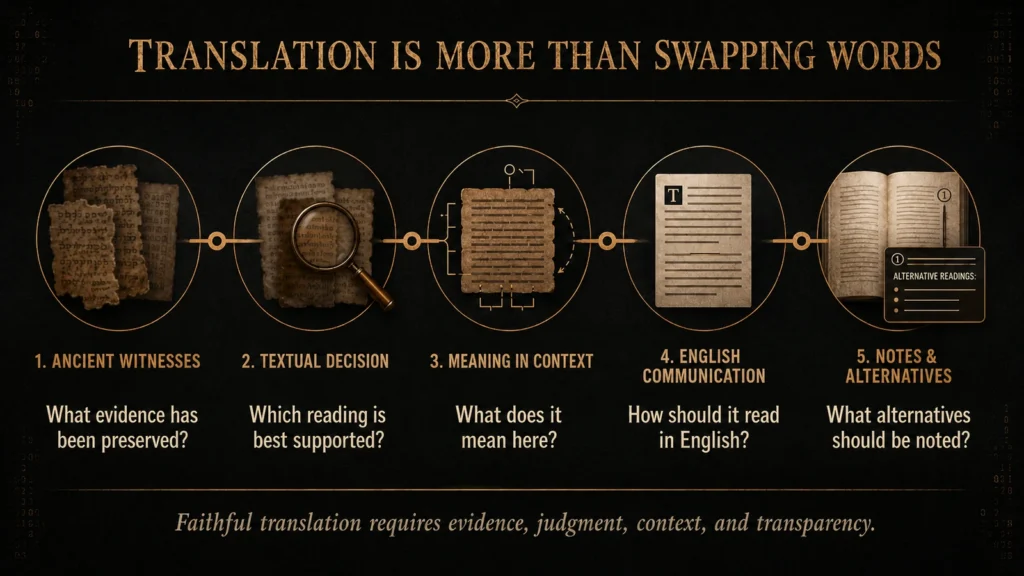
The source evidence creates another layer. The biblical writings were composed in Hebrew, Aramaic, and Greek, copied by hand, and preserved in many manuscripts and ancient translations. Most differences among copies are small, but some affect a line or verse. Committees must weigh that evidence and decide which reading most likely represents the earliest recoverable text. Their footnotes often preserve a serious alternative.
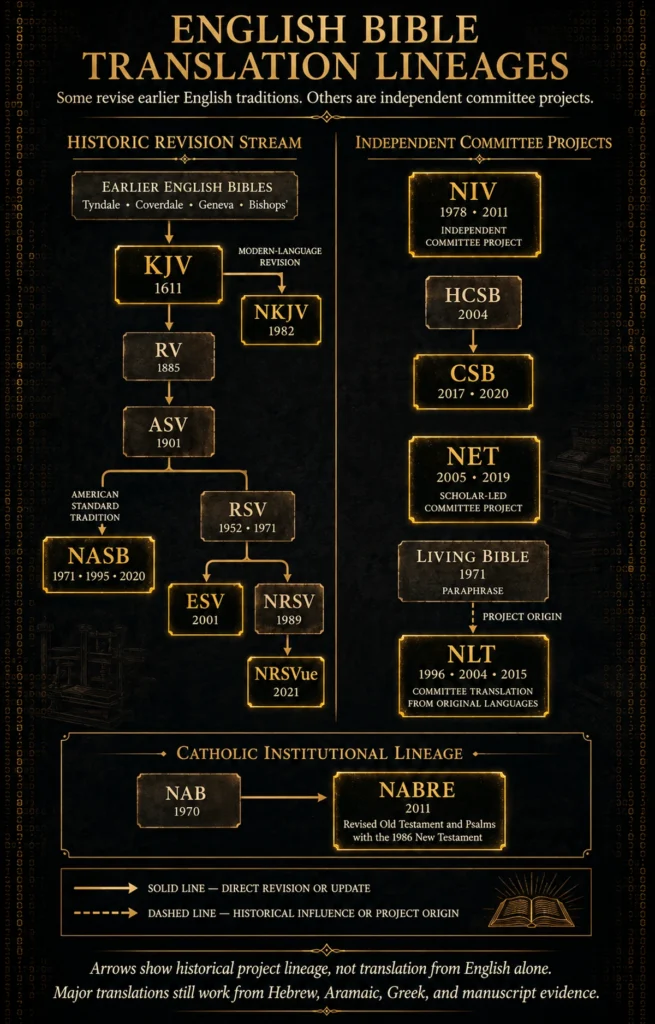
No committee begins without history. The KJV revised earlier English Bibles. The ESV revises within the RSV lineage. The NASB continues the American Standard tradition. The NKJV updates the KJV tradition while retaining its main New Testament textual base. The NIV, CSB, NLT, and NET are committee translations with their own development histories. The NABRE belongs to a Catholic institutional setting, and the NRSVue to an ecumenical and academic one.
Finally, translation is stewardship performed by people. Scholars have theological commitments, linguistic judgments, literary tastes, institutional rules, and revision policies. A committee can reduce individual eccentricity, but it cannot become bias-free or interpretation-free. Responsible readers should ask who made the translation, which texts and methods governed it, how alternatives are disclosed, and whether the actual renderings withstand examination.
New versions are also produced for legitimate practical reasons. Mission settings need English that works across cultures. Audio listeners process long sentences differently from readers. Children and new believers need unfamiliar customs explained without being patronized. Scholars need notes dense enough to expose textual options. Churches need language that can be heard aloud. No one of those audiences defines faithfulness, but each reveals a real dimension of communication.
What Does “Most Accurate” Actually Mean?
“Most accurate” sounds decisive until accuracy is defined. A version can follow the visible form of a sentence closely while giving a modern reader the wrong impression. Another can communicate the likely meaning clearly while resolving an ambiguity the source text leaves open. Neither formal resemblance nor effortless readability guarantees fidelity by itself.
Translation scholars Gordon D. Fee and Mark L. Strauss emphasize that choosing a Bible requires understanding both word-for-word and meaning-based approaches, their strengths, and their weaknesses. Their analytical framework is useful because languages do not align in one-to-one lexical and grammatical units. Accuracy has several dimensions:
- Textual accuracy: Which Hebrew, Aramaic, or Greek reading is translated? Does the edition disclose meaningful alternatives?
- Lexical accuracy: Does the English word fit the source word in this context rather than merely match one dictionary gloss?
- Grammatical accuracy: Are number, tense, aspect, agency, emphasis, and relationships communicated?
- Idiomatic accuracy: Would a formally literal expression carry the same meaning in present English, or would it mislead?
- Literary accuracy: Does poetry still sound like poetry? Are metaphor, repetition, register, argument, and rhetoric represented?
- Contextual accuracy: Does the rendering fit the paragraph, book, historical situation, and biblical author’s purpose?
- Accuracy to ambiguity: Does the source permit more than one sense? If the translation chooses one, does a note preserve another credible option?
- Reader accuracy: Can today’s reader understand what the original audience could reasonably have understood?
Consider the phrase “word-for-word.” Hebrew and Greek words can carry ranges of meaning. One source word may need different English words in different contexts. English may require a subject that the source language leaves implicit, or change word order to make relationships clear. Articles, pronouns, and verb systems do not correspond mechanically. Even a highly formal translation adds, rearranges, or varies words because otherwise it would not be grammatical English.
Accuracy also includes restraint. A meaning-based translation can over-explain. It may specify who acts, resolve a metaphor, or choose a doctrinal nuance where the source remains compact. A formal translation can hide interpretation behind traditional wording, preserve an ancient idiom that no longer communicates, or give readers the illusion that English grammar mirrors Greek grammar.
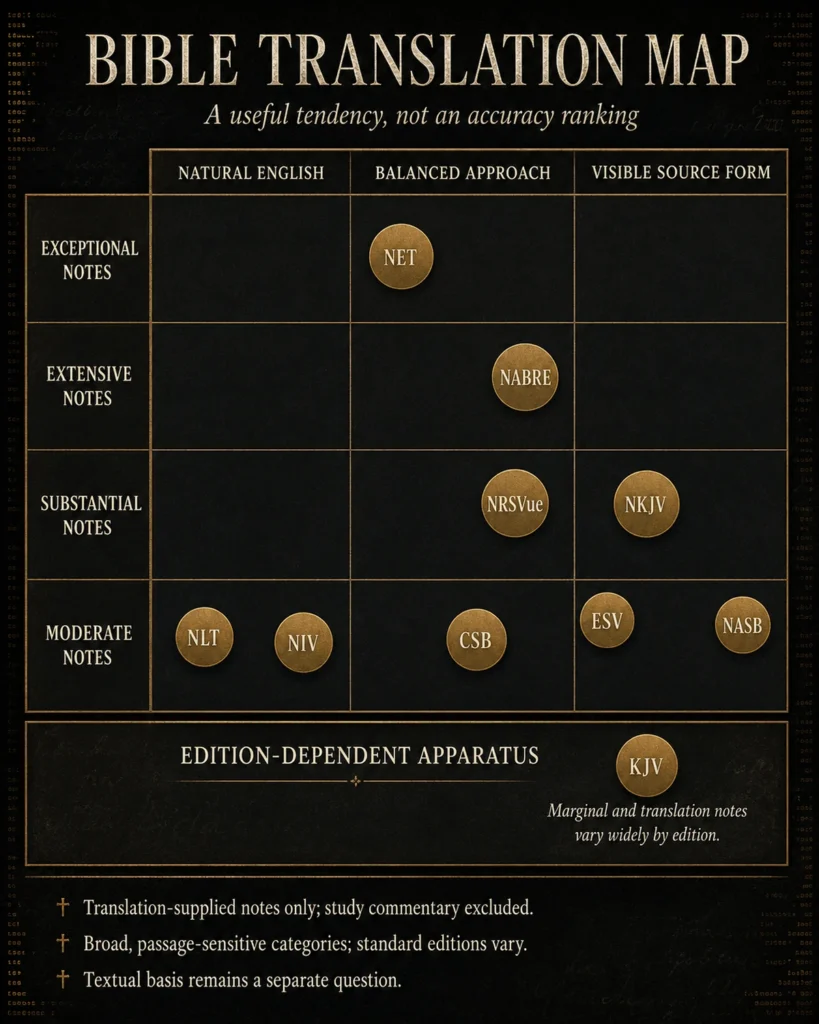
Footnotes are therefore part of accuracy, not an embarrassment to it. A note can disclose another manuscript reading, a literal source expression, a possible meaning, or uncertainty the main text cannot display. Confidence in Scripture does not require pretending that every copying or translation question is equally simple.
Accuracy must finally be judged against the source text in context, not against another English Bible treated as the hidden original. The KJV can expose a weak modern rendering, and a modern translation can expose where changed English obscures the KJV. Neither becomes the standard merely by being familiar. Hebrew, Aramaic, Greek, literary context, manuscript evidence, and responsible scholarship remain the relevant controls.
The best judgment is passage-sensitive. Ask what the author is doing, what the source expression can mean, what the English wording communicates now, and what the notes disclose. A translation can preserve the form of a sentence while obscuring its meaning, or clarify its meaning while making an interpretive decision more visible.
Word-for-Word and Thought-for-Thought Are a Spectrum
Translation charts often place versions on a line from “word-for-word” to “thought-for-thought.” The chart is useful if it introduces a tendency. It becomes misleading when it is treated as a scientific accuracy score.
Formal-equivalence translations try to preserve source-language structure, repeated terms, metaphors, and grammatical relationships where English allows. The NASB and ESV lean strongly in this direction. Their strengths include visible connections, technical vocabulary, and usefulness in close comparison. Their risks include stiffness, misunderstood idioms, and English that appears more precise than the underlying evidence permits.
Functional or meaning-based translations seek natural target-language communication. The NLT leans more strongly in this direction, while the NIV and CSB pursue different kinds of balance. Their strengths include clarity, oral comprehension, and immediate communication of idiom or implied relationships. Their risks include greater interpretive density, less visible source repetition, and fewer clues for word-level study.
Every major translation moves along the spectrum from passage to passage. Romans 6:2 shows the KJV using an English idiom rather than a lexical gloss. The NLT can preserve a metaphor when it remains understandable. The ESV can restructure syntax for English. The NIV can translate formally where the wording communicates well.
A spectrum also says little about literary success. Hebrew poetry may require parallel lines, sound, imagery, and compression. A Pauline argument may require connectives and long-range grammatical relationships. Narrative dialogue must sound like speech without becoming casual in the wrong register. A translation can be more formal at one level and less faithful at another, which is why labels should begin investigation rather than finish it.
A better visual uses two axes. One asks how visibly a version preserves source form. The other asks how much translation transparency it supplies through notes. Textual basis must remain a separate layer. No dot on a chart can tell a reader whether a specific manuscript reading, idiom, metaphor, or theological term was handled well.
Textual Basis and Translation Philosophy Are Not the Same
Two questions are often collapsed:
- Which ancient-language wording should be translated?
- How should that wording be expressed in English?
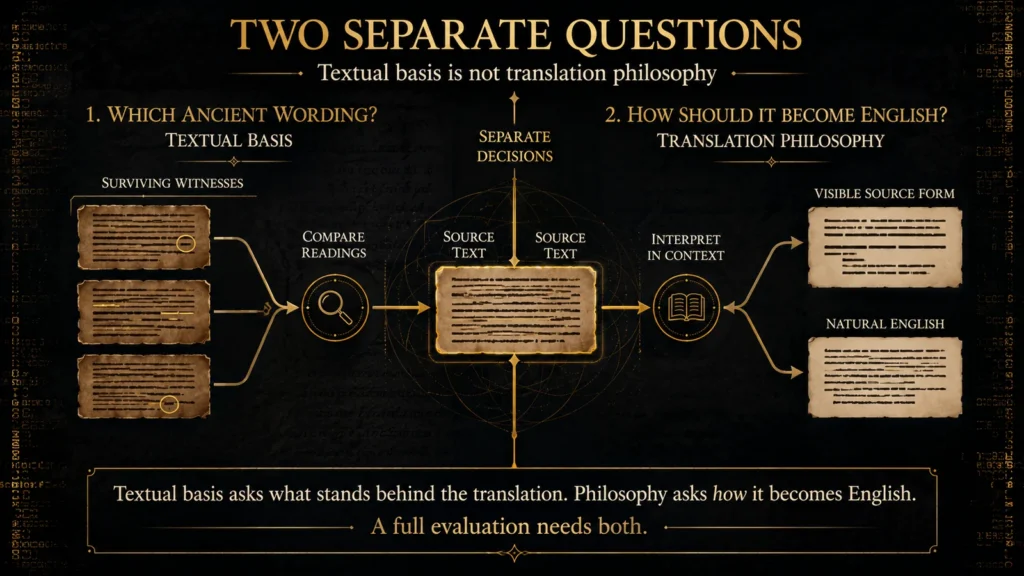
The first belongs to textual criticism. The second belongs to translation philosophy. A formal translation and a meaning-based translation can begin from substantially the same critical Greek edition yet render a phrase differently. Two formal translations can differ because they choose different source readings.
For the Old Testament, major modern Protestant translations ordinarily begin with the Masoretic Text and consult other witnesses where the Hebrew is difficult or the evidence suggests another reading. Those witnesses can include the Dead Sea Scrolls, Septuagint, Samaritan Pentateuch, Syriac Peshitta, Latin Vulgate, and Aramaic Targums. Consultation does not mean that one ancient version automatically replaces the Hebrew tradition.
The KJV New Testament reflects early printed Greek editions associated with Erasmus, Stephanus, and Beza, later grouped under the label Textus Receptus. The term refers to a family of printed texts, not one ancient manuscript or one perfectly identical edition. The Byzantine Majority Text is also not identical to the Textus Receptus.
The NIV, ESV, NASB, CSB, NLT, NRSVue, NET, and most other modern translations use modern eclectic Greek texts. Editors compare manuscript age, geographic distribution, relationships among copies, scribal habits, ancient versions, early Christian citations, and internal context. Older does not automatically mean better, and numerical majority does not automatically mean original. Both kinds of evidence require judgment.
Important uncertainty is commonly disclosed in footnotes or brackets. That is why a modern Bible may place a familiar verse in a note or mark a longer passage. The larger history of how the biblical writings were composed, recognized, copied, preserved, and translated belongs in our guide to how we got the Bible.
Textual criticism is not the act of deciding whether Scripture should exist. It compares surviving evidence because the biblical books were copied and circulated before modern printing. Christians can disagree over methods and still affirm inspiration. Theologically, preservation need not mean that every copy agrees at every letter. It can mean that God’s Word has been transmitted abundantly enough for differences to be identified, tested, and disclosed rather than concealed.
Nor does an eclectic text remain static because scholars secretly invent new Bibles. Editions change when manuscripts are reassessed, relationships are modeled differently, or a reading receives stronger explanation. Traditional printed texts also have an editorial history. Confidence should rest in the well-attested scriptural witness, not in pretending that one editorial process escaped history.
This distinction prevents two errors. A reader should not criticize the NIV’s natural English as though every difference came from a missing Greek verse. A reader should not call the KJV mechanically literal merely because it uses the traditional printed-text lineage. Textual basis asks what wording stands behind the translation. Philosophy asks how that wording becomes English. A full evaluation needs both.
Major Bible Translations Explained
The profiles below use the same questions: lineage, stewardship, stated method, textual base, strongest uses, and honest limitations. Official sources describe what projects claim about themselves; those claims are reported rather than treated as self-proving verdicts.
King James Version (KJV)
The King James Version was published in 1611 as a Church of England project commissioned under King James VI and I. It revised the Bishops’ Bible while consulting Tyndale, Coverdale, Matthew, the Great Bible, Geneva, Hebrew and Greek texts, ancient versions, and continental scholarship. Common modern KJV editions usually reflect later standardization, especially the Oxford edition of 1769.
Its method is formal and literary, but never mechanically word-for-word. The New Testament reflects early printed Greek texts later called the Textus Receptus, while the Old Testament rests principally on the Masoretic Hebrew tradition with broader consultation. Few English translations match its cadence, memorability, suitability for public reading, stable traditional vocabulary, theological influence, and deep historical reception.
Its chief limitation for current readers is language change. Archaic grammar is visible, but changed meanings can be more dangerous because familiar words may quietly mislead. Its manuscript resources also predate discoveries and analysis available to later committees. Those facts do not make it corrupt or unusable.
The original edition’s italics and margins also remind readers that its translators made judgments and sometimes supplied English needed for sense. A modern KJV without its historical preface or translation notes can look more absolute than the project originally presented itself.
The KJV remains an excellent Bible for readers who understand its English, churches formed by its public language, memorization, literary study, and historical comparison. It is faithful and valuable without being the only faithful English Bible. The KJV arose from a long English translation tradition rather than appearing from nowhere in 1611. Our historical guide traces how the King James Bible was produced from Tyndale through the six translation companies.
New King James Version (NKJV)
The New King James Version was commissioned in 1975 and completed in 1982. Thomas Nelson sponsored a project involving scholars, church leaders, and readers from multiple backgrounds. Its purpose was not to replace the KJV tradition but to retain its cadence and theological vocabulary while modernizing grammar, spelling, and words whose meanings had changed.
The NKJV follows the traditional KJV textual base in its main New Testament text. Its notes identify many differences involving the Majority Text and modern critical text, which makes it more transparent than a bare traditional-text edition. It also updates punctuation and sentence structure while preserving a recognizable elevated register.
This is often the best bridge for a person who loves the KJV but struggles with seventeenth-century English. It works well for public reading, memorization, traditional worship, and comparison with modern critical-text translations. Its clearest advantage is continuity with the KJV tradition without most of the linguistic barrier.
Readers should still distinguish updated language from updated textual evidence. The NKJV’s main text retains readings that other modern committees judge less likely to be original, even when its notes disclose alternatives. Its style can remain formal for beginners, and its title should not imply that every KJV feature has merely been rephrased. Use it as a serious translation in its own right and read its textual notes.
Because it prints traditional readings in the text while noting critical and Majority Text alternatives, the NKJV can be a productive bridge in textual discussions. It lets readers compare evidence without first surrendering familiar cadence.
New International Version (NIV)
The full New International Version appeared in 1978, with the current major edition published in 2011. Biblica holds the translation, while the text is entrusted to a self-governing fifteen-member Committee on Bible Translation. Biblica describes the committee as international, interdenominational, evangelical, and independent of publisher control over wording. That is an institutional claim readers can compare with the project’s charter and practice.
The NIV seeks a balance between source transparency and natural contemporary English. It uses the Masoretic Text with ancient Old Testament witnesses and a modern eclectic Greek New Testament. Its committee considers linguistic usage, exegesis, literary flow, and developments in textual scholarship. The translation often clarifies relationships or idioms that more formal versions leave implicit.
For sustained reading, teaching, public communication, and international English, the NIV offers an unusually strong balance of accuracy and readability. It is Paranoid Prophet’s normal reader-facing translation because many readers can understand it without giving up serious committee scholarship.
Its limitations deserve candor. It sometimes resolves an ambiguity, varies repeated source terms, or presents an interpretation more directly than a formal comparison version. Its gender-language choices remain debated. It is therefore an excellent primary Bible, not a reason to stop comparing. When doctrine or argument depends on one phrase, place the NIV beside the ESV or NASB, read the footnotes, and consult the NET notes or original-language tools.
The NIV is strongest when its target-language clarity lets paragraphs, narratives, and speeches work as communication rather than puzzles. Its weakness appears when that clarity hides how much interpretation was needed, which is why formal comparison remains part of this recommendation.
English Standard Version (ESV)
The English Standard Version was first published in 2001 as a revision in the RSV lineage under Crossway. It describes itself as “essentially literal” and seeks formal transparency, literary dignity, recurring terminology, and continuity with the Tyndale-KJV tradition. Its Old Testament base is the Masoretic Text with ancient witnesses consulted, and its New Testament uses modern Nestle-Aland and UBS Greek editions.
The ESV works especially well for close reading, memorization, public worship, tracing repeated terms, and comparing the shape of an argument. It retains technical vocabulary such as propitiation and often leaves interpretive work visible to the reader. Its footnotes are an important part of its transparency.
The same formal tendency can produce stiff or compressed English. Formal appearance does not eliminate interpretation, and some gender-language or theological decisions are disputed. Readers should not assume that a more difficult sentence is automatically closer to Greek.
Edition awareness now matters. Crossway announced a limited 2025 ESV text update affecting a small number of passages and notes, with rollout continuing through fall 2026. That does not make earlier copies unusable, but careful citation should identify the text when an updated passage matters. The ESV is an excellent formal comparison to the NIV and a strong primary Bible for readers comfortable with its register.
Readers attracted to the ESV’s stability should still treat revision as responsible stewardship rather than betrayal. The 2025 update itself shows that an “essentially literal” committee must revisit lexical, textual, and interpretive judgments.
New American Standard Bible (NASB)
The New American Standard Bible first appeared as a complete Bible in 1971, with notable updates in 1977, 1995, and 2020. It is stewarded by the Lockman Foundation, a nondenominational evangelical nonprofit. A reader should identify whether a citation uses NASB 1995 or NASB 2020 because the revisions differ in wording and style.
The NASB prioritizes formal equivalence, grammatical detail, and visibility of source-language relationships. It uses the Masoretic Text with other Old Testament evidence and a modern critical Greek New Testament. It is especially useful when a reader wants to compare clauses, connectives, verb relationships, and repeated terminology.
For sermon preparation, inductive study, and side-by-side comparison, the NASB remains especially valuable. The 2020 update improves naturalness in many places and adjusts some gender language while retaining a formal identity. Its notes disclose textual and translational alternatives.
The main trade-off is readability. Close adherence to form can yield English that feels less natural, and a precise-looking sentence may still embody interpretive choices. It is not an interlinear, nor does consistency prove that one English gloss captures every context. The NASB is best used by readers willing to slow down, compare the wider paragraph, and distinguish the translation’s English structure from the original grammar.
The NASB’s value grows when the edition is named. Comparing 1995 and 2020 can reveal where the committee judged that contemporary syntax, inclusive reference, or lexical precision warranted change without abandoning formal goals.
Christian Standard Bible (CSB)
The Christian Standard Bible was published in 2017 as a revision of the Holman Christian Standard Bible and received an update in 2020. It is associated with Holman, B&H, and the Lifeway publishing world, with an international and interdenominational scholarly team. Its project label is “optimal equivalence.”
That label describes a stated goal: use a formally transparent rendering where it communicates clearly and move toward functional expression where a formal rendering would obscure meaning. The CSB begins from the Masoretic Text and modern Nestle-Aland and UBS Greek editions, with ancient witnesses and textual alternatives considered.
In practice, the CSB combines readable current English, church usability, compact prose, and helpful notes. It often feels more formally visible than the NIV while remaining more natural than translations clustered at the formal end. It can serve well for preaching, group study, devotional reading, and a congregation seeking one versatile text.
“Optimal” is marketing language as well as a philosophy label; it cannot prove that every decision achieved the ideal. The translation has less historical stability than older versions, and readers may disagree with where it shifts between formal and functional choices. The CSB is a strong all-purpose Bible whose actual passages should be assessed like any other translation, not accepted because its name promises a perfect midpoint.
For a church choosing a new pew or teaching Bible, the CSB deserves direct testing in narrative, poetry, prophecy, Gospel, and epistle rather than evaluation by one spectrum position. Its balance is a repeated editorial judgment, not a fixed formula.
New Living Translation (NLT)
The New Living Translation was first published in 1996, substantially revised in 2004, and refined through later updates including 2015. It is stewarded in the Tyndale House context and produced through teams of evangelical scholars, senior translators, and English stylists. The NLT translation process describes multiple rounds of exegetical, committee, and stylistic review.
The NLT is meaning-based, but it is a translation, not merely a paraphrase. Its committees worked from Hebrew, Aramaic, and Greek, using the Masoretic Text with ancient Old Testament witnesses and modern UBS and Nestle-Aland Greek editions. It translates more formally when that produces accurate, clear English and more dynamically when literal wording would confuse or mislead.
The NLT excels in accessibility, idiom clarity, oral reading, narrative flow, audio use, and communication to beginners or younger readers. It can make familiar passages newly understandable and expose where a reader has been recognizing words without grasping the sentence.
Its clarity can also make interpretation less visible. It may explain a metaphor, vary a technical term, specify an implied connection, or reduce word-level correspondence. It should not be the only tool for detailed lexical argument. Use it confidently for sustained and devotional reading, then compare the NIV, ESV, NASB, or NET notes when a theological claim turns on exact phrasing.
The NLT is especially revealing beside the KJV or NASB. The contrast can show both what an ancient form contributes and what a contemporary reader may have missed. That pairing is more useful than dismissing either end of the spectrum.
NET Bible
The NET Bible is a scholar-led project associated with Bible.org. Its most distinctive feature is not a place on the formal-functional spectrum but nearly 60,000 translator, study, and text-critical notes. Those notes reveal options, manuscript evidence, linguistic arguments, and places where the committee made a difficult decision.
The NET uses modern Hebrew and Greek textual scholarship and aims at accurate, readable English. It is especially valuable when translations diverge or a preacher wants to know what lies behind a footnote. Its Romans 3:25 rendering demonstrates its willingness to foreground a debated source image.
The caution is density. Notes can overwhelm a beginner, and the main text is less established for congregational memorization. Use the NET as a transparency tool alongside a primary reading Bible rather than feeling obligated to process every note during ordinary devotion.
New Revised Standard Version Updated Edition (NRSVue)
The NRSVue is the updated form of the NRSV, copyrighted in 2021 and released through the National Council of Churches. The NCC partnered with the Society of Biblical Literature for the revision. It follows the maxim “as literal as possible, as free as necessary” and incorporates current manuscript, philological, and historical scholarship.
Its ecumenical breadth, academic use, inclusive contemporary language, broad-canon editions, and attention to textual evidence make it valuable in classrooms, interchurch comparison, scholarship, and wider-canon study.
Some conservative readers dispute particular gender renderings, culturally sensitive language, or critical judgments. Official claims that it is the “most” accurate or literal remain project claims, not neutral conclusions. Use it fairly as a serious scholarly translation and identify the edition and canon.
Its wide scholarly team makes it especially useful when a reader wants to hear judgments beyond one evangelical publishing context.
New American Bible Revised Edition (NABRE)
The NABRE was released in 2011 under Catholic institutional sponsorship. It combines a newly revised Old Testament and Psalms with the 1986 New Testament. The Confraternity of Christian Doctrine and the United States Catholic bishops oversee its ecclesial context, and the project describes a formal-equivalence tendency with current English and extensive notes.
For Catholic study, the NABRE offers the Catholic canon, manuscript awareness, historical notes, and direct institutional relevance. It also helps Protestant readers understand Catholic biblical practice without confusing canon differences with translation-method differences.
Translation differences and canon differences are separate questions. Our guide to the books of the Bible explains how Protestant, Catholic, and Orthodox collections are organized. Readers should also know that NABRE wording is not identical in every place to the text used in current U.S. Catholic Mass readings.
Paraphrases
Paraphrases such as The Message and the original Living Bible recast biblical communication with a highly individual or expansive interpretive voice. They can make a familiar passage sound fresh, expose the force of an argument, and serve devotional or supplemental reading.
They should not be confused with committee translations made directly from the full source-language evidence. Their high interpretive density makes them weak as a sole doctrinal text, and their memorable phrasing may reflect the paraphraser more visibly than the source form.
Use a paraphrase after reading a responsible translation, not instead of one. It can function like a concise commentary or imaginative restatement. The NLT does not belong in this category: it is a committee translation from Hebrew, Aramaic, and Greek.
A paraphrase can prompt attention, but any surprising doctrinal phrase should be checked in a translation whose source-language method and notes are more transparent.
What Real Passages Show About Translation
The following laboratories quote only the phrases needed to expose a translation decision. None can crown a universal winner. Each shows how form, meaning, poetry, and theology interact.
1 Peter 1:13: Ancient Image and Communicated Action
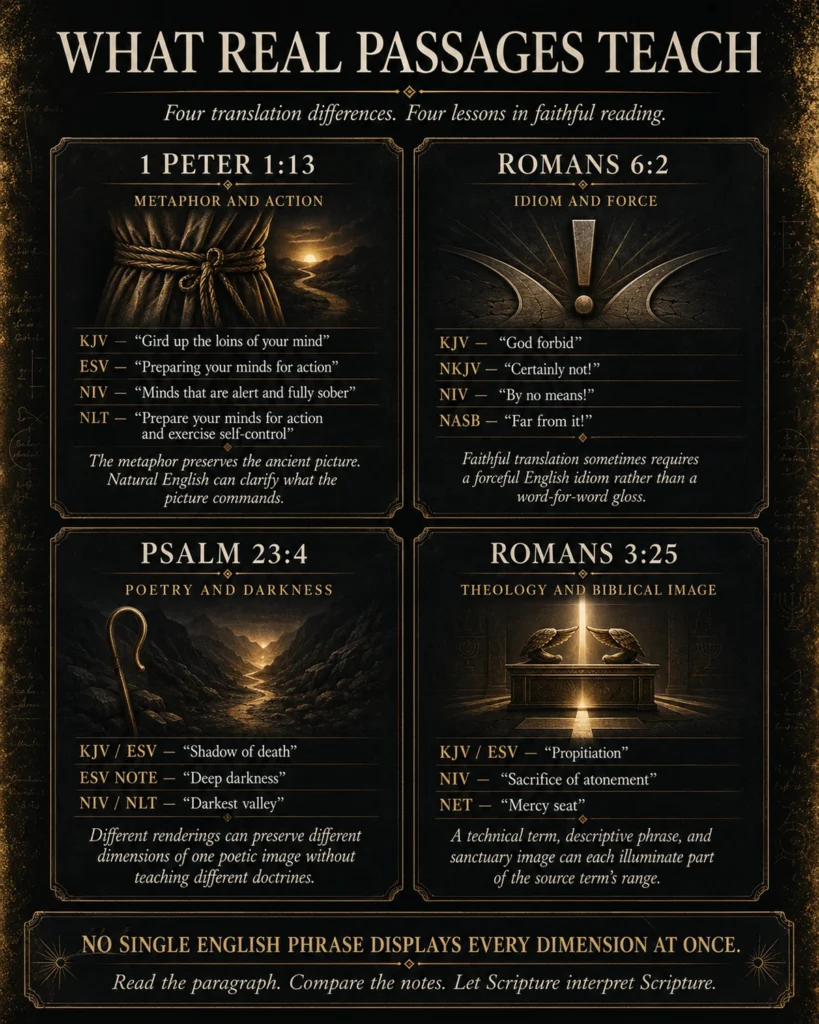
The KJV preserves “gird up the loins of your mind.” The picture comes from gathering long garments so a person can move or work. It is vivid once explained, but a modern reader who has never girded a garment may hear religious-sounding words without recognizing the command.
The ESV has “preparing your minds for action,” communicating the image’s force in formal current English while placing the literal Greek picture in a footnote. The NIV 2011 says “with minds that are alert and fully sober,” foregrounding mental readiness and sobriety. The NLT says “prepare your minds for action and exercise self-control,” making the practical commands explicit.
The KJV makes the ancient metaphor most visible. The ESV carries its force while preserving a formal tone. The NIV highlights the state of alertness. The NLT gives immediate behavioral clarity. A reader may need both the image and the intended action. Compare 1 Peter 1:13 in context.
The comparison also shows what a footnote can do. The ESV main text communicates the action while its note preserves the literal image. That division of labor lets a translation remain readable without pretending the metaphor never existed. A KJV reader receives the image in the line but may need a teacher or note to recover its cultural function.
The command’s purpose remains shared: disciplined hope and readiness as believers await Christ’s revelation.
Lesson: Formal wording can preserve the metaphor, while natural wording can help a modern reader understand what the metaphor commands.
Romans 6:2: The KJV Uses an English Idiom
The KJV answers Paul’s question with “God forbid.” The Greek expression is a forceful rejection, but it does not contain a Greek word meaning “God.” The translators used an effective English idiom of their period rather than mechanically replacing each source word.
The NKJV says “Certainly not!” The NIV 2011 says “By no means!” The NASB 2020 says “Far from it!” Each seeks current English with comparable force. None needs to insert a theological disagreement to explain the difference.
This example corrects a common oversimplification. Formal translation still requires idiom, judgment, and target-language expression. The KJV’s choice was not dishonest because it was not a lexical gloss. It was translation. Modern versions do the same kind of work when they replace an expression that would not function naturally in English. Compare Romans 6:2 across versions.
The force matters as much as the dictionary. Paul is recoiling from the suggestion that grace encourages continued sin. A weak “no” would understate his rhetoric. “Certainly not,” “by no means,” and “far from it” differ in register, but each tries to reproduce emphatic rejection for its intended English audience.
The translations differ in idiom while preserving Paul’s rejection and the argument that follows.
Lesson: The KJV itself proves that faithful translation sometimes requires an idiomatic expression rather than a word-for-word gloss.
Psalm 23:4: Poetry, Darkness, and Death
The KJV and ESV use “the valley of the shadow of death.” The traditional line is powerful, memorable, and connected to centuries of prayer, grief, and Christian hope. It also presents one way of hearing a compact Hebrew expression.
The NIV 2011 and NLT use “the darkest valley.” The Hebrew can convey deep darkness or death-shadow, so the modern phrase communicates the semantic range without limiting the scene to imminent physical death. The NIV footnote preserves the traditional alternative, and the ESV footnote notes “deep darkness.”
Traditional resonance and lexical explanation are both legitimate concerns. A funeral congregation may hear the KJV line with extraordinary depth. A new reader may understand “darkest valley” more immediately as any place of profound danger or fear. Neither wording changes the psalm’s center: the shepherd is present. Compare Psalm 23:4 and read the footnotes.
Poetry resists reduction to a single gloss. “Shadow of death” carries sound, tradition, and mortality; “deep darkness” captures lexical breadth; “darkest valley” makes the emotional landscape immediate. Comparing them can enlarge understanding when the reader returns to the whole poem rather than treating one English phrase as a doctrinal contest.
The gain comes through comparison, not by declaring one poetic dimension illegitimate.
Lesson: Different translations may preserve different dimensions of the same poetic image without teaching different doctrines.
Romans 3:25: Propitiation, Atonement, and Mercy Seat
The KJV says Christ was set forth as “a propitiation through faith in his blood.” The ESV says “a propitiation by his blood, to be received by faith.” Propitiation preserves established theological vocabulary concerning God’s righteous judgment and the dealing with sin, but many readers need the term explained.
The NIV 2011 uses “a sacrifice of atonement, through the shedding of his blood,” communicating sacrificial function and making the blood reference explicit. Its footnote points to the atonement cover on the ark. The NET renders Christ “as the mercy seat accessible through faith,” foregrounding the possible Day of Atonement image and explaining the judgment at length in its notes.
The underlying Greek term has generated serious discussion. A technical word can preserve doctrinal vocabulary, a descriptive phrase can clarify sacrificial function, and a cultic image can connect the passage to Israel’s sanctuary. Each highlights something and requires readers to inspect context and notes. Compare the main versions, then examine the NET rendering and notes.
This is precisely where a reader should resist choosing by familiarity alone. Romans 3 develops God’s righteousness, human sin, redemption, blood, faith, and the passing over of former sins. The term must be heard inside that argument and against Israel’s sacrificial imagery. No short English label can display the entire discussion without explanation.
Here translation notes perform theological service by showing why serious interpreters hear related but distinct nuances.
Lesson: A technical term may preserve doctrinal vocabulary, while a descriptive phrase or cultic image may clarify another part of the source term’s range.
Why Some Christians Believe the KJV Is Best
A fair response begins by understanding why the KJV position can feel compelling. For many Christians, its words are joined to conversion, family worship, memorized Psalms, funerals, preaching, and a church community that treated Scripture with seriousness. Stability feels safer than a shelf of changing editions. Footnotes can look like uncertainty, and missing familiar verses can feel like subtraction.
The Strongest Serious Case
The most substantial KJV superiority argument is larger than nostalgia:
- Providential preservation: God promised to preserve His Word, so a stable text received by the church may appear more consistent with providence than a continually revised critical edition.
- Church reception: Byzantine manuscripts, the traditional printed Greek text, Reformation translations, and the KJV served churches for centuries.
- Numerical manuscript support: Most surviving Greek manuscripts are broadly Byzantine, which advocates see as evidence of sustained ecclesial preservation.
- Stability and unity: A common Bible supports shared preaching, worship, memorization, and family continuity.
- Formal and literary strength: The KJV preserves theological terms, repeated wording, elevated register, and memorable rhythm.
- Concern about modern methods: Some critics believe a small number of early manuscripts receive too much weight or that modern textual criticism operates with insufficient theological confidence.
- Familiar verses and Christological wording: Brackets, omissions, or shorter readings can appear to weaken doctrine.
- Copyright and commerce: The KJV’s relative openness in the United States can feel safer than publisher-controlled licensing.
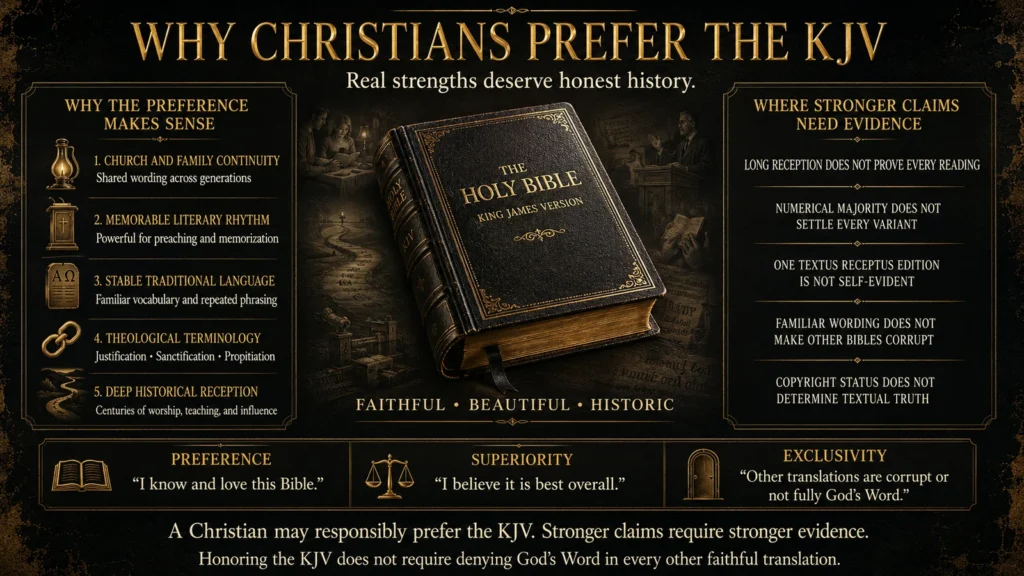
The Trinitarian Bible Society’s received-text position is useful for hearing this argument from advocates rather than from opponents. Preservation, reception, stability, and reverence are serious theological and pastoral concerns.
At its best, this case asks a legitimate question: if God intended the church to live by Scripture, what should Christians expect His preservation to look like in history? It resists a picture in which the true text disappeared until modern experts recovered it. It also warns that methods are never spiritually neutral merely because they use technical language.
The concern over stability deserves more than a shrug. Shared wording allows a congregation to recognize quotations, memorize together, and hear connections across decades. Frequent revision can exhaust readers and make a Bible feel temporary. The KJV’s long reception supplied a common English scriptural world whose pastoral value cannot be measured by a manuscript chart.
Traditional-text advocates also remind modern readers that later manuscripts are evidence, not rubbish. A reading’s wide Byzantine distribution may preserve an ancient line, and an early manuscript may contain a singular error. Responsible eclectic criticism already knows those principles, but popular defenses of modern translations sometimes speak as if “older” ends every inquiry.
There are also several forms of the preservation argument. Some defend the Byzantine text in general, some the Textus Receptus as a printed tradition, some a particular edition of the Textus Receptus, and some the English wording of the KJV itself. Those claims are not interchangeable. A numerical-majority argument cannot by itself prove a reading found only in part of the printed tradition, and a providential argument for Greek reception does not automatically establish one English rendering.
The KJV’s doctrinal vocabulary can be another genuine strength. Terms such as justification, sanctification, and propitiation connect passages to established theological reflection. Readers formed in that vocabulary may see relationships that a version with varied descriptive phrases makes less obvious. The fair question is not whether technical terms are bad, but whether the intended audience understands them and whether the underlying term has the same sense in every context.
Where the Case Overreaches
Preservation promises do not name one future English edition. The KJV itself was a revision of earlier Bibles, its translators consulted multiple sources, and common editions reflect later editorial standardization. The 1611 margins included alternate readings and translations, so footnotes are not a modern confession that Scripture has failed.
The Byzantine Majority Text and Textus Receptus are not identical. Textus Receptus editions also differ from one another. The nineteenth-century Scrivener text commonly printed today was reconstructed to represent the Greek readings behind the KJV, so using it to prove every KJV choice risks circular reasoning. A conservative evangelical critique of confessional Textus Receptus claims illustrates that disagreement is not simply liberal skepticism against faith.
Modern textual criticism uses far more than two famous codices. It weighs early and later manuscripts, versional evidence, patristic citations, geographic distribution, relationships, scribal habits, and internal context. No method is bias-free, but caricature does not test the evidence.
Church reception is meaningful without becoming infallible. Christians have received several textual forms, language traditions, and canonical arrangements across centuries. Popularity can witness to usefulness and providence, but it cannot prove every editorial reading. Otherwise competing forms would each become unquestionable wherever they achieved regional dominance.
Copyright is likewise a stewardship question, not a textual argument. The KJV’s U.S. public-domain status supports broad printing and quotation, while the Crown retains rights in the United Kingdom. Modern licenses can protect a stable text and fund committee work, though readers may fairly debate their terms. Neither openness nor restriction establishes which Greek reading is original.
The existence of ongoing critical work also need not imply that Scripture is unstable. Most variants are minor, and the places that demand sustained analysis are identifiable. A committee that updates a reading should explain its evidence; a traditional-text advocate should explain why reception or manuscript distribution outweighs competing evidence. Both sides owe readers arguments rather than alarms.
Finally, confidence in providence should encourage honest evidence, not fear it. If God has preserved His Word through a rich manuscript tradition, then examining that tradition is not an attempt to rescue Scripture from failure. The disagreement concerns how to weigh preserved witnesses, not whether God has spoken.
Modern translations also clearly proclaim Christ’s deity, incarnation, atoning death, resurrection, lordship, and return. A shorter reading in one location does not erase doctrines taught across Scripture. No central Christian doctrine rests only on one disputed textual variant.
Preference, Superiority, and Exclusivity
KJV preference says, “I know and love this Bible.” KJV superiority argues that its text, language, or stability makes it best overall. KJV-onlyism says other English translations are corrupt, dangerous, or not fully God’s Word. Those positions should not be collapsed.
A Christian may responsibly prefer the KJV. A church may use it for unity. Stronger claims require stronger evidence. KJV-onlyism is not required by Scripture, and it is difficult to reconcile with the KJV translators’ own respect for earlier translations, revision, and alternate renderings. Honoring the KJV does not require repeating claims its production history cannot support.
The healthiest conclusion is neither “the KJV is perfect” nor “the KJV is obsolete.” It is a faithful English Bible whose real virtues survive honest history. Readers can love its language, defend many of its choices, and still acknowledge that other committees possess genuine evidence and communicate God’s Word.
Is KJV-Onlyism a Denominational Belief?
KJV preference is often shaped by church tradition, but it is not simply the doctrine of one denomination. The KJV began as a Church of England translation. It later became deeply influential among Anglicans, Baptists, Methodists, Presbyterians, Pentecostals, evangelicals, and many others.
KJV-onlyism is especially visible in some Independent Fundamental Baptist, separatist fundamentalist, and highly traditional networks. It is not universal among Baptists, fundamentalists, Pentecostals, or conservative evangelicals. A church label alone cannot tell you what its members believe about translation.
Sociologists Samuel L. Perry and Joshua B. Grubbs study Bible versions as markers of religious subcultures. Their work helps explain how translation preference can signal belonging, authority, gender-language expectations, and cultural identity. It does not determine which text is best. It does show why a translation debate can feel like a dispute over family and faithfulness rather than vocabulary alone.
The pastoral response should separate identity from evidence gently. Ask what a person means by “only,” which preservation argument they hold, and whether they have read the KJV preface and notes. Respect for tradition creates room for honest examination; ridicule closes it.
Church leaders should also notice the social cost of sudden change. Replacing a pulpit Bible can affect memorization, responsive reading, and trust. Explain the reasons, demonstrate the new version in real passages, and preserve room for members who continue using a responsible older translation.
Do Modern Translations Remove Verses or Weaken Christ’s Deity?
Modern translations sometimes bracket a passage, place a familiar verse in a footnote, or use a shorter reading because their committees judge the manuscript evidence differently. That is a textual-basis question, not proof that translators dislike the verse. The KJV often follows readings found in later manuscripts and early printed editions; modern committees may prefer another reading supported by earlier or differently distributed witnesses.
This hub cannot conduct the full verse-by-verse trial. Mark 16:9-20, John 7:53-8:11, the Comma Johanneum, and other disputed texts require their own manuscript histories. Readers should inspect notes rather than infer motive from page layout.
Claims that modern Bibles systematically weaken Christ’s deity also fail as a broad description. The NIV, ESV, NASB, CSB, NLT, NRSVue, NET, and NABRE explicitly teach that the Son is divine, became incarnate, died for sins, rose bodily, reigns as Lord, and will return. Individual renderings can still be debated, but doctrine must be assessed across passages and source evidence.
Footnotes strengthen informed confidence by showing where copies differ. They allow the reader to see uncertainty instead of hiding it. A future specialist article can examine why verses are missing or bracketed without asking this broad comparison to carry every manuscript argument.
The right first response to a “missing verse” is therefore not panic or dismissal. Read the note, compare the surrounding argument, ask which manuscripts contain the wording, and check whether the teaching appears elsewhere. That method takes both evidence and doctrine more seriously than an accusation about motive.
Does Publisher Ownership Make a Translation Untrustworthy?
Every translation has an institutional home. The KJV began under royal and Church of England authority. The NKJV is associated with Thomas Nelson. Biblica stewards the NIV through the Committee on Bible Translation. Crossway oversees the ESV. The Lockman Foundation stewards the NASB. Holman and the Lifeway publishing world are associated with the CSB. Tyndale House supports the NLT. The NCC and SBL shaped the NRSVue. U.S. Catholic institutions sponsor the NABRE.
Institutional location matters because it can influence committee selection, canon, revision policy, style, terminology, licensing, and accountability. It does not prove corruption. A nonprofit can make poor decisions; a commercial publisher can support serious scholarship. Copyright can protect textual integrity and fund revision, while restrictive licensing can still deserve scrutiny.
A publisher can sponsor a translation, but no logo can make a rendering accurate or inaccurate. The evidence must be examined. Ask who governs wording, what charter or method constrains decisions, which texts are used, how dissent is handled, whether alternatives are disclosed, and whether the actual result communicates Scripture faithfully.
Independence also has degrees. Biblica says publishers cannot dictate NIV wording, while Crossway’s Translation Oversight Committee operates under its board. Catholic translations answer to ecclesial authorities. Those structures should be described accurately and then tested by their published decisions, not converted into automatic praise or suspicion.
Which Translation Is Best for Your Purpose?
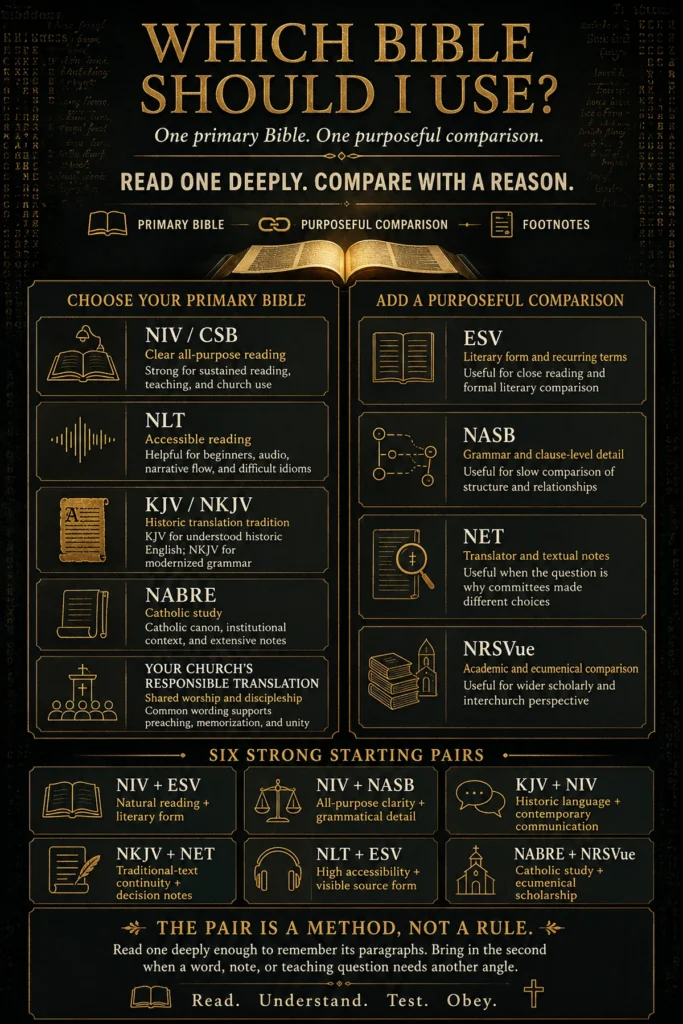
One Bible does not need to perform every task equally well. Choose a primary translation you can understand and use deeply, then add a comparison version for a defined reason.
Primary Reading and Teaching
The NIV is the best general recommendation for most Paranoid Prophet readers. It is clear enough for sustained reading, serious enough for teaching, and broad enough for church use. The CSB is an excellent alternative for readers who want a somewhat more formally visible balance.
Close Formal Comparison
Use the ESV to trace literary form, repeated vocabulary, and traditional theological terms. Use the NASB for grammatical transparency and slow clause-level comparison. Neither should be mistaken for the source text itself.
KJV Tradition
Use the KJV when its English is genuinely understood and its historic register supports worship or memorization. Use the NKJV when you want that lineage without most archaic grammar and with notes identifying major textual differences.
Accessible Reading
Use the NLT for beginners, younger readers, audio, devotional reading, narrative flow, or passages whose idioms remain opaque. Pair it with the NIV, ESV, or NASB for detailed study. Do not dismiss it as a paraphrase.
Translation Transparency
Use the NET when the important question is why committees differ. Its notes expose textual, lexical, and grammatical reasoning that most Bibles cannot fit on the page.
Academic, Ecumenical, and Catholic Study
Use the NRSVue for ecumenical and academic comparison, remembering that its inclusive-language decisions are part of its method. Use the NABRE for Catholic study, Catholic canon, and extensive notes. Identify which canon and edition you are using.
Church Unity
Follow the responsible translation your congregation reads publicly. Shared wording helps worship, sermon following, memorization, and discipleship. That practical unity does not make a version uniquely inspired. A church can share one pulpit text while encouraging careful comparison in study.
A Practical Two-Bible Pattern
For most readers, begin with one of these pairings:
- NIV plus ESV: natural reading with formal literary comparison.
- NIV plus NASB: all-purpose clarity with close grammatical comparison.
- KJV plus NIV: historic language beside contemporary communication.
- NKJV plus NET: traditional-text continuity with extensive decision notes.
- NLT plus ESV: high accessibility beside visible source form.
- NABRE plus NRSVue: Catholic study alongside broad ecumenical scholarship.
The pair is a method, not a rule. Read one deeply enough to remember its paragraphs. Bring in the second when a word, note, or teaching question needs another angle. More versions do not automatically create more insight; purposeful contrast does.
How to Compare Bible Translations Responsibly
Comparison should deepen reading, not become a way to shop for the wording you already prefer.
- Read the whole paragraph in your primary translation before comparing one verse.
- Identify the author’s argument, genre, audience, and historical setting.
- Compare one more formal translation and one meaning-based translation.
- Read every textual and translation footnote.
- Ask whether the difference concerns source wording, English method, or both.
- Consult NET notes or a reliable commentary when the issue is difficult.
- Use Hebrew and Greek tools with humility; dictionary glosses do not replace grammar or context.
- Never build a major doctrine on one unusual English phrase.
When versions disagree sharply, write down the exact difference before consulting a commentary. Is the subject different? Is a metaphor explained? Has a line moved to a footnote? Does one version use a technical term? This discipline prevents a vague feeling of contradiction from outrunning the evidence.
Then compare the conclusion with the whole book. A rendering of Romans should serve Paul’s argument in Romans. A Psalm should remain poetry. A Gospel line should fit the scene and the evangelist’s vocabulary. Translation comparison is not a contest of isolated snippets.
Do not assume harder English is holier, easier English is less faithful, or majority wording is automatically original. Do not switch versions until one says what you hoped. Let comparison expose your assumptions as well as the translators’ decisions.
Paranoid Prophet’s Recommendation
Paranoid Prophet will continue using the NIV 2011 for ordinary reader-facing quotations. It offers a strong balance of accuracy, clarity, international scholarship, committee process, and contemporary English. That choice is a practical editorial judgment, not a declaration that the NIV wins every verse.
For close study, compare the ESV or NASB. Use NET notes when a claim depends on a disputed phrase. Use the NLT to restore clarity when inherited wording has become opaque. Respect readers and churches formed by the KJV, and use the NKJV as a bridge where appropriate. Consult the NRSVue and NABRE when ecumenical, academic, or Catholic context matters.
This recommendation rests on our broader conviction that faithful translations genuinely communicate the true and authoritative Word of God. Read what Paranoid Prophet believes about Scripture.
The recommendation may change in detail as editions develop, but its governing method should not: use a clear primary text, compare responsibly, disclose uncertainty, and let no publisher’s claim replace examination.
Frequently Asked Questions
Which Bible translation is most accurate?
No version is most accurate in every dimension and passage. The NIV is a strong primary Bible for most readers; the ESV and NASB offer close formal comparison; the NET makes decisions unusually visible.
Is the KJV the best Bible translation?
It is faithful, beautiful, memorable, and historically monumental. It is not uniquely inspired or automatically clearest and most accurate in every passage.
Is the NIV reliable?
Yes. It is a responsible committee translation and an excellent primary Bible. Compare another version when an argument depends on one phrase.
Is the NLT a translation or paraphrase?
It is a translation produced by scholar teams from Hebrew, Aramaic, and Greek. Its meaning-based method is more interpretive than formal versions.
Which Bible is easiest to understand?
The NLT is especially accessible. The NIV and CSB combine current English with somewhat greater formal visibility.
Which translation is best for study?
Use a readable primary version plus the ESV or NASB, footnotes, NET notes, and reliable commentaries. No English Bible replaces disciplined context.
Why do translations use different words?
They may choose different source readings, understand a word or grammar differently, or express the same source meaning through different English methods.
Should Christians read more than one translation?
Yes, especially when interpretation depends on one phrase. Deep reading of one primary Bible plus purposeful comparison is better than constant shallow switching.
Sources and Further Reading
- Gordon D. Fee and Mark L. Strauss, How to Choose a Translation for All Its Worth.
- Samuel L. Perry and Joshua B. Grubbs, “Bible Translations as Markers of Religious Subcultures”, Sociology of Religion 81.3.
- Biblica on the NIV translation process.
- ESV preface and textual basis.
- NLT translation process.
- Friendship Press on the NRSVue.
- USCCB on the NABRE.
- NET Bible preface and principles.
- Trinitarian Bible Society on the Received Text.
Scripture Quotation Notices
Short comparison phrases are quoted solely to identify translation choices.
- NIV: Scripture taken from the Holy Bible, NEW INTERNATIONAL VERSION®, NIV®. Copyright © 1973, 1978, 1984, 2011 by Biblica, Inc.® Used by permission. All rights reserved worldwide. NEW INTERNATIONAL VERSION® and NIV® are registered trademarks of Biblica, Inc.
- ESV: Scripture quotations marked ESV are from the ESV® Bible (The Holy Bible, English Standard Version®), © 2001 by Crossway, a publishing ministry of Good News Publishers. Used by permission. All rights reserved.
- NASB 2020: Scripture quotations taken from the NASB® New American Standard Bible®, Copyright © 2020 by The Lockman Foundation. Used by permission. All rights reserved. www.Lockman.org.
- NKJV: Scripture taken from the New King James Version®. Copyright © 1982 by Thomas Nelson. Used by permission. All rights reserved.
- NLT: Scripture quotations marked NLT are taken from the Holy Bible, New Living Translation, copyright © 1996, 2004, 2015 by Tyndale House Foundation. Used by permission of Tyndale House Publishers, Carol Stream, Illinois 60188. All rights reserved.
- NET: Quotations designated NET are from the NET Bible® copyright © 1996, 2019 by Biblical Studies Press, L.L.C. netbible.com. All rights reserved.
- KJV: King James Version quotations are public domain in the United States.
The Best Translation Leads You to Christ
Translation is an act of service. Committees compare manuscripts, study grammar, test words, revise sentences, and disclose uncertainty so readers can hear the prophetic and apostolic witness in a language they understand. Their work should be examined carefully and received gratefully, but no committee, publisher, philosophy, or English edition stands above the Scripture it serves.

Jesus Christ is the eternal Son, the Word made flesh, the crucified Savior, the risen Lord, and the coming King. Faithful translations serve Scripture’s witness to Him; they must never become objects of worship. The best use of any Bible is to hear His voice in the written Word, trust His saving work, obey His teaching, and proclaim His name.