
GUIDED ARTICLE EXPERIENCE
How Did We Get the Bible? Who Wrote It, Chose the Books, and Preserved the Text
Read along as the narration moves through the article.
Private device narration · No hosted audio or tracking
CONTINUE GUIDED TOUR
Continue where you left off.
GUIDED TOUR COMPLETE
You have reached the end of this study.
Study record saved on this device.
GUIDED TOUR
How Did We Get the Bible? Who Wrote It, Chose the Books, and Preserved the Text
Narrator: Paranoid Prophet Recommended Voice Native device narration
Prepare to follow the article as it is narrated.
VOICE & TOUR OPTIONS
Voice & Listening
NARRATOR
Finding a narrator…
Checking the best narrator available on this device.
Restores the best curated narrator available on this device.
Narrator choices are curated for clear, long-form listening on this device.
Screen-awake support will be checked when narration starts.
CHOOSE A NARRATOR
Curated for this device
Choose a verified narrator for this browser, or use System Narrator. Automatic mode uses the best reliable route exposed by this device; your chosen narrator is preserved even if this device needs a temporary fallback.
Preparing the guided article experience…
RESUME GUIDED TOUR?
Continue where you left off.
GUIDED TOUR COMPLETE
You have reached the end of this study.
A Bible can be held in one hand. Its table of contents looks settled, its pages run in order, and its binding makes dozens of writings feel like one book. Hidden inside that familiar object is a history stretching across centuries: prophets spoke, poets composed, scribes copied, apostles wrote, churches exchanged texts, communities argued over boundaries, and translators carried ancient words into new languages.
How did we get the Bible? The honest answer is neither magical nor conspiratorial. It did not descend as a finished volume, and it did not emerge from one secret vote. Its history is public, human, sometimes untidy, and inseparable from the Christian claim that God worked through those real events. This account follows the evidence under the same Sources and Verification standard used across Paranoid Prophet: sources must be allowed to say what they establish, and uncertainty must remain visible where the evidence stops.
Paranoid Prophet receives the sixty-six books of the Protestant Bible as Holy Scripture and normally quotes the New International Version (NIV). Catholic, Orthodox, Jewish, and scholarly positions are represented here so their evidence can be examined fairly; their inclusion does not mean that every canon claim is treated as equally authoritative. Scripture remains the final standard, and the purpose of this history is to understand how the prophetic and apostolic witness reached us.
Article Guide16 sections
Short Answer: How Did We Get the Bible?
One Bible, many books, centuries of history
The Bible is a library written by many human authors in different periods, places, languages, and genres. Its pages include covenant law, narrative, poetry, wisdom, prophecy, Gospel testimony, letters, and apocalypse. Christians confess that these authors truly wrote while God acted through them. Inspiration does not erase Moses’ legal instruction, Davidic poetry, Jeremiah’s anguish, Luke’s research, Paul’s argument, or John’s distinctive voice.
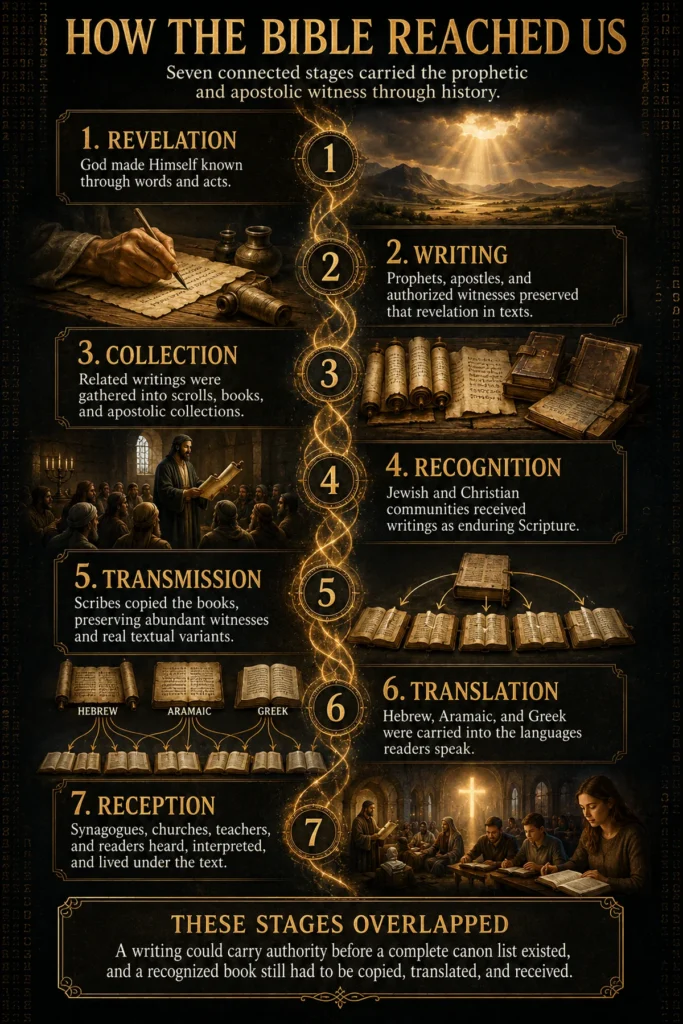
The process can be oriented through seven connected stages:
- Revelation: God made Himself known through words and acts.
- Writing: Prophets, apostles, and other authorized witnesses preserved that revelation in texts.
- Collection: Communities gathered related writings such as Torah scrolls, prophetic books, Psalms, Gospels, and apostolic letters.
- Recognition: Jewish and Christian communities judged which writings carried enduring scriptural authority.
- Transmission: Scribes copied the books before printing, leaving abundant witnesses and real variants.
- Translation: Hebrew, Aramaic, and Greek texts were carried into the languages readers speak.
- Interpretation and reception: Synagogues, churches, teachers, and ordinary readers heard, taught, debated, and lived under the text.
These stages overlapped. A writing could function authoritatively before a complete list existed, and a collected book still had to be copied. Christians believe the church recognized prophetic and apostolic writings rather than making merely human books inspired, though recognition required genuine judgment.
The church recognized a canon it did not create from nothing
The Greek word kanon came to mean a rule or norm and, eventually, the bounded collection of scriptural books. Christians often summarize the history by saying the church recognized the canon rather than creating it. That preserves an essential theological conviction: divine authority comes from God, not from a bishop’s vote.
The sentence needs historical texture. Churches copied books, read them in worship, compared them with inherited teaching, examined claims to apostolic connection, debated difficult cases, issued lists, and made conciliar decisions. Christian traditions interpret the authority of those actions differently, but none can tell the story without the communities that carried the writings.
A major center came into view before every edge was settled. Israel’s Torah and Prophets were authoritative long before Christians existed. The four Gospels and a substantial Pauline collection circulated before fourth-century councils. Later lists did not choose among equal strangers; they clarified boundaries around a body of literature already embedded in worship and teaching.
Preservation and translation without perfect-copy myths
No known biblical autograph survives. Hand copying produced differences, and some are important enough to affect how a passage is read. The existence of variants is not evidence that the text vanished. It is evidence that the manuscript history survived and can be compared. Modern editions identify both well-supported wording and places where confidence is lower.
Translation also requires judgment. English cannot reproduce every feature of Hebrew poetry, Aramaic expression, or Greek syntax with one-to-one substitutions. A responsible translation truly communicates Scripture while remaining a translation, not a fresh act of inspiration in every editorial choice.
That is the short answer. The Bible reached modern readers through revelation, writing, collection, recognition, copying, translation, and reception. The rest of the history explains why those stages deserve trust without asking them to become simpler than they were.
The Bible Did Not Arrive as a Finished Volume
Revelation, inspiration, Scripture, and canon
Several terms often collapse into the single question, “Where did the Bible come from?” They answer different questions.
Revelation is God’s act of making Himself known. Christians believe creation discloses His power, while His saving identity and purpose are made known through covenant, prophetic speech, redemptive events, and supremely Jesus Christ. A fuller account begins with how God makes Himself known.
Inspiration describes God’s action through human authors in the production of Scripture. Second Timothy calls Scripture “God-breathed” and connects it to salvation, teaching, correction, training, and faithful action (2 Timothy 3:14-17). Inspiration is not a claim that every writer received verbal dictation or lost his historical personality.
Scripture names writings received as God’s authoritative word within the covenant community. Canon names the recognized body of those writings. A text’s divine authority, its first use as Scripture, and its appearance in a surviving complete canon list are related facts, but they are not the same date.
Writing, collection, transmission, and translation
The Bible itself shows revelation becoming text. Covenant words are written and read publicly in Exodus. Deuteronomy depicts Moses giving written Torah to priests and commanding its recurring public reading. Jeremiah dictates prophetic words to Baruch; after a king destroys the scroll, the words are written again with additional material. These scenes are theological claims inside Scripture, yet they also refuse the idea of a book untouched by ordinary historical means.
Collection came next and often happened in smaller units. Laws, prophetic scrolls, songs, proverbs, Gospel traditions, and letters were gathered before anyone possessed one codex resembling a modern Bible. Transmission continued the process as each text was copied. Translation began within the biblical world itself and became essential as Jewish and Christian communities crossed linguistic boundaries.
Interpretation is another stage, not a contaminant added only by modern readers. Nehemiah 8 joins reading with explanation. Jesus interprets Israel’s Scriptures. The apostles argue from them. Translators choose among possible meanings, and readers bring questions that must be disciplined by context. Illumination, in Christian theology, is the Spirit’s work enabling people to understand and receive the Word; it is not permission to replace the text with private impressions.
Why authority can precede a final list
A nation does not need a complete archive before the first covenant document can bind it. A church does not need every future apostolic letter before a received letter can be read publicly. That principle makes the evidence easier to understand.
The absence of an early surviving table of contents does not prove that no writing carried scriptural authority. Conversely, age, popularity, or religious usefulness alone does not make a work canonical. The historical task is to trace both realities: writings acting as authoritative before complete lists, and communities eventually drawing boundaries around that authority.
Once these categories are kept distinct, the story can begin where the Christian Bible begins—with Israel’s covenant Scriptures.
How Israel’s Scriptures Took Shape
Torah at the center of covenant life
The Torah occupied a foundational position in Israel. Biblical narratives present covenant commands being written, preserved beside the ark, taught to children, read at national gatherings, and recovered during periods of reform. Nehemiah 8 depicts the returned community gathering around the book of the Law, hearing it read, receiving explanation, and ordering communal life under it.
Historians debate the composition and editing of Pentateuchal materials. This hub cannot settle every source theory, and Christian trust does not require pretending that each layer can be dated with certainty. The more modest point is strong: Torah held defining authority in Israel’s covenant identity and supplied the frame within which later prophets, wisdom, worship, and history were heard.
The Law, the Prophets, and other ancestral books
By the late second century BC, the Greek Prologue to Sirach referred to “the Law,” “the Prophets,” and other ancestral books. The prologue also comments on the difficulty of carrying Hebrew expression into another language. It therefore witnesses both to differentiated inherited collections and to ancient translation awareness.
It does not provide a named final list. Luke 24:44 later speaks of the Law of Moses, the Prophets, and the Psalms, reflecting a recognizable tripartite orientation. That language shows a scriptural heritage with shape and depth, while leaving modern arguments over every boundary to additional evidence.
Qumran: a stable center with real textual plurality
The Dead Sea Scrolls move the evidence from later codices into the Second Temple period. The caves preserve copies of nearly every book later found in the Hebrew Bible, with especially frequent witnesses to Psalms, Deuteronomy, Isaiah, and Genesis. They also preserve Tobit, Sirach, Enoch, Jubilees, community rules, hymns, interpretations, and other religious works.
Calling the whole Qumran library a canon would mistake possession for authority. A modern pastor’s shelf contains sermons, commentaries, and Scripture without assigning all three the same status. The scrolls do show a substantial scriptural center inside a wider literary world.
They also show continuity and variation together. The Great Isaiah Scroll preserves the complete book in its familiar order with extensive agreement in content. Other witnesses align more closely with the Hebrew tradition behind the Septuagint, the Samaritan Pentateuch, or distinct literary editions. The official Dead Sea Scrolls archive allows the surviving evidence to be inspected rather than reduced to a slogan.
Josephus’s twenty-two and 4 Ezra’s twenty-four
Near the end of the first century, Josephus described twenty-two trusted books: five associated with Moses, thirteen prophetic books, and four containing hymns and moral instruction. His count probably overlaps substantially with the later Hebrew collection, whose books can be grouped and counted differently. He does not name each title, so he cannot simply be quoted as holding a modern Protestant table of contents.
Around the same period, 4 Ezra 14 speaks of twenty-four books made public and seventy reserved for the wise. Its literary vision is not a Christian doctrine of canon, and the twenty-four are not listed. It is still valuable evidence that a numbered public collection could coexist with claims of additional revelation.
No surviving source supplies one early universal table of contents for every Jewish community. The evidence instead shows Torah at the center, recognized prophetic and ancestral collections, a substantial common inheritance, and some continuing plurality of books and textual forms. That history prepares the next question: if Christians inherited Israel’s Scriptures, why did their Old Testament boundaries eventually differ?
Why Christian Old Testaments Do Not All Contain the Same Books
What the Septuagint was—and was not
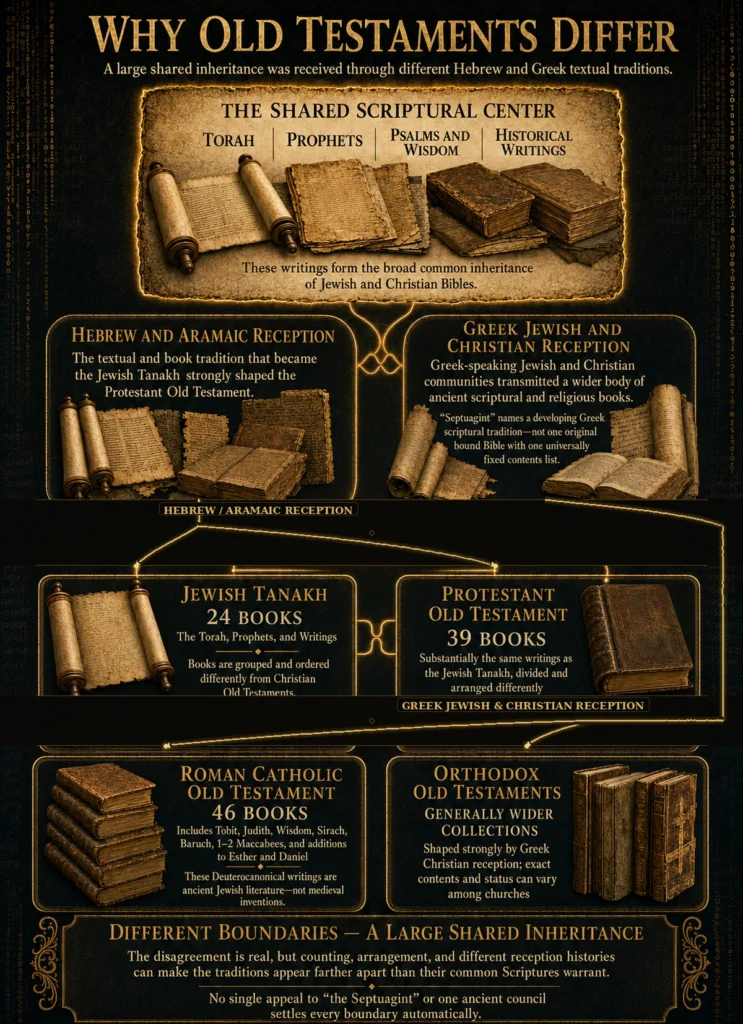
Christianity inherited Israel’s Scriptures in more than one linguistic stream. The Torah was translated into Greek beginning centuries before Christ, and other books followed over time. “Septuagint” now serves as an umbrella term for this Greek scriptural tradition. It was not one original bound codex issued with the precise contents of a later Catholic or Orthodox Bible. Surviving Greek manuscripts also differ in contents, arrangement, and the status implied by placement.
New Testament authors frequently used Greek Jewish Scripture, but their citation practices vary. Greek-speaking churches naturally continued reading those texts, and surviving Christian codices sometimes contain books beyond the later rabbinic Jewish collection. That history helps explain wider Christian Old Testaments. It does not allow one appeal to “the Septuagint” to settle every boundary automatically.
The shared core and the disputed books
Jewish, Catholic, Orthodox, and Protestant collections share the Torah, Prophets, Psalms, wisdom, and historical books that form the Old Testament’s broad center. Counting conventions can obscure the overlap. The Jewish twenty-four-book Tanakh and the Protestant thirty-nine-book Old Testament contain substantially the same writings, arranged and divided differently.
Roman Catholic Bibles receive forty-six Old Testament books, including Tobit, Judith, Wisdom, Sirach, Baruch, 1-2 Maccabees, and additions to Esther and Daniel. These Deuterocanonical writings are ancient Jewish literature, not medieval inventions. Eastern Orthodox collections are generally wider and shaped by Greek reception, while exact lists and status categories can vary among churches.
The differences matter. They affect liturgical reading, doctrinal argument, and the history each tradition claims. They do not mean that Christians possess unrelated Old Testaments.
Protestant, Catholic, and Orthodox reception
The strongest Catholic account emphasizes that Scripture was received within apostolic Tradition and that church authority definitively identified the canon it had long used. Trent did not discover the Deuterocanonical books in the sixteenth century; it reaffirmed a longstanding Catholic boundary amid Reformation dispute.
Orthodox Christians usually resist treating canon as an abstract list detached from worship. Scripture lives within Holy Tradition, and the Greek scriptural inheritance has enduring weight. Yet “the Orthodox canon” should not be spoken of as though every jurisdiction has always printed an identical table of contents.
The classic Protestant account receives the Hebrew collection as the normative Old Testament and treats other ancient books as useful but not a basis for doctrine. Reformers did not encounter one uncontested universal list and casually remove seven books. Their decision was a theological and historical judgment, and Catholics and Orthodox Christians dispute it. The Westminster Confession states the mature Reformed position; the USCCB book list and an Orthodox Church in America explanation show the other traditions in their own words.
This hub need not pronounce every Deuterocanonical dispute settled. Fair history can identify the common inheritance, the divergent Hebrew and Greek reception paths, and the different authority models brought to the boundary.
Why the Council of Jamnia story fails
Older accounts often said a Jewish council at Jamnia or Yavneh closed the Old Testament around AD 90. No ancient record describes such a canon vote. Rabbinic discussions of Ecclesiastes, Song of Songs, Esther, and other writings matter, but they do not reveal one meeting that created a final Jewish Bible.
The evidence points instead to long use, debate, and consolidation. Christianity entered that still-textured world, inherited Israel’s Scriptures, and then produced a new body of witness centered on Jesus.
How the New Testament Writings Began
Apostolic preaching came before a completed New Testament
The New Testament began with events and proclamation: Jesus’ ministry, crucifixion, the conviction that God raised Him, and the apostolic announcement of forgiveness in His name. Churches worshiped, baptized, remembered Jesus’ teaching, and interpreted Israel’s Scriptures before the twenty-seven books existed as a collection.
Writing began within that first generation. The opening of Luke describes earlier accounts, eyewitness tradition, investigation, and an ordered narrative (Luke 1:1-4). John openly says his Gospel is selective and written so readers may believe Jesus is the Messiah and Son of God. The Gospels are theological testimony, but theological purpose does not make them detached from claimed events and witnesses.
Paul’s letters were read, preserved, and exchanged
Paul wrote to particular churches about particular crises. Those letters were not intended to vanish after one reading. First Thessalonians commands that the letter be read to the whole church. Colossians describes an exchange with Laodicea, though Pauline authorship of Colossians remains debated. Second Peter refers to a collection of Paul’s letters alongside “other Scriptures,” but its date and authorship are among the hardest New Testament questions.
By the end of the first century, First Clement 47 could tell Corinth to consult Paul’s earlier epistle about its divisions. A local letter retained authority after its immediate occasion because it bore apostolic instruction the church judged worth preserving.
Why written Gospels were produced
Oral proclamation and written testimony were partners, not enemies. Memory, teaching, worship, and eyewitness report circulated in communities; writing stabilized and extended witness across distance and generations. Luke explains a purpose of orderly assurance. John names saving belief. Mark and Matthew shape Jesus’ ministry, death, and resurrection for communities that needed the story proclaimed as witnesses died and the mission spread.
The Gospel narratives do not name their authors within their main text, although early manuscript titles and church traditions attribute them to Matthew, Mark, Luke, and John. Those traditions matter, but the full authorship debate also requires internal evidence, source relationships, and the history of reception. The historical question cannot be solved by calling the books either obvious eyewitness diaries or anonymous legends.
Written witness entered public worship
By the middle of the second century, Justin Martyr described Christians gathering on Sunday to hear the “memoirs of the apostles” or the writings of the prophets read aloud. The reading was followed by instruction and exhortation, common prayer, Eucharistic thanksgiving, and care for people in need. Elsewhere Justin calls those memoirs Gospels. He does not give a neat list of four titles here, so the passage cannot prove universal agreement by itself.
It does show that written apostolic testimony was already shaping the worship and moral formation of ordinary Christians long before Nicaea. Many believers encountered Scripture primarily by hearing it in the gathered church rather than by owning a private codex. Authority, public reading, and circulation were already at work; the remaining history concerns how individual writings became recognizable collections.
How the Gospels and Letters Became Collections
Ignatius, Polycarp, Papias, and the early church network
Early Christian letters reveal a network extending through Syria, Asia Minor, Macedonia, Rome, and beyond. Ignatius draws extensively on apostolic traditions as he writes to several churches. Polycarp reminds Philippi of Paul’s letter and forwards a requested collection of Ignatius’s correspondence. Texts moved because churches were connected.
Papias, known mainly through later quotations in Eusebius, preserves traditions connecting Mark with Peter and Matthew with collected sayings. His lost work cannot settle the modern Gospel-authorship debate. It does show second-century Christians evaluating Jesus traditions through apostolic connection, memory, order, and truthfulness.
Marcion and the pressure to define boundaries
Around the middle of the second century, Marcion used one Gospel related to Luke and ten Pauline letters while rejecting Israel’s Creator and Scriptures. His restricted collection did not invent Paul, the Gospel, or Christian Scripture. It demonstrates that Gospel and Pauline corpora already existed strongly enough to be edited, challenged, and contested.
Marcion’s pressure made boundaries urgent. Christians had to explain why his shortened texts and severed story did not preserve the apostolic gospel. Controversy accelerated clarification, but it did not create the literature being debated.
Irenaeus and the fourfold Gospel
Around AD 180, Irenaeus explicitly names Matthew, Mark, Luke, and John and defends a fourfold Gospel in churches spread across regions (Against Heresies 3.11). His analogy between four Gospels and four winds is theological rhetoric, not proof that history had to produce four. His testimony is evidence that the four-book collection was sufficiently established for him to defend against rival reduction and expansion.
Irenaeus did not invent those Gospels, and his confidence does not demonstrate simultaneous agreement in every church. It marks an important point in a process already visible in worship and interchurch exchange.
P45 and P46: collections that survive physically
Manuscripts turn literary history into physical evidence. P46, commonly dated around AD 200, preserves a substantial Pauline codex and places Hebrews after Romans. Its damaged final contents require reconstruction, so it should not be called a complete edition of every Pauline letter. It nevertheless proves that Christians gathered a large Pauline corpus in one book before Nicaea.
P45, from the third century, preserves portions of Matthew, Mark, Luke, John, and Acts from one codex. It is fragmentary, not a complete four-Gospel Bible, yet its original collection is materially significant.
By then Christians did not merely possess scattered writings. Gospels and letters were being copied as collections, read across regions, and defended as apostolic witness. A major core was visible before universal agreement on every remaining book. Those disputed edges reveal how recognition actually worked.
Who Decided Which Books Belonged in the Bible?
Recognition was real human judgment
No single bishop, emperor, or council sat down with a pile of Christian books and created the New Testament. Churches made judgments over time. Pastors read writings in worship, teachers cited them, copyists grouped them, and neighboring churches compared what they had received. Bishops and councils later stated boundaries, sometimes amid remaining disagreement.
Calling this process “recognition” is useful because the church did not believe it gave inspired books their authority. It sought to receive writings that already carried apostolic authority. Yet recognition should not be made to sound effortless or invisible. Christians used memory, testimony, theological judgment, debate, and institutional decisions. God’s providence, in the Christian account, worked through that plainly human history.
What early Christians looked for
Several concerns repeatedly overlapped. Was a writing connected to an apostle or the apostolic generation? Did its teaching fit the rule of faith churches had received about the Creator, Christ, salvation, and resurrection? Was it used broadly and publicly rather than guarded by a small circle? Had it shown enduring value in worship and instruction?
These were not four boxes invented at one council. Nor did every accepted book satisfy them in exactly the same way. Mark and Luke were associated with apostolic witnesses rather than numbered among the Twelve. Hebrews was valued deeply while its author remained uncertain. Revelation had a strong claim to prophetic authority but faced regional resistance. Widespread use carried weight, but local popularity alone could not make a book apostolic.
Eusebius gives a revealing early-fourth-century snapshot. In Ecclesiastical History 3.25, he distinguishes acknowledged, disputed, and rejected writings. His categories are not identical to a modern table of contents, but they show a recognized core and debated edges before Nicaea. They also show that church leaders did not conceal disagreement.
Different traditions explain the church’s role differently
Catholic and Orthodox Christians understand the canon within the authoritative life and Tradition of the church. On this account, believers know the canon not through historical reconstruction alone but through the Spirit-guided community that received, proclaimed, and defined it. Catholic theology gives particular weight to definitive magisterial judgment; Orthodox theology generally emphasizes conciliar and liturgical reception.
Protestants usually say the church recognized rather than constituted the canon, and that the Spirit enabled God’s people to receive the voice of Scripture. That protects Scripture from depending on a later institution for its authority. It also raises a fair question: historical evidence for reception still comes through the church whose testimony Protestants cannot simply ignore.
The traditions disagree about the final ground of certainty. They need not disagree that apostles wrote before councils ruled, that churches exercised judgment, or that public reception matters more than a hidden decree.
Why Were Some Books Disputed or Left Out?
Disputed did not mean condemned
Hebrews, James, 2 Peter, 2-3 John, Jude, and Revelation were disputed in some places. The reasons differed. Hebrews circulated without an agreed author, James and Jude had narrower early attestation, the brief letters of John traveled less widely, and Revelation’s symbolism and use by controversial movements prompted caution.
Second Peter remains the hardest case for many scholars because its style differs from 1 Peter, its relation to Jude is close, and its reception is comparatively late. A fair account does not hide that problem or leap from “disputed” to “forged.” Arguments continue about secretarial help, literary convention, authorship, and date. Canonical status and modern confidence about an attribution are related questions, but they are not identical.
Dispute could also travel by region. Revelation was strong in much of the West and questioned in parts of the Greek East. Hebrews was especially strong in the East and debated longer in the West. The eventual twenty-seven-book canon joins writings whose routes to broad reception were not uniform.
Useful Christian books could remain outside the canon
The Shepherd of Hermas, First Clement, the Didache, and the Epistle of Barnabas were respected by many Christians. Codex Sinaiticus even includes Barnabas and part of Hermas after the New Testament books; its contents can be inspected online. Their presence shows that an ancient codex could preserve valued church reading beyond the books later treated as canonical.
These writings were not excluded because everything in them was false. They lacked the same combination of apostolic connection, broad reception, and recognized scriptural authority. “Outside the canon” therefore covers several categories: honorable early Christian instruction, later devotional literature, works with uncertain origins, and texts whose theology churches judged incompatible with apostolic faith.
Later gospels do not all have the same historical claim
Works such as the Gospel of Thomas, Gospel of Peter, and Gospel of Judas deserve study as evidence for strands of early Christianity. Their titles do not establish apostolic authorship. Most survive in later manuscripts, are attested later than the four canonical Gospels, or present Jesus through theological worlds that differ sharply from the Jewish and first-century setting of the earliest proclamation.
That does not justify the slogan that church officials suppressed every rival because they feared questions. Some writings were known and criticized openly. The better comparison asks about date, sources, reception, theology, and historical proximity one work at a time.
The same discipline applies to books that fascinate modern readers. Jude’s use of a tradition found in 1 Enoch does not make the entire work canonical, just as Paul’s use of a pagan poet does not canonize that poet. A separate guide explains what the Book of Enoch is and why it matters without pretending every Christian tradition gives it the same status.
Ancient Christians did not accept every work merely because it carried an apostle’s name or offered useful teaching. They questioned provenance, compared doctrine, observed public use, and sometimes withheld judgment for generations. The disagreement was real, but it clustered around a limited number of writings at the edges. The four Gospels, Acts, major Pauline letters, and proclamation of Christ’s death and resurrection were already deeply embedded in Christian life.
Did Constantine or Nicaea Choose the Bible?
What the Council of Nicaea actually addressed
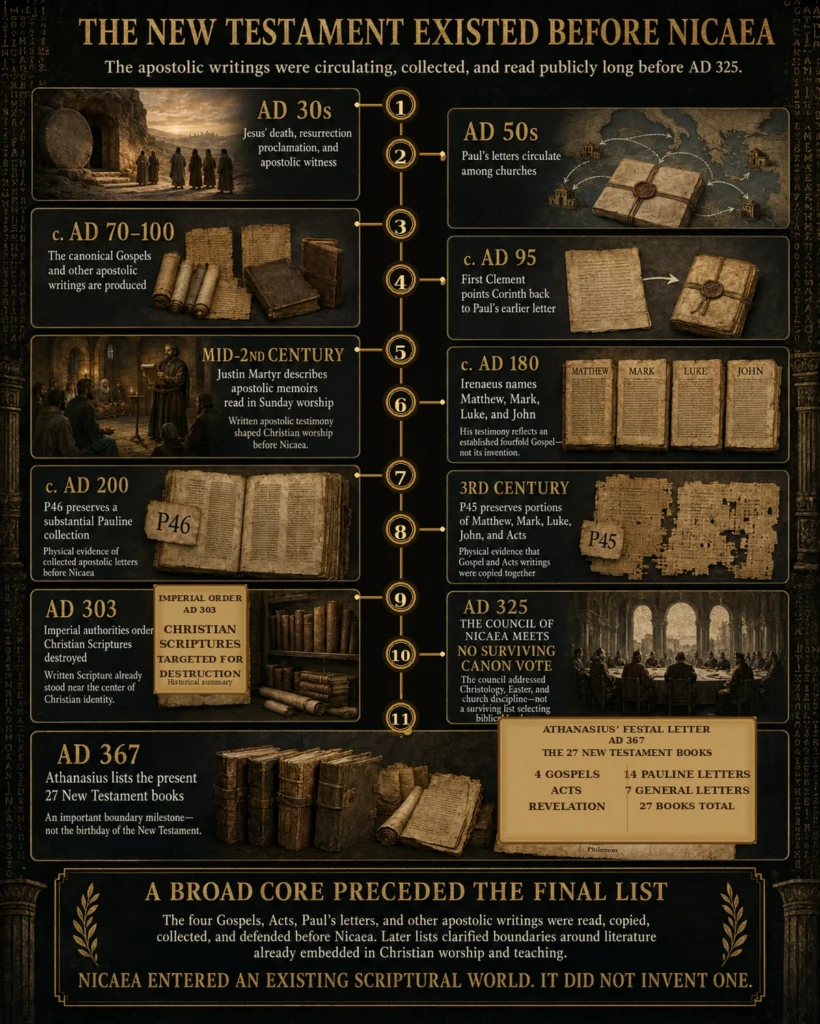
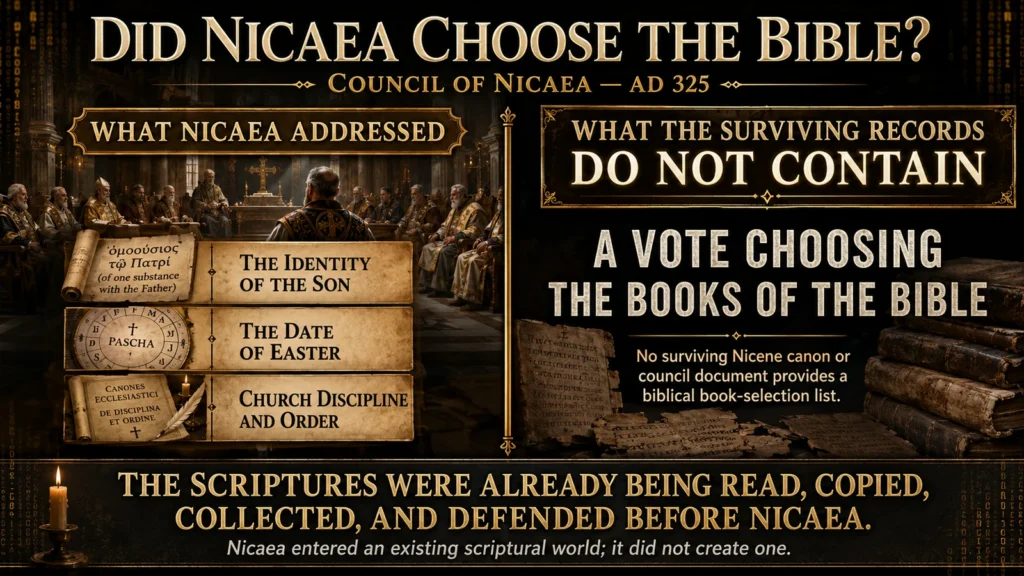
The First Council of Nicaea met in AD 325 chiefly because of conflict over the identity of the Son and His relation to the Father. It produced a creed, addressed the date of Easter, and issued disciplinary canons concerning clergy and church order. The surviving Nicene canons and documents contain no list selecting the books of the Bible.
More than two decades earlier, the Great Persecution had targeted Christian books directly. In Church History 8.2, Eusebius says he saw sacred Scriptures burned in public marketplaces and reports the AD 303 edict ordering churches leveled and Scriptures destroyed by fire. That evidence does not identify the precise contents of every local collection, but it shows that written Scripture already stood near the center of Christian corporate life. Before one emperor commissioned biblical codices, another government had tried to destroy them.
The popular story is nevertheless very specific: Constantine supposedly gathered bishops, chose politically useful books, and suppressed the rest. The primary evidence does not support it. Debate over Christian writings is visible both before and after 325, which would be strange if one imperial meeting had settled the matter.
Constantine later commissioned copies of Scripture for churches in his new capital. The precise contents of those codices are unknown. An imperial order for books is not evidence that the emperor invented their canon, and it should not be confused with the council’s agenda.
Why Athanasius’s AD 367 list matters
In his Thirty-Ninth Festal Letter, Athanasius names the same twenty-seven New Testament books used today. It is the earliest surviving document known to present that exact list. He also distinguishes books appointed for catechetical reading from canonical writings and warns against apocryphal works.
That is an important milestone, not a birthday. Athanasius wrote forty-two years after Nicaea, and the Gospels, Acts, Pauline corpus, and most other New Testament books had been received long before him. His list records and advocates a boundary in his setting; it did not instantly determine practice everywhere.
Agreement continued to consolidate after Nicaea
Cyril of Jerusalem’s mid-fourth-century catechetical list omits Revelation. The Council of Laodicea’s canonical rules discuss which writings may be read, but the authenticity of its final book list, Canon 60, is doubtful in the manuscript tradition (Laodicea texts). North African councils at Hippo and Carthage played a real regional role; the surviving Carthage record reflects a list close to later Catholic reception and asks for confirmation beyond the region.
These details do not reveal chaos. By the fourth century the central collection was remarkably stable, while a few edges and Old Testament boundaries still varied. Councils helped formalize consensus, settle local practice, and transmit judgments. None provides the missing scene in which one ruler secretly manufactured the Bible.
Formal lists are only one kind of evidence. Manuscripts show which works were copied together; lectionaries show what churches read; commentaries reveal which texts teachers expounded as Scripture; and translations show which books crossed linguistic borders. These witnesses do not always line up at the same date. That is precisely why a responsible history compares them instead of treating the first surviving list as the moment all Christians changed their minds. The canon became visible through repeated, public use as well as formal statements.
The honest history is less cinematic and more durable: texts rooted in apostolic witness circulated early, a broad core became entrenched, disputed books were examined, and communities reached deep agreement across time and distance. Christian Scriptures were being read, copied, collected, contested, and even targeted for destruction before Nicaea. The council entered an existing scriptural world; it did not invent one.
The next question is whether the wording of those books survived the copying required to carry them forward.
Has the Bible Been Changed Through Copying?
We do not possess the original sheets
No surviving manuscript is the physical page written by Moses, Isaiah, Paul, or a Gospel author. That is normal for ancient literature, but it should be said without evasion. The biblical books reached later readers because scribes copied them by hand, and hand copying introduced differences.
Some differences are accidental: spelling, word order, repeated or skipped lines, and confusion between similar words. Others are intentional in the limited sense that a scribe clarified grammar, harmonized parallel accounts, expanded a title, or inserted a familiar liturgical phrase. “Intentional” does not automatically mean a conspiracy to rewrite Christian belief. It means copying involved people capable of both mistakes and editorial judgment.
The result is not one perfect manuscript preserved in a vault. It is a large, geographically scattered body of evidence. The CSNTM manuscript catalogue lets readers inspect images and metadata for many Greek New Testament witnesses. Manuscript counts change as items are reclassified, joined, or discovered, so dramatic totals should be dated and qualified.
Ancient translations and quotations by early Christian writers provide additional checks. They are indirect and require care, but they can corroborate readings beyond surviving Greek copies.
The Old Testament has both continuity and textual plurality
Before the Dead Sea Scrolls were found, the earliest complete Hebrew Bible manuscripts available to scholars came from the medieval Masoretic tradition. Scrolls and fragments from the Judean Desert moved direct Hebrew evidence many centuries earlier. The official Dead Sea Scrolls archive makes that evidence publicly searchable.
The scrolls confirm substantial continuity. Isaiah at Qumran is recognizably the book known from later Hebrew manuscripts, not a lost religion with the same title. Yet the scrolls also preserve real variation. Some readings align more closely with the later Masoretic Text, some with the Hebrew underlying Greek translations, some with the Samaritan Pentateuch, and some are distinctive.
That combination matters. “The text was unchanged letter for letter” overstates the evidence. “The Bible was rewritten beyond recovery” ignores the stable identity and extensive overlap of the textual traditions. Modern Old Testament editions compare Masoretic manuscripts with the Dead Sea Scrolls, ancient translations, the Samaritan tradition where relevant, and other evidence rather than pretending only one witness exists.
More manuscripts reveal more variants
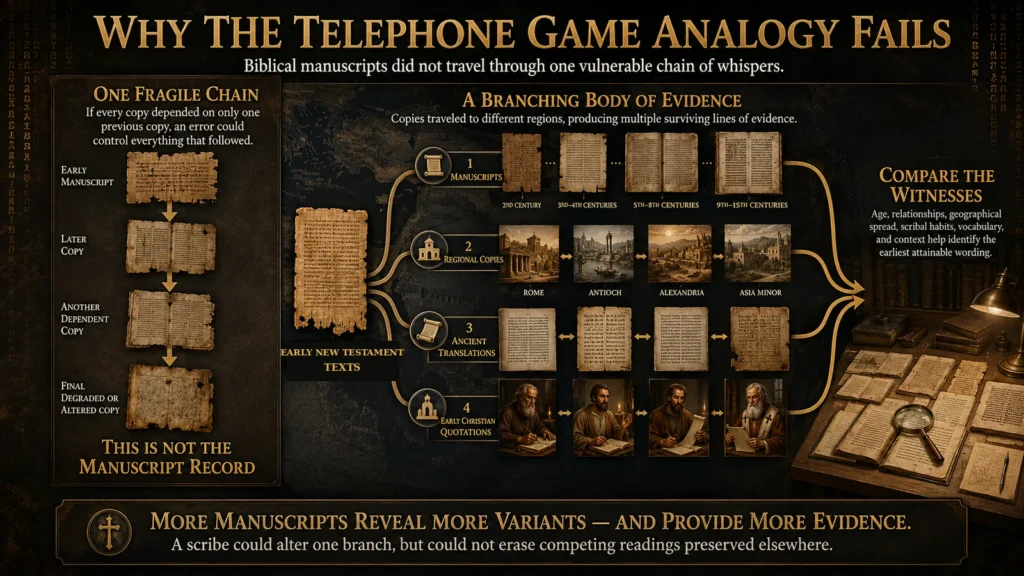
The New Testament survives in thousands of catalogued Greek witnesses, although they differ greatly in date, completeness, relationship, and textual value. Early translations and quotations by Christian writers add further evidence. Abundance does not eliminate variants. It exposes them. If ten copies contain one difference, a thousand copies can preserve that difference in many combinations and add others.
This is why raw variant counts can mislead. Counting every spelling difference in every manuscript produces a large number, but most do not affect translation. A smaller set changes wording or meaning, and a still smaller set remains both meaningful and difficult to resolve. The quantity of evidence creates work; it also prevents one late copy from controlling the text unnoticed.
Did scribes ever change wording for theological reasons?
Yes, some variants appear to reflect theological pressure. A scribe might strengthen a title for Jesus, smooth a difficult statement, align one Gospel with another, or protect a passage from misunderstanding. Scholars debate the motive in individual cases because a theological effect does not prove a conscious theological intention.
What the evidence does not show is one successful campaign that revised every manuscript family in the same direction. Differences remain visible precisely because earlier and competing readings survived in separate branches, translations, and quotations. Christian honesty should allow both facts to stand: scribes were not neutral copying machines, and no later authority gained control of the entire manuscript record.
What textual critics actually do
Textual criticism compares witnesses to identify the earliest attainable wording. Scholars examine age, geographical spread, manuscript relationships, scribal habits, and which reading best explains the rise of the others. They also consider the author’s vocabulary and immediate context. No rule works mechanically: the oldest manuscript is not always right, the majority is not automatically right, and the shortest reading is not automatically right.
The process is visible in critical editions. The Nestle-Aland 28th edition prints an edited Greek text and an apparatus that records important alternatives. Editors can be wrong, and editions are revised as evidence and methods improve. A critical edition is a scholarly reconstruction, not a newly inspired replacement for the manuscripts.
Christians sometimes compare transmission to a telephone game in which one whispered sentence mutates down a single line. The analogy fails because manuscript transmission branched. Copies traveled to different regions, and earlier witnesses can be compared with later ones. A scribe in one location could alter a reading; that scribe could not reach backward and erase other branches.
Mark 16, John 7:53-8:11, and other major variants
The most famous variants should be faced directly. Mark 16:9-20 appears in many manuscripts and has a long history in Christian teaching, but the earliest attainable manuscript text of Mark probably ends at 16:8. Scholars continue to debate whether Mark intended that abrupt ending or whether an original conclusion was lost. Codex Sinaiticus moves from Mark 16:8 to Luke on the same page; readers can inspect the manuscript page. Other witnesses preserve different endings. The longer ending may contain ancient material, but it should not carry an argument by itself.
The story of the woman caught in adultery, John 7:53-8:11, is absent from P66, P75, Sinaiticus, Vaticanus, and other important early witnesses. It also appears at different locations in later transmission. Those facts make it very unlikely to have belonged to the earliest form of John, even if the story preserves an ancient memory about Jesus. Modern brackets and footnotes are warranted.
The direct Trinitarian wording found in some late copies of 1 John 5:7-8, often called the Comma Johanneum, has extremely late and sparse Greek support. The Trinity should not be defended from that expansion. Acts 8:37 likewise appears to preserve a later baptismal confession rather than the earliest text of Acts.
Not every case is so clear. Luke 22:43-44, where an angel strengthens Jesus and His sweat becomes like blood, has early evidence both for inclusion and omission. Luke 23:34a, “Father, forgive them,” also presents a difficult pattern. Honest textual criticism states different confidence levels instead of forcing every variant into one reassuring answer.
Do variants overturn Christian doctrine?
No central Christian doctrine depends solely on Mark’s longer ending, the adulterous-woman passage, the Comma, Acts 8:37, or another seriously disputed reading. Christ’s deity, the Trinity, the resurrection, forgiveness, baptism, and judgment rest on multiple passages whose textual standing is not in comparable doubt.
That statement should not be inflated into “no variant affects anything important.” Some affect interpretation, preaching, and beloved stories. Nor does it prove inspiration. It answers a narrower charge: known textual variation has not erased the New Testament’s central proclamation.
A disputed sentence is not a disputed gospel. The manuscript differences do not produce one textual tradition in which Jesus was crucified and raised and another in which He was not. Across the major streams, the same apostolic center remains visible: Jesus died, was buried, was proclaimed risen, was worshiped as Lord, and was preached among the nations. Textual criticism matters because individual readings matter, but the Christian faith does not hang from one doubtful verse.
Christian preservation is therefore better described as providentially abundant and substantially reliable than as perfect uniformity in every copy. God’s word was preserved through manuscripts that can be compared, not by exempting every scribe from error. Footnotes that disclose uncertainty are not admissions that the Bible collapsed. They are evidence that the difficult places can be named.
We possess enough evidence to reconstruct the text with very high confidence across the overwhelming majority of its wording, while retaining uncertainty at a limited number of places. That is a strong historical claim, not an absolute promise that scholars have solved every word. It gives translators a responsible base for the next task: carrying ancient Hebrew, Aramaic, and Greek into living languages.
Can We Trust Modern Bible Translations?
Modern Bibles are translated from ancient-language texts
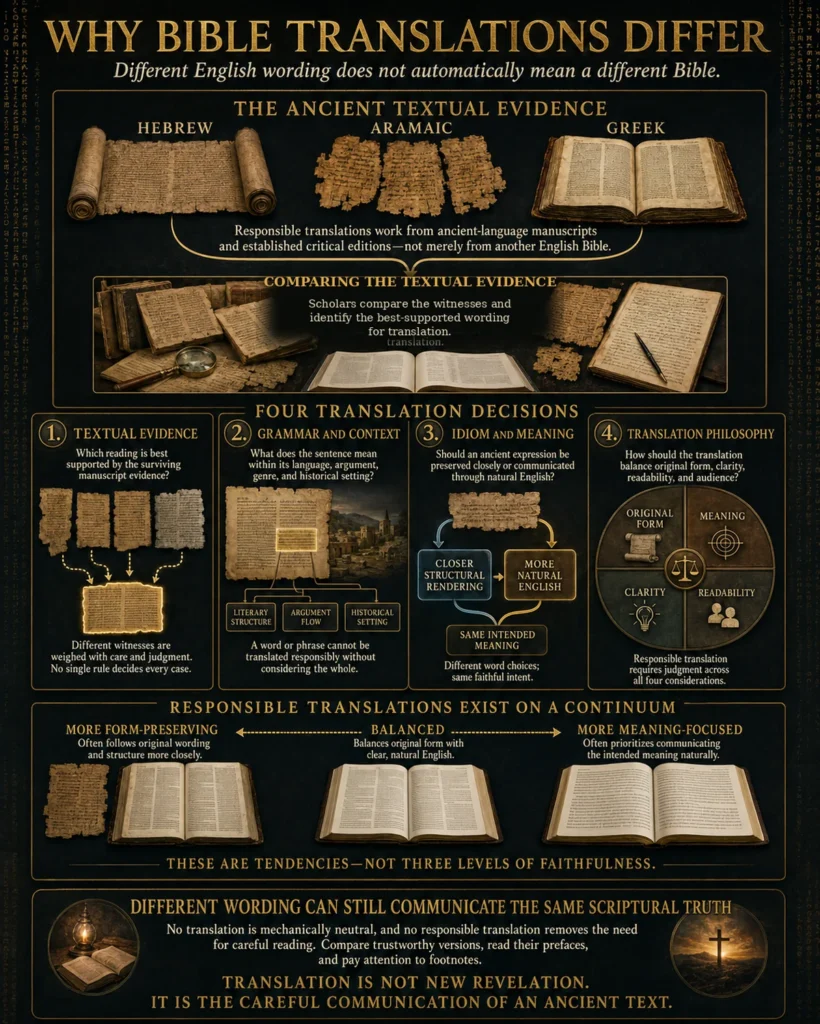
Major English Bible translations are not usually revisions made from another modern language. Committees work from Hebrew and Aramaic Old Testament texts and Greek New Testament texts, consulting manuscript evidence, ancient versions, lexicons, grammar, and previous translations. Their published prefaces name the textual bases and explain where judgment was required.
That does not make every translation equally accurate or every committee decision correct. It does mean the common picture of translators casually rewriting an English Bible is false. Readers can compare versions, inspect notes, and read the committees’ own explanations.
Every translation includes interpretation
Languages do not match word for word. A Hebrew or Greek expression can carry an idiom, grammatical emphasis, ambiguity, or cultural association that no single English phrase reproduces. Translators must decide whether to preserve form, make implied information explicit, choose between possible senses, or leave ambiguity in place.
“Formal equivalence” tends to stay closer to source-language structures where English permits. “Functional equivalence” gives greater priority to producing a comparable meaning or effect in natural English. These are tendencies along a continuum, not two sealed camps. The ESV preface describes an “essentially literal” approach, the NRSVue preface describes being as literal as possible and as free as necessary, and the CSB speaks of “optimal equivalence.”
A very literal rendering can obscure an idiom; a very functional one can settle an ambiguity too quickly. Accuracy includes words, syntax, discourse, genre, and meaning. Comparing a more formal translation with a clear functional translation can reveal where decisions lie.
Why responsible translation committees still differ
Most major translations use teams with expertise across biblical books, languages, and disciplines. Review by churches and outside readers can expose awkward wording or theological assumptions, making a committee less likely than one translator to impose a private theory everywhere. Yet committees still have traditions, mandates, target audiences, and style policies.
Two teams can begin with the same Hebrew or Greek reading and produce different English without either being deceptive. They may divide a long sentence differently, preserve or unpack a metaphor, choose different senses of a word, or decide where punctuation and quotations begin. A study Bible may retain technical language that a version designed for public listening explains more directly. Trust should therefore be informed rather than blind: read the preface, compare reputable versions at contested passages, and distinguish a translation choice from a manuscript difference.
What about the King James Version?
The King James Version is a monumental achievement whose language shaped English-speaking Christianity. Its translators were learned churchmen working from the best resources accessible to them, and they did not claim that every previous English Bible was corrupt. In The Translators to the Reader, they described revision as part of producing a good translation; the original preface remains available.
The KJV New Testament relied chiefly on editions of the Greek Textus Receptus, an early printed text formed from a relatively small set of late manuscripts, with editorial decisions in places where evidence was limited. The Textus Receptus is not one ancient manuscript, and it is not identical to the modern “Majority Text,” which follows readings dominant across a much larger Byzantine manuscript tradition.
Modern critical editions use a broader and often earlier evidence base. That is why many recent translations omit, bracket, or footnote wording that appears in the KJV. Their translators are not deleting the Trinity or resurrection. They are judging that certain words entered later transmission. A reader may prefer the KJV’s literary register while still recognizing why modern versions handle those places differently.
Footnotes are part of a trustworthy translation
Notes such as “some manuscripts add” or “the earliest manuscripts do not include” can feel unsettling. They are better understood as disclosure. Instead of hiding uncertainty, editors identify it and let readers see where another rendering or textual reading is possible.
The NET Bible preface explains a project built around extensive translator and textual notes. Other versions provide fewer notes for readability. Neither design is automatically more faithful; they serve different reading situations.
For close study, use more than one responsible translation and keep at least one edition with substantial notes. For public reading, choose clear language suited to the congregation. For memorization, consistency may matter more than constantly switching versions. No English translation reproduces every feature of the originals, but a reader does not need Hebrew and Greek to encounter their central message faithfully.
Christians do not need to fear a bracket or manuscript note. It means the evidence has not been hidden. A faith that depended on suppressing variants would be fragile. Notes allow readers to see where witnesses differ while also seeing how little those differences alter the Bible’s central proclamation.
Modern translations are trustworthy in a qualified, testable sense: they rest on abundant ancient evidence, public methods, skilled review, and disclosed alternatives. Translation differences do not place Christ beyond the reach of ordinary readers. Across responsible versions, the central message remains clear: humanity is estranged from God, Jesus died for sins, God raised Him from death, and forgiveness and life are offered in His name.
That historical confidence prepares the deeper Christian question. Why regard the writings being translated as more than unusually well-preserved religious literature?
Why Christians Believe the Bible Is God’s Word
History can carry the question only so far
At this point, the question how did we get the Bible? becomes theological as well as historical. Historical research can ask when a book appears, what sources it uses, how it circulated, and whether its text survives. It cannot place “inspired by God” under a microscope. Inspiration is a theological judgment. That does not make history irrelevant; it means the historical case and the theological claim must not be confused.
Three terms help. Revelation is God making Himself and His will known in words and deeds. Inspiration is the Holy Spirit’s work through human authors so that their writings communicate what God intends. Canon is the recognized collection that serves as Scripture for the covenant community. God can reveal something before it is written, a writing can be inspired before a council lists it, and a canon can be recognized without creating its inspiration.
Scripture claims divine authority through human authors
The Bible is not stylistically flat. Its authors narrate, lament, research, sing, argue, collect proverbs, write letters, report visions, and shape earlier material. Luke refers to predecessors and investigation. Paul responds to local questions. The Psalms sound like many human situations because they arose within them. Christian inspiration therefore need not mean mechanical dictation; God’s agency and genuine human authorship operate together.
Second Timothy 3:14-17 says the sacred writings make a person wise for salvation through faith in Christ and calls Scripture God-breathed, useful for teaching, correction, training, and equipping. Second Peter 1:19-21 says prophecy did not originate merely in human will; people spoke from God as carried along by the Holy Spirit.
Those texts are essential evidence for what biblical writers claim about Scripture. They are not neutral proof for a reader who does not yet grant biblical authority. Quoting “the Bible says it is true” cannot finish the argument. The Christian case must ask whether this self-witness coheres with the person and events at its center.
Jesus receives Scripture and brings it to its goal
Across the Gospel traditions, Jesus treats Israel’s Scriptures as God’s binding word. He quotes them in temptation, appeals to them in debate, corrects interpretations, and says that Scripture cannot be broken (John 10:34-36). Yet He is not presented merely as one interpreter among others. He speaks with personal authority and claims that Israel’s story reaches its fulfillment in Him.
Luke 24:44-49 concentrates that pattern. The risen Jesus opens the disciples’ minds to the Law, Prophets, and Psalms, connecting them with the Messiah’s suffering, resurrection, forgiveness, worldwide mission, and their role as witnesses. Christian reading is Christ-centered because the apostles claim Easter disclosed where the long scriptural story was going.
Hebrews 1:1-4 frames that history of revelation around the Son: God spoke through the prophets in many times and ways and has now spoken climactically in the One through whom He made the world. Scripture is not an independent authority standing beside Christ. The prophetic and apostolic writings lead readers to the Son in whom God’s revelation reaches its summit.
That claim must still honor context. Direct prediction, covenant promise, typology, and later apostolic interpretation are not interchangeable. A responsible study of prophecies Christians believe Jesus fulfilled should not turn every shared word into a secret code.
The resurrection is the public hinge
The Christian argument finally depends on who Jesus is. Evidence that Jesus lived and was crucified anchors the story in public history; a separate review presents the historical evidence for Jesus. The earliest Christian proclamation went further: God raised Him.
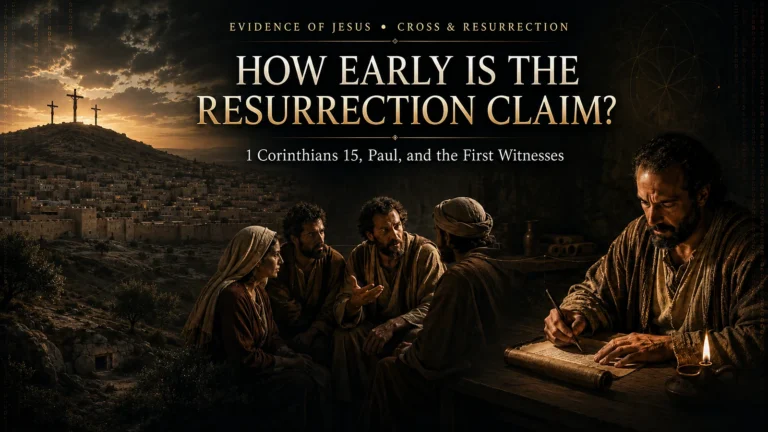
In 1 Corinthians 15:3-8, Paul says he received and delivered a tradition about Christ’s death, burial, raising, and appearances to named people and groups. Historical method can place resurrection proclamation in Christianity’s first generation and examine the witnesses, alternative explanations, and consequences. It cannot rerun Easter in a laboratory or compel the conclusion that God acted.
Christians make that theological inference because the resurrection best explains the total pattern and vindicates the crucified Jesus as Lord. The focused evidence deserves its own treatment, including the prophecies connected with Jesus’ resurrection and the broader question of whether Jesus is the Son of God.
If God raised Jesus, His view of Scripture matters. So does His appointment of witnesses. In John 14-16, Jesus promises that the Spirit will teach, bring His words to remembrance, bear witness, guide the disciples, and glorify the Son. Those promises establish a Spirit-dependent apostolic mission. They do not supply a future table of twenty-seven books or guarantee every decision made by every church leader.
John states the purpose of written apostolic witness with unusual clarity: Jesus did many things not recorded, but these signs were written so readers may believe He is the Messiah and Son of God and have life in His name (John 20:30-31). Sufficiency does not require an exhaustive transcript. It requires a faithful witness adequate to its saving purpose.
Why this history should strengthen Christian confidence
The history of the Bible is not the story of a lost book rescued by modern scholars. It is the history of a public faith that read Scripture in worship, carried letters between churches, copied apostolic collections, examined difficult books, preserved competing readings, and translated the text for new peoples.
By the middle of the second century, Christians were hearing apostolic memoirs beside the prophets in Sunday worship. During the Great Persecution beginning in AD 303, imperial authorities ordered Christian Scriptures destroyed. Neither fact settles every boundary, but both show that written Scripture shaped Christian identity before Nicaea.
Ancient Christians did not receive every work that sounded spiritual or carried an apostolic name. Their caution sometimes lasted generations, while Israel’s Scriptures, the fourfold Gospel, Acts, a substantial Pauline collection, and the proclamation of Jesus’ death and resurrection were already established.
Christians therefore need not pretend that the history was simple. They may confess that God’s providence worked through vulnerable manuscripts, fallible copyists, public worship, correction, translation, and communities that did not always agree. The prophetic and apostolic witness remained available across regions and languages so later generations could continue to hear of Christ.
Five facts are worth remembering:
- Israel’s Scriptures existed before Christianity.
- Gospels and Pauline collections existed before Nicaea.
- Ancient debate concentrated mainly around limited edges.
- Variants remain visible because multiple witnesses survived.
- Across responsible manuscripts and translations, Jesus remains crucified, risen, worshiped, and proclaimed as Lord.
Learning this history can replace borrowed certainty with informed confidence. It shows where evidence is firm, where humility is necessary, and why faith need not depend on exaggerated claims. The means were ordinary; the purpose was extraordinary—that the nations would continue to hear the testimony to God’s Son.
The Christian case is cumulative, not a trick
A skeptic can reasonably notice a circle: Scripture witnesses to Jesus, and Jesus authorizes Scripture. Every claim to ultimate authority contains some self-reference, but that cannot excuse indifference to evidence. Christianity also points to multiple writings, early received traditions, public events, manuscript transparency, wide reception, and a redemptive pattern developed across centuries.
That pattern moves through creation, covenant, sacrifice, kingdom, exile, restoration, Messiah, cross, resurrection, Spirit, church, judgment, and new creation. Its coherence is not mathematical proof, and Christians should avoid assigning impressive probabilities to disputed prophecy readings. It is part of a cumulative case whose center is a person rather than a code.
Protestant theology often calls the believer’s inward recognition of Scripture the Spirit’s internal testimony. Properly understood, this is not a new revelation saying, “trust this book,” or a feeling that makes evidence unnecessary. The Spirit works by and with the written Word, enabling readers to recognize and obey the apostolic gospel. Because other religions also report inward certainty, Christian assurance remains joined to Scripture’s public content and its historical claim about Jesus.
The church’s reception matters without proving inspiration by itself. Christians across regions copied, translated, proclaimed, and sometimes suffered for these writings. Their use was not uniform, and Scripture has also been distorted to defend power and prejudice. Its fruit supports the claim only when it resembles Jesus.
Catholics locate Scripture within the one deposit of Scripture and apostolic Tradition authoritatively served by the church. Orthodox Christians receive it within Holy Tradition, worship, and Christ-centered ecclesial interpretation. Protestants hold that Scripture’s authority comes from God and stands above the church, while the Spirit enables believers to recognize God’s voice in it. The models differ seriously. They share the conviction that God speaks through genuinely human prophetic and apostolic writings.
Did God Speak Outside the Bible?
Not every true word from God became a biblical book
The Bible itself implies more divine speech and apostolic activity than it records. Prophets delivered words for particular moments. Paul appears to refer to an earlier letter to Corinth that has not been preserved, although scholars differ over how that reference relates to the surviving Corinthian correspondence. John says Jesus did many other signs. A true message from God is not automatically a permanent, inspired rule for the whole church.
That distinction prevents a false choice. Christians need not claim that God spoke only when producing the Bible, nor that every later spiritual impression belongs beside Romans or Isaiah. Canon identifies the public, foundational norm; it does not place God under a vow of inactivity.
A closed canon does not mean a silent God
Christians may believe God guides, convicts, gives wisdom, answers prayer, distributes gifts, and directs His church. They disagree about whether particular revelatory gifts continue in the same form today. This article does not need to settle the cessationist-continuationist debate to make a more basic point: later claims do not add a new foundation or outrank the prophetic and apostolic witness.
That boundary is pastoral as well as doctrinal. “God told me” can be used to bypass wisdom, accountability, and the freedom of another person. A claimed message should never become a device for control merely because it is delivered with confidence.
Later claims are tested by the apostolic gospel
Christians test teaching by its confession of the Creator, Christ’s incarnation, His cross and bodily resurrection, the character of the apostolic gospel, and the moral fruit it produces. A message that denies the Son or overturns that gospel cannot be accepted as a harmless update from the same God.
This test is openly Christian, not religiously neutral. It will not persuade someone who rejects Jesus and the apostolic sources. It explains why Christians regard the canon as sufficient while continuing to pray for the living God’s guidance.
The Bible’s authority is therefore neither a bare institutional decree nor a private feeling immune to questions. It is a theological confidence joined to public claims, a received textual history, and above all the crucified and risen Christ. The remaining practical objections can now be answered without pretending that every mystery has disappeared.
Frequently Asked Questions
How did we get the Bible in simple terms?
God’s words and acts were remembered and written by prophets, apostles, and their associates. Communities preserved, read, exchanged, and collected those writings. Churches recognized a stable scriptural core while debating some boundaries. Scribes copied the books, scholars compare surviving witnesses, and translators carry the Hebrew, Aramaic, and Greek into modern languages.
Who wrote the Bible?
The Bible has many human authors working in different periods, genres, and circumstances; some books are anonymous or have disputed attributions. Christian doctrine says the Holy Spirit inspired these real authors without erasing their research, vocabulary, personality, or historical setting. Divine authorship and human authorship are therefore not competing explanations within the Christian account.
Who decided which books belonged in the Bible?
No one person made the decision. Churches weighed apostolic or prophetic connection, agreement with received faith, broad public use, and lasting value in worship. A core was established early, while several books remained disputed. Bishops and regional councils later clarified boundaries and practices, but their lists formalized a history already underway.
Did Constantine or the Council of Nicaea choose the Bible?
No. Nicaea met in AD 325 chiefly over the identity of the Son, along with Easter and church discipline. Its surviving canons contain no biblical book list. Constantine later commissioned Scripture copies, but their contents are unknown. Debate and canon lists continued after his reign, disproving the story of one imperial selection.
Why do Catholic, Orthodox, and Protestant Bibles contain different Old Testament books?
They inherited a shared scriptural center through different Jewish Hebrew and Greek reception paths. Protestants follow the Hebrew collection for their Old Testament; Catholics receive the Deuterocanonical books; Orthodox collections are generally wider and can vary. The disagreement is real, but counting and arrangement can make their extensive common content look smaller than it is.
Were books removed or hidden from the Bible?
That slogan compresses several histories. Some early Christian works were valued but never broadly received as apostolic Scripture. Some canonical books were disputed before gaining wide acceptance. Later gospels must be evaluated individually by date, sources, theology, and reception. Catholic, Orthodox, and Protestant disagreements over Old Testament boundaries should not be reduced to a secret purge.
Has the Bible been changed through copying?
Handwritten copies contain real variants, including a few substantial passages. Because manuscripts, early translations, and quotations survive from different places, scholars can compare competing readings rather than trust one chain of copies. Most differences are minor; some affect interpretation; no central Christian doctrine rests only on a seriously doubtful reading. Uncertainty remains visible in responsible footnotes.
Why do Bible translations differ?
Translators make judgments about manuscripts, grammar, idiom, ambiguity, style, and reading level. Some versions preserve source-language form more closely; others prioritize natural English meaning. Committees can also choose different valid senses of the same text. Differences are not automatically corruption. Comparing reputable translations and reading their prefaces reveals where genuine interpretive choices occur.
Why do Christians believe the Bible is God’s Word?
Christians consider Scripture’s own claims, Jesus’ reception and fulfillment of Israel’s Scriptures, the apostolic witness, the resurrection claim, the Bible’s redemptive coherence, the church’s reception, and the Spirit’s testimony. None functions as a detached mathematical proof. Together they form a Christ-centered case whose decisive question is whether God raised Jesus from the dead.
Could God speak through someone whose words are not in the Bible?
Yes. The Bible does not record every prophetic word, apostolic conversation, or act of Jesus. Christians may also speak of divine guidance, wisdom, conviction, and spiritual gifts today. Such claims do not become permanent Scripture automatically. They remain accountable to Christ, the apostolic gospel, the canonical writings, wise communal testing, and moral fruit.
Sources and Further Reading
This article’s primary evidence and major reference points include:
- Prologue to Sirach
- Josephus, Against Apion 1.37-43
- Justin Martyr, First Apology 67
- Eusebius, Church History 3.25
- Eusebius, Church History 8.2
- Athanasius, Festal Letter 39
- Codex Sinaiticus Project
- Israel Antiquities Authority Dead Sea Scrolls archive
- Institute for New Testament Textual Research
- Timothy H. Lim, The Formation of the Jewish Canon
- Edmon L. Gallagher and John D. Meade, The Biblical Canon Lists from Early Christianity
- Harry Y. Gamble, Books and Readers in the Early Church
- KJV, “The Translators to the Reader”
- Dei Verbum
- Orthodox Church in America, “The Bible”
- Westminster Confession of Faith, chapter 1
Related studies are collected in Christian Foundations.
The Written Word Bears Witness to the Living Word
The Bible came through history, not around it. Human authors wrote from particular places and crises. Communities copied, carried, debated, translated, and confessed their words. Some boundaries took time to settle, and some textual readings remain uncertain. Honest faith does not need to hide those facts. It asks what kind of confidence the evidence can bear, receives correction where claims have outrun it, and refuses to mistake a simple story for a truthful one.
Yet Christianity does not finally invite people to trust a canon chart, a manuscript count, or a translation committee. Scripture has authority because of the God who speaks through it, and its central purpose is to make Him known in the Son. The Law, Prophets, Psalms, Gospels, and apostolic letters form one many-voiced witness whose destination is not the page alone.
Jesus Christ is the eternal Word made flesh, Israel’s promised Messiah, the crucified Savior, and the bodily risen Lord. He is the One who opens the Scriptures, gathers a people through the gospel, and reigns as the King who will return. The written Word bears witness so that readers may know, trust, obey, and worship the living Christ. Its final summons is therefore personal: hear and answer the risen Lord to whom all Scripture faithfully points.