
GUIDED ARTICLE EXPERIENCE
Who Divided the Bible Into Chapters and Verses? When and Why the Numbers Were Added
Read along as the narration moves through the article.
Private device narration · No hosted audio or tracking
CONTINUE GUIDED TOUR
Continue where you left off.
GUIDED TOUR COMPLETE
You have reached the end of this study.
Study record saved on this device.
GUIDED TOUR
Who Divided the Bible Into Chapters and Verses? When and Why the Numbers Were Added
Narrator: Paranoid Prophet Recommended Voice Native device narration
Prepare to follow the article as it is narrated.
VOICE & TOUR OPTIONS
Voice & Listening
NARRATOR
Finding a narrator…
Checking the best narrator available on this device.
Restores the best curated narrator available on this device.
Narrator choices are curated for clear, long-form listening on this device.
Screen-awake support will be checked when narration starts.
CHOOSE A NARRATOR
Curated for this device
Choose a verified narrator for this browser, or use System Narrator. Automatic mode uses the best reliable route exposed by this device; your chosen narrator is preserved even if this device needs a temporary fallback.
Preparing the guided article experience…
RESUME GUIDED TOUR?
Continue where you left off.
GUIDED TOUR COMPLETE
You have reached the end of this study.
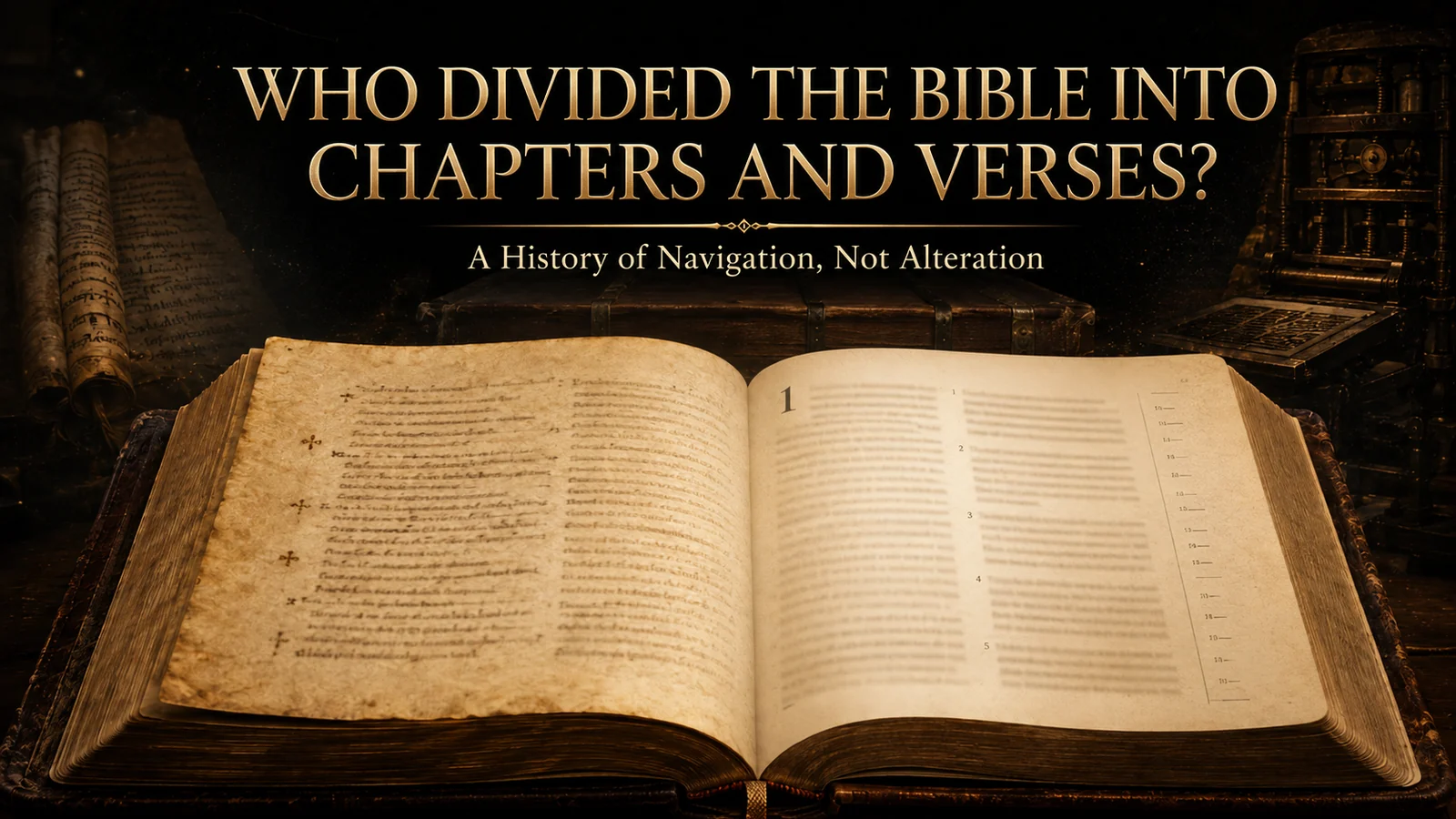
Open almost any Bible and the page seems built from permanent coordinates: Genesis 1:1, Psalm 23:4, John 3:16. Yet the biblical authors did not write those modern numbers. So who divided the Bible into chapters and verses?
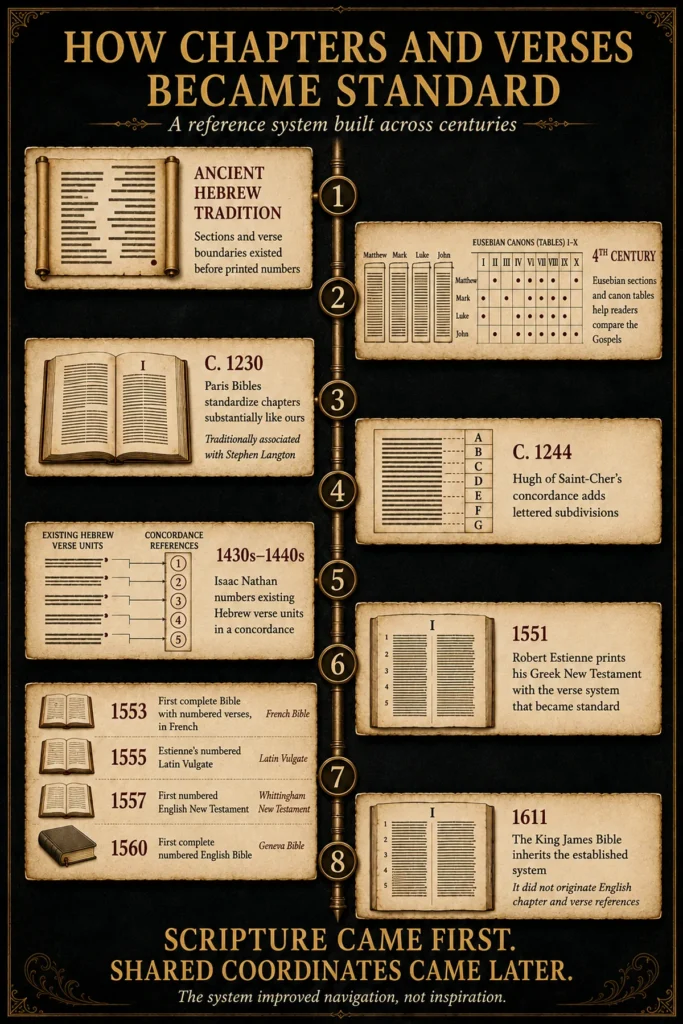
The answer developed in stages. Modern chapters were standardized through the early thirteenth-century Paris Bible tradition and are traditionally associated with Stephen Langton, although the system may slightly predate him. Hebrew verse boundaries were already ancient before numbers were printed beside them. Robert Estienne’s 1551 Greek New Testament introduced the numbered New Testament verses that became standard. William Whittingham used those numbers in the first English New Testament to do so in 1557, and the complete Geneva Bible followed in 1560.
That history should reassure readers, not alarm them. Later readers placed reference tools around writings already transmitted, publicly read, taught, and received as Scripture. Historians can compare manuscripts made before and after the numbers appeared. The numbers are useful editorial tools, not inspired wording, and their traceable history gives no reason to suspect a secret rewrite. They help us find the text. They should never decide where a biblical author’s thought begins or ends.
Article Guide16 sections
Short Answer: Who Added Chapters and Verses to the Bible?
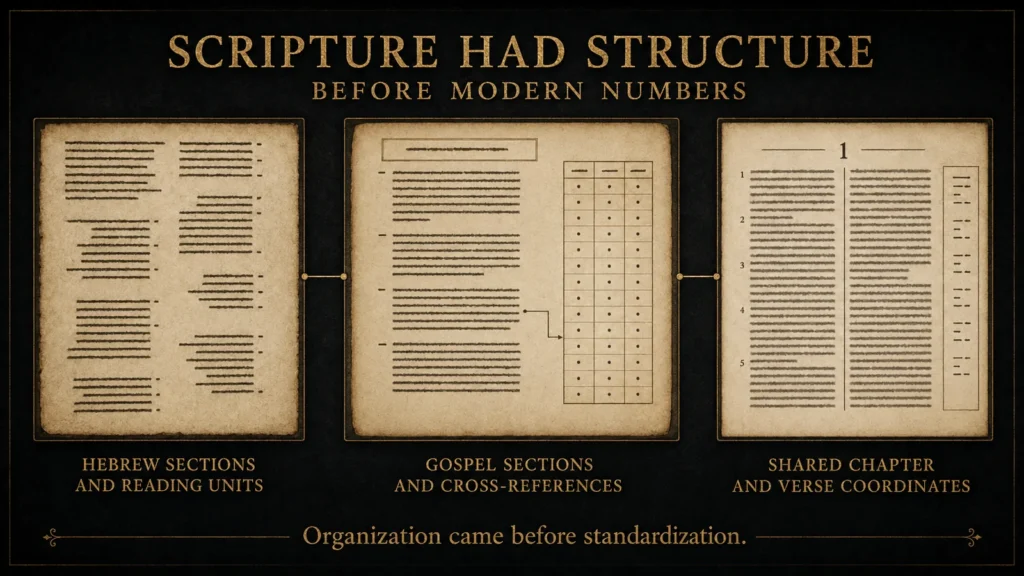
No single person created the whole system in one moment. Jewish and Christian communities had organized Scripture for centuries through sections, reading units, titles, paragraph marks, poetic layouts, and cross-references. What changed in the medieval and early modern periods was the growth of one shared set of coordinates across complete Bibles.
The modern chapter divisions took recognizable form in the Paris Bible tradition around 1230. They are usually connected with Stephen Langton, a Paris theologian who later became Archbishop of Canterbury. The attribution is traditional and important, but careful scholarship notes that the system seems to appear slightly before Langton’s work can securely account for it. Hugh of Saint-Cher and his Dominican collaborators later made the chapters more useful through a Latin concordance with lettered subdivisions. Hugh helped spread the system, while the stronger historical case places its standardization in the Paris tradition associated with Langton.
The verse story has two different streams. Hebrew scribes had long preserved verse units, accents, and section boundaries. In the fifteenth century, Isaac Nathan applied Christian chapters and numerical references to those existing Hebrew units in a concordance. For the New Testament, Robert Estienne, also known as Robertus Stephanus, printed the verse numbers that became standard in his 1551 Greek New Testament.
The main milestones are:
- Ancient and medieval Jewish scribes preserved Hebrew sections and verse boundaries.
- Around 1230, Paris Bibles used chapters substantially like ours.
- Around 1244, Hugh’s concordance used chapters with lettered subdivisions.
- In 1551, Estienne numbered New Testament verses.
- In 1553, his French Bible became the first complete Bible identified with numbered verses.
- In 1557, Whittingham published the first English New Testament with verse numbers.
- In 1560, the Geneva Bible became the first complete English Bible to use them.
These milestones describe the development of navigation and display. They did not make Scripture sacred, stable, or understandable for the first time.
Did the Original Bible Have Chapters and Verse Numbers?
The Biblical Authors Did Not Write the Modern Numbers
Moses, David, Isaiah, Matthew, Paul, and the other biblical writers composed books, songs, speeches, letters, visions, and narratives. They did not insert the modern chapter and verse numerals. Those coordinates belong to the history of copying, teaching, concordances, and printing, much as most modern punctuation, section headings, cross-references, and study notes do.
That distinction need not reduce confidence in the text. The later features surround the words rather than supply their authority. A fuller history of how the biblical writings were composed, copied, recognized, and preserved belongs in its own cornerstone guide. Likewise, the difference between inspired books and later reference divisions becomes clearer when readers understand how the books of the Bible are organized.
The distinction also guards against a false picture of “the original Bible” as one bound volume whose numbers were later erased or replaced. The biblical books arose in different times and forms, then were copied and collected. Modern references were applied to that inherited library. They are part of the history of access to the text, not a new layer of revelation inside it.
Ancient Manuscripts Were Not Completely Unstructured
It is misleading to picture every ancient Bible as an unbroken wall of letters. Practices varied by language, period, community, and manuscript. Hebrew copies used open and closed section marks, reading divisions, accents, and poetic lineation. Greek Gospel manuscripts could contain titles, chapter-like units, marginal numbers, and parallel-passage systems. Some Greek manuscripts used continuous script with little spacing between words, but that was not the only layout ancient readers knew.
Poetry could be arranged in lines, a new subject could begin with enlarged lettering, and a reader could receive cues from spacing or punctuation. Not every aid appears in every witness, and scribes did not always agree on where a section should fall. Even so, the material page was already helping communities hear literary shape.
The original writings did not contain our modern numbered system, but ancient Jews and Christians did not wait until the Middle Ages to organize biblical texts for reading and study.
Scripture Was Authoritative Before It Had Numbered Addresses
Luke 4:16-21 shows Jesus receiving Isaiah’s scroll, finding the relevant passage, reading it, and announcing its fulfillment. In Mark 12:26, He identifies the account of the burning bush. Paul refers to the passage about Elijah, while Hebrews introduces a statement about the seventh day as something God said somewhere.
These were not careless citations. Readers knew books, events, speakers, remembered wording, reading traditions, and surrounding context. The absence of modern numbers did not make Scripture uncertain or inaccessible.
How Jewish Scribes Divided and Preserved the Hebrew Bible
Open and Closed Sections
The Hebrew textual tradition includes petuhah and setumah, open and closed section markers that signal different kinds of breaks. They are useful evidence of intentional organization, though they should not be equated mechanically with modern paragraphs. Larger units called parashot served textual and reading traditions, while sedarim were associated especially with a Palestinian reading cycle.
These practices developed in different settings and should not be forced into one neat modern chart. Their shared importance is simpler: Jewish readers received Scripture as meaningful literary and liturgical units long before medieval Latin chapters became standard.
Public reading reinforced those units. Torah portions, prophetic readings, songs, and larger cycles trained communities to recognize where a passage began and how it functioned in worship. A reading division could differ from a literary paragraph, just as a modern lectionary selection can, but both assume a text that readers can identify and revisit.
Verse Boundaries Before Verse Numbers
The Masoretic tradition preserved more than consonants on a page. Masoretic codices transmit vocalization, accents, cantillation, marginal notes, traditional readings, and verse endings. The sign called sof pasuq marks the end of a verse unit. It is a boundary within the textual tradition, not an Arabic numeral printed in the margin.
Hebrew verse boundaries therefore existed long before fifteenth-century concordances and sixteenth-century printed numbers. This is why saying that Isaac Nathan “invented Old Testament verses” confuses an older textual division with a later reference convention.
Reading Divisions and Careful Stewardship
The Jewish Theological Seminary’s account of the Masorah describes a culture of detailed annotation and preservation. Scribes counted, recorded unusual forms, tracked occurrences, and guarded reading traditions because they believed they were handling sacred words.
That care should build sober confidence. It does not make every manuscript identical, render every copyist incapable of error, or give every textual question one effortless answer. Variants and editorial judgments are real. Yet this is not a history of casual rewriting. The sectioning and reference tools grew inside traditions of deliberate reading and transmission.
Masoretic notes often warned that a form was rare, recorded how a word was traditionally read, or protected an unusual spelling from being silently normalized. Such practices do not settle every question about the earliest attainable Hebrew text. They do show a disciplined concern to transmit what had been received rather than freely modernize it.
How Early Christians Navigated Gospel Manuscripts
Kephalaia and Chapter Titles
Early Christian Gospel manuscripts also used organizational systems before the Paris chapters. Units called kephalaia functioned like chapters and were often paired with titles. Lists of these units could serve as contents pages. Their boundaries did not match the modern chapters, and different systems could guide readers toward different emphases.
This matters because sectioning has always been both practical and interpretive. A title or division tells a reader where an editor thinks a unit belongs. Ancient systems were not inspired boundaries either, but they show that Christians actively studied the shape of the Gospels.
Ammonian Sections and Eusebian Canon Tables
Ammonius of Alexandria developed a method for comparing Gospel parallels. In the fourth century, Eusebius of Caesarea refined the approach into numbered Gospel sections and ten canon tables. The numbers in each Gospel directed readers to tables showing where material appeared in one, two, three, or all four Gospels.
The apparatus did not splice the Gospels into a new combined narrative. It preserved each Gospel’s order while allowing careful comparison. As Cambridge scholarship on early Gospel study shows, ancient Christians developed technically sophisticated tools for reading the fourfold Gospel. Eusebius created a sophisticated cross-reference system centuries before Langton and Estienne.
A reader found a small section number beside a Gospel passage, paired it with a canon number, and consulted the appropriate table. One table gathered material shared by all four Gospels; others tracked combinations of three, two, or one. This system made comparison possible without pretending that Matthew, Mark, Luke, and John were interchangeable.
Who Created the Modern Bible Chapters?
The Paris Bible and the Need for Shared References
By the early thirteenth century, Paris had become a major center for theological teaching and book production. Students, teachers, preachers, and copyists needed complete Bibles that were portable enough to use and consistent enough to cite. A reference that worked in one manuscript but not another frustrated lectures, concordances, debate, and pastoral study.
The Paris Bible answered that pressure through a recognizable book order, compact format, prologues, and standardized chapters. Oxford’s history of the Latin New Testament notes that Paris Bibles from around 1230 have substantially the same chapter divisions as modern Bibles. Standardization, rather than sudden invention, explains their lasting influence.
These Bibles were not created by one official decree that instantly replaced every competing format. Professional workshops reproduced a useful pattern for a mobile scholarly population. Once teachers and students could cite the same chapter in different copies, marginal cross-references and verbal indexes became far more powerful. Usefulness encouraged adoption.
Stephen Langton and the Traditional Attribution
Stephen Langton taught theology in Paris before becoming Archbishop of Canterbury. The familiar chapters are traditionally attributed to him, and his scholarly world fits their rise. Still, the evidence requires restraint: the chapter system appears to slightly predate him.
The best conclusion is not that Langton certainly sat down and divided every biblical book exactly as we have it. He is the person most closely associated with a system emerging in the Paris Bible tradition. The system spread because a scholarly and commercial network copied and used it.
What Hugh of Saint-Cher Actually Did
Around 1244, Hugh of Saint-Cher and Dominican collaborators produced a major Latin concordance. It used the standardized chapters, then subdivided them with letters such as A through G so readers could locate words more precisely. Hugh also participated in textual correction and commentary.
Later writers sometimes credited him with the chapters because his concordance made them highly visible and useful. The stronger historical judgment separates adoption from invention. Langton is the name most closely associated with the modern chapters, but standardization through the Paris Bible tradition is historically more important than a one-man invention story.
Who Numbered the Old Testament Verses?
Isaac Nathan and the Hebrew Concordance
Isaac Nathan ben Kalonymus, a Jewish scholar in Provence, compiled the first major Hebrew Bible concordance in the fifteenth century. Some older references and the first printed edition call him Mordecai Nathan, but Isaac is the historically careful name.
Nathan worked in a setting of Jewish-Christian debate. A concordance let a reader find every occurrence of a word and answer scriptural arguments with greater precision. His Me’ir Netiv adopted Christian chapter divisions, followed Vulgate order, and numbered the Hebrew text’s existing verse units. According to the Jewish Encyclopedia’s concordance history, Daniel Bomberg first printed the work in Venice in 1523.
Nathan compiled the work during the 1430s and 1440s, before its eventual printing. That gap between compilation and print matters. The reference practice was already useful in manuscript scholarship; printing later multiplied its reach. His project was not a concession that Christian divisions defined the Hebrew text’s meaning. It was a practical bridge between established Hebrew units and a widely used chapter scheme.
The distinction is essential. Isaac Nathan’s contribution was to attach numerical references to an already divided Hebrew text, not to create the Old Testament’s verse boundaries. Older Jewish sections and Masoretic verse endings remained the textual foundation; the concordance connected them to a shared Christian chapter framework.
This later system gave Jewish scholars a practical way to answer Christian citations without surrendering the Hebrew textual tradition. It is one example of a reference tool crossing religious and linguistic boundaries because accurate location mattered to all sides.
Who Numbered the New Testament Verses?
Robert Estienne’s 1551 Greek New Testament
Robert Estienne was a French printer and classical scholar also known by the Latin form Robertus Stephanus. In Geneva in 1551, he published his fourth Greek New Testament with each chapter divided into numbered units. Those New Testament verse numbers became the standard inherited by later printers and translators.
Estienne built on older Hebrew verse units and Christian Gospel sections. His decisive contribution was a stable, printed New Testament scheme that could be reproduced across editions.
Printing changed the scale of standardization. A manuscript notation might remain local or vary with a copyist, while movable type could reproduce the same numbers in hundreds of copies. Translators, pastors, scholars, and printers could then carry Estienne’s coordinates into other languages and editions. The scheme became dominant because later communities adopted it repeatedly.
The 1553 and 1555 Complete-Bible Milestones
The sequence matters. Estienne’s 1553 French Bible used numbered verses throughout. The Bibliothèque nationale de France catalogue identifies it as the first complete Bible with numbered verses. His 1555 Latin Vulgate then became the complete Latin Bible milestone.
Calling the 1555 Latin edition the first complete numbered Bible in any language erases the French Bible that preceded it. These close dates explain why simplified timelines often collapse separate achievements into one.
They also reveal that verse numbering was not a single publication event. The 1551 New Testament established the scheme for the Greek text, the 1553 French Bible extended numbered verses through a complete vernacular Bible, and the 1555 Vulgate supplied the major Latin landmark. Each claim needs its own language and evidence.
Did Estienne Divide the Verses on Horseback?
Estienne’s son later connected the work with travel. From that report grew a memorable tale: the printer supposedly divided verses while riding, and awkward breaks resulted whenever his horse stumbled.
The travel tradition deserves mention, but the jolting-horse explanation is later embellishment. It is not secure evidence for how individual boundaries were chosen. Some divisions do interrupt syntax or argument, yet a colorful story cannot substitute for the history of printing, scholarship, and repeated editorial decisions.
When Did English Bibles Receive Verse Numbers?
William Whittingham’s 1557 New Testament
English readers first encountered Estienne’s numbering throughout a New Testament in William Whittingham’s Geneva edition, printed in 1557. Whittingham was an English Protestant exile who helped translate the later Geneva Bible. The Gruber Rare Books Collection identifies his edition as the first English New Testament with verse numbers.
The Geneva Bible of 1560
The complete Geneva Bible appeared in 1560 and became the first complete English Bible with numbered verses. Its readable type, notes, maps, and verse-by-verse presentation made it influential in homes, churches, and English literature.
Printing each verse as a visually distinct unit made citation easy, but it could also make a continuous poem or argument look like a row of independent sayings. The benefit and risk arrived together: shared precision improved while literary continuity became easier to overlook.
The King James Bible Inherited the System
The 1611 King James Bible did not originate English chapter and verse references. It received a system already established through Geneva-era printing. Its typography likewise gave individual verses strong visual identity. The larger story belongs in the history of the King James Bible.
The correct English timeline is therefore 1557 for the first numbered English New Testament, 1560 for the first complete numbered English Bible, and 1611 for a major translation that inherited the convention.
Why Were Chapters and Verses Added?
Chapters solved a practical problem: they gave readers shared large-scale locations across copies. Verse numbers made those locations finer. Together they strengthened teaching, preaching, concordance work, theological debate, memorization, printing, cross-reference, and the comparison of manuscripts and translations.
The motives were not mysterious. University teachers needed students to find the same sentence. Preachers needed listeners and other clergy to verify a citation. Concordance makers needed stable coordinates. Printers needed a repeatable convention. Translators and textual scholars needed to compare wording without describing several lines of surrounding material every time.
The system also serves ordinary discipleship. A congregation can turn together to one passage. Families can memorize and revisit a line. Readers can record connections and return to them. Shared numbering helps believers carry Scripture into conversation and memory, provided the number never becomes a substitute for the surrounding book.
Stable coordinates also allow correction. A listener can check whether a sermon represents its passage fairly. A student can compare translations or commentaries without guessing which sentence is under discussion. Scholars can identify variants and citations with far less ambiguity. The tool supports accountability because claims can be traced back to a common location.
A Tool for Public Reading, Teaching, and Shared Memory
Numbering expanded practices that were already ancient. In Nehemiah 8:8, the Law is read and explained so the people understand. Paul directs Timothy toward public reading, preaching, and teaching. He tells the Colossians to exchange letters between churches, and Revelation blesses the public reader and those who hear and keep its words.
By the mid-second century, Justin Martyr described Christians gathering on Sunday to hear apostolic memoirs or prophetic writings read, followed by instruction and exhortation. Long before personal study Bibles, Scripture was publicly read, explained, circulated, remembered, preached, and obeyed. Numbering made that shared use easier; the practices themselves were already ancient.
Do Chapter and Verse Numbers Change the Bible?
No. They change how readers locate and display the text, not the source of its authority. Chapter numbers, verse numbers, most modern punctuation, paragraph breaks, headings, cross-references, and study notes are editorial features. They can influence reading, sometimes helpfully and sometimes poorly, but they do not become part of the biblical author’s inspired wording.
This is why different editions can present the same words with different paragraphs, punctuation, headings, or number counts. Jewish, Greek, Latin, Protestant, Catholic, and Orthodox traditions occasionally number Psalms or prophetic material differently. A changed coordinate can leave the underlying content unchanged.
The Numbers Serve the Word; They Do Not Govern It
Second Timothy 3:14-17 locates Scripture’s authority in its God-breathed character and purpose. The sacred writings make people wise for salvation through faith in Christ Jesus, then teach, correct, train, and equip God’s servants. A printer’s reference system can support that work without becoming its source.
A street address does not create the house. In the same way, a verse reference does not create Scripture. It helps readers find what is already there.
The fact that historians can trace when the numbers appeared should increase confidence rather than suspicion. The reference system did not secretly rewrite Scripture. It was placed around an already transmitted text, and manuscripts from before the modern system remain available for comparison. That is a historical inference about traceability, not proof that every manuscript agrees or every textual question is easy.
The distinction can be tested materially. A medieval chapter number or Renaissance verse numeral can be identified as ink, type, or marginal apparatus, then compared with earlier witnesses that preserve the same passage without that coordinate. Historians do not have to speculate that the words existed first; they can inspect the sequence in surviving evidence.
The numbers are not part of the inspired wording, but they can serve the inspired wording. Trouble begins when a navigation aid is mistaken for the boundary of the biblical author’s thought. This distinction fits what Paranoid Prophet believes about Scripture: faithful editorial tools serve the authoritative Word; they do not rule it.
Where Chapter Breaks Can Hide the Biblical Context
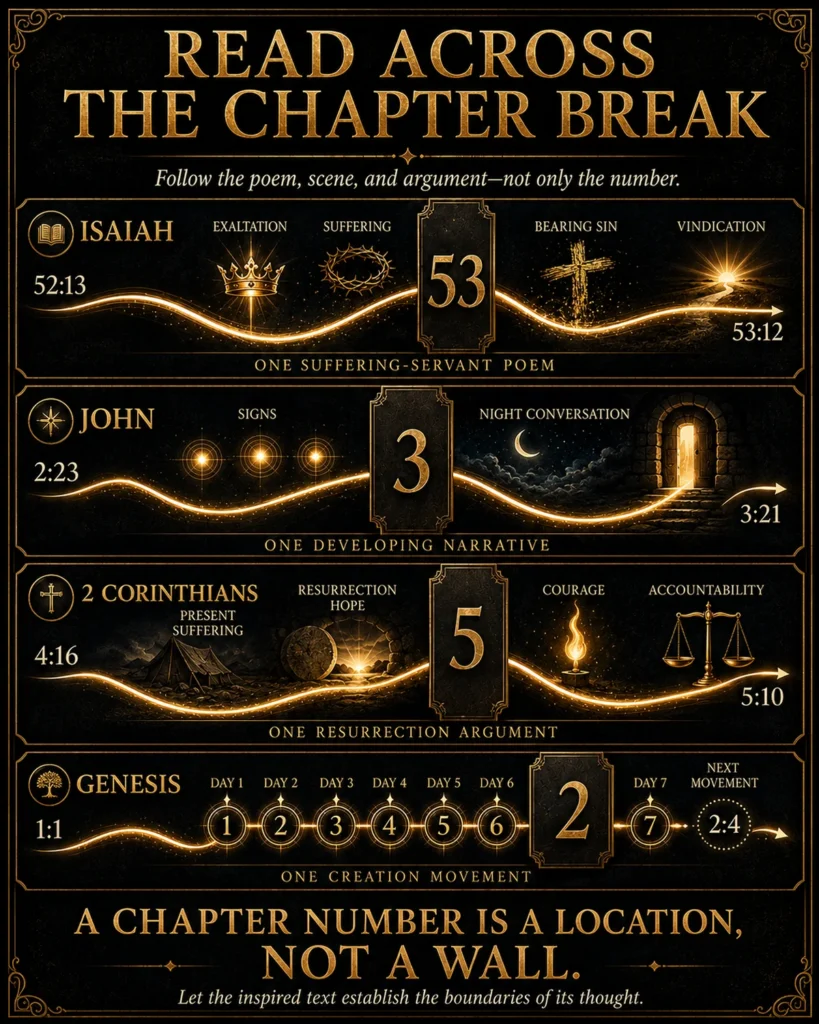
Modern chapters are highly effective coordinates, but some printed breaks fall inside larger literary units. The lesson is not to scold medieval editors. It is to let the inspired poem, scene, and argument determine the scope of interpretation.
Isaiah 52:13 Through Isaiah 53:12
Readers often begin the suffering servant passage at Isaiah 53:1. Yet the poem opens at Isaiah 52:13, where the servant is introduced as acting wisely, being raised, and being highly exalted. The movement from exaltation to disfigurement, rejection, suffering, vindication, and the bearing of sin belongs together.
Starting at the printed 53 can detach the servant’s opening elevation and worldwide impact from the suffering that follows. The chapter number falls inside the poem. The inspired unit begins before the number 53.
John 2:23 Through John 3:21
John 2 closes with many people believing because of signs, while Jesus knows what is in each person. John 3 then introduces Nicodemus as a Pharisee who comes at night and begins by mentioning the signs Jesus performs. The Greek narrative connection is especially visible because Nicodemus is introduced as a man immediately after the statement about what was in humanity.
Reading John 2:23 through 3:21 together places the conversation inside John’s developing question about signs, knowledge, new birth, and genuine faith. This framing need not imply that Nicodemus was insincere. It shows that the chapter break can hide the narrative bridge that helps readers ask the right question.
2 Corinthians 4:16 Through 5:10
Paul moves from outward wasting and inward renewal to eternal glory, what is unseen, the earthly tent, resurrection hope, life by faith, and appearing before Christ’s judgment seat. Second Corinthians 4:16 through 5:10 is one connected eschatological argument.
Stopping at the end of chapter 4 can make Paul’s contrast between present affliction and future glory feel complete before he explains embodied hope and accountability before Christ. Reading across the number reveals how resurrection, courage, faithful living, and judgment belong together.
The connection also corrects a common reduction of Paul’s “earthly tent” to a wish to escape bodily life. His movement points toward being clothed, swallowed up by life, and appearing before Christ. The full argument holds present suffering, resurrection hope, the Spirit’s guarantee, and responsible discipleship in one frame.
Genesis 1:1 Through 2:4
The opening creation account continues beyond Genesis 1:31. Genesis 2:1-3 completes the seven-day pattern as God finishes His work, rests, and blesses the seventh day. Genesis 2:4 then introduces the next literary movement with its formula concerning the heavens and the earth.
The natural literary boundary is not identical to the printed chapter boundary. Reading only Genesis 1 can separate the seventh day from the structure it completes. Reading far into Genesis 2 without noticing 2:4 can blur the transition into the next account.
This narrower observation leaves broader debates about Genesis unresolved, while demonstrating a point readers can observe directly: the numbered break after 1:31 is not the strongest guide to the account’s closing movement. Repetition, sequence, and the transition formula provide better literary evidence.
Matthew 16:28 and the Transfiguration in Matthew 17 offer another likely narrative connection across a number, although interpreters debate whether the Transfiguration exhausts the saying’s fulfillment.
How Verse Numbers Can Encourage Proof-Texting
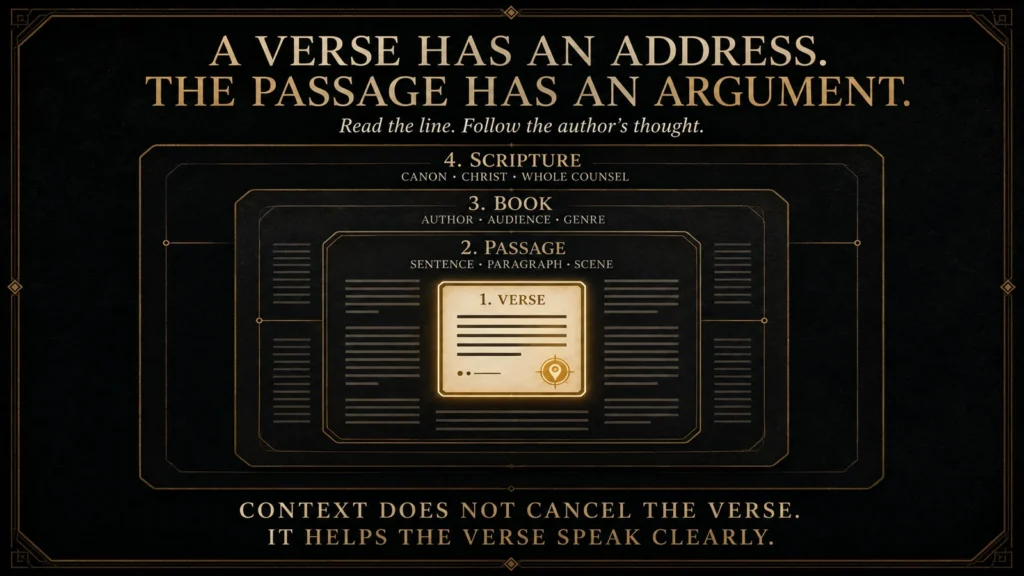
A verse number gives a sentence an address, not automatic independence from the argument around it. Individual verses can be quoted, memorized, preached, and cherished faithfully. The danger comes when the coordinate makes a line look independent from its speaker, genre, covenant setting, or paragraph.
Philippians 4:13 is often used as a promise of success in any chosen task. Paul’s nearby subject is learned contentment in hunger and plenty, need and abundance. Christ strengthens him to remain faithful through changing circumstances.
Jeremiah 29:11 speaks hope to exiles inside a letter that includes Babylon, false prophets, ordinary faithfulness, and a seventy-year horizon. The promise reveals God’s covenant purpose, but it is not a guarantee that every personal plan will become comfortable quickly.
Matthew 18:20 is true wherever Christians gather, yet its immediate setting concerns discipline, agreement, binding and loosing, and Christ’s presence among a church acting in His name. Third John 2 is a warm conventional greeting that wishes Gaius health; it cannot by itself carry a universal prosperity doctrine.
Quoting a line is not the problem. Using its number to detach it from the author’s purpose is. Good interpretation moves outward from sentence to paragraph, book, genre, and the Bible’s larger witness.
How to Read the Bible Beyond the Numbers
The solution is not to remove every reference. It is to use references with literary awareness.
- Read the full paragraph. Begin before the highlighted line and continue until the author’s thought reaches a natural pause.
- Follow connecting words. Terms such as therefore, for, but, then, and so reveal how one sentence depends on another.
- Read across chapter boundaries. Look backward and forward when a poem, scene, quotation, or argument appears unfinished.
- Identify speaker and audience. Ask who is speaking, to whom, under what circumstances, and with what purpose.
- Respect genre. Proverbs, poetry, narrative, prophecy, letters, and apocalypse communicate in different ways.
- Compare editorial presentation. Paragraphing, punctuation, and headings differ among English Bibles even when their reference numbers agree.
- Treat numbers as navigation, not divine interpretation. Let the biblical text establish its own literary units.
English Bibles may share the same chapter and verse numbers while differing in paragraphing, headings, and punctuation. Comparing those editorial choices can help readers see where printed presentation influences how a passage is read. The governing principle remains simple: use the number to return to the passage rather than shrink the passage to the number.
Bible apps can reinforce either habit. Search results and daily-verse cards make single lines easy to share, while reading views make surrounding paragraphs easy to recover. Before teaching or reposting a line, open the book view, read what leads into it, and continue until the author’s movement is clear.
Why some modern Bibles bracket or footnote familiar wording is a separate manuscript question that requires its own evidence. It should not be collapsed into this history of reference numbering.
Frequently Asked Questions
Did Jesus and the apostles use chapter and verse numbers?
No. They referred to Scripture by book, author, speaker, remembered wording, event, or passage. Jesus could receive Isaiah’s scroll, locate the reading, and announce its fulfillment without modern coordinates. The later system made shared citation easier, but Scripture’s authority and accessibility came first.
Was the Bible originally written without spaces?
Some ancient Greek manuscripts used continuous script with little or no spacing between words, but this cannot be generalized to every biblical manuscript. Hebrew and Greek copies varied in spacing, punctuation, layout, section marks, titles, and poetic arrangement.
Who divided the Bible into chapters?
Modern chapters were standardized through the Paris Bible tradition in the early thirteenth century and are traditionally associated with Stephen Langton. Earlier chapter systems existed, and the familiar system may slightly predate him.
Who added verse numbers to the Old Testament?
Jewish scribes had already preserved Hebrew verse boundaries. Isaac Nathan’s fifteenth-century concordance applied chapter and numerical references to those existing units. He numbered verse boundaries already present in the Hebrew tradition.
Who added verse numbers to the New Testament?
Robert Estienne’s 1551 Greek New Testament introduced the numbered New Testament verse system that became standard in later printed Bibles.
What was the first English Bible with verse numbers?
William Whittingham’s 1557 New Testament was the first English New Testament with numbered verses. The Geneva Bible of 1560 was the first complete English Bible to use them.
Do Bible headings, punctuation, chapters, and verse numbers change Scripture?
They affect display, location, and sometimes interpretation, but they do not create Scripture’s authority. Most headings, modern punctuation, paragraphing, chapters, verse numbers, cross-references, and study notes are later editorial aids placed around the biblical text.
Why do some Bibles number passages differently?
Jewish, Greek, Latin, Protestant, Catholic, and Orthodox traditions sometimes divide or count material differently, especially in Psalms and a few prophetic books. The words may still correspond even when chapter or verse numbers differ.
Is it wrong to quote a single Bible verse?
No. Individual verses can be quoted, memorized, and preached faithfully. Problems arise when the numbered sentence is detached from its speaker, paragraph, genre, covenant setting, or argument.
Why do some chapter breaks feel awkward?
The chapters were designed primarily for common reference, not as infallible literary analysis. A useful location marker can still fall inside a poem, scene, sentence, or argument.
The break may also reflect priorities different from a modern reader’s. Medieval scholars needed manageable shared units across an entire Bible. A boundary can succeed at that practical task while remaining secondary to the literary signals within a particular passage.
Sources and Further Reading
The disputed milestones in this article rely on university scholarship, manuscript studies, institutional catalogues, and rare-book collections rather than popular timeline summaries.
- H. A. G. Houghton, The Latin New Testament, chapter 5, on Paris Bibles, Langton, and Hugh of Saint-Cher.
- The Thirteenth Century and the Paris Bible.
- Matthew R. Crawford, “Ammonius of Alexandria, Eusebius of Caesarea and the Origins of Gospels Scholarship”.
- The Hebrew Bible.
- Jewish Encyclopedia on Isaac Nathan’s concordance.
- Bibliothèque nationale de France catalogue record for Estienne’s 1553 Bible.
- Folger catalogue record for Estienne’s 1555 Latin Bible.
- Gruber Rare Books Collection on Whittingham and the Geneva Bible.
- Württemberg State Library verse-numbering history.
These sources do not all answer the same question. Manuscript scholarship establishes ancient and medieval practices; catalogues identify specific editions; rare-book collections document English milestones. Their claims are kept within those limits.
Scripture quotation notice: Scripture taken from the Holy Bible, NEW INTERNATIONAL VERSION®, NIV®. Copyright © 1973, 1978, 1984, 2011 by Biblica, Inc.® Used by permission. All rights reserved worldwide.
NEW INTERNATIONAL VERSION® and NIV® are registered trademarks of Biblica, Inc. Use of either trademark for the offering of goods or services requires the prior written consent of Biblica US, Inc.
The Numbers Serve the Word, Not Rule It
Chapter and verse references are gifts of patient scholarship. They let congregations turn together to one place, teachers verify claims, translators compare wording, and readers carry passages into memory. Gratitude for the system does not require pretending that every printed break captures a complete literary unit.
The wiser habit is to return from coordinates to books, paragraphs, arguments, poems, and narratives. The number points; the text speaks. Good reading follows the author’s thought, receives correction, and listens for Scripture’s whole testimony.
In Luke 24:25-27 and 44-47, the risen Jesus opens the Law, the Prophets, and the Psalms around His suffering, resurrection, and the proclamation of repentance and forgiveness. In John 5:39-40, He warns that diligent study can still miss its purpose when readers refuse to come to Him for life. Faster citation is not the final goal. Scripture makes readers wise for salvation through faith in Christ, forms faithful servants, and bears witness to the One who gives life.
That purpose keeps both scholarship and devotion in their proper place. Historical precision can clear away myths, and literary context can correct misuse, but Scripture calls for more than technical competence. It summons readers to repentance, faith, worship, endurance, and hope in the Lord it reveals.
Jesus Christ is the eternal Son, the Word made flesh, the crucified Savior, the risen Lord, and the coming King. A verse reference can help us find His words, but it cannot replace hearing them in context, trusting His saving work, obeying His teaching, and proclaiming His name.