
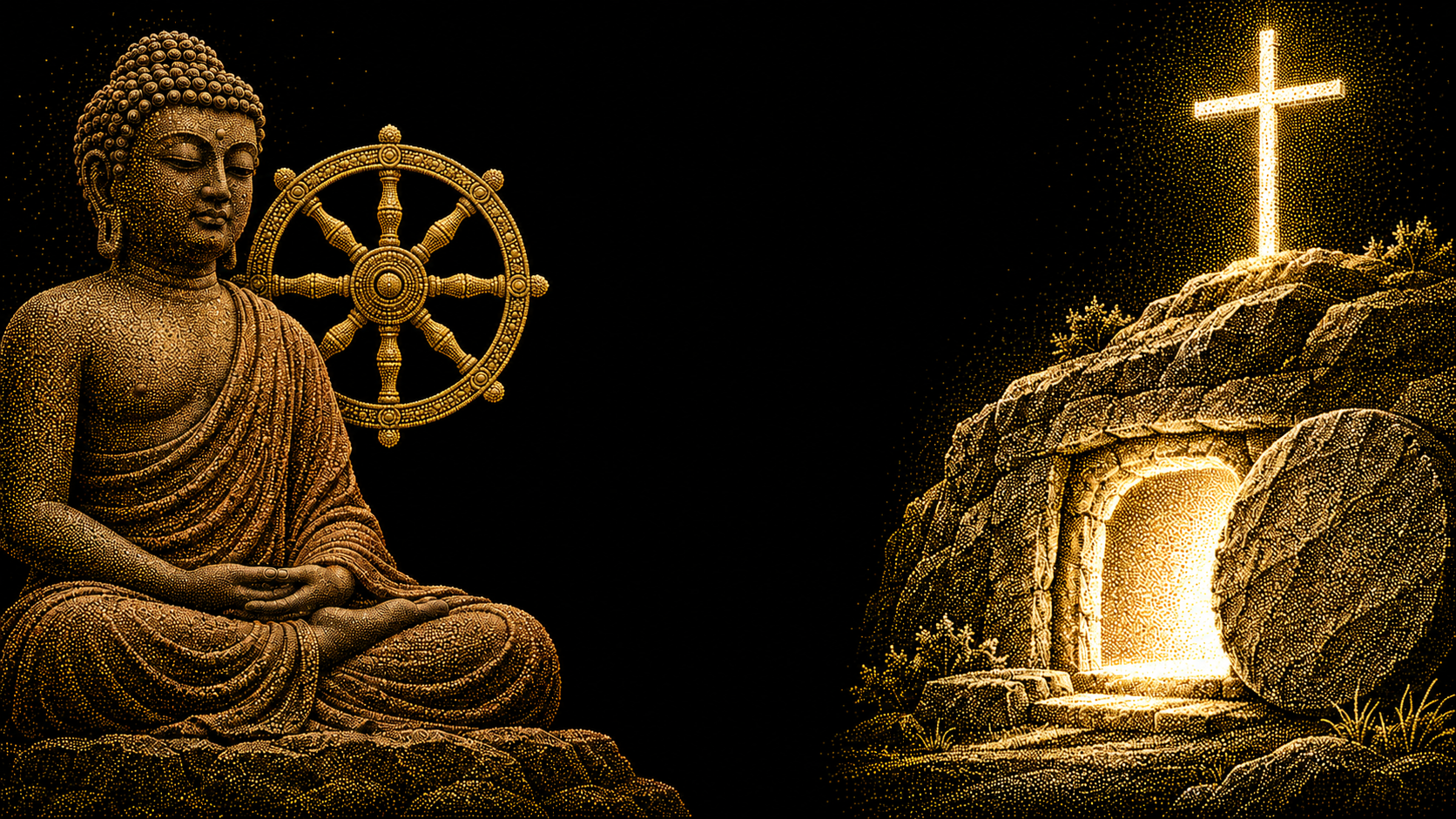

A friend says she practices Zen. A documentary introduces Tibetan Buddhism. A temple identifies itself as Theravada. Then you hear about Mahayana and Pure Land. Are these five competing versions of the same religion?
The first thing to understand is that these labels do not all describe the same level of classification. Some name broad families, others particular traditions or approaches within those families. Putting them in five equal boxes creates confusion before the conversation begins.
This guide explains how the names fit together, what their differences mean in practice, and how Christians can discuss those differences without misrepresenting their neighbors. For the foundations of karma, rebirth, suffering and liberation, start with What Do Buddhists Believe?.
GUIDED ARTICLE EXPERIENCE
Buddhist Traditions Explained: Theravada, Mahayana, Vajrayana, Zen and Pure Land
Read along as the narration moves through the article.
Browser narration · No stored audio or site tracking
CONTINUE GUIDED TOUR
Continue where you left off.
GUIDED TOUR COMPLETE
You have reached the end of this study.
Study record saved on this device.
GUIDED TOUR
Buddhist Traditions Explained: Theravada, Mahayana, Vajrayana, Zen and Pure Land
Narrator: Paranoid Prophet Recommended Voice Native device narration
Prepare to follow the article as it is narrated.
VOICE & TOUR OPTIONS
Voice & Listening
NARRATOR
Finding a narrator…
Checking the best narrator available on this device.
Restores the site recommendations available in this browser.
Our listening picks lead when available; other voices are ranked for narration. Known novelty voices are hidden. Browser-provided voices may use an online voice service.
Screen-awake support will be checked when narration starts.
Optional: improve your device voices
Listening works with the voices already available here. Your device may offer additional free voices through its own settings.
iPhone or iPad: Settings → Accessibility → Read & Speak (or Spoken Content) → Voices → English. Look for Premium or Enhanced choices, then return here.
If offered, preview Ava or Zoe for U.S. English, or Serena or Jamie for British English. An explicit Premium or Enhanced version can improve on its compact version.
Mac: System Settings → Accessibility → Read & Speak → System voice. Open the voice list to preview or download additional choices.
Windows: Settings → Accessibility → Narrator → Add natural voices. Browser availability varies; a Narrator voice may not appear on websites. Edge may also expose online Natural voices without a model download.
Android: Open Accessibility → Text-to-speech output (the location varies by device). In the preferred engine settings, look for voice data and English choices.
Download sizes vary; some enhanced voices exceed 100 MB. This website cannot install system voices, and an installed voice appears here only if your browser exposes it.
Apple voice guide · Windows voice guide · Android voice guide
CHOOSE A NARRATOR
Recommended on this device
Our listening picks: Aaron, Martha, then Daniel, when available here. Otherwise, automatic uses the highest-ranked suitable voice. Preview alternatives or save your own choice.
Preparing the guided article experience…
RESUME GUIDED TOUR?
Continue where you left off.
GUIDED TOUR COMPLETE
You have reached the end of this study.
Article Guide9 sections
The short answer: a map, not five separate denominations
Theravada is a broad Buddhist tradition associated with the Pali canon. Mahayana is a broad family that includes Zen and Pure Land. Vajrayana refers to tantric or esoteric approaches that generally operate within a Mahayana understanding of the path. Tibetan Vajrayana is therefore often described both as Mahayana and as Vajrayana. Harvard’s Pluralism Project explicitly places Zen, Pure Land and Tibetan Vajrayana within the Mahayana family. Source: The Pluralism Project.
“Denomination” can be a useful starting word for Christian readers, but it is an imperfect fit. A tradition, an institutional school, a philosophical approach and a devotional practice are not necessarily interchangeable categories.
Theravada
A broad tradition associated with the Pali canon.
Mahayana
A broad family. Examples and approaches within this setting include:
- Zen
- Pure Land
- Vajrayana / esoteric approaches
- Tibetan Vajrayana
- Japanese Shingon
Simplified orientation, not an exhaustive historical family tree. Labels describe different kinds of affiliation and practice, not exclusive equal-level boxes. Sources: Harvard Pluralism Project; Koyasan’s Shingon introduction (PDF).
At a glance: what each label tells you
| Label | Level of description | Example examined below | Practice emphasis in that example |
|---|---|---|---|
| Theravada | Broad tradition | Pali-canon traditions | Ethical discipline, tranquility and insight |
| Mahayana | Broad family | FPMT’s Tibetan Buddhist curriculum | Compassion, wisdom and awakening for others |
| Zen | Tradition within Mahayana | Soto Zen | Zazen and practice in everyday activity |
| Pure Land | Traditions within Mahayana | Jodo Shinshu Hongwanji-ha | Entrusting, nembutsu and gratitude |
| Vajrayana | Tantric/esoteric approaches within a wider path | Tibetan Kalachakra; Japanese Shingon | Lineage-based instruction and specialized practice |
These are orientation points, not exclusive boxes or a ranking. The named communities and their sources are explained below; no single practice captures every member of a tradition.
Theravada: the Pali canon and the path of liberation
Theravada has long-established communities in Sri Lanka, Thailand, Myanmar, Cambodia and Laos. Its scriptural foundation is the Pali Tipitaka, traditionally organized into discipline, discourses and systematic teaching. Meditation traditions include the cultivation of tranquility and insight. Source: Access to Insight’s practitioner introduction.
A helpful way to approach a Theravada community is to ask how its teachers connect study, ethical conduct, meditation and support for the monastic community. Do not assume that the person who attends a festival and the person undertaking an intensive retreat have identical daily routines.
One especially misleading contrast is “Theravada is selfish; Mahayana is compassionate.” The Pali discourse AN 4.125 describes loving-kindness extending in every direction without hostility. Compassionate concern cannot honestly be treated as absent from the Theravada textual world. Read the translated discourse.
Mahayana: a broad family, not one uniform church
Mahayana traditions give a central place to the bodhisattva ideal, pursuing awakening for the benefit of beings. They also recognize a wider range of scriptures than a description limited to the Pali canon would suggest. Yet “Mahayana” alone does not tell you whether someone’s religious life centers on seated meditation, devotional recitation, philosophical study or a combination. Source: The Pluralism Project.
A concrete example helps. The Foundation for the Preservation of the Mahayana Tradition identifies its heritage with the Tibetan tradition of Lama Tsongkhapa. Its introductory curriculum includes the spiritual teacher, karma, refuge, compassion, bodhichitta, emptiness and tantra. Here, Mahayana names a framework containing a substantial course of formation, rather than one isolated meditation technique. Source: FPMT’s Discovering Buddhism program.
Zen: more than an empty mind or a calm aesthetic
Zen is often encountered through photographs of uncluttered rooms and people sitting quietly. That visual shorthand leaves out much of the tradition.
The official Soto Zen introduction describes zazen, seated practice, as foundational. It explains shikantaza, often rendered “just sitting,” and presents practice and enlightenment as intimately connected rather than treating sitting merely as a technique for obtaining a later reward. It also connects Dogen’s teaching with ordinary activity. Source: Soto Zen’s account of its practice.
The Soto Zen Buddhist Association likewise emphasizes that cooking, caring for others, chanting and sitting can belong to the same life of practice. Source: Introducing Soto Zen.
These are descriptions of Soto Zen, not permission to flatten all Zen lineages into one method. They do establish why “Zen means having no beliefs” is a poor explanation.
Pure Land: devotion within a Buddhist understanding of awakening
Pure Land traditions deserve more than a footnote. Their language of trust, compassion and help beyond one’s own effort often surprises readers who have been told that Buddhism is exclusively self-reliance.
One specific example is Jodo Shinshu Hongwanji-ha, which identifies Shinran as its founder and Amida Buddha as its object of reverence. Its official teaching describes entrusting, the working of Amida’s Primal Vow, the saying of the nembutsu, reciting Amida’s name, birth in the Pure Land, attainment of Buddhahood and returning to guide others. Gratitude is central to its account of religious life. Source: Hongwanji-ha’s official teaching.
That description should remain attached to the school it describes. It is not a claim that every Pure Land community explains practice in precisely the same way.
Nor should Christian readers immediately translate “Amida” into “God,” “Pure Land” into “heaven,” and entrusting into an identical doctrine of salvation. The Stanford Encyclopedia of Philosophy situates Japanese Pure Land thought within Mahayana ideas about awakening, the self and reality, and warns that apparent Christian parallels can distort interpretation. Source: Japanese Pure Land Philosophy.
The resemblance is worth discussing. It does not settle the comparison. Ask what each tradition means by the help received, the condition from which people need deliverance, and the final goal.
Vajrayana: an approach within a larger path
Vajrayana is especially associated with Tibetan Buddhism, but “Tibetan” and “Vajrayana” should not be treated as interchangeable labels.
The Dalai Lama’s explanation of Kalachakra presents tantric practice in relation to a larger Buddhist path. It connects awakening for others with disciplined preparation and describes initiations that authorize particular practices. This is a specific religious framework, not a menu of exotic techniques detached from teachers, commitments and ethics. Source: Introduction to the Kalachakra.
Japan provides an important corrective to a Tibet-only picture. Koyasan’s official introduction describes Shingon esoteric Buddhism as a form of tantric or Vajrayana Buddhism transmitted from India through China to Japan. It identifies Kukai as the founder of Shingon in Japan. Source: Koyasan’s English introduction, PDF.
What should you actually compare?
Instead of ranking traditions from “simple” to “advanced,” use four questions:
Authority
Which scriptures, teachers and commentaries shape this community’s understanding?
Goal
What does liberation or awakening mean here?
Practice
What happens in ordinary religious life, beyond what visitors notice?
Community
How do laypeople, ordained practitioners and teachers relate?
An editorial comparison framework, not a Buddhist creed or a ranking of religions.
These questions are our suggested comparison framework, not a Buddhist creed. They help prevent a common mistake: comparing the deepest theology of one tradition with a superficial stereotype of another.
For example, a visitor might see someone sitting, hear another person reciting, and watch someone else participating in a ceremony. Those observations tell you something about visible activity. They do not, by themselves, explain the practitioner’s understanding of suffering, reality or the goal of the path.
Ask the person to explain. A good opening is: “What does this practice mean in your community?” A much weaker opening is: “I already know what all Buddhists believe.”
A Christian response: understanding the differences sharpens the question
Christians can recognize disciplined attention, generosity and concern for suffering without pretending that all religious claims agree. Respectful description is part of honest witness.
The Christian claim about Jesus has a specific center. Paul presents Christ’s death for sins, burial and resurrection as the gospel he received and proclaimed. He makes the resurrection indispensable to Christian faith and connects it with the future resurrection of the dead. That is a different claim from simply offering another technique for tranquility or another illustration of human wisdom. Read 1 Corinthians 15.
Our Christian conclusion is that Jesus answers humanity’s need through his saving death and resurrection. That conclusion should be defended through the case for Christ, not through exaggerating Buddhist weaknesses.
The comparison becomes more serious when we ask:
- Does our deepest problem include guilt before God, and what could reconcile us to him?
- What grounds our hope in the face of death?
- What would count as good reason to believe Jesus rose?
- When two traditions use words such as compassion or liberation, do they mean the same thing?
Naming Buddhist diversity does not remove those questions. It keeps us from answering them on behalf of people whose position we have never understood. For the historical Christian claim, continue with Resurrection Accounts Compared.
Frequently asked questions
Is Zen separate from Mahayana?
Zen belongs within the wider Mahayana family. “Zen” identifies a more specific tradition; “Mahayana” identifies the broader setting. The two descriptions need not conflict.
Is Pure Land just Christianity with Buddhist names?
No. Similar-sounding language about trust or help must be interpreted within the tradition using it. Pure Land accounts of Buddhahood and awakening should not be silently replaced with Christian accounts of God, sin and resurrection.
Does Vajrayana mean Tibetan Buddhism only?
No. Tibetan traditions are important examples, but Japanese Shingon also belongs in a discussion of tantric or esoteric Buddhism.
Which tradition is the most authentic?
That question requires a standard: earliest surviving texts, institutional continuity, a particular lineage’s claims, or fidelity to a specific account of the Buddha’s teaching. Those are different tests. This guide maps traditions; it does not pretend to settle their competing claims to authority.
What should Christians read first?
Begin with the basic Buddhist beliefs guide, then read a named tradition’s own account alongside careful scholarship. Use How to Compare Religions Fairly to keep description and evaluation distinct.
The takeaway: understand the family relationships, let communities explain their own terms, and bring the central claims into view. Christian confidence should make us more willing to listen accurately, not less.