
GUIDED ARTICLE EXPERIENCE
What Do Buddhists Believe? Buddhism and Christianity Compared
Read along as the narration moves through the article.
Private device narration · No hosted audio or tracking
CONTINUE GUIDED TOUR
Continue where you left off.
GUIDED TOUR COMPLETE
You have reached the end of this study.
Study record saved on this device.
GUIDED TOUR
What Do Buddhists Believe? Buddhism and Christianity Compared
Narrator: Paranoid Prophet Recommended Voice Native device narration
Prepare to follow the article as it is narrated.
VOICE & TOUR OPTIONS
Voice & Listening
NARRATOR
Finding a narrator…
Checking the best narrator available on this device.
Restores the best curated narrator available on this device.
Narrator choices are curated for clear, long-form listening on this device.
Screen-awake support will be checked when narration starts.
CHOOSE A NARRATOR
Curated for this device
Choose a verified narrator for this browser, or use System Narrator. Automatic mode uses the best reliable route exposed by this device; your chosen narrator is preserved even if this device needs a temporary fallback.
Preparing the guided article experience…
RESUME GUIDED TOUR?
Continue where you left off.
GUIDED TOUR COMPLETE
You have reached the end of this study.
Buddhism is more than meditation. It is a family of religious traditions shaped by the Buddha, the Dharma, the Sangha, scriptures, monastic communities, teachers, rituals, ethical disciplines, and many centuries of interpretation. A person may encounter it through a mindfulness app, a Thai temple, a Japanese Pure Land service, a Tibetan initiation, or Zen sitting and come away with very different first impressions.
So what do Buddhists believe? The answer begins with shared teachings about suffering, impermanence, craving, karma, rebirth, and liberation, but it must also make room for Theravada, Mahayana, Vajrayana, Zen, Pure Land, and modern forms. Good comparison describes each tradition before evaluating it. That is the method developed in our guide to how to compare religions fairly.
The central disagreement with Christianity is not whether compassion or disciplined attention can be good. It is whether humanity’s deepest problem is ignorance and craving sustained by attachment, or sin and death before the Creator, and whether the answer is the Buddhist path or salvation through the crucified and risen Jesus.
Article Guide17 sections
Short Answer: What Do Buddhists Believe?
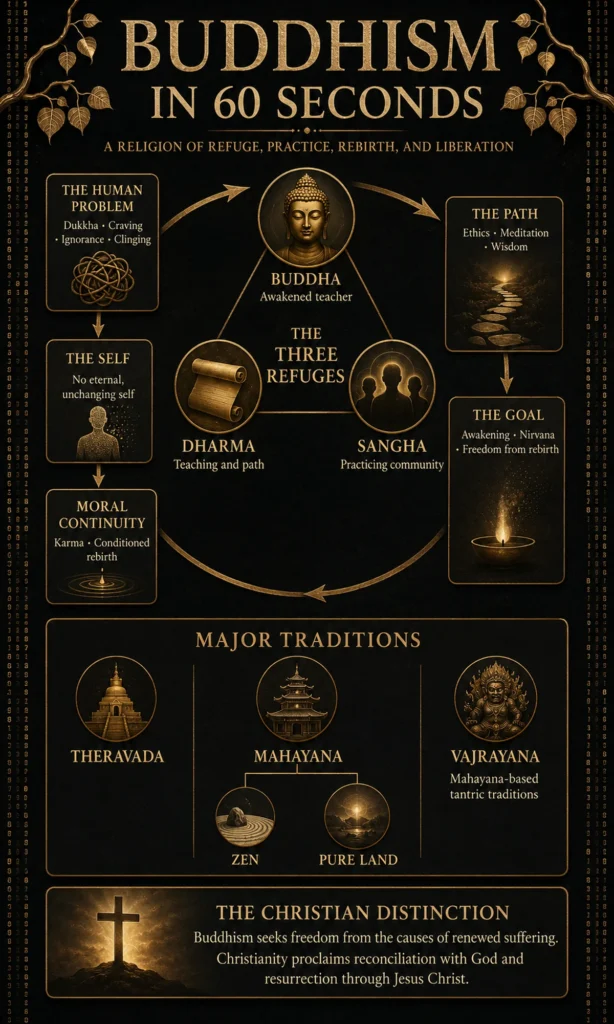
Buddhists generally take refuge in the Buddha, the Dharma, and the Sangha. They look to the Buddha as the awakened teacher, to the Dharma as his teaching and the reality it discloses, and to the Sangha as the community that preserves and practices the path. The Four Noble Truths diagnose dukkha, trace its origin to craving, announce its cessation, and prescribe the Noble Eightfold Path. Ethical conduct, meditation, wisdom, devotion, and school-specific practices aim at awakening and freedom from the cycle of rebirth.
Buddhism generally does not make liberation depend on a sovereign Creator who made the universe and reconciles sinners to Himself. Traditional Buddhist worlds may nevertheless include devas, heavens, hells, Buddhas, bodhisattvas, spirits, sacred powers, prayers, offerings, and worship. Most Buddhist accounts describe rebirth as conditioned continuity without an eternal soul. Nirvana is liberation from ignorance, craving, suffering, and renewed becoming; it is neither Christian heaven nor simple annihilation.
60-Second Buddhist Belief Map
- Founder and teacher: Siddhartha Gautama, known as the Buddha.
- Authority: Buddha, Dharma, Sangha, canons, commentaries, schools, lineages, and teachers.
- Human problem: dukkha, craving, ignorance, clinging, and karmic continuation.
- Path: ethics, meditation, wisdom, devotion, and tradition-specific disciplines.
- Self: no eternal, unchanging self in early teaching, with later school-specific elaborations.
- Goal: nirvana, awakening, buddhahood, or Pure Land birth depending on the tradition.
Christian teaching agrees that ignorance, destructive desire, and selfish habits deform us. It also identifies a deeper crisis: creatures have sinned against their Creator and stand under death and judgment. Its hope centers on God’s grace in Jesus Christ, forgiveness through His cross, transformation by His Spirit, and bodily resurrection into renewed creation.
Who Was the Buddha?
Historical Teacher
The historical Buddha is usually identified as Siddhartha Gautama, a teacher who lived in northern India sometime around the middle of the first millennium BC. Exact dates remain debated. Modern historical study works back through texts preserved by later communities, comparing languages, parallel discourses, institutions, and ideas. The Stanford Encyclopedia of Philosophy’s study of the Buddha provides a careful introduction to that reconstruction.
He taught in a religious world already debating sacrifice, karma, rebirth, asceticism, liberation, and the nature of the self. His movement formed communities of monks and nuns while also addressing householders, rulers, workers, parents, and seekers. His teaching challenged both indulgence and destructive self-mortification.
The sources were preserved by communities that regarded him as authoritative, not by detached modern biographers. That does not make historical inquiry impossible. Repeated teachings, parallel collections, early institutional patterns, and the Indian setting allow cautious conclusions. It does mean that a responsible profile avoids two extremes: treating every sacred episode as a modern transcript or dismissing the entire tradition because its texts were transmitted before being written down.
Traditional biography. Buddhist traditions tell a fuller sacred biography. Siddhartha is born into privilege, encounters old age, sickness, and death, leaves home, studies with renowned teachers, practices severe austerities, and then adopts a middle way. Seated beneath the Bodhi tree, he overcomes temptation and ignorance, awakens, and begins teaching. Later accounts enrich this story with predictions, miracles, former lives, cosmic significance, and devotional detail.
What “Buddha” means. Buddha means “awakened one.” Gautama is not merely someone who accumulated information. He is understood to have directly realized the nature of suffering and the way to its cessation. Different traditions expand his identity differently: as the exemplary historical Buddha, as one Buddha among many, or through elaborate teachings about cosmic Buddhas and dimensions of buddhahood.
Historical and devotional layers. Historical reconstruction and Buddhist confession ask different questions. A historian may cautiously recover an influential ascetic teacher and early community. A Buddhist may receive the traditional life as sacred history that reveals the Buddha’s virtues and authority. Fair description distinguishes those layers without dismissing devotion or presenting every later detail as equally early.
Where Do Buddhist Teachings Come From?
Buddhism has no single worldwide pope, creed, or book functioning exactly like a universal Buddhist Bible. Authority is distributed among texts, communities, lineages, institutions, teachers, and claims of realization. Different Buddhist traditions preserve overlapping but nonidentical scriptural worlds.
Early Nikayas and Agamas
The earliest Buddhist teachings survive in related collections, especially the Pali Nikayas and Chinese Agamas. They were transmitted orally and edited within developing communities, yet their parallels provide the strongest textual basis for describing early Buddhism. They preserve discourses on the Four Noble Truths, dependent origination, meditation, ethical conduct, monastic life, cosmology, and liberation.
These texts should be heard before later summaries are projected backward. That does not make later traditions inauthentic by definition. It simply distinguishes early shared material from Mahayana sutras, tantric literature, philosophical treatises, and school commentaries that claim authority through different histories and criteria.
The Pali Canon. The Pali Canon, or Tipitaka, is central to Theravada Buddhism. Its three “baskets” are the Vinaya Pitaka, governing monastic discipline; the Sutta Pitaka, preserving discourses; and the Abhidhamma Pitaka, offering systematic analysis. It is an immense and internally varied collection, not one continuous book. It is also not the universal canon of every Buddhist.
The Chinese Buddhist Canon. East Asian Buddhist traditions draw from a much larger Chinese canonical world. It includes Agamas, several Vinaya traditions, Abhidharma works, Mahayana sutras, philosophical treatises, ritual and esoteric texts, commentaries, and writings composed in China. The BDK English Tripitaka project translates selected works from the Taisho edition of this canon. Calling it a “Mahayana Bible” would hide both its scale and its diversity.
The Tibetan Kangyur and Tengyur. Tibetan Buddhist traditions distinguish the Kangyur, works regarded as translated Buddha-word, from the Tengyur, Indian treatises and commentaries on philosophy and practice. The collections include sutras, Vinaya, tantras, and systematic interpretation. The institutional 84000 translation project documents this two-part canon and is translating it into English.
Scripture, Sangha, Lineage, and Teacher
Texts do not interpret themselves. Monastic ordination lines, commentaries, ritual transmission, philosophical debate, local institutions, and trusted teachers shape how Buddhists understand them. Theravada communities may privilege Pali commentaries and monastic elders. Zen emphasizes lineage and direct realization while possessing extensive scriptures and literature. Vajrayana requires initiation and close guidance for practices that are not treated as self-study material.
Buddhist authority lives in texts, institutions, and people. Practitioners may test teachings through study and practice while still submitting to inherited forms. The Dalai Lama is a major Tibetan leader, not a spokesperson whose judgments bind all Buddhists. Nor can one modern convert teacher define an Asian tradition of hundreds of millions.
Canon diversity also changes the meaning of “What did the Buddha teach?” Theravada may identify preserved Pali texts as Buddha-word. Some Mahayana traditions explain the later literary appearance of certain sutras through hidden preservation, restricted audiences, or teachings disclosed when conditions were ready. Historians assess their development through the surviving textual evidence. Tibetan traditions add translated tantric corpora and interpretive systems. Description should report each community’s claim and historical scholarship’s judgment without pretending they are the same kind of statement.
Is Buddhism One Religion?
Buddhists share important family resemblances: reverence for Buddha, Dharma, and Sangha; concern with dukkha, karma, samsara, ethical cultivation, mental discipline, wisdom, and liberation. Yet schools disagree about authoritative texts, the ideal practitioner, the nature of buddhahood, the analysis of mind and reality, and the most effective path.
Theravada
Theravada, prominent in Sri Lanka and mainland Southeast Asia, centers the Pali Canon, monastic discipline, merit, meditation, and the arhat ideal. The arhat is liberated through fully realizing the path. Lay devotion and generosity are not marginal additions; they sustain the Sangha and shape daily religious life.
Mahayana
Mahayana traditions receive additional sutras and emphasize the bodhisattva aspiration to buddhahood for the benefit of beings. They develop teachings on emptiness, skillful means, Buddha nature, cosmic Buddhas, and vast compassion. Compassion is central in earlier Buddhism as well, and Mahayana itself is not one uniform school.
Vajrayana
Vajrayana builds on Mahayana foundations and uses mantra, visualization, mandala, ritual, initiation, and teacher-guided tantric methods. It is especially associated with Tibetan Buddhism but is not limited to Tibet. Reducing it to sexual tantra ignores its ordinary liturgies, ethical vows, philosophical study, and disciplined contemplative systems.
Zen
Zen stresses direct realization, disciplined sitting, teacher-student transmission, liturgy, and precepts. Some schools use koans; others emphasize “just sitting.” Its suspicion of attachment to words does not make it scripture-free. Zen communities read sutras, preserve records of teachers, chant, perform rituals, and maintain extensive literature.
Pure Land
Pure Land traditions direct trust and aspiration toward Amitabha Buddha and birth in Sukhavati, a realm favorable for awakening. Practices include reciting Amitabha’s name as nianfo or nembutsu. Interpretations of faith, practice, and other-power differ. Sukhavati is not Christian heaven, and Amitabha is not the Creator.
These labels also overlap. Tibetan Buddhism is generally Vajrayana and Mahayana. Zen and Pure Land are Mahayana families. Many East Asian communities combine practices that Western textbooks separate. Modern Buddhist movements may reinterpret karma, cosmology, ritual, or meditation in conversation with science, nationalism, psychology, or secular culture.
Modern Western presentations sometimes foreground meditation and personal experience while backgrounding merit, monastic authority, rebirth, protective ritual, or devotion. Asian modernists have also reformed Buddhism in response to colonial power and science. These forms are real Buddhism when rooted in Buddhist communities, but they are interpretations, not a neutral essence finally stripped of culture. A complete profile listens to temple, monastery, household, text, and retreat center.
The Four Noble Truths and the Noble Eightfold Path
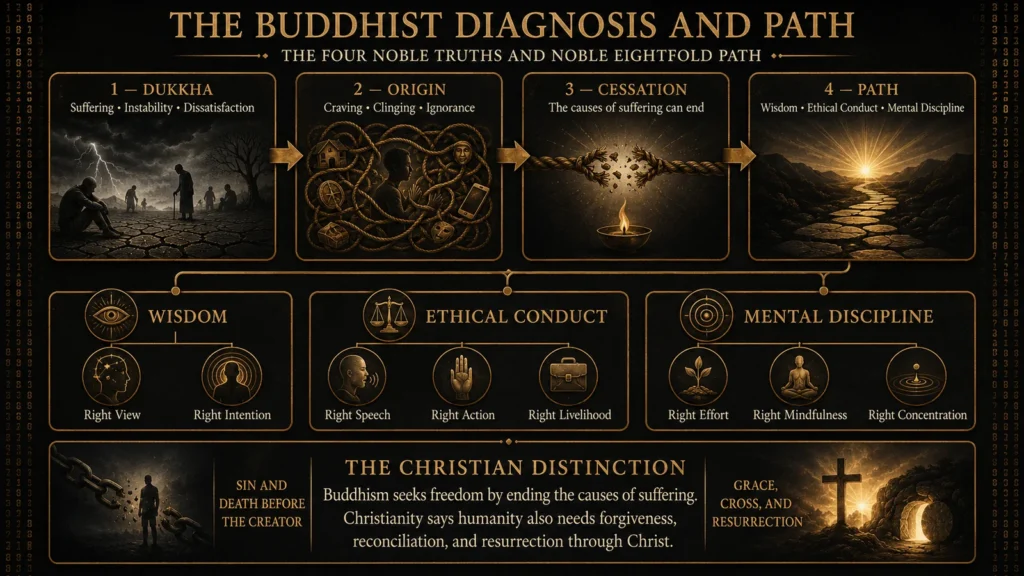
The Four Noble Truths organize the Buddha’s diagnosis and cure. In SN 56.11, translated by Bhikkhu Bodhi, they are not merely propositions to agree with. Suffering is to be understood, craving abandoned, cessation realized, and the path developed.
Dukkha
Dukkha is often translated “suffering,” but it includes more than intense pain. Birth, aging, sickness, death, grief, frustration, association with what is disliked, separation from what is loved, and the instability of conditioned experience all belong to its field. Pleasant experiences are not denied; they are unreliable as final refuge because they change and cannot be possessed permanently.
Craving and Ignorance
The second truth identifies craving: thirst for sensual pleasure, continued existence, or nonexistence. Clinging hardens that thirst around possessions, experiences, views, rituals, and theories of self. Ignorance is deeper than lack of data. It is failure to see impermanence, dukkha, no-self, conditioned arising, and the Four Truths accurately. Craving and ignorance sustain each other and perpetuate karmic becoming.
Cessation
The third truth announces that craving can cease. Nirvana is the extinguishing of greed, hatred, and delusion and freedom from the process that generates renewed suffering. This is not a promise that every difficulty can be managed through a calmer attitude. It is the radical Buddhist claim that the causes binding beings to samsara can be ended.
The Fourth Truth: The Path
The fourth truth gives the path: right view, intention, speech, action, livelihood, effort, mindfulness, and concentration. “Right” means aligned with awakening, not merely whatever feels authentic. The factors support one another. Ethical restraint stabilizes life; mental discipline reveals patterns of craving; wisdom understands reality and loosens clinging.
That moral seriousness deserves respect, but the diagnosis remains disputed. Jesus also exposes enslaving desire, hypocrisy, anger, and self-deception. The Bible, however, locates these within rebellion against God. The sufferer is not only trapped in ignorance; the sinner needs pardon, reconciliation, and life from the Creator.
The Four Truths are sometimes called pessimistic because they begin with suffering. Buddhists commonly answer that a physician must name the disease before offering a cure. The framework is practical and hopeful because cessation is possible. The real Christian disagreement concerns the adequacy of the diagnosis and cure, not the lazy charge that Buddhists simply enjoy gloomy thoughts.
The eight factors are often grouped under wisdom, ethical conduct, and mental discipline. They are not eight stages completed once in order. They mature together as a way of seeing, acting, and training the mind.
Wisdom
Right view understands action and consequence, the Four Truths, and reality as Buddhist teaching presents it. Right intention cultivates renunciation, goodwill, and harmlessness in place of grasping, ill will, and cruelty. Wisdom here is practical and moral, not detached speculation.
Ethical Conduct
Right speech avoids falsehood, divisiveness, harshness, and empty chatter. Right action restrains killing, stealing, and sexual misconduct. Right livelihood seeks work that does not depend on exploitation or serious harm. These disciplines address both outward behavior and the intentions that form character.
Mental Discipline
Right effort prevents and abandons unwholesome states while developing wholesome ones. Right mindfulness attends carefully to body, feelings, mind, and phenomena. Right concentration gathers and steadies the mind, classically including deep absorptions called jhanas. Buddhist meditation trains attention for ethical clarity, insight, and liberation rather than merely blanking the mind.
The path demands sustained practice. Christian discipleship also includes obedience, attention, self-control, prayer, and transformed habits. In the gospel, these disciplines are fruits of grace and life with God, not a technique by which a person solves guilt and death apart from divine rescue.
What Do Buddhists Believe About the Self?
Impermanence
Buddhist analysis begins with impermanence. Bodies age, sensations change, perceptions shift, intentions arise and pass, and consciousness depends on conditions. What we call a person is not a static object hidden beneath experience. Clinging to changing processes as “me” or “mine” creates fear, frustration, and suffering.
No-Self
Early Buddhist teaching denies that form, feeling, perception, formations, or consciousness constitute an eternal, unchanging self. In SN 22.59, translated by Bhikkhu Bodhi, each aggregate is examined as impermanent, afflicted, and not fully subject to command. The disciple learns not to identify it as “mine,” “I,” or “my self.”
No-self does not mean that nothing exists, choices are unreal, or pain has no subject in ordinary language. Buddhism speaks conventionally of persons, responsibility, teachers, and compassion. Its challenge is to belief in an independent, permanent essence. Later schools analyze personhood differently, but none should be casually turned into modern materialism.
Dependent Origination
SN 12.2, in Bhikkhu Bodhi’s translation, analyzes conditioned arising: ignorance conditions formations, formations condition consciousness, and the sequence proceeds through name-and-form, sense fields, contact, feeling, craving, clinging, existence, birth, aging, and death. When ignorance and craving cease, the mass of suffering ceases. The point is neither a first-cause theory nor fatalism, but a map of dependence and release.
Mahayana teachings on emptiness press this logic further: things lack independent, self-existing essence because they arise through relations and conditions. Emptiness is not nihilism. It is meant to loosen reification and attachment while preserving conventional causation, ethics, and compassion.
Madhyamaka warns that even emptiness must not become a new substance. Yogacara analyzes consciousness, perception, and karmic seeds without simply restoring an eternal soul. Buddha-nature language can sound more positive, but schools debate whether it names potential for awakening, a skillful teaching, or ultimate reality. These differences matter. It is inaccurate either to force every Buddhist school into one theory of the person or to read each unfamiliar term as a hidden version of the Christian soul.
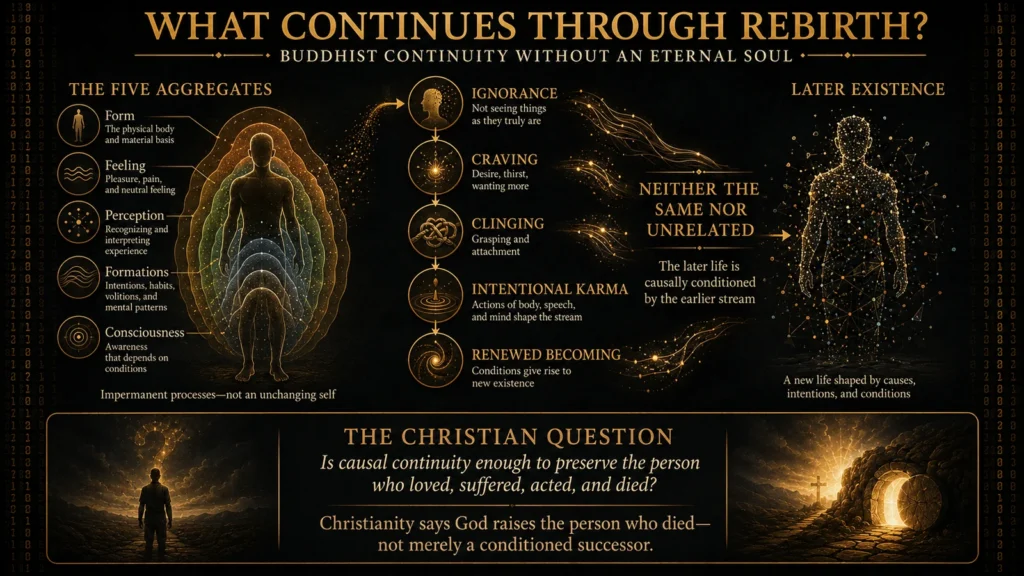
What Continues Through Rebirth?
Buddhist rebirth generally does not require an eternal soul. Intentional action, craving, and ignorance condition renewed existence. MN 38, translated by Bhikkhu Bodhi, rejects the idea that the same consciousness simply travels through the round. Continuity is causal: the later life is not an unchanged substance, yet neither is it unrelated to the earlier stream.
That answer can be understood on its own terms and still raise a question: does causal relation without enduring personal identity adequately ground moral desert, love, memory, and hope? The Christian account describes the person as created, embodied, relational, morally responsible, fallen, redeemable, and destined for resurrection. God raises the person who died, not an impersonal process or a replacement.
What Are Karma, Rebirth, and Nirvana?
Karma means action, especially intentional action with morally relevant consequences. It is not a god’s punishment and not a guarantee that every present misfortune can be traced to one obvious past deed. Buddhist traditions develop highly detailed accounts of how intentions bear fruit across this life and future lives. MN 135, translated by Suddhaso Bhikkhu, connects differing conditions with patterns of action while directing attention toward responsibility.
Rebirth continues samsara, the recurring round of birth and death. Favorable rebirth may provide better conditions for practice; unfavorable rebirth intensifies suffering. The ultimate Buddhist aim is not an endless sequence of improved lives. It is liberation from the ignorance and craving that produce renewed becoming.
Nirvana names that liberation. Early texts describe it through the ending of greed, hatred, and delusion, the cessation of craving, and release from future birth. Traditions debate its conceptual description and the relation between nirvana and samsara, but it should not be reduced to a pleasant afterlife, absorption into God, or extinction in the crude sense of “nothingness.”
The full personal-identity and evidence questions belong in our study of resurrection and reincarnation compared. The decisive contrast is that Buddhist liberation ends the causes of renewed becoming, while Christianity teaches one life followed by judgment, the resurrection of the same person, and creation renewed under God.
Do Buddhists Believe in God or Worship Buddha?
A simple yes or no can mislead. Buddhists generally do not believe that liberation depends on one eternal Creator God who made all things and saves humanity. That is why Buddhism is often called non-theistic. Traditional Buddhist worlds can still be religiously rich rather than secular, materialist, or empty of sacred beings.
Why Buddhism Is Called Non-Theistic
The Four Noble Truths do not begin with creation, covenant, sin against God, or reconciliation with Him. They diagnose conditioned suffering and prescribe a path of ethical, meditative, and wise cultivation. Some early Buddhist texts challenge creator claims, but this framework does not require a Creator doctrine to explain suffering or liberation. The liberation of mind does not depend on receiving pardon from a divine Judge.
Devas, Heavens, and Cosmology
Buddhist texts nevertheless contain devas, Brahmas, heavenly realms, hells, spirits, guardians, and multiple world systems. Some beings are powerful and long-lived; some receive honor or petitions. They remain impermanent and conditioned within samsara. A heavenly birth may be pleasant, but it is not final liberation. No deva simply occupies the role of the uncreated biblical God.
Buddhas and Bodhisattvas
Mahayana and Vajrayana traditions may direct intense devotion toward Buddhas and bodhisattvas. Amitabha is associated with Pure Land birth; Avalokiteshvara embodies compassion; Manjushri represents wisdom; Tara is invoked for protection and aid. Traditions interpret their status and presence through developed buddhology, vows, manifestations, and sacred cosmology. Calling them ordinary “gods” can obscure those categories, but pretending the devotion is merely philosophical can obscure the religion people actually practice.
For many practitioners, cosmology is lived through funeral rites, protective chanting, temple calendars, vows, stories, pilgrimage, and hopes for favorable rebirth. Others interpret these realms psychologically or suspend judgment. The presence of modern symbolic readings does not erase traditional claims, and traditional claims should not be used to deny the existence of naturalistic Buddhists.
A compact answer:
- Creator: no sovereign Creator is central to Buddhist liberation.
- Sacred beings: many traditions affirm devas, Buddhas, bodhisattvas, guardians, heavens, and hells.
- Devotion: prayer, offerings, vows, refuge, and invocation can be central.
- Christian distinction: none of these beings is simply the eternal Creator, Judge, and Redeemer revealed in Scripture.
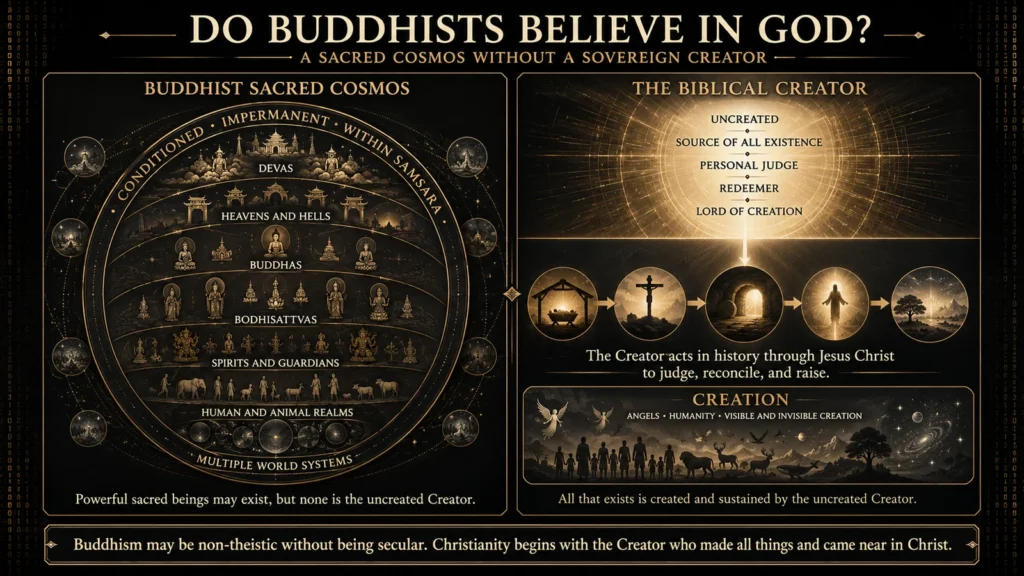
Christian teaching begins with the uncreated God: the eternal Word was with God and was God, and all things were made through Him. The Creator is not one conditioned being within a larger cosmos. He gives existence to all things, knows persons completely, judges evil, and acts to reconcile sinners through His Son. The God question changes the meaning of suffering, morality, worship, and salvation.
Worship, Devotion, and Refuge
Many Buddhists bow before Buddha images, offer incense, lamps, food, or flowers, chant praises, honor relics, and take refuge in the Buddha. In ordinary English, some of these practices can reasonably be called worship or devotion. Buddhists do not normally mean that Gautama is the eternal Creator God.
Bowing, offerings, and refuge. A bow may express gratitude, humility, aspiration, reverence, or submission to the path. Flowers can teach impermanence as they fade; light can signify wisdom; incense can mark sacred space. Taking refuge is more than admiring a historical philosopher. It publicly locates religious trust in Buddha, Dharma, and Sangha.
Images and relics. Buddha images may serve as reminders, representations, ritual centers, consecrated objects, or supports for meditation. Relics are enshrined in stupas, honored through pilgrimage and offerings, and associated with the presence or merit of the Buddha and revered teachers. DN 16 in Bhikkhu Sujato’s translation records funeral veneration and the distribution of the Buddha’s relics, showing that devotion is not merely a late Western misunderstanding.
Devotion without Creator doctrine. Many Buddhists practice devotion without identifying Buddha as the Creator. This prevents two errors: saying Buddhists never worship, and saying they worship Buddha exactly as Christians worship God. Christian worship is directed to the uncreated Lord. Buddhist devotion operates within a different account of reality, refuge, merit, and awakening.
How Do Buddhists Practice?
Practice varies by country, school, age, family, and level of commitment. Meditation alone does not make someone Buddhist, and not every Buddhist meditates regularly. A lay family attending festivals and supporting a monastery may be as recognizably Buddhist within its culture as a Western retreat participant.
Refuge and the Five Precepts
Taking refuge in Buddha, Dharma, and Sangha is a basic marker of Buddhist identity. Laypeople commonly undertake five precepts: refraining from killing, stealing, sexual misconduct, false speech, and intoxicating heedlessness. The commitments are training rules that form attention and conduct. AN 8.39 in Bhikkhu Sujato’s translation joins the three refuges and five precepts as streams of merit.
Meditation
Buddhist meditation includes mindfulness of breathing, concentration, insight, recollection, contemplation of impermanence and death, loving-kindness, compassion, and, in some traditions, visualization and mantra. MN 10 in Suddhaso Bhikkhu’s translation trains attention to body, feelings, mind, and phenomena. The aim is not simply relaxation, although calm may result. Practice sits within teachings about conduct, mind, reality, and liberation.
Secular mindfulness programs do not require Buddhist refuge. A systematic review of meditation programs found small to moderate improvements in anxiety, depression, and pain, while evidence for several other outcomes was low or insufficient. Psychological benefit does not prove metaphysical truth. A breathing practice cannot by itself establish karma across lives, no-self, nirvana, or the nonexistence of a Creator.
Chanting and Prayer
Buddhists chant refuge formulas, precepts, sutras, praises, protective texts, mantras, and names of Buddhas. Prayer may include aspiration, confession, petitions, remembrance, and dedication of merit. Some traditions address celestial Buddhas or bodhisattvas for aid; others emphasize how chanting disciplines the practitioner’s own mind. “Buddhists do not pray” is too broad.
Merit and Generosity
Generosity, temple support, gifts to monastics, precept observance, chanting, pilgrimage, copying or sponsoring texts, honoring relics, and meditation may generate merit. Merit is not best described as a crude spiritual point system. It concerns wholesome action and its effects, can support favorable conditions and progress, and may be dedicated to others according to tradition.
Monastic and Lay Life
Monks and nuns follow Vinaya disciplines involving celibacy, possessions, food, community procedure, study, meditation, teaching, and ritual. Monastic communities preserve texts and provide fields of merit, but their forms differ across Buddhist cultures. Lay Buddhists maintain households, work, raise children, keep altars, attend festivals, give alms, chant, meditate, make pilgrimages, and support temples. They are not incomplete monks.
Zen, Pure Land, and Vajrayana. A Zen service may combine zazen, bows, chanting, memorial rites, work practice, and precepts. Pure Land practice may center on hearing Amitabha’s vow and reciting his name with trust and aspiration. Vajrayana may combine foundational ethics and compassion with liturgy, mantra, visualization, mandala, and authorized instruction. Each belongs to a complete religious world, not a detachable technique.
Christian prayer and meditation also train attention and desire as responses to the living God. Christians address the Father through the Son, attend to God’s Word, confess sin, ask for daily bread, intercede for others, and receive grace. Similar outward quiet can serve a different object, story, and hope.
Buddhist Ethics, Compassion, Nonviolence, and Forgiveness
Intention and the Three Poisons
Buddhist ethics gives intention a central role. Greed, hatred, and delusion are the three poisons that drive harmful action and continued suffering. Generosity, non-hatred, and wisdom oppose them. Rules matter, but moral formation reaches into motives, habits, attention, and the kind of mind an action strengthens. The Stanford Encyclopedia of Philosophy’s survey of Buddhist ethics shows why no single Western category fully captures this tradition.
Loving-Kindness and Compassion
Metta or maitri seeks the genuine welfare of beings. Its cultivation deliberately widens goodwill beyond friends to strangers, difficult people, and all creatures. It is not sentimental approval of every action. It trains freedom from ill will and the wish that others be well.
Karuna responds to suffering with the wish that suffering and its causes end. It can motivate generosity, care for the sick, animal protection, peacemaking, education, and social action. Buddhist traditions debate how contemplative nonattachment relates to political engagement, but compassion is not merely passive inward calm.
Modern “engaged Buddhism” applies non-harm, interdependence, and compassion to war, poverty, prisons, ecology, and structural injustice. Its advocates disagree about politics and strategy, just as Christian activists do. The movement shows that Buddhist ethics can move from individual intention to institutions, while debates around it show that no easy slogan settles how liberation relates to public responsibility.
The Bodhisattva Ideal
Mahayana celebrates the bodhisattva who aspires to complete buddhahood for the benefit of beings and cultivates generosity, ethics, patience, effort, meditation, and wisdom. Great vows and stories dramatize costly compassion. Theravada texts and communities also honor generosity, loving-kindness, compassion, and service; its ideal should not be caricatured as selfish.
The Buddhist exposure of greed, hatred, and delusion meets a real moral need. Jesus commands love of God and neighbor, enemy-love, mercy, truth, and care for the vulnerable. Christian love, however, is grounded in God’s character and prior action: “We love because he first loved us.” For Christianity, the highest pattern of compassion is the holy Son giving Himself for His enemies.
The First Precept
The first precept against taking life gives Buddhism a strong nonviolence ideal. Texts praise harmlessness, patience, restraint of anger, and compassion even toward enemies. Monastic rules can be especially strict, and many Buddhist teachers and movements have offered serious resources for peace.
Exceptional-Force Debates
Buddhists have still debated rulers, policing, self-defense, protection of the Dharma, and rare claims that force might prevent greater harm. Stories and later arguments sometimes frame violent action through compassionate intention, though such reasoning remains morally dangerous and contested. The existence of debate does not erase the precept.
Nationalism and Warfare
Buddhist institutions and actors have participated in warfare, ethnic hierarchy, persecution, and nationalism. Sri Lankan Buddhist nationalism and Myanmar’s Buddhist nationalisms developed within distinct political, ethnic, and institutional histories. John Clifford Holt’s academic volume Buddhist Extremists and Muslim Minorities examines one Sri Lankan setting; Matthew J. Walton’s chapter on nationalism, violence, and war in Myanmar’s Theravada Buddhist context examines the Myanmar case. These histories refute romantic claims that Buddhist societies are automatically peaceful without making the two countries interchangeable or proving that Buddhist teaching uniquely causes violence.
Fair Historical Comparison
Buddhist ideals should be compared with Christian ideals, and Buddhist histories with Christian histories. Christians must not use Buddhist failures to excuse crusades, coercion, racial injustice, or abuse committed under Christian banners. Both communities contain texts, institutions, reformers, compromises, and betrayals. The relevant test is which teachings authorize correction and whether followers obey them.
Harmful Action and Remorse
Buddhism does not lack moral fault. People break precepts, act from greed or hatred, injure others, form destructive habits, and incur karmic consequences. The usual vocabulary is not identical to guilt before a Creator, but moral seriousness is real.
Wholesome remorse recognizes harm and motivates restraint; paralyzing shame can strengthen fixation and despair. Buddhist teachers may urge practitioners to acknowledge an action clearly, make amends where possible, cultivate the opposite virtue, and stop rehearsing a permanent identity as “a bad self.” That can be psychologically and morally wise.
Confession and Purification
Monastic communities have procedures for acknowledging offenses. Lay and Mahayana practices may include repentance ceremonies, renewed vows, prostrations, recitation, merit, and purification. Vajrayana traditions may employ mantra and visualization under authorized guidance. These acts address conduct, obscurations, karmic formation, and community repair. They are not the same claim as absolution by God.
Interpersonal Forgiveness
Buddhist forgiveness often emphasizes releasing hatred, ending resentment, acknowledging harm, cultivating compassion, and breaking retaliation. Forgiveness need not deny justice or restore unsafe access to an abuser. Traditions differ in terminology and ritual, but saying Buddhism has no forgiveness ignores substantial resources for moral repair.
Christian Forgiveness
Christian practice includes remorse, confession, restitution, changed conduct, and release from vengeance. It also rests on a further claim: wrongdoing is sin before the personal God. We cannot purify away guilt by technique or merit. God reconciles sinners to Himself through Jesus Christ, whose willing death bears judgment and whose resurrection opens new life. Grace neither calls evil harmless nor leaves the forgiven person unchanged.
What Do Buddhists Believe About Jesus?
No Canonical Buddhist Doctrine
Buddhism arose centuries before Jesus, so its ancient canons contain no doctrine about Him. Views expressed by Buddhists today are later, school-specific, cultural, or personal. There is no Buddhist council whose answer binds Theravada, Zen, Tibetan, and Pure Land communities alike.
Compassionate Teacher
Some Buddhists admire Jesus as a teacher of compassion, nonattachment, humility, care for the poor, enemy-love, or self-sacrifice. The Dalai Lama’s The Good Heart is a prominent modern Tibetan Buddhist engagement with Gospel passages. Such appreciation can create honest conversation, but it does not establish a universal Buddhist verdict.
A Buddhist reader may interpret resurrection symbolically, treat God-language as skillful means, or separate Jesus’ ethics from church doctrine. Those moves can make Jesus more familiar, but they should be named as reinterpretations. Historical fairness first asks what the earliest Christian witnesses meant before deciding whether their claims fit Buddhist philosophy.
A Bodhisattva-Like Interpretation
Calling Jesus a bodhisattva may honor His compassion, but it changes His identity. The New Testament presents Jesus not as one practitioner advancing toward buddhahood but as the eternal Son through whom all things were made and through whom sinners are reconciled to God.
No Credible Jesus-in-India Evidence
Stories that Jesus studied in India or Tibet entered popular debate chiefly through Nicolas Notovitch’s late nineteenth-century claim that Hemis Monastery preserved a Life of Saint Issa. A peer-reviewed history of the Jesus-in-India legend traces that controversy; neither the alleged manuscript nor credible early evidence establishes the journey. The earliest Christian sources locate Jesus within Jewish Scripture, Galilee, Judea, and the first-century Roman world. Similar ethical sayings do not prove travel or borrowing.
The New Testament’s Greater Claim
Jesus does not merely recommend compassion. He announces God’s kingdom, forgives sins, receives worship, claims unique relation with the Father, gives His life as a ransom, rises bodily, and promises to judge and raise the dead. Readers should test the evidence that Jesus is the Son of God rather than fitting Him into a category chosen in advance.
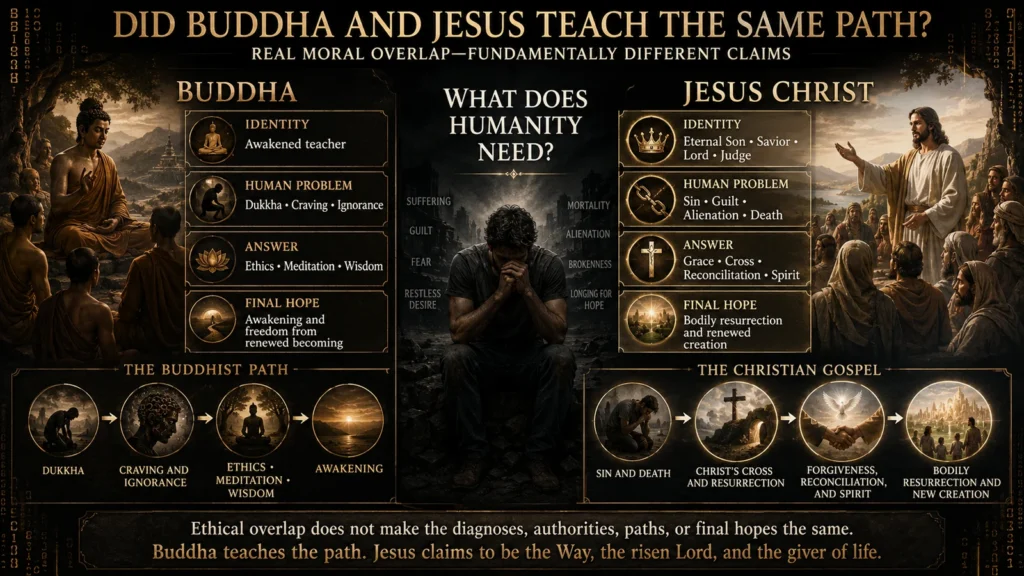
Did Buddha and Jesus Teach the Same Path?
Real Ethical Overlap
Buddha and Jesus both challenge greed, hatred, hypocrisy, and destructive desire. Their traditions praise generosity, humility, inward moral seriousness, compassion for sufferers, and restraint toward enemies. Christians should acknowledge those parallels without anxiety. Truth is not threatened when another tradition recognizes a moral reality.
Overlap does not establish identity. Two physicians may warn against the same symptom while diagnosing different diseases and prescribing incompatible cures. Ethical sayings must be read within each teacher’s authority, account of reality, and final hope.
Different Diagnoses
Buddhist teaching places dukkha within impermanence, craving, ignorance, clinging, and karmic becoming. Christianity includes distorted desire and blindness but identifies them as expressions of sin: creatures refuse the Creator and worship created things, harm neighbors, and become enslaved to corruption and death. The Buddhist problem is not usually guilt before a holy Creator; the Christian problem cannot be solved by insight alone.
Different Authorities
The Buddha presents himself as awakened to the path and teaches others to realize it. Jesus speaks as the Father’s unique Son. He does not say only, “Follow this way I discovered.” He says, “Follow me,” forgives sins in His own authority, and makes a person’s response to Him decisive. His identity is part of His message.
Path and Grace
Buddhist traditions offer demanding paths of ethics, meditation, wisdom, devotion, vows, merit, and reliance on Buddhas or teachers. Pure Land other-power can sharply criticize self-reliance, yet it still operates within Buddhist accounts of Amitabha, karma, rebirth, and awakening. In the Christian gospel, the Creator acts in history to save the guilty. Jesus does what sinners cannot do, and faith receives Him. Obedience follows grace; it does not purchase reconciliation.
Nirvana and Resurrection
Nirvana is release from the ignorance and craving that sustain renewed becoming. Christian hope is bodily resurrection and renewed creation. It does not aim to extinguish personal identity or return the soul in another body. God defeats death, restores embodied persons, judges evil, and dwells with His people.
Same Words, Different Meanings
- Suffering: dukkha within conditioned existence; also, in Christianity, pain within a creation corrupted by sin and death.
- Self: no permanent independent essence; or a created person accountable to God and destined for resurrection.
- Compassion: response to suffering shaped by nonattachment and wisdom; or love grounded in the personal God’s character and action.
- Liberation and salvation: release from craving and renewed becoming; or reconciliation, forgiveness, transformation, and resurrection through Christ.
- Meditation and prayer: Buddhist mental cultivation within the Dharma; or communion with God through Christ and attention to His Word.
- Nirvana and heaven: cessation of the causes of rebirth; or personal life with God culminating in resurrection and new creation.
- Faith and trust: confidence or entrusting within a Buddhist path; or reliance on God’s promise and saving work in Christ.
Buddha and Jesus Compared
Buddha
- Awakened teacher and refuge within Buddhism
- Diagnoses dukkha, craving, ignorance, and clinging
- Teaches a path of ethics, meditation, and wisdom
- Enters final nirvana in the traditional account
Jesus
- Eternal Son, promised Messiah, holy and sinless Savior, risen Lord, and coming Judge and King
- Exposes sin, guilt, idolatry, corruption, and death
- Gives Himself to reconcile sinners to God
- Rises bodily and promises resurrection
The Christian claim finally depends on events, not only comparisons of sayings. Jesus was crucified, and Christians proclaimed Him risen within the first generation. His death must be understood by asking why Jesus died; His resurrection claim determines whether His authority is true.
Buddhism and Christianity Compared at a Glance
God.
Buddhism: liberation is not centered on a Creator.
Christianity: the one Creator is Judge and Redeemer.
Self.
Buddhism: no permanent independent self.
Christianity: created personal identity, fallen and redeemable.
Human problem.
Buddhism: dukkha, craving, ignorance, clinging.
Christianity: sin, guilt, alienation, corruption, death.
Moral order.
Buddhism: intentional karma and consequence.
Christianity: personal judgment by the all-knowing God.
Practice.
Buddhism: ethics, meditation, wisdom, and devotion.
Christianity: faith, prayer, obedience, worship, and life in the Spirit.
Liberation.
Buddhism: awakening and freedom from renewed becoming.
Christianity: grace, forgiveness, holiness, resurrection.
Death.
Buddhism: rebirth continues while its causes remain.
Christianity: one life, judgment, and resurrection.
Final hope.
Buddhism: nirvana, buddhahood, or school-specific goal.
Christianity: life with God in renewed creation.
Jesus.
Buddhism: no canonical doctrine; later interpretations vary.
Christianity: eternal Son, crucified Savior, risen Lord.
These compact comparisons summarize governing patterns, not every school or denomination. They show why combining the religions through shared vocabulary produces confusion. Their accounts of reality, authority, personhood, salvation, and destiny cannot all be true in the same sense.
Which Diagnosis of the Human Problem Is True?
Christian apologetic synthesis: Buddhism sees something real. Craving can enslave. The mind rationalizes selfishness. Everything conditioned is unstable, and practices of attention can expose habits we would rather hide. Buddhist moral and contemplative discipline can shame shallow Christianity that speaks of grace while ignoring character.
Craving, Ignorance, Sin, and Guilt
That diagnosis still leaves willful wrongdoing to explain. People knowingly exploit others, suppress truth, and turn good gifts into idols. Craving is not only a mistaken attachment to impermanent things; it can be a willful refusal to love God and neighbor. Conscience testifies not merely that an action was unskillful but that we owe what we failed to give. Christianity names that debt sin and refuses both denial and self-salvation.
Karma, Judgment, Path, and Grace
Karma connects intention and consequence without making a Creator-Judge central. On the Christian account, moral reality is personal because goodness is grounded in the holy God. Judgment is not an impersonal mechanism; it is the verdict of One who knows every motive and victim. That is frightening if salvation depends on our record. The gospel announces that God Himself bears the cost of reconciliation in Christ.
Grace is not permission to remain greedy or cruel. The crucified and risen Lord forgives, gives His Spirit, forms love, and will set creation right. The historical claim matters: the historical evidence for Jesus’ crucifixion is strong; Paul’s letters show how early the resurrection proclamation appeared; and the sources let readers examine what the first witnesses claimed. History does not force a theological conclusion, but Christianity openly argues that God raised Jesus.
Nirvana and Resurrection
If the deepest problem is conditioned craving, release from its cycle answers it. If the Creator made persons for covenant love, then final hope cannot leave communion with God, embodied personhood, and resurrection behind. Christianity promises more than another turn of samsara and more than escape from becoming: forgiven persons raised bodily, evil judged, death destroyed, and creation healed under Christ.
Frequently Asked Questions
Is Buddhism a Religion or Philosophy?
It can be studied philosophically, but lived Buddhism is religious: it has scriptures, refuge, monastic orders, rituals, devotion, sacred images, relics, cosmology, festivals, moral disciplines, and communities. Some modern forms minimize these elements, but they do not define all Buddhism.
Do Buddhists Believe in God?
Buddhism generally does not center liberation on an eternal Creator God. Many traditions still affirm devas, heavens, hells, Buddhas, bodhisattvas, spirits, and sacred powers. Those beings remain different from the uncreated Creator of Christianity.
Do Buddhists Worship Buddha?
Many bow, chant, offer incense or flowers, honor relics, and take refuge in Buddha. “Worship” or “devotion” can describe these acts in ordinary English, provided one adds that Buddhists do not normally identify Gautama as the eternal Creator.
Do Buddhists Believe in a Soul?
Early Buddhist teaching denies an eternal, unchanging self within the five aggregates. Traditions offer sophisticated accounts of conventional personhood and continuity. No-self should not be translated as “nothing exists,” and rebirth should not be described as an immortal soul migrating unchanged.
What Is Nirvana?
Nirvana is liberation from greed, hatred, delusion, craving, suffering, and renewed becoming. Buddhist schools differ in conceptual explanation, but nirvana is not the Christian heaven, a Creator, or simple annihilation.
Do All Buddhists Meditate?
No. Meditation is important, but many lay Buddhists focus more on refuge, precepts, offerings, chanting, festivals, generosity, pilgrimage, family rites, and support for monastics. Practice also differs greatly among Zen, Pure Land, Theravada, Vajrayana, and modern communities.
Is Karma Punishment?
Karma is intentional action and consequence, not a sentence imposed by a divine judge. Its effects are treated with varying complexity across traditions. It should not be used to blame sufferers or assume that every tragedy has one obvious past-life cause.
Are Buddhists Pacifists?
Non-harm is a major Buddhist ideal, and many Buddhists embrace strong nonviolence. Not every Buddhist or school is absolutely pacifist. Buddhist rulers, institutions, monks, and movements have also participated in warfare and nationalist violence.
Do Buddhists Believe in Jesus?
There is no ancient canonical Buddhist doctrine of Jesus. Modern Buddhists may respect Him as a compassionate teacher, holy person, or bodhisattva-like figure. These are later interpretations, not the New Testament’s claim that He is the eternal Son and risen Lord.
Was Jesus a Buddhist?
No credible early evidence shows Jesus studied Buddhism in India or Tibet. The earliest sources place Him in first-century Jewish and Roman-world settings. Ethical similarities do not establish travel, dependence, or shared identity.
Is Buddha Like Jesus?
Both are influential teachers associated with compassion and transformed life. Their identities and messages differ fundamentally. Buddha teaches awakening from dukkha and craving; Jesus claims divine authority, dies for sinners, rises bodily, and will judge humanity.
Can Christians Practice Buddhist Meditation?
Christians can use ordinary attention skills such as slow breathing without adopting a religion. They should examine the purpose, vows, visualizations, objects of refuge, and doctrinal claims attached to a practice. Christian meditation is finally shaped by Scripture, prayer, worship, and communion with the Triune God through Christ.
Sources and Further Reading
Early Buddhist descriptions use Bhikkhu Bodhi, Bhikkhu Sujato, and Suddhaso Bhikkhu translations at SuttaCentral, especially SN 56.11, SN 22.59, SN 12.2, MN 38, MN 135, MN 10, DN 16, and AN 8.39. Canon discussions use the BDK English Tripitaka project and 84000’s documentation of the Kangyur and Tengyur.
- General history and doctrine: Rupert Gethin, The Foundations of Buddhism; Peter Harvey, An Introduction to Buddhism; the Stanford Encyclopedia of Philosophy entry on Buddha.
- Mahayana and Vajrayana: Paul Williams, Mahayana Buddhism; BDK English Tripitaka; 84000: Translating the Words of the Buddha.
- Ethics and violence: Peter Harvey, An Introduction to Buddhist Ethics; Damien Keown’s work on Buddhist ethics; the Stanford ethics survey; John Clifford Holt, ed., Buddhist Extremists and Muslim Minorities; Matthew J. Walton, “Nationalism, Violence and War in Myanmar’s Theravada Buddhist Context.”
- Jesus in modern Buddhist interpretation: the Dalai Lama, The Good Heart: A Buddhist Perspective on the Teachings of Jesus.
- Modern claims and evidence: Madhav Goyal et al., “Meditation Programs for Psychological Stress and Well-Being”; Simon J. Joseph, “Jesus in India? Transgressing Social and Religious Boundaries.”
- Christian sources: Genesis 1; Matthew 5-7; Mark 10:45; John 1 and 20; Romans 1-5; 1 Corinthians 15; Philippians 2; Revelation 20-22.
For related Christian engagement with other faiths, visit the World Religions library.
Jesus Is More Than an Enlightened Teacher
Buddhism asks readers to look steadily at suffering, impermanence, craving, and the habits that construct a defended self. Christians should not answer that seriousness with caricature. Buddhist traditions contain disciplined thought, costly compassion, moral restraint, devotion, beauty, and searching accounts of the mind.
But Jesus does not come merely to improve awareness. The eternal Word becomes flesh as the promised Messiah and sinless Savior. He knows the human heart and names evil as sin against God. He welcomes the ashamed, confronts the self-righteous, touches the unclean, forgives sins, and calls people to lose their lives for His sake. His authority is not borrowed from a path above Him.
At the cross, Jesus willingly gives Himself for sinners. Christianity does not say guilt is imaginary or that suffering automatically purifies. It says God is just, evil costs more than we can repay, and the Son bears judgment to reconcile enemies. The cross reveals both the horror of sin and the depth of divine love.
Then God raises Jesus bodily. The earliest proclamation does not describe His consciousness entering another person or His disciples discovering a timeless principle. They proclaim the crucified Jesus alive. His resurrection vindicates His identity, begins the defeat of death, and promises that those united to Him will be raised. That claim deserves investigation through the sources, not reduction to a metaphor.
Read the Gospels and 1 Corinthians 15. Ask whether Jesus speaks truthfully about God, sin, Himself, and the world to come. Bring Him real guilt, fear, desire, and death. Christian faith is not blind optimism; it is trust in the Lord who entered history, gave Himself, and rose.
This invitation does not require pretending Buddhists have learned nothing true or lived nothing admirable. It asks whether partial insight can carry the weight of final hope. If Jesus is who He claims to be, then the Creator has not left humanity to escape suffering by mastering a path. He has come near, borne sin, defeated death, opened His kingdom to everyone who repents and trusts Him, and will return as Judge and King.
Buddha taught a path toward awakening. Jesus Christ came as the Lord who gives His life for sinners, rises from the dead, and calls every person to Himself.