
Proverbs 6:16–19 names seven things God hates: haughty eyes, a lying tongue, hands that shed innocent blood, a heart that devises wicked plans, feet eager to run toward evil, a false witness who breathes out lies, and one who spreads discord among brothers.
These are not seven disconnected mistakes. Together, they portray a person whose pride, speech, actions, intentions, direction, testimony, and relationships have become instruments of evil. The passage does not claim that these are the only sins God hates, nor does it clearly rank them from least to greatest. It gathers seven detestable traits into one concentrated warning about character opposed to God’s holiness, truth, justice, and peace.
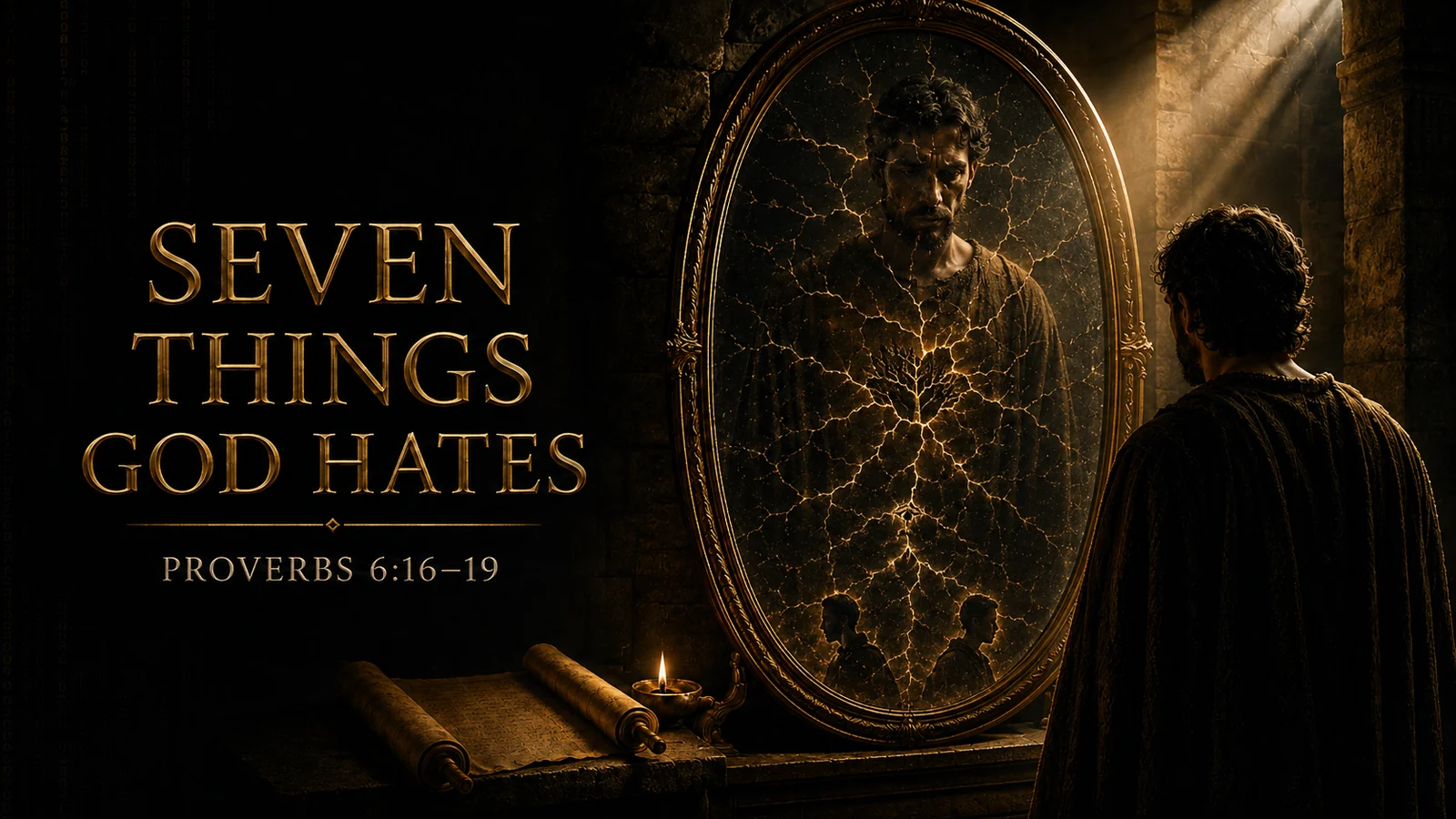
This is not merely a moral checklist. It is a mirror.
“There are six things that the LORD hates,
Proverbs 6:16–19, ESV
seven that are an abomination to him:
haughty eyes, a lying tongue,
and hands that shed innocent blood,
a heart that devises wicked plans,
feet that make haste to run to evil,
a false witness who breathes out lies,
and one who sows discord among brothers.”
Read Proverbs 6:16–19 in context.
Watch Proverbs 6:16–19 in Motion
This cinematic short presents the seven warnings through symbolic imagery. Watch it as an introduction, then continue below for the passage’s context, structure, and meaning.
The video compresses the warning into symbolic scenes. The passage deserves slower attention, because Proverbs began describing this corrupt character before the seven-item list appeared.
Explore more Cinematic Bible Shorts.
Article Guide8 sections
Proverbs 6:16–19 in Context
The Corrupt Troublemaker in Proverbs 6:12–15
Proverbs 6:16–19 does not appear in isolation. The preceding verses describe a corrupt troublemaker who speaks with a crooked mouth, signals deceptively with his eyes, feet, and fingers, devises evil in his heart, and continually spreads conflict.
His speech conceals rather than reveals. His gestures assist deception. His heart does not merely encounter temptation; it plans harm. His influence leaves broken trust and strife behind him. Verses 16–19 then examine that corruption more closely.
An Anatomy of Wickedness
The list moves through the human person. Haughty eyes reveal pride. The tongue creates falsehood. The hands carry out violence. The heart designs evil. The feet hurry to pursue it. The false witness corrupts testimony. Finally, the damage reaches the community as trust and fellowship are torn apart.
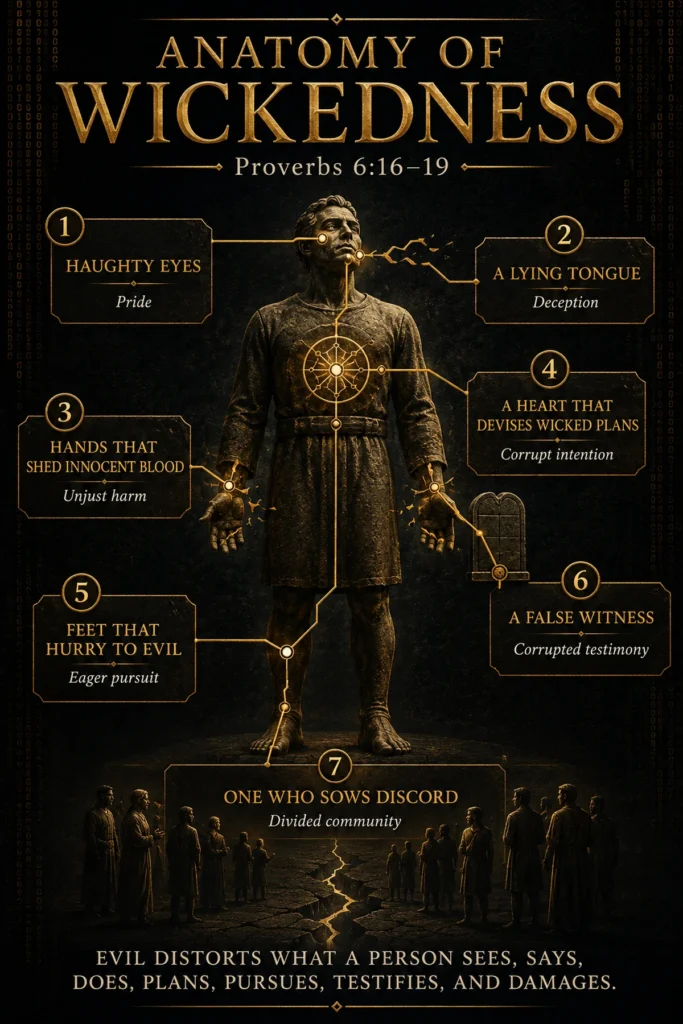
Proverbs gives us an anatomy of wickedness. Evil affects what a person sees, says, does, plans, pursues, testifies, and damages in others. The list is concerned with more than isolated outward acts. It portrays a character increasingly organized around pride, deception, harm, and division.
Why Proverbs Says “Six Things…Seven”
The wording “six things…seven” is a numerical saying found elsewhere in biblical wisdom, including several times in Proverbs 30. The pattern builds anticipation and brings the saying to a memorable completion.
It does not mean that God first identified six sins and then remembered another. Nor does it mean these are the only evils He opposes. Other passages in Proverbs also condemn pride, dishonest business, corrupt worship, lying lips, and the evil way.
The formula does not give us a clear ranking from the least serious offense to the worst. The final item may receive special emphasis, particularly because spreading discord was already mentioned in verse 14. Yet all seven are included among the things God hates.
What Are the Seven Things God Hates?
Each expression now develops the unified warning: evil distorts how a person sees, speaks, acts, plans, moves, testifies, and treats a community.
1. Haughty Eyes
The Hebrew expression translated “haughty eyes” literally describes eyes raised high. It is the outward gaze of inward pride: a posture that elevates self, looks down on others, and resists correction. Proverbs is not condemning confidence, healthy conviction, or the responsible use of God-given ability. The problem is self-exaltation that treats other people as inferior and forgets our dependence on God.
Haughty eyes can hide beneath spiritual language, education, influence, or discernment. Knowledge becomes dangerous when it establishes superiority rather than serving others. Scripture answers this posture with humility, teachability, and the mind of Christ.
2. A Lying Tongue
A “lying tongue” is a tongue of falsehood—speech used to create, protect, or benefit from deception. It includes direct lies, but it can also include manipulated context, dishonest omissions, promises made without intent to keep them, and statements designed to leave a false impression.
An honest factual mistake is not identical to a lie. People can misunderstand, forget, or speak from incomplete information. Yet knowingly distorting the truth—or continuing to repeat a claim after learning it is false—turns error into a moral choice.
Proverbs contrasts deceptive speech with words that bring truth and healing. As Proverbs 12:18 shows, speech can cut like a sword or become an instrument of wisdom. The godly alternative is truthful speech offered with integrity, restraint, and concern for the good of others.
3. Hands That Shed Innocent Blood
This image is direct and severe. God hates the unjust taking of innocent life. The proverb condemns violence against those who have not deserved such harm and the corrupt use of power that allows the innocent to be destroyed.
The phrase should not be reduced to a metaphor for every insult, disagreement, or wounded feeling. Its primary meaning is bloodshed. Jesus teaches that murder has roots in sinful anger and contempt, deepening moral accountability without pretending that hostile thoughts and actual killing carry identical earthly consequences.
The principle also confronts those who plan, authorize, assist, or conceal unjust violence. Its opposite is the protection of life, justice for the vulnerable, and self-giving love.
4. A Heart That Devises Wicked Plans
In Proverbs, the heart is the center of thought, desire, intention, and decision. A heart that “devises” wicked plans does more than encounter temptation. It adopts evil as a project, considering how to manipulate circumstances, deceive another person, carry out revenge, or secure selfish gain through harm.
An intrusive thought, unwanted image, sudden temptation, or fear is not the same as a wicked plan. Proverbs condemns the heart that welcomes evil, develops it, and begins arranging how it will be done.
That is why Scripture tells us to guard the heart. Outward conduct grows from what we repeatedly welcome, justify, and cultivate within. Wisdom submits both plans and motives to God.
5. Feet That Hurry to Run to Evil
The doubled movement in this phrase is intentional: the feet hurry and run. This is not the picture of someone who stumbles into sin, grieves it, and turns back. It describes eagerness—a person ready to seize an opportunity to participate in wrongdoing.
Modern versions include rushing to retaliate, joining an online mob, spreading scandal before the facts are known, or participating in cruelty because the crowd makes it exciting. Evil is not merely tolerated; it is pursued.
Pondering the path of our feet means asking where our habits, reactions, and desires are taking us before momentum becomes bondage. Wisdom moves quickly toward mercy, justice, and obedience instead.
6. A False Witness Who Breathes Out Lies
A lying tongue and a false witness overlap, but they are not identical. The lying tongue describes deception broadly. A false witness directs falsehood against another person through testimony, accusation, or claims presented as evidence.
The phrase “breathes out lies” portrays falsehood flowing readily from the witness. This may occur in a courtroom, but the moral principle also reaches families, churches, workplaces, media, and online disputes. False witness includes fabricating allegations, presenting suspicion as established fact, removing context that changes the meaning, editing quotations deceptively, or refusing to correct a damaging claim after learning the truth.
Discernment never excuses careless accusation. A commitment to exposing deception requires a deeper commitment to evidence and truthful testimony.
When facts remain uncertain, restraint is wiser than multiplying words that may destroy another person. Proverbs 10:19 warns about the danger of excessive speech. Faithful testimony distinguishes fact from inference, preserves necessary context, accepts correction, and refuses to use uncertainty as a weapon.
7. One Who Sows Discord Among Brothers
The final offense describes someone who spreads strife among people who should share trust, loyalty, and fellowship. “Brothers” can include literal family, but the warning extends naturally to friends, churches, teams, and communities.
Sowing discord means cultivating hostility or mistrust through deception, whispering, exaggeration, manipulation, needless provocation, or faction-building. It may involve carrying private comments between people, recruiting allies before pursuing direct resolution, reopening settled disputes, or presenting partial facts in a way designed to divide.
Proverbs 16:28 shows how whispering can separate close friends. Proverbs 26:20 compares conflict to a fire that continues because someone keeps adding fuel.
Not every disagreement is discord. Necessary correction, documented exposure, reporting abuse, setting boundaries, and confronting false teaching are not automatically acts of division. The moral question concerns both truth and method: is someone seeking justice and restoration, or using information to provoke hostility and build a faction?
The faithful alternative is truthful peacemaking. It neither conceals evil nor manufactures superficial unity. It tells the truth, refuses manipulation, and seeks peace without sacrificing righteousness.
Why Does God Call These Things Detestable?
“Hates” and “Abomination” in Hebrew
Proverbs uses deliberately strong language. The Hebrew verb saneʾ means “to hate,” while toʿevah refers to something detestable or morally abhorrent. These words do not describe mild divine displeasure. The seven traits stand in direct opposition to the Lord’s character and righteous will.
Yet toʿevah is not a technical label with exactly the same nuance in every passage. It appears in contexts involving idolatry, dishonest conduct, corrupt judgment, and other serious evils. Here, the list itself determines its force.
God’s Love Is Not Moral Indifference
When Scripture says the Lord hates these things, it does not portray Him as unstable or driven by sinful human spite. His hatred is His holy opposition to what contradicts His goodness and harms His creatures.
Because God loves truth, He opposes deception. Because He values life, He opposes innocent bloodshed. Because He is just, He opposes corrupt testimony. Because He desires righteous peace, He opposes manipulation that tears people apart.
God’s love is not moral indifference. A love neutral toward murder, slander, exploitation, and calculated division would not be good. Yet His judgment does not cancel His mercy. Scripture also declares that God takes no pleasure in the death of the wicked but calls sinners to turn from evil and live.
Why Does Sowing Discord Come Last?
The final item likely receives special rhetorical weight. Proverbs 6:14 had already described the corrupt troublemaker as someone who continually spreads discord. Verse 19 returns to the same offense at the conclusion of the seven-item saying.
Across the list, corruption appears in posture, speech, action, intention, pursuit, and testimony. The closing image shows its damage spreading through relationships and communities. That does not prove that sowing discord is categorically worse than shedding innocent blood or bearing false witness. All seven are included among the things the Lord hates.
Some of the most devastating sins are whispered. They travel through private messages, suggestive comments, selective retellings, and conversations designed to make one person distrust another. Their damage may remain hidden for a time, yet fracture relationships that took years to build.
Use This Passage as a Mirror, Not a Magnifying Glass
Examine the Heart Before Labeling Others
Proverbs warns us about destructive people, and wisdom requires that we recognize dangerous patterns. But the safest first use of this passage is not to search for the worst person we know.
Use this passage as a mirror—not a magnifying glass.
Where has pride made correction difficult? Have we created a false impression while avoiding a direct lie? Repeated an accusation because it confirmed what we wanted to believe? Recruited sympathetic listeners before speaking to the person involved? Secretly enjoyed another person’s humiliation?
The passage becomes spiritually useful when it exposes what we have tolerated in ourselves. Its purpose is not to provide religious language for contempt. It calls us to repentance.
Truth Is Not the Same as Discord
Biblical peace is not the absence of disagreement. Jesus instructed believers to confront sin directly, and Paul opposed Peter when his conduct contradicted the gospel. Scripture joins correction and accountability with gentleness, patience, and peace.
Truth may reveal a division that already exists. Sowing discord manufactures or inflames hostility through sinful motives and methods. Exposing documented wrongdoing is therefore not automatically divisive.
Before repeating a damaging claim, ask:
- Is it true?
- Is it sufficiently established?
- Have I included the context necessary to understand it fairly?
- Is sharing it proportionate to the situation?
- Am I seeking justice and restoration—or humiliation and faction-building?
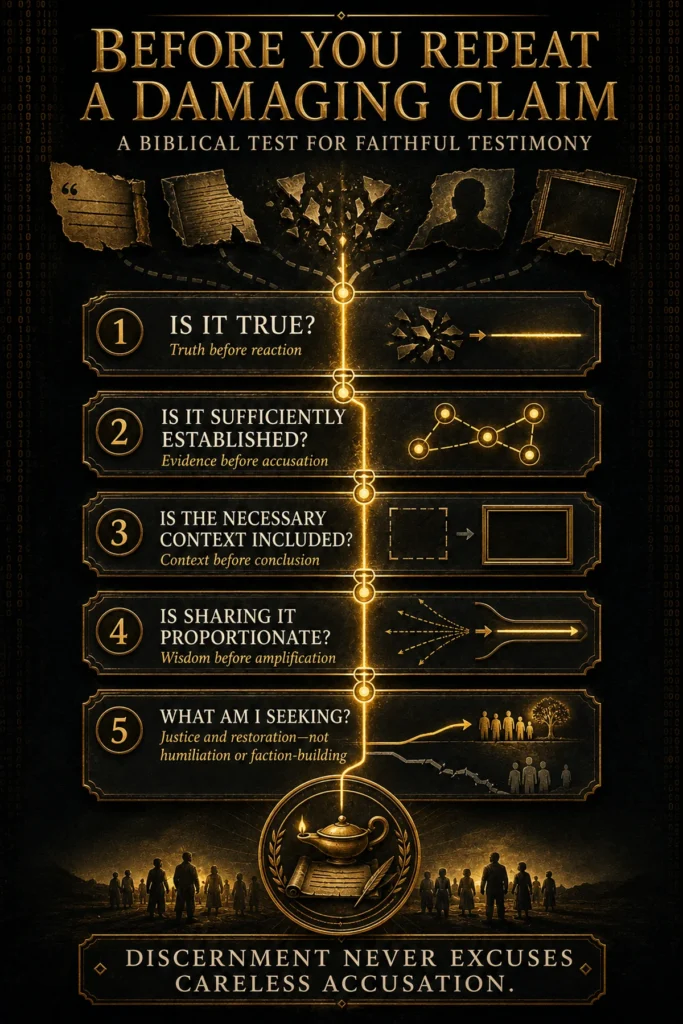
These questions do not require silence in the face of abuse or deception. They require integrity. A truthful witness does not exaggerate, and a peacemaker does not use truth as a weapon for revenge.
That balance appears in Proverbs 15:1. A gentle answer can restrain needless anger without surrendering truth. Biblical gentleness concerns the manner and spirit of our speech, not the abandonment of conviction.
What Scripture Calls Us to Pursue
In place of the seven evils, Scripture calls us toward humility, truthful speech, protection of life, pure motives, eagerness for good, faithful testimony, and peace grounded in truth.
These virtues require a transformed heart. We may restrain our words, conceal pride beneath politeness, or avoid public conflict while resentment grows within. Proverbs reaches deeper than outward behavior because God sees the source from which conduct flows.
Proverbs names the life God rejects, but even its positive opposites cannot rescue us from the guilt the passage exposes.
Jesus Christ and the Holiness God Requires

Jesus Embodies the Life Opposed to These Evils
Proverbs 6 describes character bent toward pride, deception, violence, corrupt intention, eagerness for evil, false testimony, and division. Jesus Christ stands in complete contrast.
He did not exalt Himself at the expense of others but humbled Himself, taking the form of a servant and becoming obedient even to death on a cross. No deceit was found in His mouth. He never used power to crush the innocent, devised wickedness, or used falsehood to gather followers. Revelation calls Him the faithful witness.
Jesus pursued peace without compromising truth. He confronted hypocrisy, exposed unbelief, and called sinners to repentance. His words sometimes revealed divisions already present in the human heart, but He never manufactured hostility through gossip, deception, or faction-building. He makes peace through truth and sacrifice.
The List Also Exposes Us
It is easy to read these warnings and imagine people more corrupt than ourselves. Yet the passage reaches into ordinary forms of pride, selective truth, private resentment, careless accusation, and enjoyment of conflict.
We may not identify equally with every item, and not every reader has committed every offense in the same way. Still, no one perfectly embodies the humility, truth, purity, and peace God requires. The list does more than warn us about dangerous people. It exposes our need for repentance.
Christ Offers More Than Moral Improvement
Christ is not merely the flawless example standing opposite these seven evils. He is the sinless Savior who bore the guilt of sinners, reconciles enemies to God through the cross, and forms a people devoted to humility, truth, righteousness, and peace.
First Peter says Jesus bore our sins in His body on the tree so that we might die to sin and live to righteousness. Ephesians declares that He makes peace through the cross, breaking down hostility and reconciling sinners to God.
The Gospel offers more than improved manners or better self-control. In Christ, guilt can be confessed, forgiveness received, motives purified, and lives redirected. The proud can learn humility. The deceptive can become truthful. The divisive can become peacemakers through repentance, grace, and obedience to the risen Lord.
Frequently Asked Questions
What are the seven things God hates?
Proverbs 6:16–19 names haughty eyes, a lying tongue, hands that shed innocent blood, a heart that devises wicked plans, feet eager to run toward evil, a false witness who breathes out lies, and one who spreads discord among brothers.
Are these the only sins God hates?
No. Other passages in Proverbs condemn pride, dishonest scales, lying lips, corrupt worship, and the evil way. Proverbs 6 presents a concentrated seven-item portrait, not an exhaustive catalog of every sin God opposes.
Why does Proverbs say “six things…seven”?
This is a numerical saying found elsewhere in biblical wisdom. The construction builds attention and brings the list to a memorable completion. It does not suggest that God forgot the seventh item or that the seven are arranged in a strict moral ranking.
Is sowing discord the worst of the seven?
Its final position and repetition from Proverbs 6:14 give it special rhetorical weight. However, the passage does not explicitly declare discord worse than shedding innocent blood, false testimony, or the other offenses. All seven are described as detestable.
What is the difference between a lying tongue and a false witness?
A lying tongue refers broadly to deceptive speech. A false witness uses falsehood as testimony or accusation against another person, especially by corrupting evidence, damaging a reputation, or presenting suspicion as established fact.
Does God hate sinners or only sin?
Scripture sometimes speaks of God opposing the wicked as well as hating wicked actions. Yet His righteous judgment does not cancel His mercy. He calls sinners to repent and offers forgiveness and reconciliation through Jesus Christ.
Sources and Further Reading
- Proverbs 6:12–19
- NET Bible translation notes on Proverbs 6:16–19
- Bruce K. Waltke, The Book of Proverbs: Chapters 1–15
- Michael V. Fox, Proverbs 1–9
- Tremper Longman III, Proverbs
- Brown–Driver–Briggs Hebrew and English Lexicon
Continue Studying Proverbs
- Proverbs 15:2 — Your Words Reveal Your Wisdom
- Proverbs 11:9 — When Words Destroy or Deliver
- Proverbs 18:21 — Speak Life or Sow Death
- Explore the complete Proverbs Bible Study Library
A Prayer for Truth, Humility, and Peace
Father, expose the pride, deception, resentment, and divisiveness I have tolerated within myself. Purify my words and motives. Slow my feet when I am eager to react, and keep me from repeating what I have not established as true. Make my testimony faithful, my correction gentle, and my pursuit of peace sincere. Conform me to Jesus Christ, who is humble, righteous, truthful, and holy. Amen.
God’s warning does not leave repentant sinners without hope. In Jesus Christ, guilt is brought into the light rather than hidden, mercy is received rather than presumed, and lives once shaped by pride, deception, and strife can be remade for truth, righteousness, and peace. The Lord who exposes sin is also the Savior who forgives, reconciles, and transforms.
CONTINUE THE INVESTIGATION
Next wisdom study
Proverbs 21:2 Meaning | God Weighs the Heart
Continue from what God condemns toward the heart, self-control, perseverance, and integrity that biblical wisdom commends.